Daily reading
Paschal Time
Double · April 29 · Sanctoral
April 29, 2022
From Dom Guéranger’s The Liturgical Year.
A Double leads the weekday.Rubric
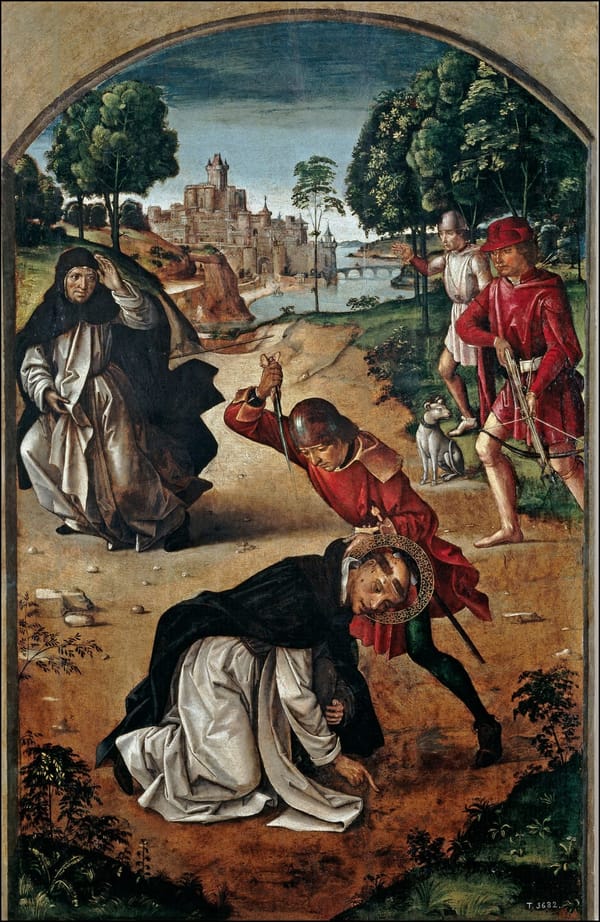 |
April 29: St. Peter, Martyr
THE hero deputed this day by the Church to greet our Risen Lord was so valiant in the good fight that martyrdom is part of his name. He is known as Peter the Martyr; so that we cannot speak of him without raising the echo of victory. He was put to death by heretics, and is the grand tribute paid to our Redeemer by the thirteenth century. Never was there a triumph hailed with greater enthusiasm than this. The martyrdom of St Thomas of Canterbury excited the admiration of the faithful of the preceding century, for nothing was so dear to our forefathers as the liberty of the Church; the martyrdom of St Peter was celebrated with a like intensity of praise and joy. Let us hearken to the fervid eloquence of the great Pontiff, Innocent IV, who thus begins the Bull of the martyr's canonization: ‘The truth of the Christian faith, manifested, as it has been, by great and frequent miracles, is now beautified by the new merit of a new Saint. Lo! a combatant of these our own times comes, bringing us new and great and triumphant signs. The voice of his blood shed (for Christ) is heard, and the fame of his martyrdom is trumpeted, through the world. The land is not silent that sweateth with his blood; the country that produced so noble a warrior resounds with his praise; yea, the very sword that did the deed of parricide proclaims his glory . . . . Mother Church has great reason to rejoice, and abundant matter for gladness; she has cause to sing a new canticle to the Lord, and a hymn of fervent praise to her God; . . . the Christian people has cause to give forth devout songs to its Creator. A sweet fruit, gathered in the garden of faith, has been set upon the table of the eternal King: a grape-bunch taken from the vineyard of the Church has filled the royal cup with new wine . . . . The flourishing Order of Preachers has produced a red rose, whose sweetness is most grateful to the King; and from the Church here on earth there has been taken a stone, which, after being cut and polished, has deserved a place of honour in the temple of heaven.'1
Such was the language wherewith the supreme Pontiff spoke of the new martyr, and the people responded by celebrating his feast with extraordinary devotion. It was kept as were the ancient festivals, that is, all servile work was forbidden upon it. The churches served by the Fathers of the Dominican Order were crowded on his feast; and the faithful took little branches with them, that they might be blessed in memory of the triumph of Peter the Martyr. This custom is still observed; and the branches blessed by the Dominicans on this day are venerated as being a protection to the houses where they are kept.
How are we to account for all this fervent devotion of the people towards St Peter? It was because he died in defence of the faith; and nothing was so dear to the Christians of those days as faith: Peter had received the charge to seize all the heretics who at that time were causing great disturbance and scandal in the country round about Milan. They were called Cathari, but in reality were Manicheans; their teachings were detestable, and their lives most immoral. Peter fulfilled his duty with a firmness and equity which soon secured him the hatred of the heretics; and when he fell a victim to his holy courage, a cry of admiration and gratitude was heard throughout Christendom. Nothing could be more devoid of truth than the accusations brought by the enemies of the Church and their indiscreet abettors against the measures formerly decreed by the public law of Catholic nations, in order to foil the efforts made by evil-minded men to injure the true faith. In those times, no tribunal was so popular as that whose office it was to protect the faith, and to put down all them that attacked it. It was to the Order of St Dominic that this office was mainly entrusted; and well may they be proud of the honour of having so long held one so beneficial to the salvation of mankind. How many of its members have met with a glorious death in the exercise of their stem duty! St Peter is the first of the martyrs given by the Order for this, holy cause: his name, however, heads a long list of others who were his brethren in religion, his successors in the defence of the faith, and his followers to martyrdom. The coercive measures that were once, and successfully, used to defend the faithful from heretical teachers have long since ceased to be used: but for us Catholics, our judgement of them must surely be that of the Church. She bids us to-day honour as a martyr one of her Saints, who was put to death whilst resisting the wolves that threatened the sheep of Christ’s fold; should we not be guilty of disrespect to our Mother if we dared to condemn what she so highly approves? Far, then, be from us that cowardly truckling to the spirit of the age, which would make us ashamed of the courageous efforts made by our forefathers for the preservation of the faith! Far from us that childish readiness to believe the calumnies of Protestants against an institution which they naturally detest! Far from us that deplorable confusion of ideas which puts truth and error on an equality, and, from the fact that error can have no rights, concludes that truth can claim none!
The following is the account given us by the Church of the virtues and heroism of St Peter the Martyr:
The following Antiphons and Responsory are taken from the Dominican Breviary:
The victory was thine, O Peter! and thy zeal for the defence of our holy faith was rewarded. Thou didst ardently desire to shed thy blood for the holiest of causes, and by such a sacrifice to confirm the faithful of Christ in their religion. Our Lord satisfied thy desire; he would even have thy martyrdom be in the festive season of the Resurrection of our divine Lamb, that his glory might add lustre to the beauty of thy holocaust. When the death-blow fell upon thy venerable head, and thy generous blood was flowing from the wounds, thou didst write on the ground the first words of the creed, for whose holy truth thou wast giving thy life.
Protector of the Christian people! what other motive hadst thou, in all thy labours, but charity? What else but a desire to defend the weak from danger induced thee not only to preach against error, but to drive its teachers from the flock? How many simple souls, who were receiving divine truth from the teaching of the Church, have been deceived by the lying sophistry of heretical doctrine, and have lost the faith? Surely the Church would do her utmost to ward off such dangers from her children; she would do all she could to defend them from enemies, who were bent on destroying the glorious inheritance which had been handed down to them by millions of martyrs! She knew the strange tendency that often exists in the heart of fallen man to love error; whereas truth, though of itself unchanging, is not sure of its remaining firmly in the mind, unless it be defended by learning or by faith. As to learning, there are but few who possess it; and as to faith, error is ever conspiring against it, and, of course, with the appearance of truth. In the Christian ages it would have been deemed not only criminal, but absurd, to grant to error the liberty which is due only to truth; and they that were in authority considered it a duty to keep the weak from danger, by removing from them all occasions of a fall; just as the father of a family keeps his children from coming in contact with wicked companions who could easily impose on their inexperience, and lead them to evil under the name of good.
Obtain for us, O holy martyr, a keen appreciation of the precious gift of faith—that element which keeps us in the way of salvation. May we zealously do everything that lies in our power to preserve it, both in ourselves and in them that are under our care. The love of this holy faith has grown cold in so many hearts; and frequent intercourse with heretics or free-thinkers has made them think and speak of matters of faith in a very loose way. Pray for them, O Peter, that they may recover that fearless love of the truths of religion which should be one of the chief traits of the Christian character. If they be living in a country where the modem system is introduced of treating all religions alike—that is, of giving equal rights to error and to truth—let them be all the more courageous in professing the truth, and detesting the errors opposed to the truth. Pray for us, O holy martyr, that there may be enkindled within us an ardent love of that faith without which it is impossible to please God.2 Pray that we may become all earnestness in this duty, which is of vital importance to salvation; that thus our faith may daily gain strength within us, till at length we shall merit to see in heaven what we have believed unhesitatingly on earth.
Friday of the Second Week after Easter
LET us to-day turn to another subject. Let us think of that unfortunate Jerusalem, which, a few days since, re-echoed with the blasphemous cry: Away with him! Away with him! Crucify him! Is the city impressed by the great events that have taken place in her midst? Is the report still afloat of the sepulchre’s being found empty? Have Jesus’ enemies succeeded in tranquillizing the public mind by their lying scheme? They have summoned the soldiers who were set to guard the tomb, and have bribed them to say that they neglected their duty, that they fell asleep, and that the disciples came in the meanwhile, and stole away their Master’s corpse. As to the punishment due to this infraction of military discipline, the soldiers are told that they need be under no apprehension, inasmuch as they are assured that every excuse shall be made to the governor in case of need.1
Such is the final effort made by the Synagogue to make the world forget the name of Jesus of Nazareth! She would convince men that he was a mere contemptible impostor, who deserved his ignominious death, and will now be execrated for the posthumous attempt at a Resurrection! And yet, in a few years hence, the name of Jesus will be known and loved far beyond the walls of Jerusalem or the territory of Judea—it will be held in blessing in the furthermost parts of the earth. Let a hundred years pass, and the adorers of this Jesus will be found in every country. After three centuries paganism will own itself beaten; the idols will roll in the dust; the majesty of the Cæsars will humble itself before the Cross. And thou, O blind and obstinate Jew! wilt have it that he whom thou didst blaspheme and crucify is not risen, although he be now the King of the earth—the loved Monarch of a boundless empire! Read thy heaven-given prophecies, which thou hast handed down to us. Do they not tell thee that the Messias is to be despised—reputed with the wicked,2 and treated as one of them? But do they not likewise tell thee that his sepulchre shall he glorious?3 With all other men the grave puts an end to their name and their glory; whereas with Jesus his sepulchre is the trophy of his victory; we proclaim him to be the Messias, the King of ages, the Son of God, because by his own death he conquered death.
But Jerusalem is carnal-minded; and the humble Nazarene has not flattered her pride. His miracles were undeniable; the wisdom and authority of his words surpassed everything that had ever been heard; his goodness and compassion even exceed the miseries he is come to allay—but Israel has seen nothing, heard nothing, understood nothing; and now he remembers nothing. Alas! his fate is sealed, and it is himself that has sealed it. Five centuries before this, Daniel had thus prophesied: The people that shall deny him (Christ) shall not he his.4 Let them, therefore, that would escape the most terrible chastisement ever sent upon man, lose no time in recognizing the risen Jesus as the Messias.
A heavy atmosphere broods over the deicide city. Her people have said: Let his Blood he upon us and upon our children!—so indeed it is: it hangs like a storm-cloud of vengeance over Jerusalem, and, forty years hence, will send forth its thunderbolts of slaughter, fire, destruction, and a desolation which shall continue even to the end.5 Impostors will rise up, giving themselves out as the Messias. Jerusalem knows that the time for the fulfilment of the prophecies is come; and hence the credulity of her people in siding with these pretenders. Seditions are the consequence of this fanaticism. At length Rome is obliged to interfere. She sends her legions; and having drowned the rebellion with a deluge of blood, she banishes Israel from his country, making him a Cain-like wanderer on the face of the earth.
Why do not these unhappy Jews acknowledge, as the Messias, this Jesus whom they have crucified? Why still expect a fulfilment which has been so evidently accomplished? Why pass by, with sullen unrepentance, this empty sepulchre which is ever protesting against them? Have they not clamoured for the shedding of innocent Blood? They have but to confess this crime—this fruit of their pride—and they will be pardoned. But if they persist in defending what they have done, there is no hope for them—their chastisement will be blindness of heart, they will walk on in darkness even to the abyss, and hell will be their eternity. Bethphage and Mount Olivet are still echoing with the cry of Hosanna to the Son of David! O Israel! thou hast yet time! repeat this acclamation of thy loyalty! The hours are passing swiftly by; the solemnity of Pentecost will soon be upon us. On that day the law of the Son of David is to be promulgated, and the law of Moses will be abrogated, for its work is done and its figures are turned into realities. On that day thou wilt feel two peoples within thy womb6 one, weak in number, but destined to conquer all nations by leading them to the true God, will humbly and lovingly acknowledge for their King this Crucified and Risen Son of David; the other, proud and haughty, will obstinately blaspheme its Messias, and will become, by its ingratitude, the type of voluntary hardness of heart. It denies, even to this day, the Resurrection of its victim; but the chastisement which is to lie upon it to the end of time proves that he who punishes is God—the God of truth, whose anathemas are infallible.
Let us honour the Resurrection of our divine Messias by offering him this Easter sequence of the ancient Missal of St Gall.
Sequence
Atque pulchritudo
In cruce victoriam,
Est mortis principatus,
Est peccati veteris
Chirographum,
Immolatur victima
Pro ovili,
De Edom qui venerat,
Et de Bosra.
Serpentini vulneris
Sanat morsum.
Reconciliatur mundus:
Per lignum nunc redemptus,
Per lignum in Adam venditus.
Sociatur matutinis,
Factura novissima,
Restaurans cœli dispendia.
Vitam mundi portans
Atque pretium,
Tu vectis es botri
Nati in vineis
Engaddi.
Inimicitias solvens
Iis qui erant prope
Dans pacem,
Et his qui a longe.
Mundum attrahis,
Amplexando tuis
Hinc inde brachiis.
Ima perforans,
Vinctos, quos absolvis,
Ad summa erigis.
Hac dierum summa constructum,
Quam tetragrammaton
Adam græce colligit,
In te dissolvendum obtulit
Sed, ut mundum
Salvet quadrifidum,
Reaedificat post triduum.
Cruce tollens crimina mundi,
Da, ut in augmento
Charitatis, fidei, spei,
Crucis sacrosanctae valeamus,
Cum sanctis omnibus,
Dimensiones comprehendere,
Carnem macerantes,
Crucis almae bajulos
Tua trahas post vestigia.
Ibi ad tribunal, judex, tuum
Simus sanctae
Crucis per signaculum,
Quia regnavit a ligno Deus.
praise magnify
on the Cross.
the empire of death;
the handwriting
of the sin that was of old;
the Paschal Lamb
for the flock;
by him that came from Edom
and Bosra.
that cures the sting
of the serpent’s wound.
brought back into God's favour;
it was, in Adam, sold by a tree,
and by a tree is now redeemed.
the last made of creatures
is associated with the morning stars,
and repairs heaven’s losses.
that bearest the Life
and Ransom of the world
—thou art the staff,
bearing upon thee the cluster of grapes
from the vineyards of Engaddi.
who taketh enmities away,
and giveth peace
to them that are afar off,
and to them that are nigh.
thou drawest the whole world
to thyself, and, with thy two arms,
embracest all mankind.
thou penetratest into the depths below,
and raisest to heaven
the captives thou loosest.
—which had been built in the number of days
expressed by the four Greek letters composing Adam’s name
—he offered it that it might be destroyed;
but he raised it up again
in three days,
that he might save
the four quarters of the world.
that by the Cross takest away the sins of the world!
grant, that by our growth
in faith, hope, and charity,
we may be able to comprehend,
with all the Saints,
the measure of the Holy Cross;
and mortifying our flesh,
we may carry the dear Cross,
and be drawn by thee to walk in thy footsteps.
grant, O divine Judge,
that, by the sign of the holy Cross,
we may be so, when standing before thy tribunal,
‘That the Lord hath reigned from the Wood.’
| Previous Thursday of the Second Week after Easter | Next Friday of the Second Week after Easter |