Daily reading
Paschal Time
Double · April 30 · Sanctoral
April 30, 2022
From Dom Guéranger’s The Liturgical Year.
A Double leads the weekday.Rubric
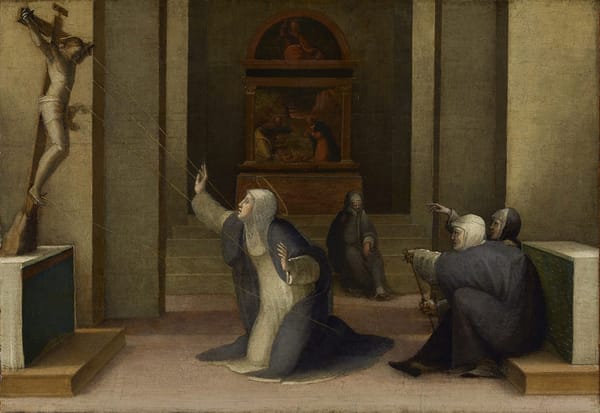 |
April 30: St. Catherine of Siena, Virgin
THE Dominican Order, which yesterday presented a rose to our Risen Jesus, now offers him a lily of surpassing beauty. Catharine of Siena follows Peter the Martyr: it is a coincidence willed by Providence, to give fresh beauty to this season of grandest mysteries. Our divine King deserves everything we can offer him; and our hearts are never so eager to give him every possible tribute of homage as during these last days of his sojourn among us. See how nature is all flower and fragrance at this loveliest of her seasons! The spiritual world harmonizes with the visible, and now yields her noblest and richest works in honour of our Lord, the author of grace.
How grand is the Saint whose feast comes to gladden us to-day! She is one of the most favoured of the holy Spouses of the Incarnate Word. She was his, wholly and unreservedly, almost from her very childhood. Though thus consecrated to him by the vow of holy virginity, she had a mission given to her by divine Providence which required her living in the world. But God would have her to be one of the glories of the religious state; he therefore inspired her to join the Third Order of St Dominic. Accordingly, she wore the habit, and fervently practised during her whole life the holy exercises of a Tertiary.
From the very commencement, there was something heavenly about this admirable servant of God, which we fancy existing in an angel who had been sent from heaven to live in a human body. Her longing after God gave one an idea of the vehemence wherewith the blessed embrace the Sovereign Good on their first entrance into heaven. In vain did the body threaten to impede the soaring of this earthly seraph; she subdued it by penance, and made it obedient to the spirit. Her body seemed to be transformed, so as to have no life of its own, but only that of the soul. The Blessed Sacrament was frequently the only food she took for weeks together. So complete was her union with Christ that she received the impress of the sacred stigmata, and with them the most excruciating pain.
And yet in the midst of all these supernatural favours, Catharine felt the keenest interest in the necessities of others. Her zeal for their spiritual advantage was intense, whilst her compassion for them in their corporal sufferings was that of a most loving mother. God had given her the gift of miracles, and she was lavish in using it for the benefit of her fellow-creatures. Sickness and death itself were obedient to her command; and the prodigies witnessed at the beginning of the Church were again wrought by the humble Saint of Siena.
Her communings with God began when she was quite a child, and her ecstasies were almost without interruption. She frequently saw our Risen Jesus, who never left her without having honoured her either with a great consolation or with a heavy cross. A profound knowledge of the mysteries of our holy faith was another of the extraordinary graces bestowed upon her. So eminent indeed was the heavenly wisdom granted her by God that she, who had received no education, used to dictate the most sublime writings, wherein she treats of spiritual things with a clearness and eloquence to which human genius could never attain, and with a certain indescribable unction which no reader can resist.
But God would not permit such a treasure as this to lie buried in a little town of Italy. The Saints are the supports of the Church; and though their influence be generally hidden, yet at times it is open and visible, and men then learn what are the instruments which God uses for imparting blessings to a world that would seem to deserve little else besides chastisement. The great question, at the close of the fourteenth century, was the restoration to the Holy City of the privilege of having within its walls the Vicar of Christ, who for sixty years had been absent from his see. One saintly soul, by merits and prayers, known to heaven alone, might have brought about this happy event after which the whole Church was longing; but God would have it done by a visible agency, and in the most public manner. In the name of the widowed Rome—in the name of her own and the Church's Spouse—Catharine crossed the Alps, and sought an interview with the Pontiff, who had not so much as seen Rome. The prophetess respectfully reminded him of his duty; and in proof of her mission being from God, she told him of a secret which was known to himself alone. Gregory XI could no longer resist; and the Eternal City welcomed its Pastor and Father. But at the Pontiff's death, a frightful schism, the forerunner of greater evils to follow, broke out in the Church. Catharine, even to her last hour, was untiring in her endeavours to quell the storm. Having lived the same number of years as our Saviour had done, she breathed forth her most pure soul into the hands of her God, and went to continue in heaven her ministry of intercession for the Church she had loved so much on earth, and for souls redeemed in the precious Blood of her divine Spouse.
Our Risen Jesus, who took her to her eternal reward during the season of Easter, granted her whilst she was living on earth a favour which we mention here as being appropriate to the mystery we are now celebrating. He one day appeared to her, having with him his blessed Mother. Mary Magdalen—she that announced the Resurrection to the Apostles—accompanied the Son and the Mother. Catharine's heart was overpowered with emotion at this visit. After looking for some time upon Jesus and his holy Mother, her eyes rested on Magdalen, whose happiness she both saw and envied. Jesus spoke these words to her: ‘My beloved! I give her to thee, to be thy mother. Address thyself to her, henceforth, with all confidence. I give her special charge of thee.' From that day forward, Catharine had the most filial love for Magdalen, and called her by no other name than that of mother.
Let us now read the beautiful, but too brief, account of our Saint’s life, as given in the Liturgy.
Her learning was not acquired, but infused. Theologians proposed to her the most difficult questions of divinity, and received satisfactory answers. No one ever approached her, who did not go away a better man. She reconciled many that were at deadly enmity with one another. She visited Pope Gregory the Eleventh, who was then at Avignon, in order to bring about the reconciliation of the Florentines, who were under an interdict on account of their having formed a league against the Holy See. She told the Pontiff that there had been revealed to her the vow which he, Gregory, had made of going to Rome a vow which was known to God alone. It was through her entreaty that the Pope began to plan measures for taking possession of his See of Rome, which he did soon after. Such was the esteem in which she was held by Gregory, and by Urban the Sixth, his successor, that she was sent by them on several embassies. At length, after a life spent in the exercise of the sublimest virtues, and after gaining great reputation on account of her prophecies and many miracles, she passed hence to her divine Spouse, when she was about the age of three and thirty. She was canonized by Pius the Second.
Being once at Pisa, on a Sunday, and having received the Bread of heaven, she was rapt in an ecstasy. She saw our crucified Lord approaching her. He was encircled with a great light, and from his five Wounds there came rays, which fell upon the five corresponding parts of Catharine's body. Being aware of the favour bestowed upon her, she besought our Lord that the stigmata might not be visible. The rays immediately changed from the colour of blood into that of gold, and passed, under the form of a bright light, to the hands, feet and heart of the Saint. So violent was the pain left by the wounds, that it seemed to her as though she must soon have died, had not God diminished it. Thus our most loving Lord added favour to favour, by permitting her to feel the smart of the wounds, and yet removing their appearance. The servant of God related what had happened to her to Raymund, her confessor. Hence, when the devotion of the faithful gave a representation of this miracle, they painted, on the pictures of St Catharine, bright rays coming from the five stigmata she received.***Her learning was not acquired, but infused. Theologians proposed to her the most difficult questions of divinity, and received satisfactory answers. No one ever approached her, who did not go away a better man. She reconciled many that were at deadly enmity with one another. She visited Pope Gregory the Eleventh, who was then at Avignon, in order to bring about the reconciliation of the Florentines, who were under an interdict on account of their having formed a league against the Holy See. She told the Pontiff that there had been revealed to her the vow which he, Gregory, had made of going to Rome a vow which was known to God alone. It was through her entreaty that the Pope began to plan measures for taking possession of his See of Rome, which he did soon after. Such was the esteem in which she was held by Gregory, and by Urban the Sixth, his successor, that she was sent by them on several embassies. At length, after a life spent in the exercise of the sublimest virtues, and after gaining great reputation on account of her prophecies and many miracles, she passed hence to her divine Spouse, when she was about the age of three and thirty. She was canonized by Pius the Second.
Pope Pius II, one of the glories of Siena, composed the two following hymns in honour of his saintly and illustrious fellow-citizen. They form part of the Office of St Catharine of Siena in the Dominican Breviary.
Hymn
Pope Pius II, one of the glories of Siena, composed the two following hymns in honour of his saintly and illustrious fellow-citizen. They form part of the Office of St Catharine of Siena in the Dominican Breviary.
Hymn
Quæ tu is læti, Catharina, sacris,
Hoc quidem pacto modulamur omnes,
Perfer Olympo.
Annuas nobis veniam, praecamur:
Non sumus tanti ingenii, fatemur,
Optima virgo.
Virginis laudes Quis in orbe toto
Fœminæ invictæ peritura numquam
Carmina pandet?
Moribus praestans, sapiens abunde;
Temperans, fortis, pia, justa, prudens,
Æthera scandis.
Quo nequit dici sanctius per orbem?
Vulnerum formam miserata Christi,
Exprimis ipsa.
Et malis cunctis penitus refertæ,
Fortiter spernens pretiosa quæque,
Sidera adisti.
Filio magni Genitoris almo,
Spiritum Sanctum veneremur, et sit
Laus tamen una.
these canticles of praise, which we,
gladdened by thy feast,
sing thus in thine honour.
pardon us, we beseech thee.
Nay, we own, O glorious Saint!
that we are not equal to the task we have undertaken.
Is there, in the wide world, a poet that could write an ode
immortal enough for this heroine,
whom no enemy could vanquish?
thou wast rich in virtue and wisdom;
and with the riches of thy temperance, fortitude,
piety, justice and prudence, thou didst ascend into heaven.
which were never surpassed in this world?
Thy compassion for the sufferings of Christ
stamped thee with the impress of his wounds.
of this short, mournful, and miserable life,
which abounds with every evil,
thou didst mount to heaven.
to the Son ever blessed of the Eternal Father!
let us give glory to the Holy Ghost!
to the Three, one equal praise!
Hymn
Jure censeris, quoniam triumphos
Ipsa cœlorum, probitate mira,
Nacta refulges.
Et simul munus probitatis almæ
Accipis cœlo, cumulata cunctis
Denique rebus.
Orbis exemplar, pietate plenum
Praedicatorum venerata Patrem,
Ordine fulges.
Nullus omatus, nitor ecce nullus
Corporis, semper fugiens iniqua
Crimina vitæ.
Quam pie flagris cruor hinc et inde
Fluxerat rivis! hominumque demum
Crimina flebas.
Orbe terrarum cruciantur omnes:
Quotque vel curis agitantur ipsi
Undique diris.
Si tuæ laudes repetantur omnes:
Tu quidem longe pietate cunctis
Inclyta præstas.
Et duces iras posuere sævas:
Hi necem diram populo minata
Sæpe Senensi.
Viribus summis operam dedisti:
Litteræ doctæ, lepidæque
Claris Urbibus exstant.
Niteris rectum suadere cunctis:
Sic ais: Tan tum probitas beatos
Efficit omnes.
Fortiter temnens, nihil extimescens,
Præmium nostræ vocitare vitæ
Sæpe solebas.
Quo sacros artus cineresque busto
Linqueres, cœlos aditura flentes
Ipsa docebas.
Hostiam libans, lacrymis obortis,
Dixeras cunctis documenta vitæ,
Voce suprema.
Filio magni Genitoris almo
Spiritum Sanctum veneremur, et sit
Laus tamen una.
thy praise, O Catharine!
for, by thy wondrous virtues, thou hast received
a triumphant welcome from heaven itself.
where thou art enriched with all good things,
that thou hast received the reward of thy holy life,
and the recompense of thy grand virtue.
that perfect model of every virtue;
thou didst enter his Order
and art one of its brightest glories.
none had charms for thee.
Thou couldst not brook sin,
the injustice offered to God by his creature.
and to atone for the sins of men,
oft didst thou severely scourge thyself till thine innocent blood
would flow in streams on the ground.
no matter where they might be, or what their misfortune.
Thy sympathy was ever ready for them, too,
that were a prey to care.
were we to tell all thy praises, O Catharine!
whose sanctity far surpassed
that of other mortals.
who were threatening
the people of Siena with death,
withdrew at thy word.
to the study of sacred things:
and thy letters, teeming with wisdom and elegance,
are still treasured in some of our richest cities.
and persuading all to follow what was right.
Thus didst thou speak to them:
'Virtue alone can make man happy.'
for the dread claims of death,
which thou wast wont to call
the recompense of life.
to leave thy sacred body to the tomb,
and ascend into heaven, thou gavest lessons of consolation
to them that stood weeping around thee.
and received amidst abundant tears of devotion the saving Host,
thou gavest thy last instructions
to all how to lead a holy life.
to the Son ever blessed of the Eternal Father!
let us give glory to the Holy Ghost!
to the Three, one equal praise!
Holy Church, filled as she now is with the joy of her Jesus’ Resurrection, addresses herself to thee, O Catharine, who followest the Lamb whithersoever he goeth1 Living in this exile, where it is only at intervals that she enjoys his presence, she says to thee: Hast thou seen him whom my soul loveth?2 Thou art his Spouse; so is she: but there are no evils, no separation, for thee; whereas for her, the enjoyment is at rare and brief periods, and, even so there are clouds that dim the lovely light. What a life was thine, O Catharine! uniting in itself the keenest compassion for the sufferings of Jesus, and an intense happiness by the share he gave thee of his glorified life. We might take thee as our guide both to the mournful mysteries of Calvary, and to the glad splendours of the Resurrection. It is these latter that we are now respectfully celebrating: oh! speak to us of our Risen Jesus. Is it not he that gave thee the nuptial ring, with its matchless diamond set amidst four precious gems? The bright rays which gleam from thy stigmata tell us that when he espoused thee to himself thou sawest him all resplendent with the beauty of his glorious Wounds. Daughter of Magdalen! like her, thou art a messenger of the Resurrection; and when thy last Pasch comes—the Pasch of thy thirty-third year—thou takest thy way to heaven, to keep it for eternity. O zealous lover of souls! love them more than ever, now that thou art in the palace of the King, our God. We too are in the Pasch, in the new life; intercede for us, that the life of Jesus may never die within us, but that we may strengthen its power by loving him with an ardour like thine own.
Obtain for us, great Saint, something of the filial devotedness for holy Mother Church which prompted thee to do such glorious things! Her sorrows and her joys were thine; for there can be no love for Jesus where there is none for his Spouse: and is it not through her that he gives us all his gifts? Oh, yes! we too wish to love this mother of ours; we will never be ashamed to own ourselves as her children! we will defend her against her enemes; we will do everything that lies in our power to win others to acknowledge, love, and be devoted to her.
Our God used thee as his instrument, O humble virgin, for bringing back the Roman Pontiff to his See. Thou wast stronger than the powers of this earth, which would fain have prolonged an absence disastrous to the Church. The relics of Peter in the Vatican, of Paul on the Ostian Way, of Lawrence and Sebastian, of Cecily and Agnes, exulted in their glorious tombs when Gregory entered with triumph into the Holy City. It was through thee, O Catharine, that a ruinous captivity of seventy years’ duration was brought on that day to a close, and that Rome recovered her glory and her life. In these our days, hell has changed its plan of destruction! men have deprived its Pontiff-King of the city which was chosen by Peter as the See where the Vicar of Christ should reign to the end of the world. Is this design of God, this design which was so dear to thee, O Catharine!—is it now to be frustrated? Oh! beseech him to end this sacrilege speedily. Come to our aid!—and though thy divine Spouse, in his just anger, permits us to suffer these humiliations, pray that at least they may be shortened.
Pray, too, for unhappy Italy, which was so dear to thee, and which is so justly proud of its Saint of Siena. Impiety and heresy are now permitted to run wild through the land; the name of thy Spouse is blasphemed; the people are taught to love error, and to hate what they had hitherto venerated; the Church is insulted and robbed; faith has long since been weakened, but now its very existence is imperilled. Intercede for thy unfortunate country, dear Saint! oh! surely, it is time to come to her assistance, and rescue her from the hands of her enemies. The whole Church hopes that thou mayest effect the deliverance of this her illustrious province: delay not, but calm the storm which seems to threaten a universal wreck!
Saturday the Second Week after Easter
THIS being Saturday, let us once more think of Mary, and of the joy she feels at the Resurrection of her Son. She had been his companion in his sufferings; there was not one that she had not endured, and suffered as far as a mere creature could suffer: so, too, there is not a single glory or gladness of the Resurrection in which she is not now made to participate. It was meet that she, to whom God had granted the grace and merit of sharing in the work of the Redemption, should take her part in the prerogatives which belong to her Jesus, now that he is risen. Her soul is raised to a higher state of perfection; grace loads her with new favours; her actions and sentiments become more than ever heavenly.
She was the first to receive a visit from Jesus after his Resurrection—the first, consequently, to receive from him his own new life. Can we be astonished at her receiving it when we remember that every Christian, who, being purified by his having compassionated with Jesus in his Passion, unites himself afterwards with holy Church, in the sublime mystery of the Pasch, becomes a sharer in the life of his risen Lord? This transformation, which in us is weak, and often, alas! of short duration, was perfect in Mary, for her high vocation and her incomparable fidelity deserved that it should be so; of her, then, far more truly than of us, it may be said that she was indeed risen in her Jesus. The thought of these forty days, during which Mary still possesses her divine Son on this earth, reminds us of those other forty of Bethlehem, when we paid our affectionate homage to the young Virgin-Mother who fed her divine Babe at her breast; we heard the angels singing their Gloria, we saw the shepherds and the Magi; all was exquisite sweetness. What mainly impressed us then was the humility of our Emmanuel; we recognized him as the Lamb that had come to take away the sins of the world; there was nothing that betokened the Mighty God. What changes have happened since that dear time! What sorrows have pierced Mary's heart before her reaching this blissful season of Paschal joy! The sword foretold by Simeon is now, indeed, sheathed, yea, broken for ever, but oh! how sharp and cruel have been its thrusts! Well may Mary now say with the Psalmist: According to the multitude of my sorrows in my heart, thy comforts, O Lord, have given joy to my soul!1 The Lamb, the gentle little Lamb, has become the Lion of the tribe of Juda; and Mary, the Mother of the Babe of Bethlehem, is equally the Mother of the glorious Conqueror.
With what delight does he not show the glories of his victories to his Mother! His work is done, and now he is the beautiful crowned King of Ages; yes, this is he whom she held for nine months within her womb, whom she fed at her breast, and who, for all eternity, will honour her as his Mother. He honours her during these last forty days on earth with every possible mark of affection; he satisfies her maternal love by frequently visiting her. How admirable must not these interviews be between such a Son and Mother! How delightedly must not Mary look upon her Jesus now? the same dear one, it is true, but oh! so changed from what he was a few days ago! That face, so familiar to Mary, beams with a light which is new even to her. The Wounds that remain in his hands, feet, and side, dart forth a brightness which effaces every recollection of sadness. But how shall we speak of the joy wherewith Jesus gazes upon Mary, his Immaculate Mother—his companion in the work of man’s salvation—the creature who is more perfect and more worthy of love than all other creatures put together? Who could describe the conversations of such a Son with such a Mother, during these days preceding his Ascension, when another long separation is to follow? Eternity will tell us what they were; but, even now, if we love the Son and the Mother, we can imagine some little of what passed between them. Jesus would offer to Mary some compensation for the prolongation of her stay on earth, which is required of her by her ministry as Mother of men; more privileged than was heretofore Martha’s sister, she hears his every word, and feeds on its sweetness in an ecstasy of love. O happy hours, to be followed by long years of absence, flow slowly by! Give this blessed Mother time to satiate her love with the sight and caresses of this dearest and most beautiful of the sons of men! O Mary! by these hours of joy which repaid thee for those long bitter ones of thy Jesus’ Passion, pray to him for us, that he permit us to feel and relish his presence in our hearts during this our exile, wherein we are absent from him.2 Thus shall we persevere in our devoted service until the arrival of that blissful moment when we are to be united with him in heaven, never again to be separated from him.
Let us offer to the blessed Mother this beautiful sequence, wherewith the Churches of Germany used formerly to celebrate her Seven Joys, of which the Resurrection was one of the grandest.
Sequence
Deus summæ bonitatis et misericordiæ,
Qui tuae humilitatis
Et dulcorem suavitatis vidit et fragrantiæ.
Cum per angelum mandatur tibi salus gratiæ;
Modum quæris, demonstratur,
Dum consentis, incarnatur confestim rex gloriæ.
Ut hunc regem mereamur habere propitium,
Et ab eo protegamur,
Protecti recipiamur in terra viventium.
Quod tu solem stella paris, velut luna radium;
Pariendo non gravaris,
Virgo manes, non mutaris propter puerperium.
Suum non perdit decorem, cum odor emittitur;
Sic nec propter creatorem
Virginitatis candorem tu perdis, cum nascitur.
Esto nobis recta via apud tuum fiilium,
Atque pro tua gratia
Repelle nostra vitia per secundum gaudium.
Stella monet, quam morari vides super filio
Cum a magis adorari
Ipsum cernis et ditari munere tam vario.
Tresque reges trinitatem in dicto sacrificio;
Aurum mentis puritatem,
Myrrha carnis castitatem, thus est adoratio.
A peccatis simus mundi per te, Virgo Maria,
Et virtutibus fœcundi,
Læti tecum et jocundi, lætemur in patria.
Cum a morte suscitatur Christus die tertia.
Per hoc fides roboratur,
Spes redit et mors fugatur per te, plena gratia;
Homo captus liberatur,
Et ab humo sublevatur
Sursum ad coelestia.
Funde preces cunctis horis, ut per istud gaudium,
Post cursum hujus laboris,
Beatis jungamur choris supernorum civium.
Ascendentem dum vidisti filium in gloria.
Tunc aperte cognovisti
Quod tu mater exstitisti, cujus eras filia.
Via, per quam ascendatur ad cœli palatia;
Ergo surgat et sequatur
Istam viam, qui moratur in mundi miseria.
Ne subjici valeamus dæmonis imperio;
Sed ad coelos ascendamus,
Ubi semper gaudeamus, tecum et cum filio.
De supernis qui descendit in linguis Paraclitus,
Dum confirmat et defendit,
Replet, mundat et accendit Apostolos penitus,
Ut per ignem sit sanatus homo linguis perditus,
Et per ignem emendatus
Qui fuerat maculatus per peccatum primitus.
Ora, Virgo, tuum natum, ut in hoc exilio
Nostrum deleat reatum,
Ne sit in nobis peccatum in magno judicio.
Cum de mundo te vocavit Christus ad coelestia,
Super thronos exaltavit,
Exaltatam honoravit speciali gratia.
Qui nemini reservatur in coelesti curia;
Nec virtutibus ditatur,
Nisi cui per te datur virtutum custodia.
Sentiamus bonitatis tuæ beneficia;
Et nos serves a peccatis,
Et perducas cum beatis ad aeterna gaudia.
A peccatis nos emunda per haec septem gaudia;
Et fœcunda nos fœcunda,
Et duc tecum ad jocunda Paradisi gaudia.
the God of all goodness and mercy,
being pleased with the loveliness of thy humility,
meekness, and purity, is announced as having to be born of thee.
by the angel who hails thee full of grace.
Thou askest how? and thou art told.
Thou consentest: and the King of glory instantly becomes incarnate in thy womb.
that we may deserve to receive mercy from this King,
be protected by him, and, thus protected,
be admitted into the land of the living.
the Star, givest birth to the Sun, as the Moon emits its ray.
This birth injures thee not;
thou remainest a Virgin as before.
by sending forth its fragrance;
so neither losest thou the bloom of thy Virginity
by giving birth to thy Creator.
be to us the way that leads to thy Son;
and, by thy second Joy,
graciously intercede for us, that we be converted from our sins.
Thou seest a star resting over thy Child,
the Magi adoring him,
and offering their varied gifts.
three Kings, Trinity;
the gold signifies purity of soul;
the myrrh, chastity of body; the incense, adoration.
pray for us, that we may be cleansed from our sins,
enriched with virtue, and united with thee
in the happiness and bliss of the heavenly Country.
when Jesus rose from the tomb, on the third day.
By this Mystery, faith is strengthened, hope restored, and death put to flight;
and thou, O full of grace, hadst thy share in effecting these wonders.
Man, who had been made captive, is set free,
and raised from earth
to heaven above.
pray hourly for us, that, by this Joy,
we may be associated with the choirs of the heavenly citizens,
after this life’s labours are over.
when thou wast present at thy Son’s Ascension into heaven.
Then didst thou clearly know
that he whose Mother thou wast was thy Creator.
the path whereby we are to ascend to heaven.
Let us then, who dwell in this miserable world,
arise, and follow this path.
to pray that we may never be made subject to Satan’s power;
but that we ascend to heaven,
where, with thee and thy Son, we may rejoice for all eternity.
was when the Holy Ghost descended, in the form of fiery tongues, from heaven,
strengthening, defending,
filling, cleansing, and inflaming the Apostles.
that man, who owed his perdition to a tongue,
might be saved by such fire; and that he who, at the beginning,
had been defiled by sin, might by fire be purified.
intercede for us to thy Son,
that he pardon us our sins, now in this our exile,
lest there be found guilt upon us at the great judgement.
when he called thee out of this world to heaven,
placed thee on thy throne,
and honoured thee with special favours.
such as none of the blessed in heaven enjoy;
nor can any mortal attain to the perfection of virtue,
unless by thine intercession he receive the safeguard of virtue.
give us to feel the proofs of thy loving intercession,
which will preserve us from sin,
and lead us to eternal joys, in the company of the Blessed.
pray that we may be purified from our sins;
and, being made fruitful in good works,
lead us, O fruitful Mother, to the blissful joys of heaven.
| Previous Friday of the Second Week after Easter | Next Saturday the Second Week after Easter |