Daily reading
Paschal Time
Double · May 2 · Sanctoral
May 2, 2022
From Dom Guéranger’s The Liturgical Year.
A Double leads the weekday.Rubric
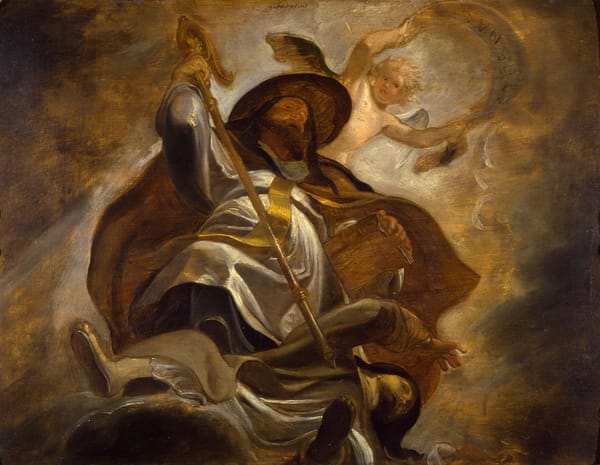 |
May 2: St. Athanasius, Bishop and Doctor of the Church
THE court of our divine King, during this grandest of seasons, is brilliant beyond measure; and, to-day, it is gladdened by the arrival of one of the most glorious champions that ever fought for his holy cause. Among the guardians of the word of truth, confided by Jesus to the earth, is there one more faithful than Athanasius? Does not his very name remind us of dauntless courage in the defence of the sacred deposit, of heroic firmness and patience in suffering, of learning, of talent, of eloquence—in a word, of everything that goes to form a Saint, a Bishop, and a Doctor of the Church? Athanasius lived for the Son of God; the cause of the Son of God was that of Athanasius: he who blessed Athanasius, blessed the eternal Word; and he who insulted Athanasius insulted the eternal Word.
Never did our holy faith go through a greater ordeal than in the sad times immediately following the peace of the Church, when the bark of Peter had to pass through the most furious storm that hell has, so far, let loose against her. Satan had vainly sought to drown the Christian race in a sea of blood; the sword of persecution had grown blunt in the hands of Diocletian and Galerius; and the Cross appeared in the heavens, proclaiming the triumph of Christianity. Scarcely had the Church become aware of her victory when she felt herself shaken to her very foundation. Hell sent upon the earth a heresy which threatened to blight the fruit of three hundred years of martyrdom. Arius began his impious doctrine, that he who had hitherto been adored as the Son of God was only a creature, though the most perfect of all creatures. Immense was the number, even of the clergy, that fell into this new error; the Emperors became its abettors; and had not God himself interposed, men would soon have set up the cry throughout the world that the only result of the victory gained by the Christian religion was to change the object of idolatry, and put a new idol, called Jesus, in place of the old ones.
But he who had promised that the gates of hell should never prevail against his Church, faithfully fulfilled his promise. The primitive faith triumphed; the Council of Nicæa proclaimed the Son to be consubstantial with the Father; but the Church stood in need of a man in whom the cause of the consubstantial Word should be, so to speak, incarnated—a man with learning enough to foil the artifices of heresy, and with courage enough to bear every persecution without flinching. This man was Athanasius: and everyone that adores and loves the Son of God, should love and honour Athanasius. Five times banished from his See of Alexandria by the Arians, who even sought to put him to death, he fled for protection to the West, which justly appreciated the glorious confessor of Jesus' divinity. In return for the hospitality accorded him by Rome, Athanasius gave her of his treasures. Being the admirer and friend of the great St Antony, he was a fervent admirer of the monastic life, which, by the grace of the Holy Ghost, had flourished so wonderfully in the deserts of his vast patriarchate. He brought the precious seed to Rome, and the first monks seen there were the ones introduced by Athanasius. The heavenly plant became naturalized in its new soil; and though its growth was slow at first, it afterwards produced fruit more abundantly than it had ever done in the East.
Athanasius, who has written so admirably upon that fundamental dogma of our faith—the divinity of Christ —has also left us most eloquent treatises on the mystery of the Pasch: they are to be found in the Festal Letters which he addressed each year to the churches of his patriarchate of Alexandria. The collection of these Letters, which were once thought to have been irretrievably lost, was found, a few years back, in the monastery of St Mary of Scete, in Egypt. The first, for the year 329, begins with these words, which beautifully express the sentiments we should feel at the approach of Easter: ' Come, my beloved brethren, celebrate the feast; the season of the year invites you to do so. The Sun of justice, by pouring out his divine rays upon you, tells you that the time of the solemnity is come. At such tidings, let us keep a glad feast; let not the joy slip from us with the fleeting days, without our having tasted of its sweetness.’ During almost every year of his banishment, Athanasius continued to address a Paschal Letter to his people. The one in which he announces the Easter of 338, and which he wrote at Treves, begins thus: ' Though separated from you, my brethren, I cannot break through the custom which I have always observed, and which I received from the tradition of the Fathers. I will not be silent; I will not omit announcing to you the time of the holy annual feast, and the day on which you must keep the solemnity. I am, as you have doubtless been told, a prey to many tribulations; I am weighed down by heavy trials; I am watched by the enemies of truth, who scrutinize everything I write, in order to rake up accusations against me and thereby add to my sufferings; yet notwithstanding, I feel that the Lord strengthens and consoles me in my afflictions. Therefore do I venture to address to you the annual celebration; and from the midst of my troubles, and despite the snares that beset me, I send you, from the furthermost part of the earth, the tidings of the Pasch, which is our salvation. Commending my fate into God’s hands, I will celebrate this feast with you; distance of place separates us, but I am not absent from you. The Lord who gives us these feasts, who is himself our feast, who bestows upon us the gift of his Spirit—he unites us spiritually to one another, by the bond of concord and peace.’
How grand is this Pasch, celebrated by Athanasius, an exile on the Rhine, in union with his people who keep their Easter on the banks of the Nile! It shows us the power of the Liturgy to unite men and make them, at one and the same time, and despite the distance of countries, enjoy the same holy emotions and feel the same aspirations to virtue. Greeks or Barbarians, we have all the same mother-country, the Church; but that which, after faith, unites us all into one family, is the Church’s Liturgy. Now there is nothing in the whole Liturgy so expressive of unity as the celebration of Easter. The unhappy Churches of Russia and the East, by keeping Easter on a different day from that on which it is celebrated by the rest of the Christian world, show that they are not a portion of the One Fold of which our Risen Jesus is the One Shepherd.
We will now read the sketch of the life of St Athanasius, given in the Breviary.
The Greek Church, which celebrates the feast of our Saint at another season of the year, is enthusiastic in her admiration of his virtues. The following stanzas are from the hymn she sings in his praise:
Hymn (Die XVIII Januarii)
Thou wast throned, O Athanasius! on the Chair of Mark in Alexandria; and thy name is emblazoned near his on the sacred cycle. He left Rome, sent by Peter himself to found the second patriarchal See; and thou, three centuries later, didst visit Rome, as successor of Mark, to seek protection from Peter's successor against them that were disturbing thy venerable See by injustice and heresy. Our Western Church was thus honoured by thy presence, O intrepid defender of the faith. She looked on thee with veneration as the glorious exile, the courageous confessor; and she has chronicled thy sojourning in her midst as an event of the greatest interest.
Intercede for the country over which was extended thy patriarchal jurisdiction; but forget not this Europe of ours, which gave thee hospitality and protection. Rome defended thy cause; she passed sentence in thy favour, and restored thee thy rights; make her a return, now that thou art face to face with the God of infinite goodness and power. Protect and console her Pontiff, the successor of that Julius who so nobly befriended thee fifteen hundred years ago. A fierce tempest is now raging against the Rock on which is built the Church of Christ; and our eyes have grown wearied looking for a sign of calm. Oh! pray that these days of trial be shortened, and that the See of Peter may triumph over the calumnies and persecutions which are now besetting her, and endangering the faith of many of her children.
Thy zeal, O Athanasius! checked the ravages of Arianism; but this heresy has again appeared, in our own times, and in almost every country of Europe. Its progress is due to that proud superficial learning which has become one of the principal perils of the age. The Eternal Son of God, consubstantial with the Father, is blasphemed by our so-called philosophers, as being only Man—the best and greatest of men, they say, but still only Man. They despise all the proofs which reason and history adduce of Jesus' divinity; they profess a sort of regard for the Christian teaching which has hitherto been held, but they have discovered (so they tell us) the fallacy of the great dogma which recognizes in the Son of Mary the Eternal Word who became incarnate for man’s salvation. O Athanasius, glorious Doctor of holy Mother Church! humble these modem Arians; expose their proud ignorance and sophistry; undeceive their unhappy followers, by letting them see how this false doctrine leads either to the abyss of the abominations of pantheism, or to the chaos of scepticism, where all truth and morality are impossibilities.
Preserve within us, by the influence of thy prayers, the precious gift of faith, wherewith our Lord has mercifully blessed us. Obtain for us that we may ever confess and adore Jesus Christ as our eternal and infinite God; ' God of God; Light of Light; True God of True God; Begotten, not made; who, for us men, and for our salvation, took Flesh, of the Virgin Mary.’ May we grow each day in the knowledge of this Jesus, until we join thee in the face-to-face contemplation of his perfections. Meanwhile, by means of holy faith, we will live with him on this earth that has witnessed the glory of his Resurrection. How fervent, O Athanasius, was thy love of this Son of God, our Creator and Redeemer! This love was the very life of thy soul, and the stimulus that urged thee to heroic devotedness to his cause. It supported thee in the combats thou hadst to sustain with the world, which seemed leagued together against thy single person. It gave thee strength to endure endless tribulations. Oh! pray that we may obtain this love—a love which is fearless of danger, because faithful to him for whom we suffer—a love which is so justly due, seeing that he, though the Brightness of his Father's glory, and Infinite Wisdom, emptied himself, taking the form of a servant, and humbled himself, becoming obedient unto death, even to the death of the Cross.* How else can we make him a return for his devotedness to us except by giving him all our love, as thou didst, O Athanasius! and by ever singing his praise in compensation for the humiliations which he endured in order to save us?
* Philipp, ii 7, 8. ↩︎
Monday of the Third Week after Easter
THE first stone of the Church is laid; and on this foundation Jesus now begins to build. The shepherd of the sheep and lambs has been proclaimed; it is time to form the fold. The keys of the kingdom have been given to Peter; it is time to inaugurate the kingdom. Now this Church, this fold, this kingdom, designate a society which is to be called Christian, after the name of its Founder. This society, composed of the disciples of Christ, is destined to receive within it every individual of the human race; and if all do not actually enter, it is not in consequence of any ban of exclusion. It will subsist to the end of time; for there can be no elect out of its pale. It will be One; for Christ says not: ‘I will build my Churches he speaks but of One. It will be holy; for all the means of sanctification are in its keeping. It will be Catholic, that is, Universal, in order that, being known in all times and places, men may be able to hear its teachings and follow them. It will be Apostolic; that is to say, that how long soever this world may last, it will come down, by lawful succession, from these men with whom Jesus is, during these forty days, arranging everything that is connected with its establishment.
Such is to be the Church, out of which there is no salvation for those who, having known her, have refused to become her members. A few days hence, and the world will hear of her existence. The spark that is now but in Judea will soon become a fire spread throughout the whole earth. Before the close of the century, not only will there be members of the Church in every province of the vast Roman Empire, but even in countries where Rome has never planted the standard of her proud eagles. Nay more, this miraculous propagation is to be perpetual—in every page new apostles will set forth, and win new victories for this immortal Church. Nothing human is lasting; but the Church's ceaseless duration will excite the spleen of incredulity and baffle all its calculations. Persecutions, heresies, schisms, apostasies, and scandals—all will strive to work her ruin; but she will survive them all. The descendants of her bitterest foes will call her mother. Thrones and dynasties, nations, and even whole races, will be carried away by the tide of time: she alone will subsist throughout the ages, stretching out her arms to receive all men, teaching ever the same truths, repeating, even to the last day, the same symbol of faith, and ever faithful to the instructions given her by our Risen Jesus during these forty days preceding his Ascension.
How shall we worthily thank thee, O God our Saviour, for thy having, even at our first entrance into life, made us members of this thy immortal Spouse, which alone possesses thy heavenly teachings and the means whereby is wrought salvation? We have no need to search for thy Church; it is in and by her that we live, even here below, the supernatural life, the perfection of which is to be given to us in heaven, provided we be faithful to grace. Oh! show thy mercy to those countless souls who have not had the privilege we have enjoyed, and whose entrance into thy Church is to cost them many a painful sacrifice. Strengthen them with light; give them courage; rouse them from indifference; bless their efforts; that thus, O divine Shepherd! thy fold may increase, and thy Church, thy Spouse, may be, as thou hast promised she ever shall be, the joyful mother of children!
Let us continue our homage to the mystery of the Pasch, borrowing another canticle from the inexhaustible Adam of Saint-Victor.
Sequence
Lux insignis, lux unica,
Lux lucis et laetitiae,
Lux immortalis gloriae.
Commendat ab initio,
Quam Christi resurrectio
Ditavit privilegio.
Lucis exsultent filii,
Vindicent membra meritis
Conformitatem Capitis.
Et vota sunt solemnia;
Primae diei dignitas
Prima requirit gaudia.
Paschalis est victoria,
Sub multis aenigmatibus
Prius promissa patribus.
Quod vetus lex praecinuit
Figuram res exterminat,
Et umbram lux illuminat.
Quid hœdus gesserit,
Nostra purgans piacula,
Messias nobis aperit.
Solvit a morte debita;
Praedam captans illicitam,
Praeda privatur licita.
Caro peccati nescia;
Die reflorens tertia
Corda confirmat dubia.
Tu Christo nos vivifica!
Mors morti non obnoxia,
Da nobis vitæ praemia.
the brilliant light, the light above all other,
the light of light and joy,
the light of immortal glory.
from the very beginning of the world:
the day enriched
with the prerogative of Christ’s Resurrection.
exult with the hope of everlasting joy:
let the members so act as to merit
to be like their Head.
so are our prayers.
The grandest of days
should have the grandest joy.
is the most glorious of feasts.
It was promised to our fathers
under many types.
and all is made visible that was foretold in the Old Law.
The reality effaces the figure;
and light throws light on the shadow.
—has revealed to us
the mysteries of the spotless Lamb
and the Kid.
he delivered us from the death we so truly deserved.
Death, making a prey of him on whom he had no claim,
was deprived of the prey that was justly his own.
cancelled the sins of ours:
it rose again on the third day,
and, reblooming, refreshed all wavering hearts.
give us to live in Jesus.
O undying death!
give us the prize of life.
| Previous May 11 [May 1]: Sts. Philip and James the Less, Apostles | Next Monday of the Third Week after Easter |