Daily reading
Paschal Time
Double · May 4 · Sanctoral
May 4, 2022
From Dom Guéranger’s The Liturgical Year.
A Double leads the weekday.Rubric
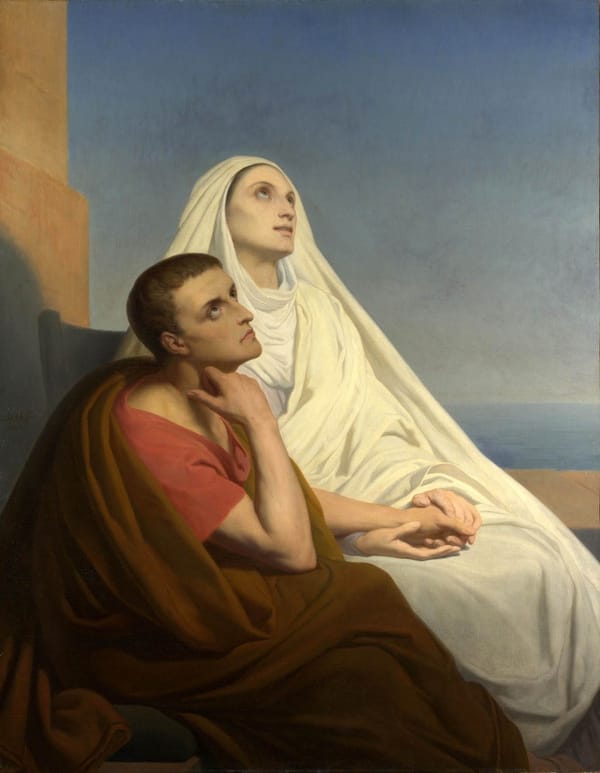 |
May 4: St. Monica, Widow
IN the company of our Risen Lord there are two women, two mothers, of whom we have often had to speak during the last few weeks: they are Mary, mother of James the Less and Thaddeus, and Salome, mother of 'James the Great and John the beloved disciple. They went with Magdalen to the Sepulchre on the Resurrection morning; they carried spices to anoint the Body of Jesus; Angels spoke to them; and, as they returned to Jerusalem, our Lord appeared to them, greeted them, and allowed them to kiss his sacred feet. Since that day, he has repaid their love by frequently appearing to them; and on the day of his Ascension from Mount Olivet, they will be there, together with our blessed Lady and the Apostles, to receive his farewell blessing. Let us honour these faithful companions of Magdalen, these models of the love we should show to our Lord in his Resurrection; let us also venerate them as mothers who gave four Apostles to the Church.
But lo! on this fourth morning of beautiful May, there rises, near to Mary and Salome, another woman, another mother. She, too, is fervent in her love of Jesus. She, too, gives to Holy Church a treasure—the child of her tears, a Doctor, a Bishop, and one of the grandest Saints of the New Law. This woman, this mother, is Monica, doubly mother of Augustine. This masterpiece of God's grace was produced on the desert soil of Africa. Her virtues would have been unknown till the day of judgement, had not the pen of the great bishop of Hippo, prompted by the holy affection of his filial heart, revealed to us the merits of this woman, whose life was humility and love, and who now, immortalized in men’s esteem, is venerated as the model and patroness of Christian mothers.
One of the great charms of the book of Confessions is Augustine’s fervent praise of Monica’s virtues and devotedness. With what affectionate gratitude he speaks, throughout his whole history, of the untiring constancy of this mother who, seeing the errors of her son, 1 wept over him more than other mothers weep over the dead body of their children.’1 Our Lord, who from time to time consoles with a ray of hope the souls he tries, had shown to Monica in a vision the future meeting of the son and mother; she had even heard a holy bishop assure her that the child of so many tears could never be lost: still the sad realities of the present weighed heavily on her heart; and both her maternal love and her faith caused her to grieve over this son, who kept away from her, yea, who kept away from her because he was unfaithful to his God. The anguish of this devoted heart was an expiation which would at a future period be applied to the guilty one; fervent and persevering prayer, joined with suffering, prepared Augustine’s second birth; and, as he himself says, ‘she went through more when she gave me my spiritual than when she gave me my corporal birth.’2
At last, after long years of anxiety, the mother found at Milan this son of hers who had so cruelly deceived her, when he fled from her roof to go and risk his fortune in Rome. She found him still doubting the truth of the Christian religion, but tired of the errors that had misled him. Augustine was not aware of it, but he had really made an advance towards the true faith. ‘She found me,’ says he, ‘in extreme danger, for I despaired of ever finding the truth. But when I told her that I was no longer a Manichean, and yet not a Catholic Christian, the announcement did not take her by surprise. She leaped for joy at being made sure that one half of my misery was gone. As to the other, she wept over me, as dead indeed, but to rise again; she turned to thee, O my God, and wept, and in spirit brought me and laid the bier before thee, that thou mightest say to the widow's son: Young man! I say to thee, arise! Then would he come to life again, and begin to speak, and thou couldst give him back to his mother! . . . Seeing then that although I had not yet found the truth, I was delivered from error, she felt sure that thou wouldst give the other half of the whole thou hadst promised. She told me in a tone of gentlest calm, but with her heart full of hope, that she was confident, in Christ, that before leaving this world, she would see me a faithful Catholic.’3
At Milan, Monica formed acquaintance with the great St Ambrose, who was the instrument chosen by God for the conversion of her son. ‘She had a very great affection for Ambrose,' says Augustine, ' because of what he had done for my soul; and he too loved her, because of her extraordinary piety, which led her to the performance of good works, and to fervent assiduity in frequenting the Church. Hence, when he saw me, he would frequently break out in her praise, and congratulate me on having such a mother.’4 The hour of grace came at last. The light of faith dawned upon Augustine, and he began to think of enrolling himself a member of the Christian Church; but the pleasures of the world, in which he had so long indulged, held him back from receiving the holy sacrament of baptism. Monica's prayers and tears won for him the grace to break this last tie. He yielded and became a Christian.
But God would have this work of his divine mercy a perfect one. Augustine, once converted, was not satisfied with professing the true faith; he aspired to the sublime virtue of continence. A soul favoured as his then was could find no further pleasure in anything that this world had to offer him. Monica, who was anxious to guard her son against the dangers of a relapse into sin, had been preparing an honourable marriage for him; but Augustine came to her one day, accompanied by his friend Alypius, and told her that he was resolved to aim at the most perfect life. Let us listen to the Saint's account of this interview with his mother; it was immediately after he had been admonished by the voice from heaven: ‘We (Augustine and Alypius) go at once to my mother's house. We tell her what has taken place; she is full of joy. We tell her all the particulars; she is overpowered with feelings of delight and exultation. She blessed thee, O my God, who canst do beyond what we ask or understand. She saw that thou hadst done more for me than she had asked of thee, with her many piteous and tearful sighs . . . . Thou hadst changed her mourning into joy even beyond her wishes, yea, into a joy far dearer and chaster than she could ever have had in seeing me a father of children.’5 A few days after this, and in the Church of Milan, a sublime spectacle was witnessed by angels and men: Ambrose baptized Augustine in Monica's presence.
The saintly mother had fulfilled her mission: her son was regenerated to truth and virtue, and she had given to the Church the greatest of her Doctors. The evening of her long and laborious life was approaching and she was soon to find eternal rest in the God for whose love she had suffered so much. The son and mother were at Ostia, waiting for the vessel that was to take them back to Africa. ‘I and she were alone,’ says Augustine, ‘and were standing near a window of our lodging, which commanded a view of the garden. We were having a most charming conversation. Forgetting the past, and stretching forward to the things beyond, we were talking about the future life of the Saints, which eye hath not seen, nor ear heard, nor hath it ascended into man's heart . . . . And whilst thus talking about it and longing for it, our hearts seemed to bound forward and reach it. We sighed, and left the first-fruits of our spirit there, and returned to the sound of our own voice . . . . Then my mother said to me: “ My son! as far as I am concerned, there is nothing now that can give me pleasure in this life. I know not what I can do, or why I should be here, now that I have nothing to hope for in this world. There was one thing for which I desired to live somewhat longer, and it was to see thee a Catholic Christian before my death. My God has granted me this and more, for I see that thou hast despised earthly pleasures and become his servant. What do I here?”’6
She had not long to wait for the divine invitation. She breathed forth her pure soul a few days after this incident, leaving an indelible impression upon the heart of her son, a name most dear and honoured to the Church, and a perfect example of the purest and holiest maternal affection to Christian mothers.
The life and virtues of St Monica are thus briefly portrayed in to-day’s Liturgy:
The Middle Ages have left us several liturgical pieces composed in honour of St Monica; but most of them are poor. The sequence we select is not without merit; it has even been attributed to Adam of Saint-Victor.
Sequence
Atque suæ piæ matris laudes et præconia
Decantemus, venerantes
Et optata celebrantes hodie solemnia.
Vita clara, Christo chara, hæc beata Monica
De profano propagatum,
Jam nunc parit suum natum in fide catholica.
Quo effulsit tam præclarum lumen in Ecclesia!
Multo fletu seminavit,
Germen ubi reportavit metens in lætitia.
O quam miro tunc gestivit Spiritus tripudio,
Cernens natum fide ratum,
Sed et Christo jam sacratum toto mentis studio!
Et in eis Christum pavit, mater dicta pauperum;
Curam gerens infirmorum,
Lavit, stravit, et eorum tersit sordes vuinerum.
Quam transfigunt amorosa crucifixi stigmata!
His accensa sic ploravit,
Lacrymis quod irrigavit pavimenti schemata.
Stat a terris elevata cubiti distantia;
Mente rapta exsultavit:
‘Volitemus,’ exclamavit, ‘Ad cœli fastigia.’
Advocata et patrona sis pro tuis filiis,
Ut dum carne exuemur,
Nato tuo sociemur paradisi gaudiis.
and of his holy mother.
Let us devoutly celebrate
the beloved solemnity of this day.
well instructed in the faith, edifying in her conduct, and dear to Christ.
Her son was born of a pagan father;
but she gave him a second birth—she brought him to the Catholic faith.
through which shone forth so bright a light within the Church!
Monica sowed in much weeping,
but she reaped her fruit in joy.
Oh! how grand was the gladness that filled her soul,
when she saw her son staunch in faith,
yea, and devoted with his whole heart to Christ!
for she ministered to them in their necessities, and gave to Christ the food she gave to them.
She took care of the sick,
washed them, nursed them, and dressed their wounds.
with compassion for the dear Wounds of her crucified Lord!
She wept for love when she thought upon them,
and her tears bedewed the spot on which she prayed.
she was raised from the ground
and in her rapture exclaimed with joy:
‘Let us fly to heaven above!'
be to us thy children an advocate and patroness,
that so, when we quit the flesh, we may be united to Augustine,
thy son, in the joys of paradise.
O thou model of mothers! Christendom honours thee as one of the most perfect types of human nature regenerated by Christ. Previous to the Gospel, during those long ages when woman was kept in a state of abjection, a mother’s influence on her children was feeble and insignificant; her duties were generally limited to looking after their bodily well-being; and if some mothers of those times have handed their names down to posterity, it is only because they taught their sons to covet and win the passing glory of this world. But we have no instance in pagan times of a mother training her son to virtue, following him from city to city that she might help him in the struggle with error and the passions, and encourage him to rise after a fall; we do not meet with one who devoted herself to continual prayer and tears, with a view to obtain her son's return to truth and virtue. Christianity alone has revealed a mother's mission and power.
What forgetfulness of thyself, O Monica, in thine incessant endeavour to secure Augustine's salvation! After God, thou livest for him, and to live for thy son in such a way as this, is it not living for God, who deigns to use thee as the instrument of his grace? What carest thou for Augustine's glory and success in this world when thou thinkest of the eternal dangers and of the eternal separation from God and thee to which he is exposed. There is no sacrifice which thy maternal heart is not ready to make in order to satisfy the divine justice: it has its rights and thou art too generous not to satisfy them. Thou waitest patiently, day and night, for God's good time to come. The delay only makes thy prayer more earnest. Hoping against all hope, thou at length feelest within thy heart the humble but firm conviction that the object of all these tears can never be lost. Moved with mercy towards thee, as he was towards the sorrowing mother of Naim, he speaks with that voice which nothing can withstand: ‘Young man! I say to thee, arise!’ and he gives him to his mother,’7 he gives thee the dear one whose death thou hadst so bitterly bewailed, but from whom thou couldst not tear thyself.
What a recompense of thy maternal love is this! God is not satisfied with restoring thee Augustine full of life; this son of thine rises at once from the very depths of error and sin to the highest virtue. Thou hadst prayed that he might become a Catholic and break certain ties which were both a disgrace and danger to him; when lo! one single stroke of grace has raised him to the sublime state of the Evangelical Counsels. Thy work is more than done, O happy mother! Speed thee to heaven; where till thy Augustine joins thee, thou art to gaze on the saintly life and works of this son, whose salvation is due to thee and whose glory, even while he sojourns here below, sheds a bright halo over thy venerated name.
From the eternal home where thou art now happy with this son who owes to thee his life both of earth and heaven, cast a loving look, O Monica, on the many Christian mothers who are now fulfilling on earth the hard but noble mission which was once thine. Their children are also dead with the death of sin; and they would restore them to true life by the power of their maternal love. After the Mother of Jesus, it is to thee that they turn, O Monica, whose prayers and tears were once so efficacious and so fruitful. Take their cause in hand; thy tender and‘devoted heart cannot fail to compassionate them in the anguish which was once thine own. Maintain their courage; teach them to hope. The conversion of these dear ones is to cost them many a sacrifice; procure them the generosity and fortitude to pay the price thus asked of them by God. Let them remember that the conversion of a soul is a greater miracle than raising a dead man to life; and that divine justice demands a compensation which they, the mothers of these children, must be ready to make. This spirit of sacrifice will destroy that hidden egotism which is but too frequently mingled with what seems to be affection of the purest kind. Let them ask themselves if they would rejoice as thou didst, O Monica, at finding that a vocation to the Religious life was the result of the conversion they have so much at heart. If they are thus disinterested, let them not fear; their prayers and sufferings must be efficacious; sooner or later, the wished-for grace will descend upon the prodigal, and he will return to God and to his mother.
Wednesday of the Third Week after Easter
THERE is nothing on earth so grand, nothing so exalted, as the princes of the Church—the pastors, appointed by the Son of God—who are to follow on, in unbroken succession, to the end of time: but let us not suppose that the subjects of this vast empire, called the Church, are devoid of dignity and greatness. The Christian people, in which both prince and beggar are equally subjects, is superior to every other, in intellectual and moral worth. It carries civilization with it, wheresoever it goes, for it carries with it the true notion of God and of the supernatural end of man. Barbarism recedes; pagan institutions, how ancient soever they may be, are forced to give way. Even Greece and Rome laid down their own laws to adopt those of the Christian code—the code which was based on the Gospel. So, too, in our own times, the mere sight of a Christian army, though composed of but a few thousand men, struck terror into the heart of an immense empire of the East: its ruler who counts four hundred million subjects, and calls himself the ‘Son of the Celestial Empire, was so overcome by fear that without offering the slightest resistance he fled from his palaces and capital. Yes, this is the superiority given by baptism to Christian nations; for it would be absurd to attribute this superiority to our civilization, seeing that civilization itself is but a consequence of baptism.
But if the outward bearing of the Christian people be such as to exercise an influence on even infidels, what must not be that dignity which faith teaches us is its inheritance? The Apostle St Peter—the universal shepherd, into whose hands the divine Shepherd placed the keys—thus describes the flock entrusted to his care: You are a chosen generation, a kingly priesthood, a holy nation, a purchased people; that you may declare his virtues, who hath called you out of darkness into his marvellous light.1 So, indeed, it is; divine truth is entrusted to this people, and its light can never be extinguished among them. When the teaching authority has, with its infallibility, to proclaim a solemn definition in doctrinal matters, it first appeals to the faith of the Christian people; and the sentence declares that to be the truth which has been believed ‘everywhere, always, and by all.’2 Amidst the Christian people there exists that strangest phenomenon under heaven, union of mind; whereby there is one common faith amidst nations the most opposite to each other in every other respect. Let them be as hostile to one another as you please; in matters of faith, in submission to their pastors, they are all one and the same great family. The most admirable, at times the most heroic virtues are to be found amidst this people, for Jesus has given it a large share of that element of holiness wherewith his grace has enriched human nature.
Observe, too, how affectionately it is protected and honoured by its pastors! Every pastor, no matter what may be his rank in the Church, is bound, in virtue of his office, to lay down his life for his sheep, if called upon to do it. The sacrifice is not even counted as an act of heroism; it is a strict duty. Shame and curse upon the pastor who flees through cowardice! The Redeemer stigmatizes such a one with the name of hireling. Hence it is, that during these last eighteen hundred years, there have been so many thousands of pastors who have given their lives for their flocks. One or other of their names are to be found in every page of the Church’s history. The list is headed by St Peter, who was crucified like his divine Master; it continues down to the Bishops of Cochin-China, Tonkin, and Corea, whose recent martyrdoms attest that the pastor has not ceased to consider himself as a victim for his flock. Thus, before confiding his lambs and sheep to Peter, Jesus asks him if he have greater love than the rest. If Peter love his Master, he will love his Master’s lambs and sheep; he will love them even to laying down his life for them. For this reason, after entrusting him with the care of the whole flock, our Saviour tells Peter that he is to die a martyr. Happy is that people whose rulers only exercise their authority on condition of being ready to die for these their Master’s sheep!
If one of these should evince in his life the marks which denote sanctity, and this so far as to deserve to be proposed to the faithful as a model and intercessor, you will not only see the priest whose word calls down the Son of God upon the altar, not only the bishop whose sacred hands wield the pastoral staff, but the very Vicar of Christ, humbly kneeling before the tomb or statue of the Servant of God, how poor or despised soever he or she may have been on this earth. This sacred hierarchy testifies the same sentiments of respect for the sheep of Christ on every occasion. Thus in a baptized babe, that knows not how to utter a single word, that is not counted among the citizens of the state, that, like a tender flower, may perhaps have faded before the close of day, yet does the pastor recognize in it a worthy member of the Body of Christ, the Church; he reverences it as a being that is enriched with gifts so sublime as to be an object of heaven’s love, and a source of blessing to all around it. When the Faithful are assembled in the house of God, and the sacred oblations and altar have been thurified, the Celebrant, as the representative of Christ, and any others of the clergy who may be in the sanctuary, are also honoured with the same mysterious tribute of homage: but the incense is to go beyond the sanctuary. The thurifer advances towards the people, and in the name of the Church, gives them the same honour as that just given to the pontiff and the clergy; for the faithful people are also members of Christ. Again: when the corpse of a Christian, even though he may have been the poorest of the poor, is carried into the house of God, observe what honour is paid to his mortal remains! On this occasion, also, the incense is made to express the affectionate homage wherewith the Church honours the Christian character of her children. O Christian people! how truly we may say of thee what Moses said of Israel: There is no other nation so great as thou!3
It is our Risen Jesus that has procured us all this honour: let us express our love and gratitude in this canticle of the ancient Missal of Saint Gall.
Sequence
Unquam præevalet, regum summe,
Typica majestatis tuae Promere?
Qui Parenti supremo
Deitate coaequalis,
Omnia potestate pari disponis;
In Patre callebas Sophia;
Per quam facta sunt omnia,
Quæque profert
Triplex machina.
Qui cernens immersos esse barathro,
Tua quos adornat imago,
Propter nos factus es homo,
Ut nos solveres Sanguine tuo.
Isaac parentis nostri immolatio,
Mactabatur aries
Pro quo Domino.
Joseph prænotavit
Venditus in Ægypto,
Nunc daturus typicos victus populo.
Infernum fracturus,
Cum Samson vir invictus
Leonem suffocavit,
Et portas hostiles Disrupit.
Illius flos virgæ,
Quam fudit radix Jesse
Generosa germine,
Quod sunt præconati Prophetae.
O Redemptor, ceu sub umbra primitus,
Quæ nos verius
Te monstrante cernimus.
Tu cuncta procul fugas nubila,
Terrae reddens tui vultus Lumina.
Quæ morte tua
Fuscabatur tremula.
Cuncta ornantur
Elementa sereno,
Quia redisti victor Barathro.
Hinc et nos, o socii,
Mente Dominum
Sincera et humili
Simul laudemus
Carmine tali:
Criminum nos cœno,
Haud pepercit proprio
Propter nosmet Filio.
Pro nobis qui factus est homo,
Ut solvens nos tartaro
Redderet paradiso.
Ævo omni.
can worthily celebrate
the mysteries wrought by thy majesty?
God co-equal with the Father, Eternal,
thou rulest all things
with the selfsame power as his.
when thou wast,
in the bosom of the Father,
the Wisdom whereby all things were made,
yea all that compose this triple world.
Seeing that they who were adorned with thy image
had fallen into an abyss of misery,
thou wast made man for our sakes,
that by thy Blood thou mightest rescue us.
was the sacrifice of our father Isaac;
in whose stead
a ram was immolated unto the Lord.
was prefigured by Joseph sold into Egypt,
where he fed the people
with mysterytelling food.
was foreshadowed
by the invincible Samson
slaying a lion
and breaking his enemies’ gates.
Flower of the Branch
that nobly grew
from Jesse's root,
as sang the Prophets of old.
were shown, in a shadow, to our Fathers;
thou hast shown them to us in their truth.
Thou dispellest all clouds,
and makest the light of thy countenance
to shine once more on the earth,
that had been thrown into darkness
and fear by thy death.
in beauteous light,
because thou hast returned
in victory from the tomb.
Let us, then, brethren,
with upright
and humble hearts,
unite in praising
thus our God:
who, to raise us from the mire of our sins,
spared not his own Son,
for our sake.
who to ransom us from hell,
and restore us to heaven,
was made Man for our sake.
for ever.
| Previous Tuesday of the Third Week after Easter | Next Wednesday of the Third Week after Easter |