Daily reading
Paschal Time
Double · May 5 · Sanctoral
May 5, 2022
From Dom Guéranger’s The Liturgical Year.
A Double leads the weekday.Rubric
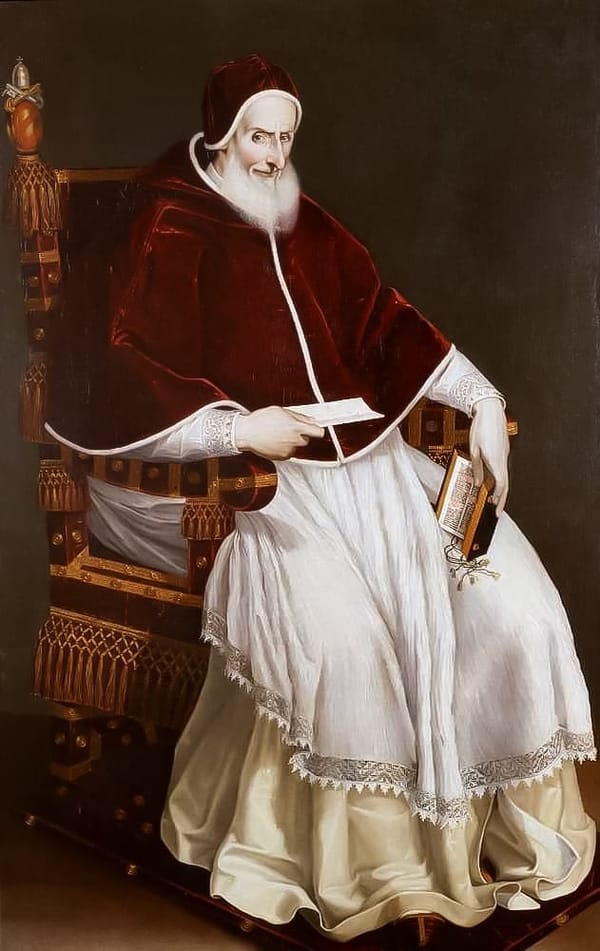 |
May 5: St. Pius V, Pope
WE have already met with the names of several Pontiffs on the Paschal Calendar. They form a brilliant constellation around our Risen Jesus, who, during the period between his Resurrection and Ascension, gave to Peter, their predecessor, the keys of the kingdom of heaven. Anicetus, Soter, Caius, Cletus and Marcellinus, held in their hands the palm of martyrdom: Leo was the only one who did not shed his blood in the cause of his divine Master. To-day there comes before us a holy Pope who governed the Church in these latter times; he is worthy to stand amidst the Easter group of Pontiffs. Like Leo, Pius V was zealous in combating heresy; like Leo, he saved his people from the barbarian yoke.
The whole life of Pius V was a combat. His pontificate fell during those troubled times when Protestantism was leading whole countries into apostasy. Italy was not a prey that could be taken by violence: artifice was therefore used, in order to undermine the Apostolic See and thus develop the whole Christian world in the darkness of heresy. Pius defended the Peninsula with untiring devotedness from the danger that threatened her. Even before he was raised to the Papal Throne he frequently exposed his life by his zeal in opposing the preaching of false doctrines. Like Peter the Martyr, he braved every danger and was the dread of the emissaries of heresy. When seated on the Chair of Peter, he kept the innovators in check by fear, roused the sovereigns of Italy to energy and by measures of moderate severity drove back beyond the Alps the torrent that would have swept Christianity from Europe had not the Southern States thus opposed it. From that time forward, Protestantism has never made any further progress: it has been wearing itself out by doctrinal anarchy. We repeat it: this heresy would have laid all Europe waste, had it not been for the vigilance of the pastor who animated the defenders of truth to resist it where it already existed, and who set himself as a wall of brass against its invasion in the country where he himself was the master.
Another enemy, taking advantage of the confusion caused in the West by Protestantism, organized an expedition against Europe. Italy was to be its first prey. The Ottoman fleet started from the Bosphorus. This again would have meant the ruin of Christendom but for the energy of the Roman Pontiff, our Saint. He gave the alarm, and called the Christian Princes to arms. Germany and France, tom by domestic factions that had been caused by heresy, turned a deaf ear to the call. Spain alone, together with Venice and the little Papal fleet, answered the summons of the Pontiff. The Cross and Crescent were soon face to face in the Gulf of Lepanto. The prayers of Pius V decided the victory in favour of the Christians, whose forces were much inferior to those of the Turks. We shall return to this important event when we come to the Feast of the Rosary in October. But we cannot omit to mention to-day the prediction uttered by the holy Pope, on the evening of the great day of October 7, 1571. The battle between the Christian and Turkish fleets lasted from six o'clock in the morning till late in the afternoon. Towards evening, the Pontiff suddenly looked up towards heaven, and gazed upon it in silence for a few seconds. Then turning to his attendants, he exclaimed: ' Let us give thanks to God! The Christians have gained the victory!' The news soon arrived at Rome; and thus, Europe once more owed her salvation to a Pope! The defeat at Lepanto was a blow from which the Ottoman Empire has never recovered: its fall dates from that glorious day.
The zeal of this holy Pope for the reformation of Christian morals, his establishment of the observance of the laws of discipline prescribed by the Council of Trent and his publication of the new Breviary and Missal have made his six years' pontificate to be one of the richest periods of the Church’s history. Protestants themselves have frequently expressed their admiration of this vigorous opponent of the so-called Reformation.
‘I am surprised,’ said Bacon, ‘that the Church of Rome has not yet canonized this great man.’ Pius V did not receive this honour till about a hundred and thirty years after his death; so impartial is the Church, when she has to adjudicate this highest of earthly honours even to her most revered Pastors!
Of the many miracles which attested the merits of this holy Pontiff, even during his life, we select the two following: As he was one day crossing the Vatican piazza, which is on the site of the ancient Circus of Nero, he was overcome with a sentiment of enthusiasm for the glory and courage of the martyrs who had suffered on that very spot in the first persecution. Stooping down, he took up a handful of dust from the hallowed ground which had been trodden by so many generations of the Christian people since the peace of Constantine. He put the dust into a cloth which the Ambassador of Poland, who was with him, held out to receive it. When the Ambassador opened the cloth, after returning to his house, he found it all saturated with blood, as fresh as though it had been that moment shed: the dust had disappeared. The faith of the Pontiff had evoked the blood of the martyrs, which thus gave testimony against the heretics that the Roman Church, in the sixteenth century, was identically the same as that for which those brave heroes and heroines laid down their lives in the days of Nero.
The heretics attempted more than once to destroy a life which baffled all their hopes of perverting the faith of Italy. By a base and sacrilegious stratagem, aided by treachery, they put a deadly poison on the feet of the crucifix which the Saint kept in his Oratory, and which he was frequently seen to kiss with great devotion. In the fervour of prayer, Pius was about to give this mark of love to the image of his crucified Master, when suddenly the feet of the crucifix detached themselves from the Cross and eluded the proffered kiss of the venerable old man. The Pontiff at once saw through the plot whereby his enemies would fain have turned the life-giving Tree into an instrument of death.
In order to encourage the faithful to follow the sacred Liturgy, we will select another interesting example from the life of this great Saint. When, lying on his bed of death, and just before breathing his last, he took a parting look at the Church on earth, which he was leaving for that of heaven, he wished to make a final prayer for the flock which he knew was surrounded by danger; he therefore recited, but with a voice that was scarcely audible, the following stanza of the Paschal hymn: ‘We beseech thee, O Creator of all things! that in these days of Paschal joy, thou defend thy people from every assault of death!’1
Let us now read the eulogy of this saintly Pope of modern times, as given in the divine Office:
St Pius is one of the leading glories of the Dominican Order. We find the following Responsories and Hymns in the Breviary of that Order:
Responsories
Hymn
Canora pangant organa:
Nimbosque pellant nubilos
Sacræ diei gaudia.
Fregit draconis impetum:
Piique sumpto nomine,
Hostem repressit impium.
Umbone firmo depulit:
Sectariorum spicula
Mucrone forti messuit.
Sacris stetit pro mcenibus,
Ut barbaros acinaces
Arceret a fidelibus.
Cura revexit sedula:
Et impiis erroribus
Objecit hic repagula.
Non vinxit in sudario
Necessitates publicas
Toto juvans ærario.
Manus habens tomatiles,
Pavit greges famelicos
Effusione munerum.
In hoc paschali gaudio,
Ab omni mortis impetu
Tuum defende populum.
give forth their glad sound in honour of blessed Pius!
Let the joys of this sacred day
dispel all stormy clouds.
and he conquered the devil in battle:
he took the name of Pius
and repressed the impious foe.
against the dangers that attacked the Church:
he was the strong sword
that mowed down the ranks of the heretics.
who stood for the defence of the Holy City,
that he might protect the faithful
from the scimitar of the Turks.
redisciplined morals;
and to impious errors
he opposed a barrier of restraint.
to hide his wealth in a napkin;
he threw open his whole treasury,
that he might relieve the necessities of his people.
with his hands ever pouring forth charity,
he fed and amply provided for his subjects
when suffering famine.
that in these days of Paschal joy
thou defend thy people
from every assault of death.
The following hymn is placed near the tomb of our Saint, in the Church of Saint Mary Major, for the use of those who visit his shrine:
Hymn
Cultus Dei contemnitur:
Ultrixque culpam persequens,
Jam poena terris imminet.
Cœlestium de sedibus
Præsentiorem vindicem,
Quam te, Pie, invocabimus?
Intensiore robore
Quam tu, superni numinis
Promovit in terris decus;
Avertit a cervicibus,
Quod christianis gentibus
Jugum parabant barbari.
Tu supplices nunc aspice:
Tu civium discordias
Compesce et iras hostium.
Terras revisat, ut
Deo Tuti queamus reddere
Mox lætiora cantica.
Uni Deo sit gloria,
Laus et potestas omnia
Per sæculorum sæcula.
for the worship of God is despised:
the chastisement that avenges guilt
is menacing our earth.
which of the heavenly citizens
can we better invoke
in our defence than thee, O Pius?
no mortal ever laboured
with such zealous vigour
to promote God's glory on earth as thou didst;
to free Christian lands from the yoke
which barbarians were seeking
to put upon them.
that thou art in heaven:
look upon us thy clients!
Restrain civil discord and repel our enemies.
that in calm security
we may sing our canticles to God
with a gladder heart.
one God, be glory,
praise and power, for ever
and ever.
Pontiff of the living God! thou wast, whilst on earth, the pillar of iron and wall of brass, spoken of by the prophet.2 Thine unflinching firmness preserved the flock entrusted to thee from the violence arid snares of its many enemies. Far from desponding at the sight of the dangers thou didst redouble thy courage just as men raise the embankments higher when they see the torrent swell. By thee was the spread of heresy checked; by thee was the Mussulman invasion repelled, and the haughty Crescent humbled. God honoured thee by choosing thee as the avenger of his glory and the deliverer of the Christian people: receive our thanks and the homage of our humble praise! By thee were repaired the injuries .done to the Church during a period of unusual trial. The true reform—the reform that is wrought by authority—was vigorously applied by thy strong and holy hand. To thee is due the restoration of the Divine Service by the publication of the books of holy Liturgy. And all these glorious deeds were done in the six short years of thy laborious pontificate!
Hear now the prayers addressed to thee by the Church Militant, whose destinies were once in thy hands. When dying, thou didst beseech our Risen Jesus to grant her protection against the dangers which were then threatening her: oh! see the state to which licentious error has now reduced almost the whole Christian world! The Church has nothing left to her wherewith to make head against her countless enemies, save the promises of her divine Founder; all visible support is withdrawn from her; she has been deprived of everything except the merit of suffering and the power of prayer. Unite, O holy Pontiff, thy prayers to hers, and show how unchanged is thy love of the flock of Christ. Protect in Rome the Chair of thy successor attacked by open violence and astute hypocrisy. Princes and peoples seem to have conspired against God and his Christ: disconcert the schemes of sacrilegious ambition, and the plots of impiety which would fain give the lie to the word of God. Avert, by thine intercession, the scourges which are threatening those nations that have become ungrateful to the Church and indifferent to the attempts made against her to whom they owe all they possess. Pray that the blind may see and the wicked be confounded. Pray that the True Faith may enlighten those numberless souls that call error truth and darkness light.
In the midst of this dark and menacing night, thine eyes, O holy Pontiff, discern them that are the faithful sheep of Christ: bless them, aid them, increase their number. Graft them on the venerable Tree which dieth not, that they may not be carried away by the storm. Obtain for them docility to the Faith and traditions of Holy Church; it is their only stay amidst the tide of error which is now threatening to deluge the whole world. Preserve to the Church the holy Order in which thou wast trained for the high mission destined for thee; maintain within her that race of men, powerful in work and word, zealous for the faith and sanctification of souls, of which we read in her Annals, and which has yielded saints such as thyself. And lastly, O Pius, remember that thou wast once the Father of the faithful: continue to be so, by thy powerful intercession, till the number of the elect be filled up!
- The Stanza recited by the dying Pontiff was, in the Breviary of his time, as follows: Quæsumus, Auctor omnium, In hoc Paschali gaudio, Ab omni mortis impetus Tuum defende populum. When the hymns were corrected under the pontificate of Urban the Eighth, this stanza was totally changed: Ut sis perenne mentibus, etc. [The Monastic Breviary has retained the original.—Tr.] ↩︎
- Jer. i 18. ↩︎
Thursday of the Third Week after Easter
THIS Church founded and maintained by Christ —is it nothing more than a society of minds that know, and of hearts that love, the truths revealed to it by heaven? Have we adequately defined it, when we call it ‘a spiritual society'? No, most assuredly; for we are told that it was to spread, and actually has been spread, throughout the whole world. Now how could such progress and conquest have taken place, if the spiritual society founded by our Redeemer had not also been exterior and visible? On earth, souls cannot hold intercommunication without bodies. Faith cometh by hearing, says the Apostle: and how shall they hear without a preacher?1 When, therefore, our Risen Jesus says to his Apostles: Go, teach all nations!2 he distinctly implies that the word of God will be heard, that it will resound throughout the world, and that its sound will be heard both by them that obey and by them that reject the teaching of his ministers. Has this word a right to circulate thus freely, independently of any permission from earthly powers? Yes; for the Son of God has said: Go, teach all nations! He must be obeyed; the word of God cannot be fettered.3
The word, then, the exterior word is free; and being free, it obtains numerous disciples. Will these disciples live isolatedly? Will they not rather group around their apostle, the better to profit by his teaching? Will they not look on one another as brethren, and members of the same family? And if so, they must hold their assemblies. Thus the new people is brought before the notice of the world. It was necessary that this should be; for if this people, which is to attract all others to itself, be not visible, how can it do its work?
But the people thus assembled must have their buildings, their temples. Therefore do they erect houses of preaching and prayer. The stranger—that is, he who is not a Christian—seeing these new places of worship, asks: ‘What means all this? Whence come these people who pray aloof from their fellow-citizens? Would not one be inclined to say that we have a nation within the nation?’ The stranger is right; there is a nation within the nation, and it will continue to be so until the whole nation itself have passed into the ranks of this new people.
Every society stands in need of laws; the Church, therefore, will not be long without giving outward proof of her internal government. There are her festivals, her solemnities, which denote a great people; her ritual rules, forming a visible bond of union between the members of her society, and this not merely during the hours of divine service; there are commandments and orders made by the various degrees of the hierarchy, which are promulgated and claim obedience; there are institutions and corporations existing within the great society itself, and they add to her strength and beauty; in a word, there is everything that is needed, even penal laws against offending and refractory members.
But it does not suffice the Church that she have places where her children can assemble together; provision must also be made for the support of her clergy, for the expenses attendant on the divine worship, for the necessities of her indigent members. Aided by the generosity of her children, she enters into possession of certain landed properties, which become sacred by reason of their use, as also because of the superhuman dignity of her who owns them. Nay more; when the princes of this earth, tired of their vain efforts to stay the Church’s progress, shall ask to be admitted as her children, a new necessity will arise from this: the supreme Pontiff can be no longer the subject of any temporal sovereign, and he himself must become king. The Christian world hails with joy this crowning of the work of Christ, to whom all power has been given in heaven and on earth ,4 and who was one day to reign, with temporal power, in the person of his Vicar.
Such is the Church: a spiritual, but at the same time an exterior and visible society; just in the same way as man is spiritual because of his soul and material because of his body, which is an essential part of his being. The Christian, therefore, should love the Church such as God has made her; he should detest that false and hypocritical spiritualism which, with a view to subvert the work of Christ, would confine religion within the exclusively spiritual domain. We never can admit such a limitation. The Divine Word has assumed our fiesh; he permitted his creature man to hear and see and handle him;5 and when he organized his Church on earth, he made it speaking, visible, and so to say palpable. We are a vast state; we have our king, our magistrates, our fellow-citizens; and we should be willing to lay down our lives for this supernatural country, whose excellence is as far superior to that of our earthly country as heaven is better than the whole earth. Satan has an instinctive hatred for this country, which is to bring us to the Paradise whence he has been driven; he has used every means in his power to ruin it. He began by attacking the liberty of the word which is preached to men, and leads them to the Church. Did not his first agents forbid the Apostles to speak at all in the name of Jesus to any man?6 The strategy was shrewd enough; and although it failed to arrest the progress of the Gospel, it has ever been resorted to by the enemy, even to this very day.
The powers of the world have always been jealous of Christian assemblies; the jealousy began early, and has periodically manifested its fury during these eighteen centuries. Frequently during a fit of persecution we have been obliged to flee to caves and forests, and seek the hours of night for our celebrations of the mysteries of light, and for singing the praises of the divine Sun of Justice: Our dearest churches, which had been erected by the piety of our ancestors, and were sacred by innumerable memories—how many times have they not been made ruins! Satan's ambition is to efface every vestige of Christ's kingdom on earth, for that kingdom is his defeat.
The laws promulgated by the Church, and the communications of the pastors with one another and with the sovereign Pontiff—these, also, have excited the most tyrannical jealousy. The right of self-government has been denied to the Church; servile men have aided emperors and kings to fetter the Spouse of Christ. Her temporal possessions, too, have tempted the avarice of sovereigns. These possessions procured her independence; it was, therefore, considered necessary to rob her of them, that she might become the creature of the state. It was a wicked attempt, and has brought the most terrible chastisements upon the countries where it was perpetrated, yet there was one more wicked still, which aimed at depriving of his throne, venerable by its thousand years’ duration, the Pontiff who holds in his sacred hands the keys of the kingdom of God.
Meanwhile, the most detestable errors are being propagated. Among these, we would mention one, which in spite of its impious absurdity, finds favour with thousands: we mean the doctrine that the Church should be purely spiritual, or, if it is to be a visible Church, that it should be an instrument in the hands of government, for political purposes. Let us hold such doctrine in execration; let us think of those countless martyrs, who have shed their blood in order to maintain and secure to the Church of Christ her position as a society, visible, external, independent of every human power, in a word, complete in herself. It may be that we are the last inheritors of the promise; and if so, it would be an additional reason for our proclaiming the rights of the Spouse of Christ, upon whom he has conferred the empire of the world, which only exists because of her, and will be destroyed as soon as it refuses her a resting-place.
Let us close these reflections with a hymn of praise to our divine Head. The ancient Missal of Saint Gall gives us this other Sequence in honour of our paschal mystery.
Sequence
Socii, laudum resonis
Celebremus gaudia
Simul temporis,
Per Christum patet
Reserata spes nobis.
Quos afflixit vernaculos.
Grates regi,
Qui nos redemit Barathro.
More Judaeorum, solvimur pæno,
Mentes pariter praeparemus,
Typicam ut immolemus Victimam,
Insigniti mentis domo,
Non pavemus Angeli ensem
Plectentis reos vindicem.
Mysticis ut ejus
Epulemur carnibus,
Fermenta criminum purgemus,
Sinceriter vivamus.
Eremo vitæ quimus
Per coeleste lumen
De tetris hostibus;
Digne ipsum laudare hymno Moysi,
Qui suos maligno pressos Pharaone alumnos liberat, obstructo
Atris abyssis inimico.
Tantae potestatis Domino, et suae januam
Praecelsae pietatis pulsemus
Moriendo ut qui mortis legem rupit atrocis,
Hic redemptos custodiat,
Ne post tergum decidant,
Sed ut regnum scandant promissum.
in sweetest hymns of praise,
the joys of this
bright spring time,
our hopes
of heaven revive.
he tortured with the scourge of death.
to the divine king,
who delivered us from the abyss.
delivered by Christ from Egyptian tyranny,
let us prepare ourselves
to offer up the mystic Lamb.
shall mark the dwelling of our souls,
and we not fear the avenging sword
of the destroying angel.
partake of his sacred Flesh,
us put away the leaven of and
make our lives
the unleavened bread of sincerity.
we shall be delivered
from the wicked enemies
that fill the desert of this world.
and we will praise him in the canticle which Moses sang
when he rescued his Israelites from Pharaoh’s cruelty,
and saw the dark waves close upon the pursuant foe.
we sing to this almighty Lord;
and knocking at the door of his infinite mercy,
that having by his own dying broken the yoke of death,
he may watch over the people he has redeemed,
preserve them from lagging behind,
and aid them to reach the Promised Land above.
| Previous Wednesday of the Third Week after Easter | Next Thursday of the Third Week after Easter |