Daily reading
Paschal Time
Greater Double · May 6 · Sanctoral
May 6, 2022
From Dom Guéranger’s The Liturgical Year.
A Greater Double leads the weekday.Rubric

|
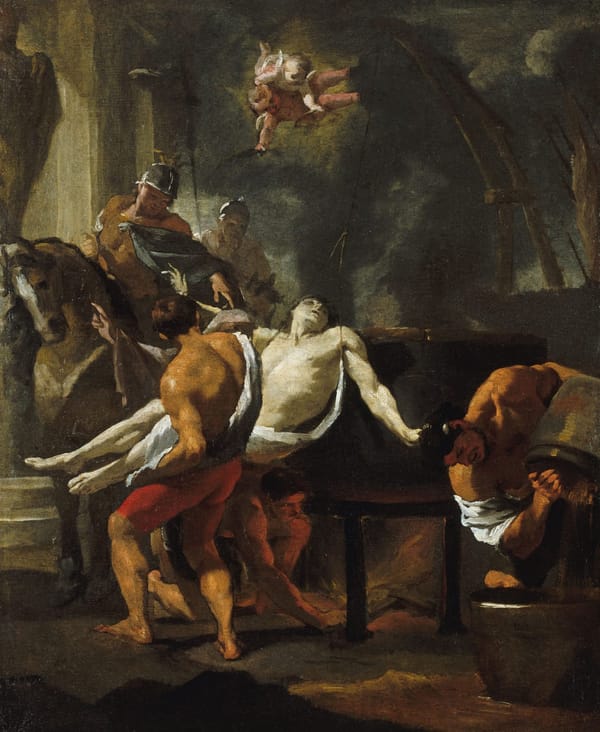
May 6: St. John before the Latin Gate
THE beloved Disciple John, whom we saw standing near the crib of the Babe of Bethlehem, comes before us again to-day; and this time he pays his delighted homage to the glorious Conqueror of death and hell. Like Philip and James, he is clad in the scarlet robe of martyrdom. The month of May, so rich in Saints, was to be graced with the palm of St John.
Salome one day presented her two sons to Jesus, and with a mother’s ambition asked him to grant them the highest places in his kingdom. The Saviour, in his reply, spoke of the chalice which he himself had to drink, and foretold that these two disciples would also drink of it. The elder, James the Great, was the first to give his Master this proof of his love; we shall celebrate his victory when the sun is in Leo: it was to-day that John, the younger brother, offered his life in testimony of Jesus’ divinity.
But the martyrdom of such an Apostle called for a scene worthy the event. Asia Minor, which his zeal had evangelized, was not a sufficiently glorious land for such a combat. Rome, whither Peter had transferred his Chair and where he died on his cross, and where Paul had bowed down his venerable head beneath the sword, Rome alone deserved the honour of seeing the beloved disciple march on to martyrdom, with that dignity and sweetness which are the characteristics of this veteran of the Apostolic College.
Domitian was then Emperor—a tyrant over Rome and the world. Whether it were that John undertook this journey of his own free choice, and from a wish to visit the Mother Church, or that he was led thither bound with chains, in obedience to an imperial edict—John, the august founder of the seven Churches of Asia Minor, appeared before the tribunal of pagan Rome. He was convicted of having propagated, in a vast province of the Empire, the worship of a Jew who had been crucified under Pontius Pilate. He was a superstitious and rebellious old man, and it was time to rid Asia of his presence. He was therefore sentenced to an ignominious and cruel death. He had somehow escaped Nero’s power: but he should not elude the vengeance of Caesar Domitian!
A huge cauldron of boiling oil is prepared in front of the Latin Gate. The sentence orders that the preacher of Christ be plunged into this bath. The hour is come for the second son of Salome to partake of his Master’s chalice. John’s heart leaps with joy at the thought that he—the most dear to Jesus, and yet the only Apostle that has not suffered death for him—is at last permitted to give him this earnest of his love. After cruelly scourging him, the executioners seize the old man, and throw him into the cauldron; but, lo! the boiling liquid has lost all its heat; the Apostle feels no scalding; on the contrary, when they take him out again he feels all the vigour of his youthful years restored to him. The Praetor’s cruelty is foiled, and John, a martyr in desire, is to be left to the Church for some few years longer. An imperial decree banishes him to the niggled Isle of Patmos, where God reveals to him the future of the Church, even to the end of time.
The Church of Rome, which counts among her most glorious memories the abode and martyrdom of St John, has marked with a Basilica the spot where the Apostle bore his noble testimony to the Christian faith. This Basilica stands near the Latin Gate, and gives a title to one of the Cardinals.
In honour of the great Apostle of love, we give the following Sequence, composed by Adam of Saint-Victor:
Sequence
Summum regem gloriæ
Videns mentis acie
Non repulsa,
Angelis parificat,
Spiritu qui indicat
Cœli summa.
Hic est potus recumbentis
Supra pectus Domini;
Hic expugnat vires ignis
Et ferventis olei.
Tormenti sævitia,
Quod martyr quis fiat
Et pœnas non sentiat.
O custos Virginis
Per quam mundo gloria,
Ex quo sunt, in quo sunt,
Per quem sunt omnia,
Per te det suffragia!
Christum, a quo diligeris,
Interpellans et exorans,
Nos ei concilia.
Tu qui collis, due ad montem;
Præsta Sponsum ad videndum,
Virgo totus gratia.
where the King of glory
is seen by the soul's
unfettered gaze,
and equality with the angels, to
John, whose revelations have made known
to men the mysteries of heaven.
that spring up to life eternal,
when he leaned on his Lord's breast.
have made him shine as a bright light in the Church.
He quenched the heat of the boiling oil.
for him are cruel beyond measure;
yet do they wonder within themselves,
how a man can be a martyr and feel no pain.
O guardian of the Virgin
by whom the world received him
who is its glory!
pray for us to Jesus, from whom, and in whom,
and by whom are all things.
by thine intercession and prayers,
render Jesus, by whom thou wast loved,
propitious unto us.
O thou that art a hill, lead us to the mountain!
O thou whom grace made wholly pure,
pray for us that we may see the Beloved.
We are delighted to meet thee again, dear disciple of our Risen Jesus! The first time we saw thee was at Bethlehem, where thou wast standing near the Expected of Nations, the promised Saviour, who was sweetly sleeping in his crib. We then thought of all thy glorious titles: Apostle, Evangelist, Prophet, highsoaring Eagle, Virgin, Doctor of charity, and above all, Jesus' Beloved Disciple. To-day we greet thee as martyr; for if the ardour of thy love quenched the fire prepared for thy torture, thy devotion to Christ had honestly and willingly accepted the chalice of which he spoke to thee in thy younger years. During these days of Paschal Time, which are passing so rapidly, we behold thee ever close to this divine Master, who treats thee with every mark of affection. Who could be surprised at his special love for thee? Wast thou not the only one of all the disciples who stood at the foot of the Cross? Was it not to thee that he gave the care of his Mother, making her thine? Wast thou not present when his Heart was opened on the Cross by a spear? When, on the morning of the great Sunday, thou didst repair with Peter to the Tomb, wast thou not, by thy faith, the first of all the disciples to honour Jesus' Resurrection? Oh, yes! thou hast a right to all the special love wherewith Jesus treats thee; but pray to him for us, O blessed Apostle!
We ought to love him for all the favours he has bestowed upon us; and yet we are tepid in his love—we humbly confess it. Thou hast taught us to know the infant Jesus, thou hast described to us the crucified Jesus; show us now the Risen Jesus, that we may keep close to him during these last few days of his sojourn on earth. And when he has ascended into heaven, procure us brave hearts, that like thee we may be prepared to drink the chalice of trials which he has destined for us.
Rome was the scene of thy glorious confession, O holy Apostle! She is most dear to thee; join, then, with Peter and Paul in protecting her. If the palm of martyrdom be in thy hand as well as the pen of the Evangelist, remember it was at the Latin Gate that thou didst obtain it. It was in the East that thou didst pass the greater part of thy life; but the West claims the honour of counting thee as one of her grandest martyrs. Bless our Churches, reanimate our faith, rekindle our love, and deliver us from the Antichrists against whom thou didst warn the faithful of thine own times, and who are causing such ravages among us. Adopted son of Mary! thou art now enjoying the sight of thy Mother's glory: present to her the prayers we are offering to her during this month, which is consecrated to her, and obtain for us the petitions which we presume to make to her.
Friday of the Third Week after Easter
CHURCH of Jesus! that wast promised by him to the earth during the days of his mortal life; that camest forth from his sacred Side when wounded by the spear upon the Cross; that wast organized and perfected by him during the last days of his sojourn here below; we lovingly greet thee as our mother; thou art the Spouse of our Redeemer, and it is through thee that we were born to him. It is thou that gavest us life by baptism; it is thou that givest us the word, which enlightens us; it is thou that ministerest to us the helps, whereby we are led, through our earthly pilgrimage, to heaven; it is thou that governest us, in the spiritual order, by thy holy ordinances.
Under thy maternal care we are safe; we have nothing to fear. What can error do against us? Thou art the pillar and ground of the truth!1 What effect can the revolutions of our earthly habitation have upon us? We know, that if everything else should fail us, thou wilt ever be with us. It was during these very days which precede the Ascension, that our Lord Jesus said to his Apostles, and through them, to their successors: Behold! I am with you all days, even to the consummation of the world.2 What a promise of duration was this! If we consult the history of these last eighteen hundred years, it will tell us that this promise has never once been broken. The gates of hell have risen up against thee innumerable times; but they have never prevailed against thee, no, not for one single moment!
And thus it is, O Church! that being founded on Christ thy Spouse, thou givest us a share in thine own divine immutability! Established as we are in thee, there is not a truth which the eye of our faith cannot see; there is not a blessing which, despite our weakness, we may not make our own; there is no object shown us by hope, which we may not attain. Thou holdest us in thine arms; and from the height whereto thou raisest us, we see the mysteries of time and the secrets of eternity. Our eye admiringly follows thee, whether we consider thee as militant on earth, suffering in thy dear ones who are in the temporary state of expiation, or triumphant in heaven. Thou art with us in our exile, and already art thou, in millions of thy children, heiress of the eternal kingdom. Keep us near thee, nay, within thee, O thou our Mother, who art the beloved Spouse of our Lord. To whom shall we go but to thee? Is it not to thee, and to thee alone, that he has entrusted the words of eternal life?
How much they are to be pitied, O Church! who do not know thee! And yet, if they are seeking God with all their heart, they will, one day, know thee. How much they are to be pitied who once knew thee, and afterwards, in their pride and ingratitude, denied thee! And yet no one ever fell into such misery, unless he first voluntarily shut his eyes against the light that was within him. How much they are to be pitied who know thee, and still live enjoying what thou givest thy children, and who yet take side with thine enemies in insulting and betraying thee! They are men whose character is shallowness of mind; they speak their opinions as though they were oracles; they have contracted the flippant effrontery of our age: and to hear them speak of thee, one would suppose that they look on thee as a human institution, which they may approve or blame according to their humour.
Instead of revering whatsoever thou hast taught regarding thyself and thy rights; instead of revering what thou hast ordained, regulated, and practised; these Catholics, whose sympathies are all with thine enemies, would have thee conform thy teachings and conduct with the so-called Progress of the times. The whole world is given to thee as thine inheritance; and yet these insolent children would have thee be content with what they think proper to assign to thee. Thou, the Mother of mankind, must be under their wise care! It is from them thou must, henceforth, learn how best to fulfil thy mission! Godless men, adorers of what they called the rights of man, dared, a century back, to expel thee from political life, which up till then thou hadst kept in harmony with its divine Master. These men have left disciples, who would have thee withdraw from everything that regards the outward world, and look on as a mere stranger. Thou must no longer exercise the rights given thee by the Son of God over both soul and body; this royalty of thine is out of date, and thou must be satisfied to enjoy the liberty which, in virtue of the law of Progress, is granted alike to error and to truth. The wise and powerful ones of this world have dethroned the Vicar of thy Spouse after a thousand years' reign; and instead of resenting such a project with holy indignation, as tending to the destruction of the last bulwark of Christendom—there are many among us who approve of it, and this on principles which are, it is true, in favour with rationalistic politicians, but which are formally condemned by thy teachings, thy acts, nay, by thy very existence. How short-sighted are such Catholics as these, who hope to make thee acceptable to the world by giving thee the semblance of a human institution! The world is too shrewd: it knows thee to be essentially supernatural, and this is what it never can tolerate.
Wiser and more Christian by far are they who, detesting such profane theories, have, like devoted Machabees, drawn the sword against thine enemies, O Church of Christ! and even in an age like this, when faith has grown weak, have so well understood their Christian duty as to die in thy defence, and, by so dying, to win the crown of martyrdom. Yes, it is our duty to confess thee: to disguise thee is to belie thee. Thou art one of the articles of our Creed: 'I believe the holy Catholic Church.' Thou hast been known these nineteen hundred years; and shall men now pretend that thou must conform to the world’s capricious views? This cannot be. Jesus made thee be like himself—a sign of contradiction:3 and as such we must receive thee. We must listen to thy protestations against false principles and practices, and not attempt to remodel thee. Only God has power to give his Church a form other than that he has already given her.
Blessed are they who share thy lot, dear Church of our Redeemer! In these unchristian times thou art unpopular. Thou wast so in ages long gone by, when men could not become thy children save at the risk of being despised. It is the same now, and we are resolved to espouse thy cause. We confess thee to be our mother, inaccessible to the changes of this world. Whether honoured or persecuted, thou continuest thy mission here below. Thus will it be until the time comes when this earth, which was created to be thy kingdom, shall see thee ascend to heaven, and flee from a world which will deserve the severest chastisements of God’s anger, because of its having despised and rejected thee.
In honour of the divine Spouse of our Mother, let us sing this paschal canticle, taken from the ancient Missals of Flanders.
Sequence
Alleluia, votis, voce solemnia
Celebrando paschalia.
Congaudeat turma,
Sacro fonte nivea,
Spernens Phlegethontis undas.
Aptemus fibras
Arte musica;
Voce sonora
Modificantes
Prorsus neumata
Voce satis tinnula.
Factus nostra ob remedia,
Crucis tulit robora;
Maneret, subiit lethalia.
Passus praelibare pocula.
Transfixus clavis et lancea.
Descendit ad ima Tartara.
Revehit potens ampla ovando trophæa.
Ac resumpta carne,
Resurgit victor
Die hodierna.
Ipsi canamus odas.
Redit æterna,
Et cœli clara
Nobis patescit aula.
Alleluia! and by its prayers and hymns,
celebrate the Paschal solemnity.
share in the common joy;
it comes, white as snow, from the sacred font,
having been rescued from the waters of the stream of hell.
string our harps
to tune;
And sing,
whilst going through
the many-varied modes,
with voices sweet and ringing.
has become the Victim of our salvation,
and has carried the wood of his Cross.
that we might have eternal life.
the bitter cup of gall.
with the nails and spear.
he descended into the depths below.
and brought back, in power and triumph, the richest trophies.
his Soul was reunited to his Body;
and this is the day
of his glorious Resurrection.
to him our lays of joy.
and heaven’s bright gate
thrown open to us
by him.
| Previous Thursday of the Third Week after Easter | Next Friday of the Third Week after Easter |