Daily reading
Paschal Time
Double of the I Class · Movable from Easter · Temporal
May 8, 2022
From Dom Guéranger’s The Liturgical Year.
A Double of the I Class leads; the Apparition of St. Michael the Archangel is commemorated.Rubric

|
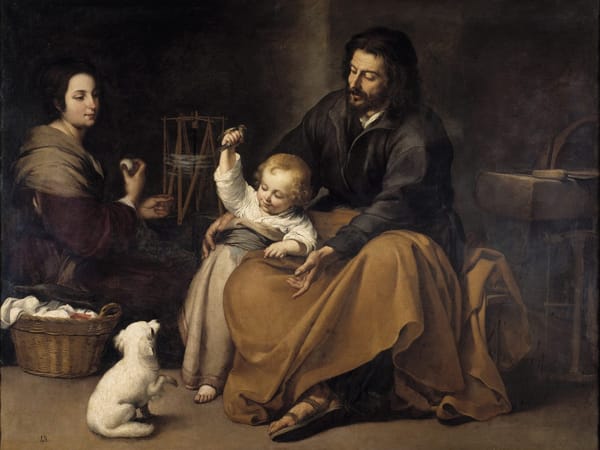
The Solemnity of Saint Joseph, Spouse of the B. V. Mary, Patron of the Universal Church
THE Easter mysteries are superseded to-day by a special subject, which is offered for our consideration. The holy Church invites us to spend this day in honouring the Spouse of Mary, the Foster-Father of the Son of God. And yet, as we offered him the yearly tribute of our devotion on March 19, it is not, properly speaking, his feast that we are to celebrate to-day. It is a solemn expression of gratitude offered to Joseph, the Protector of the Faithful, the refuge and support of all that invoke him with confidence. The innumerable favours he has bestowed upon the world entitle him to this additional homage. With a view to her children's interests, the Church would, on this day, excite their confidence in this powerful and everready helper.
Devotion to St Joseph was reserved for these latter times. Though based on the Gospel, it was not to be developed in the early ages of the Church. It is not that the faithful were in any way checked from showing honour to him who had been called to take so important a part in the mystery of the Incarnation; but divine Providence had its hidden reasons for retarding the liturgical homage to be paid, each year, to the Spouse of Mary. As on other occasions, so here also; the East preceded the West in the special cultus of St Joseph: but in the fifteenth century the whole Latin Church adopted it, and since that time it has gradually gained the affections of the faithful. We have treated of the glories of St Joseph on March 19; the present feast has its own special object, which we will at once proceed to explain.
The goodness of God and our Redeemer's fidelity to his promises have ever kept pace with the necessities of the world; so that in every age appropriate and special aid has been given to the world for its maintaining the supernatural life. An uninterrupted succession of seasonable grace has been the result of this merciful dispensation, and each generation has had given to it a special motive for confidence in its Redeemer. Dating from the thirteenth century, when, as the Church herself assures us, the world began to grow cold,1 each epoch has had thrown open to it a new source of graces. First of all came the feast of the most Blessed Sacrament, with its successive developments of Processions, Expositions, Benedictions and the Forty Hours. After this followed the devotion to the Holy Name of Jesus (of which St Bernardine of Siena was the chief propagator) and that of Via Crucis or Stations of the Cross. with its wonderful fruit of compunction. The practice of frequent Communion was revived in the sixteenth century, owing principally to the influence of St Ignatius and the Society founded by him. In the seventeenth was promulgated the devotion to the Sacred Heart of Jesus, which was firmly established in the following century. In the nineteenth, devotion to the Holy Mother of God made such progress as to form one of the leading supernatural characteristics of the period. The Rosary and Scapular, which had been handed down to us in previous ages, regained their place in the affections of the people; pilgrimages to the sanctuaries of the Mother of God, which had been interrupted by the influence of Jansenism and rationalism, were renewed; the Archconfraternity of the Sacred Heart of Mary spread throughout the whole world; numerous miracles were wrought in reward for the fervent faith of individuals; in a word, the nineteenth century witnessed the triumph of the Immaculate Conception—a triumph which had been looked forward to for many previous ages.
Now devotion to Mary could never go on increasing as it has done, without bringing with it a fervent devotion to St Joseph. We cannot separate Mary and Joseph, were it only for their having such close connection with the mystery of the Incarnation—Mary, as being the Mother of the Son of God; and Joseph, as being guardian of the Virgin’s spotless honour, and Foster-Father of the divine Babe. A special veneration for St Joseph was the result of increased devotion to Mary. Nor is this reverence for Mary's Spouse to be considered only as a just homage paid to his admirable prerogatives: it is, moreover, a fresh and exhaustless source of help to the world, for Joseph has been made our protector by the Son of God himself. Hearken to the inspired words of the Church’s Liturgy: ‘Thou, O Joseph! art the delight of the blessed, the sure hope of our life, and the pillar of the world.’2 Extraordinary as is this power, need we be surprised at its being given to a man like Joseph, whose connections with the Son of God on earth were so far above those of all other men? Jesus deigned to be subject to Joseph here below; now that he is in heaven, he would glorify the creature to whom he consigned the guardianship of his own childhood and the honour of his Mother. He has given him a power which is above our calculations. Hence it is, that the Church invites us on this day to have recourse, with unreserved confidence, to this all-powerful protector. The world we live in is filled with miseries which would make stronger hearts than ours quake with fear; but let us invoke St Joseph with faith, and we shall be protected. In all our necessities, whether of soul or body—in all the trials and anxieties we may have to go through—let us have recourse to St Joseph, and we shall not be disappointed. The king of Egypt said to his people when they were suffering from famine: Go to Joseph!3 the King of Heaven says the same to us: the faithful guardian of Mary has greater influence with God than Jacob's son had with Pharaoh.
As usual, God revealed this new spiritual aid to a privileged soul, that she might be the instrument of its propagation. It was thus that were instituted several feasts, such as those of Corpus Christi, and of the Sacred Heart of Jesus. In the sixteenth century St Teresa (whose writings were to have a world-wide circulation) was instructed by heaven as to the efficacy of devotion to St Joseph: she has spoken of it in the Life (written by herself) of Teresa of Jesus. When we remember that it was by the Carmelite Order (brought into the Western Church in the thirteenth century) that this devotion was established among us, we cannot be surprised that God should have chosen St Teresa, who was the reformer of that Order, to propagate the same devotion in this part of the world. The holy solitaries of Mount Carmel—devoted as they had been, for so many centuries, to the love of Mary—were not slow in feeling the connection that exists between the honour paid to the Mother of God and that which is due to her virginal Spouse. The more we understand St Joseph’s office, the clearer will be our knowledge of the divine mystery of the Incarnation. As when the Son of God assumed our human nature, he would have a Mother; so also would he give to his Mother a protector. Jesus, Mary and Joseph—these are the three whom the ineffable mystery is continually bringing before our minds.
The words of St Teresa are as follows: 'I took for my patron and lord the glorious St Joseph, and recommended myself earnestly to him. I saw clearly . . . that he rendered me greater services than I knew how to ask for. I cannot call to mind that I have ever asked him at any time for anything which he has not granted: and I am filled with amazement, when I consider the great favours which God hath given me through this blessed Saint, the dangers from which he hath delivered me, both of body and soul. To other Saints, our Lord seems to have given grace to succour men in some special necessity; but to this glorious Saint, I know by experience, to help us in all: and our Lord would have us understand that, as he was himself subject to him upon earth—for St Joseph having the title of father, and being his guardian, could command him—so now in heaven he performs all his petitions. I have asked others to recommend themselves to St Joseph, and they too know this by experience; and there are many who are now of late devout to him, having had experience of this truth.'4
We might quote several other equally clear and fervent words from the writings of this seraphic virgin. The faithful could not remain indifferent to such teaching as this. The seed thus sown produced its fruit; slowly, it is true, but surely. Even in the first half of the seventeenth century, there prevailed amidst the devout clients of St Joseph a presentiment that the day would come when the Church, through her Liturgy, would urge the faithful to have recourse to him as their powerful Protector. In a book published in the year 1645, we find these almost prophetic words: ‘O thou bright sun, thou father of our days! speed thy onward course, and give us that happy day, whereon are to be fulfilled the prophecies of the saints. They have said, that in the latter ages of the world, the glories of St Joseph will be brought to light; that God will draw aside the veil, which has hitherto prevented us from seeing the wondrous sanctuary of Joseph's soul; that the Holy Ghost will inspire the faithful to proclaim the praises of this admirable Saint, and to build monasteries, churches and altars in his honour; that, throughout the entire kingdom of the Church militant, he shall be considered as the special protector, for he was the protector of the very Founder of that kingdom, namely, our Lord Jesus Christ; that the Sovereign Pontiffs will, by a secret impulse from heaven, ordain that the feast of this great Patriarch be solemnly celebrated through the length and breadth of the spiritual domain of St Peter; that the most learned men of the world will use their talents in studying the divine gifts hidden in St Joseph, and that they will find in him treasures of grace incomparably more precious and plentiful than were possessed by even the choicest of the elect of the Old Testament, during the whole four thousand years of its duration.'5
These ardent wishes have been fulfilled. It is now more than a century ago that the Carmelites sought and obtained the approbation of the Holy See for an Office in honour of the Patronage of St Joseph. A great number of dioceses obtained permission to use it. A Sunday was selected for the celebration of this new feast, in order that the faithful might be, in a way, compelled to keep it; for the Feast of St Joseph in March is not a day of obligation in all lands, and, as it always falls during Lent, it cannot be kept on a Sunday, since the Sundays of Lent exclude a feast of that rite. That the new feast might not be attended with the same risk of being unnoticed, it was put upon a Sunday —the third Sunday after Easter, that thus the consolations of such a solemnity might be blended with the Paschal joys. The new feast went on gradually spreading from one diocese to another; till at last, there was unexpectedly issued an Apostolic Decree, dated September 10, 1847, which ordered it to be kept throughout Christendom. The Church was on the eve of severe trials; and her glorious Pontiff, Pius IX, by a sacred instinct, was prompted to draw down on the flock entrusted to him the powerful protection of St Joseph, who assuredly has never had greater miseries and dangers to avert from the world, than those which threaten the present age.
Let us, then, henceforth have confidence in the patronage of St Joseph. He is the father of the faithful, and it is God's will that he, more than any other saint, should have power to apply to us the blessings of the mystery of the Incarnation—the great mystery whereof he, after Mary, was the chief earthly minister.
In the Greek Liturgy this third Sunday after Easter is called the Sunday of the Paralytic, because a special commemoration is made of the miracle wrought by our Saviour at the Probatica.
The Roman Church begins to-day, in her Office of Matins, the Book of St John's Apocalypse.
Mass
On this feast, dedicated to St Joseph as Protector of the Faithful, the Church, in the Introit of the Mass, speaks to us of the confidence we should have in the protection of God; she uses the words of the royal Prophet, and would have us make them our own. Now Si Joseph is the minister of this divine protection, and God promises it to us, if we address ourselves to this his incomparable servant.
Introit
Ps. Qui regis Israel, intende: qui deducis velut ovem Joseph, ℣. Gloria Patri.
Adjutor.
Ps. Give ear, O thou that rulest Israel: thou that leadest Joseph like a sheep. ℣. Glory, etc.
The Lord, etc.
In the Collect, the Church lays stress upon God's choosing St Joseph as Mary's Spouse, and teaches us that one of the consequences of this choice was our having a protector who will be ready to assist us by his all-powerful intercession, as often as we pray to him.
Collect
If this feast be kept on the Sunday, a commemoration of the third Sunday after Easter is then made, by this Collect:
Epistle
Cap. xlix.Filius accrescens Joseph, filius accrescens et decorus aspectu: filiae discurrerunt super murum. Sed exasperaverunt eum, et jurgati sunt, invideruntque illi habentes jacula. Sedit in forti arcus ejus, et dissoluta sunt vincula brachiorum et manuum illius per manus potentis Jacob: inde pastor egressus est lapis Israel. Deus patris tui erit adjutor tuus, et omnipotens benedicet tibi benedictionibus cœli desuper. Benedictionibus abyssi jacentis deorsum, benedictionibus uberum et vulvae. Benedictiones patris tui confortatae sunt benedictionibus patrum ejus: donec veniret desiderium collium aeternorum: fiant in capite Joseph, et in vertice Nazaræi inter fratres suos.
Ch. xlix.Joseph is a growing son, a growing son and comely to behold: the daughters run to and fro upon the wall. But they that held darts, provoked him, and quarrelled with him, and envied him. His bow rested upon the strong, and the bands of his arms and his hands were loosed, by the hands of the mighty one of Jacob: thence he came forth a Shepherd, the stone of Israel. The God of thy father shall be thy helper, and the Almighty shall bless thee with the blessings of heaven above, with the blessings of the deep that lieth beneath, with the blessings of the breasts and of the womb. The blessings of thy father are strengthened with the blessings of his fathers: until the Desire of the everlasting hills shall come: may they be upon the head of Joseph, and upon the crown of the Nazarite among his brethren.
This magnificent prophecy of the dying Jacob, wherein he makes known to his son Joseph the glorious destiny which awaits himself and his children, is most appropriate to this feast; it reminds us of the beautiful comparison drawn by St Bernard between the two Josephs. We refer our readers to March 19, where they will find the passage to which we allude, and in which we are told that the first Joseph was a type of the second. After prophesying what was to happen to his ten eldest sons, the Patriarch Jacob speaks, with marked partiality, concerning the son of Rachel. After speaking of his comeliness, he alludes to the persecution he received from his brothers, and to the wondrous ways whereby God delivered him out of their hands, and exalted him to glory and power. The words he uses may well be applied to the second Joseph, the Spouse of Mary, and the Protector of the Faithful; for who better deserves the title of Shepherd and Stone (i.e., strength) of Israel? We are all of us his family: he affectionately watches over us: and in our troubles we may rely upon him with all confidence, as our staunch unfailing defender. St Joseph's inheritance is the Church, sanctified and made fruitful by the ceaseless blessing of the Waters of Baptism; it is in the Church that he exercises his beneficent power upon all who confide in him. Jacob promised the most lavish blessings upon the first Joseph; and these blessings were to last till the Saviour, thedesire of the everlasting hills should come, when the second Joseph would begin his ministry—a ministry of help and protection, which would continue till the second coming of the Son of God. Finally, if the first Joseph be spoken of, in this prophecy, as a Nazarite (that is, one consecrated to God) and as a Saint among his Brethren, the second Joseph is to fulfil the prediction still more literally; for not only will his sanctity surpass that of Jacob’s son, but his very home will be Nazareth. In that city he will dwell with Mary; to that city he will return after the exile in Egypt; in that city he will terminate his holy career; in a word, Jesus, the Eternal Word, shall be called a Nazarite,6 because he is to live in that city with his Foster-Father.
In the first Alleluia-Versicle, we have St Joseph speaking to us; he encourages us to have recourse to him, and promises us untiring protection. In the second the Church prays for her children, that they may have the grace to imitate the purity of Mary’s Spouse: her prayer is addressed to him.
Alleluia. ℣. Fac nos innocuam, Joseph, decurrere vitam, sitque tuo semper tuta patrocinio. Alleluia.
Alleluia. ℣. Obtain for us, O Joseph, to lead an innocent life; and may it ever be safe through thy Patronage. Alleluia.
Gospel
Cap. iii.In illo tempore: Factum est autem cum baptizaretur omnis populus, et Jesu baptizato et orante, apertum est cœlum: et descendit Spiritus Sanctus corporali specie sicut columba in ipsum: et vox de coelo facta est: Tu es Filius meus dilectus, in te complacui mihi. Et ipse Jesus erat incipiens quasi annorum triginta, ut putabatur, filius Joseph.
Ch. iii.At that time: It came to pass, when all the people were baptized, that Jesus also being baptized, and praying, heaven was opened: and the Holy Ghost descended in a bodily shape, as a dove, upon him: and a voice came from heaven: Thou art my beloved Son; in thee I am well pleased. And Jesus himself was beginning about the age of thirty years: being, as it was supposed, the son of Joseph.
Being, as it was supposed, the Son of Joseph! Jesus’ filial affection for his Mother, his jealousy for the honour of the purest of Virgins, led him to treat Joseph as his father, and to allow himself to be called the Son of Joseph! Joseph heard the Son of God call him ‘father.’ He had charge of, he laboured for the maintenance of the Son of the Eternal Father. He was the head of the Holy Family at Nazareth, and Jesus recognized his authority. The plan of the Mystery of the Incarnation required that these relations should exist between the Creator and the Creature. As the Son of God, now that he is seated at the right hand of the Eternal Father, has kept our human nature indissolubly united with his divine Person; so likewise has he retained the feelings he had, when here on earth, for Mary and Joseph. With regard to Mary, his love for her, as his Mother, has but increased; and as to Joseph, it is impossible to suppose that the affection and respect he had for him have now ceased to exist in the Heart of the Man-God. No mortal was ever on such terms of intimacy and familiarity with Jesus as Joseph was. Jesus was grateful to Joseph for the paternal care he received from him; what more natural than to believe that Jesus now repays him with special honours and power in heaven? It is the belief of the Church; it is the conviction of the faithful; it is the motive which suggested the present feast.
The words of the Offertory are taken from Psalm 147. Jerusalem, that is, the Church, is bidden to rejoice, because of the means of defence which God has given her against her enemies. One of the greatest of the blessings thus conferred upon her is St Joseph's Protection.
Offertory
In the Secret, the Church prays that we may imitate the Carpenter of Nazareth in his detachment from earthly things.
Secret
Then a commemoration of the Third Sunday after Easter is made, if required, by the following Secret:
Secret
The proper Preface that follows has recently been granted by the Holy See for use in all Masses of St Joseph:
Preface
The Communion-Anthem is a sentence taken from St Matthew’s Gospel, wherein we find the glorious title of our holy Protector: Joseph, the husband of Mary; and the still more glorious one of Mary: Of whom was bom Jesus.
Communion
Holy Church prays, in the Post communion, that St Joseph, who is our Protector during this present life, may intercede for us in what concerns our eternal welfare.
Postcommunion
The priest then adds, if need be, this commemoration of the Third Sunday after Easter:
Postcommunion
The following Gospel of the Third Sunday after Easter is read at the end of Mass.
Cap. xvi.In illo tempore: Dixit Jesus discipulis suis: Modicum, et jam non videbitis me, et iterum modicum, et videbitis me: quia vado ad Patrem. Dixerunt ergo ex discipulis ejus ad invicem: Quid est hoc, quod dicit nobis: Modicum, et non videbitis me, et iterum modicum, et videbitis me, et quia vado ad Patrem? Dicebant ergo: Quid est hoc, quod dicit, Modicum? nescimus quid loquitur. Cognovit autem Jesus, quia volebant eum interrogare, et dixit eis: De hoc quæritis inter vos, quia dixi, Modicum, et non videbitis me: et iterum modicum, et videbitis me? Amen, amen dico vobis: quia plorabitis, et flebitis vos, mundus autem gaudebit: vos vero contristabimini, sed tristitia vestra vertetur in gaudium. Mulier cum parit, tristitiam habet, quia venit hora ejus: cum autem pepererit puerum, jam non meminit pressurae propter gaudium: quia natus est homo in mundum. Et vos igitur nunc quidem tristitiam habetis; iterum autem videbo vos, et gaudebit cor vestrum: et gaudium vestrum nemo tollet a vobis.
Ch. xvi.At that time: Jesus said to his disciples: A little while, and now you shall not see me: and again a little while, and you shall see me; because I go to the Father. Then some of his disciples said one to another: What is this he saith to us: A little while, and you shall not see me: and again a little while, and you shall see me, and because I go to the Father? They said therefore: What is this that he saith: A little while? we know not what he speaketh. And Jesus knew that they had a mind to ask him; and he said to them: Of this do you inquire among yourselves, because I said: a little while, and you shall not see me; and again, a little while, and you shall see me? Amen, amen, I say to you, that you shall lament and weep, but the world shall rejoice: and you shall be made sorrowful, but your sorrow shall be turned into joy. A woman when she is in labour, hath sorrow, because her hour is come: but when she hath brought forth the child, she remembereth no more the anguish, for joy that a man is bom into the world. So also you now indeed have sorrow but I will see you again, and your heart shall rejoice; and your joy no man shall take from you.
Vespers
Psalm, Dixit Dominus, page 82
Psalm, Confitebor, page 83
Psalm, Beatus vir, page 84
Psalm, Laudate pueri, page 85
Psalm 116
Quoniam confirmata est super nos misericordia ejus: * et veritas Domini manet in æternum.
For his mercy is confirmed upon us: and the truth of the Lord remaineth for ever.
Capitulum (Gen. xlix)
Hymn7
Te cuncti resonent christiadum chori,
Qui clarus meritis junctus es inclytæ
Casto fœdere Virgini.
Admirans, dubio tangeris anxius,
Afflatu superi Flaminis Angelus
Conceptum puerum docet.
Ægypti profugum tu sequeris plagas:
Amissum Solymis quæris, et invenis,
Miscens gaudia fletibus.
Palmamque emeritos gloria suscipit;
Tu vivens, Superis par, frueris Deo,
Mira sorte beatior.
Da Joseph meritis sidera scandere:
Ut tandem liceat nos tibi perpetim
Gratum promere canticum.
May the choirs of Christendom resound with thy name,
for great are thy merits,
who wast united by a chaste alliance to the holy Virgin.
a cruel doubt afflicts thy heart;
but an Angel visits thee, telling thee that she had conceived
of the Holy Ghost the Child she bore in her womb.
and go with the little fugitive to Egypt’s distant land.
When he was lost in Jerusalem, thou didst seek after him;
and having found him, thy tears were mingled with joy.
has crowned their life; they receive their glory when they have won the palm:
but thou, by a strangely happy lot, hadst, even during life, what the blessed have
in heaven —thou hadst the sweet society of thy God.
and may the intercession of Joseph aid us to reach heaven;
that there we may sing to thee
our eternal hymn of grateful love.
Antiphon of the Magnificat
A commemoration is then made of the Third Sunday after Easter, if necessary, by the following Antiphon, Versicle, and Prayer:
Many ages passed away, and thy glories had not been made known to the world; but even then, thou wast one of mankind's most powerful intercessors. Most affectionately didst thou fulfil thy office as head of the great human family, whereof the Incarnate Word was a member. Nations and individuals experienced the benefit of thy prayers; but there was not the public acknowledgement of thy favours—there was not the homage of gratitude, which is now offered to thee. The more perfect knowledge of thy glories, and the honour paid to thee as the Protector of mankind—these were reserved for our own unhappy times, when the state of the world is such as to require help beyond that which was granted to former ages. We come before thee, O Joseph! to honour the unlimited power of thine intercession, and the love thou bearest for all the children of the Church, the Brethren of Jesus.
Thou, O Mary! art pleased at seeing us honour him, whom thou didst so tenderly love. Never are our prayers so welcome to thee as when they are presented to thee by his hands. The union formed by heaven between thyself and Joseph will last for all eternity; and the unbounded love thou hast for Jesus is an additional motive for thee to love him who was the FosterFather of thy Child, and the guardian of thy Virginity. O Joseph! we also are the children of Mary, thy Spouse; treat us as such, bless us, watch over us, and receive the prayers which, now more than ever, the Church encourages us to present to thee.
Thou art ‘the pillar of the world'—columen mundi; thou art one of the foundations whereon it rests; because of thy merits and prayers, our Lord has patience with it, in spite of the iniquities which defile it. How truly may we say of these our times: There is now no saint; truths are decayed from among the children of men!8 How powerful then must not thine intercession be, to avert the indignation of God, and induce him to show us his mercy! Grow not weary of thy labour, O thou universal Protector! The Church of thy Jesus comes before thee on this day, beseeching thee to persevere in thy task of love. See this world of ours, now it is become one great volcano of danger by the boasted liberty granted to sin and heresy! Delay not thine aid, but quickly procure for us what will give us security and peace.
Whatever may be our necessities, thou art willing and able to assist us. We may be the poorest and last among the children of the Church; it matters not: thou lovest us with all the affectionate compassion of a Father. What a joy is not this to our hearts, O Joseph! We will therefore turn to thee in our spiritual wants. We will beg thee to assist us in gaining the virtues whereof we stand in need, in the battles we have to fight against the enemies of our souls, and in the sacrifices which duty asks at our hands. Make us worthy to be called thy children, O thou Father of the Faithful! Nor is thy power limited to what regards our eternal welfare; daily experience shows us how readily thou canst procure for us the blessing of God upon our temporal interests, provided they are in accordance with his divine will. Hence it is that we hope for thy protection and aid in what concerns our worldly prospects. The house of Nazareth was confided to thy care; deign to give counsel and help to all them that make thee the patron of all that regards their earthly well-being.
Glorious Guardian of the Holy Family! the family of Christendom is placed under thy special patronage; watch over it in these troubled times. Hear the prayers of them that seek thine aid, when about to choose the partner who is to share with them the joys and the sorrows of this world, and help them to prepare for their passage to eternity. Maintain between husbands and wives that mutual respect which is the safeguard of their fidelity to each other. Obtain for them the pledge of heaven’s blessings. Fill them with such reverence for the holy state to which they have been called, that they may never deserve the reproach given by St Paul to certain married people of that day, whom he compares to heathens, who know not God.9
Grant us, also, O Joseph, another favour. There is one moment of our lives which is the most important of all, since eternity depends upon it: it is the moment of our death. And yet we feel our fear abated by the thought that God’s mercy has made thee the special patron of the dying. Thou hast been entrusted with the office of making death happy and holy to those who invoke thee. To whom could such a prerogative have been given more appropriately than to thee, O Joseph! whose admirable death was one of the sublimest spectacles ever witnessed by angels or by men, for Jesus and Mary were by thy side as thou didst breathe forth thy soul. Be, then, our helper at that awful hour of our death. We hope to have Mary’s protection, for we daily pray to her that she would aid us at the hour of our death; but we know that Mary is pleased at our having confidence in thee, and that where thou art, she also is sure to be. Encouraged by thy fatherly love, O Joseph! we will calmly await the coming of our last hour; for if we are careful in recommending it to thee, thou wilt not fail to take it under thy protection.
The gladness of to-day’s feast has been united with the Paschal joy: still, it is but just that the latter should have its own expression apart. We will therefore end the day by offering to our Risen Lord the following Preface: it is taken from the ancient Gothic Missal, published by Dom Mabillon.
Contestatio
(Indie Sabbato, octava Paschœ)
- Frigescente mundo. Collect for the Feast of the Stigmata of St Francis. ↩︎
- Cœlitum, Joseph, decus atque nostræ Certa spes vitæ, columenque mundi. (Hymn for Lauds of the Feast of the Solemnity of St Joseph.) ↩︎
- Gen. xli 55. ↩︎
- The Life of St Teresa (translated by David Lewis, 1870), p. 34. ↩︎
- La gioire de Saint-Joseph, par le P. Jean Jacquinot, de la Compagnie de Jesus. Dijon, 1645. ↩︎
- St Matt ii 23. ↩︎
- In the Monastic Rite, it is preceded by this Responsory: ℟. breve. Constituit eum dominum domus suae, * Alleluia, alleluia. Constituit ℣. Et principem omnis possessionis suæ. * Alleluia. Gloria Patri. Constituit. ↩︎
- Ps. xi 2. ↩︎
- 1 Thess. iv 5. ↩︎
May 8: The Apparition of St. Michael the Archangel
|
DAVID foretold that Emmanuel's entrance into this world would be greeted by the angels and that they would humbly adore him on his first appearance among us.1 We saw this prophecy fulfilled on the ever blessed night when Mary brought forth the Fruit of her womb. The angelic choir sang one of their heavenly hymns, which led the shepherds to the stable; we blended our songs with theirs in homage to our infant God. The Resurrection of our Emmanuel was sure to be honoured by the presence of these blessed spirits, who had witnessed with amazement and trembling the humiliations and cruelties of his Passion. The moment he passed through the barrier that imprisoned him in his sepulchre, an angel, with a face bright as the sun, and garments white as snow, came and rolled back the stone, and proclaimed to the holy women that he whom they were seeking had risen. When they entered the cave of the sepulchre, two other angels, clad in white robes, appeared to them, and repeated the tidings of Jesus' triumph.
Let us reverently honour these princely heralds of our deliverance, and consider with what respect they cluster round Jesus their King and God during the forty days after his Resurrection. They adore this glorified humanity, which they are soon to see raised up to the highest heavens and enthroned at the Father's right hand. They rejoice with us in the happiness given by this Paschal feast, which restores immortality to us in the person of our Risen Saviour; and thus, as St Gregory told us a few days back, ‘it is the feast of the angels, because, by recalling us to heaven, it fills up their number,’2 It was but right, therefore, that one day in Paschal Time should be devoted to honouring the angelic spirits. On the day previous to the Annunciation we kept the Feast of St Gabriel, our Lady's honoured messenger; to-day it is St Michael, the Archangel and prince of the heavenly host, who is to receive our love and praise. He himself selected this day, by appearing on it and leaving us a pledge of his presence and protection.
The very name of Michael urges us to honour this glorious spirit; it is a cry of enthusiasm and fidelity, for it signifies: ‘Who is like unto God?’ Satan trembles at hearing this name, for it reminds him of the noble protest wherewith the bright Archangel answered the call of the rebel angels. Michael proved his strength and prowess when he fought the great battle in heaven. On that account, he was made the guardian and protector of God's people; first of the Jews, and afterwards of the Christian Church, for the Synagogue has forfeited all her honours. Michael now watches over Jesus' Spouse, our mother; he supports her in her trials and she wins no triumph in which he has not had some part.
But we are not to suppose that the holy Archangel is so engaged in attending to the general interests of Christ's kingdom on earth that he cannot listen to the prayers of each individual member of the Church. God has given him a compassionate love for men; and there is not a single soul that escapes his notice. He wields the sword in defence of the Spouse of Christ; he wars with the dragon, who is ever lying in wait for the Woman and her Child;3 but, at the same time, he is attentive to each one of us; for fter having confessed our sins to Almighty God, and to the Blessed Mary ever a Virgin, we acknowledge them likewise to Blessed Michael the Archangel and beseech him to pray for us to the Lord our God.
He assists at every death-bed, for his special office is to receive the souls of the elect on their quitting the flesh. With loving solicitude and princely bearing, he presents them to the Light Eternal and introduces them into the House of God’s glory. It is Holy Church herself that tells us, in the words of her Liturgy, of these prerogatives of the great Archangel. She teaches us that he has been set over Paradise, and that God has given him the charge of leading to heaven the souls of them that are to be received there. On the last day, when our Risen Jesus is to appear on the clouds of heaven to judge mankind, all of whom will then have resumed their bodies in the general resurrection, Michael with the rest of the angels will have to fulfil a ministry of awful import—that of separating the good from the bad. Our Catholic forefathers, in the Middle Ages, were fond of representing the holy Archangel engaged in this dread function, standing at the foot of Jesus’ judgement-seat, and holding a scale, in which he is weighing the souls of men and their works.
Devotion to St Michael was sure to spread through the Church, especially after the worship of idols had been banished from the various countries, and men were no longer tempted to give divine honour to creatures. Constantine built a celebrated Church called Michaelion in honour of the great Archangel, and at the time when Constantinople fell under the power of the Turks, there were no fewer than fifteen churches bearing the name of Saint Michael, either in the city or the suburbs. In other parts of Christendom this devotion took root only by degrees; and it was through apparitions of the holy Archangel that the faithful were prompted to have recourse to him. These apparitions were local and for reasons which to us might seem of secondary importance: but God, who from little causes produces great effects, made use of them whereby to excite Christians to have confidence in their heavenly protector. The Greeks celebrate the apparition that took place at Chone, the ancient Colosse in Phrygia. There was in that city a Church dedicated to St Michael, and it was frequently visited by a holy man named Archippus, who was violently persecuted by the pagans. One day, when Archippus was at his devotions in his favourite St Michael's, his enemies resolved to destroy both him and the Church. Hard by ran a brook which flowed into the river Lycus; they turned it aside and flooded the ground on which the church stood. Suddenly there appeared the Archangel St Michael holding a rod in his hand: the water immediately receded, and flowed into a deep gulf near Colosse, where the Lycus empties itself and disappears. The date of this apparition is not certain, but it occurred at the period when the pagans were numerous enough in Colosse to harass the Christians.
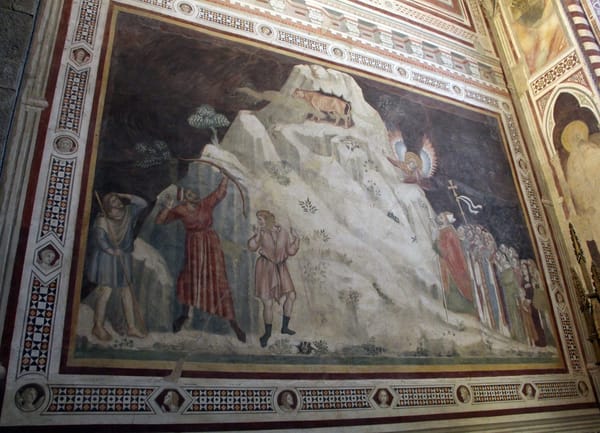
Another apparition, which encouraged devotion to St Michael in Italy, took place on Mount Gargano, in Apulia; it is the one honoured by to-day's feast. A third happened on Mount Tomba, on the coast of Normandy: we shall commemorate it on October 16.
The feast we are keeping to-day is not so solemn as the one of September 29; it is, however, more exclusively in honour of St Michael, inasmuch as the autumn feast includes all the choirs of the angelic hierarchy. The Roman Breviary gives us the following account of the apparition on Mount Gargano:
Holy Church tells us of the glories of St Michael in several portions of the Liturgy; but particularly in the following Responsory and Antiphons, taken from to-day's Office:
The first of the following hymns is used by the Church in the Vespers of the Feasts of St Michael. The second is taken from the Lauds. They speak the praises, not only of our great Archangel, but likewise of St Gabriel, St Raphael, and of all the blessed spirits in general. The Church has not instituted a feast for the collective celebration of the nine choirs of Blessed Spirits, but she includes all the members of the angelic host in her tribute of honour on the Feasts of St Michael.
First Hymn
Te vita, Jesu, cordium,
Ab ore qui pendent tuo
Laudamus inter Angelos.
Ducum corona militat:
Sed explicat victor crucem
Michael salutis signifer.
In ima pellit tartara,
Ducemque cum rebellibus
Coelesti ab arce fulminat.
Sequamur hunc nos principem,
Ut detur ex Agni throno
Nobis corona gloriæ.
Qui, quos redemit Filius,
Et sanctus unxit Spiritus,
Per Angelos custodiat.
who obey thee, we praise thee,
O Jesus, thou brightness and power of the Father,
thou life of our hearts!
this army of a thousand thousand princes,
at whose head is Michael, the Conqueror,
the standardbearer of salvation, who unfurls the Cross.
the cruel dragon into the depths of hell,
and drove the rebels, with their chief,
from the heavenly city.
that we may deserve to receive,
from the throne of the Lamb,
a crown of glory.
who, by means of the angels,
guards those whom the Son hath redeemed
and the Holy Spirit anointed.
Second Hymn
Gentis humanæ sator et redemptor,
Cœlitum nobis tribuas beatas
Scandere sedes.
Cœlitus nostras veniat; serenæ
Auctor ut pacis lacrymosa in orcum
Bella releget.
Pellat antiquos, et amica cœlo
Quæ triumphator statuit per orbem,
Templa revisat.
Adsit e cœlo Raphael, utomnes
Sanet ægrotos, dubiosque vitæ
Dirigat actus.
Et sacer nobis chorus Angelorum
Semper assistat, simul et micantis
Regia cœli.
Patris, ac Nati, pariterque Sancti
Spiritus, cujus resonat per omnem
Gloria mundum.
the Creator and Redeemer of mankind!
grant that we may ascend to the happy thrones
of the heavenly citizens.
come from heaven into this our temple,
bring us sweet peace,
and drive dismal war back again to hell.
come and rout our ancient foe;
may he often visit the heaven-loved temples
which the triumphant Jesus has placed throughout the world.
descend and visit us,
that he may heal all that are infirm
and direct our faltering steps in the path of life.
may the holy choir of angels;
may the bright court of heaven
ever assist and protect us.
Father, Son, and Holy
Ghost, whose glory is proclaimed through the whole world,
grant us this our prayer.
The following sequence is from the collection of the Monastery of Saint-Gall, and was composed by the monk Notker in the eleventh century:
Sequence
Rex cœlice, laudes Cuncta
Pangat jam canora
Caterva symphonia
Odas, atque solvat
Concio tibi nostra.
Michaelis inclyta valde festa,
Per quæ lætabunda
Perornatur machina Mundi tota.
Spirituum sunt agmina
Per te facta.
Facis hæc flammea
Per angelicas Officinas.
Sed cum simus nos ultima Factura,
Sed imago tua.
Nobis hæc ter tripartita
Per privata officia.
Phalanx et archangelica,
Principans turma.
Ac Potestas almiphona,
Dominantia numina,
Divinaque subsellia,
Cherubim ætherea,
Ac Seraphim ignicoma.
Vera dans Verbi nuntia, Atque Raphael,
Vitæ vernula, Transferte nos inter Paradisicolas.
Complentur mandata,
Quæ dat ejusdem Sophia,
Compar quoque Pneuma,
Una permanens in usia,
Cui estis administrantia Deo millia
Millium sacra.
Bis atque quingenta vestra
Centena millena
Assistunt in aula,
Ad quam Rex ovem centesimam verbigena,
Drachmamque decimam Vestra
Duxit ad agalmata.
Nos per rura terrea, pars electa,
Harmonica vota damus hinc
Per lyricas citharas.
Nostra Deo sint accepta auream super aram
Thymiamata, quo in coeva jam gloria
Condecantemus Alleluia.
may our whole assembly and choir
now sound forth
its instruments of sweet music
and sing hymns
in thy praise.
of Michael's most glorious feast,
which fills the whole earth
with great joy.
created by thee,
into nine choirs;
when thou wiliest
to seek their ministry.
whereas we are thy last,
but made after thine image.
according to their special offices,
reveals to us the mysterious design of God.
then the phalanx of Archangels;
then the host of the Principalities.
the sweet-sounding Powers,
The spiritual Dominations,
the divine Thrones,
the ethereal Cherubim,
the burning Seraphim.
messenger of the Incarnate Word! Raphael,
our guide through life! lead us to the company of the citizens of Paradise.
all the commands of the Father,
the Son who is his Wisdom,
and the co-equal Spirit,
the Three, One in essence,
the God before whom ye stand thousands
of thousands in number, as ministering spirits.
times a hundred thousand;
and hither did the King,
the Father of the Word,
bring the hundredth sheep,
and the tenth groat,
that they might share in your bliss.
and we the elect flock on earth,
give forth our tuneful praise
on sweetsounding harps.
when set on the golden altar, be acceptable to God;
Thus, when united in the same eternal glory,
may we sing together our Alleluia!
How beautiful art thou, O Michael. in thy heavenly armour, giving glory to the God whose enemy thou hadst overcome! Thine humble and fervent gaze is fixed on the throne of Jehovah, whose rights thou didst defend, and who gave thee the victory. Thy sublime cry: ‘Who is like unto God?’ roused the faithful legions and became thy name and thy crown. It will remind us for all eternity of thy fidelity to our Creator and thy triumph over the dragon. Meanwhile, we enjoy thy loving protection; we are thy happy clients.
Guardian angel of Holy·Church! now is the time for thee to exert all the might of thine arm. Satan is furious in his efforts against the noble Spouse of thy Master; brandish thy bright sword, and give battle to this implacable enemy. The kingdom of Christ is shaken to its very foundations. Is it that the reign of the Man of Sin is about to be proclaimed on the earth? Are we near that last day when, this guilty world is to be destroyed by fire, and thou art to exercise, in the name of the Sovereign Judge, the terrible office of separating the goats from the sheep? If this earth is still to exist; if the mission of the Church is not yet completed; is it not time for thee, O Michael! to show the dragon of hell that he may not, with impunity, insult on this earth the God who created it, who redeemed it, and whose name is King of kings and Lord of lords? The forces of error and crime are unceasingly dragging the world to the brink of the precipice; save it, O glorious Archangel, by confounding the dark plots which are laid for its destruction!
Thou, O Michael, art the protector of our souls in their passage from time to eternity. During this present life thine eye is upon our wants, and thine ear open to our prayers. Though awed by the brightness of thy glory, we love thee, dear prince of heaven! and we live happy and contented beneath the shadow of thy wings. In a few days, or at most years, our holy Mother the Church will be performing her last sacred rites over our lifeless remains; she will pray for us to our heavenly Father, that we may be delivered from the lion's mouth, and that the standard-bearer, St Michael, may bring us into the holy light.4 Watch over us now, O holy Archangel, lest we should then not deserve thy protection. The dragon is ever threatening us; he makes no secret of his wish to devour us. Teach us, O Michael, to repeat thy beautiful words: ' Who is like unto God?’ God’s honour, the rights he has over us, our obligation to be faithful to him, and serve him, and confess him as our Lord in all times and places—yes! these thoughts must be our shield in danger, and the armour wherewith we must fight, like thee, and win the battle. But we need the sturdy courage which resulted from the love thou hadst within thee. Oh! pray for us, that we, too, may love our common Lord and Master; then shall we be invincible. Satan cannot make head against a creature that is filled with the love of the great God.
God created thee, O Michael! and thou lovest him as thy Creator; but he has not only created us, he has redeemed us, yea, and at the price of his own Blood! What, then, should be the intensity of our love for him! Strengthen this love in our hearts; and since we are fighting under thy leadership, guide us, inspirit us; let thy look give us courage; ward off from us the blows of the enemy’s sword. We venture to hope that thou wilt be present at our last moments, O standard-bearer of our salvation! In return for our tender devotion towards thee, deign to keep guard round our deathbed, cover it with thy shield. If the dragon see the flash of thy sword, he will not dare to come near us. May our soul, on leaving the body, throw herself with affection into thine arms! Cast her not from thee, O holy Archangel, when she seeks to cling to thee; carry her to the judgement-seat, cover her beneath thy wings, calm her fears; and may the Lord, thy Master, bid thee bear her speedily to the kingdom of eternal bliss!
| Previous May 7: St. Stanislaus, Bishop and Martyr | Next May 8: The Apparition of St. Michael the Archangel |