Daily reading
Paschal Time
Double · May 9 · Sanctoral
May 9, 2022
From Dom Guéranger’s The Liturgical Year.
A Double leads the weekday.Rubric
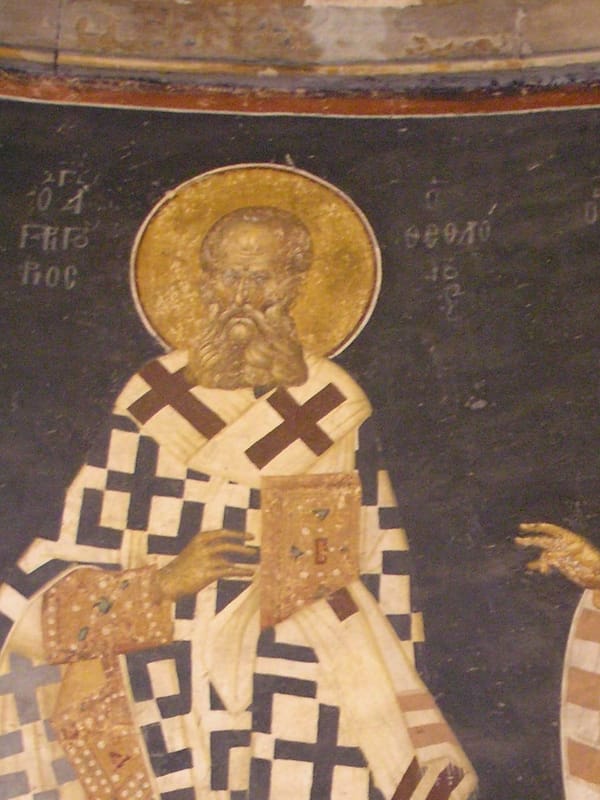 |
May 9: St. Gregory Nazianzen, Bishop, and Doctor of the Church
SIDE by side with Athanasius, another Doctor of the Church comes forward at this glad season to offer to the Risen Jesus the tribute of his learning and eloquence. It is Gregory of Nazianzum, the friend of Basil, the great orator, the admirable poet, whose style combines energy of thought with a remarkable richness and ease of expression; the one of all the Gregories who has merited and received the glorious name of Theologian, on account of the soundness of his teachings, the sublimity of his ideas, and the magnificence of his diction. Holy Church exults at being able to offer us so grand a Saint during Easter Time, for no one has spoken more eloquently than he on the Mystery of the Pasch. Let us listen to the commencement of his second Sermon for Easter; and then judge for ourselves:
I will stand upon my watch, says the admirable Prophet Habacuc.1 I, also on this day, will imitate him; I will stand on the power and knowledge granted me by the favour of the Holy Ghost, that I may consider and know what is to be seen, and what will be told unto me. And I stood and I watched: and lo! a man ascended to the clouds; and he was of exceeding high stature, and his face was the face of an angel, and his garment was dazzling as a flash of lightning. And he lifted up his hand towards the East, and cried out with a loud voice. His voice was as the voice of a trumpet, and around him stood, as it were, a multitude of the heavenly host, and he said: "To-day is salvation given to both the visible and the invisible world. Christ hath risen from the dead: do ye also rise. Christ hath returned to himself: do ye also return. Christ hath freed himself from the tomb: be ye set free from the bonds of sin. The gates of hell are opened, and death is crushed; the old Adam is laid aside, and the new one is created. Oh! if there be a new creature formed in Christ, be ye made new!”
Thus did he speak. Then did the other angels repeat the hymn they first sang when Christ was born on this earth, and appeared to us men: Glory be to God in the highest, and peace on earth to men of good will! I join my voice with them, and speak these things to you: oh! that I could have an angel’s voice, to make myself heard throughout the whole earth!
It is the Pasch of the Lord! the Pasch!—in honour of the Trinity, I say it a third time: the Pasch! This is our Feast of feasts, our Solemnity of solemnities. It is as far above all the rest, not only of those which are human and earthly, but of those even which belong to Christ and are celebrated on his account—yea, it as far surpasses them all as the sun surpasses the stars. Commencing with yesterday, how grand was the day with its torches and lights! . . . But how grander and brighter is all on this morning! Yesterday’s light was but the harbinger of the great Light that was to rise; it was but a foretaste of the joy that was to be given to us. But to-day we are celebrating the Resurrection itself, not merely in hope, but as actually come to pass, and drawing the whole earth to itself.2
This is a sample of the fervour and eloquence wherewith our Saint preached the mysteries of faith. He was a man of retirement and contemplation. The troubles of the world in which he had been compelled to live damped his spirits; the duplicity and wickedness of men fretted his noble heart; and leaving to another the perilous honour of the see of Constantinople, which he had reluctantly accepted a very short time previously, he retired to his dear solitude, there to enjoy his God and the study of holy things. And yet, during the short period of his episcopal government, notwithstanding all the obstacles that stood in his way, he confirmed the faith that had been shaken, and left behind him a light which continued even to the time when St John Chrysostom was chosen to fill the troubled Chair of Byzantium.
The holy Liturgy thus speaks to us of the virtues and actions of this great Saint:
The Greek Church, in her Menæa, gives the following magnificent encomium of St Gregory Nazianzen:
Hymn (Die XXV Januarii)
We salute thee, O glorious Doctor of the Church, on whom both East and West have conferred the title of Theologian! Illumined by the rays of the glorious Trinity, thou gavest us to share in the light thus imparted to thee—and a brighter was never granted to mortal eye. In thee was verified that saying of our Saviour: Blessed are the clean of heart, for they shall see God.3 The purity of thy soul prepared thee to receive the divine light, and thy inspired pen has transmitted to thy fellow-men something of thine own soul's enraptured knowledge. Obtain for us the gift of faith, which puts the creature in communication with its God; obtain for us the gift of understanding, which makes the creature relish what it believes. The object of all thy labours was to guard the faithful against the seductive wiles of heresy, by putting before them the magnificence of the divine dogmas. Oh! pray for us, that we may avoid the snares of false doctrines, and have our eye ever fixed on the ineffable light of the mysteries of faith; for, as St Peter tells us, it is as a lamp in a dark place, that shineth until the day dawn, and until the day-star arise in our hearts.4
There now seems to be a gleam of hope for the East, that has been, for so many long ages, a prey to error and slavery. Great changes are preparing for the unfortunate Byzantium, and politicians are studying how to profit by the crisis, and make her the prey of their respective Governments. Canst thou forget the city of which thou wast once the pastor, and where thy name is still held in veneration? Oh! help her to throw off the shackles of schism and heresy. Her being a slave to the infidel is the punishment of her having revolted against the Vicar of Christ! this yoke seems about to be broken; pray, O Gregory, that the more dangerous and humiliating one of error and schism may also be broken. A movement of return to the truth has already begun to show itself. Whole provinces are awakening to a knowledge of their misery, and are casting a look of hope towards the common Mother of all Churches, who opens her arms to receive them. Aid this long-desired conversion by thy prayers. Both East and West honour thee as one of the sublimest preachers of divine Truth; obtain by thy powerful intercession that East and West may be once more united in the one fold, and under the one shepherd, before our Risen Jesus returns to our earth to separate the cockle from the good seed, and lead back to heaven the Church, his Spouse and our Mother, out of whose pale there is no salvation.
Help us, during this season, to contemplate the glories of our Risen Lord. Oh! for something of the holy enthusiasm for this Pasch, which inebriated thee with its joys and inspired thee with such glowing eloquence! Jesus, the Conqueror of Death, was the object of thy fervent affections even from thy childhood; and when old age came, thy heart still beat with love for him. Pray for us, that we too may persevere in his service; that his divine mysteries may ever be our grandest joy; that this year’s Pasch may ever abide in our souls; that the renovation it has brought us may be visible throughout our lives; and that it may, each year as it returns, find us attentive and eager to receive its graces, until the eternal Easter comes with its endless joy!
Monday of the Fourth Week after Easter
OUR Risen Jesus is not satisfied with establishing his Church and constituting the hierarchy which is to govern it in his name to the end of time; he also confides in his disciples his divine word, that is, the truths he is come to reveal to mankind, into which truths he has given them an insight during the three years preceding his Passion. The word of God, which is also called revelation, is, together with grace, the most precious gift that heaven could bestow upon us. It is by the word of God that we know the mysteries of his divine essence, the plan according to which he framed the creation, the supernatural end he destined for such of his creatures as he endowed with understanding and free-will, the sublime work of redemption by the Incarnation of the Second Person of the Blessed Trinity—in a word, the means whereby we are to honour and serve him, and attain the end for which we were made.
From the very commencement of the world, God revealed his word to man; later on, he spoke by the prophets; but when the fulness of time came, he sent upon the earth his Only Begotten Son, that he might complete this first revelation. We have seen how, for three years, Jesus has been teaching men, and how, in order that he might make them the more easily understand his words, he has stooped to their littleness. Though his teaching was of the sublimest possible character, yet did he make it so intelligible that no instruction could be compared to his in clearness. It was for this reason that he made use of simple parables, whereby he conveyed his divine truths to the mind of his hearers. His Apostles and disciples, who were afterwards to preach his Gospel to the world, received from him frequent special instructions; although, until the accomplishment of the mysteries of his Death and Resurrection, they were slow in understanding his teaching. Since his Resurrection, they are better able to appreciate his instructions, for not only are his words more telling now that he is in the glory of his triumph over death, but the minds of his hearers have become more enlightened by the extraordinary events that have occurred. If he could say to them at the Last Supper: I will not now call you servants; but I have called you my friends: because all things whatsoever I have heard from my Father, I have made known unto you;1 how must he not treat them now that he has repeated to them the whole of his teaching, given them the whole word of God, and is on the eve of sending the Holy Spirit upon them, in order to perfect their understanding, and give them power to preach the Gospel to the entire world?
O holy word of God! O holy revelation! through thee are we admitted into divine mysteries, which human reason could never reach. We love thee, and are resolved to be submissive to thee. It is thou that givest rise to the grand virtue, without which it is impossible to please God;2 the virtue which commences the work of man's salvation, and without which this work could neither be continued nor finished. This virtue is faith. It makes our reason bow down to the word of God. There comes from its divine obscurity a light far more glorious than are all the conclusions of reason, how great soever may be their evidence. This virtue is to be the bond of union in the new society which our Lord is now organizing. To become a member of this society, man must begin by believing; that he may continue to be a member, he must never, not even for one moment, waver in his faith. We shall soon be hearing our Lord saying these words: He that believeth and is baptized shall be saved; but he that believeth not shall be condemned.3 The more clearly to express the necessity of faith, the members of the Church are to be called by the beautiful name of the faithful: they who do not believe are to be called infidels.
Faith, then, being the first link of the supernatural union between man and God, it follows that this union ceases when faith is broken, that is, denied; and that he who, after having once been thus united to God, breaks the link by rejecting the word of God, and substituting error in its place, commits one of the greatest of crimes. Such a one will be called a heretic, that is, one who separates himself; and the faithful will tremble at his apostasy. Even were his rebellion to the revealed word to fall upon only one article, still he commits enormous blasphemy; for he either separates himself from God as being a deceiver, or he implies that his own created, weak, and limited reason is superior to eternal and infinite Truth.
As time goes on, heresies will rise up, each attacking some dogma or other; so that scarcely one truth will be left unassailed; but all this will serve for little else than to bring out the revelation purer and brighter than before. There will, however, come a time, and that time is our own, when heresy will not confine itself to some one particular article of faith; but will proclaim the total independence of reason, and declare revelation to be a forgery. This impious system will give itself the high-sounding name of rationalism, and these are to be its leading doctrines: Christ's mission a failure and his teaching false; his Church an insult to man's dignity; the eighteen centuries of Christian civilization a popular illusion! The followers of this school, the so-called philosophers of modem times, would have subverted all society, had not God come to its assistance, and fulfilled the promise he made, of never allowing his revealed word to be taken away from mankind, nor the Church, to whom he confided his word, to be destroyed.
Others go not so far as this. They do not pretend to deny the benefits conferred on the world by the Christian religion; the facts of history are too evident to be contested: still, as they will not submit their reason to the mysteries revealed by God, they have a way peculiar to themselves for eliminating the clement of faith from this world. As every revealed truth, and every miracle confirmatory of divine interposition, is disagreeable to them, they attribute to natural causes every fact which bears testimony to the Son of God being present among us. They do not insult religion, they simply pass it by; they hold that the supernatural serves no purpose; people, they say, have taken appearances for realities. The laws of history and common sense count for nothing. Agreeably to their system, which they call naturalism, they deny what they cannot explain; they maintain that the people of the past eighteen centuries have been deceived, and that the Creator cannot suspend the laws of nature, just as the rationalists teach that there is nothing above reason.
Are reason and nature, then, to be obstacles to our Redeemer’s love for mankind? Thanks be to his infinite power, he would not have it so! As to reason, he repairs and perfects her by faith; and he suspends the laws of nature, that we may cheerfully believe the word whose truth is guaranteed by the testimony of miracles. Jesus is truly risen; let reason and nature rejoice; for he has ennobled and sanctified them by the glad mystery.
Let us proclaim the triumph of the Redeemer whom we adore. Let us make our own this sequence of the Cluny Missal of 1523.
Sequence
Leo de tribu Juda.
Mors vicit mortem,
Et mors nostra est vita.
Mira bella, et stupenda satis
Inter oves victoria.
Ut moriens superaret fortem
Cum callida versutia.
Domum ejus ingressus
Est Rex aeternus,
Et averni confregit vasa.
Drachmam secum quæ perierat
Asportavit, et patefecit regni claustra.
Paradisi porta
Quæ clausa fuerat
Per lignum vetitum
Et lethale in primaevo.
Quam clauserat Eva conditori,
Clauseratque cunctis
Postmodum natis
De stirpe sua.
Quæ commisit protoplastus,
Reseravit dextra per stirpis materiam.
Susceperat mors indemnem,
Quem tenere numquam potuerat propter culpam.
Dum ambiit illicita.
Quæ tenebat juste
Perdidit acquisita.
Ampliare voluerat in secessu,
Et remansit evacuata.
Hic verus est agnus legalis
Qui multis se manifestavit figuris,
Tandem se hostiam pro mundo
Dedit Patri ut redimeret membra sua.
Hic lapis est angularis,
Quem reprobaverunt aedificantes.
Jam factus est in caput anguli
Super omnes in excelso.
Regnum ejus magnum
Et potestas ejus prima per sæcula.
the Lion of the Tribe of Juda, hath conquered.
Death hath conquered death;
and that Death is our Life.
Strange was the war, and stupendous the victory
that was seen by the flock of Christ.
When he, by his Death,
vanquished the strong and crafty enemy.
The Eternal King
forced the enemy’s house,
and broke the armour of hell.
He brought back the groat that was lost,
and opened the gates of heaven.
Heaven’s gate,
that had been shut, at the beginning of the world,
by the forbidden fruit,
which brought death;
The gate, which Eve had closed
against him from whom she had been formed
and against all the children
that were to be born of her race;
Yea, what our first parent thus sinfully closed,
was thrown open by the right hand of the God that assumed our flesh.
Death laid hands on him
on whom it had no claim because he was free from sin;
And by thus coveting
what was not its own,
it lost what it hitherto had justly held.
By wishing to add to its prey,
it was made to yield up what it had devoured.
Christ is the true Lamb,
that was foretold in the Law under manifold figures,
and who, at length, offered himself to the Father
as a Victim for the world's redemption.
This is the Corner-Stone,
rejected by the builders.
He is now the Head of the Corner,
set high above all the rest.
His kingdom is great, and his power supreme:
they are for ever and ever.
| Previous May 8: The Apparition of St. Michael the Archangel | Next Monday of the Fourth Week after Easter |