Daily reading
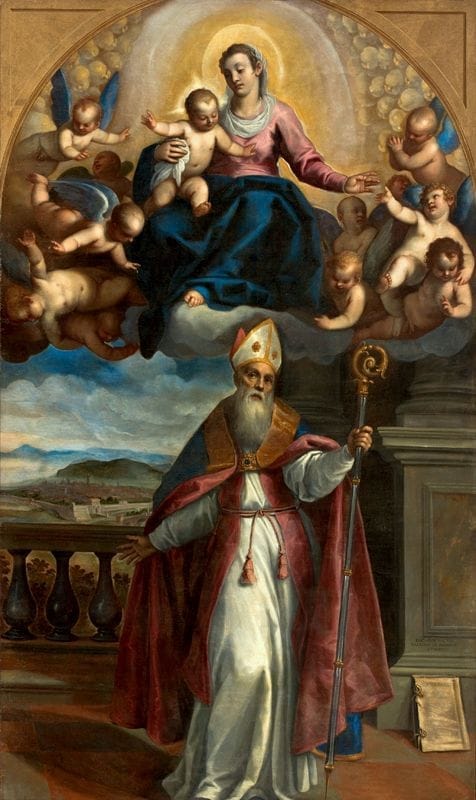
May 16: St. Ubaldus, Bishop and Confessor
IN order to honour her eternal High Priest, the Church presents to him this day the merits of a pontiff who, after his mortal career, was admitted into a happy immortality. Ubaldus, here on earth, was the image of our Lord Jesus Christ. Like his divine Master, he received the holy anointing of priesthood; he was a mediator between God and man; he was the shepherd of a flock; and now he is united with our Risen Jesus, the great Anointed, the Mediator, the Shepherd. In proof of his influence in heaven, Ubaldus has had given to him a special power against the wicked spirits who lay snares for our perdition. It has frequently happened that the simple invocation of his name has sufficed to foil their machinations. The Church has fixed this day as his feast with the view of encouraging the faithful to have recourse to his protection.
Let us now read the account she gives of the virtues of the saintly bishop:
O blessed Pontiff! be thou our protector against the spirits of hell. They are devoured by envy at seeing how man, that lowly and feeble creature, has become the object of God’s predilection. The incarnation of the Son of God, his death on the cross, his glorious resurrection, the sacraments which give us the life of Grace—all these sublime means, whereby the infinite goodness of God has restored us to our lost dignity,have excited the rage of the old enemy, and he seeks revenge by insulting, in us, the image of our Creator. At times he attacks man with all the frenzy of angry jealousy. To mimic the operations of sanctifying grace, which, so to speak, makes us the instruments of God’s good pleasure, Satan sometimes takes possession of our fellow-creatures, and makes them his slaves. Thy power, O Ubaldus, has often manifested itself by rescuing these unhappy victims of the devil’s jealousy; and Holy Church, on this day, celebrates the special prerogative conferred on thee by our heavenly Father. Relent not in the exercise of thy charitable office. And yet, O holy Pontiff, thou knowest that the snares of the wicked spirits are more inj urious to the souls than to the bodies of men. Have pity, then, on the unhappy slaves of sin, who, though the divine Sun of the Pasch has risen upon them, are still in the darkness of guilt. Pray for them, that they may become once more children of the light, and share in the Easter Resurrection which Jesus offers to all.
May 16 (the Same Day): St. John Nepomucen, Martyr
TO the martyrs who were slain because they refused to adore false gods—to the martyrs whose blood was shed by heretics—there is added to-day another brave soldier of Christ, who won his crown in a very different sort of combat. The sacrament of Penance whereby sinners regain the heaven they had lost claims John Nepomucen as its glorious defender.
A holy secrecy shrouds the reconciliation made between God and the penitent. This sacramental secrecy deserved to have its martyr. When Jesus instituted the sacrament of Penance—that second baptism, wherein the Blood of our Redeemer washes away the sins of the Christian soul—he willed that man should not be deterred from confessing his humiliations to his spiritual physician by the fear of their ever being revealed. How many hidden martyrdoms have there not been, during these eighteen hundred years, for the maintenance of this secret, which, whilst it gives security to the penitent, exposes the confessor to obloquy, injustice, and even death! But the martyr we honour to-day was not one of these hidden sufferers. His testimony to the inviolability of the sacramental seal was public; he gave it amidst cruel tortures; it cost him his life.
All praise, then, to the brave and faithful priest! Right worthy was he to hold in his hands the keys that open or shut the gate of heaven! In this great fact of the observance of the seal of confession, on which depends the salvation of millions of souls, we have a permanent miracle. But there was one thing wanting to it—the glory of martyrdom. The holy priest of Prague gave it that glory; and he offers the fair palm to our Risen Jesus, whom we have seen, during these days between his Resurrection and Ascension, mercifully instituting the sacrament of Penance, wherein he communicates to men his own power of forgiving sin.
We subjoin the Lessons approved by the Holy See for the feast of this great martyr:
How great, O glorious martyr, was the honour reserved for thee by the Son of God, when he chose thee to be the one who was to attest, by laying down his life, the sacredness of the secret which protects the sacrament of Penance! Other priests, as well as thyself, have bravely suffered persecution for the sake of the secrecy of the mystery of reconciliation: but thou wast the one chosen by heaven to give a solemn testimony of priestly discretion. Thy sufferings were known to more than angels: thy martyrdom was a public one, and the faithful honour thy courage as an eloquent proof of how truly our good Shepherd, Jesus, removes every difficulty that could deter the strayed sheep from returning to the fold.
We address ourselves to thee, O holy martyr, on this day of thy triumph and beseech thee to intercede for sinners. Admirable minister of the sacrament of Penance! thou seest how many Christians there are who neglect to avail themselves of the means of salvation prepared for them by our risen Saviour. Instead of laying hold of this ‘second plank after shipwreck,’ they let themselves be carried on to the deep abyss by the tide of their sinful habits. There are thousands who have turned a deaf ear, even this Easter, to the call of Holy Church, who invited them, as an affectionate Mother, to approach the tribunal of mercy and reconciliation. We beseech thee, intercede for these blind, unwary, ungrateful men. Procure for them the grace which will lead them to the feet of the God of mercy, who is ever ready to grant pardon.
There are others, again, who go to Confession, but who have not the dispositions requisite for receiving the grace of the Sacrament—the justification of their souls. Pray also for these, that they may see the danger they thus incur of profaning the Blood of Christ. Obtain for all them who approach the holy tribunal an honest avowal of their sins, and contrition of heart; that thus the life of our Risen Jesus may be imparted to them and that they may never again lose it. By thy powerful intercession, raise up zealous and faithful ministers of this great sacrament of which thou wast the martyr. Draw down the blessing of heaven on their arduous labour: then will the number of the children of God be increased, and the grace of the Holy Ghost triumph in souls that have long been dead in sin.
Cast, too, an eye of compassion on thy fatherland of Bohemia, where there are so many faithful hearts that love and honour thee. Alas! there are tares which disfigure that portion of the Church. The enemy came, not many years after thy glorious martyrdom, and sowed the baneful weeds of heresy in thy native land. The good seed claims thy protection; but take pity also on the cockle, for even it may be turned, by the true faith, into wheat, and be garnered into the house of our heavenly Father. Secure peace to thy Bohemia and save her from the snares that are laid for her.
Monday of the Fifth Week after Easter
JESUS bestows an inestimable gift upon his Apostles; and from this gift there proceed two sacraments. On the sixth day of the creation, the divine Word infused his breath into man, whose body he had formed out of the slime of the earth; and immediately this body was animated by a soul, bearing upon it the image of God. On the evening of the day of his Resurrection, the same divine Word, then made visible in the flesh he had assumed, suddenly appeared in the midst of his Apostles, and said to them: Peace be to you! As the Father hath sent me, I also send you.1 Then breathing upon them, he added, in a tone of command: Receive ye the Holy Ghost!2 What is this Breath, which is not given to all men but only to a few chosen ones? Jesus himself explains it, by the words he speaks: this Breath imparts the Holy Ghost to them that receive it. The Holy Ghost is given to the Apostles, because they are sent by Jesus, as Jesus is sent by the Father.
The Apostles, then, receive this divine Spirit, in order that they may communicate him to men, just as they themselves have had him given to them by Jesus. The Church's tradition fills up the brief account of the Gospel. Two sacraments, as we have already stated, take their origin from this act of our Risen Jesus, who afterwards instructed his Apostles as to the rites wherewith each of the two was to be administered.
The first of these two sacraments is Confirmation, for whose institution we will return our humble thanks to-day; the other is Holy Orders, which we will explain further on in the week; both of them belong, in their administration, to the episcopal character, which is the source whence flow the gifts conferred upon the Apostles for man’s sanctification.
Such is the importance of the sacrament of confirmation, that until such time as we have received it, we cannot be considered as perfect Christians. It is true that, by virtue of our baptism, we are children of God, members of Christ and his Church; but, as Christians, we are soldiers: we have to confess our faith, sometimes before tyrants, and even to the shedding of our blood; sometimes before the world, whose false seductive maxims are the occasion of so many apostasies; sometimes against Satan and his wicked angels, whose power is so justly feared by the servants of Christ. The seal of the Holy Ghost confers on us a degree of strength which baptism does not give. Baptism made us citizens of the Church; confirmation makes us soldiers of God and of his Christ. Again, it is true that we can fight and conquer with the armour of baptism; such is God’s will, who knows that the sacrament which perfects the Christian is oftentimes an impossibility; but, woe to them that neglect to receive the completion of their baptism I Hence, after administering the sacrament of regeneration on Holy Saturday, the bishop at once proceeded to give the Holy Ghost to all those who had been just bom in the Son, and had been adopted by the Father.
Yes, confirmation is administered by a bishop, it is for him to say to the baptized: Receive ye the Holy Ghost! It was just that this divine Spirit should be thus honoured. Even when, in cases of necessity, a priest is delegated, by the Pope, to administer this sacrament, he cannot validly do so except on the condition of his using chrism consecrated by a bishop: and thus the episcopal power is always uppermost in the conferring of the Holy Ghost.
What a solemn moment is that, wherein the Spirit of power, who strengthened the Apostles, descends upon the neophytes kneeling before the bishop! The pontiff stretches his hands over them: he pours out upon them the Spirit he has received in order to communicate him to others; and that he may give all possible solemnity to the gift he is about to bestow, he cites the words of Isaias, which prophesy the descent of the Spirit on the Branch that was to spring up from the root of Jesse—a prophecy which was fulfilled in our Jesus, when he received baptism in the river Jordan, from the hands of St John the Baptist:’ O Almighty and Eternal God! who hast vouchsafed to regenerate these thy servants by water and the Holy Ghost; send forth from heaven upon them thy sevenfold Spirit, the Holy Paraclete: the Spirit of wisdom and understanding; the Spirit of counsel and fortitude; the Spirit of knowledge and godliness; fill them with the Spirit of thy fear, and sign them with the sign of the Cross of Christ.’3
Then is brought the sacred chrism, of whose virtue we heard so much on Maundy Thursday. Confirmation was anciently called the Sacrament of Chrism—of chrism in which dwells the power of the Holy Ghost. The pontiff anoints with it the foreheads of the neophytes, and, at the same instant, the Holy Ghost imprints on their souls the sign of a perfect Christian. They are confirmed, and for ever. Let them but listen to the voice of the sacrament which is now within them, and no trial, no danger can master them. The holy oil wherewith the cross has been signed on their forehead has imparted to them that firmness of adamant which was given to the Prophet Ezechiel, and enabled him to withstand all his enemies.4
To a Christian, strength is salvation; for man's life on earth is a warfare.5 Glory, then, be to our Risen Jesus, who, foreseeing the attacks that would be made against us, has armed us for the battle, and, in this admirable sacrament of confirmation, has given us the divine Spirit, who proceeds from himself and the Father, that we might be strong and invincible! Let us thank him, with all our hearts, for his having thus completed the grace already given us in baptism. The Father, who so graciously adopted us, has delivered up his Only Begotten Son for us; the Son gives us the Spirit, that he may dwell within us; oh! how wonderful a creature is man, who is so loved by the Trinity! And yet man is a sinner and an unfaithful creature: and but too frequently, all these graces are rendered fruitless by his negligence or malice! Let us at least be faithful, by keeping ourselves closely united to Holy Church, and by devoutly celebrating, with her, the mysteries of God’s goodness which the liturgical year brings successively before us.
Let us adore our Risen Jesus, our divine Benefactor. In the name of his Church, enriched as she is by such precious gifts, let us offer him this beautiful Paschal canticle, taken from the ancient Missal of Saint Gall.
Sequence
Carmina comparibus
Ecclesia dilecto pangat suo,
Illius gaudens
Reditus triumpho.
Tergens gena lacrymulam,
Læta nunc excipiat regressum,
Quem nuper flebat
Ademptum.
Hujus et affectu ardens,
Tersit suo vulnere
Ab illa nævum
Parentis primulae.
Procul de nuptae gaudio
Synagoga pellatur,
Colore obfuscata nigerrimo.
Alta confixus crucis arbore
Sacravit lateris
Illam flumine.
Viri cum fabricatur a costa,
Et Noe arcula
Aquis levata.
Nuper tyrannus
Misere afflictam,
Atque suis a sedibus
Translatam,
Favens plorati,
Atque sternens Babylonem,
Revocasti Sion tuum
Ad montem.
Ovantem gaudiis
Gratia figurat
Mundi florentis,
Consortes nos esse
Fac Jesu redemptos
Tuo cruore;
Canopicos afflixisti
Morte principes,
Ut nos inde solveres,
Praesta in eremo
Hujus vitæ,
Viperas
Conteramus igneas.
Te duce, promissam
Veniamus ut ad terram.
rejoicing in the triumphant
return of her Beloved,
sing to him her canticles,
with voice well attuned.
from her beautiful cheeks,
and gladly welcome back her Jesus,
for whom she wept
when he was taken from her.
out of burning love for her;
and, by his Blood,
cleansed her
from the stain of Eve’s offence.
clad in robes of blackest hue,
is driven, by the Bridegroom’s piercing rays,
from the Marriage Feast.
Jesus was nailed to the lofty Tree of the Cross,
and he sanctified her by the stream
that flowed from his Side.
was a figure of the Church;
so, too, was Noe's Ark,
when it sailed on the waters.
cruelly treated thy Spouse,
O Christ,
and sent her
into exile:
on her sorrow,
and, destroying Babylon,
didst bring her back
to thy holy Mount of Sion.
decked in her flowers of spring,
is a figure of thy Church’s
triumphant joy.
to imitate her loveliness,
for thou hast redeemed us
by thy Blood.
and for our deliverance,
didst bring death
upon the princes of Egypt;
grant that we may safely walk through
the desert of this life
beneath our feet,
And, having thee
for our leader,
reach the Promised Land.
| Previous May 15: St. John Baptist de la Salle, Confessor | Next May 16 (the Same Day): St. John Nepomucen, Martyr |