Daily reading
Paschal Time
Double · May 17 · Sanctoral
May 17, 2022
From Dom Guéranger’s The Liturgical Year.
A Double leads the weekday.Rubric
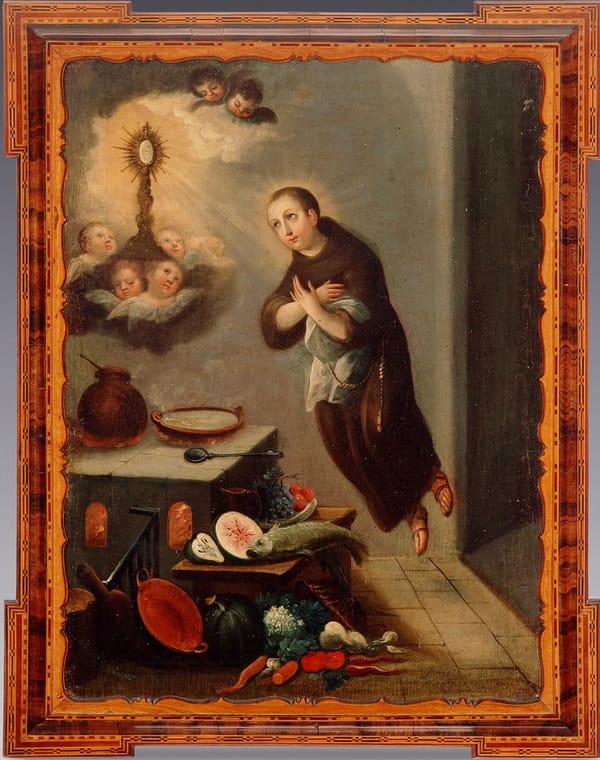 |
May 17: St. Paschal Baylon, Confessor
THE Seraph of Assisi was sure to depute some of his children to pay their court to his Risen Master. The one he sends to-day is the humblest and most obscure of men; another will follow, three days hence, powerful in word and work, and holding a palm in his hands, as a most devoted preacher of the Gospel. Paschal Baylon was a simple peasant. He was a shepherd-boy; and it was in tending his flock that he found the Lord Jesus. He had a great love for contemplation. Forests and fields spoke to him of their great Creator; and, in order that he might be the more closely united with him, he resolved to seek him in the highest paths of perfection. He was ambitious to imitate the humble, poor and suffering life of the Man-God; the Franciscan Cloister offered him the opportunity of satisfying this desire and he flew to it. On that blessed soil, he grew to be one of heaven's choicest plants, and the whole earth has now heard the name of the humble lay-brother of a little convent in Spain. Holy Church brings him before us to-day enraptured in the contemplation of Jesus' Resurrection. He had trod the path of humiliation and the cross; it was but just that he should share in his Master's triumph. It was of him, and of such as he, that this divine Saviour spoke, when he said: Ye are they that have continued with me in my temptations; and I dispose to you, as my Father hath disposed to me, a kingdom; that ye may eat and drink at my table in my kingdom, and may sit upon thrones, judging the twelve tribes of Israel.1
The account given by the Liturgy of the angelic life of this illustrious son of St Francis is as follows:
Heaven opened to receive thee, O Paschal! Even when here below, the fervour of thy contemplation often gave thee a foretaste of the delights of eternal bliss; but now every veil is drawn aside, and thou art face to face with him whom thou didst so ardently desire to possess. Thou hast no further need to unite thyself with him by humiliation and suffering; thou enjoyest his own glory, his own happiness, his own triumph, and he will have thee enjoy it for all eternity. Deign to cast an eye of pity on us, who have not thy eagerness to walk in our Redeemer’s footsteps, and who, as yet, have but the hope of being united to him for eternity. Gain for us courage. Gain for us that love which leads straight to Jesus, which surmounts every obstacle of flesh and blood, and gives to man an admirable resemblance to his divine Model. The pledge of this happy transformation has been given to us by our being permitted to partake of the Paschal Mystery; may it be perfected by our fidelity in keeping close to our divine conqueror and Lord! Though he leave us some time further in this vale of tears, his eye is ever upon us, he longs to see us persevere in our loyalty to him. Yet a little while, and we shall see him! Behold! says he, I come quickly; hold fast that which thou hast. Behold! I stand at the gate and knock. If any man shall hear my voice, and open to me the door, I will come in to him, and will sup with him, and he with me.2 Thus will the Pasch of time be changed into the Pasch of eternity. Pray for us, O Paschal, that like thee, we may hold fast that which, by the grace of our Risen Jesus, we already possess.
Tuesday of the Fifth Week after Easter
THE third sacrament—the Holy Eucharist—is so intimately connected with our Redeemer's Passion that its institution could not be deferred till the Resurrection had taken place. On Maundy Thursday, we honoured the solemn act whereby our Jesus prepared for the morrow’s sacrifice, by instituting the mystery of his Body and Blood, which are really immolated in the Eucharistic Supper. The Apostles were not only admitted, as all future generations were to be, to partake of the divine Food, which giveth life to the world,1 but they moreover received power from Jesus, the Priest for ever,2 to do what he himself had just done. The great Mystery was inaugurated; the new priesthood was instituted: and now that Jesus is risen from the dead, he makes known to his Apostles the whole importance of the gift bestowed upon mankind at the Last Supper; he bids them begin the exercise of the sublime power conferred on them, as soon as the Holy Ghost, by descending upon the earth, shall give to the Church the signal for her using the prerogatives wherewith she has been endowed; and, finally, he teaches how they are to perform this special function of their Priesthood.
At the Last Supper, the Apostles were still carnal-minded men. They were taken up with the sad event that was about to happen, and overcome with grief at their divine Master telling them that that was the last Pasch he was to keep with them. They were not, therefore, in a fit state to appreciate what it was that Jesus had done for them, when he uttered those words: Take ye and eat; this is my Body. Drink ye all of this; for this is my Blood. Still less did they understand the greatness of the power they received, of doing what their Lord himself had just done in their presence. Now that Jesus is risen from the grave, he unfolds all these mysteries to them. The sacrament of the Eucharist was not instituted during these days, but it was made known, explained, and glorified by its divine institutor: and this circumstance gives a fresh lustre to the sacred season we are now going through.
Of all the sacraments, there is not one that can be compared in dignity to that of the Eucharist. The others give grace; this gives us the very Author of grace. The others are only sacraments; this is both a sacrament and a sacrifice. We will endeavour to explain it in all its magnificence, when we come to the bright feast of Corpus Christi. Let us for the present pay the tribute of our loving adoration to our Jesus, the Living Bread, that giveth life to the world.3 Let us acknowledge his immense love for his sheep. He seems to be on the point of leaving them that he may return to his Father, and yet his love retains him amongst them by means of this august mystery, wherein he is truly though invisibly present.
Be thou blessed, then, O Son of the Eternal Father! who, even in the days of the ancient covenant, didst assure us that thy delights are to be with the children of men.4 Thou provest it now by this wonderful sacrament, which reconciles thy two announcements, apparently so contradictory: thy leaving us, and thy abiding ever in our midst.
Be thou blessed for having provided for the nourishment of our souls as well as for that of our bodies. At Christmas we welcomed thy birth at Bethlehem, which signifies a House of Bread. Thou wast both the Saviour who was born for us, and the Food that came down from heaven to nourish our souls.
Be thou blessed, who, not satisfied with working the greatest of wonders at the Last Supper, by changing bread into thy Body and wine into thy Blood, hast also willed that this same miracle should be renewed, everywhere and to the end of time, for the support and consolation of our souls.
Be thou blessed in that thou hast put no limits to our longing after this Bread of Life. On the contrary, thou biddest us make it our daily Bread, and this in order that we may not faint in the way of this our exile.
Be thou blessed for the generosity wherewith, out of thy desire to communicate thyself unto us, thou hast exposed thyself to the blasphemies of heretics, to the sacrileges of bad Christians, and to the indifference of the tepid.
Be thou blessed, O divine Lamb, who enrichest the new Pasch by the shedding of thy Blood, and invitest the new Israel to a banquet where thy sacred Body is offered as nourishment to thy faithful; there do they receive life at its very source, and share in the ineffable joys of thy Resurrection.
Be thou blessed, O Jesus, for having instituted, in the Holy Eucharist, not only the greatest of the sacraments, but also a sacrifice which surpasses all others; a sacrifice whereby we are enabled to offer to the divine Majesty the only homage that is worthy of him, give him thanks in keeping with his favours to us, make him a superabundant atonement for our sins, and finally beg and obtain from him all the graces of which we stand in need.
Be thou blessed, O Emmanuel, who, having promised to give us this heavenly Food, didst fulfil thy promise on the eve of thy Passion, and gavest us this adorable sacrament as the testament of thy love. In the interval between thy Resurrection and Ascension, thou didst reveal to thine Apostles the excellency of thy gift, that so we might receive it with becoming faith.
We offer thee, dear Jesus, this homage of our faith. We confess that in this august Mystery the bread is changed into thy Body, and the wine into thy Blood: and we believe it, because thou hast said it, and because thou canst do all things.
In praise of our Paschal Lamb, who gives himself to us to be our nourishment, let us recite the following beautiful canticle, composed by Notker for the Church of Saint Gall.
Sequence
Esu potuque dignas,
Praebeant omnes se Christianae animae.
Ipse summus Pontifex.
Ejus illita sacrosancto cruore, tuta a clade Canopica,
In mari rubro sunt obruti.
Pedes tutentur adversus viperas;
Contra canes jugiter manu bajulent;
Quo de barathro victor rediit.
Ornatibus Christo consurgens, fideles admonet,
Cum eo victuros.
to partake of the Paschal Lamb,
by holy lives.
for their sakes, as an oblation to the Father.
of the Lamb; they are protected from the slaughter that fell upon Egypt,
were engulfed in the Red Sea.
let them protect their feet against vipers;
to defend themselves against dogs;
whereby he rose again victorious from the tomb.
rises together with Christ. She teaches us,
are to share in Jesus’ victory.
| Previous Monday of the Fifth Week after Easter | Next Tuesday of the Fifth Week after Easter |