Daily reading
Paschal Time
Double · May 19 · Sanctoral
May 19, 2022
From Dom Guéranger’s The Liturgical Year.
A Double leads the weekday; St. Pudentiana is commemorated.Rubrics
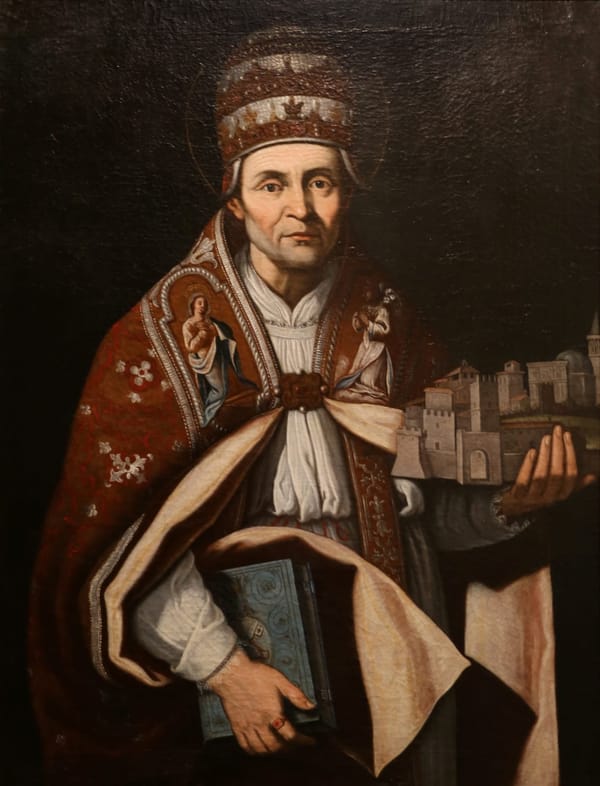 |
May 19: St. Peter Celestine, Pope
OUR Paschal season, which has already given us the admirable Doctor St Leo, brings before us to-day the humble Peter Celestine. He was, like Leo, sovereign pontiff, but no sooner was he throned on the chair of Peter than he left it and returned to solitude. Among the long list of sainted men who compose the venerable series of Roman Pontiffs, our Lord would have one in whose person was to be represented the virtue of humility; that honour was conferred on Peter Celestine. He was dragged from the quiet of his solitude, compelled to ascend the throne of St Peter, and made to hold in his trembling hand the keys of the kingdom of heaven. The holy hermit, whose eyes had been ever fixed on his own weakness, had then to provide for the necessities of the whole Church. In his humility, he judged himself to be unequal to so heavy a responsibility. He resigned the tiara, and begged to be permitted to return to his dear hermitage. His divine Master, Christ, had, in like manner, concealed his glory, first in thirty years of hidden life, and then, later on, under the cloud of his Passion and Sepulchre. The sunshine of the Pasch came; the gloom was dispersed, and the Conqueror of Death arose in all his splendour. He would have his servants share in his triumph and glory; but their share is to be greater or less, according to the measure in which they have, here on earth, imitated his humility. Who, then, could describe the glory which Peter Celestine receives in heaven, as a recompense for the profound humility which made him more eager to be unknown than the most ambitious of men could be for honour and fame? He was great on the pontifical throne, and still greater in his solitude; but his greatness, now that he is in heaven, surpasses all human thought.
Holy Church speaks his praise in these few lines; their simplicity admirably harmonizes with the hermit Pope, whose life they narrate:
Thou didst obtain, O Celestine, the object of thy ambition. Thou wast permitted to descend from the Apostolic Throne, and return to the quiet of that hidden life, which for so many years had been thy delight. Enjoy to thy heart's content the holy charm of being unknown to the world, and the treasures of contemplation in the secret of the face of God.1 But this life of obscurity must have an end; and then the Cross—the Cross which thou hast loved above all earthly possessions—will rise up in brightness before thy cell door, and summon thee to share in the Paschal triumph of him who came down from heaven to teach us this great truth, that he that humbleth himself shall be exalted.2 Thy name, O Celestine, will for ever shine on the list of Roman Pontiffs; thou art one of the links of that glorious chain which unites Holy Church with Jesus, her Founder and her Spouse; but a still greater glory is reserved for thee—the glory of being for ever with this same Risen Jesus. Holy Church, which during the short period of thy holding the keys of Peter, was obedient to thee, has now for centuries paid, and will continue to the end of the world to pay thee the tribute of her devotion, because she recognizes in thee one of God's elect, one of the princes of the heavenly court. And we, O Celestine, we also are invited to ascend where thou art, and contemplate, together with thee, the most beautiful among the children of men,3 the Conqueror of sin and hell. But there is only one path that can lead us thither; it is the path thou didst tread—the path of humility. Pray for us that we may be solidly grounded in this virtue, and desire it with all our hearts; that we may change our miserable self-esteem into an honest self-contempt; that we may despise all human glory, and be courageous, yea, cheerful under humiliation; and that thus having drunk of the torrent, as did our divine Master, we may one day, like him, lift up our heads,4 and cluster round his throne for all eternity.
May 19 (the Same Day): St. Pudentiana, Virgin
THIS same nineteenth of May has another glory attached to it; it is the day on which died the noble virgin Pudentiana. That name carries us back to the very first age of the Christian Church. She was a daughter of a wealthy Roman, called Pudens, a kinsman of the Pudens spoken of by St Paul, in his second Epistle to Timothy.1 She and her sister Praxedes had the honour of being numbered among the earliest members of the Church, and both of them consecrated their virginity to Jesus Christ. Upon their father’s death, the two sisters distributed their fortune to the poor, and devoted their whole time to good works. It was the eve of the persecution under Antoninus. Pudentiana, though scarcely sixteen years of age, was ripe for heaven, and winged her flight to her divine Spouse when the storm was at its height. Her sister survived her many years: we shall commemorate her saintly memory on July 21.
Pudentiana’s house, which in her grandfather’s time had been honoured by St Peter’s presence, was made over by the holy virgin herself to Pope Pius I, and the divine mysteries were celebrated in it. It is now one of the most venerable churches of Rome, and is the Station for the Tuesday of the third week of Lent.
Pudentiana is a tender floweret offered to our Risen Jesus by the Roman Church. Time has diminished nought of the fair lily’s fragrance; and pure as her very name, her memory will live in the hearts of the Christian people even to the end of the world.
The eulogy passed upon her by the holy Liturgy is but a commemoration; and yet says so much, and will say it each year, as long as time itself shall last.
Like the dove of Noe’s Ark, that found not where to rest her feet on the guilty earth, thou didst take thy flight, O Pudentiana, and rest in the bosom of Jesus, thy Spouse. Thus will it be at the end of the world, when the souls of the elect shall have been reunited to their bodies: they will fly like eagles to their King, and will cluster around him as the object of all their desires.2 They will flee from this sinful earth, as thou didst from the abominations of pagan Rome, that was drunk with the blood of the martyrs.3 We celebrate thy departure, dear youthful Saint, with a feeling of hope for our own future deliverance; we honour thy entrance into thy eternal home, and we long to be there, together with thee. Oh! gain for us detachment from all transitory things, intenser love of the new life which came to us with Easter, and indifference as to what concerns that other lower life, which is not that of our Risen Lord. Thou wast a daughter of the holy Church of Rome; pray, then, for thy mother. She is suffering now as she did during the pontificate of Pius I. After having reigned over Christian nations for centuries, she is now abandoned and disowned by the very people that owe all they have to her, and yet are now turning her own blessings against her. Use thine influence, O Pudentiana! assist and protect thine and our dearest mother.
Thursday of the Fifth Week after Easter
BY the first four sacraments, our Saviour provided for the several spiritual necessities of man during this mortal life. Baptism gives him spiritual birth, Confirmation arms him for the battle, the Eucharist is his food, Penance is his cure. But the last moment of life—that most important and terrible of all, on which depends eternity—does it not seem to require a special sacramental aid? Could it be that our Redeemer, after so lovingly supplying us with a sacrament to meet our other wants, would leave us unprovided when we are dying, that is, when we are passing from this to another life, and are weighed down with bodily and mental sufferings? No: he has provided a sacrament for the dying; the grace of redemption puts on a new form, that it may visit and fortify us in our last struggle.
Even before his Passion, he gave us some idea of the sacrament he intended to institute for the help of the dying. When he sent his disciples before him, that they might prepare the people for his preaching, he commanded them to anoint the sick with oil: they did so, and the result was the cure of them that were thus anointed.1 But after his Resurrection, when our Redeemer was preparing the dowry of his Church, he gave her a sacrament wherewith this Mother was to administer special grace and consolation to her children when in danger of death.
Oil is the symbol of strength; hence, the wrestlers of old used it as a means for acquiring activity and nerve. Our Saviour chose it as the matter of the sacrament of confirmation, whereby our souls, after being regenerated by baptism, are strengthened for their future combats. The hour of death is a combat, but one so terrible that it stands apart by itself. It is then that Satan, seeing how the long-coveted prey is soon to be beyond his reach, redoubles his efforts to make it his own for ever. The dying Christian, standing as he does on the brink of eternity, is exposed to two temptations: presumption and despair. In a few moments he will be before the Judge, whose sentence is irrevocable. The remnants of sin are still upon him, and clog his soul. How will he comport himself in that last combat, on which depends the final success of all the previous ones of his life? Is not this an occasion for a special sacrament, whereby our Jesus may provide his combatant with the help so urgently needed? Yes; and here again it is oil. The first anointing was that of confirmation, and it gave strength; and the last, or as it is called, extreme unction, is equally rich in power: it is the last application made to mankind of the Redeemer’s blood,’which flows in such abundance with this holy oil.’2
Let us consider the effects of extreme unction, of which the Apostle St James speaks to us in his Epistle. What he there tells us, he had received from Jesus’ own lips. First of all, this sacrament brings forgiveness of sins;3 forgiveness of those sins which the conscience, however diligent it may have been in its examination, had overlooked; but which, nevertheless, injure the soul: and forgiveness of those remnants of sin, which continue after the guilt of sin has been remitted; like wounds which, though cured, are not quite closed, and keep the patient weak. The holy oil anoints each of the senses; each has been the source of sin; each now receives its special purification. These doors, which up to this moment had been open to the world, are now closed; so that the soul can be all intent upon eternal things. Let the enemy come now, if he will; his attacks can do no harm. He expected to find his adversary the poor earthly-minded creature of old, on whom he had inflicted hundreds of wounds; but lo! he finds a soldier of Christ, vigorous and brave. It is extreme unction that has worked the change.
But the effects of this sacrament do not stop here. Though primarily instituted for imparting strength to the soul, yet it has the power of restoring health to the body too. We learn this from the Apostle St James. His words are these: Is any man sick among you? Let him bring in the priests of the Church, and let them pray over him, anointing him with oil in the name of the Lord. And the prayer of faith shall save the sick man, and the Lord shall raise him up.4 The sacred formula, which accompanies each anointing in this sacrament, has therefore the power of restoring bodily health, at the same time that it drives away the remnants of sin, which is the chief cause of all man's miseries, whether of soul or body. Such is the interpretation put by the Church on the words of St James; and we have continual proofs that our divine Master has not forgotten the promise of twofold efficacy which he gave to this sacrament. Hence it is, that after having anointed the several senses of the sick person, the priest addresses God in earnest prayer, that he would restore strength of body to him or her whose soul has received the efficacy of the heavenly remedy. Nay, the Church looks upon the restoration to bodily health as so truly a sacramental effect of extreme unction, that she does not consider as miracles, properly so called, the cures produced by its administration.
Let us, then, offer to the conqueror of death the homage of our thanks for this fresh proof of his compassionate love. He would himself experience all our miseries, not excepting even death or the agony that precedes it. When on his Cross, and enduring every anguish, as though he were a poor dying sinner, and not the Saint of saints, he thought of our deaths, and mercifully blessed our last agony with an outpouring of his precious Blood. This was the origin of the beautiful sacrament of extreme unction, which he gave to his Church, after his Resurrection, and for which we offer him to-day our humble thanks.
The following hymn—composed by St Ambrose, and used during Paschal Time in the Church of Milan—celebrates with the Saint's characteristic vigour of style the thoroughness of the salvation wrought by the Death of Christ, as was made evident in the conversion of the Good Thief.
Hymn
Sanctus sereno lumine,
Quo diluit sanguis sacer
Probrosa mundi crimina.
Cæcosque visu illuminans:
Quem non gravi solvet metu
Latronis absolutio?
Jesum brevi acquirit fide,
Justusque praevio gradu
Pervenit in regnum Dei.
Pænam videntes corporis,
Christoque adhaerentem reum
Vitam beatam carpere.
Ut abluat mundi luem,
Peccata tollit omnium,
Camis vitia mundans caro.
Ut culpa quærat gratiam,
Metumque solvat charitas,
Reddatque mors vitam novam?
Suisque se nodis liget:
Moriatur vita omnium,
Resurgat ut vita omnium.
Omnes resurgunt mortui:
Consumpta mors ictu suo
Perisse se solam gemit.
Qui surrexisti a mortuis,
Cum Patre et Sancto Spiritu,
In sempiterna sæcula.
holy with its unclouded light,
whereon the sacred Blood washed away
the world’s infamous crimes.
it gives sight to the blind.
Oh! who would not cease to despair at the thought
of the pardon granted to the Thief?
he gained Jesus by a brief act of faith;
and, being justified, was the first
to enter into the kingdom of God.
they behold the criminal suffering bodily tortures,
yet united with Christ, and culling
the flower of life everlasting.
Jesus takes upon himself the sins of the world,
that he may cleanse it from its filth:
Flesh washes away the sins of flesh.
—sin seeking for grace,
love expelling fear,
and death giving a new life.
let him be caught in his own net!
Let him but die, who is the Life of all,
and all will rise to life.
and all the dead rise again to life:
death’s blow falls on himself,
and none die but he.
who didst rise again from the dead!
and to the Father, and to the Holy Ghost,
for everlasting ages.
| Previous Wednesday of the Fifth Week after Easter | Next May 19 (the Same Day): St. Pudentiana, Virgin |