Daily reading
Semidouble · Movable from Easter · Temporal
June 2, 2022
From Dom Guéranger’s The Liturgical Year.
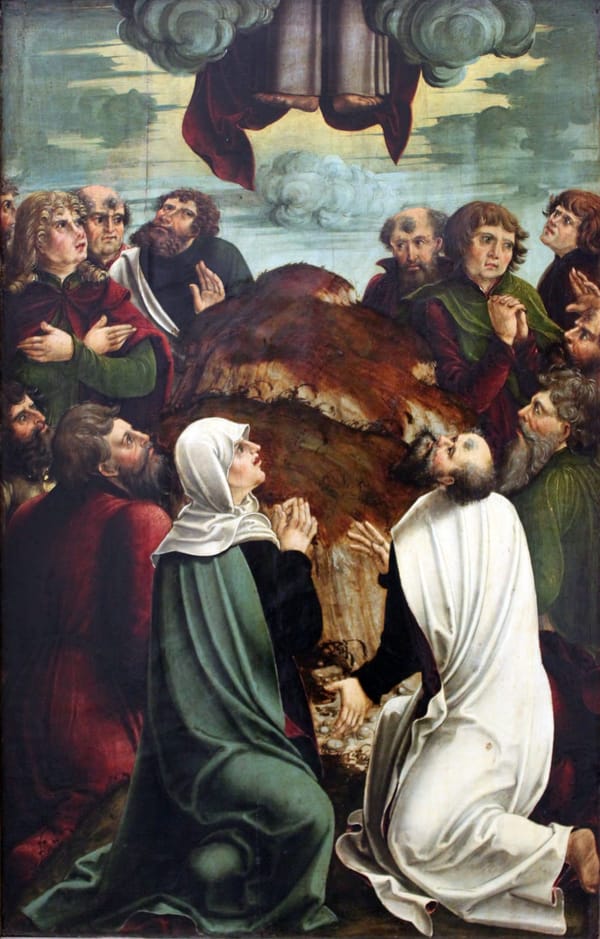
Thursday within the Octave of the Ascension
We have already seen how the Ascension of our Emmanuel won Him the empire over our understanding: it was the triumph of faith. The same mystery gave Him a second victory: the victory of love, which makes Him reign in our hearts. For eighteen hundred years, in whom have men believed, firmly and universally, except Jesus? In what have men agreed, except the dogmas of faith? What countless errors has this divine torch dispelled! What light has it given to the nations that received it! And in what darkness has it left those which rejected it after having once received it!
In like manner, no one has been loved as our Jesus has been, ever since the day of His Ascension; no one is so loved now or ever will be, as He. But that He might thus win our love He had to leave us, just as He had to do in order to secure our faith. Let us return to our text, that we may get deeper into the beautiful mystery.’It is expedient for you that I go!’1 Before the Ascension, the disciples were as inconstant in their love as they were in their faith. Jesus could not trust them. But no sooner had He left them, than they became warmly devoted to Him. Instead of complaining of their bereavement, they returned full of joy to Jerusalem. The thought of their master’s triumph made them forget their own loss, and they hastened, as He bade them, to the cenacle, where they were to be endued with power from on high. Watch these men during the subsequent years; examine what their conduct was from that time to the day of their death; count, if you can, their acts of devotedness in the arduous labour of preaching the Gospel; and say, if any other motive than love for their master could have enabled them to do what they did. With what cheerfulness did they drink His chalice!2 With what raptures did they hail His cross, when they saw it being prepared for themselves!
But let us not stop at these first witnesses; they had seen Jesus, and heard Him, and touched Him.3 Let us turn to those who came after them, and knew Him by faith only; let us see if the love, which burned in the hearts of the apostles, has been kept up by the Christians of the past eighteen centuries. First of all, there is the contest of martyrdom, which has never been altogether interrupted since the Gospel began to be preached. The opening campaign lasted three hundred years. What was it that induced so many millions to suffer, not only patiently but gladly, every torture that cruelty could devise? Was it not their ambition to testify how much they loved their Jesus? Let us not forget how these frightful ordeals were cheerfully gone through, not only by men hardened to suffering, but also by delicate women, by young girls, yea even by little children. Let us call to mind the sublime answers they gave to their persecutors, whereby they evinced their generous ardour to repay the death of Jesus by their own. The martyrs of our own times, in China, Japan, the Corea, and elsewhere, have repeated, without knowing it, the very same words to their judges and executioners as were addressed to the proconsuls of the third and fourth centuries by the martyrs of those days.
Yes, our divine King who has ascended into heaven, is loved as no other ever was or could be. Think of those millions of generous souls, who, that they might be exclusively His, have despised all earthly affections, and would know no other love than His. Every age,—even our own, in spite of all its miseries,—has produced souls of this stamp, and God alone knows how many.
Our Emmanuel has been, and to the end of time will ever be, loved on this earth. Have we not reason to say so, when we consider how many there have always been, even among the wealthiest ones of the world, who, in order that they might bear a resemblance to the Babe of Bethlehem, have given up everything they possessed? What an irresistible proof of the same truth we have in the countless sacrifices of self-love and pride, made with a view to imitate the obedience of the God-Man on earth! And what else but an ardent love of Jesus could have prompted those heroic acts of mortification and penance, whereby the sufferings of His Passion have been emulated, and, as the apostle says, filled up?4
But grand as all this is, it was not enough to satisfy man’s devoted love of His absent Lord. Jesus had said: ‘Whatsoever you do to the least of your brethren, you do it to Me.’5 Love is ever quick at catching the meaning of our Redeemer’s words. It took advantage of these, and saw in them another means for reaching Jesus,—reaching Him through the poor. And as the worst of poverties is the ignorance of divine truths, because it would make a man poor and miserable for eternity, therefore have there risen up in every age zealous apostles, who, bidding farewell to home and fatherland, have carried the light of the Gospel to them that sat in darkness and in the shadow of death. They heeded not the fatigues or the perils of such a mission: what cared they for all these things, if they could but make Jesus known and honoured and loved by one poor savage or Hindoo?
But what of those other poor ones, the sick, in whom Jesus suffers? Fear not: He is too much loved to be forgotten there. Once let the Church be free enough to develop her plans of charity, and there will be an institute of relief for every class of sufferers. The poor, the sick, all will be cared for and comforted. There will be vocations to charity, to meet every want; and women, too, urged by the love of their divine Lord, will deem it an honour to be the nurses and attendants of a suffering or dying Lazarus. The world itself is in admiration at their heroism; and though it knows not the divine principle which originates these charitable institutions, yet is it obliged to acknowledge the extraordinary good they effect.
But man’s observation can only reach the exterior; the interior is the far grander reality, and it is beyond his notice. What we have said so far is, therefore, but a very feeble description of the ardour wherewith our Lord Jesus Christ has been, and still is, loved on this earth. Let us picture to ourselves the millions of Christians who have lived since the first foundation of the Church. Many, it is true, have had the misfortune to be unfaithful to the object of their existence; but what an immense number have loved Jesus with all their heart and soul and strength!
Some have never flagged in their love; others have needed a conversion from vice or tepidity, returned to Him, and slept in the kiss of peace. Count, if you can, the virtuous actions, the heroic sacrifices, of those countless devoted servants of His, who are to be arrayed before Him in the valley of Josaphat. His memory alone can hold and tell the stupendous total of what has been done. This well-nigh infinite aggregate of holy deeds and thoughts, from the seraphic ardour of the greatest saint down to the cup of cold water given in the name of the Redeemer, what is it all but the ceaseless hymn of our earth to its beloved absent One, its never-forgotten Jesus? Who is the man, how dear soever his memory may be, for whom we would be devoted, or sacrifice our interests, or lay down our lives, especially if he had been ten or twenty ages gone from us? Who is that great Dead, the sound of whose name can make the hearts of men vibrate with love, in every country, and in every generation? It is Jesus, who died, who rose again, who ascended into heaven.
But we humbly confess, O Jesus, that it was necessary for us that Thou shouldst go from us, in order that our faith might soar up to Thee in heaven, and that our hearts, being thus enlightened, might burn with Thy love. Enjoy thine Ascension, O Thou King of angels and of men! We, in our exile, will feast on the fruits of the great mystery, waiting for it to be fulfilled in ourselves. Enlighten those poor blind infidels, whose pride will not permit them to recognize Thee, notwithstanding these most evident proofs. They continue in their errors concerning Thee, though they have such superabundant testimony of Thy Divinity in the faith and love Thou hast received in every age. The homage offered Thee by the universe, represented, as it has ever been, by the chief nations of the earth and by the most virtuous and learned men of each generation, is as nought in the eyes of these unbelievers. Who are they, to be compared with such a cloud of faithful witnesses? Have mercy on them, O Lord! save them from their pride; then will they unite with us in saying:’It was indeed expedient for this world to lose Thy visible presence, O Jesus! for never were Thy greatness, Thy power, and Thy Divinity, so recognized and loved, as when Thou didst depart from us. Glory, then, be to the mystery of Thine Ascension, whereby, as the psalmist prophesied, Thou receivedst gifts, that Thou mightest bestow them upon men!’6
We will take a hymn to-day from the Greek Church: it is the one she sings in honour of our Redeemer’s triumph, at her evening Office of Ascension day.
Hymn (In Assumptione Domini, ad magnum Vespertinum.)
As a close to this glorious octave, we offer the eighth and last of the beautiful prayers given by the Mozarabic breviary in honour of our Lord’s Ascension.
Prayer
June 2: Sts. Marcellinus, Peter, and Erasmus, Martyrs
THE glory of martyrdom illumines this day with a profusion rarely met with in the cycle; and already we seem to descry the rosy dawn of that brightest day of this month, on which Peter and Paul will consummate in their blood their own splendid confession. Italy and Gaul, Rome and Lyons concur in forming a legion of heroes in the service of heaven. For to-day Lyons, the illustrious daughter of Rome, is keeping the special festival of a whole phalanx of warriors, headed by the veteran chief, St Pothinus, disciple of St Polycarp, who, in the second century, levied the brave recruits of his battalion on the banks of the Rhone.1 But to the mother Church are due the first honours. Let us, then, hail Marcellinus, together with the numerous progeny begotten by his fruitful priesthood, and rendered worthy by the Holy Ghost to share in his triumph. Let us hail, likewise, the exorcist, Peter, leading to the sacred font a long line of pagans whom he won over to Christ by proving to them the weakness of the demons.
When Christianity appeared on earth, Satan was visibly the prince of this world. To him was every altar reared; to his empire were all laws and customs subservient. From the depths of their famous temples, the demon chiefs directed the political affairs of the cities that came to consult their oracles; under divers names the lowest of the fallen angels found honour and influence at the domestic hearth; others had functions assigned to them, in forests, on mountains, at fountains, or on sea, occupying, in opposition to God, this world that had been created by him for his glory, but which Satan, through man’s connivance, had conquered. Four thousand years of abandonment on the part of heaven permitted the usurper to consolidate his conquest; and a strong defence had been planned in preparation for the day on which the lawful King should offer to re-enter on his rights.
The coming of the Word made Flesh was the signal for the assertion of the divine claim. The prince of this world, personally vanquished by the Son of God, understood well enough that he must needs return to the depths of hell. But the countless powers of darkness constituted by him would maintain the struggle through the length of ages, and dispute their position inch by inch. Driven from towns by the abjurations of holy Church and the triumph of martyrs, the infernal legions would fain marshal their ranks in the wilderness; there, under the leadership of an Anthony or a Pachomius, the soldiers of Christ must wage against them ceaseless and terrific battle. In the west, Benedict, the patriarch of monks, finds altars to the demons, and even demons themselves, on the heights of Cassino as late as the sixth century. Even in the seventh, they are found contending against St Gall for possession of the woods, lakes and rocks of what we now call Switzerland; and at last they are heard uttering mournful complaint, because, driven from the haunts of men, even such desolate spots as these are denied them. Verily, in the divine mind, the vocation of a monk to the desert has for itsend, not only flight from the world and its concerns, but likewise the pursuit of demons into their last entrenchments.
We have dwelt upon these considerations because their importance is extreme, and because this subject is now systematically ignored. True Christians firmly believe, now as formerly, in the spiritual combat which the soul has to sustain against hell, in the secrecy of conscience; but too many have no scruple in rejecting, as if belonging to the domain of the imagination, whatever is related of the public combats maintained by our fathers against the demons. The excuse for such Christians is, no doubt, the fact that they live in a land where this external war was ended centuries ago by the social victory of Christendom. But the Holy Ghost has declared that the old serpent, bound up for a thousand years, is at last to be again unchained for a while.2 If we be nearing this fatal epoch, it is high time to look about us; we shall be ill prepared for waging the old battles, if we persist in our ignorance, and in branding with the name of legend the best attested facts in the history of our ancestors. After all, what is history, since the revolt of Lucifer, but a picture of the war that is being waged between God and Satan? Now if Satan has, by divine permission, invaded the exterior world as well as that of souls, must not the struggle to cast him out3 be a hand to hand fight, an exterior and visible encounter?
‘The Word,’ says St Justin, ‘was made Flesh for two ends: to save believers, and to drive away demons.’4 So also, the expulsion of demons from the places they occupy in this material world, and specially in the noblest part thereof, the bodies of men, appears in the Gospel to have been one of the chief characteristics of our Saviour’s power. Again, when on quitting the earth he sent his apostles to continue his work amidst the nations, this is the very thing he singled out as a primary sign of the mission they were to fulfil.5 The world of that day made no mistake about it. Soon enough had the pagans to witness the cessation of the ancient oracles in every place;6 and the cause of a phenomenon of such import to the ancient religion was evident to all: the very demons themselves were not backward in ascribing to the Christians their enforced silence. As regards this power of Christianity against hell, the apologists of the second and third centuries appeal on the subject to public testimony, without fear of contradiction. ‘Before the eyes of everyone,’ says St Justin to the emperors, ‘ the Christians drive out demons in the name of Jesus Christ, not only in Rome, but in the whole universe.᾽7 The gods of Olympus beheld themselves shamefully unmasked, in the presence of their confused adorers, and Tertullian might well challenge the magistrates of the empire thus: ‘Let one of those men who declare themselves to be under the power of the gods, be brought before your tribunals: at the command of the first comer amongst us, the spirit whereby they are possessed will be constrained to confess what he is; if he avow not himself a demon and no god, fearing to lie to a Christian, at once shed the blood of this Christian blasphemer. But no; it is the terror they have of Christ that forces them to take flight at the mere touch or even the breath of one of his servants.᾽8
Baptism sufficed to give man such power as this; and this was the real meaning of our Lord’s promise, when speaking not only of the heads of the Church, but of all who would believe in him, he said: ‘In my name they shall cast out devils.᾽9 At an early date, however, the Church, organizing the holy war, constituted among her sons one special Order having for its direct mission the pursuit of Satan on every point of this visible world. The exorcists were, by this delegation, invested with a power that accelerates the downfall of the prince of this world; and to render this defeat more odious and humiliating the Church raised no higher than to the rank of inferior clergy an Order so terrible to hell. Lucifer had aimed at being equal to the Most High;10 hurled down from heaven, he flattered himself in his folly that he would be able to supplant God upon the earth: and lo! the charge of defeating him here is confided not to angels, his equals by nature, but to men, and even to the least of this credulous race which for long ages he had seen prostrate before him! Their hand of flesh constrains him, spirit though he be, to come off his throne; at their word he must needs cast away his vain adornments, he must unmask himself; the water they bless rekindles within him his eternal tortures; of the prince of this world and his pomps nought remains but mere Satan, the ugly-faced apostate, the condemned criminal wincing in the dust at the feet of the sons of men, or fleeing like a dry leaf before the breath of their mouth.
The archangel Michael recognizes, in these sons of Adam, the worthy allies of the faithful angels he led forward to victory. But amid those who continue the mighty battle begun on the heights of heaven,11 the exorcist Peter comes before us to-day radiant with matchless splendour. The triumph of martyrdom has been added to his victories won over Satan's cohorts. None better than he drove hell back; for, chasing the demons out of men’s bodies, he moreover made conquest of their souls. The priest Marcellinus, the companion of his victories and martyrdom, is likewise his associate in glory. The Church wishes that these two names, so formidable to the spirits of darkness, should shine in one same aureole here below as in heaven. Daily does she render them the most solemn homage in her power by naming them both, on the diptych of the holy Sacrifice, together with the apostles and her first sons. Such was the importance of the mission they fulfilled and the renown of their final combat, that their bodies, translated to the Via Latina, became the nucleus of an illustrious cemetery. In the age of peace, that came soon after their glorious confession, the Christians vied with one another in obtaining sepulture near these soldiers of Christ, whose protection they craved. Constantine the Great, the vanquisher of idolatry, deposited at their sacred feet the remains of his mother, St Helena, who had herself become a terror to the demons by her discovery of the true Cross. A celebrated inscription was composed in their honour by St Damasus, who in childhood had learned the details of their martyrdom from their executioner himself after his conversion; this inscription, near their tomb, completed the monuments of that catacomb wherein Christian art had multiplied its richest teachings.
To the memory of Saints Marcellinus and Peter is joined, in the liturgy of to-day, the name of a holy bishop and martyr, formerly well known to the faithful. If the acts of his life which have reached us are not free from all reproach from a critical point of view, the favours obtained by the intercession of St Erasmus or Elmo wafted his name over the whole of Christendom, as is attested by the numberless forms this name assumed in various countries of the west during the middle ages. He holds a place in the group of saints styled auxiliatores or helpers, whose cultus is widespread particularly in Germany and Italy. Mariners look upon him as their patron, because of a certain miraculous voyage related in his life; one of the tortures to which he was subjected during his martyrdom has caused him to be invoked for colic. Nor should we forget to mention here how great a veneration St Benedict, the patriarch of western monks, had for St Erasmus; when he quitted the Campagna for his solitude on the banks of the Anio, he marked his principal station between Subiaco and Monte Cassino, by building a church and monastery at Veroli under the invocation of this holy martyr; he dedicated another in Rome itself to St Erasmus.
Let us now read the few lines devoted by the Church to the memory of our three Saints.
Holy martyrs, you all confessed Jesus Christ, in the midst of the most terrific storm ever raised by the demon against the Church. Though all three in different grades of the hierarchy, you were alike guides of the Christian people, drawing them by thousands in your train, into the arena of martyrdom, and, by still more numerous conversions, filling up the void made in earth's chosen band by the departure of your victorious companions to heaven. Wherefore the Church this day joins her grateful homage here below, with the congratulation that rings through the Church triumphant. Be propitious, as of yore, in alleviating the ills that overwhelm mankind in this vale of tears. The excess of man's misery is that he seems to have forgotten how to call on such powerful protectors in his hour of need. Revive your memory, in our midst, by new benefits to our race.
As thou, O Erasmus, wast formerly protected by heaven, do thou now, in thy turn, succour those who are a prey to the tempest-tossed sea. In thy last hour of bitter anguish, thou didst suffer thine executioners to tear thy very bowels; lend a kindly aid to such as call upon thy name when racked by pains which bear some resemblance, though but faint, to what thou didst endure for Christ.
Peter and Marcellinus, linked one to another both in toil and in glory, cast gentle eyes upon us: one glance of yours would make all hell to tremble, and would drive far from us its cohorts. But how much is your aid needed in society at large, in the whole visible world! The foe you so mightily thrust backwards into the fiery pit is once more master. Alas! have we come to the time in which, again taking up war against the saints, it shall be granted him to overcome them?12 Scarce does he even hide himself nowadays. Societies which formerly worked in secret have now openly surrendered to him a thousand sources of evil; he may be seen trying to push his way into gatherings of all sorts, into the very bosom of homes, as a family guest, as a comrade in diversion or in business, with table-turning and all those processes for divination, such as Tertullian denounced in your early day.13 The expulsion of demons by Christianity had been so absolute that, up to more recent times, such fatal practices had fallen into utter oblivion amongst us. If at first, in Christian families, the warning voice of the pastors of God's Church has prevailed over the incitements of an unhealthy curiosity, a sect has since been formed, in which Satan is sole guide and oracle. The spiritists, as they are called, in concert with freemasonry, are preparing the way for the final invasion of the exterior world by infernal bands. Antichrist, with his usurped power and vain prestige, will be but the common product of political lodges and of this sect which proposes to bring back, under a new form, the ancient mysteries of paganism. Valiant soldiers of the Church, make us, we beseech you, worthy of our forefathers. If the Christian army must needs decrease in numbers, let its faith wax all the stronger; let its courage neither fail nor go astray; may its ranks be seen facing the foe, at that last hour in which the Lord Jesus will slay, with the breath of his mouth, the man of sin,14 and plunge once again and for ever the whole of Satan's crew down into the lowest depths of the bottomless pit.
- Note of the Translator. Ss. Pothinus, Blandina, and companions, martyrs of Lyons, are marked on this day in the Roman Martyrology, but as the feast is kept only in France, we have omitted in our translation the pages devoted to their memory in this place. ↩︎
- Apoc. xx 2, 3. ↩︎
- St John xii 31. ↩︎
- 2 Apol. vi. ↩︎
- St Mark xvi 17. ↩︎
- Plutarch, De oraculor. defectu. ↩︎
- 2 Apol. vi. ↩︎
- Apol. xxiii. ↩︎
- St Mark xvi 17. ↩︎
- Is. xiv 12-15. ↩︎
- Apoc. xii 7-9. ↩︎
- Apoc. xiii 7. ↩︎
- Apolog. xxiii. ↩︎
- 2 Thess. ii 8. ↩︎
| Previous Wednesday within the Octave of the Ascension | Next June 2: Sts. Marcellinus, Peter, and Erasmus, Martyrs |