Daily reading
Semidouble · Movable from Easter · Temporal
June 3, 2022
From Dom Guéranger’s The Liturgical Year.
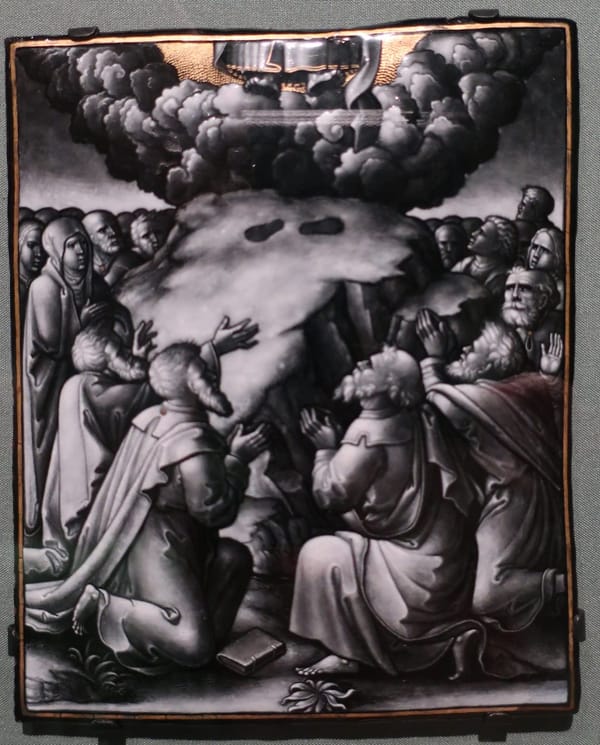
Friday after the Octave of the Ascension
The octave is over; the mystery of the glorious Ascension is completed; and our Jesus is never again to be seen upon this earth, until He comes to judge the living and the dead. We are to see Him only by faith; we are to approach Him only by love. Such is our probation; and if we go well through it, we shall, at last, be permitted to enter within the veil, as a reward for our faith and love.
Let us not complain of our lot; rather let us rejoice in that hope, which, as the apostle says, confoundeth not.1 And how can we be otherwise than hopeful, when we remember that Jesus has promised to abide with us even to the consummation of the world?2 He will not appear visibly; but He will be always really with us. How could He abandon His bride the Church? And are not we the children of this His beloved bride?
But this is not all: Jesus does something more for us. One of His last words was this, which shows us how dearly He loved us: ‘I will not leave you orphans.’3 When He used those other words, upon which we have been meditating during the last few days, ‘It is expedient for you that I go’, He added: ‘For if I go not, the Paraclete will not come to you.’4 This Paraclete, this comforter, is the Holy Ghost, the Spirit of the Father and of the Son; He is to descend upon us a few short hours hence; He will abide with us, making us feel His presence by His works, until Jesus shall again come from heaven that He may take His elect from a world which is to be condemned to eternal torments for its crimes. But the Holy Ghost is not to come until He be sent; and as the sacred text implies, He is not to be sent, until ‘Jesus shall have been glorified.’5 He is coming that He may continue the great work, which was to be begun by the Son of God, and carried on by Him as far as the eternal decrees had ordained.6
Jesus laboured in this work, and then entered into His rest, taking with Him our human nature, which, by assuming it, He had exalted to the divine. The Holy Ghost is not to assume our humanity; but He is coming to console us during Jesus’ absence; He is coming to complete the work of our sanctification. It was He that produced those prodigies which we have been admiring: the faith and love of man in and for Jesus. Yes, it is the Holy Ghost who produces faith in the soul; it is the Holy Ghost who ‘pours the charity of God into our hearts.’7
So, then, we are about to witness fresh miracles of God’s love for man! A few hours hence, the reign of the Holy Ghost will have begun on earth. There is but the interim of this one short day, for to-morrow evening the solemnity of Pentecost will be upon us. Let us then linger in our admiration of our Emmanuel. The holy liturgy has daily gladdened us with His presence, beginning with those happy weeks of Advent, when we were awaiting the day on which the Virgin Mother was to give us the ever blessed Fruit. And now He is gone! O sweet memories of the intimacy we enjoyed with our Jesus, when we were permitted to follow Him day by day, we have you treasured within us! Yea, the holy Spirit Himself is coming to impress you still deeper on our hearts; for Jesus told us that, when the Paraclete should come to us, He would help us to remember all that we have heard, and seen, and felt in the company of the God who deigned to live our life that so He might teach us to live His for all eternity.8
Neither let us forget how, when quitting this His earthly home,—where He was conceived in Mary’s womb, where He was born, where He spent the three and thirty years of His mortal life, where He died, where He rose from the grave, and from which He ascended to the right hand of His Father—He left upon it an outward mark of His love. He left the impress of His sacred feet upon Mount Olivet, as though He felt separating Himself from the earth to which so many years and mysteries had endeared Him. St. Augustine, St. Paulinus of Nola, Saint Optatus, Sulpicius Severus, and the testimony of subsequent ages, assure us of the prodigy.
These venerable authorities tell us that when the Roman army, under Titus, was encamped on Mount Olivet while besieging Jerusalem, divine Providence protected these holy marks, the farewell memorial left by our Lord to His blessed Mother, to His disciples, and to us: it is here that He stood when last seen on earth, it is here that we shall again see Him when He comes to judge mankind. Neither the rude tramp of the soldiers, nor the ponderous chariots, nor the horses’ hoofs, were permitted to efface or injure the sacred footprints. Yes, it was on this very mount, forty years after the Ascension, that the Roman banner was first unfurled, when the time of God’s vengeance came upon the city of deicide. Let us call to mind, firstly, how the angels announced that the same Jesus, who had just ascended, would again come to judge us; and secondly, how our Lord Himself had compared the two awful events, the destruction of Jerusalem, and the end of the world. These sacred marks of Jesus’ feet are, therefore, the memorial of His affectionate farewell, and the prophecy of His return as our terrible Judge. At the foot of the hill lies the valley of Josaphat, the valley of the judgement; and the prophet Zacharias has said: ‘His feet shall stand, in that day, upon the mount of Olives, which is over against Jerusalem, towards the east.’9 Let us humbly give admission to the feeling of fear, wherewith our Lord thus inspires us, that we may be more solidly grounded in His love; and let us affectionately venerate the spot on which our Emmanuel left the impress of His feet. The holy empress, St. Helen, was entrusted with the sublime mission of finding and honouring the objects and places that our Redeemer had sanctified by His visible presence. Mount Olivet was sure to elicit her devoted zeal. She ordered a magnificent church of circular form to be built upon it; but when the builders came to pave the church with rich marble, they were prevented, by a miraculous power, from covering the spot on which were imprinted the holy footmarks. The marble broke into a thousand pieces, which struck them on the face; and after several attempts, they resolved to leave that part of the rock uncovered.
This fact is attested by many holy and creditable authors, several of whom lived in the fourth century, when it occurred. But our Lord would do more than keep open to our view these His last footprints, which seem to be ever saying to us: ‘Your Jesus is but now gone, and will soon return.’ He would, moreover, have them teach us that we are to follow Him to heaven. When the time came for roofing the church, the men found that they had not power to do it; the stones fell as often as they attempted to put them up, and the building was left roofless, as though it had to be our reminder that the way opened by Jesus on the summit of Mount Olivet is ever open for us, and that we must be ever aspiring to rejoin our divine master in heaven.
In his first sermon for the feast of the Ascension, St. Bernardine of Siena relates an edifying story, which is in keeping with the reflections we have been making. He tells us that a pious nobleman, desirous of visiting the places that had witnessed the mysteries of our Redemption, passed the seas. Having reached Palestine, he would begin his pilgrimage by visiting Nazareth, and there, on the very spot where the Word was made Flesh, he gave thanks to the infinite love that had drawn our God from heaven to earth, in order that He might save us from perdition. The next visit was to Bethlehem, where our pilgrim venerated the place of our Saviour’s birth. As he knelt on the spot where Mary adored her new-born Babe, the tears rolled down his cheeks, and, as St. Francis of Sales says (for he also has related this affecting story), ‘he kissed the dust whereon the divine Infant was first laid.’10
Our devout pilgrim, who bravely travelled the country in every direction, went from Bethlehem to the banks of the Jordan; he stopped near Bothabara, at a little place called Bethany, where St. John baptized Christ. The better to honour the mystery, he went down into the bed of the river, and entered with much devotion into the water, thinking within himself how that stream had been sanctified by its contact with Jesus’ sacred Body. Thence he passed to the desert, for he would follow, as nearly as might be, the footsteps of the Son of God; he contemplated the scene of our Master’s fasting, temptation, and victory. He next went on towards Thabor; he ascended to the top, that he might honour the mystery of the Transfiguration, whereby our Saviour gave to three of His disciples a glimpse of His infinite glory.
At length, the good pilgrim entered Jerusalem. He visited the cenacle; and we can imagine the tender devotion wherewith he meditated on all the great mysteries that had been celebrated there, such as Jesus’ washing His disciples’ feet, and the institution of the Eucharist. Being resolved to follow his Saviour in each station, he passed the brook Cedron, and came to the garden of Gethsemani, where his heart well-nigh broke at the thought of the bloody sweat endured by the divine Victim of our sins. The remembrance of Jesus’ being manacled, fettered, and dragged to Jerusalem, next filled his mind. ‘He at once starts off,’ says the holy bishop of Geneva, whom we must allow to tell the rest of the story: ‘treading in the footsteps of his beloved Jesus; he sees Him dragged to and fro, to Annas, to Caiphas, to Pilate, to Herod: buffetted, scoffed at, spit upon, crowned with thorns, made a show of to the mob, sentenced to death, laden with a cross, and meeting, as He carries it, with His heart-broken Mother and the weeping daughters of Jerusalem.
The good pilgrim mounts to the top of Calvary, where he sees in spirit the cross lying on the ground, and our Saviour stretched upon it, while the executioners cruelly nail Him to it by His hands and feet. He sees them raise the cross and the Crucified in the air, and the Blood gushing from the wounds of the sacred Body. He looks at the poor Mother, who is pierced through with the sword of sorrow; he raises up his eyes to the Crucified, and listens with most loving attention to His seven words; and, at last, sees Him dying, and dead, and His side opened with a spear, so that the sacred Heart is made visible. He watches how He is taken down from the cross, and carried to the tomb; and as he treads along the path all stained with his Redeemer’s Blood, he sheds floods of tears. He enters the sepulchre, and buries his heart side by side with his Jesus’ Corpse.
After this, he rises again together with Him; he visits Emmaus, and thinks on all that happened between Jesus and the two disciples. Finally, he returns to Mount Olivet, the scene of the Ascension; and seeing there the last footprints of his dear Lord, he falls down and covers them with untiring kisses. Then, like an archer stretching his bowstring to give his arrow speed, he concentrates into one intense act the whole power of his love, and stands with his eyes and hands lifted up towards heaven: “Jesus!” he says, “O my sweet Jesus! where else am I now to go on earth seeking thee? Ah Jesus! my dearest Jesus, let this heart of mine follow thee yonder!” Saying this, his heart kept darting upwards to heaven, for the brave archer had taken too sure an aim, to miss his divine object.’11
St. Bernadine of Siena tells us, that the companions and attendants of the noble pilgrim, seeing that he was sinking under the vehemence of his desire, hastened to call a physician, that they might bring him to himself again. But it was too late: the soul had fled to her God, leaving us an example of the love that the mere contemplation of the divine mysteries can produce in man’s heart. And have not we been following these same mysteries, under the guidance of the holy liturgy? God grant that we may now keep within us the Jesus whom we have had so truly given to us! And may the holy Spirit, by His coming visit, maintain and intensify in our souls the resemblance to our divine King which we have thus received!
In order the more worthily to celebrate the great mystery which closed yesterday, and the equally glorious one which begins to-morrow, we place between the two the sublime canticle, wherein the royal psalmist prophesies both the Ascension and the Christian Pentecost. The sixty-seventh Psalm (composed for the reception of the Ark of the Covenant on Mount Sion) is, as St. Paul himself has interpreted it,12 a prophecy of Jesus’ triumphant Ascension into heaven. It begins by celebrating the victory gained by Christ over His enemies by His Resurrection; it proceeds to speak of the favours bestowed upon the Christian people; it shows us the combats and triumphs of the Church; in a word, it puts before us the commencement of the work by our Emmanuel, and its consummation by the Holy Ghost. With a view to facilitating the understanding of this mysterious psalm, we give a commentary rather than a translation; and in doing so, we offer to our readers the interpretation given by the early fathers.
Psalm 67
Etenim non credentes, inhabitare Dominum Deum.
Ut intingatur pes tuus in sanguine: lingua canum tuorum ex inimicis, ab ipso.
June 3: St. Clotilde, Queen of the Franks
At this season, in which the Office of the time is leading us to consider the early developments of holy Church, eternal Wisdom so arranges, now as ever, that the feasts of the saints should complete the teachings of the movable cycle. The Paraclete, who has but just come down upon us, is to fill the whole earth;1 the Man-God has sent Him expressly to win over the whole earth and to secure all time to His Church. Now, it is by subjecting kingdoms to the faith, that He is to form Christ’s empire;
it is by enabling the Church to assimilate all nations to herself, that He gives growth and continuance to the bride. See, therefore, how at this Season wherein He has but just taken possession of the world anew, His co-operators in this His work of conquest shine out on every side in the heavens of the holy liturgy. But the west above all concurs in forming the magnificent constellation that is mingling its radiant splendour with the fires of Pentecost. Indeed, what could better show the omnipotence of the Spirit of Christ, than the establishment of this Latin Christendom, in these distant lands of the west?
What star is this shining to-day in such silvery beauty on the land of the Franks? The city of Lyons, prepared by the blood of martyrs for this her second glory, sees this new light rise in her midst. Clotilde is a mother; and the cruel sufferings which wrung her heart while she was yet young matured her soul for the grand destinies reserved by God for the privileged children of sorrow. The violent death of her father Chilperic, dethroned by a fratricidal usurper; the sight of her brothers massacred, and of her mother drowned in the Rhone; her long captivity in the Arian court of the murderer who brought heresy with him to the throne of the Burgundians, developed in her the heroism that was to make this niece of Gondebaud become the mother of a whole nation to Christ.
God drew the visible universe out of nothingness, solely to manifest His goodness. In like manner, He has willed that man, coming from His hands without power as yet to recognize his Creator, should recognize, at least, a mother’s tender love, the first sensible ray, as it were, of infinite love. Irresistible is this ray, sublime in its gentleness, exquisite in its purity, giving to the mother a facility, belonging only to her, to complete in the soul of her child the reproduction of the divine ideal that is to be impressed upon him. Now this she does by education. To-day’s feast reveals how much more sublime, more potent, more extensive, is maternity in the order of grace than in that of nature. For when God, coming down amongst us, was pleased, to take Flesh of a daughter of Adam, maternity was raised in her to the extreme limit that separates the endowments of a simple creature from the divine attributes. Thus rising above the heavens, maternity at the same time embraced the world, bringing all mankind together into close union, without distinction of nation or family, in the one filiation of that Virgin-Mother. The new Adam, the perfect model of our race, and our first born,2 willed to have us for His brethren, in all fullness, brethren in Mary as in God.3 The Mother of God was then proclaimed Mother of men on Calvary; from the summit of the cross, the Man-God replaced upon the brow of Mary that diadem of Eve, broken beneath the fatal tree. Constituted sole Mother of the living by this noble investiture,4 our Lady once again participated in the privileges of the Father who is in heaven. Not only was she Mother by nature, as He is Father, of His Son; but, just as all paternity flows down from the eternal Father, and borrows thence supereminent dignity; so from that moment, all maternity was nought but an outflow of Mary’s in the truest sense; a delegation of her love, and a communication of her august privilege whereby she brings forth men unto God, whose sons they are to be.
Good reason, therefore, have Christian mothers to glory in their maternity, for in that does their greatness consist; through Mary, their dignity has increased to a degree that nature could never have dreamed of. But at the same time, under the aegis of Mary, not less real is the maternity of holy virgins, not only in God’s eyes, but often manifested to their own: the wife, too, prepared by a special call from God and by suffering, is sometimes, like Clotilde, endowed with a fecundity of a spiritual order, a thousand times more prolific than that of earth. Happy the fruits of this supernatural maternity, which under the favour of Mary is fraught with so much greatness! Happy the nations on whom the divine munificence has bestowed a mother!
History tells us how the founders of empires have ever had the terrible prerogative of impressing upon nations the distinctive character, disastrous or beneficial, which, through length of ages, continues to be theirs. How often does that want of counterpoise to the preponderance of power, make itself only too evident in the impetus given rather to destroy than to build up! And wherefore? Because ancient empires never had a mother; for this noble title cannot be applied to those heroines who have transmitted their names to posterity merely for having rivalled the ambition and pomp of conquerors. To Christian times it was reserved to behold introduced into a people’s life this element of maternity, more salutary, more efficacious in its humble gentleness, than that which springs from the talents or vices, from the power or genius, of their first princes.
Time was needed to subdue the savage instincts of the warriors of Clovis, and to fit his sword to the noble destiny that awaited it in the hand of a Charlemagne, or of a St. Louis. With good reason has it been said that the honour of this labour is due to the bishops and the monks. But to be more accurate and to prove a deeper insight into the ways of divine Providence, it would have been well, perhaps, to pass less lightly over woman’s part in the work of conversion and of education, which made the Frankish nation become the eldest son of the Church. Clotilde it was who led the Franks to the baptistery of Rheims, and presented to Remigius the proud Sicambrian, transformed far less by the exhortations of the holy bishop than by the force of prayer, the prayer of that strong woman elected by God to bear away this rich spoil from the camp of hell. What manly energy, what devotedness to God, are displayed in every measure taken by this noble daughter of the Burgundians’ dethroned king! Beneath the suspicious eye of the usurper, the murderer of her family, she awaits, in the silence of prayer and in the exercise of charity, heaven’s appointed hour. When at last the moment comes, taking counsel of none save the Holy Ghost and her own heart, how nobly does she dart forward to conquer unto Christ her betrothed, though yet a stranger to her, out-doing in valour, in this instance, all the warriors of her escort! Strength and beauty were indeed her covering,5 her adornment on her bridal day; and the heart of Clovis soon learnt that the conquests reserved to his bride far out-stripped in importance the booty he had hitherto seized by force of arms. Clotilde, on the other hand, found her work already prepared on the banks of the Seine. For fifty years, St. Genevieve had been busy defending Paris against the pagan hordes, and only awaiting the Baptism of the king of the Franks in order to open to him the city gates.
Still, when on that Christmas night Clotilde gave birth to the eldest son of holy Church in Mary’s name, the great work was far from being completed; this new-born people had yet, by the slow process of a laborious education to be fashioned into the most Christian nation. This chosen one of God and of our Lady does not fall short of the maternal task. But still what anguish of heart to be endured, what tears yet to be shed over these her sons, whose inborn violence seems simply indomitable, and the very exuberance of whose rich nature yields them up to the fury of passions, urging them blindly on to crimes the most atrocious! Her grand-children, inveigled from her side and caught in the perfidious trap laid for them by their faithless uncles, are massacred. Fratricidal wars carry devastation over the whole of that territory of ancient Gaul, purged by her from paganism and heresy. Finally another pang, but one of a more glorious kind, seems given as a compensation for the bitterness of intestine strife. Her cherished daughter, Clotilde the younger, dies, worn out by ill usage endured for her faith at the hand of her Arian husband. Surely all this must have shown clearly enough to the queen of the Franks, that if she was chosen by heaven to be their mother, she was to have all the pangs as well as the honour that title involves. Thus does Christ ever deal with His own, when they have earned His confidence. Clotilde well understood this: already a widow and deprived by death of the aid of Genevieve likewise, she had long ago retired to Tours, near to the sepulchre of the Thaumaturgus of the Gauls. There, in the secret of prayer and in the heroism of her childhood’s faith, did she continue, aided by St. Martin, the preparation of this new people for its mighty destinies.
An immense work was this, and one for which no single life-time could suffice! But though Clotilde was not to witness the desired transformation accomplished, her life was not to close until she had pressed to her heart, at Tours, her illustrious daughter-in-law, Radegonde; and having by this last embrace invested her with her own sublime maternity, she sends her to Poitiers, there to continue, at the tomb of St. Hilary, this great work of intercession. Then, when at length Radegonde herself, having ended her task of suffering and love, must likewise quit this earth, Bathilde will presently come forward to consummate the work, in that remarkable seventh century, when ‘the Frank, at last ready for his mission, is betrothed to holy Church, and dubbed a knight of God.’6
Clotilde, Radegonde, Bathilde, all three of them mothers of France, bear a striking resemblance to one another. All three are prepared, from the early dawn of life, to the devotedness their grand mission would require, by the like trials, captivity, slavery, and massacre or loss of their own relatives: all three bring to the throne nought but a dauntless love of Christ, the King, and a desire of seeing Him rule the people; all three set aside the queenly diadem as soon as may be, in order to be able, prostrate before God in retirement and penitence, to attain more surely the one object of their maternal and royal ambition. Heiresses of Abraham, in very deed, they found in his faith7 the fecundity which made them mothers of those countless multitudes, which the soil watered by their tears produced for heaven. Even in these weakened times of ours, there is still a goodly throng ever passing from the land of the Franks to their true home yonder, there to join the happy bands of the combatants of better days. At the sight of this ever increasing group of sons joyously pressing round their thrones, the hearts of Clotilde, Radegonde, and Bathilde, overflowing with love, give utterance in one united cry, to this word of the Prophet: ‘Who hath begotten these? I was barren and brought not forth, led away, and captive: and who hath brought up these? I was destitute and alone: and these where were they?’ Then the Lord answering, saith: ‘As I live, thou shalt be clothed with all these as with an ornament, and as a bride thou shalt put them about thee. For thy deserts, and thy desolate places, and the land of thy destruction shall now be too narrow by reason of the inhabitants. The children of thy barrenness shall still say in thine ear: the place is too strait for me, make me room to dwell in. And kings shall be thy nursing fathers, and queens thy nurses. And thou shalt know that I am the Lord, for they shall not be confounded that wait for Him.’8
But it is time to listen to the liturgical account of Saint Clotilde’s life.
Great is thy glory on earth and in heaven, O Clotilde, mother of nations! Not only hast thou given to holy Church that people of France, surnamed the most Christian; but our own England and Spain also claim their descent from thee (in the pedigree of faith) by Bertha and Ingonda, thy noble granddaughters. Ingonda, more fortunate than thy daughter Clotilde, succeeded, by the help of Saint Leander of Seville, in bringing back to the true faith her husband Hermenegilde, and even leading him to the crown of martyrdom. Bertha, queen of our own fair Kent, welcomed Augustine to our Saxon shores, and through her influence was our royal Ethelbert brought from the darkness of paganism even unto Baptism and the aureola of sanctity: realizing thus that word of the apostle, that the unbelieving husband is sanctified by the believing wife.9 Since those early days, in how many other parts of Europe, and on how many other more distant shores, have the sons of thine own nation, that nation of which thou wast mother, propagated that light of faith which they received of thee: whether brandishing the sword in defence of the Church’s right to teach freely and everywhere the word of truth; or whether, becoming themselves missioners and apostles, carrying that same truth to infidel nations, far beyond reach of any possible protection, and at the expense of their sweat and of their blood. Happy thou, to be the first in bringing forth unto Christ, the King, a nation pure from every stain of heresy and vowed to holy Church from the first moment of its new birth! Rightly indeed the church of Sainte-Marie at Rheims was the one selected on that Christmas day of the year 496, for this birth unto God of the Frankish nation; wherein our Lady, in a proportionate measure, gave thee to share her own motherhood of our race.
There especially lies our motive of confidence as we turn to thee, O Clotilde, in our intercessory prayer this day. Alas! how many of thy sons are far from being what they should be towards such a mother! But when our Lady gave thee a share in her own maternal rights, she necessarily communicated to thee also her own tender compassion for beguiled children deaf to their mother’s voice. Take pity on these unfortunate sons, led so very far astray by strange doctrines.10 The Christian monarchy founded by thee is no more. Thou didst build it upon the recognized rights of God in His Christ and in the Vicar of His Christ. Princes with shortsighted views of self-interest, traitors to the mission they had received to maintain thy work, imagined they were performing marvels, when they allowed maxims to be spread in thy France, proclaiming the independence of civil power in respect of that of holy Church; and now by a just retribution, society has proclaimed its independence of princes! But at the same time, the infatuated populace has really no other idea than that of being its own sovereign; and intoxicated by this false liberty which it dreams of having acquired, it goes so far as to contemn even the supreme dominion of the Creator Himself. The rights of man have usurped the rights of God, as the basis of social contract; a new-fangled Gospel, which France, with misguided proselytism, is fain to carry over the whole world in place of the true Gospel so loved of yore!
In that unhappy country poisoned by a lying philosophy, such is the excess of delirium, that many who deplore the apostasy of the mass of the population, and wish to remain themselves Christians, imagine they can do so whilst at the same time maintaining the destructive principle of liberalism, the very essence of revolution. Let Christ have heaven and souls, say they, but let man have earth, together with full right of governing it as he chooses, and of thinking as suits him best. While they fall on their adoring knees before the Divinity of our Lord Jesus Christ in the sanctuary of their own conscience, they search the Scriptures, and are too blind to see there expressed how the Man-God is and must be King of the whole earth. In learned theses they inform us that they have probed the very depths of history, and find therein nothing that can contradict their arguments. If indeed they must admit that the government of a Clovis, or a Charlemagne, or a St. Louis does not correspond in everything with their political axioms, we must, they say, make allowances for those primitive ages: a nation cannot be expected to come in a day to the perfect age attained at last by the law of progress! Alas! have pity, O dear mother of France, on the ravings of these poor sons of thine! Arouse once more, in that noble land, the faith of the Franks! Oh! may the God of Clotilde, the Lord of hosts, the King of nations, show Himself once more, leading on thy sons to victory, in the name that won for Clovis the field of Tolbiac: Jesus Christ!
| Previous June 2: Sts. Marcellinus, Peter, and Erasmus, Martyrs | Next June 3: St. Clotilde, Queen of the Franks |