Daily reading
After Pentecost
Double · Movable from Easter · Temporal
June 12, 2022
From Dom Guéranger’s The Liturgical Year.

|
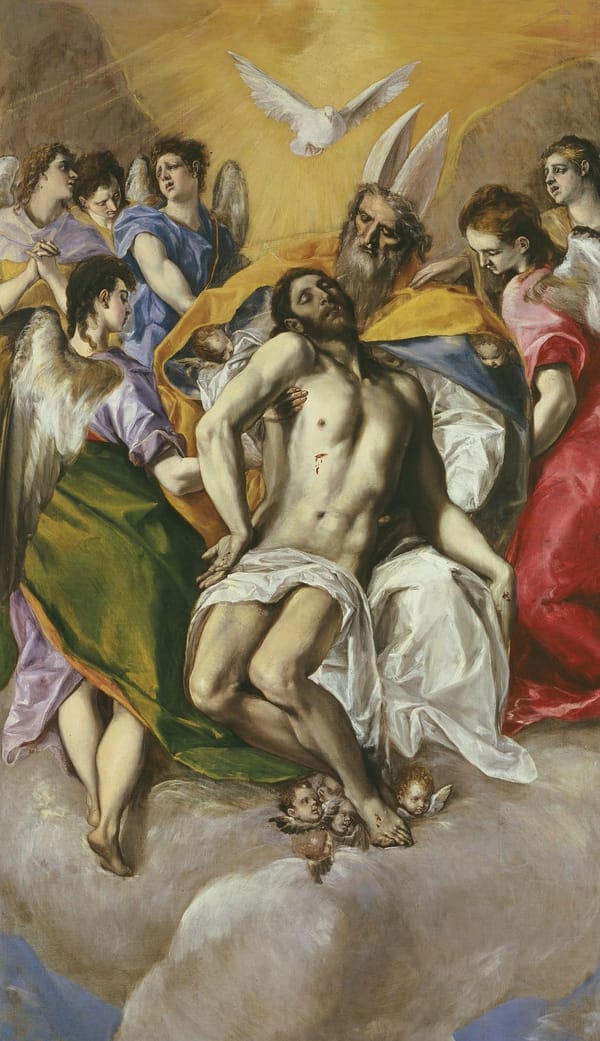
Feast of the Most Holy Trinity
On the day of Pentecost the holy apostles received, as we have seen, the grace of the Holy Ghost. In accordance with the injunction of their divine Master,;1 they will soon start on their mission of teaching all nations, and baptizing men in the name of the holy Trinity. It was but right, then, that the solemnity which is intended to honour the mystery of one God in three Persons should immediately follow that of Pentecost, with which it has a mysterious connection. And yet, it was not until after many centuries that it was inserted in the cycle of the liturgical year, whose completion is the work of successive ages.
Every homage paid to God by the Church’s liturgy has the holy Trinity as its object. Time, as well as eternity, belongs to the Trinity. The Trinity is the scope of all religion. Every day, every hour, belongs to It. The feasts instituted in memory of the mysteries of our redemption centre in It. The feasts of the blessed Virgin and the saints are but so many means for leading us to the praise of the God who is One in essence, and Three in Persons. The Sunday’s Office, in a very special way, gives us, each week, a most explicit expression of adoration and worship of this mystery, which is the foundation of all others, and the source of all grace.
This explains to us how it is that the Church was so long in instituting a special feast in honour of the holy Trinity. The ordinary motive for the institution of feasts did not exist in this instance. A feast is the memorial of some fact which took place at a certain time, and of which it is well to perpetuate the remembrance and the influence. How could this be applied to the mystery of the Trinity? From all eternity, before any created being existed, God liveth and reigneth, Father, Son, and Holy Ghost. If a feast in honour of that mystery were to be instituted, it could only be by fixing some one day in the year, whereon the faithful would assemble for offering a more than usually solemn tribute of worship to the mystery of Unity and Trinity in the one same divine Nature.
The idea of such a feast was first conceived by some of those pious and recollected souls, who are favoured from on high with a sort of presentiment of the things which the Holy Ghost will achieve, at a future period, in the Church. So far back as the eighth century, the learned monk Alcuin had had the happy thought of composing a Mass in honour of the mystery of the blessed Trinity. It would seem that he was prompted to this by the apostle of Germany, Saint Boniface. That this composition is a beautiful one, no one will doubt that knows, from Alcuin’s writings, how full its author was of the spirit of sacred liturgy; but, after all, it was only a votive Mass, a mere help to private devotion, which no one ever thought would lead to the institution of a feast. This Mass, however, became a great favourite, and was gradually circulated through the several Churches; for instance, it was approved of for Germany by the Counoil of Selingenstadt, held in 1022.
In the previous century, however, a feast properly so called of holy Trinity had been introduced into one of the Churches of Belgium—the very same that was to have the honour, later on, of procuring to the Church’s calendar one of the richest of its solemnities. Stephen, bishop of Liège, solemnly instituted the feast of holy Trinity for his Church, in 920, and had an entire Office composed in honour of the mystery. The Church’s law, which now reserves to the holy See the institution of any new feast, was not then in existence; and Riquier, Stephen’s successor in the See of Liège, kept up what his predecessor had begun.
The feast was gradually adopted. The Benedictine Order took it up from the very first. We find, for instance, in the early part of the eleventh century, that Berno, the abbot of Reichna, was doing all he could to propagate it. At Cluny, also, the feast was established at the commencement of the same century, as we learn from the Ordinarium of that celebrated monastery, drawn up in 1091, in which we find mention of holy Trinity day as having been instituted long before.
Under the pontificate of Alexander II, who reigned from 1061 to 1073, the Church of Rome, which has frequently sanctioned the usages of particular Churches by herself adopting them, was led to pass judgment upon this new institution. In one of his decretals, the Pontiff mentions that the feast was then kept in many places; but that the Church at Rome had not adopted it, and for this reason: that the adorable Trinity is, every day of the year, unceasingly invoked by the repetition of the words: Gloria Patri et Filio et Spiritui sancto; as likewise by several formulas expressive of praise.2
Meanwhile, the feast went on gaining ground, as we gather from the Micrologus; and, in the early part of the twelfth century, we have the learned abbot Rupert, who may justly be styled a doctor in liturgical science, explaining the appropriateness of that feast’s institution in these words: ‘Having celebrated the solemnity of the coming of the Holy Ghost, we, at once, on the Sunday next following, sing the glory of the holy Trinity; and rightly is this arrangement ordained, for, after the coming of the same holy Spirit, the faith in, and confession of, the name of Father, Son, and Holy Ghost, immediately began to be preached, and believed, and celebrated in Baptism.’3
In our own country, it was the glorious martyr, St. Thomas of Canterbury, that established the feast of holy Trinity. He introduced it into his archdiocese, in the year 1162, in memory of his having been consecrated bishop on the first Sunday after Pentecost. As regards France, we find a Council of Arles, held in 1260 under the presidency of archbishop Florentinus, solemnly decreeing, in its sixth canon, the feast of holy Trinity to be observed with an octave. The Cistercian Order, which was spread throughout Europe, had ordered it to be celebrated in all its houses, as far back as the year 1230. Duraudus, in his Rationale, gives us grounds for concluding that, during the thirteenth century, the majority of the Latin Churches kept this feast. Of these Churches, there were some that celebrated it, not on the first, but on the last, Sunday after Pentecost; others kept it twice: once on the Sunday next following the Pentecost solemnity, and a second time on the Sunday immediately preceding Advent.
It was evident, from all this, that the apostolic See would finally give its sanction to a practice, whose universal adoption was being prompted by Christian instinct. John XXII, who sat in the Chair of Saint Peter as early as the year 1334, completed the work by a decree, wherein the Church of Rome accepted the feast of holy Trinity, and extended its observance to all Churches.
As to the motive which induced the Church, led as she is in all things by the Holy Ghost, to fix one special day in the year for the offering of a solemn homage to the blessed Trinity, whereas all our adorations, all our acts of thanksgiving, all our petitions, are ever being presented to It: such motive is to be found in the change which was being introduced, at that period, into the liturgical calendar. Up to about the year 1000, the feasts of saints marked on the general calendar, and universally kept, were very few. From that time, they began to be more numerous; and there was evidence that their number would go on increasing. The time would come, when the Sunday’s Office, which is specially consecrated to the blessed Trinity, must make way for that of the saints, as often as one of their feasts occurred on a Sunday. As a sort of compensation for this celebration of the memory of God’s servants on the very day which was sacred to the holy Trinity, it was considered right that once, at least, in the course of the year, a Sunday should be set apart for the exclusive and direct expression of the worship which the Church pays to the great God, who has vouchsafed to reveal Himself to mankind in His ineffable Unity and in His eternal Trinity.
The very essence of the Christian faith consists in the knowledge and adoration of one God in three Persons. This is the mystery whence all others flow. Our faith centres in this as in the master-truth of all it knows in this life, and as the infinite object whose vision is to form our eternal happiness; and yet, we know it only because it has pleased God to reveal Himself thus to our lowly intelligence, which, after all, can never fathom the infinite perfections of that God, who necessarily inhabiteth light inaccessible.4 Human reason may, of itself, come to the knowledge of the existence of God as Creator of all beings; it may, by its own innate power, form to itself an idea of His perfections by the study of His works; but the knowledge of God’s intimate Being can come to us only by means of His own gracious revelation.
It was God’s good-pleasure to make known to us His essence, in order to bring us into closer union with Himself, and to prepare us, in some way, for that face-to-face vision of Himself which He intends to give us in eternity. But His revelation is gradual: He takes mankind from brightness unto brightness, fitting it for the full knowledge and adoration of Unity in Trinity, and Trinity in Unity. During the period preceding the Incarnation of the eternal Word, God seemed intent on inculcating the idea of His Unity, for polytheism was the infectious error of mankind; and every notion of there being a spiritual and sole cause of all things would have been effaced from the earth, had not the infinite goodness of God watched over its preservation.
Not that the old Testament Books were altogether silent on the three divine Persons, whose ineffable relations are eternal; only, the mysterious passages, which spoke of them, were not understood by the people at large; whereas, in the Christian Church, a child of seven will answer those who ask him, that, in God, the three divine Persons have but one and the same Nature, but one and the same Divinity. When the Book of Genesis tells us that God spoke in the plural, and said: ‘Let Us make man to Our image and likeness,’5 the Jew bows down and believes, but he understands not the sacred text; the Christian, on the contrary, who has been enlightened by the complete revelation of God, sees, under this expression, the three Persons acting together in the formation of man; the light of faith develops the great truth to him, and tells him that, within himself, there is a likeness to the blessed Three in One. Power, understanding, and will, are three faculties within him, and yet he himself is but one being.
In the Books of Proverbs, Wisdom, and Ecclesiasticus, Solomon speaks, in sublime language, of Him who is eternal Wisdom; he tells us—and he uses every variety of grandest expression to tell us—of the divine essence of this Wisdom, and of His being a distinct Person in the Godhead; but how few among the people of Israel could see through the veil! Isaias heard the voice of the Seraphim, as they stood around God’s throne; he heard them singing in alternate choirs, and with a joy intense because eternal, this hymn: 'Holy! Holy! Holy! is the Lord!’6 But who will explain to men this triple Sanctus, of which the echo is heard here below, when we mortals give praise to our Creator? So, again, in the Psalms, and the prophetic Books, a flash of light will break suddenly upon us; a brightness of some mysterious Three will dazzle us; but it passes away, and obscurity returns seemingly all the more palpable; we have but the sentiment of the divine Unity deeply impressed on our inmost soul, and we adore the Incomprehensible, the sovereign Being.
The world had to wait for the fullness of time to be completed; and then, God would send into this world His only Son, begotten of Him from all eternity. This His most merciful purpose has been carried out, and the Word made Flesh hath dwelt among us.7 By seeing His glory, the glory of the only-begotten Son of the Father,8 we have come to know that, in God, there is Father and Son. The Son’s mission to our earth, by the very revelation it gave us of Himself, taught us that God is eternally Father, for whatsoever is in God is eternal. But for this merciful revelation, which is an anticipation of the light awaiting us in the next life, our knowledge of God would have been too imperfect. It was fitting that there should be some proportion between the light of faith, and that of the vision reserved for the future; it was not enough for man to know that God is One.
So that, we now know the Father, from whom comes, as the apostle tells us, all paternity, even on earth.9 We know Him not only as the creative power, which has produced every being outside Himself; but, guided as it is by faith, our soul’s eye respectfully penetrates into the very essence of the Godhead, and there beholds the Father begetting a Son like unto Himself. But, in order to teach us the mystery, that Son came down upon our earth. He Himself has told us expressly that no one knoweth the Father, but the Son, and he to whom it shall please the Son to reveal Him.10 Glory, then, be to the Son, who has vouchsafed to show us the Father! and glory to the Father, whom the Son hath revealed unto us!
The intimate knowledge of God has come to us by the Son, whom the Father, in His love, has given to us.11 And this Son of God, who, in order to raise up our minds even to His own divine Nature, has clad Himself, by His Incarnation, with our human nature, has taught us that He and His Father are one;12 that They are one and the same Essence, in distinction of Persons. One begets, the Other is begotten; the One is named Power; the Other, Wisdom, or Intelligence. The Power cannot be without the Intelligence, nor the Intelligence without the Power, in the sovereignly perfect Being: but, both the One and the Other produce a third Term.
The Son, who had been sent by the Father, had ascended into heaven, with the human Nature which He had united to Himself for all future eternity; and lo! the Father and the Son send into this world the Spirit who proceeds from Them both. It was a new Gift, and it taught man that the Lord God was in three Persons. The Spirit, the eternal link of the first two, is Will, He is Love, in the divine Essence. In God, then, is the fullness of Being, without beginning, without succession, without increase; for there is nothing which He has not. In these three eternal Terms of His uncreated Substance, is the Act, pure and infinite.
The sacred liturgy, whose object is the glorification of God and the commemoration of His works, follows, each year, the sublime phases of these manifestations, whereby the sovereign Lord has made known His whole self to mortals. Under the sombre colours of Advent, we commemorated the period of expectation, during which the radiant Trinity sent forth but few of Its rays to mankind. The world, during those four thousand years, was praying heaven for a Liberator, a Messiah; and God’s own Son was to be this Liberator, this Messiah. That we might have the full knowledge of the prophecies which foretold Him, it was necessary that He Himself should actually come: a Child was born unto us,13 and then we had the key to the Scriptures. When we adored that Son, we adored also the Father, who sent Him to us in the Flesh, and with whom He is consubstantial. This Word of life, whom we have seen, whom we have heard, whom our hands have handled14 in the Humanity which He deigned to assume, has proved Himself to be truly a Person, a Person distinct from the Father, for One sends, and the Other is sent. In this second divine Person, we have found our Mediator, who has reunited the creation to its Creator; we have found the Redeemer of our sins, the Light of our souls, the Spouse we had so long desired.
Having passed through the mysteries which He Himself wrought, we next celebrated the descent of the holy Spirit, who had been announced as coming to perfect the work of the Son of God. We adored Him, and acknowledged Him to be distinct from the Father and the Son, who had sent Him to us with the mission of abiding with us.15 He manifested Himself by divine operations which are peculiarly His own, and were the object of His coming. He is the soul of the Church; He keeps her in the truth taught her by the Son. He is the source, the principle of the sanctification of our souls; and in them He wishes to make His dwelling. In a word, the mystery of the Trinity has become to us, not only a dogma made known to our mind by revelation, but, moreover, a practical truth given to us by the unheard-of munificence of the three divine Persons: the Father, who has adopted us; the Son, whose brethren and joint-heirs we are; and the Holy Ghost, who governs us, and dwells within us.
Let us, then, begin this day, by giving glory to the one God in three Persons. For this end, we will unite with holy Church, who in her Office of Prime recites on this solemnity, as also on every Sunday not taken up by a feast, the magnificent Symbol known as the Athanasian Creed. It gives us, in a summary of much majesty and precision, the doctrine of the holy Doctor St. Athanasius, regarding the mysteries of the Trinity and the Incarnation.16
The Athanasian Creed
Quam nisi quisque integram inviolatamque servaverit, absque dubio in æternum peribit.
Fides autem catholica hæc est, ut unum Deum in Trinitate, et Trinitatem in Unitate veneremur:
Neque confundentes Personas, neque substantiam separantes.
Alia est enim Persona Patris, alia Filii, alia Spiritus sancti.
Sed Patrie, et Filii, et Spiritus sancti una est divinitas, æqualis gloria, coæterna majestas.
Qualis Pater, talis Filius, talis Spiritus sanctus.
Increatus Pater, increatus Filius, increatus Spiritus sanctus.
Immensus Pater, immensus Filius, immensus Spiritus sanctus.
Æternus Pater, æternus Filius, æternus Spiritus sanctus.
Et tamen non tres æterni, sed unus æternus.
Sicut non tres increati, nec tres immensi, sed unus increatus et unus immensus.
Similiter omnipotens Pater, omnipotens Filius, omnipotens Spiritus sanctus.
Et tamen non tres omnipotentes, sed unus omnipotens.
Ita Deus Pater, Deus Filius, Deus Spiritus sanctus.
Et tamen non tres Dii, sed us est Deus.
Ita Dominus Pater, Dominus Filius, Dominus Spiritus sanctus.
Et tamen non tres Domini, sed unus est Dominus.
Quia sicut singillatim unamquamque Personam Deum ac Dominum confiteri Christiana veritate compellimur: ita tres Deos aut Dominos dicere Catholica religione prohibemur.
Pater a nullo est factus, nec creatus, nec genitus.
Filius a Patre solo est: non factus, nec creatus, sed genitus.
Spiritus sanctus a Patre et Filio, non factus, nec creatus, nec genitus, sed procedens.
Unus ergo Pater, non tres Patres; unus Filius, non tres Filii; unus Spiritus sanctus, non tres Spiritus sancti.
Et in hac Trinitate nihil prius aut posterius, nihil majus aut minus: sed totæ tres Personæ coæternæ sibi sunt, et coæquales.
Ita ut per omnia, sicut jam supra dictum est, et Unitas in Trinitate, et Trinitas in Unitate veneranda sit.
Qui vult ergo salvus esse: ita de Trinitate sentiat.
Sed necessarium est ad æternam salutem; ut incarnationem quoque Domini nostri Jesu Christi fideliter credat.
Est ergo fides recta, ut credamus et confiteamur: quia Dominus noster Jesus Christus Dei Filius, Deus et homo est.
Deus est ex substantia Patris ante sæcula genitus: et homo est ex substantia matris in sæculo natus.
Perfectus Deus, perfectus homo: ex anima rationali, et humana carne subsistens.
Æqualis Patri secundum divinitatem: minor Patre secundum humanitatem.
Qui licet Deus sit, et homo: non duo tamen, sed unus est Christus.
Unus autem non conversion divinitatis in carnem, sed assumptione humanitatis in Deum.
Unus omnino non confusione substantiæ, sed unitate personæ.
Nam sicut anima rationalis et caro unus est homo, ita Deus et homo unus est Christus.
Qui passus est pro salute nostra, descendit ad inferos, tertia die resurrexit a mortuis.
Ascend it ad cœlos, sedet ad dexteram Dei Patris omnipotentis: inde venturas est judicare vivos et mortuos.
Ad cujus adventum omnes homines resurgere habent cum corporibus suis, et reddituri sunt de factis propriis rationem.
Et qui bona egerunt, ibunt in vitam æternam; qui vero mala, in ignem æternum.
Hæc est fides catholica: quam nisi quisque fideliter, firmiterque crediderit, salvus esse non poterit.
Which faith, except every one doth keep entire, and unviolated, without doubt he shall perish everlastingly.
Now the Catholic faith is this: that we worship one God in Trinity, and Trinity in Unity;
Neither confounding the Persons, nor dividing the substance.
For one is the Person of the Father, another of the Son, and another of the Holy Ghost.
But the Godhead of the Father, and of the Son, and of the Holy Ghost is all one; the glory equal, the majesty coeternal.
Such as the Father is, such is the Son, such is the Holy Ghost.
The Father is uncreated, the Son is uncreated, the Holy Ghost is uncreated.
The Father is incomprehensible, the Son is incomprehensible, the Holy Ghost is incomprehensible.
The Father is eternal, the Son is eternal, the Holy Ghost is eternal.
And yet they are not three eternals, but one eternal.
As also they are not three uncreateds, nor three incomprehensibles, but one uncreated, and one incomprehensible.
In like manner the Father is almighty, the Son is almighty the Holy Ghost is almighty.
And yet they are not three almighties but one almighty.
So, the Father is God, the Son is God, the Holy Ghost is God.
And yet they are not three Gods, but one God.
So, the Father is Lord, the Son is Lord, the Holy Ghost is Lord.
And yet they are not three Lords, but one Lord.
For, as we are compelled, by the Christian truth, to acknowledge each Person, by himself, to be God and Lord; so are we forbidden, by the Catholic religion, to Say there are three Gods, or three Lords.
The Father is made of no one, neither created nor begotten.
The Son is from the Father alone; not made, nor created, but begotten.
The Holy Ghost is from the Father and the Son; not made, nor created, nor begotten, but proceeding.
There is, then, one Father, not three Fathers; one Son, not three Sons; one Holy Ghost, not three Holy Ghosts.
And in this Trinity, there is nothing before or after, nothing greater or less; but the whole three Persons are coeternal to one another, and coequal.
So that, in all things, as hath been already said above, the Unity is to be worshipped in Trinity, and the Trinity in Unity.
He, therefore, that would be saved, must thus think of the Trinity.
Furthermore, it is necessary to everlasting salvation, that he also believe rightly the Incarnation of our Lord Jesus Christ.
Now the right faith is, that we believe and confess that our Lord Jesus Christ, the Son of God, is both God and Man.
He is God, of the substance of his Father, begotten before the world; and he is Man, of the substance of his Mother, born in the world.
Perfect God, perfect Man: subsisting of a rational soul, and human flesh.
Equal to the Father according to his Godhead: less than the Father, according to his Manhood.
Who although he be both God and Man, yet he is not two, but one, Christ.
One, not by the conversion of the Godhead into flesh, but by the taking of the Manhood unto God.
One altogether, not by confusion of substance, but by unity of person.
For, as the rational soul and the flesh is one man, so God and Man is one Christ.
Who suffered for our salvation; descended into hell; rose again, the third day, from the dead.
He ascended into heaven; he sitteth at the right hand of God the Father almighty; from thence he shall come to judge the living and the dead.
At whose coming, all men shall rise again with their bodies; and shall give an account of their own works.
And they that have done good, shall go into life everlasting; and they that have done evil into everlasting fire.
This is the Catholic faith; which except every man believe faithfully and steadfastly, he cannot be saved.
Mass
Although the Sacrifice of the Mass is always celebrated in honour of the blessed Trinity, yet, for this day, the Church, in her chants, prayers, and lessons, honours, in a more express manner, the great mystery, which is the foundation of our Christian faith. A commemoration is, however, made of the first Sunday after Pentecost, in order not to interrupt the arrangement of the liturgy. The colour used by the Church on this feast of Trinity is white, as a sign of joy, as also to express the simplicity and purity of the divine Essence.
The Introit is not taken from holy Scripture. It is a formula of glorification in keeping with the feast, and speaks of the blessed Trinity as the divine source of the mercies bestowed on mankind.
Introit
In the Collect, the Church asks for us firmness in the faith, whereby we confess Unity and Trinity in God. Faith is the first condition required for salvation; it is the first link of our union with God. It is with this faith that we shall conquer our enemies, and overcome all obstacles.
Collect
Commemoration of the First Sunday after Pentecost
Epistle
Cap. xi.O altitudo divitiarum sapientiæ et scientiæ Dei: quam incomprehensibilia sunt judicia ejus, et investigabiles viæ ejus! Quis enim cognovit sensum Domini? aut quis consiliarius ejus fuit? aut quis prior dødit illi, et retribuetur ei? Quoniam ex ipso, et per ipsum, et in ipso sunt omnia: ipsi honor et gloria in sæcula. Amen.
Ch. xi.O the depth of the riches of the wisdom and of the knowledge of God! How incomprehensible are his judgments, and how unsearchable his ways! For who hath known the mind of the Lord? Or who hath been his counsellor? Or who hath first given to him, and recompense shall be made him? For of him, and by him, and in him, are all things: to him be glory for ever. Amen.
We cannot fix our thoughts upon the divine judgments and ways, without feeling a sort of bewilderment. The eternal and the infinite dazzle our weak reason; and yet this same reason of ours acknowledges and confesses them. Now, if even the ways of God with His creatures surpass our understanding, how can we pretend to discover, of ourselves, the inmost nature of this sovereign Being? And yet, in this uncreated Essence, we do distinguish the Father, the Son, and the Holy Ghost from each other, and we glorify them. This comes from the Father’s having revealed Himself, by sending us His Son, the object of His eternal delight; it comes from the Son’s showing us His own Personality, by taking our Flesh, which the Father and the Holy Ghost did not; it comes from the Holy Ghost’s being sent by the Father and the Son, and fulfilling the mission He received from Them. Our mortal eye respectfully gazes upon these divine depths of truth, and our heart is touched at the thought, that it is through God’s benefits to us that He has given us to know Him, and that our knowledge of what He is came through what He gave us. Let us lovingly prize this faith, and confidently wait for that happy moment, when it will make way for the eternal vision of that which we have believed here below.
The Gradual and Alleluia-verse are full of joy and admiration, at the presence of that sovereign Majesty, who has vouchsafed to send forth His rays into the darkness of our minds.
Gradual
Gospel
Cap. xxviii.In illo tempore: Dixit Jesus discipulis suis: Data est mihi omnis potestas in cœlo et in terra. Euntes ergo docete omnes gentes: baptizantes eos in nomine Patris, et Filii, et Spiritus sancti: docentes eos servare omnia quæcumque mandavi vobis. Et ecce ego vobiscum sum omnibus diebus, usque ad consummationem sæculi.
Ch. xxviii.At that time: Jesus said to his disciples: All power is given to me in heaven and in earth. Going, therefore, teach ye all nations: baptizing them in the name of the Father, and of the Son, and of the Holy Ghost: teaching them to observe all things whatsoever I have commanded you. And behold! I am with you all days, even to the consummation of the world.
The mystery of the blessed Trinity, which was taught us by the mission of the Son of God into this world, and by the promise of the speedy sending of the holy Spirit, is announced to men by these solemn words, uttered by Jesus just before His ascension into heaven. He had said: ‘He that shall believe, and shall be baptized, shall be saved’;17 but He adds, that Baptism is to be given in the name of the Father, and of the Son, and of the Holy Ghost. Henceforward man must not only confess the unity of God, by abjuring a plurality of gods, but he must, also, adore a Trinity of Persons in unity of Essence. The great secret of heaven is now published through the whole world.
But, whilst humbly confessing the God whom we have been taught to know as He is in Himself, we must, likewise, pay a tribute of eternal gratitude to the ever glorious Trinity. Not only has It vouchsafed to impress Its divine image on our soul, by making her to Its own likeness; but, in the supernatural order, It has taken possession of our being, and raised it to an incalculable pitch of greatness. The Father has adopted us in His Son become Incarnate; the Word illumines our minds with His light; the Holy Ghost has chosen us for His dwelling: and this it is that is expressed by the form of holy Baptism. By those words pronounced over us, together with the pouring out of the water, the whole Trinity took possession of Its creature. We call this sublime marvel to mind as often as we invoke the three divine Persons, making upon ourselves, at the same time, the sign of the cross. When our mortal remains are carried into the house of God, there to receive the last blessings and farewell of the Church on earth, the priest will beseech the Lord ‘not to enter into judgment with His servant’; and in order to draw down the divine mercy upon this Christian, who has gone to his eternity, he will say to the sovereign Judge that this member of the human family ‘was marked, whilst in this life, with the sign of the holy Trinity.’ Let us respect this divine impress which we bear upon us: it is to be eternal; hell itself will not be able to blot it out. Let it, then, be our hope, our dearest title; and let us live for the glory of the Father, of the Son, and of the Holy Ghost. Amen!
In the Offertory the Church begins the immediate preparation for the Sacrifice, by invoking on the oblation the name of the three Persons, and again proclaiming the mercy of God.
Offertory
In the Secret, holy Church asks that the homage we are making, in this Sacrifice, of ourselves to the sacred Trinity, may be presented to It not to-day only, but may become eternal by our being admitted into heaven, where we shall contemplate, and without a veil, the glorious mystery of God, One in Three Persons.
Secret
Commemoration of the First Sunday after Pentecost
Then follows the Preface; it is proper for this feast, and for all Sundays, throughout the year, which have no other assigned to them.
Preface
In the Communion-anthem, the Church continues her praise of the mercy of the great God, who has made use of His own blessings upon us, in order to enlighten and instruct us regarding His incomprehensible Nature.
Communion
Two things are needed for our reaching God: the light of faith, which gives our understanding to know Him; and the divine Food, which unites us to Him. In the Postcommunion, holy Church prays that we may have both; and be thus brought to that union, which is the happy end of our creation.
Postcommunion
Commemoration of the First Sunday after Pentecost
The last Gospel is that of the first Sunday after Pentecost; it is read by the priest instead of that of St. John.
Gospel
Ps. Dixit Dominus, page 72.
Ps. Confitebor tibi, page 73.
Ps. Beatus vir, page 74.
Ps. Laudate pueri, page 75.
Ps. In exitu Israel, page 76.
Capitulum (Rom. xi.)
Hymn*
Tu lux perennis Unitas,
Nostris, beata Trinitas,
Infunde amorem cordibus.
Te deprecamur vespere;
Digneris ut te supplices
Laudemus inter cœlites.
Tibique sancte Spiritus,
Sicut fuit, sit jugiter
Sæclum per omne gloria.
do thou, O everlasting Unity,
O blessed Trinity, our Light,
pour forth love into our hearts.
in our songs of praise: grant us, thy suppliants,
that we may praise thee
in the company of the citizens of heaven.
and Holy Ghost!
may glory be, as it hath ever been,
for ever and for endless ages.
Antiphon of the Magnificat
Commemoration of the Sunday
The middle ages have left us several sequences for the feast of the blessed Trinity. They are much overladen with metaphyeioal terms, and, for the most part, have but little melody or poetry in them. They give us the language of the Schools, with so much roughness, that they would scarcely find any readers now-a-days to relish them. There is one, however—the one composed by Adam of Saint Victor—which we here insert, as it maintains, even in its scholastic phraseology, all the majesty and melody which characterize the compositions of that great poet.
Sequence
Veneremur Trinitatem pari reverentia,
Personali differentes a se differentia.
Quum sint unum substantive, non tria principia.
Simplex tamen est usia, non triplex essentia.
Simplex velle, simplex nosse, cuncta Simplicia.
Sive trium personarum minor efficacia.
Deus unus: sed hi tamen habent quædam propria.
Unus splendor, unum lumen, hoc una quod alia.
Nec hoc tollit personalia amborum distinctio.
Spiritalis ab utroque procedit connexio.
Capi possunt hæ personæ, nec harum diecretio.
Non hic situs, aut localis rerum circumscriptio.
Nulla causa præter eum qui creat causalia.
Causa Deus, et finalis, sed nunquam materia.
Vim transcendit rationis excedit ingenia.
Me nescire sum professus: sed fide non dubia.
Et a via non declinet insolerter regia.
Nec attendat ad errores quos damnat Ecclesia.
Nos in una modulemur, fidei constantia:
Sit et simplæ Trinitati coæterna gloria!
we venerate the Trinity with one and the same worship;
differing from each other by a personal difference.
for they are substantially one, and not three principles.
thou must remember, that their Nature is one, and that their Essence is not threefold.
and will, and knowledge, all are simple:
than that of two, or of three, Persons.
and yet have they certain things proper.
one splendour, one light: what one hath, another hath.
neither is that equality destroyed by the personal distinction existing between them.
is the spiritual Bond, who proceedeth from both.
comprehend these three Persons, nor their distinction.
no position of place, no boundaries of space.
and, besides him, there is no cause that causeth things produced.
and final; but never cause material.
or genius to speak worthily of the three Persons.
and yet do I believe them with undoubting faith.
and not imprudently stray from the royal path.
and go not over to those errors which the Church condemns.
let us sing our hymns, in the constancy of one same faith;
and coeternal glory to the simple Trinity!
O indivisible Unity! O Trinity distinct in one only Nature! Infinite God, who hast revealed Thy·self unto men! graciously bear with us, while we dare to make our adorations before Thee, and pour forth our heart’s thanksgiving, feeling ourselves overwhelmed by the brightness of Thy majesty. O Unity divine! O divine Trinity! we have not, as yet, seen Thee; but we know that Thou art, for Thou hast vouchsafed to reveal Thyself unto us. This earth, whereon we are living, has the mystery distinctly proclaimed to it, every day of its existence: that same august mystery, whose vision is the source of the happiness enjoyed by the blessed, who are glorified, and are united with Thee in closest union. The human race had to wait long ages, before the divine formula was fully revealed; happy we, who live in its full possession, and can, and do, delightedly proclaim Unity and Trinity in Thine infinite Essence! There was a time, when an inspired writer spoke an allusion to this grandest of truths; but his words flashed across the minds of his hearers, as lightning traverses a cloud, and then leaves it darker than before. ‘I have not learned Wisdom,’ said he, 'and have not known the science of saints. Who hath ascended up into heaven, and descended? Who hath held the wind (the storm) in his hands? Who hath bound up the waters together, as in a garment? Who hath raised up all the borders of the earth? What is his name? and what is the name of his Son, if thou knowest?’18
Thanks to Thine unbounded mercy, O Lord God! we now know Thy name. Thou art called the Father; and He whom Thou begettest from all eternity is named the Word and Wisdom. We know, too, that from the Father and the Son proceeds the Spirit of love. The Son, clad in our flesh, has dwelt on this earth, and lived amongst men; then came down the Spirit, and He abides for ever with us, till the destinies of the human race are accomplished here below. Therefore do we dare to confess the Unity and the Trinity; for we have heard the divine testimony, and have believed; and, having believed, we have spoken, with all certainty.19 Accept, then, this our confession, O Lord, as Thou didst that of Thy brave virgin and martyr, Cecilia, who, when the executioner had thrice struck her neck with the sword, and her noble blood flowed in streams from her wound, expressed her faith, as she breathed forth her soul, and confessed, by the position of her hands, the Unity of Thy Nature and the Trinity of Thy Persons.
The hymn of Thy Seraphim has been heard here on earth: ‘Holy, Holy, Holy, the Lord God of hosts!’20 We are but mortals; we are not prophets, as was Isaias; and yet we have a happiness which he had not: we can repeat the song of those blessed spirits, with fulness of knowledge, and can say unto Thee: ‘Holy is the Father, holy is the Son, holy is the Spirit!' Those same Seraphim flew with two of their wings; with two they hid their face; and with two they covered their feet. So it is with us: strengthened, as we are, by the divine Spirit who has been given to us, we strive to lighten the heavy weight of our frail mortality, and raise it aloft on the wings of desire; we hide our sins by repentance; and veiling the weakness of our intellectual vision beneath the cloud of faith, we receive the light which is infused into our souls. Docile to the revealed word, we submit to its teachings; and it imparts to us not merely a distinct, but even an enlightened, knowledge of that mystery, which is the source and centre of all others. The angels and saints in heaven contemplate it with that inexpressible reserve, which the prophet describes by saying that they hide their face with their wings. We poor mortals have not, and cannot have, the sight of the great truth; but we have the knowledge of it; and this knowledge enlightens our path, and keeps us firm in the truth. We have a dread of presuming to be searchers of Thy majesty, lest we should he overwhelmed by glory21 but, humbly treasuring up what heaven has vouchsafed to reveal to us of its secrets, we dare thus to address Thee:
Glory be to Thee, O divine Essence, that art but one! Thou art pure Act; Thou art Being, necessary, infinite, undivided, independent, perfect from all eternity, peaceful, and sovereignly happy. In Thee we acknowledge, together with the inviolable Unity, which is the source of all Thy perfections, three Persons distinctly subsistent; but, in Their production and distinction, the one same Nature is common to all; so that the personal subsistence which constitutes Them, and distinguishes Them one from the other, causes no inequality between Them. O infinite blessedness in this life of the three Persons! They contemplate in Themselves the ineffable perfections of the Essence which unites Them together, and the attribute of each of the three, which divinely animates the Nature that nought can limit or disturb I O wonder of that infinite Essence, when it deigns to aot outside itself, by creating beings in its power and its goodness! The three Persons work then together; so that the one which acts in a way which is His special attribute does so in virtue of a will common to all. May a special love be given to that divine Person who, in the act which is common to the three, deigns to reveal Himself thus markedly to us creatures; and, at the same time, may thanks be given to the other two, who unite, in one same will, with the Person who vouchsafes to honour us with that special manifestation of Himself!
Glory be to Thee, O Father, Thou Ancient of days!22 Thou art unborn, without beginning; but communicating, essentially and necessarily, to the Son and to the Holy Ghost, the Godhead which dwells in Thee! Thou art God, and Thou art Father. He who knows Thee as God, and knows Thee not as Father, does not know Thee as Thou art. Thou producest, Thou begettest; but it is within Thine own bosom that Thou generatest; for nought is God, which is outside Thyself. Thou art being, Thou art power; but Thou hast never been without a Son. Thou speakest to Thyself all that Thou art; Thou explainest Thyself; and the fruit of the fecundity of Thy thought, which is equal to Thyself, is a second Person coming forth from Thee: it is Thy Son, Thy Word, Thine uncreated Word. Once didst Thou utter this Word; and Thy Word is eternal as Thyself, and as Thy thought, of which that Word is the infinite expression. Like the sun which is visible to our eyes, and which has never existed without its own brightness; this brightness is by the sun, it is with the sun; it emanates from it without lessening it, and it never exists as something independent of its source. Bear, O Father, with this weakness of our understanding, which borrows from the beings Thou hast created, an image whereto to compare Thee. And so, again, if we study ourselves, whom Thou hast created to Thine own likeness, we find that a thought of our own, in order that it may be something distinct from our mind, has need of a term, a word, to fix and express it.
O Father! we have been brought to know Thee by that Son whom Thou eternally begettest, and who has vouchsafed to reveal Himself to us. He has taught us that Thou art Father, and Himself Son; and that, nevertheless, Thou art one with Him.23 When one of His apostles said to Him: ‘Lord! show us the Father,’ He answered him: ‘He that seeth Me, seeth the Father.’24 O Unity of the divine Nature, whereby the Son, though distinct from the Father, is not less than the Father! O delight of the Father in the Son, by whom He has the knowledge of Himself: delight of intimate love, of which He spoke to His creature man, on the banks of Jordan, and on the top of Thabor!25
O Father! we adore Thee, but we also love Thee; for a father should be loved by his children, and we are Thy children. It is an apostle that teaches us that all paternity proceeds from Thee, not in heaven alone, but on earth too.26 No one is father, no one has paternal authority, be it in a family, or in the State, or in the Church, but by Thee, and in Thee, and in imitation of Thee. Nay more: Thou wouldst have us not only be called, but really and truly be Thy sons;27 not, indeed, by generation, as is Thy only-begotten Son, but by an adoption which makes us jointheirs with Him.28 This divine Son speaking of Thee, says: ‘I honour My Father’29 we, also, honour Thee, O sovereign Father, Father of infinite majesty! And, until eternity dawn upon us, we glorify Thee now from the depths of our misery and exile, uniting our humble praise with that which is presented to Thee by the angels, and by the blessed ones who are of the same human family as ourselves. May thy fatherly eye protect us, may it graciously find pleasure in us Thy children, whom, as we hope, Thou hast foreseen, whom Thou hast chosen, whom Thou hast called to the faith, and who presume, with the apostle, to call Thee the Father of mercies, and the God of all consolation.30
Glory be to Thee, O Son, O Word, O Wisdom of the Father! Thou emanatest from His divine Essence. He gave Thee birth before the day-star;31 and He said to Thee: ‘This day have I begotten Thee’;32 and that day which has neither eve nor morrow, is eternity. Thou art Son, and only Son; and this name expresses one same nature with Him who begets Thee; it excludes creation, and shows Thee to be consubstantial with the Father, from whom Thou comest forth, perfectly like Him in all things. And Thou comest forth from the Father, without coming out of the divine Essence, being coeternal with Thy source; for in God there is nothing new, nothing temporal. Thy sonship is not a dependency; for the Father cannot be without the Son, any more than the Son can be without the Father. If it be a glory in the Father to produce the Son, it is no less a glory in the Son to be the exhaustive term to the generative power of the Father.
O Son of God, Thou art the Word of the Father. Uncreated Word, Thou art as intimately in Him, as is His thought; and His thought is His Being. It is in Thee that this His Being expresses itself, in its whole infiniteness; it is in Thee that He knows Himself. Thou art the spiritual fruit produced by the divine intellect of the Father; the expression of all that He is, whether He keep Thee mysteriously in His bosom,33 or produce Thee outside Himself. What language can we make use of, in order to describe Thee, and Thy glories, O Son of God! The Holy Ghost has vouchsafed to come to our assistance, in the writings which He has inspired: and it is with the very expressions He has suggested, that we presume thus to address Thee: ‘Thou art the brightness of the Father’s glory; Thou art the figure of His substance.34 Thou art the brightness of eternal light, and the unspotted mirror of God’s majesty, and the image that reflects His eternal goodness.’35 We presume, likewise, to say to Thee, what we are taught by the holy Church assembled at Nicea: ‘Thou art God of God; Light of Light; true God of true God.’ And we add, with the fathers and doctors: ‘Thou art the torch eternally lit by the eternal torch. Thy light lessens nought of that which communicates Itself to Thee; neither is Thy light inferior in aught to that from which it is produced.’
But when this ineffable fecundity, which gives an eternal Son to the Father and to the Father and Son a third term, willed to manifest Itself outside the divine Essence; and, not having again the power to produce what is equal to Itself, deigned to call forth from nothingness intellectual and rational nature, as being the nearest approach to its author, and material nature, as being the least removed from nothingness—then, O only-begotten Son of God, the intimate production of Thy Person in the Father’s bosom revealed itself by creation. It is the Father who made all things; but it is in Wisdom, that is, in Thee, that He made all.36 This mission of working, which Thou receivedst from the Father, is a consequence of the eternal generation, whereby He produces Thee from Himself. Thou camest forth from Thy mysterious rest; and creatures, visible and invisible, came forth, at Thy bidding, out of nothing. Acting in closest union with the Father, Thou pouredst out upon the worlds thou createdst somewhat of that beauty and harmony, of which Thou art the image in the divine Essence. And yet, Thy mission was not at an end when creation was completed. Angels and men, who were intellectual and free beings, were destined for the eternal vision and possession of God. The merely natural order could not suffice for these two classes of Thy creatures; a supernatural way had to be prepared for them, whereby they might be brought to their last end. Thou, O only-begotten Son of God, art this way. By assuming human nature Thou unitedst Thyself to Thine own work, Thou raisedst angel and man up to God; and by Thy human Nature Thou showedst Thyself as the supreme type of the creation, which the Father bad effected by Thee. Oh unspeakable mystery! Thou art the uncreated Word, and, at the same time, Thou art the First-born of every oreature;37 not, indeed, to appear until Thy time should come; and yet preceding, in the divine mind and intention, all created beings, which were destined to be Thy subjects.
The human race, though destined to possess Thee in its midst as its divine intermediator, rebelled against its God by sin, and, by sin, was plunged into the abyss of death. Who could raise it up again? Who could restore it to the sublime destiny it had forfeited? Thou alone, O only-begotten Son of the Father! It is what we never could have hoped for; but God so loved the world, as to give His only-begotten Son,38 to be not only the Mediator, but the Redeemer, too, of us all. Thou, our First-born, askedst Thy Father to restore Thine inheritance unto Thee;39 Thou hadst to purchase back this inheritance. Then did the Father entrust Thee with the mission of Saviour to our lost race. Thy Blood, shed upon the cross, was our ransom; and by it we were born again to God, and restored to our lost privileges. Therefore, O Son of God, we, Thy redeemed, glory in calling Thee Our Lord.
Having thus delivered us from death, and cleansed us from sin, Thou vouchsafedst to restore us to all the grand things we had lost; for, henceforth, Thou art our Head, and we are Thy members; Thou art King, and we Thy happy subjects; Thou art Shepherd, and we the sheep of Thy one fold; Thou art Spouse, and the Church, our mother, is Thy bride; Thou art the living Bread come down from heaven, and we are Thy guests. O Son of God! O Emmanuel! O Son of Man! blessed be the Father who sent Thee; but blessed, also, be Thou, who didst fulfil the mission He gave Thee, and who hast been pleased to say, that Thy delights are to be with the children of men!40
Glory be to Thee, O holY Spirit, who eternally emanatest from the Father and the Son in the unity of the divine substance! The eternal Act, whereby the Father knows Himself, produces the Son, who is the infinite image of the Father; the Father is full of love for this brightness which eternally proceeds from Himself; and the Son, contemplating the source whence He for ever comes, conceives for this source a love as great as that wherewith He Himself is loved. What language could desoribe this mutual ardour and aspiration, which is the attraction and tendency of one Person to Another in the eternally immovable Essence! Thou art this Love, O divine Spirit, proceeding from the Father and the Son, as from one same principle; Thou art distinct from both, and yet art the bond that unites Them in the ineffable delights of the Godhead; Thou art living Love, personal Love, proceeding from the Father by the Son, the final term which completes the divine Nature, and eternally perfects the Trinity. In the inaccessible bosom of the great God, Thy Personality comes to Thee both from the Father, of whom Thou art the expression by a second production,41 and from the Son, who, receiving of the Father, gives Thee of His own; for the i42 nfinite Love which unites Them is of both Persons, and not of one alone. The Father was never without the Son, and the Son never without the Father; so likewise, the Father and the Son have never been without Thee, O holy Spirit! Eternally have They loved; and Thou art the infinite Love which exists between Them, and to which They communicate Their Godhead. Thy Procession from both exhausts the productive power of the uncreated Essence; and thus are the divine Persons Three in number; all that is outside Them is created being.
In the divine Essence, there is not only Power and Intelligence, but also, and necessarily, there is Will, from which action follows. Will and Love are one and the same thing; and Thou, O divine Spirit, art this Will, this Love. When the glorious Trinity works outside Itself, the act conceived by the Father, and expressed by the Son, is accomplished by Thee. By Thee, likewise, the Love, which the Father and Son have for each other, and which is personalized in Thee, is extended to beings which are to be created. It is by His Word that the Father knows them; it is by Thee, O divine Love, O holy Spirit, that He loves them; and thus, all creation proceeds from the divine goodness.
Emanating, as Thou dost, from the Father and the Son, Thou art sent, by both, to us creatures; and yet so as not to lose thereby the equality Thou hast, from all eternity with Them. The Son, when sent by the Father, clad Himself, once for ever, with our human nature; and His Person, by the works which are peculiarly His own, is shown to us as distinct from that of the Father. So likewise, O holy Spirit, we recognize Thee as distinct from the Father and the Son, by Thy coming down to fulfil in our regard the mission given to Thee by both. It is Thou that inspiredst the prophets;43 Thou that overshadowedst Mary in the divine Incarnation;44 Thou that restedst on the flower of Jesse;45 Thou that ledst Jesus into the desert;46 Thou that didst glorify Him by miracles.47 The Church, His bride, receives Thee, and Thou teachest her all truth,48 and Thou abidest in her, as her devoted friend, even to the very end of time.49 Our souls are signed with Thy seal,50 and Thou quickenest them with supernatural life;51 Thou dwellest even in our bodies, making them Thy temple;52 in a word, Thou art to us the Gift of God,53 and the fountain springing up even into life everlasting.54 May special thanks be given to Thee, O holy Spirit, for the special works Thou accomplishest in our favour!
And now, having adored each of the divine Persons, and blessed each for the favours He has bestowed upon this world, we again dare to fix our unworthy gaze upon that Trinity of Majesty which exists in the Unity of the divine Essence. O Sovereign Lord! we again confess what Thou hast taught us; and we confess it in the words of Thy servant Augustine: ‘They are not more than Three: One that loveth Him who is from Him; and One that loveth Him from whom He is; and One who is that very Love.’55 But we have still a debt of gratitude to pay for that unspeakable favour of Thine, whereby, O blessed Trinity, Thou hast vouchsafed to mark us with the image of Thyself. Having resolved, from all eternity, to admit us into fellowship with Thyself,56 Thou hast prepared us for it according to a type taken from Thine own divine Nature.57 There are three powers in our one soul; this tells us that it is Thou who gavest us our existence; and yet this likeness to Thyself, which is the glory of our natural being, was but a preparation for further purposes of Thy generous love towards us. After having bestowed upon us this natural being, it pleased Thee to decree, O sacred Trinity, that a supernatural being should also be imparted to us. The fulness of time having come, the Father sends us His Son; and this uncreated Word brings light to our understanding: the Father and the Son send us the Spirit; and the Spirit brings love to our will: and the Father, who cannot be sent, comes of Himself, and gives Himself to our soul, giving her a power beyond her own strength. It is in holy Baptism, in the name of the Father, of the Son, and of the Holy Ghost, that is produced, in the Christian, this work of the Three divine Persons, which is so admirably in keeping with the faculties of our soul; and these faculties are but an outline of the masterpiece, which the supernatural action of God can alone complete.
Blessed union! whereby God is in man, and man is in God! Union that brings us to adoption by the Father, to brotherhood with the Son, to our eternal inheritance! But how has this indwelling of God in His creature been formed? Gratuitously, by God’s eternal love. And how long will it last ? For ever, unless man himself refuse to give love for love. Mortal sin admitted into the soul, the divine indwelling is at an end: the very moment that sanctifying grace is lost, the Three divine Persons who had taken up their abode in that soul,58 and were united with her, abandon her; God is no longer in her, save by His immensity; the soul does not possess Him as she did before. Then Satan again sets up his wretched kingdom within her, the kingdom of his vile trinity: concupiscence of the flesh, concupiscence of the eyes, and pride of life.59 Woe to the man who would dare to defy his God by such rebellion, and put evil in the place of infinite good! Hell and eternal torments are the consequences of the creature’s contempt of his Creator. God is a jealous God; if we drive Him from the dwelling of our souls, the deep abyss must be our everlasting abode.
But is this rupture beyond the hope of reconciliation? Yes, as far as sinful man’s power is concerned; for he can never, of himself, recover his position with the blessed Trinity, which God’s gratuitous bounty had prepared, and His incomprehensible goodness achieved. But, as the Church teaches us, in her liturgy,60 God never shows His power more, than when He has pity on a sinner and pardons him; it is this powerful mercy of God which can work the prodigy of a reconciliation; and He really does work it, as often as a sinner is converted. When the august Trinity deigns to return into the soul of repentant man, the angels and saints in heaven are filled with joy, as the Gospel assures us;61 for the Father, Son, and Holy Ghost have testified Their love, and sought Their glory, by making him just who had been a sinner; by coining again to dwell in this lost sheep; in this prodigal, who had, but a few days before, been tending swine; in this thief who, but just now, had, with his fellow culprit, been insulting on the cross the innocent Crucified.
Adoration, then, and love, be to Thee, O Father, Son, and Holy Ghost, O perfect Trinity, who hast vouchsafed to reveal Thyself to mankind; O eternal and infinite Unity, who hast delivered our forefathers from the yoke of their false gods! Glory be to Thee, as it was in the beginning, before any creature existed; as it is now, at this very time, while we are living in the hope of that true life, which consists in seeing Thee face to face; and as it shall for ever be, in those everlasting ages, when a blissful eternity shall have united us in the bosom of Thine infinite Majesty. Amen.
- St. Matt, xxviii. 19. ↩︎
- De feriis. Cap. Quoniam. This decretal has been erroneously attributed to Alexander III. ↩︎
- De divinis Officiis. Lib. xi. Cap. 1. ↩︎
- 1 Tim. vi. 16. ↩︎
- Gen. i. 26. ↩︎
- Is. vi. 3. ↩︎
- St. John i. 14. ↩︎
- Ibid. ↩︎
- Eph. iii. 15. ↩︎
- St. Matt. xi. 27. ↩︎
- St. John iii. 16. ↩︎
- St. John xvii. 22. ↩︎
- Is. ix. 6. ↩︎
- 1 St. John i. 1. ↩︎
- St. John. xiv. 16. ↩︎
- ‘It is a psalm or hymn of praise, of confession, and of profound, self-prostrating homage, parallel to the canticles of the elect in heaven. It appeals to the imagination quite as much as to the intellect. It is the war-song of faith, with which we warn first ourselves, then each other, and then all those who are within its hearing, and the hearing of the truth, who our God is, and how we must worship Him, and how vast our responsibility will be if we know what to believe, and yet believe not. It is:
The psalm that gathers in one glorious lay
All chants that e’er from heaven to earth found way;
Creed of the saints, and anthem of the blest,
And calm-breathed warning of the kindliest love,
That ever heaved a wakeful mother’s breast.
For myself, I have ever felt it as the most simple and sublime, the most devotional formulary to which Christianity has given birth, more so even than the Veni Creator and the Te Deutn.’ (Dr. Newman; Grammar of Assent, page 129.) [Note added by Tr.] ↩︎ - St. Mark xvi. 16. * In the monastic rite, it is given thus, and is preceded by a responsory:— ℟. breve.—Benedicamus Patrem, et Filium, * Cum sancto Spiritu. Benedicamus. ℣. Laudemus et superexaltemus eum in sæcula. Cum. Gloria Patri, etc. Benedicamus. O Lux beata Trinitas, Et principalis Unitas, Jam sol recedit igneus, Infunde lumen cordibus. Te mane laudum carmine, Te deprecamur vespere; Te nostra supplex gloria Per cuncta laudet sæcula. Deo Patri sit gloria, Ejusque soli Filio, Cum Spiritu Paraclito Et nunc et in perpetuum. Amen. ↩︎
- Prov. xxx. 3, 4. ↩︎
- Ps. cxv. 10; 2 Cor. iv. 13. ↩︎
- Is. vi. 3. ↩︎
- Prov. xxv. 27. ↩︎
- Dan. vii. 9. ↩︎
- St. John X. 30. ↩︎
- Ibid, xiv. 8, 9. ↩︎
- St. Matt. iii. 17; 2 St. Pet. i. 17 ↩︎
- Eph. iii. 15. ↩︎
- 1 St. John iii. 1. ↩︎
- Rom. viii. 17. ↩︎
- St. John. viii. 49. ↩︎
- 2 Cor. i. 3. ↩︎
- Ps. cix. 3. ↩︎
- Ps. ii. 7. ↩︎
- St. John i 18. ↩︎
- Heb. i. 3. ↩︎
- Wisd. vii. 26. ↩︎
- Ps. ciii. 24. ↩︎
- Col. i. 15. ↩︎
- St. John iii. 16. ↩︎
- Ps. xv. 5. ↩︎
- Prov. viii. 31. ↩︎
- St. John xv. 26. ↩︎
- Ibid. xvi. 14, 15. ↩︎
- 2 St. Peter i. 21. ↩︎
- St. Luke i. 35. ↩︎
- Is. xi. 2. ↩︎
- St. Luke iv. 1. ↩︎
- St. Matt. xii. 28. ↩︎
- St. John xvi. 13. ↩︎
- St. John xiv. 16. ↩︎
- Eph. i. 13; iv. 30. ↩︎
- Gal. v. 25. ↩︎
- l Cor. vi. 19. ↩︎
- Hymn Veni Creator. ↩︎
- St. John iv. 14; vii. 38. 39. ↩︎
- Non amplius quam tria sunt; unus diligens eum qui de illo est, et unus diligens eum de quo est, et ipsa dilectio. S. Augustinus, De Trinitate, lib. vi. cap. 7. ↩︎
- 1. St. John. i. ↩︎
- Gen. i. 27. ↩︎
- St. John xiv. 23. ↩︎
- 1 St. John ii. 16. ↩︎
- Collect for the tenth Sunday after Pent. ↩︎
- St. Luke xv. 10. ↩︎
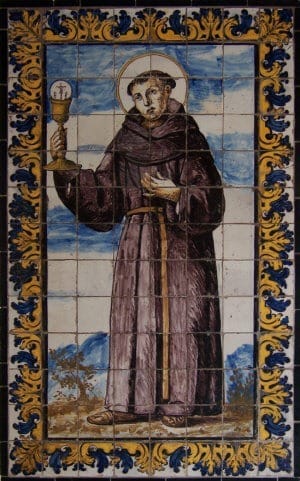
June 12: St. John a S. Facundo or of Sahagun, Confessor
 |
THE kingdom which the apostles are commissioned to establish upon earth is a reign of peace. Such was the promise pledged by heaven to earth, on that glorious night wherein Emmanuel was given to us. And on that other night which witnessed our Lord’s last farewell at the Supper, did not the Man-God base the New Testament upon the double legacy which he bequeathed to his Church, of his sacred Body and Blood, and of this peace announced of yore by Bethlehem’s angels?1 A peace unknown till then here below; a peace all his own, because, as he said, it proceeds from him, but still is not himself; this gift substantial and divine is no other than the Holy Ghost in Person! Like to some sacred leaven, this peace has been spread amongst us during this time of Pentecost. Men and nations alike have felt the secret influence. Man, at strife with heaven and divided against himself, was indeed justly punished for his insubordination to God by the ascendancy of the senses in his revolted flesh; but he now sees harmony once again established in his own being, and his appeased God treating as a son the obstinate rebel of former days. The sons of the Most High are to form a new people, stretching their confines unto earth’s furthest bounds. Seated in the beauty of peace, to use the Prophet’s expression,2 this blessed race shall see all nations flocking to its midst, and shall draw down, here below, the goodwill of heaven.
Whereas formerly nations were constantly at strife and wreaking vengeance in many a bloody combat that knew no end but the extermination of the vanquished, once baptized, they recognize each other as sisters, according to the filiation of the Father who is in heaven. Faithful subjects of the one pacific King, they yield themselves up to the Holy Ghost that he may soften their manners; and if war, the result of sin, must needs sometimes come, wofully reminding man of the consequences of the fall, this inevitable scourge will henceforth have at least some law besides that of might. The right of all nations, that Christian right which pagan antiquity rejected, the faith of treaties, the arbitration of the Vicar of Christ, supreme controller of the consciences of kings, these, and only these, can eliminate occasions of bloody discord. Thus there were to be ages in which the ‘peace of God,’ or the ‘truce of God,’ or a thousand such loving artifices of the common mother, would prevail to restrict the number of years and of days wherein the sword might be allowed to remain unsheathed against human life; were these limits outstepped, the transgressor's blade would be snapped in twain by the power of the spiritual sword, more dreaded, in those days, than warrior's steel. Such is the power of the Gospel that, even in these present days of universal decadence, the fiercest adversary respects a disarmed foe; so that after a battle victors and vanquished, meeting like brothers, lavish the same cares both corporal and spiritual on the wounded of either camp. Such is the persistent energy of the supernatural leaven which has been working progressive transformation in mankind for eighteen hundred years, and is even still acting upon those who would fain deny its power!
He whom we are honouring to-day is one of the most glorious instruments of this marvellous conduct of divine Providence. Heaven-born peace mingles her placid ray with the brilliant aureole that wreaths his brow. A noble son of Catholic Spain, he knew how to prepare the future glory of his country, as well as any mailed hero that laid Moor prostrate in the dust. Just as the eight hundred years' crusade that drove the crescent from Iberian soil was closing, and the several kingdoms of this magnanimous land were blending together under one sceptre, this lowly hermit of St Augustine was laying within hearts the foundation of that powerful unity which would inaugurate the glory of Spain's sixteenth century. When he first appeared, rivalries engendered too easily by a false point of honour in a nation armed to the teeth sullied the fair land of Spain with the blood of her sons, slain by Christian hands. As he now stands before us receiving the Church's homage, we behold discord at his feet, overthrown and vanquished by his defenceless hand.
Let us read his life as related in the liturgy.
O blessed Saint, well hast thou earned the privilege of appearing in the heavens of holy Church during these weeks that are radiant with the light of Pentecost. Long ago did Isaias thus portray the loveliness of earth, on the morrow of the coming down of the Paraclete: ‘How beautiful upon the mountains are the feet of them that bring good tidings, and that preach peace: of them that preach salvation; that say to Sion: Thy God shall reign!’3 What the prophet thus admired was the sight of the apostles taking possession of the word, in God's name. But in what did thine own mission differ from theirs thus enthusiastically pictured by the inspired pencil? The same Holy Ghost animated thy ways and theirs; the same pacific King beheld his sceptre by thy hand made yet more steadfast in its sway over a noble nation of his vast empire. Peace, the one object of all thy labours here below, is now thine eternal recompense in heaven, where thou reignest with him. Thou dost now experience the truth of thy Master's word, when he said of such as resemble thee by working to establish peace at least within the territory of their own hearts: ‘Blessed are the peacemakers, for they shall be called the children of God!’4 Yea, rest then, dear Saint, in thy Father's inheritance, into which thou hast entered; rest in the beatific repose of the Holy Trinity that inundates thy soul, and may we here, afar off on this chilly earth below, feel something of that genial peacefulness!
Vouchsafe to lavish upon thine own land of Spain the same succour which in thy lifetime was so precious to her. No longer does she hold that pre-eminence in Christendom which became hers just after thy glorious death. Would that thou couldst now persuade her that never can her greatness be recovered by lending an ear to the deceptive whisperings of false liberty! But that which could in bygone days render her so strong and powerful can do so again if she draw down upon her the benedictions of him by whom alone kings reign.5 Devotedness to Christ, that was her glory; devotedness to truth, that was her treasure! Revealed truth is alone that whereby men enter into true liberty: Truth will make you free.6 Truth alone is able to bind in unity indissoluble the many minds and wills that make up a nation; powerful is that bond, for it secures strength to a country beyond her frontiers and peace to her within. Apostle of peace, remind thine own people, and teach the same to all, that absolute fidelity to the Church's doctrines is the sole ground whereon Christians may seek and find concord.
June 12 (the Same Day): Saint Leo the Third, Pope and Confessor
The fragrance of Christmas is suddenly wafted around us, while we are in the midst of Pentecost! Leo III, as he speeds his flight from earth, sheds upon us the perfumed memory of that day, whereon the Infant God was pleased to manifest, by his means, the plenitude of His principality over all nations. Christmas Day of the year 800 witnessed the proclamation of the Holy Empire. The obscurity and poverty which had, eight centuries previously, ushered in the Birth of the Son of God, had for its object the drawing of men’s hearts; but this feebleness, so full of tenderness and condescension, was far from expressing the fullness of the mystery of the Word made Flesh. The Church tells us so, every year, as this blessed night of love comes round: ‘A Child is bom to us, and upon His shoulder is the sign of principality; His name shall be called the Wonderful, the Mighty, the Father of the world to come, the Prince of peace.’1 Peace, this day, once more shines upon the cycle: the peace of Christ, indisputably Victor and King! More even in one respect than our St. John of to-day, does Leo III deserve the united gratitude of the faithful. Here he stands like a new Sylvester, in presence of a new Constantine; by him alone is the complete victory of the Word Incarnate absolutely revealed.
Christ had successively triumphed over the false gods, over Byzantine Caesarism, and over barbarian hordes. A new society had sprung up, governed by princes who confessed that they held their crowns of the Man-God alone. To the old Roman empire founded on might, to Cæsarism, crushing the world with the iron teeth of its domination,2 rather than binding it together, was to succeed that confederation of baptized nations, which was to be called Christendom. But whence the unity needed for so vast a body? Who the chief amongst such a multitude of princes equal in birth and in rights? On what basis can the primacy of such a chieftain stand? Who may summon him? who point out the chosen of the Lord and anoint him with so potent an anointing, that his right to the first place in the councils of kings shall be undisputed by the strongest amongst them? The Holy Ghost, brooding over the chaos of peoples, as in the beginning over the dark waters,3 had long been elaborating this new creation, which must declare the glory of our Emmanuel:4 the new empire thus prepared would, as it were of itself, spring forth unto light, out of circumstances preordained strongly and sweetly,5 by eternal Wisdom.
Up to this period, the uncontested primacy of the spiritual power had stood majestic and alone, amidst Christian kingdoms. Though weakest of them all, ever did Peter’s successor behold earth prostrate at his feet; the city of the Cæsars had become his; Rome, by his voice, commanded all nations. Nevertheless, his authority, unarmed and defenceless, would have need at times to repel such assaults of violence as had already more than once imperilled the sacred patrimony which secured the independence of Christ’s Vicar. For the spiritual power, when once able to appear in sublime magnificence, became itself the object of sacrilegious ambition, the coveted prey of blackest perfidy. Leo III himself had lately experienced this in his own sacred person. A powerful lord, in conjunction with certain unworthy clerics, banded together by one common greed for gain, had beguiled the Pontiff into an ambush; his body had been mutilated, his eyes and tongue tom out, and his life preserved only by miracle; more wondrous still, his sight and speech had been afterwards restored by divine intervention. All Rome, witnessing this prodigy, was loud in heartfelt thanksgiving. God had indeed delivered His anointed; but the assassins had remained, nevertheless, masters of the city until the victorious troops of the Frankish king brought back the illustrious victim and reinstated him in his palace. Still this noble triumph was of itself no guarantee against future peril; for it had been preceded by other such victories, likewise due to the ever ready arm of the eldest daughter of the Roman Church. When her protecting sword was again withdrawn, leaving the work of restoration scarcely accomplished, new plots within or outside of Rome would soon be again set in motion for the usurpation of either the spiritual or temporal power of the Papacy. From the coast of the Bosphorus, too, the depraved successors of Constantine only applauded such intrigues, even keeping conspirators and traitors in secret pay.
Such a state of things could no longer continue. The sovereign Pontiff must necessarily look around, to find some security less precarious for the great interests confided to his keeping; the peace of the whole Christian world, the peace of souls as well as of nations, demanded that the highest authority upon earth should not be left at the mercy of ceaseless cabals. It was by no means sufficient that, at the hour of peril, the Vicar of Jesus Christ should be able to depend upon the fidelity of one nation, or of one prince. Some permanent institution was needed, not only to repair, but to ward off, every blow aimed by violence or by perfidy against Rome. Christian society was, by this time, advanced enough to furnish materials for the carrying out of such a noble conception. Already indeed, Pepin le Bref, by abandoning his Italian conquests into the hands of the apostolic See, had unreservedly constituted the temporal sovereignty of the Roman Pontiffs. But, though the use of the sword in self defence belongs to the Popes by right, just as much as to any king in his own states, yet, even when absolutely unable to act otherwise, personal use of armed force must ever be distasteful to the successor of him whom the Man-God appointed, here below, as the Vicar of His love.6 On the other hand, he well knows that he must maintain those sacred rights for which he has to answer to both God and man. Monarch as he is, Peter’s successor would be at liberty to choose from amongst the kings of the west (all of whom gloried in being his sons) one prince to whom he might confide the office of protector and defender of holy Church. Head as he is of the whole spiritual army of the elect, porter of heaven’s gates, depositary of grace and of infallible truth, he could invite the said prince to the honour of his alliance. Sublime indeed would such an alliance be, the legitimacy whereof bears the palm over that of all treaties ever concluded between potentates. Such an alliance, inasmuch as it is intended to guarantee the rights of the King of kings in the person of His representative, would entail certain obligations, it is true, on the recipient; but, at the same time, it would single him out to lofty privileges. Intrinsically vain and powerless are nobility of race, vastness of territory, glory of arms, and brilliancy of genius, to exalt a prince above his peers; such a greatness merely springs from earth, and outstrips not man’s limits. But the ally of Pontiffs would possess a dignity touching upon the heavenly; for such are the sacred interests whereof he would assume the filial guardianship. Without in the least encroaching on the domain of other kings, his compeers in other respects, or derogating from their independence, he must hold it his right, as accredited protector of his mother the Church, to carry the sword whithersoever the spiritual authority is aggrieved or requires his concurrence, in the accomplishment of the divine mission of teaching and saving souls. In this sense, his power must be universal, because the mission of holy Church is universal. So real this power, so distinct from every other, that to express it a new diadem must needs be added to the regal crown already his by inheritance; and a fresh anointing, different from the usual royal unction, must manifest in his person superiority over all other kings, chieftainship of the Holy Empire, of the Roman empire renewed, ennobled, and limitless as the earthly dominion assigned to Jesus Christ by the eternal Father.
Verily this magnificent conception unveils before us the boundless empire of the Word Incarnate, in all its wondrous plenitude! He alone possesses fully, by right of birth, by right of conquest, the universality of nations;7 He alone can delegate, for and by His Church, such power to kings. Who then may tell the splendour of that Christmas festival, whereon Charlemagne the greatest of princes, prostrate before the Infant God, beheld his anterior glories eclipsed by the pomp of that unexpected title, whereby he was officially appointed lieutenant of the divine Child couched in the humble crib! Beside the tomb of the first of Popes, of him that was crucified by the orders of a Caesar, Leo III, in the plenitude of his sole authority, reconstituted the empire; in Peter’s name, on Peter’s tomb, he linked once more the broken chain of the Caesars. Henceforth, before the eyes of all nations, the Pope and the emperor (to use the language of the papal bulls) will appear as two luminaries directing earth’s movements; the Pope, as the faithful image of the Sun of justice; the emperor, as deriving his light from the radiance cast on him by the supreme Pontiff.
Too often, indeed, will parricides stand up in revolt, and turn against the Church the sword that should be brandished only in her defence. But even these will serve only to demonstrate more clearly that the Papacy is verily the one source of empire. True, the day may come when German tyrants, rejected as unworthy by the Roman Pontiffs, will lay violent hands on the eternal city, creating antipopes, with a view to the aggrandizement of their own power. But by the very fact of carrying their insolence so far as to get themselves crowned champions of St. Peter by these pseudo-vicars of Christ, on the very tomb of the prince of the apostles, they will prove that society in those days could acknowledge no title to greatness, save such as either came, or seemed to come, from the apostolic See. The abuses and crimes, everywhere to be met with on history’s page, must not allow us Christians to forget that the value of an epoch or of an institution must, as regards God and His Church, be measured only by the progress derived thence by truth. Even though the Church suffer from the violence of rightful or of intruded emperors, she nevertheless rejoices much to see her Spouse glorified by the faith of nations, still recognizing how, through Christ, all power resides in her alone. Children of the Church, let us judge of the Holy Empire, as the Church, our mother, judges of it: it was the highest expression ever given to the influence and power of the Popes. To this glorification of Christ in His Vicar did Christendom owe its thousand years of existence.
Space fails us, or gladly would we here describe in detail the gorgeous liturgical function used during the middle-ages, in the ordination of an emperor. The Ordo Romanus, wherein these rites are handed down to us, is full of the richest teachings clearly revealing the whole thought of the Church. The future lieutenant of Christ, kissing the feet of the Vicar of the Man-God, first made his profession in due form: he ‘guaranteed, promised, and swore fidelity to God and blessed Peter pledging himself on the holy Gospels, for the rest of his life to protect and defend, according to his skill and ability, without fraud or ill intent, the Roman Church and her ruler in all necessities or interests affecting the same.’ Then followed the solemn examination of the faith and morals of the elect, almost word for word the same as that marked in the Pontifical at the consecration of a bishop. Not until the Church had thus taken sureties regarding him who was to become in her eyes, as it were, an extern bishop, was she content to proceed to the imperial ordination. While the apostolic suzerain, the Pope, was being vested in pontifical attire for the celebration of the sacred Mysteries, two cardinals clad the emperor elect in amice and alb; then they presented him to the Pontiff, who made him a clerk, and conceded to him, for the ceremony of his coronation, the use of the tunic, dalmatic, and cope, together with the pontifical shoes and the mitre. The anointing of the prince was reserved to the Cardinal Bishop of Ostia, the official consecrator of popes and emperors. But the Vicar of Jesus Christ himself gave to the new emperor the infrangible seal of his faith, namely the ring; the sword, representing that of the Lord of armies, the most potent One, chanted in the Psalm;8 the globe and sceptre, images of the universal empire and of the inflexible justice of the King of kings; lastly, the crown, a sign of the glory reserved in endless ages as a reward for his fidelity, by this same Lord Jesus Christ, whose figure he had just been made. The giving of these august symbols took place during the holy Sacrifice. At the Offertory, the emperor laid aside the cope and the ensigns of his new dignity; then, clad simply in the dalmatic, he approached the altar and there fulfilled, at the Pontiff’s side, the office of subdeacon, the servitor, as it were, of holy Church and the official representative of the Christian people. Later on, even the stole was given him: as recently as 1530, Charles V on the day of his coronation, assisted Clement VII in quality of deacon, presenting to the Pope the paten and the Host, and offering the chalice together with him.
The Christmas day of the year 800, witnessed not indeed the display of all this sacred pageantry; for these splendid rites reached full development only in course of centuries. Up to the last moment, Leo III had kept wholly secret the grand project conceived in his heart. But none the less solemn was this marvellous historic fact, when Rome, at the sight of the golden crown placed by the Pontiff’s hand on the row of the new Caesar, re-echoed the cry: To Charles, the most pious, the ever august, the monarch crowned by God, to the great and pacific emperor of the Romans, life and victory!’ This creation of an empire by the sole power and will of the supreme Pontiff, on such a day, and for the sole service of the interests of our Emmanuel, verily puts the finishing stroke to that which the birth of the Son of God was meant to achieve. As year by year this august Christmas festival returns, let us remember Leo the Third’s work,9 and so enter more and more fully into the touching antiphons of that day: The King of peace, whom the whole earth desireth to see, hath shown His greatness. He is magnified above all the kings of the earth.’
The account of this holy Pope’s life we here borrow from the ‘Proper of the city of Rome.’
Commissioned by the Lion of Juda to complete His own victory, thou, O Leo, didst constitute His kingdom, and proclaim His empire. Apostles had preached, martyrs had shed their blood, confessors had toiled and suffered, to win that great day whereon thou didst crown the labour of eight centuries; by thee, the Man-God could then rule supreme over the social edifice, not only as Pontiff in the person of His vicar, but as Lord-paramount and King in the person of His lieutenant, the armed defender of holy Church, the civil head of all Christendom. Thy work lasted as long as the eternal Father permitted the glory of His Son to shine in full splendour over the world. After a thousand years, when the divine light be came too strong for their weakened and diseased eyes, men turned away from holy Church and renounced her mighty works. They replaced God by self; the power of Christ, by the sovereignty of the people; institutions sprung from centuries of toil, by the instability of ephemeral chartas; bygone union, by the isolation of nationalities; and within each of these, anarchy. In this dark age, every utopia of man’s wild brain is called light, and every step towards nonentity is called progress! Thus the Holy Empire is no more; like Christendom itself, it can henceforth be but a name in history: and history too must soon cease to be, for the world is verging on the final term of its destinies.
Great for ever shall thy glory be, in endless ages, O thou by whom eternal Wisdom hath manifested the grandeur of His wondrous ways. A docile instrument in the hand of the Holy Ghost for the glorification of our Emmanuel, thy firmness was equalled only by thy gentleness; and this humble sweetness of thine attracted the eyes of the Lamb, the Ruler of the earth.10 Praying like Him, under the stroke of treason, for thy murderers, thou hadst to pass through thy day of humiliation, through a day of crushing anguish and of death-agony; but therefore was it given thee to distribute the spoils of the strong;11 and then, for centuries, the will of the Lord to be prosperous in thy hand,12 according to the plan which thou didst trace.
Even in these unhappy times, so unworthy of thee, vouchsafe to bless our earth. Strengthen those whom universal apostasy has as yet left unshaken. Make them by faith cling loyally to Christ; hold them ever aloof from liberalism, that fatal error whereby, men would fain remain Christians whilst actually refusing to acknowledge Christ’s kingship over all creation. What an insult to the eternal Father is such a wild notion as this; what a misconception of the mystery of the Incarnation! O holy Pontiff, make it to be clearly understood that safety is not to be sought at the hands of lying compromise with rebels; that the time is nigh, when God’s kingdom will assert itself, when the upheaving of nations against the Lord and against His Christ will be mocked by Him who dwelleth in the heavens.13 On that day, none may contest the origin of all power. On that day of wrathful vengeance, happy he who hath kept the oath of allegiance sworn to his King in Baptism!14 Like the prophet of Patmos, the faithful will easily recognize that King, when the heavens opening out a way before His feet, He shall come to crush the nations; for all the crowns of the whole earth shall rest upon His head, and He shall bear written upon the vesture of His human Nature: King of kings and Lord of lords.15
- The Office of Matins, Christmas day. ↩︎
- Dan. ii. 40. ↩︎
- Gen. i. 2; Apoc. xvii. 15. ↩︎
- Ps. xviii. 2. ↩︎
- Wisd. viii. 1. ↩︎
- Ambr. in Luc. x. ↩︎
- Ps. ii. 8. ↩︎
- Ps. xliv. 4. ↩︎
- See ‘Christmas’ Vol. I. where mention is made of this historic event in its proper place. ↩︎
- Is. xvi. 1. ↩︎
- Ibid. liii. 12. ↩︎
- Ibid. 10. ↩︎
- Ps. ii. ↩︎
- Ibid. lxii. 12. ↩︎
- Apox. xix ↩︎
June 12 (the Same Day): St. Basilides and Companions, Martyrs
BESIDE John of Sahagun, the apostle of peace, are grouped four warriors of our Lord's army. Thus peace and war go this day hand in hand, and form but one in the kingdom of the Son of God. The threefold peace preached by Christ—namely, man’s peace with his God, with himself, and with his brethren and fellowcitizens in the holy city—is to be won only at the cost of combat with Satan, the flesh, and the world, which is the ‘accursed city.’ Together with the Church, let us blend in one united homage our praises of the glorious confessor of these later ages, and of the stern veterans of persecuting times.
From you we learn, O soldiers of Jesus Christ, the nature of that peace which he came to bring upon earth to men of goodwill. Its reward is no other than God himself, who, by it and together with it, communicates himself to such as are worthy. Its invigorating sweetness overpowers every sensitive feeling, even that of tortures such as Christians, after your example, must be ready to undergo in order to preserve intact this priceless treasure. Amidst torments and beneath the deathstroke, this peace upheld you, keeping your mind and heart free, fixed on heaven alone:* this same peace now forms for ever your eternal beatitude, in the presence of the undivided Trinity. Whatsoever be the varied condition of our life here below, lead us, O holy martyrs, by the path of this perfect peace, fraught as it necessarily is with valour and love, unto the repose of endless bliss.
* Phil. iv 7. ↩︎
| Previous Saturday in Whitsun Week: The Gift of Wisdom | Next June 12: St. John a S. Facundo or of Sahagun, Confessor |