Daily reading
After Pentecost
Double · June 14 · Sanctoral
June 14, 2022
From Dom Guéranger’s The Liturgical Year.
A Double leads the weekday.Rubric
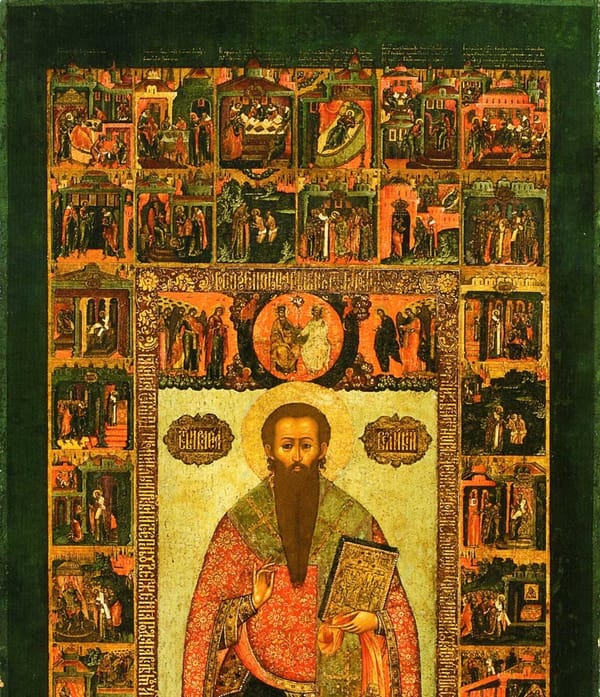 |
June 14: St. Basil the Great, Bishop and Doctor of the Church
THE Doctors who form the fourfold glory of the Greek Church complete their sacred number in the cycle to day. John Chrysostom was the first to greet us with his radiant light during Christmastide; the glorious Pasch saw the rise of two resplendent luminaries, Athanasius and Gregory Nazianzen; Basil the Great, having checked his effulgent blaze till now, illumines the reign of the Holy Ghost. He well deserves so distinguished a place, by reason of his eminent doctrine and brave combats, which prepared the way for the triumph of the divine Paraclete over the blasphemies of the impious sect of Macedonius, who used against the third Person of the consubstantial Trinity the very same arguments invented by Arius against the divinity of the Word. The Council of Constantinople, putting the finishing stroke to that of Nicæa, formulated the faith of the Churches, in him who proceedeth from the Father, no less than doth the Word himself, who is adored and glorified conjointly with the Father and the Son.1 Basil was not there on the day of victory; prematurely exhausted by austerities and labours, he had been sleeping the sleep of peace for quite two years, when this great definition was promulgated. But it was his teaching that inspired the assembled council; his word remains as the luminous expression of tradition concerning the Holy Spirit, who is himself the divine loadstone attracting all in the vast universe that aspire after holiness, the potent breeze uplifting souls, the perfection of all things. Just as we hearkened to Gregory Nazianzen on his feast day, speaking magnificent truths concerning the great Paschal mystery, let us listen now to his illustrious friend, explaining that of the present season—sanctification effected in souls.
The union of the Holy Ghost and the soul is effected by estrangement from the passions, which having crept in had separated her from God. Whoso, therefore, would disengage himself from the deformity that proceedeth from vice, and return to that beauteousness which he holds of his Creator; whoso would restore within himself the primitive features of that royal and divine original, such a one doth verily draw nigh unto the Paraclete. But then also, even as the sun coming in contact with an unsullied eye illumines it, so the Paraclete reveals to such a one the image of him that cannot be seen; and in the blissful contemplation of this image, he perceiveth the ineffable beauty of the Principle, the Model of all. In this ascension of hearts, whereof the first tottering steps as well as the growing consummation are equally his work, the Holy Spirit rendereth them spiritual who are quit of all stain, by reason of that participation of himself into which he initiates them. Bodies that are limpid and translucent, pierced by a brilliant ray, become resplendent and shed light all around them; thus also souls bearing the Holy Spirit within them are all luminous with him, and becoming themselves spiritualized, shed grace all around. Hence the superior understanding possessed by the elect, and their converse with heaven; hence all fair gifts; hence thine own resemblance to thy God; hence, O truth sublime! thou thyself art a god.2 Wherefore it is that, properly and in very truth, by the illumination of the Holy Ghost we contemplate the splendour of God’s glory; yea, it is by the character of resemblance which he has imprinted in our soul that we are raised up even unto the loftiness of him whose full similitude he, the divine Seal, beareth with himself.3 He, the Spirit of wisdom, revealeth unto us (not as it were outside but within himself) Christ, the Wisdom of God. The path of contemplation leads from the Holy Ghost, by the Son, unto the Father; concurrently, the goodness, holiness, and royal dignity of the elect come from the Father by the Son to the Holy Ghost,4 whose temples they are; and he filleth them with his own glory, illuminating their brow with a radiance like to that of Moses at the sight of God.5 Thus likewise did he, in the case of our Lord’s humanity; thus doth he unto the Seraphim who cannot cry their triple Sanctus, save in him; so also unto all the choirs of angels, whose concerts he regulates, whose songs he vibrates.6 But the carnal man, who hath never exercised his soul in contemplation, but holdeth her captive in the mud and mire of the senses, cannot lift his eyes unto Light supernal; the Holy Spirit belongs not to him.7
The action of the Paraclete surpasses the power of any creature; therefore, in thus drawing attention to the operation of the spirit of love, St Basil is anxious to bring his adversaries to confess, of their own accord, the Divinity of the Holy Ghost. On the other hand, who can fail to recognize, in this burning exposition of doctrine, not merely the invincible theologian vindicating dogma, but, furthermore, the experienced guide of souls, the sublime ascetic, deputed by God to bring down within reach of all men such marvels of holiness as an Anthony or a Pachomius brought forth in the desert?
Even as the bee, humming amidst the flowers, avoids the thorn, and knows how to eschew empoisoned sap, so Basil in his youthful days had hovered amidst the schools of Athens and of Constantinople without sucking in aught of their poison. According to the advice he himself gave to youth at a later date in a celebrated discourse,8 his quick intelligence, unsullied by passions (too often found even in the most gifted), had succeeded in stealing from rhetoricians and poets all that could adorn as well as develop his mind, and discipline it for the struggle of life. The world smiled on the young orator, whose pure diction and persuasive eloquence recalled the palmy days of Greek literature; but the noblest gifts of glory earth could offer were far beneath the lofty ambition wherewith his soul was fired in reading the Holy Scriptures. Life's struggle, in his eyes, seemed a combat for truth alone. In himself, first of all, must divine Truth be victorious, by the defeat of nature and by the Holy Ghost's triumphant creation of the new man. Therefore, heedless to know, before God's own time, whether he might not be used in winning souls to God; never once suspecting how soon multitudes would indeed come pressing to receive the law of life from his lips, he turned his back upon all things, and fled to the wilds of Pontus, there to be forgotten of men in his pursuit after holiness. Nor did the misery of those times cause him to fall into the error, so common nowadays, of wishing to devote himself to others before having first regulated his own soul. Such is not the true way of setting charity in order; such is not the conduct of the saints. It is thyself God wants of thee before all things else; when thou hast become his, in the full measure he intends, he himself will know how to bestow thee upon others, unless perchance he prefer, for thy greater advantage, to keep thee all to himself. But in any case, he is no lover of all that hurry to become useful; he does not bless these would-be utilitarians who are all eagerness to push themselves into the service of his Providence. Anthony of Padua showed us this truth yesterday; and here we have it given to us a second time. Mark it well: that which really tends to the extension of our Lord's glory is not the amount of time given to the works, but the holiness of the worker.
According to a custom frequent in that century, owing to the fear entertained of exposing the grace of Baptism to woful shipwreck, Basil remained a simple catechumen until his youth had wellnigh matured to manhood. Of the years that followed his baptism, thirteen were spent in the monastic life and nine in the episcopate. At the age of fifty he died; but his work, carried on under the impulse of the Holy Ghost, far from dying with him, appeared more fruitful, and went on thus increasing during the course of succeeding ages.
While living the life of a humble monk on the banks of the Iris, whither his mother and sister had preceded him, his whole being was intent on the 'saving of his soul’9 from the judgement of God,10 and on 'running generously in the way that leads to the eternal recompense.’11 Later on others having begged him to form them also 'unto the warfare of Christ the King,’12 according to the simplicity of faith and the Scriptures,13 our saint would not have them embrace the life of solitaries, such isolation being not without danger for the many; but he preferred for them one that would join to the blissful contemplation of the solitary the rampart and completeness of community life, wherein charity and humility14 are exercised under the conduct of a head, who, in his turn, deems himself but the servitor of all.15 Moreover he would admit none into his monasteries without serious and prolonged trial, followed by a solemn engagement to persevere in this new life.16
At the remembrance of what he had admired amongst the solitaries of Egypt and Syria, Basil compared himself and his disciples to children who would strive in a puny way to mimic strong men; or unto beginners sticking at the first difficulties of the rudiments and scarce yet fairly started on the path of true piety.17 Yet the day would come when the ancient giants of the wilderness, and the hoary legislators of the desert, would see their heroic customs and their monastic codes cede the place of honour to the familiar conferences, to the unprepared answers given by Basil to his monks in solution of their proposed difficulties, and to form them to the practice of the divine counsels. Ere long the whole of the East ranged itself under his rule; whilst in the West St Benedict called him his father.18 His order, like a fruitful nursery of holy monks and virgins, bishops, doctors, and martyrs, has furnished heaven with saints. For a long time it served as a bulwark of the faith to Byzantium; and even of recent days it has beheld, despite the schism, its faithful children sparing not to render, under the savage persecution of the Tsar of Russia, their testimony of blood and suffering to holy mother Church.
Worthily also have they herein paid a personal testimony, as it were, to their intrepid father; for Basil too was the grandson of martyrs, the son and the brother of saints. Would that we might be allowed to devote a page to the praises of his illustrious grandmother Macrina the elder; who seems to have miraculously escaped from the hands of her executioners and from a seven years' exile in the wild forests, on purpose to be instrumental in infusing into Basil's young heart that faith firm and pure, which she had herself received from St Gregory Thaumaturgus. Suffice it to say that, towards the close of his life, the great Basil, doctor of the Church and patriarch of monks, was proud to appeal to Macrina's name as a guarantee for the orthodoxy of his faith, when this was called in question.19
Basil’s lifetime was cast in one of those periods exceptionally disastrous to the Church, when shipwrecks of faith are common, because darkness prevails to such an extent as to cast its shades even over the children of light;20 a period, in fact, when, as St Jerome expresses it, ‘the astonished world waked up, to bewail itself Arian.’21 Bishops were faltering in essentials of true belief and in questions of loyalty to the successor of Peter; so that the bewildered flock scarce knew whose voice to follow; for many of their pastors, some through perfidy and some through weakness, had subscribed at Rimini to the condemnation of the faith of Nicæa. Basil himself was assuredly not one of those ‘blind watchmen: dumb dogs not able to bark.’22 When but a simple lector, he had not hesitated to sound the horn of alarm, by openly separating himself from his bishop, who had been caught in the meshes of the Arians; and now himself a bishop, he boldly showed that he was not such indeed. For when entreated for peace' sake to make some compromise with the Arians, vain was every supplication, every menace of confiscation, exile, or death. He used no measured terms in treating with the prefect Modestus, the tool of Valens; and when this vaunting official complained that none had ever dared to address him with such liberty, Basil intrepidly replied: ‘Perhaps thou never yet hadst to deal with a bishop!’
Basil, whose great soul was incapable of suspecting duplicity in another, was entrapped by the guile of a false monk, a hypocritical bishop, one Eustathius of Sebaste, who, by apparent austerity of life and other counterfeits, long captivated the friendship of Basil. This unconscious error was permitted by God for the increase of his servant’s holiness; for it was destined to fill his declining days with utmost bitterness, and to draw down upon him the keenest trial possible to one of his mould—namely, that several, in consequence, began to doubt of his own sincerity of faith.
Basil appealed from the tongue of calumny to the judgement of his brother bishops;23 but yet he recoiled not from likewise justifying himself before the simple faithful.24 For he knew that the richest treasure of a church is the pastor’s own surety of faith and his personal plenitude of doctrine. Athanasius, who had led the battles of the first half of that century and had conquered Arius, was no more; he had gone to join, in the well-merited repose of eternity, his brave companions, Eusebius of Vercelli and Hilary of Poitiers. In the midst of the confusion that Valens’ persecution was then reproducing in the East, even holy men knew not how to weather the storm. Many such were to be seen adopting first the extreme measure of utter witdrawal, through mistaken excess of prudence; and then rushing into equally false steps of indiscreet zeal. Basil alone was of a build proportioned to the tempest. His noble heart, bruised in its most delicate feelings, had drunk the chalice to the dregs; but, strong in him who prayed the prayer of agony in Gethsemani, the trial crushed him not. With wearied soul and with a body wellnigh exhausted by the jading effects of chronic infirmities, already in fact a dying man,25 he nevertheless nerved himself up against death, and bravely faced the surging waves. From this ‘ship in distress,' as he termed the Eastern Church, ‘dashing against every rock amid the dense fog,’26 his pressing cry of appeal reached the ears of the Western Church seated in peace in her unfailing light27—reached Rome, whence alone help could come, yet whose wise slowness, on one occasion, made him almost lose heart. While awaiting the intervention of Peter's successor, Basil prudently repressed anything like untimely zeal, and, for the present, required of weak souls merely what was indispensable in matters of faith;28 just as under other circumstances, and with equal prudence, he had severely reproved his own brother, St Gregory of Nyssa, for suffering himself to be betrayed by simplicity into inconsiderate measures, motived indeed by love of peace.29
Peace is just what Basil desired as much as anybody:30 but the peace for which he would give his life could be only that true peace left to the Church by our Lord.31 What he so vigorously exacted on the grounds of faith proceeded solely from his very love of peace.32 And therefore, as he himself tells us, he absolutely refused to enter into communion with those narrow-minded men who dread nothing so much as a clear, precise expression of dogma; in his eyes their captious formulas and ungraspable shiftings were but the action of hypocrites, in whose company he would scorn to approach God's altar.33 As to those merely misled,
Let the faith of our fathers be proposed to them with all tenderness and charity; if they will assent thereunto, let us receive them into our midst; in other cases, let us dwell with ourselves alone, regardless of numbers; and let us keep aloof from equivocating souls, who are not possessed of that simplicity without guile, indispensably required in the early days of the Gospel from all who would approach to the faith. The believers, so it is written, had but one heart and one soul.34 Let those, therefore, who would reproach us for not desiring pacification, mark well who are the real authors of the disturbance, and so not point the question of reconciliation on our side any more.35
In another place he thus continues:
To every specious argument that would seem to counsel silence on our part, we oppose this other—namely, that charity counts as nothing either her own proper interests or the difficulties of the times. Even though no man is willing to follow our example, what then? Are we ourselves, just for that, to let duty alone? In the fiery furnace the children of the Babylonish captivity chanted their canticle to the Lord, without making any reckoning of the multitude who set truth aside: they were quite sufficient for one another, merely three as they were!36
He thus wrote to his monks, likewise pursued and vexed by a government that would not own itself a persecutor:
There are many honest men who, though they admit that you are being treated without a shadow of justice, still will not grant that the sufferings you are enduring can quite deserve to be called confessing the faith; ah! it is by no means necessary to be a pagan in order to make martyrs! The enemies we have nowadays detest us no less than did the idolaters; if they would deceive the crowd as to the motive of their hatred, it is merely because they hope thereby to rob you of the glory that surrounded confessors in bygone days. Be convinced of it; before the face of the just Judge, your confession is every whit as real. So take heart! under every stroke renew yourselves in love; let your zeal gain strength every day, knowing that in you are to be preserved the last remains of godliness which the Lord, at his return, may find upon the earth. Trouble not yourselves about treacheries, nor whence they come: was it not the princes among God’s priests, the scribes and the ancients among his own, that plotted the snares wherein our divine Master suffered himself to be caught? Heed not what the crowd may think, for a breath is sufficient to sway the crowd to and fro, like the rippling wave. Even though only one were to be saved, as in the case of Lot out of Sodom, it would not be lawful for him to deviate from the path of rectitude, merely because he finds that he is the only one that is right. No; he must stand alone, unmoved, holding fast his hope in Jesus Christ.37
Basil himself, from his bed of sickness, set an example to all. But what was the anguish of his soul when he realized how scant a correspondence his efforts received among the leading men in his own diocese! He sadly wondered at seeing how their ambition was in no wise quenched by the lamentable state of the Churches; how they still could listen to nothing but their own puny jealous susceptibilities, when the vessel was actually foundering; and could contend for the command of the ship, when she was already sinking.38 Others there were, even among the better sort, who would hold aloof, hoping to be forgotten in their silent inertia;39 quite ignoring that, when general interests are at stake, egotistic estrangement from the scene of struggle can never save an individual, nor absolve him from the crime of treason.40 It is curious to hear our Saint himself relating the following story to his friend Eusebius of Samosata, the future martyr: how once Basil’s death was noised abroad, and consequently all the bishops hurried at once to Caesarea to choose a successor. ‘But,’ Basil continues, 'as it pleased God that they should find me alive, I took this opportunity to speak to them weighty words. Yet vainly; for while in my presence, they feared me and promised everything; but scarce had they turned their backs, than they were just the same again.’41 In the meantime persecution was pursuing its course, and, sooner or later, the moment came for each in turn to choose between downright heresy and banishment. Many, unfortunately, consummated their apostasy; others, opening their eyes at last, took the road to exile, where they were able to meditate at leisure upon the advantages of keeping quiet and of keeping out of the struggle; or better still, where they could repair their past weakness, by the heroism wherewith they would henceforth suffer for the faith.
Basil’s virtue held even his persecutors at bay; and God preserved him in such wondrous ways, that at last he was almost the only one remaining at the head of his Church, although he had really exposed himself far more than anyone else to the brunt of every attack and to every peril. He profited hereby to the benefit of his favoured flock, upon whom he lavished the boon of highest teaching and wisest administration. This he did with such marvellous success, that so much could scarcely have been attainable by another bishop in times of peace, when exclusive attention could be devoted to those employments. Cæsarea responded splendidly to his pastoral care. His word excited such avidity amongst all classes, that the populace would hang upon his lips, and await his arrival the livelong day, in the ever more and more closely thronged edifice.42 We learn this from his remarks. For instance, once, when his insatiable audience would allow him no repose in spite of his extreme fatigue, he tenderly compares himself to a worn-out mother who gives her babe the breast, not so much to feed it as to stay its cries.43 The mutual understanding of pastor and flock in these meetings is quite delightful! If the great orator by inadvertence left some verse of Scripture unexplained, his sons, by discreet signs and half-suppressed mutterings, would recall his attention to the passage of the text, which they would not allow him to pass over in silence.44 On such occasions Basil would make charming excuses for his mistake, and then rectify it in such a way as to show that he was proud of his flock! When he was explaining, for example, the magnificence of the great ocean, amongst other wonders of the works of the six days, he suddenly paused, and casting a glance of ineffable pleasure over the vast crowd closely pressing around his episcopal chair, he thus continued: ‘If the sea is beauteous, and in God’s sight worthy of goodly praise, how far more beautiful is this immense assembly, whereof better than the waves that swell and roll and die away against the coast, the mingled voices of men, women, and children bear unto God our swelling prayer. O thou tranquil ocean, peaceful in thy mighty deep, because evil winds of heresy are impotent to rouse thy waves!’45
Happy people, thus formed by Basil to the understanding of the Scriptures, especially of the Psalms, whereof he inspired the faithful with so great love, that it was quite the custom for all to repair at night to the house of God, there in the solemn accents of alternate psalmody to pour out their souls in one united homage.46 Prayer in common was one of those fruits of his ministry which Basil, like a true monk, valued the most; the importance he attached to it has made him one of the principal fathers of the Greek liturgy. ‘Talk not to me,’ he cries out, ‘ of private homes, of private assemblies. Adore the Lord in his holy court, saith the psalmist; the adoration here called for is that which is paid not outside the Church, but in the court, the one only court of the Lord.’47
Time and space would fail us, were we to attempt to follow our saint through all the details of this grand family life which he lived so thoroughly with his whole people, and which formed his one consolation in the midst of his otherwise stormy career. It would behove us to show how he made himself all to all, in gladness and in sorrow, with a simplicity which is so admirably blended in him with lofty greatness; how he would reply to the humblest consultations, just as though he had nothing more urgent on hand than to satisfy the demands of the least among his sons; how he would cry out against every touch of injustice offered to one of his flock, and cease not till full compensation was made; and finally, how, with the aid of his faithful of Caesarea, rising up as one man to defend their bishop, he would oppose himself as a strong rampart to protect virgins and widows against the brutal oppression of men in power. Though himself poor and stripped of all things since the day when, about to enter the monastic state, he had distributed the whole of his rich paternal inheritance among the poor, he nevertheless found the secret of how to raise, in his episcopal city, an immense establishment, destined as an assured refuge for pilgrims and the poor, an asylum ever open and admirably organized to meet the requirements of every kind of suffering and the needs of all ages; or rather, a new city, built beside the great Caesarea, and named by the gratitude of the people after its sainted founder. Ever ready for any combat, Basil intrepidly maintained his rights as exarch, which he possessed by reason of his See, over the eleven provinces composing the vast administrative division known to the Romans by the generic name of the diocese of Pontus. Indefatigable in his zeal for the sacred canons, he both defended his clergy against all attempts aimed at their immunities, and reformed such abuses as had crept in during times less troubled than his own. Even in the very vortex of the storm, he knew how to bring back ecclesiastical discipline to the perfection of its best days.
At last the time came when the main interests of the faith, the perils of which seemed, up to this, to have suspended in his worn-out body the law of all flesh, now no longer demanded his presence so absolutely as before. On August 9, 378, the arrow of the Goth exercised justice on Valens; soon afterwards, Gratian's edict recalled the exiled confessors, and Theodosius appeared in the East. On January 1, 379, Basil, at last set free, slept in the Lord.
The Greek Church celebrates the memory of this great bishop on the day of his death, conjointly with the Circumcision of the Word made Flesh; and a second time, on the 30th of the same month of January, she unites him with two other doctors—namely, Saints Gregory Nazianzen and John Chrysostom—bringing all the magnificence of her gorgeous liturgy to give splendour to this grand solemnity of January 30, illumined as it is by a ‘triple sun, beaming glory concordantly to the Holy Trinity.’48 The Latin Church has chosen for her celebration of St Basil the day of his ordination, June 14.
The following is the notice she gives of his holy life:
To give thus a list of thine admirable works is in itself to sing thy praises, O mighty Pontiff! Would that nowadays thou hadst imitators; for history teaches us that saints of a build like thine are those who cause an epoch to be really great and who save society. No matter how tried, how abandoned even, a people may apparently be, if only blessed with a ruler docile in all things, docile unto heroism, to the inspirations of the Holy Ghost ever abiding in holy Church, this people will assuredly weather the storm and conquer at last; whereas, if the salt lose its savour,49 society necessarily falls away, without the need of any Julian or of any Valens to bring about its ruin. O Basil, do thou then obtain for our waning society leaders such as thou wert; may the astonishment of Modestus be justly renewed in these days; let prefects, Valens' successors, meet at the head of every church a bishop in the full sense of the term as used by thee; then will their astonishment be for us a signal of victory; for a bishop is never vanquished, even should he be exiled or put to death!
Whilst keeping up the pastors of the Church to the high standard of the state of perfection in which the sacred unction supposes them to be, lead the flock, likewise, to higher paths of sanctity, such as Christianity gives scope for. Not to monks alone is that word spoken: The kingdom of God is within you.50 Thou hast taught us that the kingdom of heaven,51 that beatitude which can be ours already, is the contemplation, accessible to us here below, of eternal realities, not indeed by clear and direct vision, but in that mirror whereof the apostle speaks. How foolish is it to cultivate and feed in man naught but the senses that crave for the material alone, and to refuse to the spirit its own proper food and action! Does not the spirit urge of its own nature towards intellectual regions for which it is created? If its flight be slow and heavy, the reason is that the senses, by prevailing, impede its ascent. Teach us, therefore, to furnish it more and more with increased faith and love, whereby it may become light and agile as the hart, to leap unto loftiest heights. Tell in our age, as thou didst formerly in thine, that forgotten truth—namely, how earnestness in maintaining an upright faith is no less necessary for this end than rectitude of life. Alas! how far have thy sons, for the greater part, forgotten that every true monk as well as every true Christian detests heresy, and all that savours thereof!52 Wherefore, dear saint, bless all the more particularly those few whom such a continuity of trials has, as yet, failed to shake in their constancy; multiply conversions; hasten the happy day when the East, casting off the yoke of schism and Islam, may resume her former glorious place in the one fold of the one Shepherd.
O doctor of the Holy Ghost, O defender of the Word, consubstantial with the Father, grant that we, now prostrate at thy feet, may ever live to the glory of the Holy Trinity. These are the words of thine own admirable formulary, ‘To be baptized in the Trinity, to hold one's belief according to one’s Baptism, to glorify God according to our faith’—such was the essential basis, set down by thee, for what a monk should be;1 but is it not equally essential to a Christian? Would that all might thoroughly understand this! Vouchsafe, dear saint, to bless us all.
- Symb. Constantinop. ↩︎
- Basil. Lib. de Sp. Sancto ix. ↩︎
- Ibid. xxvi. ↩︎
- Basil. Lib. de Sp. Sancto xviii. ↩︎
- Ibid. xxi. ↩︎
- Ibid. xvi. ↩︎
- Ibid. xxii. ↩︎
- De legend. libris gentil. ↩︎
- Sermo ascetic. ↩︎
- Proœm. de judicio Dei. ↩︎
- Prævia instit. ascetica. ↩︎
- Ibid. ↩︎
- De fide; Moralia. ↩︎
- Reg. brev. tractatæ, 160 etc., 114 etc. ↩︎
- Reg. fus. tract. 30. ↩︎
- Ibid. 10; Epist. 23, al. 383; 199, al. 2, can. xviii, xix. ↩︎
- Epist. 207, al. 63. ↩︎
- S. P. Bened. Reg., cap. lxxiii. ↩︎
- Epist. 204, al. 75; 223, al. 79. ↩︎
- 1 Thess. v 5. ↩︎
- Hieron. Dial. cont. Lucif. ↩︎
- Isa. lvi 10. ↩︎
- Epist. 203, al. 77. ↩︎
- Ibid. 204, al. 75, etc. ↩︎
- Epist. 136, al. 257. ↩︎
- Lib. de Sp. S. xxx. ↩︎
- Epist. 91, al. 324; 92, al. 69, etc. ↩︎
- Ibid. 113, al. 203. ↩︎
- Ibid. 58, al. 44. ↩︎
- Ibid. 259., al. 184. ↩︎
- Ibid. 128, al. 365. ↩︎
- Ibid. ↩︎
- Ibid. ↩︎
- Acts iv 32. ↩︎
- Epist. 128, al. 265. ↩︎
- Lib. de Sp. S. xxx. ↩︎
- Epist. 257, al. 303. ↩︎
- Epist. 141, al. 262. ↩︎
- Lib. de Sp. S. xxx. ↩︎
- Ibid. 136, al. 257. ↩︎
- Epist. 141, al. 262. ↩︎
- Homil. in Ps. cxiv. ↩︎
- In Ps. lix. ↩︎
- Hom, viii in Hexæmeron. ↩︎
- In Hexæm. ↩︎
- Epist. 207, al. 63. ↩︎
- In Ps. xxviii. ↩︎
- Acolothia triplicis festi. ↩︎
- St Matt. v 13. ↩︎
- St Luke xvii 21. ↩︎
- Basil Epist. 8, al. 111. ↩︎
- Sermo de ascetic, discipl. Quomodo mouachum ornari oporteat. ↩︎
Tuesday after Trinity Sunday
The history of the blessed Eucharist is one with that of the Church herself: the liturgical usages, which have varied in the celebration of the most august of all the Sacraments, have followed the great social phases of the Christian world. This was a necessity; for the Eucharist is the vital centre, here below, whither everything in the Church converges; it is the inner bond which unites together that society of which Christ is the Head, the society whereby He is to reign over the nations, which are to be His inheritance.1 Union with Peter, the Vicar of Christ, must always be the indispensable condition, the external mark, of the union of the members with the invisible Head; but supported, in an ineffable manner, on the rock which bears the Church, the divine mystery wherein Christ gives Himself to each one of His servants must ever be the essential mystery of union; and, as such, the centre, and the bond, of the great Catholic communion. Let us, to-day, get a clear notion of this fundamental truth, on which was based the very formation of the Church, at her commencement; and let us consider the influence it exercised on the forms of eucharistic worship during the first twelve centuries. To-morrow, we will continue the subject, by examining how subsequent loss of fervour, and heresy, and social degeneracy, induced the Church to gradually modify these forms, which, after all, are but accidental: they were admirably adapted to the favoured times they had served, but would scarcely suit the changed circumstances and requirements of later generations of the Church's children.
It was on the eve of His Passion that our Lord instituted the great Memorial, which was to perpetuate; in all places, the one Sacrifice, whereby are perfected for ever they that are sanctified.2 The cross was 'the altar of the world,’ as St. Leo calls it;3 and on that cross, says the same holy Doctor, was made, a few hours after the last Supper, 'the oblation of the whole human nature; for the whole human race was united with this last act of infinite adoration and reparation, offered by its Head, to the supreme Majesty of God.’4 The Church, issuing with the Blood and water from the side of her Saviour, was then but in her infancy; and the mystery of divine union—which Jesus had come upon the earth to produce, by Himself uniting to the Father, in the Holy Ghost, the members of His mystical body—was to have its immediate realization in those members only by its successive application to each. This was the object of the sublime institution of the Eucharist at the last Supper. It was a new Testament, which gave to the future Church the possession of the mystery, whereby each generation would be linked on to its predecessors by the unity of the one Sacrifice, and would find in that same unity the mutual bond of its members.
Immediately after instituting this new Passover, Jesus said to His disciples: ‘A new commandment I give unto you: that ye love one another, as I have loved you: and, by this shall all men know that ye are My disciples.’5 This was Jesus’ first injunction to His disciples after giving Himself to them in the Eucharist; this love of, and union with, each other, was to be the mark of the Covenant, which He then, through His apostles, contracted with all those who were to believe in Him through the word of their preaching.6 His very first prayer, after that first giving of His Body and Blood under the eucharistic species, is for that same union of His faithful one with another; a union admirable as is the mystery which produces and maintains it; a union so intimate, that its model is the union existing between Jesus and His eternal Father: May they all be one, as Thou, Father, in Me, and I in Thee; that they may be made perfect in one.7
Under the direction of the holy Spirit, the Church understood, from the very first, the intentions of her divine Master. The three thousand, who were converted on the day of Pentecost, are described, in the Acts, as persevering in the doctrine of the apostles, in the communication of the breaking of bread, and in prayers.8 And so great is the power of union derived from their all partaking of the heavenly Bread, that they were remarked by the Jews as a class of men forming a society distinct from every other, which won the esteem of all that beheld them, and drew others daily to join them.9
A few years later the Church, led on by the same holy Spirit, passed beyond the narrow limits of Judea, and carried her treasures to the Gentiles. It was a world of corruption, where all was discord between man and man, and where the only remedy for the outrages of individual egotism was the tyranny of a Cæsar. Into such a world the Christians came, and showed it, from east to west, the marvel of a new people, which, by the sole influence of its virtues, recruited its members from every class of society, and from every dime, and was stronger and more united than any nation that had ever appeared on earth. The pagans were in admiration at this strange and inexplicable novelty; without knowing what they were doing, without troubling themselves with any further inquiry, they bore testimony to the perfection wherewith these Christians fulfilled the dying wishes of their Founder; they thus spoke of them: ‘See how they love one another!’
It was, indeed, a mystery; but the faithful, the initiated, understood it; for it had been thus explained to them by the apostle: ‘We, being many, are one bread, one body, all that partake of one Bread.’10
This text is admirably commented by St. Augustine in a sermon he preached to the neophytes, a few hours after their Baptism: ‘I remember,’ he says, 'the promise I made, of explaining to you, who have been baptized, the mystery of the Lord’s Table, which you now see, and of which you were made partakers in the night just past . . . That Bread which you see on the altar, that Bread which has been sanctified by the word of God, is the Body of Christ: that chalice, or, rather, what that chalice contains, which has been sanctified by the word of God, is the Blood of Christ. By these did Christ our Lord will to give us His Body and His Blood, which He shed for us, unto the remission of our sins. If you have properly received them, you are what you have received, for the apostle says: “We, being many, are one bread, one body.” It is thus that he expounded the Sacrament of the Table of the Lord: We, being many, are one bread, one body. We are, by this Bread, instructed how we are to love unity. Was this Bread made out of one grain P Were there not many grains of wheat P But, before they came to be bread, they were separated one from the other; they became joined by means of water, and by a certain bruising: for, unless the wheat be ground, and be moistened with water, it could never take the form we call bread. It was the same with you, until you were, so to say, ground by the humiliation of fasting, and by the sacrament of exorcism. Baptism and water came to you; you were moistened, that so you might come to the state of bread. But, even so, there is no bread without fire. What, then, does fire signify P It is the chrism; for the oil which makes our fire is the Sacrament of the Holy Ghost . . . The Holy Ghost, therefore, comes; after water, comes fire; and you are made Bread, which is the Body of Christ . . . Christ willed that we should be His Sacrifice—the Sacrifice of God . . . Great, very great are these mysteries! . . Do you so receive them, as to take care that you have unity in your hearts.11 Be one, by loving one another, by holding one faith, one hope, and undivided charity. When the heretics receive this Bread, they receive testimony against themselves; for they are seeking to make division, whereas this Bread is the sign of unity.’12 The Scripture, speaking of the first Christians, says that they had but one heart and one soul;13 and it is the unity which is signified by the wine in the holy mysteries. ‘For,’ continues St. Augustine, ‘the wine was once in so many bunches of grapes; but now it is all one, one in the sweetness of the chalice; for it has gone through the crushing of the wine-press. So you, after those fastings, and labours, and humility, and contrition, have come, in the name of Christ, to the chalice of the Lord; and you are there on that table, and there in that chalice. You are there together with us, for we have eaten together, and drunk together, and that because we live together.14 Thus did Christ our Lord (by the wine made one out of many grapes) signify us, and He wished us to be one with Him, and, by His Table, consecrated the mystery of our peace and unity.’15 These admirable expressions of St. Augustine are but the substance of the doctrine regarding the holy Eucharist, held by the Church in the fourth century. They give us the very essence of that doctrine, in all its fulness and in all the clearness of its literal truth; no other could have been given to neophytes, who, up to that time, had been kept in complete ignorance of the august mysteries, of which they were henceforth to partake. Of the discipline of that secrecy we shall have to speak a little further on. The doctrine of the Eucharist here laid down by the great bishop of Hippo, is identical with that given by all the fathers. In Gaul, St. Hilary of Poitiers,16 and Saint Cesarius of Arles;17 in Italy, Saint Gaudentius of Brescia:18 at Antioch and Constantinople, St. John Chrysostom;19 at Alexandria, St. Cyril:20 all had the same way of putting this dogma of faith before their people. Christ is not divided: the Head and the members, the Word and His Church are inseparably one in the unity of the mystery instituted for the very purpose of producing that unity. And this unanimous teaching of the fathers, who lived in the golden age of Christian eloquence, was reproduced by Paschasius Radbert, in the ninth century,21 by Rupert in the twelfth,22 and by William of Auvergne in the beginning of the thirteenth.23
It would be too long to give the names, and still more to quote passages, in testimony of how all the Churches, for the first twelve centuries, looked upon the holy Eucharist in this same way, that is, as instituted for the purpose of union. If we follow this traditional teaching back to the apostolic source whence it originated, we shall find St. Cyprian, in the age of persecution, speaking to his people upon the union between the divine Head and His members, which is the necessary result of the holy Sacrament; he shows this, not only by the nature of bread and wine, the essential elements for the consecration of the mysteries, but likewise by the mingling of water with the wine in the eucharistic cup: the water, he says, signifies the faithful people; the wine denotes the Blood of Christ; their union in the chalice—union necessary for the integrity of the Sacrifice, union the most complete and inseparable—expresses the indissoluble alliance between Christ and His Church, which consummates the Sacrament.24 The same St. Cyprian shows that the unity of the Church by the Chair of Peter, which is the subject of one of his finest treatises, is divinely established on the sacred mysteries; he speaks enthusiastically of the multitude of believers, the 'Christian unanimity’ being held together, in the hoods of a firm and indivisible charity, by the Sacrifice of our Lord Jesus Christ.25 Christ in His Sacrament, and Christ in His Vicar, is, in reality, but the one same Rock that bears the building which is erected upon it; the one sole Head, visible in His representative, His Vicar, and invisible in His own substance in the Sacrament.
This sentiment of union, as the result of the Eucharist, was rooted in the soul of the early Church; her very mission was to bring about the union of all the children of God, that were dispersed throughout the world;26 and when the violence of her enemies obliged her to provide her children with some secret sign, whereby they might recognize each other, and not be recognized by pagans or persecutors or blasphemers, she gave them the mysterious icthus, the fish, which was the sacred symbol of the Eucharist. The letters which form the Greek word for fish (icthus) are the initials of a formula in the same language, which gives this sentence: Jesus Christ, Son of God, Saviour. The fish is shown to us in the Book of Tobias27 as a figure of Christ, who is the food of the wayfarer, casts out the devil by His virtues, and gives light to the world grown old in iniquity. Again: it is not without a prophetic and mysterious purpose, that the fish is mentioned in Genesis, as being blessed by the Creator, at the commencement of the world, just as man himself was.28 It is found with the bread miraculously multiplied in the Gospel, when our Lord prefigures the marvels of the Eucharist. It is brought again to our notice, after the Resurrection; it is found lying on hot coals, and is offered by Jesus, together with bread, as a repast to seven of His disciples, on the banks of lake Tiberias.29 Now, what is this fish, this bread? The fathers answer: Christ is the Bread of that mysterious repast; He is the Fish taken from the living water, and is roasted on the altar of the cross by the fire of His love, and feeds the disciples on His own substance, and offers Himself to the entire world as the true icthus.30 No wonder, then, that we find this sacred symbol on almost everything that the Christians of the first three centuries possessed; on precious stones, rings, lamps, inscriptions, paintings, there was the fish, in some shape or other. It was the watchword, the tessera of the Christians, in those days of persecution. An inscription of the second century, discovered in modern times at Autun, thus speaks of the Christians: ‘This divine race of the heavenly icthus, this noble-hearted race, receive from the Saviour of the saints the nourishment which is sweet as honey, and drink long draughts of the divine fount, holding icthus in their hands.’31 A holy bishop of Asia Minor of that same early period, by name Aberoius of Hierapolis, who was divinely led into various lands, everywhere recognizes the disciples of Christ by the holy fish, which makes all, however separated by distance, to be one. ‘I have,’ says he, shortly before the close of his life of travel, ‘I have seen Rome: I have beheld the queen city, in her robes and sandals of gold; I have made acquaintance with the people decked with bright rings. I have visited the country of Syria, and all her cities. Passing the Euphrates, I have seen Nisibis; and all people in the east were in union with me, for we all formed but one body; everywhere, faith presented to all, and gave as nourishment to all, the glorious and holy icthUs, which came from the only fount, and was taken by the most pure Virgin.’32
This, then, was the bond of that mighty union between Christians, which was such a puzzle to the pagan world; and the more the real cause of that unity was kept concealed from its eyes, so much the more violent was the fury wherewith it attacked the Church. Our Lord had said: ‘Give not that which is holy to dogs; neither cast ye your pearls before swine.’33 These words contained, in principle, the discipline of secrecy, which was observed in the Church till the conversion of the western world was completed. The holiness of the Sacraments, the sublimity of the Christian doctrines, necessitated an extreme reserve on the part of the faithful, living amongst people whose moral degradation and brutal corruption were such as our Saviour had foretold. But it was most of all imperative to hide from the stare and sacrilege of pagans the most holy Eucharist, that ‘great pearl of the sacred Body of the Lamb,’ as Venantius Fortunatus calls it.34 Hence the Christian assemblies, when they met for divine worship, were divided into two classes, the initiated and the uninitiated, i.e. the faithful and the catechumens. The distinction began with the apostolic age, and was kept up till the eighth century. A few weeks before the solemn administration of Baptism, there took place, as we have elsewhere explained,35 the giving, or as it was termed, the tradition,, of the Symbol, to the future members of the Church; but the eucharistic mystery, the arcanum by excellence, was, even then, kept back from the fortunate candidates for holy Baptism. This explains the varied precautional expressions, the reticence, the studied obscurity of phraseology, used by the fathers in their discourses to their flock, and this for years after the times of Constantine and Theodosius. The catechumens were admitted while the holy Scriptures were being read, or while the Psalms were being chanted; but as soon as the bishop had given his discourse on the portion which had been read, either of the Gospel or other passages of the sacred Volume, these catechumens were dismissed by the deacon; and this missa, or missio, gave its name to that first portion of the liturgy; it was called the Mass of the catechumens; just as the second part, from the oblation to the final dismissal, was called the Mass of the faithful.
And yet, though holy mother Church kept so jealous an eye on her treasure as not to let it be fully known except to her true children, made such by Baptism, with what delight did she, at the feasts of Easter and Pentecost, reveal to her new-born children, as soon as they came from the font, the ineffable secret hitherto kept in her heart as bride, the full mystery of the icthus! Having incorporated them into Christ by the saving waters, enrolled them in His army, and marked them with the sign of His soldiers by the anointing conferred by the bishop, with what maternal fondness did she lead them, from the baptistery first, and then from the chrismarium, to the hallowed precinct of the mysteries instituted by the Word Incarnate! There Jesus, their Head, was awaiting His new members, that He might draw all the more closely the bonds which already knit them to His mystic body, and unite them to Himself in the infinite homage of that one great Sacrifice, which He Himself was offering to the eternal Father.
This wondrous unity of the Eucharistic Sacrifice, which included in one oblation both Head and members; this unity of Sacrifice, which kept alive and strengthened the union of each Christian community and of the whole Church, was admirably expressed by the magnificent forms of the primitive liturgy. After the catechumens had been dismissed and the unworthy expelled, all the faithful, without exception, from the emperor and his court down to the poorest cottager whether man or woman, advanced towards the altar, each one offering bis share of bread and wine for the sacred mysteries. Themselves a kingly priesthood, as St. Peter calls them,36 a living victim figured by the gifts they brought, they assisted, standing, at the immolation of the divine Victim, whose members they truly were; then united in the kiss of peace, the external sign of their union of heart, they received in their hands, and still standing, the sacred Body, their spiritual nourishment; the deacons offered them the chalice, and they drank of the precious Blood. Even babes in their mothers’ arms were eager for the divine drink, and received some drops, at least, into their innocent mouths. The sick, who could not leave their rooms, and prisoners, were not deprived of being united with their brethren in the sacred banquet; they received the precious Gifts at the hands of ministers, who were sent to them for the purpose by the bishop. The anchorets in their deserts, Christians living in the country, and all such as could not be present at the next assembly, took the Body of our Lord with them, that thus they might not, because of distance, be deprived of uniting in the coming celebration of the mysteries of salvation. Those were ages when unity was continually being attacked by persecution, schism, and heresy, all three at once; and the Church, to counteract the danger, had no hesitation in facilitating, by every lawful means, the use and application of the venerable Sacrament, which is the sign of unity, and the innermost centre, and the strongest tie, of the Christian community.
It was from the same principle of unity, that, although there were generally several churches or centres in each city for the assemblies of the faithful, and a greater or less number of clergy, yet all the faithful and clergy came together for the collect or synaxis, into some one place, fixed upon by the bishop. ‘Where the bishop shall show himself,' says St. Ignatius of Antioch, ‘there let the multitude be; just as, where Christ Jesus is, there is the Catholic Church. It is not lawful, either to baptize, or to celebrate the agape (the Eucharist) without the bishop.37 Do all of you assemble, for prayer, in the one same place; let there be unity of common prayer, unity of mind, unity of hope . . . Do all of you come together, as though you were one man, into the temple of God, as to one altar, as to one Christ Jesus, the great high-priest of the unborn God.38 Let us enjoy the one Eucharist; for one is the Flesh of our Lord Jesus, and one His Blood which was shed for us; one also is the Bread which was broken to us all, and one the Cup which was distributed to all; one altar to the whole Church, and one bishop surrounded by the presbyterium and the deacons.’39
The presbyterium was the college of priests of each city; they kept near the bishop, were his council, and celebrated the sacred functions together with him. It would seem that, at the beginning, they were twelve in number, the more closely to represent the apostles; but in the great cities that number was soon doubled. We find that, towards the close of the first century, there were, in Rome, five and twenty priests, who were respectively set over twenty-five titles, that is, churches, of the metropolis. The pontiff took first one, and then another, of these titles, for the celebration of the mysteries. The twentyfour priests of the other titles united with the pontiff in the solemnity of one and the same Sacrifice, and concelebrated at one and the same altar. In their respective places, the seven deacons, and all the inferior clerics, each according to his rank, co-operated in the thrice holy mysteries. We have already seen the active part taken in the same by the faithful people.
It was the very time when the eagle of Patmos, St. John the Evangelist, was being favoured with his inspiration and vision of the gorgeous ritual of heaven. He beheld the Lamb that was slain, yet standing in the midst of the four and twenty Elders who were seated on thrones encircling the throne of God, which is also the throne of the eternal High Priest. Clad in white garments, and wearing golden crowns, these four and twenty Elders held harps in their hands, and golden vials full of odours, which are the prayers of saints. Then came the seven spirits, who were before the throne of God, like so many burning lamps; and then, thousands of thousands of angels, who were round about the throne, singing praise to the Sacrifice and triumph of the Lamb; and then, every creature, which is in heaven, and on the earth, and under the earth, and such as are in the sea, all cried out, giving benediction, and honour, and glory, and power, to Him that liveth for ever and ever.40 This admirable vision represented the fullness and unity of the Sacrifice, which was offered once, but to last for ever, end was offered by Him who is the Head of all created beings. The Church on earth, the exiled bride of Jesus, did her best, when offering that same Sacrifice, to repeat the sublime ritual of heaven. And as in heaven the divine Lamb, the eternal High Priest, drew after Him the celestial hierarchy, so likewise on earth all the Churches came round the officiating pontiff, and united with him in the holy Sacrifice, each one according to the sacred Order he held.
It was impossible for the universal Church, subject as she is to the conditions of place and time, to meet here below at one altar; but the unity of the Sacrifice, which was everywhere offered, was, like the unity of the Church herself, expressed by the mutual transmission, between the various bishops, of the sacred Species that had been consecrated by them; and these, each one put into the chalice from which he received the precious Blood. St. Irenæus,41 who lived in the second century, tells us that the supreme hierarch, the Pontiff of Rome, used to send these sacred gifts, not only to Churches in the west, but even into Asia, as emblems of the unity existing between the Churches there, and the Church, the mistress and mother of all others. So, too, when the number of the faithful became so great as to induce the Church to allow individual priests to celebrate the holy mysteries privately, the priests of the town where a bishop resided never thought of exercising this isolated function, until they had received from the bishop a fragment of the Bread he had consecrated, and which they mingled with their own Sacrifice. It was the fermentum, the sacred leaven of Catholic communion.
As an appropriate conclusion to the above subject, we append the following beautiful liturgical formula taken from the Apostolic Constitutions,42 a writing admitted by critics to have been completed in the third century.
Thanksgiving for the Mysteries
- Ps. ii. 8. ↩︎
- Heb. x. 14. ↩︎
- Serm, viii. de Pass. ↩︎
- Ibid. iv. ds Pass. ↩︎
- St. John xiii. 34, 35. ↩︎
- Ibid. xvii. 20. ↩︎
- Ibid. 21-23. ↩︎
- Acts ii. 42. ↩︎
- Acts ii. 47. ↩︎
- 1 Cor. x. 17. ↩︎
- Serm, ccxxvii. In die Paschæ. Ad Infantes, de Sacramentis. ↩︎
- Serm. ccxxix. Fer. ii. Paschæ, de Sacramentis fidelium. ↩︎
- Acts iv. 32. ↩︎
- Serm. ccxxix. ↩︎
- Ibid. cclxxii. In die Pentecost. Ad Infantes, de Sacramentis. ↩︎
- Lib. viii. de Trinit. ↩︎
- Hom. vii. ↩︎
- Serm. ii. ad Neoph. ↩︎
- In cp. i, ad Cor. Hom xxiv. ↩︎
- Lib. x. in Johan. ↩︎
- De corp. et sang. Domini., cap. x. ↩︎
- De div. Off., lib. ii., c. 2. ↩︎
- De Sacrament. Euchar. cap iv. ↩︎
- Ep. lxiii. ↩︎
- Ep. lxxvi. ↩︎
- St. John xi. 52. ↩︎
- Tob. vi. ↩︎
- Gen. i. 22, 28. ↩︎
- St. John xxi. 9. ↩︎
- St. Paulin. Ep. xiii; St. Aug. Confess, xiii. 23: St. Ambr. Hymn. Pasch; Proep. African. De promission. ↩︎
- Inscript. Augustod. Spicileg. Solesm. i. ↩︎
- Titul. Abercii. Spicileg Solesm. iii. ↩︎
- St. Matt. vii. 6. ↩︎
- Vernant. Fortun. lib. ii. carm. 25. ↩︎
- Volume for Lent; Wednesday of the fourth week. ↩︎
- 1 St. Pet. ii. 9. ↩︎
- Ad Smyrn. viii. ↩︎
- Ad Magnes. vii. ↩︎
- Ad Philadelph. iv. ↩︎
- Apoc. iv, v. ↩︎
- Ap. Euseb. Hist. Eccles. lib. v. cap. 14. ↩︎
- Lib. vii. cap. 25. ↩︎
| Previous Monday after Trinity Sunday | Next Tuesday after Trinity Sunday |