Daily reading
After Pentecost
Double · Movable from Easter · Temporal
June 23, 2022
From Dom Guéranger’s The Liturgical Year.

|
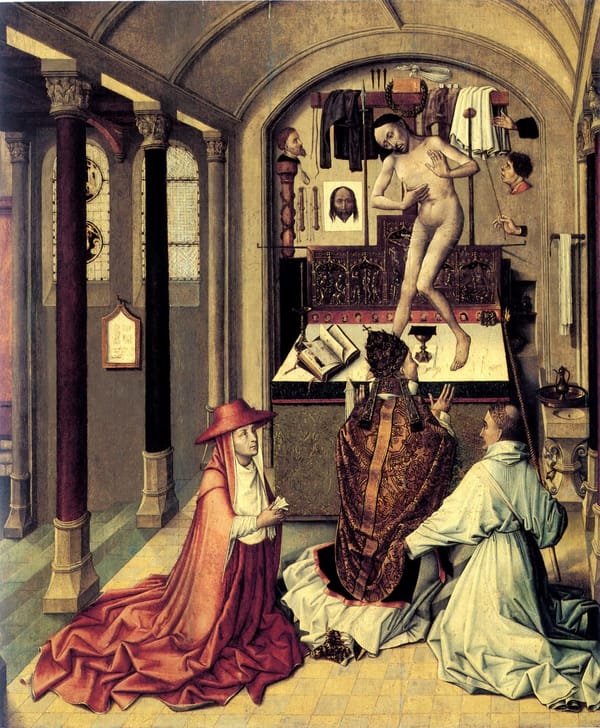
Thursday, the Octave of Corpus Christi
The bright octave, consecrated to the glory of the blessed Sacrament, closes to-day; and although we began the subject three days before the feast itself, we have been able to do little more than slightly touch upon the sublime subject proposed for our consideration and love by the Church. The Memorial left us by our Lord of all His wondrous mercies1 far exceeds the measure of our poor thoughts, and the capabilities of human language; such is the extremity of the infinite love, which God bears to His own2 creatures, that no possibility of ours could make it a return such as it deserves.
Eternal Wisdom was, even from His Father’s bosom, betrothed to human nature. He came down into this world, which sin had marred, and there He found man, who had become the slave of sin;3 He assumed the nature of man: He was thus able to make a Sacrifice, which gives infinite glory and full satisfaction to God, and He perfected His union with His creature, by means of that divine banquet, at which, as food and drink, He Himself is served; for He is the divine Victim4 immolated on the cross and at our altars.
O man! O child of Adam, that wast formed of earthy slime,5 what art thou, that thou shouldst be remembered in the court of heaven?6 Thou desired one of the everlasting hills7—for we may apply this name even to thee—what hast thou done, that thou shouldst thus be glorified?8 Yet doubt it not, thou hast had all these favours. ‘Let not my few weak words stagger thee,’ cries out St. Cyril, the brave defender at Ephesus of the sacred nuptials, of which the Eucharist is what the fathers call the glorious extension, ‘heed not my unworthiness, but listen to the voice, respect the authority, of them that have gone before us, and have preached these truths. They were not men of the common sort, they were not men undeserving of notice, who went about, like hired criers, to proclaim these things on the highroads; no, they were such men as the great Solomon, who was sent as the herald of the King of kings; he sat on his high throne, and proclaimed the mysteries of the Most High; he was clad in scarlet robes, and wore a diadem on his brow, and he was the one to publish the mandate of the God who makes and unmakes kings.’9
Christians! ye people of kings,10 who are to have crowns and thrones yonder in heaven,11 it is to you this Solomon speaks. Your dignity is great. Listen to this herald of God; learn whence comes your greatness, and live up to it. ‘Hearken, ye kings, and understand! Give ear, ye kings! To you are these my words. If ye love your thrones and your sceptres, love wisdom, that ye may reign for ever. I preferred this wisdom before kingdoms and thrones; I loved her above all treasures, and health, and beauty, and chose to have her instead of light. What this wisdom is, and what her origin, I will declare, and I will not hide from you the mysteries of God; but will seek wisdom out from the beginning of her birth, and bring the knowledge of her to light, and will not pass over the truth. I have learned her without guile, and I communicate her to you without envy. Receive, therefore, instruction by my words, and it shall be profitable unto you.’12 Would to God, that we had been able to tell the wonderful mystery we have been celebrating! Divine Wisdom Himself has been pressing us, during all these days, to study the excellencies of that sacred Bread, which yields delights to the kings, His guests.13 The Church has kept close to the throne of her Jesus, that cloud in which He dwells out of love for us.14 She is full of love for Him; He has given her unity by the Sacrament of union; and she, like a strong compact city, summons her tribes of Israel,15 the holy nation, the people of the redeemed, the chosen race of the priests and kings,16 to come together again on this octave-day, that they may testify their faith, and sing their love, and be grateful for the peace which the holy Eucharist secures to them, and for the abundance of grace and blessing it gives to these her children.17 These days of universal joy and festivity around the holy Host were revealed by the Holy Ghost to the son of Sirach; and the vision made him exclaim: ‘Wisdom shall praise her own self, and shall be honoured in God, and shall glory in the midst of her people, and shall open her mouth in the churches of the Most High, and shall glorify herself in the sight of His power. And in the midst of her own people, she shall be exalted, and shall be admired in the holy assembly. And in the multitude of the elect, she shall have praise, and among the blessed (of the Father) she shall be blessed.’18
‘Blessed the man,’ continues the inspired writer, still speaking in the future, ‘that shall dwell in wisdom! Blessed the man that considereth her ways in his heart, and hath understanding in her secrets, who goeth after her as one that traceth, and prepareth for her snares of love;19 who looketh in at her windows, and hearkeneth at her door! Blessed is he that lodgeth near her house, and, fastening a pin in her walls, shall set up his tent nigh unto her, where good things shall rest in his lodging for ever. He shall set his children under her shelter, and shall lodge under her branches. He shall be protected under her covering from the heat, and shall rest in her glory.’20
O house of God, house of the feasting of kings,21 filled with the fragrance of sweetest incense!22 Better is one day in thy precincts, than a thousand elsewhere. It is a joy to my soul to think of days spent there!23 The poor bird that once was lonely, and sat moaning on a roof that could never give her rest,24 here, in the house of God, finds all she wants. The turtle-dove, having found at the altar of her Lord a nest for her young ones,25 has no further solicitude. In the secret of that little cloud, far from the conflicts and disturbances of the world, and where there is no contradiction of tongues—there, from early dawn, eternal Wisdom is pouring out upon souls the multitude of His light and sweetness;26 there, each of the Church’s hours, choirs will be singing psalms and canticles of praise and joy around the tabernacle,27 wherein resides the Lamb who, though slain, is ever living,28 beautiful on His throne of love, the Hod of gods in our Sion.29
Truly, He abides among us; our earth has received the mystery of the marriage-feast, of the divine espousals with human nature, and she ever possesses the Lord her Hod dwelling with her in the Eucharist. O thou gladness of morning!30 O heavenly wine that bringest forth virgins!31 O happy moments, wherein the beauty of Jesus, whose full vision is the joy of the angels, gives itself under the sacramental veil to our souls, you leave behind you something more than a joyous recollection. The altar of Sacrifice, and the house of the great Banquet, both continue as the throne ever occupied by our King; they are the earthly abode of that Wisdom, who, though He is seated at the right hand of the Father in the brightness of the saints,32 and is loved by the Lord of all things,33 yet has not changed towards us poor children of men; He still delights to be with us, and keep up His loved union with us; and, as He tells us He did at the beginning, so He still loves this world of ours, and, to use His own word, He still plays with it.34 On the throne of His tabernacle, He, beautiful Wisdom, receives the adorations of them that rule this world, for it is from Him they have their crowns and sceptres; and when they have wisdom, it is from Him they have it, and they asked Him for it on bended knees.35 On that same throne He hears and grants the prayer of those little ones, little by humility and simplicity of heart, whom He so sweetly presses to go to Him;36 they are attracted to Him by His divine loveliness and riches;37 and they go to Him, that He may teach them how to love Him and fill their treasures to the brim.38
Glory be to the Lamb, whose Sacrifice has given us this wonderful Presence in the blessed Sacrament I To Him be power, and divinity, and wisdom, and strength, and honour, and glory, and benediction, for ever and ever!39 By His lovely light40 let us, as a close to this day and the octave, respectfully contemplate what this ineffable permanence is, which thus secures to us in its fullness, to the end of time, the great mystery of faith.
How different is the divine Lamb of the true Passover, from that ancient one of the Jewish people, which we now so well understand!41 In prescribing the rites to be observed in the sacrifice of the figurative Paschal Lamb, which was to be eaten but once a year, Moses laid down this strict injunction: ‘Neither shall there remain anything of it until morning’;42 nothing was to be left, all was to be consumed! Let us listen, now, to an apostle of the new Law: it is Andrew, brother of Peter; he is speaking to a Roman proconsul, and, through him, to all the Gentiles: ‘Every day, I offer up to the almighty God, who is one and true, not the flesh of oxen, nor the blood of goats, but the spotless Lamb, upon the altar; of whose Flesh the whole multitude of the people eat; and the Lamb that is sacrificed, remains whole and living.’43
‘How can that be?’ asks the proconsul. ‘Become a disciple and thou shalt learn,' replies Andrew. But that could not be: the representative of the pagan world was officially appointed to persecute the crucified Jesus in His members; and as to the sublime dogma he had just heard, and which was the very basis of the religion proscribed by the State, he had but one way of dealing with it and its preacher: laugh at it, and hang Andrew on the cross. The apostle thus sealed his testimony by his death, leaving to the Holy Ghost, who had inspired him with the words he had spoken,44 the future victory which that teaching was to win. His brother-apostles, who had been his fellow-guests at the last Supper, also laid down their lives for Jesus and His doctrine; and, by that sacrifice of themselves, they made themselves food to the same dear Lord. So did Andrew. He followed the counsel of the Wise Man: ‘When thou shalt sit to eat with a prince, consider diligently what is set before thy face, and lay this to thy heart, and know that it behoveth thee to give a like feasting to the prince.’45 Having, therefore, been fed with Jesus’ cross in the banquet of His Body at the last Supper, as St. Augustine expresses it,46 Andrew made a right noble return.
And so was it with the other martyrs, who came after him: the joy they showed, in the midst of their tortures, kept up the proof of the power that exists in the precious Wine and heavenly Bread, which can thus gladden man’s heart and make it brave.47 The time would come, when the demonstration of the mystery of faith, so sublimely expressed by the apostle St. Andrew, would convince the world; not indeed by the force of argument, or by the clever sequel of learned deductions, but by the world itself becoming transformed from paganism to Christianity. That transformation was an impossibility, as far as the world’s own misery and power were concerned; and yet it was an undeniable fact; and it was the result of an irresistible influence: the influence of the divine leaven, which, in the language of the Gospel, was put into the whole measure of flour at the last Supper. From south to north, from east to west, everywhere throughout the globe, the children of the Church now sing these words, which are but St. Andrew’s expression that has triumphed over the world, won its faith, and is set to rhythm and music: ‘Christ’s Flesh is food, and His Blood is drink; yet is He whole under each Species. He is not cut by the receiver, nor broken, nor divided: He is taken whole. He is received by one, He is received by a thousand; the one receives as much as all; nor is He consumed, who is received And when the Sacrament is broken, waver not, but remember that there is as much under each fragment as is hidden under the whole. Of the substance there is no division; it is but the sign that is broken; and He who is the Signified, is not thereby diminished, either as to state or stature.’48
The Church’s doctrine is this: that ‘under each Species, and under each part of each Species, there is contained, truly, really, and substantially, the Body and the Blood, together with the Soul and Divinity of our Lord Jesus Christ, and therefore the whole Christ.’49 Of themselves, it is true, the words of Consecration in the Sacrifice do but produce what they signify; and therefore, exclusively and isolatedly, under the twofold Species, produce the Body and the Blood; but our risen Lord, who liveth now for ever, remains indivisible. As the apostle teaches us, Christ, rising again from the dead, dieth now no more; for, in that He died to sin (that is, because of our sin), He died once; but in that He liveth, He liveth unto God.50 Therefore, wheresoever, in virtue of the words of consecration, there is the most holy Body, or the Blood of our Redeemer, there also, by an essential and necessary concomitance, is the whole entire sacred Humanity, united with the Word.
And here, for the sake of greater precision, we are going to adopt the scholastic phraseology. And firstly, the change of bread into the Body, and of wine into the Blood, is one of substance into substance; but in this miraculous change, very appropriately, on that account, called trans-substantiation, the accidents or modes of the two terms of the change are in no way altered or destroyed. So that, being deprived of their natural subject, or support, the species, or appearances of bread and wine are immediately sustained by God’s omnipotence, and they produce and receive the same impressions as they would do if they were joined to their own proper substances. They are the sacramental sign; and although they do not inform the Body of Christ, that is, do not give It their own qualities or properties, yet they determine and maintain Its presence, so long as these species are not essentially modified. As regards the Body of our Lord—which, in Its own true substance, is substituted for the substance alone of bread and wine—It is withdrawn, by the sacred formula, from those mysterious laws of extension, which are so far from being thoroughly understood by human science; It is whole under the whole species, and whole under each sensible portion of the species; and, in this, It resembles spiritual substances, such as, for instance, the soul of man, which is whole in his whole body, and whole in each member of the same. Such, then, is the mystery of the sacramental state: whilst present to us under the dimensions of the Host, and not beyond them, by reason of His substance being independent of our known laws of extension, Christ our Lord abides in Himself precisely what He is in heaven. As St. Thomas of Aquin expresses it: ‘The Body of Christ, in the Sacrament, retains all Its accidents, as a necessary consequence; and Its several parts are just as they are in His sacred Body, although they are not subject to the conditions of external space.’51
The very notion of Sacrifice required this passive appearance; in the same way that the idea of a banquet, in which He is received, determined what was to be the peculiar nature of the sacramental elements selected by our divine Lord. Of course, when we behold the sacred Host, we must banish every such thought as bondage, or actual suffering, or laborious virtues, on the part of the divine Guest who dwells under the sacred Species: under this external passiveness or apparent death, there abound life, and love, and the beauty of the Lamb, who has vanquished death, and who is the immortal King of ages.
He resides under the white Host, with all His power and brightness, the most beautiful of the children of men;52 He has all those admirable proportions, and all the perfect finish of those divine members, which were formed from the flesh of the most beautiful of the daughters of Adam, and the purest of virgins. Let us venerate, with all the respect we are capable of, those feet, which were watered by the tears of the repentant Magdalene, and dried with her hair,53 and embalmed with the sweetest ointment, beforehand, as Jesus emphasised her act, when He praised it;54 those feet of our merciful Redeemer, more beautiful than the feet of them who bring us the tidings of His having come among us;55 they are bright, beyond the brightness of fine brass when in a burning furnaoe.56 Let us send our reverential kisses, beyond the veil, to those hands, which are spotless, and consecrated for the office of High Priest;57 those hands, which worked at the wood in Joseph’s shop; those hands, which scattered blessings and miracles throughout the land of Israel; they are there, under that Host, just as the bride of the Canticle saw and described them, bright as gold, formed to the model of perfection, and full of something extremely precious, which she called hyacinths,58 and which perhaps signify those wounds of which the prophet speaks, saying, ‘horns are in His hands, and there is His strength hid.’59 Would that we might look beneath the little cloud which hides from us that divine head, the admiration of the angels; that face, once disfigured, and buffeted, and covered all over with reproaches, out of love for us,60 but now resplendent as the sun when he shineth in his power!61 O mouth of our Jesus, thou instrument of the Word, whose voice is as the sound of many waters,62 and whose breathing is death to the wicked!63 O lips, which our Scriptures tell us, are as lilies dropping choice myrrh!64 And you, O eyes, which shed tears over Lazarus,65 and now are lighting up with your brightness66 the abode of the saints! Oh! that we might see all, see Thee Thyself, Jesus, beneath the mystery and the veil! But no! the mystery and the veil may not be removed; and surer are we, than if our eyes were the witnesses, that Thou, O Beloved of our hearts, art behind our wall, looking at us through the lattices;67 and this is enough to make us adore Thee. Verily the sweetest test to which Thou couldst put our love, was that we should have faith in this mystery of the adorable Sacrament!
O precious Blood, thou price of our ransom, shed profusely on this earth, but now again within the sacred veins of Jesus! thou art now, as during His years here below, diffusing thy life-giving qualities to His divine members, under the action of that sacred Heart, which we are so solemnly to honour to-morrow! Most holy Soul of Jesus, present in the Sacrament as form substantial68 of that most perfect Body, which, through thee, is the ever-living Body of the Man-God, thou possessest within thee all the treasures of eternal Wisdom.69 Thou hadst the office intrusted to thee, of putting into a varied and sensible language the ineffable beauty of that Wisdom of the Father, who was taken with love for the children of men, and desired, by a manifestation which they could understand, to secure their love to Himself! Every word, every step, of Jesus, every mystery of His public or hidden life, was a gradual revelation, to us men, of that divine brightness. Truly, as we have it in the Gospel, this Wisdom, like the grace that was within Him, advanced in His manifestation to the creatures, whose love He had come down from heaven to win.70 When, at length, He had achieved all His work—given us His teachings, and examples, and mysteries, those marvellous manifestations of His own infinite perfections—He gave them perpetuity, that so all ages to come might possess them and benefit by them; He fixed them, so to say, in the Sacrament of love, that abiding source of grace and light to men, that living Memorial, wherein divine love is ever ready to bestow upon us the graces of the wonderful works He has wrought by His Incarnation. ‘The Flesh, the Blood of Christ, is the Word made manifest,’ says St. Basil; ‘it is Wisdom made visible by the Incarnation and by all that mystery of His life in the flesh, whereby He unfolds to us all moral perfection, and all the beautiful, both natural and divine. It is that which is the food of our soul, and which is preparing her, even in this world, for the contemplation of the divine realities.’71
The solemn Exposition, during which the blessed Sacrament has been receiving our most fervent homage of adoration and love, is concluded, as it began, with a procession. As soon as the Vespers are over (and they are the same as those of the feast, page 273), the deacon takes the monstrance from the throne, and gives it to the priest. The sacred Host is once more carried outside the church, with the same holy ceremonies, and chants, and joyous worship of the faithful. Again It has all nature doing homage to the Creator; It sanctifies every place through which It is carried; drives away the hostile power which, as the apostle tells us, seeks to infest this air;72 blesses our streets and our country lanes, and imparts to our fields a pledge of rich harvest. It is then brought back to the church, not to leave the hallowed precincts again, save for the sake of the dying, to strengthen them for their last long journey, or for the sick, that It may be administered to them, since they are not able to go to their Lord. The Benediction is then given to the adoring assembly, and the sacred Host is replaced in the tabernacle.
Whilst these sentiments of faith and love are so active within us, let us give them expression, by the beautiful hymn, Adoro te devote: it was composed by the Angelic Doctor, St. Thomas of Aquin; and it is hard to say which of the two predominates in these verses, the theological science of the saint, or his humble and glowing love.
But when the tabernacle-door closes upon Jesus in His holy Sacrament, our hearts will still continue with Him. This octave always brings with it such an increase of light regarding the great Mystery! It has been so, this year. More than ever, for the future, will we love and reverence the Banquet which is, and produces, all that we have been considering during these days: we know so much better now, than formerly, the perfections of eternal Wisdom, who has given Himself to us in the Eucharist; we will let Him guide us into all grace and truth.
Rhythmus S. Thomæ
Quæ sub his figuris vere latitas:
Tibi se cor meum totum subjicit,
Quia te contemplans totum deficit.
Sed auditu solo tuto creditur.
Credo quidquid dixit Dei Filius,
Nil hoc verbo veritatis verius.
At hic latet simul et humanitas;
Ambo tamen credens atque confitens,
Peto quod petivit latro pœnitens.
Deum tamen meum te confiteor.
Fac me tibi semper magis credere,
In te spem habere, te diligere.
Panis vivus, vitam præstans homini:
Præsta meæ menti de te vivere,
Et te illi semper dulce sapere.
Me immundum munda tuo sanguine,
Cujus una stilla salvum facere
Totum mundum quit ab omni scelere.
Oro fiat illud quod tam sitio:
Ut te revelata cernens facie
Visu sim beatus tuæ gloriæ.
who truly liest concealed under these forms:
to thee my whole heart subjects itself,
because it finds itself quite lost in contemplating thee.
but the hearing alone may be safely believed.
I believe whatsoever the Son of God has spoken;
nothing is more true than this word of truth.
but here the humanity also lies hid:
but I believe and confess them both,
and ask for what the penitent thief asked.
yet do I confess thee to be my God.
Oh! grant that I may ever believe in thee, more and more,
and put my hope in thee, and love thee.
O living Bread, that givest life to man!
Grant that my soul may ever live on thee,
and may ever relish thy sweetness.
cleanse me, an unclean sinner, with thy Blood,
one drop whereof
could save the whole world from all its guilt.
I beseech thee, let that be done,
for which I do so thirst: that I may see thine unveiled face,
and be happy in the vision of thy glory.
The devout Ratpert, monk of St. Gall, friend of Notker, and, like him, a writer of liturgical compositions, shall provide us with an appropriate conclusion to this our octave of Corpus Christi, in the following devout hymn, which he composed for the faithful of the ninth century.
Ad Eucharistiam Sumendam
Corporis immensi, Sanguinis atque tui.
Tu licet indignis propitiare tuis:
Prosit ut invictis appropiare sacris.
Purificans corpus, cor pariterque pius.
Interea terris dans medicamen opis.
Summeque pascentes protege Pastor oves.
Consolidans dono nos sine fine tuo.
Tu pietate tua, Rex, rege castra tua.
Spiritus atque potens, trinus et unus apex.
honouring the gifts bestowed upon us of the adorable Body and Blood.
have mercy on us thy servants, though unworthy ones.
that our approaching these triumphant sacred Mysteries may be to our profit.
the holy angel who will lovingly cleanse both our body and soul.
giving us meanwhile, here on earth, the restoring power.
O best of shepherds, protect us thy sheep, now feeding on it!
for ever strengthen us by the gift
do thou in thy mercy, O King, rule thine own soldiers!
and the all-powerful Spirit, the perfect Three and One giver of the gifts.
- Ps. cx. 4. ↩︎
- St. John xiii. 1. ↩︎
- Heb. ii. 14, 15. ↩︎
- Prov. ix. 2. ↩︎
- Gen. ii. 7. ↩︎
- Ps. viii. 5. ↩︎
- Gen. xlix. 26. ↩︎
- Job vii. 17. ↩︎
- Hom. div. x in Myst. cœn. ↩︎
- St. Matt. xxv. 34. ↩︎
- Apoc. v. 9, 10. ↩︎
- Wisd. vi. vii. passim. ↩︎
- Gen. xlix. 20. Cf. ant. 3 Laud. in die festi. ↩︎
- Ecclus. xxiv. 7. ↩︎
- Ps. cxxi. 3, 4. ↩︎
- 1 St. Pet. ii.9. ↩︎
- Ps. cxxi. 4-8. ↩︎
- Ecclus. xxiv. 1-4. ↩︎
- Juxta græc. ↩︎
- Ecclus. xiv. 22-27. ↩︎
- Ps. xli. 5. ↩︎
- Ecclus. xxiv. 20, 21. ↩︎
- Ps. lxxxiii. 2, 11. ↩︎
- Ps. ci. 8. ↩︎
- Ibid. lxxxiii. 4. ↩︎
- Ibid. xxx. 20, 21. ↩︎
- Ibid. xxvi. 6. ↩︎
- Apoc. v. 6. ↩︎
- Ps. lxxxiii. 8. ↩︎
- Ps. xxix. 6. ↩︎
- Zach. ix. 17. ↩︎
- Ps. cix. 3. ↩︎
- Wisd. viii. 3. ↩︎
- Prov. viii. 31. ↩︎
- Ibid. 14-16. ↩︎
- Prov. ix. 4; St. Mark x. 14. ↩︎
- Ecclus, xxiv. 26. ↩︎
- Prov. viii. 21. ↩︎
- Apoc. v. xii. ↩︎
- Ibid. xxi. 23. ↩︎
- Paschal Time, vol. 1. ↩︎
- Exod. xii. 10. ↩︎
- Pass. S. Andr. ap. Lipom. ↩︎
- St. Matt. x. 20. ↩︎
- Prov. xxiii. 1, 2. juxta græc. ↩︎
- In Ps. c. ↩︎
- Ps. ciii. 15. ↩︎
- Sequen. Lauda Sion. ↩︎
- Conc. Trid. Sess. xiii. can. 1, 3. ↩︎
- Rom. vi. 9, 10. ↩︎
- P. 3. Q,. lxxvi. a, 4; Sent. lib. 4. dist. 10, art. 2. ↩︎
- Ps. xliv. 3. ↩︎
- St. Luke vii. 37, 38. ↩︎
- St. Mark xiv. 8. ↩︎
- Is. lii. 7. ↩︎
- Apoc. i. 15. ↩︎
- Lev. xxi. 10. ↩︎
- Cant. v. 14. ↩︎
- Hab. iii. 4. ↩︎
- Lam. iii. 30. ↩︎
- Apoc. i. 16. ↩︎
- Ibid. 15. ↩︎
- Is. xi. 4. ↩︎
- Cant. v. 13. ↩︎
- St. John xi. 35. ↩︎
- Apoc. i. 14. ↩︎
- Cant. ii. 9. ↩︎
- Concil. Vienn. ↩︎
- Col. ii. 3. ↩︎
- St. Luke ii. 52. ↩︎
- Epist. viii. ↩︎
- Eph. ii. 2; vi. 12. ↩︎
June 23: St. Etheldreda, Queen, Virgin, and Abbess
ETHELDREDA, or Audrey, whom the Church offers to our veneration to-day, was one of the most popular saints among our English forefathers. She was bom in the middle of the seventh century, about a.d. 630, at Exning, near Newmarket, in Suffolk, and was the third daughter of Anna, the Christian king of East Anglia. In a meadow outside the village is still shown the brook in which, as village tradition tells us, the future queen and saint was baptized by St Felix, first bishop of Dunwich. Much against her will, for she had vowed herself to the religious life, she was given in marriage to Tondbert, a prince of East Anglia, who bestowed upon her the Isle of Ely as a dowry. He respected her vow, and on his death a short time after, she was married to Ecgfrid, king of Northumbria, with whom she lived twelve years in such manner as to keep all the while the glory of her virginal integrity, as St Bede the Venerable, to whom we owe the facts of her life, attests. She afterwards retired to the monastery of Coldingham, near Berwick-on-Tweed, where she was veiled a nun by St Wilfrid, bishop of York. In 673 she built a monastery on her property at Ely and was made its first abbess. There she became, in the words of Bede, ‘the virgin-mother of many virgins consecrated to God, instructing them by the example of her heavenly life and by her holy admonitions.’ She died on June 23, a.d. 679, in the sixth year of her abbacy, ‘being taken to the Lord in the midst of her own people,’ and, as she had herself ordered, was buried among them in a wooden coffin. During her last illness she was afflicted with a violent pain in her jaw and neck, and was wont to say: ‘I most certainly know that I deservedly bear the weight of this illness on my neck, on which, I remember, when I was very young, I carried the superfluous weight of pearls and jewels. I believe the divine goodness would for this reason have me endure this pain in my neck, that I may be absolved from the guilt of my former vanity, sending me now, instead of gold and precious stones for my neck, this swelling and burning.’
Sixteen years after Etheldreda's death her sister Sexburga, who had succeeded her as abbess, removed her incorrupt body and placed it in a white marble coffin, a relic of ancient Roman art found near the walls of Grantchester (Cambridge). During the ages that followed Etheldreda's shrine became one of the most famous places of pilgrimage in England, and many were the miracles wrought through the intercession of the virgin-queen. After various translations the white marble tomb containing the saint’s relics was placed in the new presbytery of Ely Cathedral built in a.d. 1257, and there it remained for two centuries until the overthrow of religion when it was demolished and the relics dispersed. The incorrupt hand of St Etheldreda escaped destruction and is in the possession of Catholics.
The Roman Breviary gives us the following lessons on the life of the saint.
Let us make our prayer to God for the intercession of this glorious virgin-queen in the words holy Church makes use of on this her feast day. 'O God, who year by year dost gladden us by the festival of blessed Etheldreda thy virgin: mercifully grant that we who admire the splendid examples of her chastity may be helped by her merits.’
June 23 (the Same Day): The Vigil of St. John the Baptist
THERE was in the days of Herod the king of Judea, a certain priest named Zachary, of the course of Abia, and his wife was of the daughters of Aaron, and her name Elizabeth. And they were both just before God, walking in all the commandments and justifications of the Lord without blame. And they had no son, for that Elizabeth was barren, and they both were well advanced in years. And it came to pass, when he executed the priestly function in the order of his course before God, according to the custom of the priestly office, it was his lot to offer incense, going into the temple of the Lord; and all the multitude of the people was praying without at the hour of incense. And there appeared to him an angel of the Lord, standing on the right side of the altar of incense. And Zachary seeing him was troubled, and fear fell upon him; but the angel said to him: Fear not, Zachary, for thy prayer is heard; and thy wife Elizabeth shall bear thee a son, and thou shalt call his name John: and thou shalt have joy and gladness, and many shall rejoice in his nativity. For he shall be great before the Lord: and shall drink no wine nor strong drink: and he shall be filled with the Holy Ghost even from his mother's womb. And he shall convert many of the children of Israel to the Lord their God. And he shall go before him in the spirit and power of Elias; that he may turn the hearts of the fathers unto the children, and the incredulous to the wisdom of the just, to prepare unto the Lord a perfect people.1
This page which the Church reads to us to-day is precious in the annals of the human race, for here begins the Gospel itself, here we have the first word of the good tidings of salvation. Man had not been kept in total ignorance of heaven's plans for the rescue of our fallen race and the gift of a Redeemer, but weary and long had been this period of expectation, since the day when first the sentence pronounced against the accursed serpent pointed out to Adam and Eve a future wherein man should be healed by the Son of the woman, and God also by him should be avenged. Age upon age rolled on, and the promise, still unaccomplished, gradually assumed certain developments. Each generation saw the Lord, by means of the prophets, adding some new feature to the characteristics of this Brother of our race; in himself so great that the Most High would call him ‘my Son’;2 so impassioned for justice that he would shed the last drop of his Blood to ransom earth's whole debt.3 A Lamb in his immolation, he would rule the earth by his gentleness;4 though springing from Jesse's root, yet was he to be the desired of the Gentiles;5 more magnificent than Solomon,6 he would graciously hearken to the love of these poor ransomed souls: taking the advance of their longing desires, he is fain to announce himself as the Spouse descending from the everlasting hills.7 The Lamb laden with the crimes of the world, the Spouse awaited by the bride—such was to be this Son of Man, Son likewise of God, the Christ, the Messias promised unto earth. But when will he come, this desired of nations? Who will point out unto earth her Saviour? Who will lead the bride to the Bridegroom?
Mankind, gone forth in tears from Eden, had stood with wistful gaze fixed on futurity. Jacob, when dying, hailed from afar this beloved Son whose strength would be that of the lion, whose heavenly charms, still more enhanced by the blood of the grape, rapt him in inspired contemplation on his deathbed.8 In the name of the Gentile world, Job, seated on the dunghill whereon his flesh was falling to pieces, gave response to ruin in an act of sublime hope in his Redeemer and his God.9 Breathlessly panting under the pressure of his woe and the fever of his longing desires, mankind beheld century roll upon century, while consuming death continued its ravages, while his craving for the expected God waxed hotter within his breast. Thus, from generation to generation, what a redoubling of imploring prayer, what a growing impatience of entreaty! Oh! that thou wouldst rend the heavens and wouldst come down!10 ‘Enough of promises,’ cries out the devout St Bernard, together with all the fathers, speaking in the name of the Church of the expectation, and commenting the first verse of the Canticle of Canticles; ‘enough of figures and of shadows, enough of others’ parleying! I understand no more of Moses; no voice have the prophets for me; the Law which they bear has failed to restore life to my dead.11 What have I to do with the stammerings of their profane mouths,12 I to whom the Word hath announced himself? Aaron's perfumes may not compare with the oil of gladness poured out by the Father on him whom I await.13 No more deputies, no more servants for me: after so many messages, let him come at last, let him come himself!’
Prostrate, in the person of the worthiest of her sons, upon the heights of Carmel, the Church of the expectation will not raise herself up till appears in the heavens the proximate sign of salvation's rain-cloud.14 Vainly, even seven times, shall it be answered her that as yet naught can be descried arising seawards; still prolonging her prayer and her tears, her lips parched by the ceaseless drought, and cleaving to the dust, she will yet linger on, awaiting the appearance of that fertilizing cloud, the light cloud that beareth her God under human features. Then, forgetting her long fasts and weary expectant years, she will rise upon her feet, in all the vigour and beauty of her early youth; filled with the gladness the angel announceth to her, in the joy of that new Elias, whose birthday this Vigil promises on the morrow, she will follow him, the predestined Precursor running, more truly than did the ancient Elias,15 before the chariot of Israel’s king.
We borrow from the Mozarabic Breviary the following beautiful liturgical formula, which will imbue us thoroughly with the spirit of the feast.
Capitula
Let us here add two prayers from the Sacramentary of Gelasius.
Prayers
| Previous June 22 (the Same Day): St. Paulinus, Bishop and Confessor | Next June 23: St. Etheldreda, Queen, Virgin, and Abbess |