Daily reading
After Pentecost
Semidouble · Movable from Easter · Temporal
July 3, 2022
From Dom Guéranger’s The Liturgical Year.

|
The Fourth Sunday after Pentecost
The fourth Sunday after Pentecost was called, for a long period, in the west, the Sunday of mercy, because, formerly, there was read upon it the passage from St. Luke beginning with the words : ‘Be merciful, as your Father is merciful.’ But, this Gospel having been since assigned to the Mass of the first Sunday after Pentecost, the Gospel of the fifth Sunday was made that of the fourth; the Gospel of the sixth became that of the fifth; and so on, up to the twenty-third. The change we speak of was, however, not introduced into many Churches till a very late period;1 and it was not universally received till the sixteenth century.
Whilst the Gospels were thus brought forward a week, in almost the whole series of these Sundays, the Epistles, Prayers, and the other sung portions of the ancient Masses were, with a few exceptions, left as originally drawn up. The connexion which the liturgists of the eleventh, twelfth, and thirteenth centuries had fancied they found between the Gospel and the rest of the liturgy for these Sundays was broken. Thus the Church spared not those favourite views and explanations which were at times farfetched; and yet she did not intend thereby to condemn those writers, nor to discourage her children from perusing their treatises, for, as the holy reflections they contained were frequently suggested by the authority of the ancient liturgies, such reading would edify and instruct. We are quite at liberty, then, to turn their labours to profit; let us only keep this continually before us—that the chief connexion existing between the several portions of the proper of each Mass for the Sundays after Pentecost consists in the unity of the sacrifice itself.
In the Greek Church there is even less pretension to anything approaching methodical arrangement in the liturgy of these Sundays. On the morrow of Pentecost they begin the reading of the Gospel of St. Matthew, and continue it, chapter after chapter, up to the feast of the Exaltation of the holy Cross, in September. St. Luke follows St. Matthew, and is read in the same way. The weeks and Sundays of this season are simply named according to the Gospel of each day; or they take the name of the evangelist whose text is being read : thus, our first Sunday after Pentecost is called by them the first Sunday of St. Matthew; the one we are now keeping is their fourth of St. Matthew.
So important is the Sunday's liturgy, destined each week to honour such profound mysteries, that, for a long time, the Roman Pontiffs kept down the number of feasts which were above the rank of semi-doubles; that thus the Sunday, which is itself a semi-double, might not be superseded. It was not till the second half of the seventeenth century that this discipline of reserve was relaxed. Then it was that it had to give way in order thereby to meet the attacks, made by the Protestants and their allies the Jansenists, against the cult of the saints. It was needful to remind the faithful that the honour paid to the servants of God detracts not from the glory of their Master; that the cult of the saints, the members of Christ, is but the consequence and development of that which is due to Christ their Head. The Church owed it to her Spouse to make a protest against the narrow views of these innovators, who were really aiming at lessening the glory of the Incarnation by thus denying its grandest consequences. It was, therefore, by a special inspiration of the holy Spirit that the apostolic See then permitted several feasts, both old and new, to be ranked as of a double rite. To strengthen the solemn condemnation she had pronounced against the heretics of that period, she wisely adopted the course of allowing the feasts of saints to be sometimes kept on Sundays, although these latter were considered as being especially reserved for the celebration of the leading mysteries of our Catholic faith, and for the obligatory attendance of the people.
The Sunday, or dominical, liturgy was not, however, altogether displaced by the celebration of any particular feast on the Lord’s Day; for, no matter how solemn soever the feast falling on a Sunday may be, a commemoration must always be made of the Sunday, by adding its Prayers to those of the occurring feast, and by reading its proper Gospel, instead of that of St. John, at the end of Mass. Neither let us forget that after the assisting at the solemn Mass and the canonical Hours, one of the best means for observing the precept of keeping holy the sabbath-day is oar own private meditation upon the Epistle and Gospel appointed by the Church for each Sunday.
Recently, however, in view of the great increase in the number of festivals of Saints kept by the Universal Church, which had resulted in the Sunday liturgy being very rarely used, the Holy See has thought well to ordain that greater or lesser double feasts falling on Sundays shall be merely commemorated in the Mass and Office of the day. Henceforth the Mass of the season is said on every Sunday throughout the year which is not occupied by a double feast of the first or second class, or by a Feast of Our Lord. Thus the Sunday liturgy is restored to its former high rank in the scheme of the Church's year.
Mass
The Church, on the morrow of Trinity Sunday, began the reading of the Books of Kings in her Night Office. On this very night preceding our Sunday she entered on the admirable history of Davids triumph over Goliath, the Philistine giant. Now, who is the Church's true David but that divine leader who, for these eighteen hundred years, has been marshalling the army of the saints to victory? Is not she herself the King's daughter,2 who was promised to Him who should win the battle against satan? That battle was won on Calvary by our Lord Jesus Christ; He saved the true Israel, and avenged the insult offered to the God of hosts. Filled with the sentiments breathed into her by this episode of sacred history, the Church, the bride, borrows the words of David,3 wherewith to celebrate the noble exploits of her Spouse, and to tell the confidence which she has in Him, in consequence of His triumph. It is her Introit
Introit
Notwithstanding her confidence in heaven’s help in times of trial, yet does the Church ever pray to the Most High that He would bless the world with peace. If, when the battle comes, the bride thrills at the thought that she will then have the chance of proving her devoted love, yet, as mother, she trembles when she thinks that many of her children, who would have been saved had the times been peaceful, will perish because of days of trouble overtaking them. Let us pray with her in the Collect.
Collect
Second Collect
The third Collect is left to the priest's own choice.
Epistle
Cap. viii.Fratres, Existimo quod non sunt condignæ passiones hujus temporis ad futuram gloriam, quæ revelabitur in nobis. Nam exspectatio creaturæ revelationem filiorum Dei exspectat. Vanitati enim creatura subjecta est non volens, sed propter eum qui subjecit eam in spe : quia et ipsa creatura liberabitur a servitute corruptionis in libertatem gloriæ filiorum Dei. Scimus enim quod omnis creatura ingemiscit, et parturit usque adhuc. Non solum autem illa, sed et nos ipsi primitias Spiritus habentes, et ipsi intra nosgemimus, adoptionem filiorum Dei exspectantes, redemptionem corporis nostri: in Christo Jesu Domino nostro.
Ch. viii.Brethren : I reckon that the sufferings of this time are not worthy to be compared with the glory to come, that shall be revealed in us. For the expectation of the creature waiteth for the revelation of the sons of God. For the creature was made subject to vanity, not willingly, but by reason of him that made it subject, in hope : because the creature also itself snail be delivered from the servitude of corruption, into the liberty of the glory of the children of God. For we know that every creature groaneth, and travaileth in pain even till now. And not only it, but ourselves also, who have the first-fruits of the Spirit, even we ourselves groan within ourselves, waiting for the adoption of the sons of God, the redemption of our body in Christ Jesus our Lord.
The first-fruits of the Spirit are the grace and the virtues which He has put into our souls, as the earnest of salvation and the germ of future glory. Our faith confirms our possession of these divine pledges; and regenerate human nature, even amidst all the trials of this life, is consoled at the very thought of the noble destiny to which it is called. Satan may use his fiercest efforts to regain his lost ground; and the soul may have many and frequent battles to fight, in order to hold what was once under the dominion of the enemy; but Christian hope is an armour of heavens own making. Hope 'entereth in even within the veil';4 and then she comes, telling the combatant about the disproportion, here mentioned by the apostle, between the fatigues of the march here below and the bliss which is to reward our fidelity in the happy land above. He has the promises of God and the marvellous dealings of the Paraclete in his regard, both in the past and now, all justifying his expectations of the future glory that shall then be revealed, be realized, in him. The very earth he dwells on, which now so often tyrannizes over him and deceives his senses, urges him to fix his heart on something far better than itself; it even seems to share in his hopes. St. Paul tells us so in our to-day's Epistle : the wild upheavings, the restless changes of material creation, are so many voices clamouring for the destruction of sin, and for the fìnal and total triumph over the which followed sin. The present condition of this world, therefore, furnishes a special and most telling motive, inviting us to the holy virtue of hope. They alone can find anything strange in such teaching who have no idea of how man's being raised up to the supernatural order was, from the beginning, a real ennobling of the world which was made for man's service. Men of this stamp have their own ways of explaining God's creation; but the truth which explains everything both on earth and in heaven—the divine axiom which is the principle and reason of everything that has been made—is this : that God, who of necessity does everything for His own glory, has, of His own free choice, appointed that the perfection of this His glory shall consist in the triumph of His love, by the ineffable mystery of divine union realized in His creature. To bring this divine union about is, consequently, by God's gracious will, not only the one sole end, but, moreover, the one only law, the vital and constitutive law, of creation. When the Spirit moved over chaos, He adapted the informal matter to the designs of infinite love. Thereby the various elements, and the countless atoms, of the world that was in preparation really derived from this infinite love the principle of their future development and power; they received it as their one single mission to co-operate, each in its own way, with the holy Spirit, in leading man, the creature chosen by eternal Wisdom, to the proposed glorious end—union with God. Sin broke the alliance, and would have destroyed the world by taking from it the purpose of its existence, had it not been for the incomprehensible patience of the God it outraged, and the marvellous renovations of the original plan achieved by the Spirit of love. A violent state, the state of struggle and expiation, has now been substituted for what, in the primal design of the Creator, was to be the effortless advance of the king of creation to his grand destiny, the spontaneous growth of what someone has called man, ‘the god in the bud.’ Divine union is still offered to the world, but at what a cost of trouble and travail! We may still enjoy the eternal music of triumph, and all the joys of the divine nuptial banquet; but oh! what a long prelude of sighs and sobs must precede!
Men who recognize no other law than that of the flesh may be as deaf and as indifferent as they please to the teachings of positive revelation; but mere matter will go on ever condemning their materialism. Nature, which they pretend to acknowledge as their only authority, will continue to preach the supernatural with her thousand mouths, and will preach it in every nook of the earth; and creation, disturbed though it be, and turned astray by the fall of Adam, will still keep proclaiming—all the louder because it is in suffering—that the fallen king, whom it was intended to serve, has a destiny far beyond all finite things. O ye mysterious sufferings of creatures, which the apostle here calls your groanings, may we not name you, as one of the poets did, ‘the tears of things'?5 Truly, you are like the soul of music of this land of trial; we have but to listen to your sweet plaintive sounds, and let you speak your eloquence, and you lead us to Him who is the source of all beauty and love. The pagan world heard your voice; but its philosophers would have it that you meant pantheism! The Holy Ghost had not yet begun His reign. He alone could explain to us the strange language of nature, and her vehement aspirations, all of which had been put into her by Himself. All is now made clear to us : the Spirit of the Lord hath filled the whole earth;6 the divine witness, who giveth us assurance that we are the sons of God,7 has carried His precious testimony to the farthest limits of creation; for all creation thrills with expectancy, impatient to see the coming of that glorious day which is to be the revelation of the glory that belongs to these sons of God. It is on their account that they too have had to suffer; together with them they shall be set free, and shall share in the brightness of their coronation-day. St. John Chrysostom compares the earth to 'the nurse who has brought up the king's son; when he succeeds to his father's kingdom, she too is made all the better off . . . . It is much the same with all men; when a son of theirs is to appear in the splendour of some new dignity, they let his very servants wear richer suits. So will God vest in incorruption every creature when the day of the deliverance and glory of His children shall come.’8
The Gradual offers up to God the prayers of Christians who, though they are far from being free from sin, and feel that they are unworthy of His assistance, yet, for His own glory's sake, sue Him to have compassion on them. Poor though they be, they are His soldiers; their cause is His. The Alleluia-verse shows us the Church, though here below she be poor and persecuted, sending up her prayer of confidence to the throne of her Spouse, the most just Judge.
Gradual
℣. Adjuva nos, Deus salutaris noster : et propter honorem nominis tui, Domine, libera nos. Alleluia, alleluia. ℣. Deus, qui sedes super thronum, et judicas æquitatem, esto refugium pauperum in tribulatione. Alleluia.
℣. Help us, O Lord, our Saviour, and, for the honour of thy name, deliver us, O Lord. Alleluia, alleluia. ℣. O God, who sittest on thy throne, and judgest justly, be a refuge to the poor in distress. Alleluia.
Gospel
Cap. v.In illo tempore : Cum turbæ irruerent in Jesum, ut audirent verbum Dei, et ipse stabat secus stagnum Genezareth. Et vidit duas naves stantes secus stagnum: piscatores autem descenderant, et lavabant retia. Ascendens autem in unam navim, quæ erat Simonis, rogavit eum a terra reducere pusillum. Et sedens, docebat de navicula turbas. Ut cessavit autem loqui, dixit ad Simonem : Duc in altum, et laxate retia vestra in capturam. Et respondens Simon, dixit illi : Præceptor, per totani noctem laborantes, nihil cepimus : in verbo autem tuo laxabo rete. Et cum hoc fecissent, concluserunt pisci um multitudinem copiosam; rumpebatur autem rete eorum. Et annuerunt sociis, qui erant in alia navi, ut venirent, et adjuvarent eos. Et venerunt, et impleverunt ambas naviculas, ita ut pene mergerentur. Quod cum videret Simon Petrus, procidit ad genua Jesu, dicens : Exi a me, quia homo peccafcor sum, Domine. Stupor enim circumdederat eum, et omnes qui cum illo erant, in captura piscium quam ceperant : similiter autem Jacobum et Joannem, fìlios Zebedæi, qui erant socii Simonis. Et ait ad Simonem Jesus : Noli timere: exhoc jam homines eris capiens. Et subductis ad terram navibus, relictis omnibus secuti sunt eum.
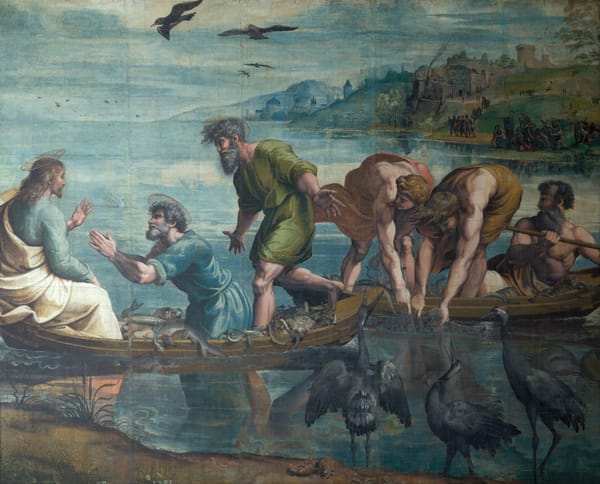
Ch. v.At that time, it came to pass, that when the multitude pressed upon him to hear the word of God, he stood by the lake of Genesareth, and saw two ships standing by the lake; but the fishermen were gone out of them and were washing their nets. And going into one of the ships that was Simon's, he desired him to draw back a little from the land. And sitting he taught the multitudes out of the ship. Now when he had ceased to speak, he said to Simon : Launch out into the deep, and let down your nets for a draught. And Simon, answering, said to him : Master, we have laboured all the night, and have taken nothing; but at thy word, I will let down the net. And when they had done this, they enclosed a very great multitude of fishes, and their net broke. And they beckoned to their partners that were in the other ship, that they should come and help them. And they came and filled both the ships, so that they were almost sinking. Which when Simon Peter saw, he fell down at Jesus' knees, saying : Depart from me, for I am a sinful man, O Lord. For he was wholly astonished, and all that were with him, at the draught of the fishes which they had taken. And so were also James and John the sons of Zebedee, who were Simon’s partners. And Jesus saith to Simon : Fear not; from henceforth thou shalt catch men. And having brought their ships to land, leaving all things they followed him.
The prophecy and promise made by Jesus to Simon the son of John is now fulfilled. We were in amazement, on the day when the Holy Ghost came down, at the success which attended Peter's first fishing for men; he cast in his nets, and it was the choicest of the sons of Israel that he took, and offered them to the Lord Jesus. But the bark of Peter was not to be long confined within Jewish waters. Insignificant as it seems to human views, the ship is now sailing on the high seas; it rides on the deep waters, which are, so St. John tells us, peoples and nations.9 The boisterous wind, the surging billows, the storm, no longer terrify the boatman of Lake Tiberias; for he knows that he has on board Him who is the master of the waves— Him, that is, who has given the deep as a garment to clothe the earth.10 Endued with power from on high,11 Peter has cast his net, the apostolic preaching, all over the great ocean; for it is large as the world, and is to bring the sons of the ‘great fish,’12 the divine Ichthus,13 to the eternal shore. Grand indeed is the work assigned to Peter. Though fellow-labourers have been joined to him in his divine enterprise, yet does he preside over them all as their undisputed head, as master of the ship where Jesus commands in person, and directs all the operations to be done for the worlds salvation. Our to-day's Gospel very opportunely prepares us for, and sums up, the teachings included in the feast of the prince of the apostles, which always comes close on the fourth Sunday after Pentecost. For that very reason, we leave for that feast the detailed enumeration of the glories inherent in the vicar of Christ; and limit ourselves, for the present, to the consideration of the other mysteries contained in the text before us.
The evangelists have left us the account of two miraculous fishings made by the apostles in presence of their divine Lord : one of these, related by St. Luke, the Church proposes for our consideration on this Sunday; the other, with its exquisite symbolism, was put before us by the beloved disciple on Easter Wednesday. The former of these, which took place while our Lord was still in the days of His mortal life, merely states that the net was cast into the water, and that it broke with the multitude of the draught; but no notice is taken by the evangelist of either the number or the kind of fish. In the second, it is our risen Lord who tells the fishermen, His disciples, that the net must be let down on the right side of their boat; it catches, and without breaking, a hundred and fifty great fishes ; these are brought to the shore where Jesus is waiting for them, that He may join them with the mysterious bread and fish that He Himself has already prepared for His labourers.14 The fathers are unanimous in the interpretation of these two fishings : they represent the Church; first of all, the Church as she now is, and next as she is to be in eternity. As she now is, the Church is the multitude, without distinction between good and bad; but afterwards—that is, after the resurrection—the good alone will compose the Church, and their number will be for ever fixed. ‘The kingdom of heaven,’ says our Lord, ‘is like to a net cast into the sea, and gathering together of all kind of fishes; which, when it was filled, they drew out; they chose out the good into vessels, but the bad they cast forth.’15
To speak with St. Augustine, the fishers of men have cast forth their nets; they have taken the multitude of Christians which we see in wonderment; they have filled the two ships with them, the two peoples, Jew and Gentile. But what is this we are told? The multitude weighs down the ships, even to the risk of sinking them; it is what we witness now : the pressing and mingled crowd of the baptized is a burden to the Church. Many Christians there are who live badly; they are a trouble to, and keep back, the good. Worse than these, there are those who tear the nets by their schisms or their heresies; they are impatient of the yoke of unity, and will not come to the banquet of Christ; they are pleased with themselves. Under pretext that they cannot live with the bad, they break the net which kept them in the apostolic track, and they die far off the shore. In how many countries have they not thus broken the great net of salvation? The Donatists in Africa, the Arians in Egypt, Montanus in Phrygia, Manes in Persia; and since their times, how many others have excelled in the work of rupture! Let us not imitate their folly. If grace have made us holy, let us be patient with the bad while living in this world's waters. Let the sight of them drive us neither to live as they do, nor to leave the Church. The shore is not far off, where those on the right, or the good, will alone be permitted to land, and from which the wicked will be repulsed, and cast into the abyss.16
In the Offertory, the Christian army sues for that light of faith which alone can make it sure of victory; and this, because it tells where the enemy is, and what are his plans. For a servant of God who is thus enlightened, night has no dangers; the brightness of heaven's beams keeps off from his eyes that fatal sleep which implies defeat and death.
Offertory
The gifts offered on the altar for the all-mighty transformation of the sacrifice are a figure of the faithful themselves. It is on this account that the Church prays, in the Secret, that our Lord would draw to Himself our rebel wills, and change them, as He is about to do with these gifts. Let us remember, that of all the fish that were in the mysterious net, those only, as the fathers tell us, will be the elect of the eternal shores who 'live in such wise as to deserve to be introduced, by the fishermen of the Church, to the banquet of Christ Jesus.'17
Secret
Second Secret
The third Secret is left to the priest's own choice.
That God who enabled David's weakness to triumph over the giant Philistine, gives Himself to us in the sacred mysteries. Let us sing the psalm from which the Communion-anthem is taken: let us sing these few words in praise of His merciful power, which makes itself become ours by means of this adorable Sacrament.
Communion
St. Augustine18 gives the name of sacrament of hope to the divine mystery wherein the Church daily proclaims and restores, here below, her social union. The real union, though at present it be veiled, of the Head and the members in the banquet of eternal Wisdom, is a pledge of the future glories of regenerate humanity, far exceeding that restless expectation of creation, of which the apostle spoke to us in to-day's Epistle. Let us pray, in the Postcommunion, that our defilements may be removed, and may not impede this holy Sacrament from producing its full effect in us; for such is its virtue, that it is able to lead us to the consummate perfection of salvation.
Postcommunion
Second Postcommunion
The third Postcommunion is left to the priest's own choice.
Vespers
The psalms, capitulum, hymn, and versicle, as above, pages 71-81.
Antiphon of the Magnificat
- Cf. cum Missali hodierno Bern. Aug. De offic. Mis. cap. V; Microlog. De eccl. obs. cap. lxi; Honor. Augustod. Gemma animæ,l. iv; Rupert. De div. off. l. xii; Durand. 1. vi; etc. ↩︎
- Kings xvii. 25-27. ↩︎
- Ps. xxvi. ↩︎
- Heb. vi.19. ↩︎
- Virg., ‘Æn.,’ I. 462. ↩︎
- Wisd. i. 7. ↩︎
- Rom. viii. 16. ↩︎
- In Ep, ad Rom., Hom. xiv. 5. ↩︎
- Apoc. xvii. 15. ↩︎
- Ps. ciii. 6. ↩︎
- St. Luke xxiv. 49. ↩︎
- Titul. S. Abercii. ↩︎
- Inscript. Augustod. ↩︎
- St. John xxi. 1-13. ↩︎
- St. Matt. xiii. 47, 48. ↩︎
- S. Aug. Serm. 248-252, passim. ↩︎
- Bruno Ast. Expos. in Gen., c. I. ↩︎
- Contra Faustum. L. xii. 20. ↩︎
July 3 (the Same Day): St. Leo the Second, Pope and Confessor
IT were fitting that our attention should not be diverted during this Octave from the feast which the Church is keeping. But the triumph of Peter will shine out with all the more splendour in proportion as the testimony he rendered to the Son of God is shown to have been maintained with all fidelity during the long series of succeeding ages by the Pontiffs, inheritors of his Primacy. For a considerable time the twentyeighth of June was consecrated by the memory of St Leo the Great; it was the day chosen by Sergius I for the translation of the illustrious doctor, and indeed a more magnificent usher for the solemnity could hardly be desired. From no other lips than his has Rome ever set forth, in such elevated language, the glories of these two princes of the apostles and her own fame; never since the incomparable scene enacted at Caesarea Philippi has the mystery of the Man-God been affirmed in a manner so sublime as on that day whereon the Church, striking the impious Eutyches at Chalcedon, received from Leo the immortal formula of Christian dogma. Peter once more spoke by the mouth of Leo; yet the evil was far from being ended: two centuries more were needed; and another Leo, he whom we this day honour, had the honour of ending it at the sixth Council.
The Spirit of God, ever watchful over the development of the sacred liturgy, by no means wished any change to be effected in the train of thought of the faithful people. Thus when towards the beginning of the fourteenth century April 11 was again assigned to St Leo I (for that was really the primitive place occupied by him in the cycle), St. Leo II, the anniversary of whose death was June 28, and who hitherto had been merely commemorated thereon, being now raised to the rank of a semi-double, came forward to remind the faithful of the glorious struggles maintained both by his predecessor and by himself, in the order of apostolic confession. Latterly his feast was transferred to this day, in order that St Irenæus may be commemorated on the Vigil of the Apostles.
How was it that St Leo’s clear and complete exposition of the dogma and the anathemas of Chalcedon did not succeed in silencing the arguments of that heresy which refused to our nature its noblest title, by denying that it had been assumed in its integrity by the divine Word? Because for truth to win the day it suffices not merely to expose the lie uttered by error. More than once, history gives instances of the most solemn anathemas ending in nothing but lulling the vigilance of the guardians of the holy city. The struggle seemed ended, the need of repose was making itself felt amidst the combatants, a thousand other matters called for the attention of the Church's rulers; and so whilst feigning utmost deference, nay, ardour even, if needful, for the new enactments, error went on noiselessly, making profit of the silence which ensued after its defeat. Then did its progress become all the more redoubtable at the very time it was pretending to have disappeared without leaving a trace behind.
Thanks, however, to the divine Head, who never ceases to watch over his work, such trials seldom reach to such a painful depth as that into which Leo II had to probe with steel and fire in order to save the Church. Once only has the terrified world beheld anathema strike the summit of the holy mount. Honorius, placed on the pinnacle of the Church, ‘had not made her shine with the splendour of apostolic doctrine, but by profane treason had suffered the faith, which should be spotless, to be exposed to subversion';1 Leo II, therefore, sending forth his thunders in unison with the assembled Church against the new Eutychians and their accomplices, did not spare even his predecessor. And yet, as all acknowledge, Honorius had otherwise been an irreproachable Pope; and even in the question at stake he had been far from professing heresy or teaching error. Wherein, then, did his fault lie?
The Emperor Heraclius, who by victory had reached the height of power, beheld with much concern how continual division persisted between the Catholics of his empire and the late disciples of Eutyches. The bishop of the imperial city, the patriarch Sergius, fostered these misgivings in his master's mind. Vain of a certain amount of political skill which he fancied himself to possess, he now aimed at re-establishing, by his sole effort, that unity which the Council of Chalcedon and St Leo the Great had failed to obtain; thus would he make himself a name. The disputants agreed in acknowledging two natures in Jesus Christ; hence to reply to their advances one thing was needed, he thought, to impose silence on the question as to whether there are in him two wills or only one. The enthusiasm with which this evident compromise was hailed by the various sects rebellious to the fourth General Council showed that they still preserved all the venom of error; and the fact that they denied, or hesitated to acknowledge, that in the Man-God there is any other will than that proper to the divine Nature, was equivalent to declaring that he had assumed but a semblance of human nature, since this nature could by no means exist devoid of that will which is proper to it. Therefore, the Monophysites, or partisans of the one Nature in Christ, made no difficulty in henceforth being called by the name of Monothelites, or partisans of the one will. Sergius, the apostle of this novel unity, might well congratulate himself; Alexandria, Antioch, Constantinople, hailed with one accord the benefit of this peace. Was not the whole East here represented by her patriarchs? If Rome in her turn would but acquiesce, the triumph would be complete! Jerusalem, however, proved a jarring note in this strange concert.
Jerusalem, the witness of the anguish suffered by the Man-God in his human nature, had heard him cry out in the garden of his agony: 'Father, if it be possible, let this chalice pass from me; yet, not my will, but thine be done!'2 The city of dolours knew better than any other what to believe concerning these two wills, which by the heroism of incomparable love were maintained in such full harmony, and the time for her to bear testimony had come. The monk Sophronius, now her bishop, was by his sanctity, courage and learning ready for the task that lay before him. But while, in the charity of his soul, he was seeking to reclaim Sergius before appealing against him to the Roman Pontiff, the bishop of Constantinople took the initiative; he succeeded thus by a hypocritical letter in circumventing Honorius, and in getting him to impose silence on the patriarch of Jerusalem. Hence, when at last St Sophronius, at the head of the bishops of his province assembled in council, thought it had become his positive duty to turn towards Rome, it was but to receive for answer a confirmation of the prohibition to disturb the peace. This was a sad mistake, which though it did not directly implicate the infallible magistracy because it was a measure exclusively political, was one that cost the Church bitter tears and much blood, and which resulted fifty years later in the condemnation of the unfortunate Honorius.
The Holy Ghost, who has guaranteed the infallible purity of the doctrine taught officially from the apostolic Chair, has not pledged himself to protect in a like degree from all failure either the virtue, or the private judgement, or even the administrative acts of the Sovereign Pontiff. In order to promote this marvellous union which the Creator made to reign both upon earth and in heaven, our Lord, when he founded the society of saints upon the authentic and immutable basis of the faith of Peter, willed that to the prayers of all should be confided the charge of completing his work by obtaining for the successors of Peter such preservative graces as do not of themselves necessarily spring from the divine constitution of the Church.
Meanwhile Mahomet was just letting loose his hordes upon the world. Heraclius was now to learn the worth of his patriarch's lying peace, and was to come down lower in shame than he had been exalted in glory by his victories over the Persians, in the days when he had acted as the hero of the cross. Palestine, Syria and Egypt fell simultaneously beneath the blows of the lieutenants of the prophet. Sophronius, placed as he was in the very midst of the scene of invasion, grew still greater under trial. Abandoned by the emperor where the defence of the empire was at stake, disavowed by Rome as to faith, he alone intrepidly treated with Omar as power opposed to power; and when about to die, still hoping against all hope in Rome, though thence had come a blow harder far to bear than that of the caliph, he confided to Stephen of Dora the supreme mission, which the latter thus relates: 'In his justice strong as a lion, contemning calumnies and intrigues, blessed Sophronius took me, unworthy as I am, and conducted me to the sacred spot of Calvary. There he bound me by an indissoluble engagement, in these words: “Thou shalt have to render account to him who being God was voluntarily crucified for us according to the flesh on this spot, when on the day of his terrible coming he will appear in glory to judge the living and the dead, if thou defer or neglect the interests of his faith now in peril. Thou knowest that I cannot in the body do this thing, being hindered by the incursion of the Saracens which our sins have deserved. Set out as soon as possible, and go from here to the farthest ends of the earth, until thou reach the apostolic See, where the foundations of orthodox dogma are set. Go again and again, not once, not twice, but endlessly, and make known to those living there the shock that our land has sustained. Importunately, ceaselessly, implore and supplicate, until apostolic prudence at length determine, by its canonical judgement, the victory over these perfidious teachings."’3
The bishop of Dora was faithful to this command. When, twelve years later, he gave this touching narrative at the Council of Lateran in 649, it was then the third time that, in spite of the snares and other difficulties of the times, he could say: ' We have taken the wings of a dove, as David speaks, and we have come to declare our situation to this See, elevated in the sight of all, this sovereign, this principal See, where is to be found remedy for the wound that has been inflicted upon us.'4 St Martin I, who received this appeal, was one worthy to hear it; and soon afterwards he repaired by his own martyrdom the fault committed by Honorius in suffering himself to be tricked by an impostor. His glorious death, followed by the tortures endured for the truth by the saintly abbot Maximus and his companions, prepared the victory which the heroic faith of Sophronius had announced to the Roman Pontiff. Thus was an odious silence rectified by holy Church: now were her doctors to be seen, with tongue plucked out, still continuing by divine power to proclaim that Christian dogma which cannot be enchained;5 still with lopped-off hands finding means, in their indomitable zeal, to affix to the mutilated arm the pen whose function, now made doubly glorious, continued thus to carry throughout the world the refutation of falsehood.
But it is time to come to the issue of this memorable contest. It is to be found in him whose feast we are celebrating. St Agatho had assembled the sixth General Council at Constantinople, at the request of another Constantine, an enemy of heresy and a victor over Islam. Faith and justice now did the work hand in hand; and St Leo II could at last sing aloud: 'O holy mother Church, put off thy garb of mourning, and deck thee in robes of gladness. Exult now with joyous confidence: thy liberty is not cramped.'6
The holy liturgy devotes the following lines to the history of this pontificate, short indeed, but well filled:
O glorious Pontiff, to thee was granted the privilege of completing the apostolic confession by giving the furthest development to the testimony rendered by Peter to the Son of the living God, who is at the same time Son of man. Thou wast to finish the work of Sylvester, Celestine and that other Leo, a Pontiff beloved of earth and of heaven. Convoking, inspiring, confirming the illustrious Councils of Nicæa, Ephesus and Chalcedon, they had triumphantly proved in our Emmanuel both his Divinity consubstantial with the Father, and his unity of person which causes Mary to be truly his Mother, and furthermore his twofold Nature, without which he could not have been our Brother. Satan, who had allowed himself to be more easily overcome on the first two points, disputed the third with utmost rage. As on that great battle-day when he was hurled from heaven, the form of his revolt had been a refusal to adore God under human features; so now, together with all hell, enforced by holy Church to bend the knee, his jealousy would fain pretend that at least God had taken of man but a mutilated nature. Let it be granted that the Word was made Flesh, but in this Flesh do not allow that he had other impulses, other energies, save those of the Divinity itself; such an inert nature as this, uncrowned of its proper will, would in reality be no human nature, even though it were to retain all the rest. Then would Lucifer, in his pride, have less cause to blush; for then man, the object of his infernal envy, would have nothing in common with the divine Word save a vain appearance! Thanks be to thee, O Leo, in the name of all mankind! By thee, in face of heaven, earth and hell, is promulgated authentically the incomparable title whereby, without any restriction, our nature is established at the right hand of the Father, in the highest heavens; by thee our Lady crushes the vile serpent's head once again.
But what craft was displayed by Satan in this campaign, prolonged for two centuries, noiselessly, the better to secure success! What exultation rang through the abyss when one sad day saw the representative of him who is essential Light appear to side for a moment with the powers of darkness! A cloud seemed to have come between heaven and those mountains of God, where he dwells with his Vicar; it is probable that the social aid of intercession was weaker just then than it should have been. Be ever at hand, O Leo, to ward off all similarly dangerous situations. Uphold, in every age, the Pastor who rules Christ's Church, that he may keep himself aloof from the darkening mists that earth exhales; keep ever alive in the hearts of the faithful flock that strong prayer, which should continually be made without ceasing for him by the Church:7 and then Peter, were he even chained in the depths of the darkest dungeon, will be reached by the Sun of justice and clearly see his way in that pure ray; then will the whole body of the Church be lightsome. For Jesus hath said, 'the light of the body is the eye: if the eye be single the whole body will be lightsome.'8
By thy teaching we realize more fully the strength of the rock whereon the Church stands; we know that the gates of hell shall never prevail against her.9 For surely the efforts of the spirits of darkness never went to such lengths as they did in that sad crisis to which thou didst put an end; nor was their success, however great in appearance, contrary to the divine promise; for it is to the teaching of Peter, not to his silence, that the unfailing assistance of the Holy Ghost is guaranteed. O loving Pontiff, obtain for us uprightness of faith and heavenly enthusiasm wherewith it behoves us to hail Peter and Christ acting together in the unity divinely established between them. The liturgy is deeply indebted to thee; grant us to relish more and more the hidden manna it contains, and may our hearts and voices fittingly render these sacred melodies!
July 3 (the Same Day): The Fifth Day within the Octave of the Holy Apostles Peter and Paul
ALTHOUGH amongst the saints there is none who is undeserving of earth's humble homage, or whose intercession is powerless on our behalf, yet the cultus rendered to them, and the confidence evinced, necessarily vary in proportion to what we know of their glory. It is therefore only just, as St Leo remarks in to-day’s Office, that we should honour in a most special manner those whom divine grace has exalted so far above all others, that they are considered, as it were, the two brilliant eyes of Christ’s mystical body, the Church, giving light to all of us, who are the members thereof.* For this reason, the festival of these two princes of the apostles is held superior to that of any other servant of God occurring in the entire cycle.
When the Church’s own practice gave tone to the particular customs of the various countries, national confidence and even private devotion knew no other preferences than those of the holy liturgy; and long were it to tell of all that can be produced by history, public charts, simple contracts and monuments of every sort, in endless proof of our forefathers' love for the glorious doorkeeper of heaven and his illustrious companion armed with the sword. Faith was lively in those days. It was then well understood that of all God's gifts to earth, none is comparable to the graces of sanctification, doctrine and unity, of which Peter and Paul are for all the predestined instruments. The heart became dilated as the mind expanded. Men were eager, therefore, to know as much as they could touching the lives of these fathers of the Christian people; and they made great account of the devotedness wherewith the two apostles had so unsparingly poured out their sweat and blood for them.
Alas! can it be said that such is the case nowadays? How many baptized persons are there, Catholics not merely in name, but even considered practical Catholics, who scarcely possess such elementary notions of true Christianity as to appreciate the importance of the role performed amongst men by these founders of the Church, or even to give it a passing thought! Yet some there are, and thanks be to God their number is now on the increase, who glory in studying the principles on which rests the divine constitution of society purchased by the Blood of our Lord. Such men as these understand and revere the august position which has been, and always must be, held by Peter and Paul in the economy of Christian dogma. Nevertheless, do even these persons honour really as they ought these two princes of the apostles? What they know on this subject shows them plainly enough that it cannot be the case with these two apostles as it is with many other saints, whose cultus increases or diminishes according to circumstances of time, place and the like: the cultus of SS Peter and Paul has its roots in the very foundations of Catholicism; whether in nations or in individual souls it cannot wane, save to the great detriment of Catholicity itself. But then, no cultus is real, except that which implies devotion and love; can it be really said of the class of persons to whom we refer that their knowledge of the holy apostles has penetrated deeply enough from their mind into their heart?
In the case of too many people, this knowledge, being confined to the region of theory, is not sufficiently personal with regard to the two apostles themselves; and, therefore, principles the most nicely drawn do by no means impart the spirit of faith, the seat of which is in the heart, and which animates the life. Let them put the finishing stroke to their science. Without losing sight of dog matic science, let them seek in prayer and in humble study of the Gospel of the Acts of the Apostles, of the Epistles and of ecclesiastical tradition, that intimate revelation of the very soul of Peter and of Paul which cannot fail to make them admire, and above all love them personally as much as and even more than their sublime prerogatives. Then perhaps will they be astonished to have come so late to a knowledge of many precious details and thousands of instructive features about them, which little children in bygone ages (now reputed barbarous) would have blushed not to know. As a necessary consequence, they will thus begin to feel more Catholic in soul; they will consider themselves happy to have learnt, at last, how to share the devotion of the humble peasant woman and her ingenuous confidence, not unmixed with fear, in the doorkeeper of paradise.
The following beautiful Preface is taken from the Mozarabic Missal. Its theme is that assemblage of divine contrasts, amidst which eternal Wisdom loves, as it were, to play, and which are found wonderfully multiplied in the lives of these two apostles.
Illatio
His igitur dispari mortis genere, non dispari moriendi amore perfunctis: exsultet in eorum doctrinis Ecclesia catholica; in exsequiis religiositas universa; in memoriis urbs Romana; in patrociniis omnis anima christiana. Hæc autem omnia tu, Domine, operaris: qui a prophetis demonstraris; ab angelis adoraris; et in omni sæculo apostolorum lumine declararis. Cui merito omnes Angeli et Archangeli non cessant clamare quotidie, ita dicentes: Sanctus, Sanctus, Sanctus.
These two, therefore, differ in the manner of their death, but not in the love shown forth in dying: the Catholic Church exults in their teaching; all religion, in the celebration of their death; the Roman city, in their memory; each Christian soul, in their patronage. Now, all these things thou, O Lord, hast operated, thou who wast pointed out by the prophets, art adored by the angels, art manifested throughout the world, by the light of the apostles. To whom meetly, all Angels and Archangels unceasingly cry out daily, saying: Holy, Holy, Holy.
The same liturgy makes use of the following hymn on this festival. It is attributed, not without some foundation, to St Ambrose, and seems to have preceded the hymn of Elpis in liturgical use.
Hymn
Diem sacravit sæculis,
Petri triumphum nobilem,
Pauli coronam proferens.
Cruor triumphalis necis;
Deum secutos præsules
Christi coronavit fides.
Nec Paulus impar gratia:
Electionis vas sacræ
Petri adæquavit fidem.
Simon honorem dans Deo,
Suspensus ascendit, dati
Non immemor oraculi.
Elevatus ab altero,
Quo nollet ivit, sed volens
Mortem subegit asperam.
Devotionis extulit,
Fundata tali sanguine
Et vate tanto nobilis.
Stipata tendunt agmina:
Trinis celebratur viis
Festum sacrorum martyrum.
Concurrere plebem poli:
Electa genitum caput,
Sedes magiatri gentium.
Ejusque soli Filio,
Cum Spiritu Paraclito
In sempiterna sæcula.
hath consecrated this immortal day,
presenting Peter's noble triumph
and Paul's crown.
hath conjoined these men, peers in fame;
the faith of Christ hath crowned
these jubilant followers of God.
next, Paul his peer in grace.
The vessel of sacred election
hath equalled the faith of Peter.
Simon, suspended, ascends
along the heaven-turned footprints
of the cross, giving glory to God.
girded by another’s hand, is upraised.
Whither he would not, he has had to go;
but willing now, dire death hath he subdued.
the exalted head of religious worship,
founded, as she is, in such blood as this,
and by so illustrious a prophet.
of so great a city, close packed,
crowds are pressing along, by three ways,
for the celebration of the holy martyrs' festival.
that the people of all nations had assembled here;
lo! verily, the chosen head of the Gentiles,
the seat of the teacher of the Gentiles!
and to his only Son,
together with the Paraclete Spirit,
for ever and ever.
* Sermo I in Nat. A post. Lect. II Nocturni. ↩︎
| Previous July 2 (the Same Day): Sts. Processus and Martinianus, Martyrs | Next July 3 (the Same Day): St. Leo the Second, Pope and Confessor |