Daily reading
After Pentecost
Double · Movable from Easter · Temporal
August 28, 2022
From Dom Guéranger’s The Liturgical Year.

|
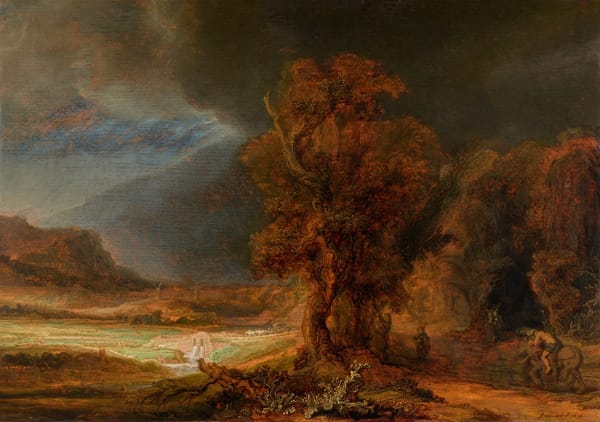
The Twelfth Sunday after Pentecost
On this Sunday, which is their twelfth of Saint Matthew, the Greeks read in the Mass the episode of the young rich man who questions Jesus, given in the nineteenth chapter of the Saint’s Gospel. In the west, it is the Gospel of the Good Samaritan which gives its name to this twelfth Sunday after Pentecost.
The Introit begins with that beautiful verse of Psalm lxix. : 'Come to mine assistance, O God! O Lord, make haste to help me!’ Cassian, in his tenth Conference, has admirably drawn out the beauty of these words, and shows how they are appropriate for every circumstance of life, and how fully they respond to every sentiment of the Christian soul.1 Durandus applies this Introit to Job, because the lessons for the Divine Office, which are taken from that Book of Scripture, sometimes, though not often, coincide with this Sunday.2 Rupert looks on this Introit as the fitting prayer of the deaf and dumb man, whose cure was the subject of our reflexions this day last week. He says : 'The human race, in the person of our first parents, had become deaf to the commandments of God, and dumb in His praise; the first use he makes of his untied tongue, is to call upon the God who has healed him.'3 The same words are the Church’s first address, each morning, to her Creator, and her opening of each of the canonical hours, both day and night.
Introit
It frequently happens (and we have already explained the reason), that the Collect of the Masses for the Time after Pentecost contains an allusion to the Gospel of the foregoing Sunday. The one for to-day evidently does so. Eight days back, we were taught how man, who had rendered himself incapable of serving his Creator, finds by divine mercy, that his supernatural faculties are restored to him; and then, he gives forth the voice of praise, and that, too, rightly (loquebatur recte). The Church, taking up the idea here suggested, prays thus:
Collect
The other Collects, as on page 120.
Epistle
2 Cap. iii.
Fratres, Fiduciam talem habemus per Christum ad Deum : non quod sufficientes simus cogitare aliquid a nobis, quasi ex nobis : sed sufficientia nostra ex Deo est : qui et idoneos nos fecit ministros novi testamenti, non littera, sed spiritu : litter a enim occidit, spiritus autem vivificat. Quod si ministratio mortis litteris deformata in lapidibus, fuit in gloria, ita ut non possent intendere filii Israel in faciem Moysi, propter gloriam vultus ejus, quæ evacuatur : quomodo non magis ministratio spiritus erit in gloria? Nam si ministratio damnationis gloria est: multo magis abundat ministerium justitiæ in gloria.
2 Ch. iii.
The glorious promises mentioned in the concluding words of our Collect are described to us in the Epistle, which seems, at first sight, to be entirely in praise of the apostolic ministry; but the glory of the apostles is the glory of Him whom they announce; and this one glory, which is His, Christ, the Head, communicates to all His members, making it also their one glory. This divine glory flows, together with the divine life, from that sacred Head; and they both flow copiously through all the channels of holy Church.4 If they do not come to all Christians in the same proportions, such difference in no wise denotes that the glory and the life themselves are of a different kind for some from what they are for others. Each member of Christ's mystical Body is called upon to form his own degree of capacity for glory; not, of course, as the apostle says, that we are, of ourselves, sufficient even to think anything as of ourselves— but, what diversity there is in the way in which men turn to profit the divine capital allotted to each by grace!
Oh! if we did but know the gift of God!5 if we did but understand the supereminent dignity reserved, under the law of love, to every man of good will!6 Then, perhaps, our cowardice and sluggishness would, at last, go; then, perhaps, our souls would get fired with the noble ambition which turns men into saints. At all events, we should then come to realize that Christian humility, of which we were speaking on the last two Sundays, is not the vulgar grovelling of a low-minded man, but the glorious entrance upon the way which leads, by divine union, to the only true greatness. Are not those men inconsistent and senseless who, longing by the very law of their nature for glory, go seeking it in the phantoms of pride, and allow themselves to be diverted, by the baubles of vanity, from the pursuit of those real honours which eternal Wisdom7 had destined for them! And those grand honours were to have been heaped upon them, not only in their future heaven, but even here in their earthly habitation; and God and His saints were to have been admiring and applauding spectators!
In the name, then, of our dearest and truest interests, let us give ear to our apostle, and share his heavenly enthusiasm. We shall understand his exquisite teaching all the better, if we read the sequel to the few lines assigned for to-day’s Epistle. It is but fully carrying out the wishes of the Church, when her children, after or before assisting at her liturgical services, take the sacred Scriptures, and read for themselves the continuation of passages, which are necessarily abridged during the public celebrations. It were well, if they did this all through the year. What a fund of instruction they would thus acquire! To-day, however, there is an additional motive for the suggestion, inasmuch as this second Epistle to the Corinthians is brought before us for the first and only time during this season of the liturgy.
But let us examine what is this glory of the new Testament, which so fills the apostle with ecstasy, and, in his mind, almost entirely eclipses the splendour of the old. Splendour there undoubtedly was in the covenant of Sinai. Never had there been such a manifestation of God’s majesty, and omnipotence, and holiness, as on that day, when, gathering together, at the foot of the mount, the descendants of the twelve sons of Jacob, He mercifully renewed, with this immense family, the covenant formerly made with their fathers,8 and gave them His Law in the extraordinarily solemn manner described in the Book of Exodus. And yet, that Law, engraven as it was on stone by God’s own hand, was not, for all that, in the hearts of the receivers; neither did its holiness prevent, though it condemned, sin—sin which reigns in man’s heart.19 Moses, who carried the divine writing, came down from the mount, having the rays of God’s glory glittering on his face;10 but this glory was not to be shared in by the people of whom he was the head; it was for himself alone, as was likewise the privilege he had enjoyed of speaking with God face to face;11 it ceased with him, thus signifying, by its short duration, the character of that ministration, which was to cease on the coming of the Messiah, just as the night’s borrowed light vanishes when the day appears. And, as it were, the better to show that the time was not as yet come, when God would manifest His glory—the children of Israel were not able to gaze steadfastly on the face of Moses; so that, when he had to speak to the people, he had need to put on a veil. Though a mere borrowed light, the brightness of Moses’ face represented the glory of the future Covenant, whose splendour was to shine, not, of course, externally, but in the hearts of us all, by giving us 'the light of the knowledge of the glory of God, in the face of Christ Jesus.'12 Light, living and life-giving, which is none other than the divine Word,13 the Wisdom of the Father,14 and which the energy of the sacraments, seconded by contemplation and love, makes to pass from the Humanity of our divine Head to the very recesses of our souls.
We shall find our Sunday giving us a second reminder of Moses; but the true and enduring greatness of the Hebrew leader lies in what we have been stating. In the same way that Abraham was grander by the spiritual progeny which was the issue of his faith, than he was by the posterity that was his in the flesh—so the glory of Moses consisted not so much in his having been at the head of the ancient Israelites for forty long years, as in his having represented, in his own person, both the office of the Messiah King, and the prerogatives of the new people. The Gentile is set free from the law of fear and sin15 by the law of grace, which not only declares justice, but gives it; the Gentile, having been made a son of God,16 communes with Him in that liberty which comes of the Spirit of love.17 But, this privileged Gentile has no type which so perfectly represents him, in the first Covenant, as this the very lawgiver of Israel, this Moses who finds such favour with the Most High as to be admitted to behold His glory,18 and converse with Him with all the intimacy of friend to friend.19 Whereas God showed Himself to this His servant —as far, that is, as mortal man is capable of such sight20—and as He was seen by him without the intermediation of figures or images,21 so, when he approached thus to God, Moses took from his face the veil he wore at other times. The Jew persists, even to this very day, in keeping this veil between himself and Christ.22 The Christian, on the contrary, with the holy daring of which the apostle speaks,23 removes all intermediaries between God and himself, and draws aside the veil of all figures. ‘Beholding the glory of the Lord with face uncovered, we are transformed into the same image from glory to glory, as by the Spirit of the Lord,’24 for we become other christs, and are made like to God the Father, as is His Son Christ Jesus.
Thus is fulfilled the will of the almighty Father for the sanctification of the elect. God sees Himself reflected in these predestinated, who are become, in the beautiful light divine, conformable to the image of His Son.25 He could say of each one of them what He spoke at the Jordan and on Thabor: ‘This is my beloved son, in whom I am well pleased.’26 He makes them His true temple,27 verifying the word He spoke of old : ‘I will set my tabernacle in the midst of you: I will walk among you, and will be your God;28 I will bring thy seed from the east, and gather thee from the west; I will say to the north : “Give up!” and to the south: “Keep not back!” Bring my sons from afar, and my daughters from the ends of the earth!’29
Such are the promises, for whose realization we should, as the apostle says, be all earnestness in working out our sanctification, by cleansing ourselves from all defilement of the flesh and of the spirit, in the fear of God,30 and in His love. Such is that glory of the new Testament, that glory of the Church and of every Christian soul, which so immensely surpasses the glory of the old, and the brightness which lit up the face of Moses. As to our carrying this treasure in frail vessels, we must not, on that account, lose heart, but rather rejoice in this weakness, which makes God's power all the more evident; we must take our miseries, and even death itself, and turn them into profit, by giving the stronger manifestation of our Lord Jesus’ life in this our mortal flesh. What matters it to our faith and our hope, if our outward man is gradually falling to decay, when the inner is being renewed day by day? The light and transitory suffering of the present is producing within us an eternal weight of glory. Let us, then, fix our gaze, not on what is seen, but on what is unseen; the visible passes, the invisible is eternal.31
The human race, delivered from its long ages of dumbness, and blessed at the same time with God’s gifts, sings, in the Gradual, the hymn of its warmest gratitude.
Gradual
Gospel
Cap. x.In illo tempore : Dixit Jesus discipulis suis : Beati oculi, qui vident quæ vos videtis. Dico enim vobis, quod multi prophetæ, et reges voluerunt videre quæ vos videtis, et non viderunt : et audire quæ auditis, et non audierunt. Et ecce quidam legisperitus surrexit tentans illuni, et dicens: Magister, quid faciendo vitam æternam possidebo? At ille dixit ad eum : In lege quid scriptum est? quomodo legis? Ille respondens dixit : Diliges Domimim Deum tuum ex toto corde tuo, et ex tota anima tua, et ex omnibus viribus tuis, et ex omni mente tua : et proximum tuum sicut teipsum. Dixitque illi : Recte respondisti : hoc fac, et vives. Ille autem volens justificare seipsum, dixit ad Jesum: Et quis est meus proximus? Suscipiens autem Jesus, dixit: Homo quidam descendebat ab Jerusalem in Jericho, et incidit in latrones, qui etiam despoliaverunt eum : et plagis impositis abierunt, semivivo relicto. Accidit autem ut sacerdos quidam descenderet eadem via : et viso illo, præterivit. Similiter et Levita, cum esset secus locum, et videret eum, pertransiit. Samaritanus autem quidam iter faciens, venit secus eum : et videns eum, misericordia motus est. Et appropians, alligavit vulnera ejus, infundens oleum, et vinum : et imponens illum in jumentum suum, duxit in stabulum, et curam ejus egit. Et altera die protulit duos denarios, et dedit stabulario, et ait : Curam illius habe : et quodeumque supererogaveris, ego cum rediero, reddam tibi. Quia horum trium videtur tibi proximus fuisse illi, qui incidit in latrones? At ille dixit: Qui fecit misericordiam in ilium. Et ait illi Jesus: Vade, et tu fac similiter.
Ch. x.At that time : Jesus said to his disciples : Blessed are the eyes that see the things which you see. For I say to you, that many prophets and kings have desired to see the things that you see, and have not seen them : and to hear the things that you hear, and have not heard them. And behold, a certain lawyer stood up, tempting him, and saying: Master, what must I do to possess eternal life? But he said to him : What is written in the law? how readest thou? He answering said: Thou shalt love the Lord thy God with thy whole heart, and with thy whole soul, and with all thy strength, and with all thy mind : and thy neighbour as thyself. And he said to him : Thou hast answered right: this do and thou shalt live. But he willing to justify himself, said to Jesus : And who is my neighbour? And Jesus answering said: A certain man went down from Jerusalem to Jericho, and fell among robbers, who also stripped him, and having wounded him, went away, leaving him half dead. And it chanced that a certain priest went down the same way: and seeing him, passed by. In like manner also a levite, when he was near the place, and saw him, passed by. But a certain Samaritan, being on his journey, came near him; and seeing him, was moved with compassion. And going up to him, bound up his wounds, pouring in oil and wine; and setting him upon his own beast, brought him to an inn, and took care of him. And the next day, he took out two pence, and gave to the host, and said: Take care of him; and whatsoever thou shalt spend over and above, I at my return will repay thee. Which of these three in thy opinion was neighbour to him that fell among the robbers? But he said: He that showed mercy to him. And Jesus said to him: Go, and do thou in like manner.
The doctor and apostle of the Gentiles was speaking to us, in the Epistle, of the glory of the new Testament: Jesus, the Man-God, of whom Paul was but the servant, reveals to us, in the Gospel, the perfection of that Law, which He came to give to the world. And as though He would, in a certain way, unite His own divine teachings with those of His apostle, and justify that apostle’s enthusiasm, it is from the very depth of His own most holy soul, and in the Holy Ghost,32 that, having thanked His eternal Father for these great things, He cries out, turning to His disciples: Blessed are the eyes that see the things which ye see!
The same idea was expressed by the prince of the apostolic college, alluding to the unspeakable and glorious joy,33 which resulted from the new Alliance, wherein figures were to be replaced by realities. In his first Epistle to the elect of the holy Spirit,34 Peter speaks, in the same strain as his divine Master35 had done, of the unfulfilled aspirations of the saints of the old Testament,— those admirable men, whom St. Paul describes36 as being so grand in faith, as to be both heroic in combat and sublime in virtue. St. Peter then expresses, in inspired language, how the elect of the Church of expectation were continually looking forward to the grace of the time that was to come; how they were ever counting the years which were to intervene; how they were carefully searching (scrutinizing, as our Vulgate words it) the long ages, to find out when that happy time would be realized; although they were well aware, that the longed-for sight of the mysteries of salvation was never to be theirs, and that their mission was limited to prophesying those grandeurs to future generations.37
But, who are those kings spoken of in our Gospel, as uniting with the prophets in the desire to see the things we see? To say nothing of those holy ones who thought less of the throne they sat on, than of the divine Object of the world’s expectation,—may we not say, with the holy fathers,38 that those well deserved to be called kings, whom St. Paul describes as, by their faith, conquering kingdoms, vanquishing armies, stopping the mouths of lions, masters of the very elements, yea, what is more, masters of themselves? Heedless of the mockeries, as well as of the persecutions, of the world that was not worthy to possess such men, these champions of the faith were seen wandering in the deserts, sheltering in dens and caves, and yet happy in the love of One whom they knew they were not to see until long ages after their death.39
Do we, then, who are their descendants,—we for whom they were obliged to wait, in order to enjoy a share of those blessings which their sighs and vehement desires did so much to hasten,—appreciate the immense favour bestowed on us by our Lord? Our virtue scarcely bears comparison with that of the fathers of our faith; and nevertheless, by the descent of the holy Spirit of love, we have been more enlightened than ever were the prophets, for, by that holy Spirit, we have been put in possession of the mysteries which they only foretold. How is it, then, that we are so sadly slow to feel the obligation we are under of responding, by holiness of life,40 and by an ardent and generous love, to the liberality of that God, who has gratuitously called us from darkness to His admirable light?41 Having so great a cloud of witnesses over our heads, let us lay aside the burden of sin which impedes us, and run, by patience, in the fight proposed to us. Let us fix our eyes on Jesus, the author and finisher of faith, who, having joy set before Him, preferred to endure the cross, despising the shame, and now sitteth on the right hand of the throne of God.42 We know Him with greater certainty than we do the events which are happening under our eyes, for He Himself, by His holy Spirit, is ever within us, incorporating His mysteries into us.
The illumination of holy Baptism has produced within our souls that revelation of Christ Jesus which constitutes the basis of the Christian life, and on which the Man-God congratulated His disciples. It was of that revelation or knowledge that He spoke, rather than of the exterior sight of His human Nature, a sight which was common not only to His devoted followers, but to every enemy that chose to stare at Him. The apostle of the Gentiles makes this very clear, when, after the change produced in the disciples by the Holy Ghost’s coming upon them, he thus spoke : ‘If we once knew Christ according to the flesh, now we know Him so no longer.’43 It is literally in us, and no longer in the cities of Judea, that the kingdom of God is to be found.44 It is faith that shows us the Christ, who is dwelling in our hearts, that He may establish us in charity, and grow in us, by transforming us into Himself, and fill us with all the fullness of God.45 It is by fixing his eye on the divine image which silently lights up the soul that has been purified by Baptism that, as we were just now saying, the inner man is renewed from day to day, by incessant contemplation, and growing love, and persevering and, at last, perfect imitation, of his Creator and Saviour.46
How important it is, then, to let the supernatural light have such free scope and expansion within us, that not one of our acts or thoughts, not even the deepest recess of our hearts, may escape its sovereign influence and guidance! It is on this point, that the Holy Ghost works prodigies in faithful souls: the unrestrained development of His highest gifts, understanding and wisdom, gives such a predominance to the divine light, that the brightness of the sun’s rays pales before it. Breathing, in His omnipotent freedom, when and as He willeth, this holy Spirit does not always wait for the regular development of those gifts which He bestows upon all: the soul, drawn up to heights unreached by the ordinary paths of the Christian life, finds herself plunged in the deepest abyss of Wisdom;47 there she delightedly imbibes the rays which come to her from the eternal summits, and, in their tranquil and radiant simplicity which holds all in itself, she feels that she has the secret of all things. There are moments, when, raised up still higher,— above the region of the senses and the domain of human reasoning, or, as St. Denis the Areopagite words it, above all the intelligible,48—she is permitted to rest her wings on the summit, where dwells the uncreated light in its essence, and whence it streams down even to the furthest limits of creation, lending something of its divine splendour to every creature. Then it is, that mercifully acting on the soul, which cannot yet bear the direct infinite glory, the blessed Trinity shrouds her in that mysterious darkness, of which the saints speak as belonging to these highest degrees of mystical ascension. The darkness, beyond which is the very God of Majesty,49 is an obscurity which penetrates the soul with higher bliss than does light itself; it is a sacred night, whose silence is more eloquent than any sound that this earth could hear; it is a holy of holies, where adoration absorbs the soul; vision is not there, still less is science, and yet, it is in this sanctuary, that understanding and love, acting together in ineffable unison, take hold of the sublimest mysteries of theology.
It is quite true that such favours as these are imparted to but few; and no man can lay the slightest claim to them, be his virtue ever so great, or his fidelity ever so tried. Neither does perfection depend upon them. Faith, which guides the just man, is enough to make him estimate the life of the senses for what it really is,—miserable and grovelling. With the aid of ordinary grace, he easily lives in that intimate retirement of the soul, wherein he knows that the holy Trinity resides; he knows it, because he has it from the teaching of the Scripture.50 His heart is a kind of heaven, where his life is hidden in God, together with that Jesus upon whom are fixed all his thoughts:51 there he gives to his beloved Lord the only proof of love which is to be trusted, the only one that this Lord asks at our hands,—the keeping of the commandments.52 In spite of the ardent longings of his hope, he waits patiently and calmly for that final revelation of Christ, which, on the last day, will give him to appear together with Him in glory :53 for, as without seeing Him he believes in Him, so without seeing Him he knows that he loves Him.54 The ever-advancing growth in virtue, which men observe in such a man, is a more unmistakable proof of the power of faith, than can be those extraordinary manifestations of which we were just speaking, and in which the soul is so irresistibly subdued, that she has scarcely the power to refuse her love.
Hence, it is not without a reason and a connexion that the Gospel chosen for to-day passes at once, after the opening verses which we have been commenting, to the new promulgation of the great commandment, which includes the whole Law and the Prophets.55 Faith assures man that he may and must love the Lord his God with his whole heart, and with his whole soul, and his whole strength, and his whole mind, and his neighbour as himself. In the homily on the sacred text,56 the Church gives us the interpretation as far only as the question proposed by the Jewish lawyer: by this she insinuates that the latter portion of the Gospel, though by far the longer, is but the practical conclusion of the former, according to the saying of the apostle, that faith worketh by charity.57 The parable of the good Samaritan, though containing materials for the sublimest symbolic teaching, is spoken here in its literal sense by our Lord, for the one purpose of removing the restrictions put by the Jews on the great precept of love.
If all perfection be included in love,—if, without love, no virtue produces fruit for heaven,—it is important for us to remember, that love is not of the right kind unless it include our neighbour; and it is only after stating this particular, that St. Paul affirms that love fulfilleth the whole law,58 and that love is the plenitude of the law.59 Thus we find that the greater number of the precepts of the Decalogue concern our duties to our neighbour;60 and we are told, that the love we have for God is only then what it ought to be, when we love not only Him, but also what He loves, that is, when we love man whom He made to His own likeness.61 Hence, the apostle St. Paul does not explicitly distinguish, as the Gospel does, between the two precepts of love. He says:' All the law is fulfilled in one sentence: Thou shalt love thy neighbour as thyself.'62
Such being the importance of this love, it is necessary to have a clear understanding as to the meaning and extent of the word neighbour. In the mind of the Jews, it comprised only their own race; and in this they were following the custom of the pagan nations, to whom every stranger was an enemy. But, here in our Gospel, we have a representative of this Jewish diminished law63 eliciting, from Him who is the author of the law, an answer which declares the precept in all its fullness. This time, He does not make His voice heard amidst thunder and fire, as on Mount Sinaï. He, as Man living and conversing with men,64 reveals to them, and in the most intelligible way possible, the whole import of the eternal commandment which leads to life.65 In a parable (wherein, as many think, He is relating a fact which has really happened, and is known to those to whom He is addressing it), our Jesus describes how there was a man who went forth from the holy city, and how he fell in with a Samaritan, that is, with a stranger the most despised and the most disliked of all those whom an inhabitant of Jerusalem looked on as his enemies.66 And yet, the shrewd lawyer who questions Jesus, and, no doubt, all those who have been listening to the answer, are obliged to own that the neighbour, for the poor fellow who had fallen into the hands of robbers, was not so truly the priest, or the levite (though both of them were of his own race), as this stranger, this Samaritan, who forgets all national grudges as soon as he sees a suffering creature, and cannot look on him in any other light than as a fellow-man. Our Jesus made Himself thoroughly understood; and everyone present must have well learnt the lesson, that the greatest of all laws, the law of love, admits of no exception, either here or in heaven.
The Offertory is taken from the Book of Exodus, where Moses is described as striving with God, striving, that is, to induce Him to spare His people, after their crime of worshipping the golden calf. Moses was permitted to triumph, and God’s anger was appeased. It may sometimes happen that this Sunday falls close upon, or even on, the very day when the Church, in her Martyrology (September 4), makes a commemoration of the Jewish leader; and Honorius of Autun67 tells us, that this is the reason for such frequent mention being made in to-day’s liturgy of this glorious lawgiver of Israel.
Offertory
The Secret prays our Lord to accept graciously the offerings of the Sacrifice— offerings which are made for the purpose of winning pardon for us, and giving honour to His divine majesty.
Secret
The other Secrets, as on page 130.
As on last Sunday, so again to-day, the Communion-anthem evidently alludes to harvest-time and vintage. Bread, wine, and oil, are not only the supports of our material life; they are, also, the matter of the most august of our Sacraments. No moment is so suitable for speaking their praise as that of our having been made sharers in the sacred banquet.
Communion
The life imparted to us by the sacred mysteries, finds in them its perfection, and also its protection; for they are continually removing from us, gradually more and more, those remnants of the evil which had first brought death upon us. Such is the teaching expressed in the Postcommunion.
Postcommunion
The other Postcommunions, as on page 181.
Vespers
The psalms, capitulum, hymn, and versicle, as above, pages 71-81.
Antiphon of the Magnificat
- Cass., Collat., x. 10. ↩︎
- Dur., Rat., vi. 126. ↩︎
- Rup., De div. off., xii. 12. ↩︎
- Eph. iv. 15, 16. ↩︎
- St. John iv. 10. ↩︎
- St. Luke ii. 14. ↩︎
- Ecclus vi. 29-32. ↩︎
- Gen. xv. 18. ↩︎
- Rom. vii 12, 13. ↩︎
- Exod. xxxiv. 29-35. ↩︎
- Ibid. xxxiii. 11. ↩︎
- 2 Cor. iv. 6. ↩︎
- St. John i. 4-9. ↩︎
- Wisd. vii. 25, 26 ↩︎
- Rom. vii. 2. ↩︎
- Ibid. 15. ↩︎
- 2 Cor. iii. 17. ↩︎
- Exod xxxiii. 17-19. ↩︎
- Ibid. 11. ↩︎
- Ibid. 20. ↩︎
- Num. xii. 8. ↩︎
- 2 Cor. iii. 14. ↩︎
- Ibid. 12. ↩︎
- 2 Cor. iii. 18. ↩︎
- Rom. viii. 29. ↩︎
- St. Matt. iii. 17, xvii. 5. ↩︎
- 2 Cor. vi. 16. ↩︎
- Lev. xxvi. 12. ↩︎
- Isa. xliii. 5-7. ↩︎
- 2. Cor. vii. 1. ↩︎
- 2 Cor. iv. 7-18, etc. ↩︎
- St. Luke x. 21-23. ↩︎
- 1 St. Pet. i. 8. ↩︎
- Ibid. 1, 2. ↩︎
- St. Amb., in Luc., x. ↩︎
- Heb. xi. ↩︎
- 1 St. Pet. i. 10-12. ↩︎
- ℣. Beda, in Luc., iii. Homily for the day. ↩︎
- Heb. xi. 33-39. ↩︎
- 11 St. Pet. i. 13-16. ↩︎
- Ibid. ii. 9. ↩︎
- Heb. xii. 1, 2. ↩︎
- 2 Cor. v. 16. ↩︎
- St. Luke xvii. 21. ↩︎
- Eph. iii. 16-19. ↩︎
- Col. iii. 10. ↩︎
- St. Denis Areop., De div. nom., vii. 3. ↩︎
- De myst. theol., i. 1. ↩︎
- Ps. xvii. 12. ↩︎
- St. John xiv. 23. ↩︎
- Col. iii. 3. ↩︎
- St. John. xiv. 21. ↩︎
- Col. iii. 4. ↩︎
- 1 St. Pet. i. 8. ↩︎
- St. Matt. xxii. 36-40. ↩︎
- The Office of Matins. ↩︎
- Gal. v. 6. ↩︎
- Rom. xiii. 8. ↩︎
- Ibid. 10. ↩︎
- Ibid. 9 ↩︎
- 1 St. John iv. 20. ↩︎
- Gal. v. 14. ↩︎
- Ps. xi. 2. ↩︎
- Baruch iii. 38. ↩︎
- Ibid. iv. 1. ↩︎
- St. John iv. 9. ↩︎
- Gemm. anim., iv. 69. ↩︎
August 28: St. Augustine, Bishop and Doctor of the Church
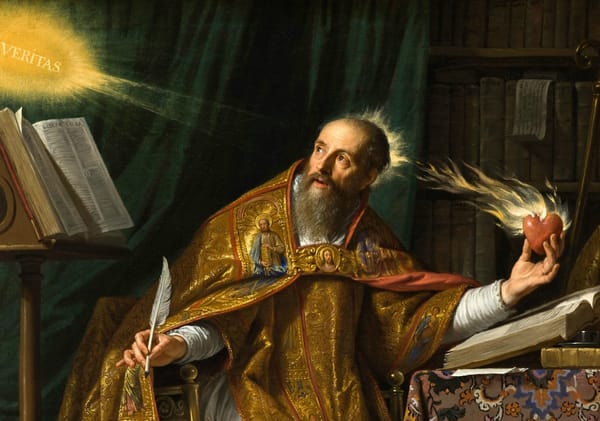 |
To-day Augustine, the greatest and the humblest of the Doctors, is hailed by heaven, where his conversion caused greater joy than that of any other sinner; and celebrated by the Church, who is enlightened by his writings as to the power, the value, and the gratuitousness of divine grace.
Since that wonderful, heavenly conversation at Ostia,1 God had completed His triumph in the son of Monica’s tears and of Ambrose’s holiness. Far away from the great cities where pleasure had seduced him, the former rhetorician now cared only to nourish his soul with the simplicity of the Scriptures, in silence and solitude. But grace, after breaking the double chain that bound his mind and his heart, was to have a still greater dominion over him; the pontifical consecration was to consummate Augustine’s union with that divine Wisdom, whom alone he declared he loved ‘for her own sole sake, caring neither for rest nor life save on her account.’2 From this height, to which the divine mercy had raised him, let us hear him pouring out his heart:
Too late have I loved Thee, O Beauty so ancient and yet so new! Too late have I loved Thee! And behold Thou wast within me, and I, having wandered out of myself, sought Thee everywhere without . . . . I questioned the earth, and she answered me: “I am not the one thou seekest”; and all the creatures of earth made the same reply. I questioned the sea and its abysses and all the living things therein, and they answered: “We are not thy God; seek above us.” I questioned the restless winds; and all the air with its inhabitants replied: “Anaximenes is mistaken, I am not God.” I questioned the sky, the sun, the moon, the stars, and they said: “We are not the God whom thou seekest.” And I said to all these things that stand without at the gates of my senses: “Ye have all confessed concerning my God that ye are not He, tell me now something about Him.” And they all cried with one great voice: “It is He that made us.” I questioned them with my desires, and they answered by their beauty.— Let the air and the waters and the earth be silent! Let man keep silence in his own soul! Let him pass beyond his own thought; for beyond all language of men or of angels, He, of whom creatures speak, makes Himself heard; where signs and images and figurative visions cease, there eternal Wisdom reveals Herself . . . . Thou didst call and cry so loud that my deaf ears could hear Thee; Thou didst shine so brightly that my blind eyes could see Thee; Thy fragrance exhilarated me, and it is after Thee that I aspire; having tasted Thee I hunger and thirst; Thou hast touched me and thrilled me, and I burn to be in Thy peaceful rest. When I shall be united to Thee with my whole being, then will my sorrows and labours cease.3
To the end of his life Augustine never ceased to fight for the truth against all the heresies then invented by the father of lies; in his ever repeated victories, we know not which to admire most: his knowledge of the holy Scriptures, his powerful logic, or his eloquence. We see too that divine charity which, while inflexibly upholding every iota of God’s rights, is full of ineffable compassion for the unhappy beings who do not understand those rights.
Let those be hard upon you who do not know what labour it is to reach the truth and turn away from error. Let those be hard upon you, who know not how rare a thing it is, and how much it costs, to overcome the false images of the senses and to dwell in peace of soul. Let those be hard upon you, who know not with what difficulty man’s mental eye is healed so as to be able to gaze upon the Sun of justice; who know not through what sighs and groans one attains to some little knowledge of God. Let those, finally, be hard upon you, who have never known seduction like that whereby you are deceived . . . . As for me, who have been tossed about by the vain imaginations of which my mind was in search, and who have shared your misery and so long deplored it, I could not by any means be harsh to you.4
These touching words were addressed to the disciples of Manes, who were hemmed in on all sides even by the laws of the pagan emperors. How fearful is the misery of our fallen race, when the darkness of hell can overpower the loftiest intellects! Augustine, the formidable opponent of heresy, was, for nine years previously, the convinced disciple and ardent apostle of Manicheism. This heresy was a strange variety of Gnostic dualism, which, to explain the existence of evil, made a god of evil itself; and which owed its prolonged influence to the pleasure taken in it by satan’s pride.
Augustine sustained also a prolonged though more local struggle against the Donatists, whose teaching was based on a principle as false as the fact from which it professed to originate. This fact, which on the petitions presented by the Donatists themselves was juridically proved to be false, was that Cæcilianus, primate of Africa in 311, had received episcopal consecration from a traditor, i. e. one who had delivered up the sacred Books in time of persecution. No one, argued the Donatists, could communicate with a sinner, without himself ceasing to form part of the flock of Christ; therefore, as the bishops of the rest of the world had continued to communicate with Cæcilianus and his successors, the Donatists alone were now the Church. This groundless schism was established among most of the inhabitants of Roman Africa, with its four hundred and ten bishops, and its troops of Circumcellions ever ready to commit murders and violence upon the Catholics on the roads or in isolated houses. The greater part of our saint’s time was occupied in trying to bring back these lost sheep.
We must not imagine him studying at his ease, in the peace of a quiet episcopal city chosen as if for the purpose by Providence, and there writing those precious works whose fruits the whole world has enjoyed even to our days. There is no fecundity on earth without sufferings and trials, known sometimes to men, sometimes to God alone. When the writings of the saints awaken in us pious thoughts and generous resolutions, we must not be satisfied, as we might in the case of profane books, with admiring the genius of the authors, but think with gratitude of the price they paid for the supernatural good produced in our souls. Before Augustine’s arrival in Hippo, the Donatists were so great a majority of the population, that, as he himself informs us, they could even forbid anyone to bake bread for Catholics.5 When the saint died, things were very different; but the pastor, who had made it his first duty to save, even in spite of themselves, the souls confided to him, had been obliged to spend his days and nights in this great work, and had more than once run the risk of martyrdom.6 The leaders of the schismatics, fearing the force of his reasoning even more than his eloquence, refused all intercourse with him; they declared that to put Augustine to death would be a praiseworthy action, which would merit for the perpetrator the remission of his sins.7
‘Pray for us,’ he said at the beginning of his episcopate, ‘pray for us who live in so precarious a state, as it were between the teeth of furious wolves. These wandering sheep, obstinate sheep, are offended because we run after them, as if their wandering made them cease to be ours.—Why dost thou call us? they say; why dost thou pursue us?—But the very reason of our cries and our anguish is that they are running to their ruin.—If I am lost, if I die, what is it to thee? what dost thou want with me? —What I want is to call thee back from thy wandering; what I desire is to snatch thee from death. —But what if I will to wander? what if I will to be lost?—Thou wiliest to wander? thou wiliest to be lost? How much more earnestly do I wish it not! Yea, I dare to say it, I am importunate; for I hear the Apostle saying: “Preach the word: be instant in season, out of season.”8 In season, when they are willing; out of season, when they are unwilling. Yes then, I am importunate: thou wiliest to perish, I will it not. And He wills it not, who threatened the shepherds saying: “That which was driven away you have not brought again, neither have you sought that which was lost.”9 Am I to fear thee more than Him? I fear thee not; the tribunal of Donatus cannot take the place of Christ’s judgment seat, before which we must all appear. Whether thou will it or not, I shall call back the wandering sheep, I shall seek the lost sheep. The thorns may tear me; but however narrow the opening may be, it shall not check my pursuit; I will beat every bush, as long as the Lord gives me strength; so only I can get to thee wherever thou strivest to perish.’10
Driven into their last trenches by such unconquerable charity, the Donatists replied by massacring clerics and faithful, since they could not touch Augustine himself. The bishop implored the imperial judges not to inflict mutilation or death upon the murderers lest the triumph of the martyrs should be sullied by such a vengeance. Such mildness was certainly worthy of the Church; but it was destined to be one day brought forward against her in contrast to certain other facts of her history, by a school of liberalism that can grant rights and even preeminence to error. Augustine acknowledges his first idea to have been that constraint should not be used to bring any one into the unity of Christ; he believed that preaching and free discussion should be the only arms employed for the conversion of heretics. But on the consideration of what was taking place before his eyes, the very logic of his charity brought him over to the opinion of his more ancient colleagues in the episcopate.11
Who [he says] could love us more than God does? Nevertheless God makes use of fear in order to save us, although He teaches us with sweetness. When the Father of the family wanted guests for His banquet, did He not send His servants to the highways and hedges, to compel all they met to come in? This banquet is the unity of Christ’s body. If, then, the divine goodness has willed that, at the fitting time, the faith of Christian kings should recognize this power of the Church, let the heretics brought back from the by-ways, and schismatics forced into their enclosures, consider not the constraint they suffer, but the banquet of the Lord to which they would not otherwise have attained. Does not the shepherd sometimes use threats and sometimes blows, to win back to the master’s fold the sheep that have been enticed out of it? Severity that springs from love is preferable to deceitful gentleness. He who binds the delirious man, and wakes up the sleeper from his lethargy, molests them both, but for their good. If a house were on the point of falling, and our cries could not induce those within to come out, would it not be cruelty not to save them by force in spite of themselves? and that, even if we could snatch only one from death, because the rest, seeing it, obstinately hastened their own destruction: as the Donatists do, who in their madness commit suicide to obtain the crown of martyrdom. No one can become good in spite of himself; nevertheless, the rigorous laws, of which they complain, bring deliverance not only to individuals, but to whole cities, by freeing them from the bonds of untruth and causing them to see the truth, which the violence or the deceits of the schismatics had hidden from their eyes. Far from complaining, their gratitude is now boundless and their joy complete; their feasts and their chants are unceasing.12
Meanwhile the justice of heaven was falling upon the queen of nations; Rome, after the triumph of the cross, had not profited of God’s merciful delay; now she was expiating, under the hand of Alaric, the blood of the saints which she had shed before her idols. 'Go out from her my people.’13 At this signal the city was evacuated. The roads were all lined with barbarians; and happy was the fugitive who could succeed in reaching the sea, there to entrust to the frailest skiff the honour of his family and the remains of his fortune. Like a bright beacon shining through the storms, Augustine, by his reputation, attracted to the African coast the best of the unfortunates; his varied correspondence shows us the new links then formed by God, between the bishop of Hippo and so many noble exiles. At one time he would send, as far as Nola in Campania, charming messages, mingled with learned questions and luminous answers, to greet his 'dear lords and venerable brethren, Paulinus and Therasia, his fellow disciples in the school of our Lord Jesus.’ Again it was to Carthage, or even nearer home, that his letters were directed, to console, instruct, and fortify Albina, Melania, and Pinianus, but especially Proba and Juliana, the illustrious grandmother and mother of a still more illustrious daughter, the virgin Demetrias, the greatest in the Roman world for nobility and wealth, and Augustine’s dear conquest to the heavenly Spouse. 'Oh! who,' he wrote on hearing of her consecration to our Lord, 'could worthily express the glory added this day to the family of the Anicii? For years, it has ennobled the world by the consuls its sons, but now it gives virgins to Christ! Let others imitate Demetrias; whosoever ambitions the glory of this illustrious family, let him take holiness for his portion!’14 Augustine’s desire was magnificently realized, when, less than a century later, the gens Anicia gave to the world Scholastica and Benedict, who were to lead into intimate familiarity and union with God so many souls eager for true nobility.
When Rome fell, the shock was felt throughout the provinces and even beyond. Augustine tells us how he, a descendant of the ancient Numidians, groaned and wept in his almost inconsolable grief;15 so great, even in her decadence, was the universal esteem and love for the queen city, through the secret action of Him who was holding out to her new and higher destinies. Meanwhile the terrible crisis furnished the occasion for Augustine’s most important writings. The City of God was an answer to the still numerous partisans of idolatry, who attributed the misfortunes of the empire to the suppression of the false gods. In this great work he refutes, in the most complete and masterly way, the theology and also the philosophy of Roman and Grecian paganism; he then proceeds to set forth the origin, the history, and the end of the two cities, the earthly, and the heavenly, which divide the world between them, and which are founded upon ‘two opposite loves: the love of self even to the despising of God, and the love of God even to the despising of self.’16
But Augustine’s greatest triumph was that which earned for him the title of the Doctor of grace. His favourite prayer: Da quod jubes, et jube quod vis,17 offended the pride of a certain British monk, whom the events of the year 410 had led into Africa.18 This was Pelagius, who taught that nature, all-powerful for good, was quite capable of working out salvation, and that Adam’s sin injured himself alone, and was not passed down to his posterity. We can well understand Augustine, who owed so much to the divine mercy, feeling so strong an aversion for a system whose authors seemed to say to God: ‘Thou madest us men, but it is we that justify ourselves.'
In this new campaign no injuries were spared to the former convert; but they were his joy and his hope. He had already said, with regard to similar arguments adduced by other adversaries:
Catholics, my beloved brethren, one flock of the one Shepherd, I care not how the enemy may insult the watch-dog of the fold; it is not for my own defence, but for yours, that I must bark. Yet I must needs tell this enemy that, as to my former wanderings and errors, I condemn them, as every one else does; I can but see therein the glory of Him who has delivered me from myself. When I hear my former life brought forward, no matter with what intention it is done, I am not so ungrateful as to be afflicted thereat; for the more they show up my misery, the more I praise my physician.19
While he made so little account of himself, his reputation was spreading throughout the world, by reason of the victory he had won for grace. Wrote the aged St. Jerome from Bethlehem:
Honour to you, honour to the man whom the raging winds have not been able to overthrow! . . . Continue to be of good courage. The whole world celebrates your praises; the Catholics venerate and admire you as the restorer of the ancient faith. But what is a mark of still greater glory, all the heretics hate you. They honour me, too, with their hatred. Not being able to strike us with the sword, they kill us in desire.20
These lines reveal the intrepid combatant with whom we shall make acquaintance in September, and who, soon after writing them, was laid to rest in the sacred cave near which he had taken refuge. Augustine had yet some years to continue the good fight, to complete the exposition of Catholic doctrine in contradiction to some even holy persons, who were inclined to think that at least the beginning of salvation, the desire of faith, did not require the special assistance of God. This was semi-pelagianism. A century later (529) the second Council of Orange, approved by Rome and hailed by the whole Church, closed the struggle, taking its definitions from the writings of the bishop of Hippo. Augustine himself, however, thus concluded his last work:
Let those who read these things give thanks to God, if they understand them; if not, let them pray to the teacher of our souls, to him whose shining produces knowledge and understanding. Do they think that I err? Let them reflect again and again, lest perhaps they themselves be mistaken. As for me, when the readers of my works instruct and correct me, I see therein the goodness of God; yea, I ask it as a favour, especially of the learned ones in the Church, if by chance this book should fall into their hands, and they deign to take notice of what I write.21
But let us return to the privileged people of Hippo, won over by Augustine’s devotedness, even more than by his admirable discourses. His door was open to every comer; and he was ever ready to listen to the requests, the sorrows, and the disputes of his children. Sometimes, at the instance of other churches, and even of councils, requiring of Augustine a more active pursuit of works of general interest, an agreement was made between the flock and the pastor, that on certain days of the week no one should interrupt him. But the convention could not last long. Whoever wished could claim the attention of this loving and humble shepherd, beside whom the little ones especially knew well that they would never meet with a refusal. As an instance of this we may mention the fortunate child, who wishing to enter into correspondence with the bishop, but not daring to take the initiative, received from him the touching letter which may be seen in his works.22
Besides all his other glories, our saint was the institutor of monastic life in Roman Africa, by the monasteries he founded, and in which he lived before he became bishop. He was a legislator by his letter to the virgins of Hippo, which became the rule whereon so many servants and handmaids of our Lord have formed their religious life. Lastly, together with the clerics of his church who lived with him a common life of absolute poverty, he was the example and the head of the great family of Regular Canons. But we must close these already lengthy pages, which will be completed by the narrative of the holy liturgy.
Let us, then, read this authentic account. Independently of the present feast, the Church, in her martyrology, makes special mention of Augustine’s conversion on the fifth of May.
What a death was thine, O Augustine, receiving on thy humble couch nought but news of disasters and ruin! Thy Africa was perishing at the hands of the barbarians, in punishment of those nameless crimes of the ancient world, in which she had so large a share. Together with Genseric, Arius triumphed over that land, which nevertheless, thanks to thee, was to produce, for yet a hundred years, admirable martyrs for the Consubstantiality of the Word. When Belisarius restored her to the Roman world, God seemed to be offering her, for the martyrs’ sake, an opportunity of returning to her former prosperity; but the inexperienced Byzantines, preoccupied with their theological quarrels and political intrigues, knew not how to raise her up, nor to protect her against an invasion more terrible than the first; and the torrent of Mussulman infidelity soon swept all before it.
At length, after twelve centuries, the cross reappeared in those places, where the very names of so many flourishing churches had perished. May the nation on which thy country is now dependent, show that it is proud of this honour, and understand its consequent obligations!
During all that long night which overhung thy native land, thy influence did not cease. Through out the entire world, thy immortal works were enlightening the minds of men and arousing their love. In the basilicas served by thy sons and imitators, the splendour of divine worship, the pomp of the ceremonies, the perfection of the sacred melodies, kept up in the hearts of the people the same supernatural enthusiasm which took possession of thine own, when for the first time in our west, St. Ambrose instituted the alternate chanting of the psalms and sacred hymns.24 Throughout all ages the perfect life, in its many different ways of exercising the double precept of charity, draws from the waters of thy fountains. Continue to illumine the Church with thine incomparable light. Bless the numerous religious families which claim thine illustrious patronage. Assist us all, by obtaining for us the spirit of love and of penance, of confidence and of humility, which befits the redeemed soul. Give us to know the weakness of our nature and its unworthiness since the fall, and at the same time the boundless goodness of our God, the superabundance of His Redemption, the all-powerfulness of His grace. May we all, like thee, not only recognize the truth, but be able loyally and practically to say to God: ‘Thou hast made us for Thyself, and our heart is ill at ease till it rest in Thee.’25
- See life of St. Monica, May 4, Paschal time Vol II. ↩︎
- Soliloq. i. 22. ↩︎
- Confess. Lib. ix and x. passim. ↩︎
- S. Aug. contra epist. Manichæi quam vocant fundamenti 2-3. ↩︎
- Contra litteras Petiliani, ii. 184. ↩︎
- Possidius, vita Augustini. 13. ↩︎
- Ibid. 10. ↩︎
- 2 Tim. iv. 2. ↩︎
- Ezech. xxxiv. 4. ↩︎
- S. Aug. sermon xlvi, 14. ↩︎
- Epistolæ, passim. ↩︎
- Epistolæ, passim. ↩︎
- Apoc. xviii. 4. ↩︎
- Epist. cl, cl. clxxix. ↩︎
- De urbis excidio, 3. ↩︎
- De ciritate Dei contra paganos xiv, xxviii. ↩︎
- Lord give me grace to do what thou commandest, and command what thou wilt. ↩︎
- De dono perseverantiæ, 53. ↩︎
- Contra litteras Petiliani, iii, 11. ↩︎
- Hieron. epist, cxli, al, lxxx. ↩︎
- De dono perseverantiæ, 68. ↩︎
- Epist. cclxvi, al. cxxxii. Augustinus Florentinæ puellæ. ↩︎
- Souk-Arhas, in Algeria, 25 leagues to the south of Bona. the ancient Hippo. ↩︎
- Aug. confess. ix. ↩︎
- Ibid. i. ↩︎
August 28 (the Same Day): St. Hermes, Martyr
According to the most ancient monuments of the Roman Church,* another saint has always been honoured on this same day, viz: Hermes, a Roman magistrate, who bore witness to Christ under Trajan. The crypt constructed, less than half a century after the death of the apostles, to receive this martyr’s relics, is remarkable for its majestic and ample proportions not usually found in the subterranean cemeteries. It was his sister Theodora, who received from Balbina, daughter of the tribune Quirinus, the venerable chains of St. Peter.
Prayer
* Calendarium Bucherii. ↩︎
| Previous August 27: St. Joseph Calasanctius, Confessor | Next August 28: St. Augustine, Bishop and Doctor of the Church |