Daily reading
After Pentecost
Double of the II Class · Movable from Easter · Temporal
October 2, 2022
From Dom Guéranger’s The Liturgical Year.

|
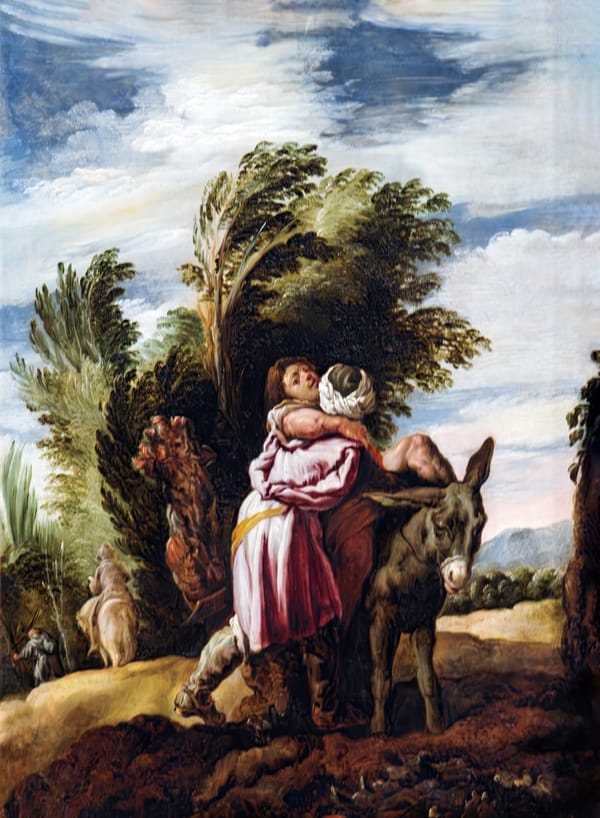
The Seventeenth Sunday after Pentecost
The Gospel, which is now assigned to the Mass of the seventeenth Sunday, has given it the name of the Sunday of the love of God, dating, that is, from the time when the Gospel of the cure of the dropsy and of the invitation to the wedding-feast was anticipated by eight days. Previously even to that change, and from the very first, there used to be read, on this seventeenth Sunday, another passage from the new Testament, which is no longer found in this series of Sundays: it was the Gospel which mentions the difficulty regarding the resurrection of the dead, which the Sadducees proposed to our Lord.1
Mass
The judgments of God are always just, whether it be, in His justice, humbling the proud, or, in His mercy, exalting the humble. This day last week we saw this sovereign disposer of all things, allotting to each his place at the divine banquet. Let us recall to mind the behaviour of the guests, and the respective treatment shown to the humble and the proud. Adoring these judgments of our Lord, let us sing our Introit; and, as far as regards ourselves, let us throw ourselves entirely upon His mercy.
Introit
The most hateful of all the obstacles which divine love has to encounter upon earth is the jealousy of satan, who endeavours, by an impious usurpation, to rob God of the possession of our souls—souls, that is, which were created by and for Him alone. Let us unite with holy Church in praying, in the Collect, for the supernatural assistance we require for avoiding the foul contact of the hideous serpent.
Collect
The other Collects, as on page 120.
Epistle
Cap. iv.Fratres, Obsecro vos ego vinctus in Domino, ut digne ambuletis vocatione, qua vocati estis, cum omni humilitate, et mansuetudine, cum patientia, supportantes invicem in charitate, solliciti servare unitatem spiritus in vinculo pacis. Unum corpus, et unus Spiritus, sicut vocati estis in una spe vocationis vestræ. Unus Dominus, una fides, unum baptisma. Unus Deus et Pater omnium, qui est super omnes, et per omnia, et in omnibus nobis. Qui est benedictus in sæcula sæculorum. Amen.
Ch. iv.Brethren: I, a prisoner in the Lord, beseech you that you walk worthy of the vocation in which you are called, with all humility and mildness, with patience, supporting one another in charity. Careful to keep the unity of the Spirit in the bond of peace. One body and one spirit; as you are called in one hope of your calling. One Lord, one faith, one baptism, one God, and Father of all, who is above all, and through all, and in us all, who is blessed for ever and ever. Amen.
The Church, by thus giving these words from St. Paul’s Epistle to the Ephesians, again takes up the subject so dear to her, viz., the dignity of her children. She beseeches them to correspond, in a becoming manner, to their high vocation. This vocation, this call, which God gives us is, as we have been so often told, the call, or invitation, made to the human family to come to the sacred nuptials of divine union; it is the vocation given to us to reign in heaven with the Word, who has made Himself our Spouse, and our Head.2 The Gospel read to us last week was formerly the one appointed for this present Sunday, and was thus brought into close connexion with our Epistle. These words of St. Paul to the Ephesians are an admirable commentary on that Gospel, and it, in turn, throws light on the apostle’s words about the vocation. ‘When thou art invited to a wedding (cum vocatus fueris) sit down in the lowest place!’ These were our Lord’s words to us last Sunday; and now we have the apostle saying to us : Walk worthy of the vocation in which you are called, yes, walk in that vocation with all humility!
Let us now attentively hearken to our apostle, telling us what we must do, in order to prove ourselves worthy of the high honour offered to us by the Son of God. We must practise, among other virtues, these three—humility, mildness, and patience. These are the means for gaining the end that is so generously proposed to us. And what is this end? It is the unity of that immense body, which the Son of God makes His own, by the mystic nuptials He vouchsafes to celebrate with our human nature. This Man-God asks one condition from those whom He calls, whom He invites, to become, through the Church, His bride, bone of His bones and flesh of His flesh.3 This one condition is, that they maintain such harmony among them, that it will make one body and one spirit of them all, in the bond of peace. ‘Bond most glorious!’ cries out St. John Chrysostom—‘bond most admirable, which unites us all with one another, and then, thus united, unites us with God.’4 The strength of this bond is the strength of the holy Spirit Himself, who is all holiness and love; for it is that holy Spirit who forms these spiritual and divine ties; He it is who, with the countless multitude of the baptized, does the work which the soul does in the human body— that is, gives it life, and unites all the members into oneness of person. It is by the Holy Ghost that young and old, poor and rich, men and women, distinct as all these are in other respects, are made one, fused, so to say, in the fire which eternally burns in the blessed Trinity. But, in order that the flame of infinite love may thus draw into its embrace our regenerated humanity, we must get rid of selfish rivalries, and grudges, and dissensions, which, so long as they exist among us, prove us to be carnal,5 and, therefore, to be unfit material either for the divine flame to touch, or for the union which that flame produces. According to the beautiful comparison of St. John
Chrysostom,6 when the fire lays hold of various species of wood which have been thrown into it, if it find the fuel properly dry, it makes one burning pile of all the several woods; but, if they are damp and wet, it cannot act on them separately, nor reduce the whole to one common blaze. So is it in the spiritual order; the unhealthy humidity of the passions neutralizes the action of the sanctifying Spirit; and union, which is both the means and the end of love, becomes an impossibility.
Let us, therefore, bind ourselves to our brethren by that blessed link of charity, which, if it fetters at all, fetters only our bad tempers; but, in all other respects, it dilates our hearts, by the very fact of its giving free scope to the Holy Ghost to lead them safely to the realization of that one hope of our common vocation and calling, which is to unite us to God by love. Of course, charity, even with the saints, is, so long as they are on this earth, a laborious virtue; because, even with the best, grace seldom restores to a perfect equilibrium the faculties of man, which were put out of order by original sin. From this it follows that the weaknesses of human nature will sometimes show themselves, either by excess or by deficiency; and when these weaknesses do appear, not only the saint himself is humbled by their getting the better of him, but, as he is well aware, those who live with him have to practise kindness and patience towards him. God permits all this, in order to increase the merit of us all, and make us long more and more for heaven. For it is there alone that we shall find ourselves, not only totally, but without any effort, in perfect harmony with our fellow-men; and this because of the perfect peaceful submissiveness of our entire being under the absolute sway of the thrice holy God, who will then be all in all.7 In that happy land God Himself will wipe away the tears of His elect, for their miseries will all be gone; and their miseries will be gone because their whole being will be renovated, because united with Him, who is its infinite source.8 The eternal Son of God, having then conquered in each member of His mystical body the hostile powers and death itself,9 will appear, in the fullness of the mystery of His Incarnation, as the true Head of humanity, sanctified, restored,10 and developed in Him. He will rejoice at seeing how, by the workings of the sanctifying Spirit, there has been wrought the destined degree of perfection in each of the several parts of that marvellous body,11 which He vouchsafed to aggregate to Himself by the bond of love; and all this in order that He might Himself eternally celebrate, in concert with all creation, the glory of the ever adorable Trinity. How will the sweetest music of earth be then surpassed! How will our most perfect choirs seem to us then to have been almost like the noise of children singing out of tune, compared with the concord and harmony of that eternal song! Let us make ourselves ready for that heavenly concert. Let us put our voices in order, by now attuning our hearts to that plenitude of love, which, alas! is not often enjoyed here below, but which we should ever be trying to realize, by patiently supporting the faults of our brethren and ourselves, as the Epistle so earnestly impresses upon us.
In the ecstasy of her delight at hearing these few sounds of heaven’s music brought to her by such a singer as her apostle, our mother the Church seems to feel herself carried away far beyond time, and boldly joins a short song of her own to that of Jesus and His apostle; for by way of a conclusion to the text of our Epistle, she adds an ardent expression of praise, which is not in the original; and thus she forms a kind of doxology to the inspired words of her apostolic cantor.
We now know the priceless gifts brought to our earth by the Man-God.12 Thanks to the prodigies of power and love achieved by the divine Word and the sanctifying Spirit, the soul of the just man is a little heaven on earth. Let us sing in our Gradual and Alleluia the happiness of the Christian people, chosen by God for His own inheritance.
Gradual
Gospel
Cap. xxii.In illo tempore : Accesserunt ad Jesum Pharisæi, et interrogavit eum unus ex eis legis doctor, tentans eum : Magister, quod est mandatum magnum in lege? Ait illi Jesus : Diliges Dominum Deum tuum ex toto corde tuo, et in tota anima tua, et in tota mente tua. Hoc est maximum, et primum mandatum. Secundum autem simile est huic : Diliges proximum tuum sicut teipsum. In his duobus mandatis universa lex pendet, et prophetæ. Congregatia autem Pharisæis, interrogavit eos Jesus, dicens : Quid vobis videtur de Christo? cujus filius est? Dicunt ei : David. Ait illis: Quomodo ergo David in spiritu vocat eum Dominum, dicens : Dixit Dominus Domino meo : Sede a dextris meis, donec ponam inimicos tuos scabellum pedum tuorum? Si ergo David vocat eum Dominum, quomodo filius ejus est? Et nemo poterat ei responded verbum; neque ausus fuit quisquam ex illa die eum amplius interrogare.
Ch. xxii.At that time : The Pharisees came to Jesus: and one of them, a doctor of the law, asked him, tempting him: Master, which is the great commandment in the law? Jesus said to him : Thou shalt love the Lord thy God with thy whole heart, and with thy whole soul, and with thy whole mind. This is the greatest and the first commandment. And the second is like to this: Thou shalt love thy neighbour as thyself. On these two commandments dependeth the whole law and the prophets. And the Pharisees being gathered together, Jesus asked them saying: What think ye of Christ? whose son is he? They say to him: David’s. He saith to them : How then doth David in spirit call him Lord, saying : The Lord said to my Lord, Sit on my right hand, until I make thy enemies thy footstool? If David then called him Lord, how is he his son? And no man was able to answer him a word; neither durst any man from that day forth ask him any more questions.
The Man-God allowed temptation to approach His sacred Person in the desert;13 He disdained not to sustain the attacks, which the devil’s spiteful cunning has, from the world’s beginning, been inventing, as the surest means of working man’s perdition. Our Jesus permitted the demon thus to tempt Him, in order that He might show His faithful servants how they are to repel the assaults of the wicked spirit. To-day, our adorable Master, who would be a model to His children in all their trials,14 is represented to us as having to contend, not with satan’s perfidy, but with the hypocrisy of His bitterest enemies, the pharisees. They seek to ensnare Him in His speech,15 just as the representatives of the world, which He has condemned,16 will do to His Church, and that in all ages, right to the end of time. But as her divine Spouse triumphed, so will she; for He will enable her to continue His work upon earth, and amidst the same temptations and the same snares. She is ever to obtain the victory, by maintaining a most inviolable fidelity to God’s law and truth. The tools of satan, who are the heretics and the princes of the world, chafing at the restraint put by Christianity on their ambition and lust, will always be studying how best to outwit the guardian of the divine oracles, by their captious propositions or questions. When necessity requires her to speak, she is quite ready; for, as bride of that divine Word, who is His Father’s eternal and substantial utterance, what can she be but a voice, either to announce Him on earth, or to sing Him in heaven? That word of hers, endowed as it is with the power and penetration of God Himself, will not only never be conquered by surprise, but, like a two-edged sword, it will generally go much deeper than the crafty questioners of the Church anticipated; it will not only refute their sophistry, it will also expose the hypocrisy and wickedness of their intentions.17 By their sacrilegious attempts, they will have gained nothing but disgrace and shame, and the mortification of having occasioned a fresh lustre to truth by the new light in which it has been put, and of having procured a clearer knowledge of dogma or morals for the devoted children of the Church.
It was thus with the pharisees of to-day’s Gospel. As the homily upon it tells us, they wanted to see if Jesus, who had declared Himself to be God, would not, consequently, make some addition to the commandment of divine love; and if He did they would be justified in condemning Him as having tried to change the letter of the law in its greatest commandment.18 Our Lord disappointed them. He met their question by giving it a longer answer than they had asked for. Having first recited the text of the great commandment as given in the Scripture, he continued the quotation, and, by so doing, showed them that He was not ignorant of the intention which had induced them to question Him. He reminded them of the second commandment, like unto the first, the commandment of love of our neighbour, which condemned their intended crime of deicide. Thus were they convicted of loving neither their neighbour, nor God Himself, for the first commandment cannot be observed if the second, which flows from and completes it, be broken.
But our Lord does not stop there; He obliges them to acknowledge, at least implicitly, the Divinity of the Messiah. He puts a question, in His turn, to them, and they answer it by saying, as they were obliged to do, that the Christ was to be of the family of David; but if He be his Son, how comes it that David calls Him his Lord, just as he calls God Himself, as we have it in Psalm cix., where he celebrates the glories of the Messiah? The only possible explanation is, that the Messiah, who in due time, and as Man, was to be born of David’s house, was God, and Son of God, even before time existed, according to the same psalm: ‘From my womb, before the day-star, I begot thee.’19 This answer would have condemned the pharisees, so they refused to give it; but their silence was an avowal; and, before very long, the eternal Father’s vengeance upon these vile enemies of His Son will fulfil the prophecy of making them His footstool in blood and shame: that time is to be the terrible day when the justice of God will fall upon the deicide city.
Let us Christians, out of contempt for satan, who stirred up the expiring Synagogue thus to lay snares for the Son of God, turn these efforts of hatred into an instruction which will warm up our love. The Jews, by rejecting Christ Jesus, sinned against both of the commandments which constitute charity, and embody the whole law; and we, on the contrary, by loving that same Jesus, fulfil the whole law.
Jesus is the brightness of eternal glory,20 one, by nature, with the Father and the Holy Ghost; He is the God whom the first commandment bids us love, and it is in Him also that the second has its truest and adequate application. For not only is He as truly Man as He is truly God, but He is the Man par excellence,21 the perfect Man, on whose type, and for whom, all other men were formed;22 He is the model and the brother of all of them;23 He is at the same time the leader who governs them as their King,24 and offers them to God as their High Priest;25 He is the Head who communicates to all the members of the human family beauty, and life, and movement, and light; He is the Redeemer of that human family since it has fallen, and on that account He is twice over the source of all right, and the ultimate and highest motive, even when not the direct object, of every love that deserves to be called love here below. Nothing counts with God, excepting so far as it has reference to Jesus. As St. Augustine says,26 God loves men only inasmuch as they either are, or may one day become, members of His Son; it is His Son that He loves in them; thus He loves, with one same love though not equally, His Word, and the Flesh of His Word, and the members of His Incarnate Word. Now, charity is love—love such as it is in God, communicated to us creatures by the Holy Ghost. Therefore, what we should love, by charity, both in ourselves, and in others, is the divine Word, either as being, or, according to another expression of the same St. Augustine, ‘that He may be,’ in others and in ourselves.27
Let us take care, also, as a consequence of this same truth, not to exclude any human being from our love, excepting the damned, who are absolutely and eternally cut off from the body of the Man-God. Who can boast that he has the charity of Christ if he do not embrace His unity? The question is St. Augustine’s again.28 Who can love Christ, without loving, with Him, the Church, which is His body? without loving all His members? What we do—be it to the least, or be it to the worthiest, be it of evil, or of good—it is to Him we do it, for He tells us so.29 Then, let us love our neighbour as ourselves, because of Christ, who is in each of us, and who gives to us all union and increase in charity.30
That same apostle who says, 'The end of the law is charity,’31 says also: ‘The end of the law is Christ;’32 and we now see the harmony existing between these two distinct propositions. We understand, also, the connexion there is between the word of the Gospel: On these two commandments dependeth the whole law and the prophets, and that other saying of our Lord: Search the Scriptures, for the same are they that give testimony of Me.33 The fullness of the law, which is the rule of men’s conduct, is in charity,34 of which Christ is the end; just as the object of the revealed Scriptures is no other than the Man-God, who embodies in His own adorable unity, for us His followers, all moral teaching, and all dogma. He is our faith and our love, ‘the end of all our resolutions,’ says St. Augustine; 'for all our efforts tend but to this—to perfect ourselves in Him; and this is our perfection —to reach Him: having reached Him, seek no farther, for He is your End.’35 The holy Doctor gives us, when we have reached this point, the best instruction as to how we are to live in the divine union: 'Let us cling to One, let us enjoy One, let us all be one in Him; hcereamus Uni, fruamur Uno, permaneamus unum'36
The beautiful anthem for to-day’s Offertory, separated, as we now have it, from the verses which formerly accompanied it, does not suggest why, in the earliest ages, it was assigned to this Sunday. We subjoin these verses to the anthem, which has been retained. The second concludes with the announcement of the arrival of the prince of the heavenly hosts, who is coming to the aid of God’s people. This gives the desired explanation; and it becomes all the clearer, when we remember that this Sunday begins the week of the great archangel in the antiphonary published, from the most ancient manuscripts, by the blessed Thomasi; and that the following Sunday is there designated as the first Sunday after Saint Michael (post Sancti Angeli).
Offertory
Forgiveness of our past sins, and preservation from future ones, these are the effects produced by the holy sacrifice. Let us pray for them, in the Secret, together with the Church.
Secret
The other Secrets, as on page 130.
It is while assisting at these great mysteries that the Christian soul, in the enthusiasm of her love, presents to her God her promises and her engagements. Let her, then, give herself unreservedly to God, who overwhelms her with His favours; but, while thus giving free vent to the holy emotions which she so justly feels, let her not forget, that He who hides Himself, out of consideration for our weakness, under the eucharistic veil, is the Most High, who is terrible to the kings of the earth, and an avenger of infidelity to what is vowed.
Communion
It is the very holiness of God that in this divine Sacrament comes for the purpose of curing our vices, and fortifying our faltering steps on the road which leads to eternity. In the prayer of the Postcommunion, let us yield our souls to His almighty influence.
Postcommunion
The other Postcommunions, as on page 131.
Vespers
The psalms, capitulum, hymn, and versicle, as above, pages 71-81.
Antiphon of the Magnificat
- St. Matt. xxii. 23-33. ↩︎
- Eph. ii. 5. ↩︎
- Eph. v. 30. ↩︎
- St. Chrys., in Ep. ad Eph., Hom. ix. 3. ↩︎
- 1 Cor. iii. 3. ↩︎
- St. Chrys., ubi supra. ↩︎
- 1 Cor. xv. 28. ↩︎
- Apoc. xxi. 4, 5 ↩︎
- 1 Cor. xv. 24-28. ↩︎
- Eph. i. 10. ↩︎
- Ibid. iv. 13-16. ↩︎
- Eph. iv. 8. ↩︎
- St. Matt. iv. 1-11. ↩︎
- Heb. ii. 17, 18; iv. 15. ↩︎
- St. Matt. xxii. 15. ↩︎
- St. John xvi. 8-11. ↩︎
- Heb. iv. 12. ↩︎
- St. Chrys., Hom, lxxvii. in Matt. ↩︎
- Ps. cix. 3. ↩︎
- Heb. i. 3. ↩︎
- St. John xix. 5. ↩︎
- Rom. viii. 29. ↩︎
- Heb. ii. 17. ↩︎
- St. John xviii. 37. ↩︎
- Heb. x. 14. ↩︎
- S. Aug., in Joan. Tract cx. ↩︎
- Serm. cclv., in dieb pasch. ↩︎
- Epist. lxi. ↩︎
- St. Matt. xxv. 40-45. ↩︎
- Eph. iv. 15, 16. ↩︎
- 1 Tim. i 5 ↩︎
- Rom. x. 4. ↩︎
- St. John v. 39. ↩︎
- Rom. xiii. 10. ↩︎
- St. Aug., in Ps. Ivi. ↩︎
- De Trinit., L. iv. 11. ↩︎
First Sunday of October: Feast of the Most Holy Rosary
|
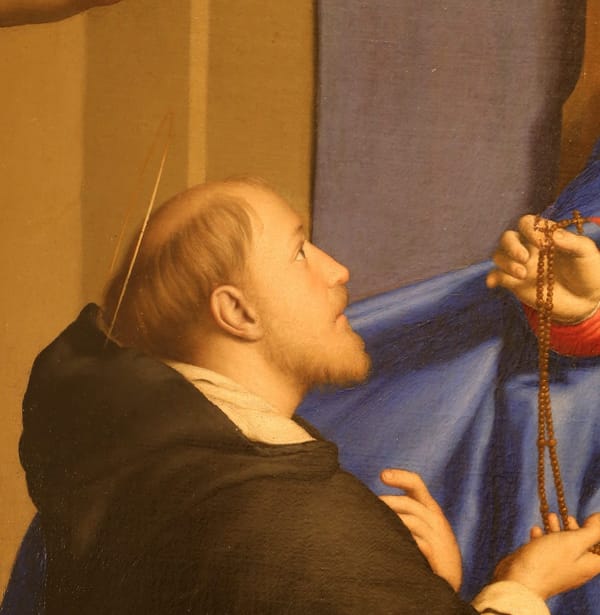
It is customary with men of the world to balance their accounts at the end of the year, and ascertain their profits. The Church is now preparing to do the same. We shall soon see her solemnly numbering her elect, taking an inventory of her holy relics, visiting the tombs of those who sleep in the Lord, and counting the sanctuaries, both new and old, that have been consecrated to her divine Spouse. But to-day’s reckoning is a more solemn one, the profits more considerable: she opens her balance-sheet with the gain accruing to our Lady from the mysteries which compose the cycle. Christmas, the cross, the triumph of Jesus, these produce the holiness of us all; but before and above all, the holiness of Mary. The diadem which the Church thus offers first to the august Sovereign of the world, is rightly composed of the triple crown of these sanctifying mysteries, the causes of her joy, of her sorrow, and of her glory. The joyful mysteries recall the Annunciation, the Visitation, the Birth of Jesus, Mary’s Purification, and the Finding of our Lord in the temple. The sorrowful mysteries bring before us the Agony of our blessed Lord, His being scourged, and crowned with thorns, the carrying of the cross, and the Crucifixion. While, in the glorious mysteries, we contemplate the Resurrection and Ascension of our Saviour, Pentecost, and the Assumption and Coronation of the Mother of God. Such is Mary’s rosary; a new and fruitful vine, which began to blossom at Gabriel’s salutation, and whose fragrant garlands form a link between earth and heaven.
In its present form, the rosary was made known to the world by St. Dominic at the time of the struggles with the Albigensians, that social war of such ill-omen for the Church. The rosary was then of more avail than armed forces against the power of satan; it is now the Church’s last resource. It would seem that, the ancient forms of social prayer being no longer relished by the people, the holy Spirit has willed by this easy and ready summary of the liturgy to maintain, in the isolated devotion of these unhappy times, the essential of that life of prayer, faith, and Christian virtue, which the public celebration of the Divine Office formerly kept up among the nations. Before the thirteenth century, popular piety was already familiar with what was called the psalter of the laity, that is, the angelical salutation repeated one hundred and fifty times; it was the distribution of these Hail Marys into decades, each devoted to the consideration of a particular mystery, that constituted the rosary. Such was the divine expedient, simple as the eternal Wisdom that conceived it, and far-reaching in its effects; for while it led wandering man to the Queen of Mercy, it obviated ignorance which is the food of heresy, and taught him to find once more ‘the paths consecrated by the Blood of the Man-God, and by the tears of His Mother.’1
Thus speaks the great Pontiff who, in the universal sorrow of these days, has again pointed out the means of salvation more than once experienced by our fathers. Leo XIII, in his encyclicals, has consecrated the present month to this devotion so dear to heaven; he has honoured our Lady in her litanies with a new title, Queen of the most holy rosary;2 and he has given the final development to the solemnity of this day, by raising it to the rank of a second class feast, and by enriching it with a proper Office explaining its permanent object.3 Besides all this, the feast is a memorial of glorious victories, which do honour to the Christian name.
Soliman II, the greatest of the Sultans, taking advantage of the confusion caused in the west by Luther, had filled the sixteenth century with terror by his exploits. He left to his son, Selim II, the prospect of being able at length to carry out the ambition of his race: to subjugate Rome and Vienna, the Pope and the emperor, to the power of the crescent. The Turkish fleet had already mastered the greater part of the Mediterranean, and was threatening Italy, when, on October 7, 1571, it came into action, in the Gulf of Lepanto, with the pontifical galleys supported by the fleets of Spain and Venice. It was Sunday; throughout the world the confraternities of the rosary were engaged in their work of intercession. Supernaturally enlightened, St. Pius V watched from the Vatican the battle undertaken by the leader he had chosen, Don John of Austria, against the three hundred vessels of Islam. The illustrious Pontiff, whose life’s work was now completed, did not survive to celebrate the anniversary of the triumph; but he perpetuated the memory of it by an annual commemoration of our Lady of Victory. His successor, Gregory XIII, altered this title to our Lady of the rosary, and appointed the first Sunday of October for the new feast, authorizing its celebration in those churches which possessed an altar under that invocation.
A century and a half later, this limited concession was made general. As Innocent XI, in memory of the deliverance of Vienna by Sobieski, had extended the feast of the most holy name of Mary to the whole Church; so, in 1716, Clement XI inscribed the feast of the rosary on the universal calendar, in gratitude for the victory gained by Prince Eugene at Peterwardein, on August 5, under the auspices of our Lady of the snow. This victory was followed by the raising of the siege of Corfu, and completed a year later by the taking of Belgrade.
Mass
The joys experienced on the other feasts of the Mother of God, are all gathered up and resumed in this one, for us, for the angels, and for our Lady herself. Like the angels, then, let us offer, together with Mary, the homage of our just delight to the Son of God, her Son, her King and ours.
Introit
The mysteries of the Son and of the Mother are our instruction and our hope. The Church prays in the Collect that they may also be our rule of life and our pledge of eternal happiness.
Collect
Then is made a commemoration of the occurring Sunday.
Epistle
Prov. cap. viii.Dominus possedit me in initio viarum suarum antequam quidquam faceret a principio. Ab æterno ordinata sum, et ex antiquis, antequam terra fieret, Nondum erant abyssi, et ego jam concepta eram. Nunc ergo, filii, audite me: Beati qui cnstodiunt vias meas. Audite disciplinam, et estote sapientes, et nolite abjicere eam. Beatus homo qui audit me, et qui vigilat ad fores meas quotidie, et observat ad postes ostii mei. Qui me invenerit, inveniet vitam, et hauriet salutem a Domino.
Prov. ch. viii.The Lord possessed me in the beginning of his ways, before he made anything from the beginning. I was set up from eternity, and of old before the earth was made. The depths were not as yet, and I was already conceived. Now therefore, ye children, hear me: Blessed are they that keep my ways. Hear instruction and be wise, and refuse it not. Blessed is the man that heareth mo, and that watcheth daily at my gates, and waiteth at the posts of my doors. He that shall find me, shall find life, and shall have salvation from the Lord.
Our Lady’s mysteries are before all time in God’s sight, like those of her divine Son; like these they will endure for all eternity; like them they rule the ages, which circle round the Word and Mary, preparing for both in the days of figures, perpetuating their presence by the incessant glorification of the most holy Trinity, in whose name all Christians are baptized. Now the rosary honours all this series of mysteries; to-day’s feast is a glance back upon the cycle as it draws to its close. From these mysteries, from this view of them, we must draw the conclusion formulated by our Lady herself in this passage from Proverbs, which the Church applies to her: ‘Now therefore, my children, consider my ways; imitate me, that you may find happiness.’ Blessed is he that watcheth at her gate! Let us pray to her, rosary in hand, considering her at the same time, meditating on her life and her greatness, and watching, were it but for a quarter of an hour, at the entrance to the palace of this incomparable Queen. The more faithful we are, the more assured will be our salvation and our progress in true life.
In the Gradual, let us congratulate the Queen of the holy rosary on her perfect life, all truth, and justice, and meekness, which won her the love of the supreme King. In the Alleluia verse, let us proclaim the nobility of her race, unequalled in the whole world.
Gradual
The Gospel is the same as on the feast of the most holy name of Mary (page 176). ‘At that time, the angel Gabriel was sent from God, into a city of Galilee, called Nazareth, to a Virgin espoused to a man whose name was Joseph, of the house of David; and the Virgin’s name was Mary. And the angel being come in, said to her: Hail, full of grace! the Lord is with thee; blessed art thou among women? Blessed art thou among women, repeated Elizabeth a few days later, and blessed is the fruit of thy womb. These two salutations, with the name of Mary added to the angel’s greeting and the name of Jesus to Elizabeth’s, constituted the Ave Maria in the time of St. Dominic, the promulgator of the rosary. The prayer, 'Holy Mary Mother of God’ which now so beautifully completes the formula of praise, received the sanction of the Church in the sixteenth century. No better Gospel could, then, have been chosen for to-day, for it gives the original text of the rosary, and describes the first of its mysteries.
All grace, all light, all life, are to be found in our Lady; by her holy rosary she, as we sing in the Offertory, has multiplied flowers and fruits in the garden of the Church. Every offering acceptable to God, comes from Mary, with and by Jesus.
Offertory
As the Secret tells us, the rosary, piously meditated, prepares us for the Sacrifice of the altar, that supereminent and august memorial of the mysteries which it imprints in the heart and mind of the Christian.
Secret
Then a commemoration of the Sunday.
The Preface as on September 8, substituting ‘in solemnitate, on the solemnity,’ for ‘in Nativitate, on the Nativity,’ of the blessed Virgin Mary.
After the sacred banquet, our soul must not remain barren. The fragrance of virtue’s flowers must embalm all that surrounds us, and prove to the Spouse that His visit has not been made in vain.
Communion
In the Postcommunion, the Church prays that our Lady may, by her intercession, second the effects of this Sacrifice, and-of the mysteries in which she played so great a part.
Postcommunion
Then is added the Postcommunion of the Sunday, and the Gospel of the same is read at the end of the Mass.
Vespers
A few days ago, the Church borrowed from the Servites of Mary her Office of the Seven Dolours; to-day she seeks her responsories, hymns, and antiphons from the noble family which claims the rosary as its birthright. The Christian world owes a new debt of gratitude to the sons of St. Dominic for enriching it with these beautiful liturgical formulæ. But as the Use of the Friars Preachers gives but one antiphon for the psalms in the Vespers of the saints, the following antiphons have been added for the Roman rite. The hymn, which so gracefully and yet concisely resumes the triple series of the mysteries, is the fourth of the entire Office: the first celebrates, at first Vespers, the joyful mysteries; the second, at Matins, the sorrowful; the third, at Lauds, the glorious. 'From these mysteries let us gather roses, and weave garlands for the Mother of fair love.’
Ps. Dixit Dominus, page 38.
Ps. Laudate pueri, page 41.
Ps.Lætatus sum, page 152.
Ps. Nisi Dominus, page 153.
Ps. Lauda Jerusalem, page 154.
Capitultum
Eccli. xxiv. xxxix.
Hymn
Te sauciam doloribus,
Te jugi amictam gloria,
O Virgo Mater pangimus.
Dum concipis, dum visitas,
Et edis, offers, invenis,
Mater beata, Filium.
In corde agonem, verbera,
Spinas, crucemque Filii
Perpessa, princeps martyrum.
In ignibus Paracliti,
In regni honore et lumine,
Regina fulgens gloria.
Ex his rosas mysteriis,
Et pulchri amoris inclytæ
Matri coronas nectite.
Qui natus es de Virgine,
Cum Patre et almo Spiritu,
In sempiterna sæcula.
thee wounded with the sword of sorrow,
thee girt with everlasting glory,
we sing, O Virgin Mother.
when thou conceivest; when thou visitest thy cousin;
when thou bringest forth thy Son, offerest him to God,
findest him in the temple, O happy Mother!
in thy inmost heart the agony, the scourging,
the thorns, and the cross of thy Son,
O first of martyrs!
in the triumphs of thy Son,
in the fires of the Paraclete,
in the honour and splendour of thy queenliness.
gather roses from these mysteries,
and wreathe therewith garlands
for the Mother of fair love.
born of the Virgin;
together with the Father and the holy Spirit,
through everlasting ages.
Antiphon of the Magnificat
The Prayer as on page 299.
Then is made a commemoration of the Sunday.
October 2: The Holy Guardian Angels
Although the solemnity of September 29 celebrates the praises of all the nine glorious choirs, yet the piety of the faithful, in the latter ages, desired to have a special day consecrated to the Guardian Angels. Several churches having taken the initiative, and kept the feast under various rites and on different days, Paul V (1608) authorized its celebration ad libitum. Clement X (1670) established it by precept as a feast of double rite1 on October 2, the first free day after Michælmas, on which it thus remains in some way dependent.
It is of faith, on the testimony of the Scriptures and of unanimous tradition, that God commits to His angels the guardianship of men, who are called to contemplate
Him together with these blessed spirits in their common fatherland. Catholic theology teaches that this protection is extended to every member of the human race, without any distinction of just and sinners, infidels and baptized. To ward off dangers; to uphold man in his struggle against the demons; to awaken in him holy thoughts; to prevent him from sinning, and even, at times, to chastise him; to pray for him, and present his prayers to God: such is the office of the Guardian Angel. So special is his mission, that one angel does not undertake the guardianship of several persons simultaneously; so diligent is his care, that he follows his ward from the first day to the last of his mortal existence, receiving the soul as it quits this life, and bearing it from the feet of the sovereign Judge to the place it has merited in heaven, or to its temporary sojourn in the place of expiation and purification.
It is from the lowest of the nine choirs, the nearest to ourselves, that the Guardian Angels are for the most part selected. God reserves to the Seraphim, Cherubim, and Thrones the honour of forming His own immediate court. The Dominations, from the steps of His throne, preside over the government of the universe; the Virtues watch over the course of nature’s laws, the preservation of species, and the movements of the heavens; the Powers hold the spirits of wickedness in subjection. The human race in its entirety, as also its great social bodies, the nations and the churches, are confided to the Principalities; while the Archangels, who preside over smaller communities, seem also to have the office of transmitting to the Angels the commands of God, together with the love and light which come down even to us from the first and highest hierarchy. O the depths of the wisdom of God! Thus, then, the admirable distribution of offices among the choirs of heavenly spirits terminates in the function committed to the lowest rank, the guardianship of man, for whom the universe subsists. Such is the teaching of the School;2 and the apostle, in like manner, says: ‘Are they not all ministering spirits, sent to minister for them, who shall receive the inheritance of salvation?’3
But God, magnificent as He is towards the whole human race, honours in a special manner the princes of His people, those who are most favoured by His grace, or who rule the earth in His name; the saints testify, that a supereminent perfection, or a higher mission in Church or State, ensures to the individual the assistance of a superior spirit, without the angel that was first deputed being necessarily removed from his charge. Moreover, with regard to the work of salvation, the Guardian Angel has no fear of being left alone at his post; at his request, and at God’s command, the troops of his blessed companions, who fill heaven and earth, are ever ready to lend him their aid. These noble spirits, acting under the eye of God whose love they desire to second by all possible means, have secret alliances between them, which sometimes induce between their clients, even on earth, unions the mystery whereof will be revealed in the light of eternity.
‘How profound a mystery,’ says Origen, ‘is the apportioning of souls to the angels destined for their guardians! It is a divine secret, part of the universal economy centred in the Man-God. Nor is it without ineffable order that the ministries of earth, the many departments of nature, are allotted to the heavenly Virtues; fountains and rivers, winds and forests, plants, living creatures of land and sea, whose various functions harmonize together by the angels directing them all to a common end.’4
Again, on these words of Jeremias: How long shall the land mourn?5 Origen, supported by the authority of his translator St. Jerome, continues:6
It is through each one of us that the earth rejoices or mourns; and not only the earth, but water, fire, air, all the elements; by which name we must here understand not insensible matter, but the angels who are set over all things on earth. There is an angel of the land, who, with his companions, mourns over our crimes. There is an angel of the waters to whom are applied the words of the psalm: The waters saw Thee, and they were afraid, and the depths were troubled; great was the noise of the waters; the clouds sent out a sound, for Thy arrows pass.7
How grand is nature viewed in this light! It is thus the ancients, more truthful as well as more poetical than our generation, always considered the universe. Their error lay in adoring these mysterious powers, to the detriment of the only God, under whom they stoop that bear up the world.8
‘Air and earth and ocean, everything is full of angels,’ says St. Ambrose.9 ‘Eliseus, besieged by a whole army, felt no fear; for he beheld invisible cohorts assisting him. May the prophet open thine eyes also; may the enemy, be he legion, not terrify thee; thou thinkest thyself hemmed in, and thou art free: there are more with us than with them.’10
But let us return to our own specially-deputed angel, and meditate on this other testimony: ‘The noble guardian of each one of us sleeps not, nor can he be deceived. Close thy door, and make the darkness of night; but remember, thou art never alone; he has no need of daylight in order to see thy actions.’ And who is it that speaks thus? Not a father of the Church, but a pagan, the slave philosopher Epictetus.11
In conclusion, let us listen to the Abbot of Clairvaux, who here gives free rein to his eloquence:
In every place show respect to thy angel. Let gratitude for his benefits incite thee to honour his greatness. Love this thy future coheir, the guardian appointed for thee by the Father during thy childhood. For though we are sous of God, we are as yet but children, and long and dangerous is our journey. But God hath given His angels charge over thee, to keep thee in all thy ways. In their hands they shall bear thee up, lest thou dash thy foot against a stone. Thou shalt walk upon the asp and the basilisk; and thou shalt trample under foot the lion and the dragon.12 Yes; where the road is smooth enough for a child, they will content themselves with guiding thee, and sustaining thy footsteps, as one does for children. But if trials threaten to surpass thy strength, they will bear thee up in their hands. Oh those hands of angels! Thanks to them, what fearful straits we have passed through, as it were without thinking, and with no other impression left upon us, than that of a nightmare suddenly dispelled!13
And in his commentary on the Canticle of canticles, St. Bernard thus describes the triumph of the angel: 'One of the companions of the Spouse, sent from heaven to the chosen soul as mediator, on witnessing the mystery accomplished, how he exults, and says: “I give thee thanks, O God of majesty, for having granted the desire of her heart!” Now it was he that, as a persevering friend, had not ceased, on the way, to murmur into the soul’s ear: “Delight in the Lord, and He will give thee the requests of thy heart;” and again: “Expect the Lord, and keep His way”; and then: “If He make any delay, wait for Him, for He will surely come and will not tarry.” Meanwhile he represented to our Lord the soul’s desire, saying: “As the hart panteth after the fountains of water, so this soul panteth after Thee, O God; have pity on her, hear her cries, and visit her in her desolation.” And now the faithful paranymph, the confidant of ineffable secrets, is not jealous. He goes from the Spouse to the bride, offering desires, bringing back gifts; he incites the one, he appeases the other. Sometimes, even in this world, he brings them into each other’s presence, either by raising up the bride in ecstasy, or by bringing down the Bridegroom; for he is one of the household, and well known in the palace; and he fears no rebuff, for every dav he beholds the face of the Father.’14
Let us unite with the Church, and offer to our Guardian angels this hymn of to-day’s Vespers.
Hymn
Naturæ fragili quos Pater addidit
Cadestis comites, insidiantibus
Ne succumberet hostibus.
Concessis merito pulsus honoribus,
Ardens invidia pellere nititur
Quos cado Deus advocat.
Avertens patria de tibi eredita
Tam morbos animi, quam requiescere
Quidquid non sinit incolas.
Cujus perpetuo numine machina
Triplex hæc regitur, cujus in omnia
Regnat gloria sæcula.
whom our heavenly Father has given us as companions,
lest our weak nature should he overcome
by the snares of our enemies.
and was justly cast down from the honours he enjoyed,
burning with envy he now endeavours
to expel those whom God calls to heaven.
ward off from the land committed to thy care
as well diseases of soul, as all that threatens to disturb
the peace of the inhabitants.
by whose eternal power is ruled
this triple world, heaven and earth and the abyss;
and whose glory is supreme throughout all ages.
Before the establishment of a special feast in honour of the Guardian Angels, the following sequence was sung in certain churches on September 29.
Sequence
Defensores Christi gregis vocemus suspiriis:
Montes isti circa thronum
Nuncupantur, juxta donum quod habent præ aliis.
Vigens sub una Sophia, trino fruens lumine:
Hæc perficit nos et purgat,
Illuminat, ut resurgat nostra mens a crimine.
Cum mittuntur non recedunt, intra Deum cursitant:
Hostes arcent, justos regunt,
Fovent pios quos protegunt, desolatos visitant.
Nobis tamen deputati nostras preces deferunt:
Ut ex ipsis integrai
Possint, hisque sociari, sanctos hic non deserunt.
Qui, dum expient suas vices, fruuntur perenniter:
Hos fidentes deprecemur,
Ut ab ipsis adjuvemur apud Deum jugiter.
the defenders of Christ’s flock:
these are called mountains,
encircling the throne of God by a privilege all theirs.
flourishing under the one divine Wisdom, and enjoying the threefold light;
they perfect us, cleanse us,
enlighten us, that our soul may rise from sin.
when sent to do his will, they depart not from him, for their coming and going is all within God.
They keep the enemy at bay, they guide the just,
they assist and protect their loving clients, and console them when afflicted.
yet delegated to us, they carry our prayers to God:
they abandon not the saints on earth, but desire their company,
that their own ranks may be completed.
lose not the joys of heaven:
let us pray to them with confidence,
that they may ever assist us before God.
Blessed be ye, O holy angels, for that your charity is not wearied out by the crimes of men; among so many other benefits, we thank you for keeping the earth habitable, by deigning to dwell always therein. Solitude often weighs heavily upon the hearts of God’s children, in the great towns, and in the paths of the world, where one meets only strangers or enemies; but if the number of the just grows loss, yours never diminishes. In the midst of the excited multitude, as well as in the desert, not a human being that has not beside him an angel, the representative of universal Providence over wicked and good alike. O blessed spirits! you and we have the same fatherland, the same thought, the same love; why should the confused noises of a frivolous crowd disturb the heavenly life we may lead even now with you P Does the tumult of public places hinder you from holding your choirs there, or prevent the Most High from hearing your harmonies? We also, beholding by faith the face of our heavenly Father, which you ever delightedly contemplate, we wish to sing in every place the praises of our Lord and to unite at all times our adorations with yours. Thus, when our manners have become altogether angelic, the present life will be full of peace, and we shall be well prepared for eternity.
- It has been a greater double since 1883. ↩︎
- Suarez. Dc Angelis, lib. vi. cap. xviii. 5. ↩︎
- Heb. i. 14. ↩︎
- Origen. in Josue, Hom, xxiii. ↩︎
- Jerem. xii. 4. ↩︎
- Origen. in Jerem. Hom. x.juxta Hieron. viii. ↩︎
- Ps. lxxvi. 17, 18. ↩︎
- Job ix. 13. ↩︎
- Ambr. in Psalm. Cxviii, Sermon i. 9, 11, 12. ↩︎
- iv Kings vi. 16. ↩︎
- Ap. Arrian. Diss, 1. 14. ↩︎
- Ps. xc. 11-13. ↩︎
- Bern, in Psalm, xc. Sermon xii. ↩︎
- Bernard, in Cunt. Sermon xxxi. ↩︎
| Previous October 1: St. Remigius, Bishop and Confessor, Apostle of the Franks | Next First Sunday of October: Feast of the Most Holy Rosary |