Daily reading
Advent
Double · December 3 · Sanctoral
December 3, 2022
From Dom Guéranger’s The Liturgical Year.
A Double leads the weekday.Rubric
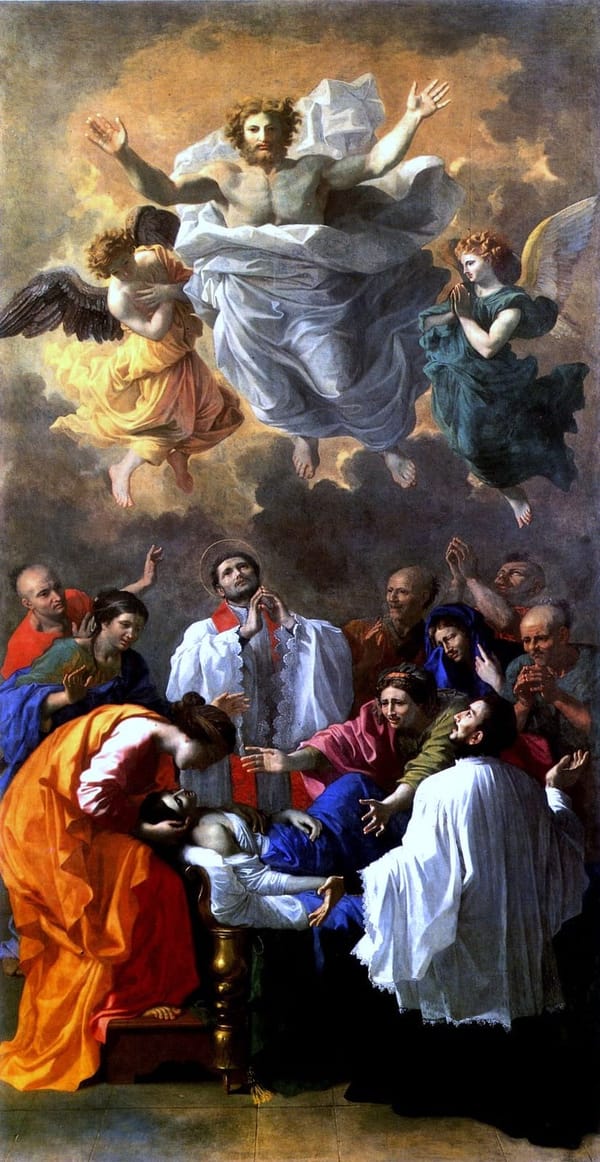 |
December 3: Saint Francis Xavier, Confessor; Apostle of the Indies
The apostles being the heralds of the coming of the Messias, it was fitting that Advent should have in its calendar the name of some one among them. Divine Providence has provided for this; for, to say nothing of St. Andrew, whose feast is oftentimes past before the season of Advent has commenced, St. Thomas’s day is unfailingly kept immediately before Christmas. We will explain, later on, why St. Thomas holds that position rather than any other apostle; at present, we simply assert the fitness of there being at least one of the apostolic college, who should announce to us, in this period of the Catholic cycle, the coming of the Redeemer. But God has not wished that the first apostolate should be the only one to appear on the first page of the liturgical calendar; great also, though in a lower degree, is the glory of that second apostolate, whereby the bride of Jesus Christ multiplies her children, even in her fruitful old age, as the psalmist expresses it.1 There are Gentiles who have still to be evangelized; the coming of the Messias is far from having been announced to all nations. Now of all the valiant messengers of the divine Word who have, during the last few hundred years, proclaimed the good tidings among infidel nations, there is not one whose glory is greater, who has worked greater wonders, or who has shown himself a closer imitator of the first apostles, than the modern apostle of the Indies, St. Francis Xavier.
The life and apostolate of this wonderful man were a great triumph for our mother the holy Catholic Church; for St. Francis came just at a period when heresy, encouraged by false learning, by political intrigues, by covetousness, and by all the wicked passions of the human heart, seemed on the eve of victory. Emboldened by all these, this enemy of God spoke, with the deepest contempt, of that ancient Church which rested on the promises of Jesus Christ; it declared that she was unworthy of the confidence of men, and dared even to call her the harlot of Babylon, as though the vices of her children could taint the purity of the mother. God’s time came at last, and He showed Himself in His power: the garden of the Church suddenly appeared rich in the most admirable fruits of sanctity. Heroes and heroines issued from that apparent barrenness; and whilst the pretended reformers showed themselves to be the most wicked of men, two countries, Italy and Spain, gave to the world the most magnificent saints.
One of these is brought before us to-day, claiming our love and our praise. The calendar of the liturgical year will present to us, from time to time, his contemporaries and his companions in divine grace and heroic sanctity. The sixteenth century is, therefore, worthy of comparison with any other age of the Church. The so-called reformers of those times gave little proof of their desire to convert infidel countries, when their only zeal was to bury Christianity beneath the ruin of her churches. But at that very time, a society of apostles was offering itself to the Roman Pontiff, that he might send them to plant the true faith among people who were sitting in the thickest shades of death. But, we repeat, not one of these holy men so closely imitated the first apostles as did Francis, the disciple of Ignatius. He had all the marks and labours of an apostle: an immense world of people evangelized by his zeal, hundreds of thousands of infidels baptized by his indefatigable ministration, and miracles of every kind, which proved him, to the infidel, to be marked with the sign which they received who, living in the flesh, planted the Church, as the Church speaks in her liturgy. So that, in the sixteenth century, the east received from the ever holy city of Rome an apostle, who, by his character and his works, resembled those earlier ones sent her by Jesus Himself. May our Lord Jesus be for ever praised for having vindicated the honour of the Church, His bride, by raising up Francis Xavier, and giving to men, in this His servant, a representation of what the first apostles were, whom He sent to preach the Gospel when the whole world was pagan.
Let us now read the short account given us, in the words of the Church, of this new apostle.
Glorious apostle of Jesus Christ, who didst impart His divine light to the nations that were sitting in the shadows of death! we, though unworthy of the name of Christians, address our prayers to thee, that by the charity which led thee to sacrifice everything for the conversion of souls, thou wouldst deign to prepare us for the visit of the Saviour, whom our faith and our love desire. Thou wast the father of infidel nations; be the protector, during this holy season, of them that believe in Christ. Before thy eyes had contemplated the Lord Jesus, thou didst make Him known to countless people; now that thou seest Him face to face, obtain for us that, when He is come, we may see Him with that simple and ardent faith of the Magi, those glorious first-fruits of the nations to which thou didst bear the admirable light.2
Remember also, O great apostle, those nations which thou didst evangelize, and where now, by a terrible judgement of God, the word of life has ceased to bring forth fruit. Pray for the vast empire of China, on which thou didst look when dying, but which was not blessed with thy preaching. Pray for Japan, thy dear garden which has been laid waste by the savage wild beast, of which the psalmist speaks. May the blood of the martyrs, which was poured out on that land like water, bring it the long-expected fertility. Bless, too, all the missions which our holy mother the Church has undertaken in those lands where the cross has not yet triumphed. May the heart of the infidel be opened to the grand simplicity and light of faith; may the seed bring forth fruit a hundred-fold; may the number of thy successors in the new apostolate ever increase; may their zeal and charity fail not; may their toil receive its reward of abundant fruit; and may the crown of martyrdom, which they receive, be not only the recompense but the perfection and the triumph of their apostolic ministry. Recommend to our Lord the innumerable members of that Association, which is the means of the faith being propagated through the world, and which has thee for its patron. Pray, with a filial affection and earnestness, for that holy Society, of which thou art so bright an ornament, and which reposes on thee its firmest confidence. May it more and more flourish under the storm of trial which never leaves it at rest; may it be multiplied, that so the children of God may be multiplied by its labours; may it ever have ready, for the service of the Christian world, zealous apostles and doctors; may it not be in vain that it bears the name of Jesus.
Let us consider the wretched condition of the human race, at the time of Christ’s coming into the world. The diminution of truths3 is emphatically expressed by the little light which the earth enjoys at this season of the year. The ancient traditions are gradually becoming extinct; the Creator is not acknowledged, even in the very work of His hands; everything has been made God, except the God who made all things. This frightful pantheism produces the vilest immorality, both in society at large, and in individuals. There are no rights acknowledged, save that of might. Lust, avarice, and theft, are honoured by men in the gods of their altars. There is no such thing as family, for divorce and infanticide are legalized; mankind is degraded by a general system of slavery; nations are being exterminated by endless wars. The human race is in the last extreme of misery; and unless the hand that created it reform it, it must needs sink a prey to crime and bloodshed. There are indeed some few just men still left upon the earth, and they struggle against the torrent of universal degradation; but they cannot save the world; the world despises them, and God will not accept their merits as a palliation of the hideous leprosy which covers the earth. All flesh has corrupted its way, and is more guilty than even in the days of the deluge: and yet, a second destruction of the universe would but manifest anew the justice of God; it is time that a deluge of His divine mercy should flood the universe, and that He who made man, should come down and heal him. Come then, O eternal Son of God! give life again to this dead body; heal all its wounds; purify it; let grace superabound, where sin before abounded; and having converted the world to Thy holy law, Thou wilt have proved to all ages that Thou, who camest, wast in very truth the Word of the Father; for as none but a God could create the world, so none but the same omnipotent God could save it from satan and sin, and restore it to justice and holiness.
A Responsory in Advent
(The Roman breviary, fourth Sunday of Advent)
Saturday of the First Week of Advent
Cap. vii.Et adjecit Dominus loqui ad Achaz, dicens: Pete tibi signum a Domino Deo tuo in profundum inferni, sive in excelsum supra. Et dixit Achaz: Non petam, et non tentabo Dominum. Et dixit: Audite ergo domus David: Numquid parum vobis est molestos esse hominibus, quia molesti estis et Deo meo? Propter hoc dabit Dominus ipse vobis signum: Ecce Virgo concipiet, et pariet Filium: et vocabitur nomen ejus Emmanuel.
Ch. vii.And the Lord spoke again to Achaz, saying: Ask thee a sign of the Lord thy God, either unto the depth of hell or unto the height above. And Achaz said: I will not ask, and I will not tempt the Lord. And he said: Hear ye, therefore, O house of David: Is it a small thing for you to be grievous to men, that you are grievous to my God also? Therefore, the Lord himself shall give you a sign. Behold, a Virgin shall conceive and bear a Son, and his name shall be called Emmanuel.
Let your hearts be filled with hope and joy at hearing this fair and sweet prophecy: A Virgin shall conceive and bear a Son. These words contain the salvation of the world, as these others express its perdition: ‘The woman took of the fruit of the tree, and did eat, and gave unto her husband.' This Virgin promised to us has at length come: the divine Fruit is in her womb. By her, Eve’s disobedience is repaired, the world is raised from its fall, the head of the serpent is crushed, God Himself is more glorified by the fidelity of this second Virgin, than He had been outraged by the disobedience of the first. The consent of Mary exercises an immense influence in the saving of the world. It is true that the Word Himself is coming; ‘but,’ says St. Bernard, 'Mary is the way whereby He comes; it is from her virginal womb He issues, as the Bridegroom from the nuptial chamber. Let us endeavour, therefore, to go up to Jesus by Mary, for Jesus came down to us by ner. By thee, O blessed one that didst find grace, O parent of life, O mother of salvation, may we have access to thy Son! May He, who was given to us by thee, receive us by thee. May He admit thy purity, and, for its sake, forgive our impurities: may He give us the pardon of our pride, because of the pleasure He took in thy humility. May thy abundant charity cover the multitude of our sins. May thy glorious fruitfulness get us fruitfulness of merit. Our Lady! our mediatrix! our advocate I reconcile us to thy Son, commend us to thy Son, present us to thy Son. By the grace thou didst find, by the prerogative thou didst merit, by the Mercy thou didst bring forth, grant, O blessed Virgin! that Jesus, who deigned to become, through thy maternity, partaker of our weakness and misery, may, through thy intercession, make us partakers of His glory and bliss.’*
Prose in Honor of the Blessed Virgin
(Composed by Abelard; it is found in all the Roman-French missals)
Non quemvis angelum:
Sed fortitudinem
Suum Archangelum,
Amator hominis.
Pro nobis nuncium,
Naturae faciat
Ut praejudicium
In partu Virginis.
Natus Rex gloriæ:
Regnet et imperet,
Et zyma scoriæ
Tollat de medio.
Terat fastigia:
Colla sublimium
Calcet vi propria,
Potens in prælio.
Mundanum principem;
Secumque faciat
Matrem participem
Patris imperii.
Haec dona dissere:
Revela veteris
Velamen litterae,
Virtute nuncii.
Dic: Ave, cominus.
Dic: Plena gratia:
Dic: Tecum Dominus:
Et dic: Ne timeas.
Dei depositum,
In quo perficias
Casta propositum
Et votum teneas.
Puella nuncium:
Credit et concipit
Et parit Filium,
Sed admirabilem,
Humani generis:
Deum et hominem
Et Patrem posteris,
In pace stabilem.
Nos reddat stabiles,
Ne nos labilitas
Humana labiles
Secum præcipitet,
Concessa venia,
Per Matrem gratiæ
Obtenta gratia,
In nobis habitet.
Peccati veniam:
Reatus deleat,
Donet et patriam
In arce siderum.
sends to the Virgin
no less an angel than him
who is called God’s strength,
the Archangel Gabriel.
be speedily at his work;
may he stay the rights
and laws of nature
in the Virgin’s delivery.
when born, triumph over nature;
may he reign and command;
may he take away from the midst of men
all leaven and rust.
may this God,
mighty in war,
trample in his power
on the necks of the haughty.
the prince of this world;
and make his Mother
share with him
the empire which his Father has given him.
announce these gifts;
lift up,
by the virtue of thy annunciation,
the veil of the ancient Scripture.
Say, when thou art in her presence: ‘Hail!’
Say: ‘O full of grace !"
Say: ‘The Lord is with thee!’
And then: ‘Fear not!’
the divine deposit;
by him fulfil
thy chaste purpose,
and keep thy vow.
and accepts the announcement;
she believes and conceives,
and brings forth a Son,
but he is the admirable,
of mankind,
God and Man,
Father of the world to come,
the Prince of peace.
render us firm,
lest human frailty
should make us stumble
into the abyss.
granting us pardon
and grace, obtained
by the Mother of grace,
dwell within us.
pardon of our sins,
wipe away all our guilt,
and give us the country
in the starry heaven.
Prayer from the Gallican Sacramentary
(Christmas Eve)
* Second Sermon of Advent. ↩︎
| Previous Friday of the First Week of Advent | Next Saturday of the First Week of Advent |