Daily reading
Advent
Semidouble · Movable from Advent · Temporal
December 11, 2022
From Dom Guéranger’s The Liturgical Year.

|
The Third Sunday of Advent
To-day, again, the Church is full of joy, and the joy is greater than it was. It is true that her Lord has not come; but she feels that He is nearer than before, and therefore she thinks it just to lessen somewhat the austerity of this penitential season by the innocent cheerfulness of her sacred rites. And first, this Sunday has had the name of Gaudete given to it, from the first word of the Introit; it also is honoured with those impressive exceptions which belong to the fourth Sunday of Lent, called Lœtare. The organ is played at the Mass; the vestments are rose-colour; the deacon resumes the dalmatic, and the subdeacon the tunic; and in cathedral churches the bishop assists with the precious mitre. How touching are all these usages, and how admirable this condescension of the Church, wherewith she so beautifully blends together the unalterable strictness of the dogmas of faith and the graceful poetry of the formulæ of her liturgy! Let us enter into her spirit, and be glad on this third Sunday of her Advent, because our Lord is now so near unto us. To-morrow we will resume our attitude of servants mourning for the absence of their Lord and waiting for Him; for every delay, however short, is painful and makes love sad.
The Station is kept in the basilica of St. Peter, at the Vatican. This august temple, which contains the tomb of the prince of the apostles, is the home and refuge of all the faithful of the world; it is but natural that it should be chosen to witness both the joy and the sadness of the Church.
The night Office commences with a new Invitatory. The voice of the Church no longer invites the faithful to come and adore in fear and trembling the King, our Lord„ who is to come. Her language assumes another character; her tone is one of gladness; and now, every day, until the vigil of Christmas, she begins her nocturns with these grand words:
Now let us take the book of the Prophet, and read with the Church:
Cap. xxvi.In die illa cantabitur canticum istud in terra Juda: Urbs fortitudinis nostræ Sion; Salvator ponetur in ea murus et antemurale. Aperite portas, et ingrediatur gens justa, custodiens veritatem. Vetus error abiit, servabis pacem; pacem, quia in te speravimus. Sperastis in Domino in saeculis æternis: in Domino Deo forti in perpetuum. Quia incurvabit habitantes in excelso, civitatem sublimem humiliabit. Humiliabit eam usque ad terram, detrahet eam usque ad pulverem. Conculcabit eam pes; pedes pauperis, gressus egenorum. Semita justi recta est, rectus callis justi ad ambulandum. Et in semita judiciorum tuorum, Domine, sustinuimus te: nomen tuum, et memoriale tuum in desiderio animæ. Anima mea desideravit te in nocte: sed et spiritu meo in præcordiis meis, de mane vigilabo ad te.
Ch. xxvi.In that day shall this canticle be sung in the land of Juda. Sion the city of our strength: a Saviour, a wall, and a bulwark shall be set therein. Open ye the gates and lot the just nation, that keepeth the truth, enter in. The old error is passed away, thou wilt keep peace: peace, because we have hoped in thee. You have hoped in the Lord for evermore: in the Lord God mighty for ever. For he shall bring down them that dwell on high, the high city he shall lay low. He shall bring it down even to the ground, he shall pull it down even to the dust. The foot shall tread it down; the feet of the poor, the steps of the needy. The way of the just is right, the path of the just is right to walk in. And in the way of thy judgements, O Lord, we have patiently waited for thee: thy name and thy remembrance are the desire of the soul. My soul hath desired thee in the night: yea, and with my spirit within me in the morning early I will watch to thee.
O holy Roman Church, city of our strength! behold us thy children assembled within thy walls, around the tomb of the fisherman, the prince of the apostles, whose sacred relics protect thee from their earthly shrine, and whose unchanging teaching enlightens thee from heaven. Yet, O city of strength: it is by the Saviour, who is coming, that thou art strong. He is thy wall, for it is He that encircles, with His tender mercy, all thy children; He is thy bulwark, for it is by Him that thou art invincible, and that all the powers of hell are powerless to prevail against thee. Open wide thy gates, that all nations may enter thee; for thou art mistress of holiness and the guardian of truth. May the old error, which sets itself against the faith, soon disappear, and peace reign over the whole fold! O holy Roman Church! thou hast for ever put thy trust in the Lord; and He, faithful to His promise, has humbled before thee the haughty ones that defied thee, and the proud cities that were against thee. Where now are the Cæsars, who boasted that they had drowned thee in thine own blood? where the emperors, who would ravish the inviolate virginity of thy faith? where the heretics, who, during the past centuries of thine existence, have assailed every article of thy teaching, and denied what they listed? where the ungrateful princes, who would fain make a slave of thee, who hadst made them what they were? where that empire of Mahomet, which has so many times raged against thee, for that thou, the defenceless State, didst arrest the pride of its conquests? where the reformers, who were bent on giving the world a Christianity, in which thou wast to have no part? where the more modern sophists, in whose philosophy thou wast set down as a system that had been tried, and was a failure, and is now a ruin? and those kings who are acting the tyrant over thee, and those people that will have liberty independently and at the risk of truth, where will they be in another hundred years? Gone and forgotten as the noisy anger of a torrent; whilst thou, O holy Church of Rome, built on the immovable rock, wilt be as calm, as young, as unwrinkled as ever. Thy path through all the ages of this world’s duration, will be right as that of the just man; thou wilt ever be the same unchanging Church, as thou hast been during the eighteen hundred years past, whilst everything else under the sun has been but change. Whence this thy stability, but from Him who is very truth and justice? Glory be to Him in thee! Each year, He visits thee; each year, He brings thee new gifts, wherewith thou mayst go happily through thy pilgrimage; and to the end of time, He will visit thee, and renew thee, not only with the power of that look wherewith Peter was renewed, but by filling thee with Himself, as He did the ever glorious Virgin, who is the object of thy most tender love, after that which thou bearest to Jesus Himself. We pray with thee, O Church, our mother, and here is our prayer: ‘Come, Lord Jesus! Thy name and Thy remembrance are the desire of our souls: they have desired Thee in the night, yea, and early in the morning have they watched for Thee.’
The Mass
The assembly of the faithful is attentive; the cantors intone the Gregorian melody, and the church echoes with these sweet words:
The Introit
Ps. O Lord thou hast blessed thy land: thou hast turned away the captivity of Jacob. ℣. Glory.
In the Collect, the Church asks for the grace of that divine visit, which dispels darkness and brings light. Darkness produces fear in the soul; whereas, light gives courage and joy to the heart.
Collect
The other Collects of the blessed Virgin, against the persecutors of the Church, and for the Pope, are the same as on the first Sunday in Advent, page 128.
Epistle
Cap. iv.Fratres, gaudete in Domino semper: iterum dico, gaudete. Modestia vestra nota sit omnibus hominibus: Dominus prope est. Nihil solliciti sitis; sed in omni oratione, et obsecratione, cum gratiarum actione, petitiones vestræ innotescant apud Deum. Et pax Dei, quae exsuperat omnem sensum, custodiat corda vestra, et intelligentias vestras, in Christo Jesu Domino nostro.
Ch. iv.Brethren, rejoice in the Lord always: again I say, rejoice. Let your modesty be known to all men: the Lord is nigh. Be nothing solicitous: but in everything, by prayer and supplication with thanksgiving, let your petitions be made known to God. And the peace of God, which surpasseth all understanding, keep your hearts and minds in Christ Jesus our Lord.
Nothing is more just than that we rejoice in the Lord. Both the prophet and the apostle excite us to desire the Saviour, both of them promise us peace. Therefore, let us not be solicitous: the Lord is nigh; nigh to His Church, and nigh to each of our souls. Who can be near so burning a fire, and yet be cold? Do we not feel that He is coming to us, in spite of all obstacles? He will let nothing be a barrier between Himself and us, neither His own infinite high majesty, nor our exceeding lowliness, nor our many sins. Yet a little while, and He will be with us. Let us go out to meet Him by these prayers and supplications, and thanksgiving which the apostle recommends to us. Let our zeal to unite ourselves with our holy mother the Church become more than ever fervent: now every day her prayers will increase in intense earnestness, and her longings after Him, who is her light and her love, will grow more ardent. First let us say together with her:
Gradual
Qui sedes, Domine, super Cherubim, excita potentiam tuam et veni.℣. Qui regis Israel, intende: Qui deducis velut ovem Joseph.Alleluia, alleluia.℣. Excita Domine potentiam tuam, et veni, ut salvos facias nos. Alleluia.
O Lord, who sittest on the Cherubim, exert thy power and come.℣. Thou who rulest Israel, hearken. Thou who leadest Joseph as a sheep.Alleluia, alleluia.℣. Exert, O Lord, thy power, and come to save us. Alleluia.
Gospel
Cap. i.In illo tempore: Miserunt Judæi ab Jerosolymis sacerdotes et levitas ad Joannem ut interrogarent eum: Tu quis es? Et confessus est, et non negavit, et confessus est: Quia non sum ego Christus. Et interrogaverunt eum: Quid ergo? Elias es tu? Et dixit: Non sum. Propheta es tu? Et respondit: Non. Dixerunt ergo ei: Quis es, ut responsum domus his qui miserunt nos? Quid dicis de te ipso? Ait: Ego vox clamantis in deserto: Dirigite viam Domini, sicut dixit Isaias propheta. Et qui missi fuerant erant ex Pharisæis. Et interrogaverunt eum, et dixerunt ei: Quid ergo baptizas, si tu non es Christus, neque Elias, neque propheta? Respondit eis Joannes, dicens: Ego baptizo in aqua: medius autem vestrum stetit, quem vos nescitis. Ipse est, qui post me venturus est, qui ante me factus est: cujus ego non sum dignus ut solvam ejus corrigiam calceamenti. Hæc in Bethania facta sunt trans Jordanem, ubi erat Joannes baptizans
Ch. i.At that time: the Jews sent from Jerusalem priests and levites to John, to ask him: Who art thou? And he confessed, and did not deny, and he confessed: I am not the Christ. And they asked him: What then? Art thou Elias? And he said: I am not. Art thou a prophet? And he answered: No. They said therefore unto him: Who art thou, that we may give an answer to them that sent us? What sayest thou of thyself? Ho said: I am the voice of one crying in the wilderness: Make straight the way of the Lord, as said the prophet Isaias. And they that were sent were of the Pharisees. And they asked him and said to him: Why then dost thou baptize, if thou be not Christ, nor Elias, nor a prophet? John answered them saying: I baptize with water; but there hath stood one in the midst of you, whom you know not. The same is he that shall come after me, who is preferred before me: the latchet of whose shoe I am not worthy to loose. These things were done in Bethania, beyond the Jordan, where John was baptizing.
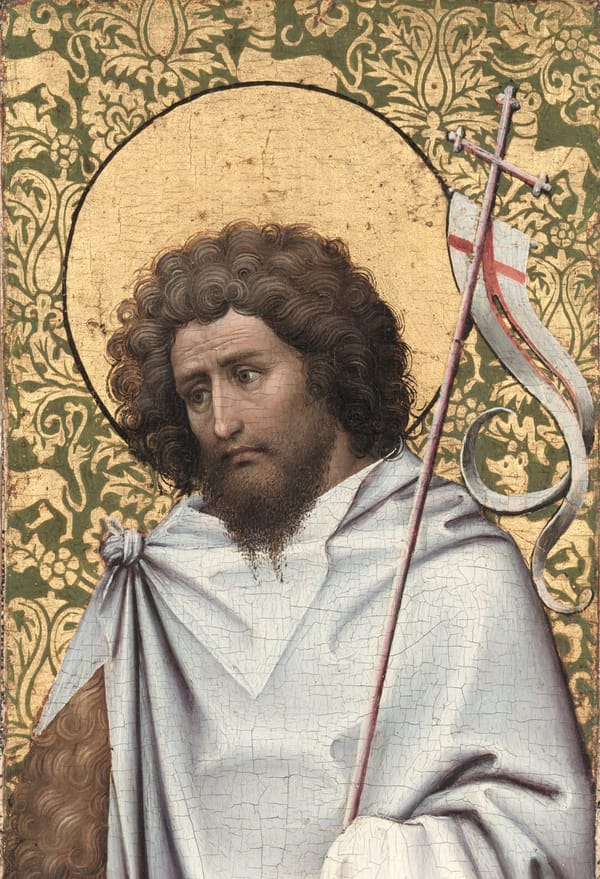
There hath stood One in the midst of you, whom you know not, says Saint John the Baptist to them that were sent by the Jews. So that our Lord may be near, He may even have come, and yet by some be not known! This Lamb of God is the holy Precursor’s consolation: he considers it a singular privilege to be but the voice, which cries out to men to prepare the way of the Redeemer. In this, St. John is the type of the Church, and of all such as seek Jesus. St. John is full of joy because the Saviour has come: but the men around him are as indifferent as though they neither expected nor wanted a Saviour. This is the third week of Advent; and are all hearts excited by the great tidings told them by the Church, that the Messias is near at hand? They that love Him not as their Saviour, do they fear Him as their Judge? Are the crooked ways being made straight, and the hills being brought low? Are Christians seriously engaged in removing from their hearts the love of riches and the love of sensual pleasures? There is no time to lose: the Lord is nigh! If these lines should come under the eye of any of those Christians who are in this state of sinful indifference, we would conjure them to shake off their lethargy, and render themselves worthy of the visit of the divine Infant: such a visit will bring them the greatest consolation here, and give them confidence hereafter, when our Lord will come to judge all mankind. Send Thy grace, O Jesus, still more plentifully into their hearts; 'compel them to go in,’ and permit not that it be said of the children of the Church, as St. John said of the Synagogue: There standeth in the midst of you One, whom you know not.
During the Offertory the faithful should unite in the prayer of the Church, and beg that the captivity in which our sins hold us may be brought to an end, and that the divine Deliverer may come.
Offertory
Secret
The other Secrets are given on page 132.
During the Communion, the Church chants the words of the prophet Isaias, which bid the heart of the sinner take courage. Fear not, Christian people! He that is coming is God; but He comes to save His creatures, and to give Himself to them.
Communion
The Church asks of God, in the following prayer, that the secret visit which she has just been receiving from her divine Spouse, may fit her for that solemn one which she is preparing to receive at the feast of Christmas.
Postcommunion
The other Postcommunions as on the first Sunday, page 134.
Vespers
Listen: recording
Capitulum
Phil. iv. 4.
The hymn Creator alme siderum, and the canticle Magnificat, are given on pages 107 and 109.
Antiphon of the Magnificat
But if the third Sunday of Advent fall on December 17, then, instead of the above, is said the first of the Great Antiphons (O Sapientia), which will be found, with the other six, in the proper of saints, from December 17 to 23 (page 484).
Prayer
December 11: Saint Damasus, Pope and Confessor
This great Pontiff comes before us in the liturgical year, not to bring us tidings of peace as St. Melchiades did, but as one of the most illustrious defenders of the great mystery of the Incarnation. He defends the faith of the universal Church in the divinity of the Word, by condemning, as his predecessor Liberius had done, the acts and the authors of the celebrated Council of Rimini. With his sovereign authority, he bore witness to the teaching of the Church regarding the Humanity of Jesus Christ, and condemned the heretic Apollinaris, who taught that Jesus Christ had assumed only the flesh and not the soul of man. He commissioned St. Jerome to make a new translation of the new Testament from the Greek, for the use of the Church of Rome; here, again, giving a further proof of the faith and love which he bore to the Incarnate Word. Let us honour this great Pontiff, whom the Council of Chalcedon calls ‘the ornament and support of Rome by his piety.’ St. Jerome, too, who looked upon St. Damasus as his friend and patron, calls him ‘a man of the greatest worth; a man whose equal could not be found, well versed in the holy Scriptures, and a virgin doctor of the virgin Church.’ The legend of the breviary gives us a brief account of his life.
Prose
(Taken from the Cluny missal of 1523)
Holy Pontiff Damasus! during thy life on earth, thou wast the light, which guided the children of the Church; for thou didst teach them the mystery of the Incarnation, and didst guard them against those perfidious doctrines, wherewith hell ever strives to corrupt that glorious symbol of our faith, which tells us of God’s infinite mercy towards us, and of the sublime dignity of man thus mercifully redeemed. Seated on the Chair of Peter, thou didst confirm thy brethren, and thy faith failed not; for Jesus had prayed to His Father for thee. We rejoice at the infinite recompense with which this divine Prince of pastors has rewarded the unsullied purity of thy faith, O thou ‘virgin doctor of the virgin Church!’ Oh that we could have a ray of that light which now enables thee to see Jesus in His glory! Pray for us, that we may have light to see Him, and know Him, and love Him, under the humble guise in which He is so soon to appear to us. Obtain for us the science of the sacred Scriptures, in which thou wast so great a master; and docility to the teachings of the Bishop of Rome, to whom, in the person of St. Peter, Christ has said: ‘Launch out into the deep!’*
Obtain also for all Christians, O thou the successor of this prince of the apostles, that they be animated with those sentiments, which St. Jerome thus describes in one of his letters addressed to thee: ‘It is the Chair of Peter that I will consult, for from it do I derive that faith which is the food of my soul. I will search for this precious pearl, heeding not the vast expanse of sea and land which I must pass over. Where the body is, there shall the eagles be gathered together. It is now in the west that the Sun of justice rises. I ask the Victim of salvation from the priest, and from the shepherd the protection of the sheep. On that rock I know the Church is built. He that eats the Lamb in any house but this, is profane. He that is not in Noah’s ark, shall perish in the waters of the deluge. I know not Vitalis, I reject Meletius, I pass by Paulinus. He that gathers not with thee, Damasus, scatters; for he that is not of Christ, is of Antichrist.’
Let us contemplate our divine Saviour in the womb of His most holy Mother Mary. Let us, together with the holy angels, adore Him in this state of profound humiliation, to which His love for us has brought Him. See Him there offering Himself to His Father for the redemption of mankind, and commencing at once to fulfil the office of our Mediator, which He has taken upon Himself. What an excess of love is this of our Jesus, that He is not satisfied with having humbled Himself in assuming our nature,though that alone would have sufficed to redeem a million worlds! The eternal Son of God wills to remain, as other children, nine months in His Mother’s womb: after that, to be born in poverty, to live a life of labour and suffering, and to be obedient to death, even to the death of the cross. O Jesus! mayst Thou be praised and loved by all creatures for this Thy immense love of us! Thou hast come down from heaven the Victim that art to take the place of all those which were hitherto offered, but which could not efface man’s sin. At length, the earth possesses its Saviour, though as yet unseen. God will not curse the earth, which, though covered with crime, is rich in such a treasure as this. Still repose, O Jesus, in the chaste womb of Mary, that living ark which contains the true manna sent for the food of man. But the time is approaching for Thee to leave this loved sanctuary. The tender love which Thou hast received from Mary, must be changed for the malice wherewith men will treat Thee; yet it must needs be that Thou be born on the day which Thou Thyself hast decreed: it is the will of Thy eternal Father, it is the expectation of the world, it is the salvation of all who shall love Thee.
Prose in Honor of the Blessed Virgin
(Taken from the Cluny missal of 1523)
Prayer for the Time of Advent
(The Mozarabic breviary, Monday of the first week of Advent)
* St. Luke v. 4. ↩︎
| Previous Saturday of the Second Week of Advent | Next December 11: Saint Damasus, Pope and Confessor |