Daily reading
December 12 · Sanctoral
December 12, 2022
From Dom Guéranger’s The Liturgical Year.
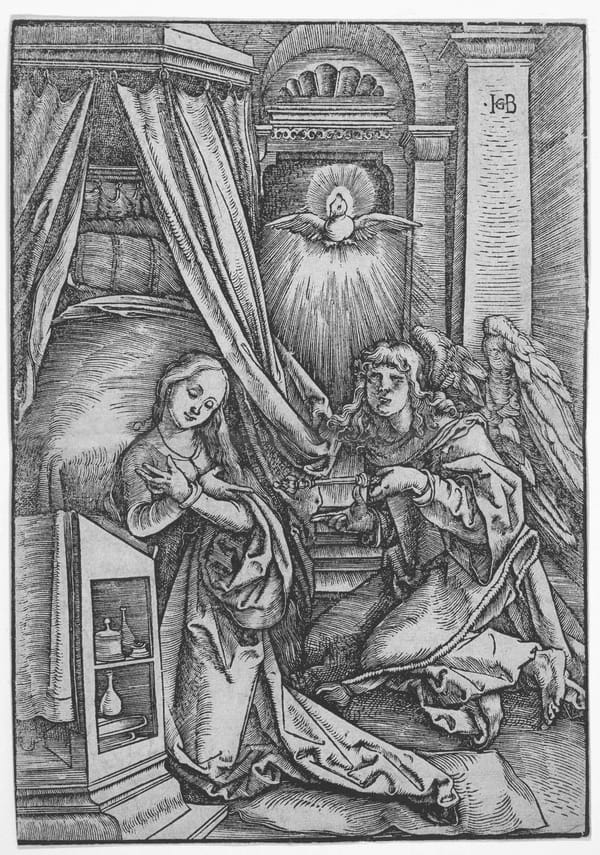
December 12: The Fifth Day within the Octave of the Immaculate Conception
Let us contemplate the sentiments of profound respect and maternal tenderness, which fill the soul of our blessed Lady, now that she has conceived Jesus in her chaste womb: He is her God, and yet He is her Son. Let us think upon this wonderful dignity bestowed upon a creature; and let us honour the Mother of our God. It is by this mystery that the prophecy of Isaias was fulfilled: ‘Behold, a Virgin shall conceive and bear a Son;’1 and that of Jeremias: ‘The Lord hath created a new thing upon the earth; a woman shall compass a Man.’2 The Gentiles themselves had received the tradition of these prophecies. Thus in the old pagan Carnutum (Chartres), there was an altar dedicated ‘To the Virgin that was to bring forth a Son and that of Jeremias: 'The Lord hath created a new thing upon the earth; a woman shall compass a Man.' 11 The Gentiles them- selves had received the tradition of these prophecies. Thus in the old pagan Oarnutum (Chartres), there was an altar dedicated ' To the Virgin that was to bring forth a Son and that of Jeremias: 'The Lord hath created a new thing upon the earth; a woman shall compass a Man.' 11 The Gentiles them- selves had received the tradition of these prophecies. Thus in the old pagan Oarnutum (Chartres), there was an altar dedicated ' To the Virgin that was to bring forth a Son (Virgini Parituræ)’; and whilst modern rationalism, with its ignorant scepticism, was affecting to throw a doubt on this fact of history, the researches of science were discovering that Carnutum was far from being the only city of the west which had such an altar.
But what human language could express the dignity of our Lady, who carries within her chaste womb Him that is the world’s salvation! If Moses, after a mere colloquy with God, returned to the Israelites with the rays of the majesty of Jehovah encircling his head, what an aureola of glory is due to Mary, who has within her, as in a living heaven, that very God Himself! The divine Wisdom tempers the effulgence of her glory that it be not visible to men; and this in order that the state of humility, which the Son of God has chosen as the one in which He would manifest Himself to the world, should not be removed at the very outset by the dazzling glory which would, otherwise, have been seen gleaming from His Mother.
The sentiments which filled the heart of Mary during these months of her ineffable union with the divine Word, may be thus expressed in the words of the bride in the sacred Canticle: ‘I sat under the shadow of Him whom I desired; and His fruit was sweet to my palate. I sleep, but my heart watches. My soul melted when He spoke. I to my Beloved and my Beloved to me, who feedeth among the lilies, till the day break, and the shadows retire.’3 And if there ever were a human heart, that was forced, by the overpowering vehemence of its love of God, to use these other words of the same Canticle, it was Mary’s: ‘O daughters of Jerusalem! stay me up with flowers, compass me about with fragrant fruits; for I languish with love.’4 ‘These sweet words,’ says the venerable Peter of Celles, ‘are those of the bride that dwelleth in the gardens, and is now near the time of her delivery. What so lovely in creation as this Virgin, who loves the Lord with such matchless love and is so exceedingly loved by this her Lord? It is she of whom the Scripture speaks, when it calls the bride the dearest hind. What, too, so lovely as that well-beloved Son of God, born of His beloved Father from all eternity, and now, at the end of time, as the apostle speaks, formed in the womb of His dearest Mother, and become to her, in the words of the same divine proverb, the sweetest fawn? Let us, therefore, cull our flowers, and offer them to both Child and Mother. But let me briefly tell you what are the flowers you must offer to our Lady. Christ says, speaking of His Humanity, “I am the flower of the field, and the lily of the valleys.” By Him, therefore, let us purify our souls and bodies, and so be able to approach our God in chastity. Next, preserve this flower of purity from all that would injure it; for flowers are tender things, and soon droop and fade. Let us wash our hands among the innocent, and, with a pure heart, and pure body, and cleansed lips, and chaste soul, let us gather in the paradise of our heavenly Father our fresh flowers for the new Nativity of our new King. With these flowers let us stay up this most saintly Mother, this Virgin of virgins, this Queen of queens, this Lady of ladies; that so we may deserve to receive the blessing of the Mother and of the divine Babe.’5
Virgo Mater gloriosa,
Mater Regis gloriæ.
Ave, fulgens margarita
Per quam venit mundi vita,
Christus sol justitiæ.
O oliva fructifera,
Tu pietatis viscera
Nulli claudis hominum.
Nos exsules laetificas,
Ut vitis, dum fructificas
Salvatorem Dominum.
Ave, Virgo Mater Dei,
Tu superni sol diei,
Et mundi noctis luna.
Succurre nobis miseris,
Mortalium spes unica.
Ave, decus virginale,
Templum Dei speciale! Per te fiat veniale
Omne quod committimus.
Tu nobis es singularis;
Tu nos ducas, stella maris;
Tu nos semper tuearis:
En ad te confugimus.
Ad te, pia, suspiramus,
Si non ducis, deviamus;
Ergo doce quid agamus;
Post hunc finem ut vivamus
Cum sanctis perenniter.
Jesu Christe, Fili Dei,
Tota salus nostræ spei;
Tuæ matris interventu,
Angelorum nos conventu
Fac gaudere jugiter.
glorious Virgin-Mother
of the King of glory!
Hail, fair pearl!
by whom came the life of the world,
Christ the Sun of justice.
O fruitful olive!
thou excludest no mortal
from thy tender compassion.
Thou givest gladness to us exiles,
for, like a fruitful vine,
thou yieldest thy fruit, Jesus our Lord.
Hail, Virgin Mother of God!
thou art the sun of the heavenly day!
thou art the moon of the world’s night!
Tenderest of Mothers!
help us poor mortals,
for God wills us to hope in thee above all creatures.
Hail, O purest Virgin!
God’s special temple! pray for us to him,
that he would forgive us all our sins.
Thou art unto us what no other creature is.
Guide us, O star of the sea!
Defend us always and in all places.
We fly to thee in our necessities.
Tender Mother! we pray thee guide us,
or we go astray.
Tell us what would thy Jesus have us do?
that so, after this life is ended,
we may live for ever with the saints.
O Jesus! Son of God,
our only Saviour, in whom rests all our hope!
grant by the intercession of thy Mother,
that we may be united
to the angels in eternal joy.
A Prayer for the Time of Advent
(The Mozarabic breviary, first Sunday of Advent)
Monday of the Third Week of Advent
Cap. xxviii.Hæc dicit Dominus Deus: Ecce ego mittam in fundamentis Sion lapidem, lapidem probatum, angularem, pretiosum, in fundamento fundatum. Qui crediderit, non festinet. Et ponam in pondere judicium, et justitiam in mensura, et subvertet grando spem mendacii, et protectionem aquæ inundabunt. Et delebitur fœdus vestrum cum morte, et pactum vestrum cum inferno non stabit.
Ch. xxviii.Thus saith the Lord God: Behold I will lay a stone in the foundations of Sion, a tried stone, a corner-stone, a precious stone, founded in the foundation. He that believeth, let him not hasten. And I will set judgement in weight, and justice in measure; and hail shall overturn the hope of falsehood, and waters shall overflow its protection. And your league with death shall be abolished, and your covenant with hell shall not stand.
Heavenly Father! Thou art preparing to set in the foundations of Sion a corner-stone, that is tried and solid; and this stone, which is to give firmness to Sion Thy Church, is Thy Incarnate Son. It was prefigured, as Thy apostle assures us,1 by that rock of the desert, which yielded the abundant and saving stream that quenched the thirst of Thy people. But now Thou art about to give us the reality; it has already come down from heaven, and the hour is fast approaching when Thou wilt lay it in the foundations. O sacred Stone, which makest all one, and givest solidity to the whole structure! By Thee it will come to pass, that there shall be no longer Jew or Gentile, but all nations shall become one family. Men shall no more build on sand, nor set up houses which floods and storms may overturn. The Church shall rise up from the stone which God now sets, and, secure on the great foundation, her summit shall touch the clouds. With all his weakness, and all his fickleness, man will partake of Thy immutability, O divine Stone, if he will but lean on Thee. Woe to him that rejects Thee, for Thou hast said, and Thou art the eternal Truth: 'Whosoever shall fall upon that stone, shall be bruised; and upon whomsoever it shall fall, it will grind him to powder.’2 From this twofold evil, O Thou that art chief corner-stone, deliver us, and never permit us to be of the number of those blind men who rejected Thee. Give us grace ever to honour and love Thee as the cause of our strength, and the one sole origin of our solidity: and since Thou hast communicated this Thy quality of the rock to one of Thine apostles, and by him to his successors unto the end of the world, grant us ever to cling to this rock, the holy Roman Church, in union with which all the faithful on the face of the earth are preparing to celebrate the glorious solemnity of Thy coming, O precious and tried Stone! Thou art coming, that Thou mayst destroy the kingdom of falsehood, and break the league which mankind had made with death and hell.
Hymn for Advent
(In the Mozarabic breviary, first Sunday of Advent)
Rerum parenti proximas
Quas esse sentit gratias,
Laudesque promat maximas.
Perfecit olim tradita,
Cum nos redemit unicus
Factoris orbis Filius.
Tulit reatum criminum,
Sumensque nostrum pulverem,
Mortis peremit principem.
Sed sempiternus a Patre,
Duabus in substantiis,
Persona sola est Numinis.
Nitescat ut cultu novo
Renatus in nato Deo,
Factus novus vetus homo.
Ovans trophæo, gentium
Renata plebs per gratiam
Hæc festa præbet annua.
Votis feratur omnibus,
Quos sustinere convenit,
Tanti diei gloriam.
Orbemque terror presserit;
Succurrat hæc humillima
Susceptionis dignitas.
Ejusque soli Filio,
Cum Spiritu Paraclito,
In sempiterna sæcula.
laud the graces that are nigh,
and sing their highest praises
to their Creator.
who created this world, redeemed us,
he fulfilled the promises
which the heavensent prophets spoke in the ages past.
and shown himself to men,
took away the punishment due to their sins;
and assuming our nature, though but dust, he vanquished the prince of death.
but begotten eternally from the Father,
in the two substances there is but one Person,
that is the Person of the Word.
that our old man being changed into the new,
we may put on new beauty
by being regenerated in the new-born God.
in gladness and exultation
at the trophy won by the divine Nativity,
keep every year its feast.
be celebrated with devout solemnity by all,
who have so just a share
in the glory of this great day.
shall burst upon the world and fill it with fear,
this most humble expression
of our devout celebration of the first may give us confidence.
and to his only Son,
and to the holy Spirit,
be glory for ever and ever.
Prayer from the Ambrosian Missal
(In the Mass of the sixth Sunday of Advent, Preface).
| Previous December 11: Saint Damasus, Pope and Confessor | Next Monday of the Third Week of Advent |