Daily reading
December 14 · Sanctoral
December 14, 2022
From Dom Guéranger’s The Liturgical Year.
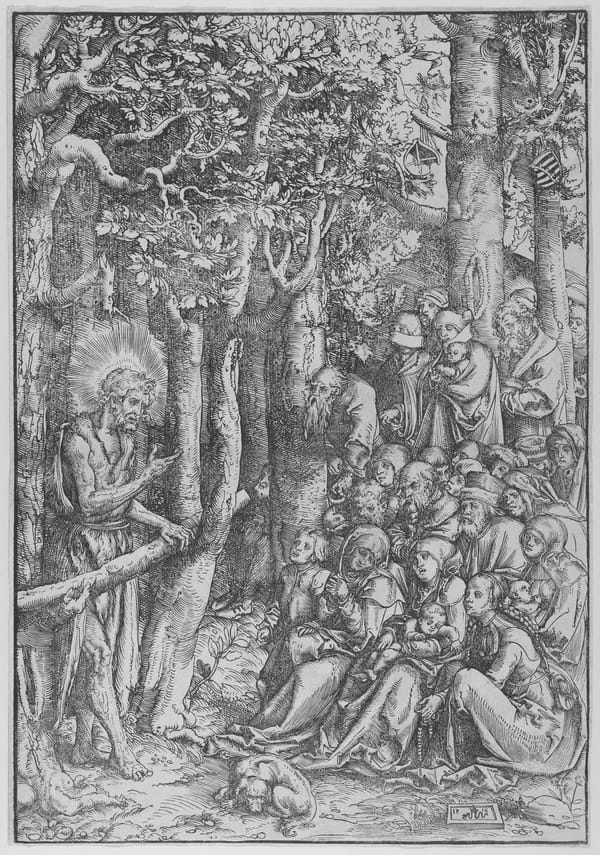
December 14: The Seventh Day within the Octave of the Immaculate Conception
Let us consider how our blessed Lady, having arrived at the house of her holy cousin Elizabeth, rendered her every possible service with the greatest love, favoured her with her sweet and holy conversations, assisted at the glorious birth of St. John the Baptist, and at length returned home to her humble dwelling in Nazareth. But, that we may the better enter into these divine mysteries, let us again listen to the seraphic St. Bonaventure.
When, therefore, her time was expired, Elizabeth gave birth to a son, whom our Lady took up, and with all diligence did what was required. The babe looked into Mary’s face like one that knew her; and as she gave him unto his mother, he turned his head towards Mary, for he fain would be in her arms again. Mary, on her part, delighted in nursing this holy babe, and fondled him, and kissed him with great joy. Consider the honour that is here given unto John. Never had child such arms as these to carry him. Many other privileges are related as being granted unto him; but for this present, I must needs pass them by.
Now, on the eighth day, the child was circumcised, and was called John. Then was the mouth of Zachary opened, and he prophesied, saying: “Blessed be the Lord God of Israel!” Thus were made, in that house, the two most beautiful canticles, namely, the Magnificat and the Benedictus. Meanwhile our Lady, going aside lest she should be seen by those that had come together for the ceremony, listened attentively to the canticle of Zachary, which prophesied of her Son, and most prudently pondered in her heart upon all these things. At length, when the time came for her to return home, she bade Elizabeth and Zachary farewell, and, giving John her blessing, she returned unto Nazareth. Recall to thy mind, in this her second journey, all that was told thee of her poverty. She returned to her house, where she would find neither bread, nor wine, nor those things which were needed. She had no property, nor money. She had been, now these three months, living with persons who were very rich; but now she returns unto her poor cottage, and has to procure her livelihood by the labour of her hands. Do thou sympathize with her, and learn to love poverty.
Sequence in Honour of Our Blessed Lady
(Taken from the ancient Roman-French Missals)
Cœli jubar, mundi rosa,
Cœlibatus lilium.
Ave, gemma pretiosa,
Super solem speciosa,
Virginale gaudium.
Spes reorum, O Maria,
Redemptoris Mater pia,
Redemptorum gloria.
Finis lethi, vitæ via;
Tibi triplex hierarchia
Digna dat præconia.
Virga Jesse florida,
Stella maris lucida,
Sidus veræ lucis.
Fructum vitæ proferens,
Et ad portum transferens
Salutis, quod ducis.
Florens hortus, ægris gratus,
Puritatis fons signatus,
Dans fluenta gratiæ.
Thronus veri Salomonis,
Quem præclaris cœli donis
Ornavit Rex gloriæ.
O regina pietatis,
Et totius sanctitatis
Flumen indeficiens.
In te salva confidentes,
Salutari sitientes
Potu nos reficiens.
Ad te flentes suspiramus,
Rege mentes, invocamus,
Evæ proles misera.
Statum nostræ paupertatis,
Vultu tuæ bonitatis,
Clementer considera.
Cella fragrans aromatum,
Apotheca charismatum
Salutaris.
Tuam nobis fragrantiam
Spirans, infunde gratiam
Qua ditaris.
Dulcis Jesu Mater bona,
Mundi salus, et Matrona
Supernorum civium,
Pacem confer sempiternam,
Et ad lucem nos supernam
Transfer post exsilium.
Amen.
brightness of the heavens, rose of the world,
lily of purity.
Hail, precious gem!
more beauteous than the sun,
and joy of pure souls.
Thou art the sinner’s hope, O Mary!
thou art the holy Mother of our Redeemer,
and the consolation of us whom he redeemed.
Thou didst stay the reign of death,
thou didst commence the reign of life.
To thee, O Mary, the triple hierarchy sing their praises.
Hail! flowery stem of Jesse,
bright star of the sea,
source that broughtest to us him that is our true light.
Thou bearest the fruit of life,
and he whom thou leadest
will not miss the port of salvation.
O flowery garden, so sweet to the sick!
O sealed fount of purity,
that gavest us Jesus, the author of grace.
Thou throne of the true Solomon,
enriched by the King of glory
with the best of heaven’s gifts.
O merciful Queen!
thou art the rich unfailing
stream of all sanctity.
Have pity on us who trust in thee,
and refresh our thirsty souls
with thy efficacious prayers.
Hear our sighs, O Mary!
and suffer us not,
poor children of Eve, to go astray.
Look with thy eye of love
on our many wants:
compassionate our poverty.
Vessel of every fragrance,
and Mother and treasury
of divine grace.
Breathe thy fragrance
into our souls,
and obtain for us the riches of grace.
Beautiful Mother of our sweet Jesus!
the world received its Saviour through thee,
and the heavenly citizens call thee Queen.
Obtain for us that peace which has no end,
and, after this our exile,
that light which is divine.
Prayer for the Time of Advent
(The Mozarabic breviary, Friday of the second week of Advent, Capitula)
Wednesday in Ember Week of Advent
To-day the Church begins the fast of Quatuor Tempora, or, as we call it, of Ember days: it includes also the Friday and Saturday of this same week. This observance is not peculiar to the Advent liturgy; it is one which has been fixed for each of the four seasons of the ecclesiastical year. We may consider it as one of those practices which the Church took from the Synagogue; for the prophet Zacharias speaks of the fasts of the fourth, fifth, seventh, and tenth months.* Its introduction into the Christian Church would seem to have been made in the apostolic times; such, at least, is the opinion of St. Leo, of St. Isidore of Seville, of Rabanus Maurus, and of several other ancient Christian writers. It is remarkable, on the other hand, that the orientals do not observe this fast.
From the first ages the Quatuor Tempora were kept, in the Roman Church, at the same time of the year as at present. As to the expression, which is not unfrequently used in the early writers, of the three times and not the four, we must remember that in the spring, these days always come in the first week of Lent, a period already consecrated to the most rigorous fasting and abstinence, and that consequently they could add nothing to the penitential exercises of that portion of the year.
The intentions, which the Church has in the fast of the Ember days, are the same as those of the Synagogue; namely, to consecrate to God by penance the four seasons of the year. The Ember days of Advent are known, in ecclesiastical antiquity, as the fast of the tenth month; and St. Leo, in one of his sermons on this fast, of which the Church has inserted a passage in the second nocturn of the third Sunday of Advent, tells us that a special fast was fixed for this time of the year, because the fruits of the earth had then all been gathered in, and that it behoved Christians to testify their gratitude to God by a sacrifice of abstinence, thus rendering themselves more worthy to approach to God, the more they were detached from the love of created things. 'For fasting,’ adds the holy doctor, 'has ever been the nourishment of virtue. Abstinence is the source of chaste thoughts, of wise resolutions, and of salutary counsel. By voluntary mortifications, the flesh dies to its concupiscences, and the spirit is renewed in virtue. But since fasting alone is not sufficient whereby to secure the soul’s salvation, let us add to it works of mercy towards the poor. Let us make that which we retrench from indulgence, serve unto the exercise of virtue. Let the abstinence of him that fasts, become the meal of the poor man.’
Let us, the children of the Church, practise what is in our power of these admonitions; and since the actual discipline of Advent is so very mild, let us be so much the more fervent in fulfilling the precept of the fast of the Ember days. By these few exercises which are now required of us, let us keep up within ourselves the zeal of our forefathers for this holy season of Advent. We must never forget that although the interior preparation is what is absolutely essential for our profiting by the coming of our Lord Jesus Christ, yet this preparation could scarcely be real unless it manifested itself by the exterior practices of religion and penance.
The fast of the Ember days has another object besides that of consecrating the four seasons of the year to God by an act of penance: it has also in view the ordination of the ministers of the Church, which takes place on the Saturday, and of which notice was formerly given to the people during the Mass of the Wednesday. In the Roman Church, the ordination held in the month of December was, for a long time, the most solemn of all; and it would appear, from the ancient chronicles of the Popes, that, excepting very extraordinary cases, the tenth month was, for several ages, the only time for conferring Holy Orders in Rome. The faithful should unite with the Church in this her intention, and offer to God their fasting and abstinence for the purpose of obtaining worthy ministers of the word and of the Sacraments, and true pastors of the people.
The Church does not read anything, in the Matins of to-day, from the prophet Isaias: she merely reads a sentence from the chapter of St. Luke, which gives our Lady’s Annunciation, to which she subjoins a passage from St. Ambrose’s Homily on that Gospel. The fact of this Gospel having been chosen for the Office and Mass of to-day, has made the Wednesday of the third week of Advent a very marked day in the calendar. In several ancient Ordinaries, used by many of the larger churches, both cathedral and abbatial, we find it prescribed that feasts falling on this Wednesday should be transferred: that the ferial prayers should not be said kneeling on that day; that the Gospel Missus est, that is, of the Annunciation, should be sung at Matins by the celebrant vested in a white cope, with cross, lights, and incense, the great bell tolling meanwhile; that in abbeys, the abbot should preach a homily to the monks, as on solemn feasts. We are indebted to this custom for the four magnificent sermons of St. Bernard on our blessed Lady, which are entitled: Super Missus est.
As the Mass of the Ember days is seldom sung, excepting in churches where the canonical Office is said, as also that we might not add unnecessarily to this volume, we have thought it advisable to omit the Masses of Ember Wednesday, Friday, and Saturday of Advent. The Station for the Wednesday is at St. Mary Major, on account of the Gospel of the Annunciation, which, as we have just seen, has caused this day to be looked upon as a real feast of the blessed Virgin.
Having to speak, later on, of this mystery, in the proper of saints, we will conclude this Wednesday with a prose of the middle ages, in honour of our blessed Lady’s receiving the angel’s salutation, and with a prayer taken from one of the ancient liturgies.
Prose in Honour of the Blessed Virgin
(Taken from the missal of Cluny of 1523.)
Subintrans in conclavi,
Virginis formidinem
Demulcens, inquit ei:
Cœli terraeque Dominum
Concipies et paries,
Salutem hominum;
Tu porta cœli facta,
Medela criminum
Quæ virum non cognovi?
Qualiter infringerem
Quæ firma mente vovi?
Perficiet haec omnia:
Ne timeas, sed gaudeas,
Quod castimonia
Manebit in te pura,
Dei potentia.
Respondens inquit ei:
Servula sum humilis
Omnipotentis Dei.
Tanti secreti conscio,
Consentiens, et cupiens
Factum quod audio,
Parata sum parere
Dei consilio.
Et statim puellaris
Uterus intumuit,
Vi partus virginalis.
Novem mensium numero,
Hinc exiit et iniit
Affigens humero crucem,
Quæ dedit ictum
Hosti mortifero.
Quæ pacem reddidisti
Angelo et homini,
Quando Christum genuisti;
Ut se nobis propitium
Exhibeat, et deleat
Præstans auxilium
Vita frui beata,
Post hoc exsilium.
entering the Virgin’s chamber,
and gently bidding her not to fear,
says to her:
thou shalt conceive in thy womb
the Lord of heaven and earth;
thou shalt bring forth the salvation of mankind,
O gate of heaven bringing to the world
the remedy of its iniquities!
for I know not man?
How wouldst thou have me
break the vow which I have sworn to keep?
shall accomplish all these things, said the angel.
Fear not, but rejoice.
shall be left intact:
the power of God
shall maintain it.
said to the angel:
I am the lowly handmaid
of the omnipotent God.
O heavenly messenger,
bearer of so great a secret,
what thou announcest,
I am ready to obey
the decree of God.
and in that moment her virginal womb conceived
the Word made flesh
from hers.
for nine months:
then he left it, and began
carrying the cross upon his shoulders,
wherewith he struck the enemy who brought death into the world.
who didst bring peace
to angels and to men
by giving birth to Christ,
that he be merciful to us,
and forgive us
and give us his assistance,
whereby, after this exile,
we may possess the blessed joys of eternal life.
Prayer from the Mozarabic Missal
(Second Sunday of Advent, Illatio)
* Zach. viii. 19. ↩︎
| Previous Tuesday of the Third Week of Advent | Next Wednesday in Ember Week of Advent |