Daily reading
Advent
Double · December 15 · Sanctoral
December 15, 2022
From Dom Guéranger’s The Liturgical Year.
A Double leads the weekday.Rubric

|
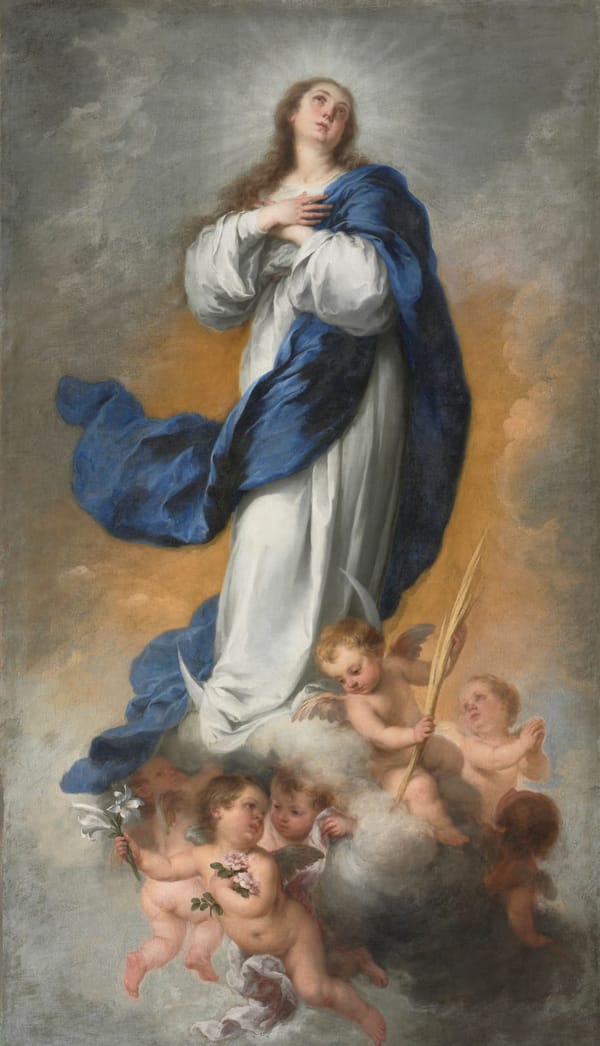
December 15: Octave of the Immaculate Conception of the Most Blessed Virgin
This, the eighth day from that on which we kept the feast of the Immaculate Conception, is the octave properly so called; whereas the other days were simply called days within the octave. The custom of keeping up the principal feasts for a whole week is one of those which the Christian Church adopted from the Synagogue. God had thus spoken in the Book of Leviticus: 'The first day shall be called most solemn and most holy, you shall do no servile work therein . . . . The eighth day also shall be most solemn and most holy, and you shall offer holocausts to the Lord, for it is the day of assembly and congregation: you shall do no servile work therein.'1 We also read in the Book of Kings, that Solomon, having called all Israel to Jerusalem for the dedication of the temple, suffered not the people to return home until the eighth day.
We learn from the Books of the new Testament that this custom was observed in our Saviour’s time, and we find Him authorizing, by His own example, this solemnity of the octave. Thus, we read in Saint John, that Jesus once took part in one of the Jewish festivals, about the midst of the feast;2 and the same Evangelist relating how our Lord cried out to the people: 'If any man thirst, let him come to Me, and drink’: observes, that it was on the last and great day of the festivity.3
In the Christian Church there are three kinds of octaves. Some feasts are celebrated with a privileged octave—that is, one of which the Office is said daily, or at least a commemoration is always made. Other feasts have a common octave, or one whose commemoration may, on greater feasts, be sometimes omitted. And, lastly, some have a simple octave, of which only the Octave Day itself is kept or commemorated. Privileged octaves, whose office is said or commemorated every day, are divided into three Orders. The octaves of the First Order are those of Easter and Pentecost. Those of the Second Order, of which days within the octave exclude all feasts except doubles of the First Class, are the octaves of the Epiphany and of Corpus Christi. The octaves of the Third Order, which must always be commemorated, although days within the octave exclude only the same feasts as do common octaves, are those of Christmas and of the Ascension of Our Lord. The octave of the Immaculate Conception, the first that occurs in the ecclesiastical year, is a common octave.
Let us once more devoutly reverence the mystery of Mary’s Immaculate Conception: our Emmanuel loves to see His Mother honoured. After all, is it not for Him and for His sake that this bright star was prepared from all eternity, and created when the happy time fixed by the divine decree came? When we honour the Immaculate Conception of Mary, it is really to the divine mystery of the Incarnation that we are paying our just homage. Jesus and Mary cannot be separated, for Isaias tells us that she is the branch and He the Flower.4
We give Thee thanks, O Jesus our Emmanuel, because Thou hast granted us to live during the time that the privilege of Thy blessed Mother was proclaimed on this earth; the glorious privilege wherewith Thou didst enrich the first instant of the life of the happy creature, from whom Thou didst take upon Thyself our human nature! This definition of Thy Church has given us a clearer knowledge of Thine infinite holiness. It has taught us to see more distinctly the harmony there is in all Thy divine mysteries. But it has also impressed upon us the great truth that we ourselves, being destined to the most intimate union with Thee here, and to the face to-face vision of Thy infinite Majesty hereafter, must labour without ceasing to purify ourselves from the smallest stains of sin. Thou hast said: 'Blessed are the clean of heart, for they shall see God';5 and Thou showest us, by the dogma of Thy blessed Mother’s Immaculate Conception, what is the purity which Thy sovereign sanctity demands of us. Ah! by the love, which led Thee to preserve her from every stain of sin, have mercy on us who are her devoted children. Thou art so soon to be among us! Before many days are past we shall have yielded to Thy invitations, and have presumed to approach Thy sacred crib. We are not yet ready, dear Jesus! The effects of original sin are still so plainly upon us, and, what is worse, there are so many of our own sins, which we have added to this of our first parent. Oh! prepare our hearts and our senses, for we will not approach to Bethlehem unworthily. The sinless purity of Thy Mother is not for us; we ask not for that; but we ask for forgiveness of our countless sins, for conversion, for hatred of the world and the world’s maxims, and for perseverance in Thy holy love.
O Mary! created mirror of divine justice, and purer than the Cherubim and Seraphim, in return for the homage paid thee by this our generation, on that blissful day when the glory of thy Immaculate Conception was proclaimed throughout the world, give us that abundant richness of thy protecting love, which thou didst reserve till now. The world is shaken to its very foundations: thy hand can help it to rest again. Hell has let loose upon mankind the most terrible of its spirits of wickedness, who breathe but blasphemy and destruction; but, at the same time, the Church of thy Jesus feels that her youth has been renewed within her, and that the seed of the divine word is broadcast and healthy in a thousand fresh portions of the earth. Never was the battle more fierce on both sides: so that we need all our hope to make us feel that hell will not prevail. Is this the great struggle, which is to be followed by the day of judgement?
O blessed Mother of Jesus! O Queen of the universe! can it be that the star of thy Immaculate Conception has shone in the heavens only to light up the ruin and wreck of this earth? The sign foretold by the beloved disciple St. John, of the woman that appeared in the heavens clad with the sun, bearing on her head a crown of twelve stars, and crushing the crescent beneath her feet6—has it not more brightness and power than that other, which appeared in the heavens telling men that God’s anger was appeased, and that the deluge was over? The light which shines upon us is from a Mother. It is our Mother that comes to console and heal us. It is heaven that smiles upon poor guilty earth. We have deserved the chastisement we have received, and more than we have received: but the anger of God will give way, and He will spare us.
The graces which God poured out upon the world on that great day of the Church’s definition of Mary’s Immaculate Conception, were not to be without their effect; a new period then commenced. Mary, on whom heresy had heaped its blasphemies for three hundred years, will again reign in the love of those whom her Son redeemed; countries will abandon those errors which have made them slaves and dupes of men’s doctrines; the old serpent will again writhe under that crushing pressure which God set up from the beginning; and the divine Sun of justice will pour out on the regenerated world the floods of a light more than ever dazzling and resplendent. We may not live to see that time; but we have signs of ite near approach.
It was in the last century that thy devout servant whom the Church has placed upon her altars, Leonard of Porto-Maurizio, predicted that when this dogma of thy Immaculate Conception should be defined, the world would enjoy a long period of peace. The troubles of the present time in which we are living are, we doubt not, a prelude to that happy peace, during which the divine word will traverse the whole world unimpeded, and the Church militant will reap her harvest for the Church in heaven. Sweet Mother of our Jesus! the world was also in agitation in those times which preceded the birth of thy divine Son; but peace reigned throughout the whole earth, when thou didst give it its Saviour in Bethlehem. Until that grand time come when thou wilt show to the world the magnificence of the power which God has given to thee, assist us, each year, to prepare for the glorious solemnity of Christmas: oh! pray for us, that we may be cleansed from all our sins when that splendid night comes, during which will be born of thee Jesus Christ, the Son of God, the light eternal.
Prose in Honour of the Holy Mother of God
(Taken from the ancient Roman-French missals)
Ut devote celebretur
Virginis Conceptio.
Mens amore inflammetur
Et amori copuletur
Laus et jubilatio.
Haec concepta miro more
Est ut rosa cum nitore,
Est ut candens lilium.
Ut fructus exit a flore,
Est producta cum pudore,
Praeventa per Filium.
Sicut ros non corrumpitur,
Quando in terra gignitur,
Elementi rubigine;
Sic Virgo non inficitur.
Quum in matre concipitur,
Originali crimine.
Nos ergo dulci carmine,
Laudemus in hac Virgine
Conceptum Bine nubilo.
Hanc conceptam ex semine,
Et mundam ab origine,
Laudet chorus cum jubilo.
Ut mota dulci modulo,
Nos servet in hoc saeculo
Mundos ab omni crimine.
Et in mortis articulo,
Liberet a periculo
Et inferni voragine.
Amen.
and devoutly celebrate the Conception
of the Virgin ever blessed.
Let the mind be inflamed with love;
and let praise and jubilee
unite with the love.
In her admirable Conception,
she is a rose in its beauty,
she is a lily in its whiteness.
As fruit that comes from the flower,
so was Mary brought forth in her purity,
for her Son had possession of her from the first.
As a dew-drop contracts not a stain
from the earth
whereon ’tis formed,
when she was conceived
in her mother’s womb.
in praise of a cloudless brightness,
the Immaculate Conception.
Put on all your joy, ye choirs of earth,
and sing of her, that was a daughter of Adam,
but not of his sin.
May she be pleased with our hymns,
and defend us from all sin
in this our present life.
And when our last hour comes,
deliver us by her prayers from the abyss of hell,
into which the devil will seek to drag us.
Amen.
A Prayer for the Time of Advent
(The Mozarabic breviary, fourth Sunday of Advent, Oratio)
Thursday of the Third Week of Advent
Cap. xxxiii.Domine, miserere nostri: te enim exspectavimus: esto brachium nostrum in mane, et salus nostra in tempore tribulationis. A voce angeli fugerunt populi, et ab exaltatione tua dispersæ sunt Gentes. Et congregabuntur spolia vestra sicut colligitur bruchus, velut cum fossæ plenæ fuerint de eo. Magnifìcatus est Dominus, quoniam habitavit in excelso: implevit Sion judicio et justitia. Et erit fides in temporibus tuis: divitiæ salutis sapientia et scientia: timor Domini ipse est thesaurus ejus. Conterriti sunt in Sion peccatores: possedit tremor hypocritas. Quis poterit habitare de vobis cum igne devorante? quis habitabit ex vobis cum ardoribus sempiternis? Qui ambulat in justitiis, et loquitur veritatem, qui projicit avaritiam ex calumnia, et excutit manus suas ab omni munere, qui obturat aures suas ne audiat sanguinem, et claudit oculos suos ne videat malum. Iste in excelsis habitabit, munimenta saxorum sublimitas ejus: panis ei datus est, aquæ ejus fideles sunt. Regem in decore suo videbunt oculi ejus: cernent terram de longe.
Ch. xxxiii.O Lord, have mercy on us: for we have waited for thee: be thou our arm in the morning, and our salvation in the time of trouble. At the voice of the angel the people fled, and at the lifting up thyself the nations are scattered. And your spoils shall be gathered together as the locusts are gathered, as when the ditches are full of them. The Lord is magnified, for he hath dwelt on high: he hath filled Sion with judgement and justice. And there shall be faith in thy times, riches of salvation, wisdom and knowledge: the fear of the Lord is his treasure. The sinners in Sion are afraid: trembling hath seized upon the hypocrites. Which of you can dwell with devouring fire? which of you shall dwell with everlasting burning? He that walketh in justices, and speaketh truth, that casteth away avarice by oppression, and shaketh his hands from all bribes, that stoppeth his ears lest he hear blood, and shutteth his eyes that he may see no evil. He shall dwell on high, the fortifications of rocks shall be his highness: bread is given him, his waters are sure. His eyes shall see the king in his beauty; they shall see the land far off.
Happy he whose eyes shall thus contemplate the new-born King in the sweet majesty of His love and His humility! He shall be so taken with this His beauty, that the earth, with all its magnificence, shall appear as nothing in his eyes. The only thing he will care to look upon, will be the Child laid in a manger, and wrapped in swaddling clothes. But, that we may have this happiness of closely contemplating the divine King who is coming to us, that we may merit to enter His court, we must do as the prophet bids us: we must walk in justice, and speak truth. Let us listen to the pious Rabanus Maurus, who expresses this, with much unction, in his first sermon on preparation for the feast of Christmas: ‘If at all times it behoves us to be adorned with the comeliness of good works, we should be so, with an especial care, on the day of our Saviour’s birth. Consider within yourselves, my brethren, what you would do, were a king, or prince, to invite you to come to celebrate his birthday. Your garments would be as new, as elegant, even as magnificent, as you could procure them, for you would think it an insult to him who invited you, were you to appear before him with anything upon you that was tom, or poor, or unclean. Show a like solicitude on the occasion of the coming feast: and let your souls, beautified with the several ornaments of virtue, go forth to their King. He loves the pearls of simplicity, and the flowers of chaste sobriety: wear them therefore. Let your consciences be composed in a holy calm, now that the solemn feast of Jesus’ Nativity is so close upon us. Assist at it lovely in your chastity, gorgeous in your charity, beauteous by your almsdeeds, brilliant with justice and humility, and, above all, radiant in the love of God. If the Lord Jesus shall see you thus when you keep His feast, believe me, He will do more than visit your souls; He will treat you with such familiarity, that He will choose them for His favourite abode, and there He will dwell for ever, as it is written: Behold! I will come, and I will dwell with them and they shall be my people, and I will be their God.’ Christians, you have no time to lose: quickly prepare yourselves for this great visit. Let sinners be converted and become just: let the just become more just; let the holy become more holy, for He that is coming is the Lord our God, and none else.
Prose for the Time of Advent
(Composed in the eleventh century, and taken from the ancient Roman-French missals)
Per quem condita sunt sæcula;
Cœlum quod plurima luce coruscat, et diversa sidera;
Sol mundi schema, noctium decus luna, cunctaque splendentia;
Mare, solum, alta, plana, et profunda flumina;
Aeris ampla spatia: quæ discurrunt aves, venti atque pluvia.
Haec simul cuncta tibi soli Deo Patri militant.
Nunc et in ævum, sine fine per sæcula:
Laus eorum tua gloria:
Qui pro salute nostra Prolem unicam,
Pati in terra misisti sine culpa, sed ob nostra delicta.
Te, sancta Trinitas, precamur, ut corpora nostra et corda regas et protegas, et dones peccatorum veniam. Amen.
By whom all ages were made;
The firmament, which shines with much light, and the countless stars;
The sun, the ornament of the world; the moon, which is the night’s beauty; and all shining things;
The sea, the land, the hills, the plains, and the deep rivers;
The wide space of the air, through which float birds, and winds, and rain;
All these obey thee alone, O God, as their Maker and King.
Now and evermore, for endless ages:
Their praise is thy glory;
Who for our salvation didst send thine only-begotten Son,
In whom could be no sin, to suffer on earth for our sins.
We beseech thee, O holy Trinity, to govern and protect our souls and bodies, and grant us forgiveness of cur sins. Amen.
Prayer from the Ambrosian Missal
(Second Sunday of Advent, Præfatio)
| Previous Wednesday in Ember Week of Advent | Next Thursday of the Third Week of Advent |