Daily reading
Temporal
January 8, 2023
From Dom Guéranger’s The Liturgical Year.
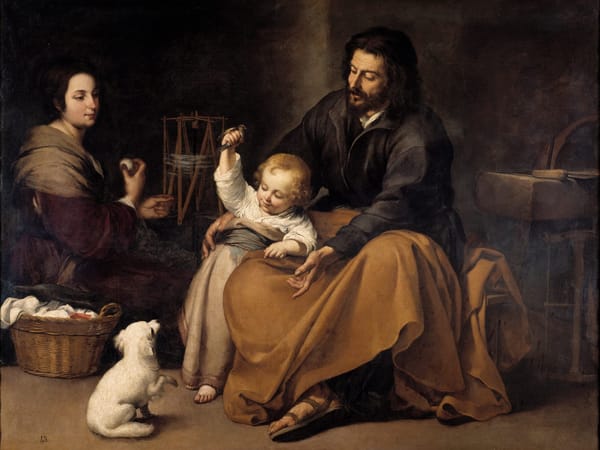
Sunday within the Octave of the Epiphany (or, the Feast of the Holy Family)
THIS Sunday has been chosen by the Church for the celebration of the Feast of the Holy Family; the liturgy of the day, as expressed in the Gospel, harmonizes well with the mystery of the new Feast, for it already carries us forward to the childhood of our Emmanuel and gives us those wonderful words which, after the example of his Blessed Mother, we must ever ponder within our hearts: ‘And he went down with them and came to Nazareth and was subject to them.’
The Feast of the Holy Family is of recent origin. In 1663 Barbara d'Hillehoust founded at Montreal the Association of the Holy Family; this devotion soon spread and in 1893 Leo XIII expressed his approval of a feast under this title and himself composed part of the Office. The Feast was welcomed by succeeding Pontiffs as an efficacious means for bringing home to the Christian people the example of the Holy Family at Nazareth, and by the restoration of the true spirit of family life, stemming, in some measure, the evils of present-day society. These motives led Benedict XV to insert the Feast in the universal Calendar, and from 1921 it has been fixed for this present Sunday.
Mass
The Introit recalls the joy that must have filled the cave of Bethlehem on that Christmas night; let us again rejoice with Mary and Joseph and sing the praises of the resting-place of the Lord of Hosts.
Introit
The Church prays in the Collect that the home life of every Christian family may be sanctified and perfected by the example of that of the Holy Family; this is her unceasing wish for her children.
Collect
Commemoration is made of the Sunday within the Octave:
Then of the Epiphany:
Epistle
Cap. III.Fratres, induite vos, sicut electi Dei, sancti, et dilecti, viscera misericordiæ, benignitatem, humilitatem, modestiam, patientiam, supportantes invicem, et donantes vobismetipsis, si quis adversus aliquem habet querelam: sicut et Dominus donavit vobis, ita et vos. Super omnia autem hæc, caritatem habete, quod est vinculum perfectionis: et pax Christi exsultet in cordibus vestris, in qua et vocati estis in uno corpore; et grati estote. Verbum Christi habitet in vobis abundanter, in omni sapientia, docentes, et commonentes vosmetipsos, psalmis, hymnis, et canticis spiritualibus, in gratia cantantes in cordibus vestris Deo. Omne quodcumque facitis, in verbo aut in opere, omnia in nomine Domini nostri Jesu Christi, gratias agentes Deo et Patri per Jesum Christum Dominum nostrum.
Ch. III.Brethren, put ye on therefore as the elect of God. holy, and beloved, the bowels of mercy, benignity, humility, modesty, patience; bearing with one another, and forgiving one another, if any have a complaint against another; even as the Lord hath forgiven you, so you also. But above all these things have charity, which is the bond of perfection; and let the peace of Christ rejoice in your hearts, wherein also you are called in one body; and be ye thankful. Let the word of Christ dwell in you abundantly in all wisdom, teaching and admonishing one another in psalms, hymns, and spiritual canticles, singing in grace in your hearts to God. All whatsoever you do in word, or in work, all things do ye in the name of the Lord Jesus Christ, giving thanks to God and the Father, through Jesus Christ our Lord.
If we would attain to charity, the bond of perfection which unites all Christians together in the one great family of God, we must pay heed to those virtues which the Epistle puts before us. We must be full of mercy, benignity, humility, modesty and patience; we must bear with one another and forgive one another, after the example of the Incarnate Word. Then the peace of Christ will dwell not only in our hearts, but in those around us, and our homes will truly become like that of Nazareth, where Mary and Joseph were ever singing in grace to the Lord God.
In the Gradual Holy Church again celebrates the praises of the House of the Lord; she proclaims the blessedness of those that obtain lasting fellowship in the heavenly home above; yet in the Alleluia verse she recalls the lowliness of the earthly home of our Emmanuel which made him truly a hidden King.
Gradual (Ps. xxiii)
Alleluia, alleluia. ℣. Isa. 45. Vere tu es Rex absconditus. Deus Isræl Salvator. Alleluia.
Alleluia, alleluia. ℣. Isa. 45. Verily thou art a hidden King, the God of Israel, the Saviour. Alleluia.
Gospel
Cap. II.Cum factus esset Jesus annorum duodecim, ascendentibus illis Jerosolymam secundum consuetudinem diei festi, consummatisque diebus, cum redirent, remansit puer Jesus in Jerusalem, et non cognoveruntparentes ejus. Existimantes autem ilium esse in comitatu, venerunt iter diei, et requirebant eum inter cognatos et notos. Et non invenientes, regressi sunt in Jerusalem, requirentes eum. Et factum est, post triduum invenerunt illum in tempio sedentem in medio doctorum, audientem illos, et interrogantem eos. Stupebant autem omnes, qui eum audiebant, super prudentia et responsis ejus. Et videntes admirati sunt. Et dixit mater ejus ad ilium: Fili, quid fecisti nobis sic? ecce pater tuus et ego dolentes quærebamus te. Et ait ad illos: Quid est quod me quærebatis? Nesciebatis quia in his quæ Patris mei sunt, oportet me esse? Et ipsi non intellexerunt verbum, quod locutus est ad eos. Et descendit cum eis, et venit Nazareth: et erat subditus illis. Et mater ejus conservabat omnia verba hæc in corde suo. Et Jesus proficiebat sapientià, et ætate, et gratia apud Deum et homines.
Ch. II.When Jesus was twelve years old, they went up to Jerusalem, according to the custom of the feast; and having fulfilled the days, when they returned, the Child Jesus remained in Jerusalem, and his parents knew it not. And thinking that he was in the company, they came a day’s journey, and sought him among their kinsfolk and acquaintance. And not finding him, they returned into Jerusalem, seeking him. And it came to pass, that after three days they found him in the temple, sitting in the midst of the doctors, hearing them, and asking them questions. And all that heard him were astonished at his wisdom and his answers. And seeing him, they wondered. And his Mother said to him: Son, why hast thou done so to us? Behold thy father and I have sought thee sorrowing. And he said to them: How is it that you sought me? Did you not know that I must be about my Father’s business? And they understood not the word that he spoke unto them. And he went down with them, and came to Nazareth, and was subject to them. And his Mother kept all these words in her heart. And Jesus advanced in wisdom, and age, and grace with God and men.
Thus, O Jesus! didst thou come down from heaven to teach us. The tender age of Childhood, which thou didst take upon thyself, is no hindrance to the ardour of thy desire that we should know the one only God, who made all things, and thee, his Son, whom he sent to us. When laid in the Crib, thou didst instruct the Shepherds by a mere look; when swathed in thy humble swaddling-clothes, and subjected to the voluntary silence thou hadst imposed on thyself, thou didst reveal to the Magi the light they sought in following the star. When twelve years old, thou explainest to the Doctors of Israel the Scriptures which bear testimony to thee. Thou gradually dispellest the shadows of the Law by thy presence and thy words. In order to fulfil the commands of thy heavenly Father, thou dost not hesitate to occasion sorrow to the heart of thy Mother, by thus going in quest of souls that need enlightening. Thy love of man will pierce that tender Heart of Mary with a still sharper sword, when she shall behold thee hanging on the Cross, and expiring in the midst of crudest pain. Blessed be thou, sweet Jesus, in these first Mysteries of thine Infancy, wherein thou already showest thyself devoted to us, and leavest the company of thy Blessed Mother for that of sinful men, who will one day conspire thy Death.
The Offertory takes us in thought to the Feast of the Purification; let us again offer ourselves to the Lord.
Offertory (Luke ii)
In the Secret the Church again prays that she may be strengthened in peace and grace; these gifts have been purchased for us by our Lord himself; it is through the Holy Mass that we can be more strongly established in them.
Secret
Commemoration of the Sunday
Commemoration of the Epiphany
The Preface is as on the Epiphany, p. 126.
The Communion recalls the subject of to-day's Gospel; let us never cease to meditate on the divine humility shown us in these words.
Communion (Luke ii)
If we have kept before our eyes the example of the holy Family, we may humbly trust that at the hour of our death we shall be helped and consoled and be found worthy to have fellowship with Christ in the eternal dwellings. Such is the last prayer of the Church, and may it be one we love to repeat and dwell on.
Postcommunion
Commemoration of the Sunday
Commemoration of the Epiphany
Vespers
Antiphons
The Psalms are from the Common of the Blessed Virgin Mary, and will be found on the Feast of the Purification, p. 488.
Little Chapter
(Luke ii)
Hymn
Et summa spes mortalium, Jesu,
O cui domestica
Arrisit orto caritas.
O sola quæ casto potes
Fovere Jesum pectore,
Cum lacte donans oscula.
Delecte custos Virginis,
Dulci patris quem nomine
Divina proies invocat.
Nati in salutem gentium,
Audite nos qui supplices
Vestras ad aras sistimus.
Rebus nitorem detrahit,
Nos hic manentes intimo
Ex corde vota fundimus.
Virtutis omnis gratia,
Hanc detur in domesticis
Referre posse moribus.
Qui natus es de Virgine,
Cum Patre, et almo Spiritu,
In sempiterna sæcula.
Sole hope of them that dwell on earth,
The purest love that ever graced
A home, did smile upon thy birth.
Was ever yet so rich in grace?
Didst nourish Christ upon thy knee
And fold him in a sweet embrace?
The Virgin with thy gentle might,
The Infant Jesus smiled on thee
And called thee father as by right.
Were born of David’s noble line,
O hear the humble prayers of all
To-day, who gather round your shrine.
And earth is veiled in shadows gray;
Yet hearts a-fire with joy and love
Still bid us linger on to pray.
Which held the earthly Trinity,
Be shed abroad upon the world
And bless the Christian family.
Immortal glory be to thee;
Praise to the Father infinite
And Holy Ghost eternally.
At the Magnificat
Collect as at Mass, p. 139.
Commemoration of the Epiphany
or—
The Collect as on p. 139.
Commemoration of the Sunday
The Collect as on p. 139.
MASS OF THE SUNDAY WITHIN THE OCTAVE OF THE EPIPHANY
(In some Churches, the Feast of the Holy Family is not observed on this day; the Mass will then be of the Sunday.)
It is the Kingship of the divine Infant that the Church again proclaims in the opening Canticle of the Mass for the Sunday within the Octave of the Epiphany. She sings the praises of her Emmanuel's Throne, and takes her part with the Angels who hymn the glory of Jesus' eternal Empire. Let us do the same, and adore the King of Ages, in his Epiphany.
Introit
The Collect is given on p. 139.
Epistle
Cap. XII.Fratres, obsecro vos per misericordiam Dei, ut exhibeatis corpora vestra hostiamviventem, sanctam, Deo placentem, rationabile obsequium vestrum. Et nolite conformari huic sæculo, sed reformamini in novitate sensus vestii: ut probetis quse sit voluntas Dei bona, et beneplacens, et perfecta. Dico enim per gratiam quæ data est mihi, omnibus qui sunt inter vos: Non plus sapere quam oportet sapere, sed sapere ad sobrietatem: et unicuique sicut Deus divisit mensuram fidei. Sicut enim in uno corpore multa membra habemus, omnia autem membra non eumdem actum habent: ita multi unum corpus sumus in Christo, singuli autem alter alterius membra: in Christo Jesu Domino nostro.
Ch. XII.Brethren, I beseech you, by the mercy of God, that you present your bodies a living sacrifice, holy, pleasing unto God, your reasonable service. And be not conformed to this world, but be reformed in the newness of your mind: that you may prove what is the good, and the acceptable, and the perfect will of God. For I say, by the grace that is given me, to all that are among you, not to be more wise than it behoveth to be wise, but to be wise unto sobriety, and according as God hath divided unto every one the measure of faith. For as in one body we have many members, but all the members have not the same office: so we, being many, are one body in Christ, and every one members of one another, in Jesus Christ our Lord.
The Apostle invites us to make our offering to the new-born King, after the example of the Magi; but the offering which this Lord of all things asks of us is not anything material or lifeless. He that is Life gives his whole self to us; let us, in return, present him our hearts, that is, a living sacrifice, holy, pleasing unto God; whose service may be reasonable, that is, whose obedience to the divine will may be accompanied by a formal intention of offering itself to its Creator. Here again, let us imitate the Magi, who went back another way into their own country—let us not adopt the ideas of this world, for the world is the covert enemy of our beloved King. Let us reform our worldly prudence according to the divine wisdom of Him, who may well be our guide, seeing he is the Eternal Wisdom of the Father. Let us understand, that no man can be wise without Faith, which reveals to us that we must all be united by love, so as to form one body in Christ, partaking of his life, his wisdom, his light, and his kingly character.
In the chant which follows the Epistle, the Church returns to her praise of the ineffable wonders of a God with us: Justice and righteousness have come down from heaven, to take up their abode on our mountains and hills.
Gradual
Alleluia, alleluia. ℣. Jubilate Deo omnis terra: servite Domino in lætitia. Alleluia.
Alleluia, alleluia. ℣. Sing joyfully to the Lord, ail the earth: serve ye the Lord with gladness. Alleluia.
The Gospel is the one for the Feast of the Holy Family, p. 141.
During the Offertory, the Church resumes her canticles of joy; the presence of the Divine Infant fills her with joy.
Offertory
The Secret is given on p. 143.
Whilst distributing the Bread of Life come down from heaven, the Church repeats the words addressed by Mary to her Son: Why hast thou done so to us? I and thy father have sought thee. The Good Shepherd, who feeds his Sheep with his own Flesh, replies, that he must needs do the will of his Father who is in heaven. He is come to be our Life, our light, and our food: he, therefore, leaves everything in order to give himself to us. But, whilst the Doctors in the Temple only saw and heard him, we, in this Living Bread, possess him and are united with him in sweetest union.
Communion
The Postcommunion is given on p. 144.
January 8: The Third Day within the Octave of the Epiphany
THE great Mystery of the Alliance of the Son of God with the universal Church, which is represented in the Epiphany by the Magi, was looked forward to by the world in every age previous to the coming of our Emmanuel. The Patriarchs and Prophets had propagated the tradition; and the Gentile world gave frequent proofs that the tradition prevailed even with them.
When Adam in Eden first beheld her whom God had formed from one of his ribs, and whom he called Eve, because she was the Mother of all the living.1 he exclaimed: 'This is the bone of my bones, and flesh of my flesh. Man shall leave father and mother, and shall cleave to his wife; and they shall be two in one flesh.'2 In uttering these words, the soul of our first Parent was enlightened by the Holy Spirit, and, as we are told by the most profound interpreters of the Sacred Scriptures (such as Tertullian, St Augustine, St Jerome, etc.), he foretold the alliance of the Son of God with his Church, which issued from his Side, when opened by the spear, on the Cross; for the love of which Spouse he left the right hand of his Father, and the heavenly Jerusalem, his mother, that he might dwell with us in this our earthly abode.
The second father of the human race, Noe, after he had seen the Rainbow in the heavens, announcing that now God’s anger was appeased, prophesied to his three Sons their own respective future, and in theirs, that of the world. Cham had drawn upon himself his father’s curse; Sem seemed to be the favoured son, for from his race there should come the Saviour of the world; but, the Patriarch immediately adds: 'May God enlarge Japheth, and may he dwell in the tents of Sem.'3 In the course of time, the ancient alliance that had been made between God and the people of Israel was broken; the Semitic race fluctuated in its religion, and finally fell into infidelity; and at length God adopts the family of Japheth, that is, the Gentiles of the West, as his own people; for ages, they had been without God, and now the very Seat of religion is established in their midst, and they are put at the head of the whole human race.
Later on it is the great God himself that speaks to Abraham, promising him that he shall be the father of a countless family. ‘I will bless thee,' says the Lord, 'and I will multiply thy seed as the stars of heaven.'4 As the Apostle tells us, more numerous was to be the family of Abraham according to the faith than that which should be born to him of Sara. All they that have received the faith of a Mediator to come, and all they that, being warned by the Star, have come to Jesus as their God—all are the children of Abraham.
The Mystery is again expressed in Rebecca, the wife of Isaac. She feels that there are two children struggling within her womb;5 and this is the answer she received from God, when she consulted him: ‘Two nations are in thy womb, and two peoples shall be divided out of thy womb; and one people shall overcome the other, and the elder shall serve the younger.'6 Now, who is this ‘younger’ child that overcomes the elder, but the Gentiles, who struggle with Juda for the light, and who, though but the child of the promise, supplants him who was son according to the flesh? Such is the teaching of St Leo and St Augustine.
Next it is Jacob, who, when dying, calls his twelve sons, the fathers of the twelve tribes of Israel, around his bed, and prophetically assigns to each of them the career they were to run. Juda is put before the rest; he is to be the king of his brethren, and from his royal race shall come the Messias. But the prophecy concludes with the prediction of Israel's humiliation, which humiliation is to be the glory of the rest of the human race. 'The sceptre shall not be taken away from Juda, nor a Ruler from his thigh, till he come that is to be sent, and he shall be the Expectation of the Nations.'7
When Israel had gone out of Egypt, and was in possession of the Promised Land, Balaam cried out, setting his face towards the desert where Israel was encamped: 'I shall see him, but not now; I shall behold him, but not near. A Star shall rise out of Jacob, and a sceptre shall spring up from Israel . . . . Who shall live when God shall do these things? They shall come in galleys from Italy; they shall overcome the Assyrians, and shall waste the Hebrews, and at the last they themselves also shall perish.'8 And what kingdom shall succeed this? The kingdom of Christ, who is the Star, and the King that shall rule for ever.
David has this great day continually before his mind. He is for ever celebrating, in his Psalms, the Kingship of his Son according to the flesh: he shows him to us as bearing the Sceptre, girt with the Sword, anointed by God his Father, and extending his kingdom from sea to sea: he tells us how the Kings of Tharsis and the Istlands, the Kings of the Arabians and of Saba, and the Princes of Ethiopia, shall prostrate at his feet and adore him: he mentions their gifts of gold.9
In his mysterious Canticle of Canticles, Solomon describes the joy of the spiritual union between the divine Spouse and his Church, and that Church is not the Synagogue. Christ invites her, in words of tenderest love, to come and be crowned; and she, to whom he addresses these words, is dwelling beyond the confines of the land where lives the people of God. 'Come from Libanus, my Spouse, come from Libanus, come! Thou shalt be crowned from the top of Amana, from the top of Sanir and Hermon, from the dens of the lions, from the mountains of the leopards.’10 This daughter of Pharaoh confesses her unworthiness: I am black, she says; but, she immediately adds that she has been made beautiful by the grace of her Spouse.11
The Prophet Osee follows with his inspired prediction: 'And it shall be in that day, saith the Lord, that she shall call me My Husband, and she shall call me no more Baali. And I will take away the names of Baalim out of her mouth, and she shall no more remember their name . . . . And I will espouse thee to me for ever . . . . And I will sow her unto me in the earth, and I will have mercy on her that was without mercy. And I will say to that which was not my people: Thou art my people: and they shall say: Thou art my God.'12
The elder Tobias, whilst captive in Babylon, prophesies the same alliance. The Jerusalem which was to receive the Jews after their deliverance by Cyrus, is not the City of which he speaks in such glowing terms; it is a new and richer and lovelier Jerusalem. 'Jerusalem! City of God! bless the God eternal, that he may rebuild his tabernacle in thee, and may call back all the captives to thee. Thou shalt shine with a glorious light. Nations from afar shall come to thee, and shall bring gifts, and shall esteem thy land as holy. For they shall call upon the great Name in thee . . . . All that fear God shall return thither. And the Gentiles shall leave their idols, and shall come into Jerusalem, and shall dwell in it. And all the kings of the earth shall rejoice in it, adoring the King of Israel.'13
It is true, the Gentiles shall be severely chastised by God on account of their crimes; but that justice is for no other end than to prepare those very Gentiles for an eternal alliance with the great Jehovah. He thus speaks by his Prophet Sophonias: 'My judgement is to assemble the Gentiles, and to gather the kingdoms: and to pour upon them my indignation, all my fierce anger: for with the fire of my jealousy shall all the earth be devoured. Because then I will restore to the people a chosen lip, that all may call upon the name of the Lord, and may serve him with one shoulder. From beyond the rivers of Ethiopia shall my suppliants, the children of my dispersed people, bring me an offering.'14
He promises the same mercy by his Prophet Ezechiel: ‘One King shall be over all, and they shall no more be two nations, neither shall they be divided any more into two kingdoms. Nor shall they be defiled any more with their idols: and I will save them out of all the places in which they have sinned. And they shall be my people, and I will be their God. And they shall have One Shepherd. And I will make a covenant of peace with them; it shall be an everlasting covenant with them: and I will establish them, and will multiply them, and will set my Sanctuary in the midst of them for ever.'15
After the prophet Daniel has described the three great Kingdoms which were successively to pass away, he says there shall be a Kingdom 'which is an everlasting Kingdom, and all kings shall serve him' (the King) 'and shall obey him.' He had previously said: ‘The power' (that was to be given to the Son of man) ‘is an everlasting power that shall not be taken away; and his Kingdom shall not be destroyed.'16
Aggeus thus foretells the great events which were to happen before the coming of the One Shepherd, and the establishment of that everlasting Sanctuary which was to be set up in the very midst of the Gentiles: ‘Yet one little while, and I will move the heaven, and the earth, and the sea, and the dry land. And I will move all nations, and the Desired of all nations shall come.'17
But we should have to cite all the Prophets in order to describe in all its grandeur the glorious spectacle promised by God to the world, when, being mindful of the Gentiles, he should lead them to the feet of Jesus. The Church has quoted the Prophet Isaias in the Epistle of the Feast, and no Prophet is so explicit and so sublime as this son of Amos.
The expression of the same universal expectation and desire is found also among the Gentiles. The Sibyls kept up the hope in the heart of the people; and in Rome itself we find the Poet Virgil repeating in one of his poems the oracles they had pronounced. ‘The last age,' says he, ‘foretold by the Cumean Sibyl, is at hand; a new and glorious era is coming: a new race is being sent down to earth from heaven. At the birth of this Child, the iron age will cease, and one of gold will rise upon the whole world.... No remnants of our crimes will be left, and their removal will free the earth from its neverending fear.'18
If we are unwilling to accept, as did St Augustine and so many other holy Fathers, these Sibylline oracles as the expression of the ancient traditions—we have pagan philosophers and historians, such as Cicero, Tacitus, and Suetonius, testifying that in their times the world was in expectation of a Deliverer; that this Deliverer would come, not only from the East, but from Judea; and that a Kingdom was on the point of being established which would include the entire world.
O Jesus, our Emmanuel! this universal expectation was that of the holy Magi, to whom thou didst send the star. No sooner do they receive the signal of thy having come, than they set out in search of thee, asking, 'Where is he born, that is King of the Jews?' The oracles of thy Prophets were verified in them; but if they received the first-fruits of the great promise, we possess it in all its fulness. The Alliance is made, and our souls, for love of which thou didst come down from heaven, are thine. The Church is come forth from thy divine side, with the Blood and Water; and all that thou dost for this thy chosen Spouse, thou accomplishest in each of her faithful children. We are the sons of Japheth, and we have supplanted the race of Sem, which refused us the entrance of its tents; the birthright which belonged to Juda has been transferred to us. Each age do our numbers increase, for we are to become numerous as the stars of heaven. We are no longer in the anxious period of expectation; the star has risen, and the Kingdom it predicted will now for ever protect and bless us. The Kings of Tharsis and the Islands, the Kings of Arabia and Saba, the Princes of Ethiopia, are come, bringing their gifts with them; all generations have followed them. The Spouse has received all her honours, and has long since forgotten Amana, and Sanir, and Hermon, where she once dwelt in the mdist of wild beasts; she is not black, she is beautiful, with neither spot nor wrinkle upon her, but in every way is worthy of her divine Lord. Baal is forgotten for ever, and she lovingly speaks the language given her by her God. The One Shepherd feeds the one flock. The last Kingdom, the Kingdom which is to continue for ever, is faithfully fulfilling its glorious destiny.
It is thou, O Divine Infant! that bringest us all these graces, and receivest all this devoted homage of thy creatures. The time will soon come, dear Jesus! when thou wilt break the silence thou hast imposed on thyself in order that thou mightest teach us humility—thou wilt speak to us as our Master. Cæsar Augustus has long ruled over Pagan Rome, and she thinks herself the kingdom that is to have no end; but she and her Rulers must yield to the Eternal King and his eternal City: the throne of earthly power must now give place for the Throne of Christian charity, and a new Rome is to spring up, grander than the first. The Gentiles are looking for thee, their King; but the day will come when they will have no need to seek thee, but thou, in thy mercy, wilt go in search of them, by sending them apostles and missioners who will preach thy Gospel to them. Show thyself to them as he to whom all power has been given in heaven and on earth; and show them also Her whom thou hast made to be Queen of the universe. May this august Mother of thine be raised up from the poor Stable of Bethlehem, and from the humble dwelling of Nazareth, and be taken on the wings of Angels to that throne of mercy which thou hast made for her, and from which she will bless all peoples and generations with her loving protection.
We will now borrow some of those Canticles wherewith the several Churches were formerly wont to celebrate the Epiphany. Prudentius, the Prince of our Latin liturgical Poets, thus sings the Magi's journey to Bethlehem.
Hymn
Sol unde sumit januam,
Cernunt periti interpretes
Regale vexillum Magi.
Quod ut refulsit, cæteri
Cessere signorum globi:
Nec pulcher est ausus suam
Conferre formam Lucifer.
Quis iste tantus, inquiunt,
Regnator, astris imperans;
Quem sic tremunt cœlestia,
Cui lux, et æthra inserviunt?
Illustre quiddam cernimus,
Quod nesciat finem pati:
Sublime, celsum, interminum,
Antiquius cœlo, et chao.
Hic ille Rex est Gentium,
Populique Rex Judaici,
Promissus Abrahæ Patri,
Ejusque in ævum semini.
Æquanda nam stellis sua
Cognovit olim germina
Primus sapor credential,
Nati isolator unici.
Jam flos subit Davidicus,
Radice Jesse editus:
Sceptrique per virgam virens,
Rerum cacumen occupat.
Fixis in altum vultibus,
Qua stella sulcum traxerat,
Claramque signabat viam.
Signum pependit imminens,
Pronaque submissum face
Caput sacratum prodidit.
Videre quod postquam Magi,
Eoa promunt munera,
Stratique votis offerunt
Thus, myrrham, et aurum regium.
Agnosce clara insignia
Virtutis, ac regni tui,
Puer o, cui trinam
Pater Prædestinavit indolem.
Regem Deumque annuntiant
Thesaurus et fragrans odor
Thuris Sabæi: ac myrrheus
Pulvis sepulcrum prædocet.
Hoc est sepulcrum, quo Deus,
Dum corpus exstingui sinit,
Atque id sepulcrum suscitat,
Mortis refregit carcerem.
where opens first the gate unto the rising sun,
the Magi, most wise interpreters,
perceive the standard of the King.
It shone, and the other stars of heaven
put out their lights:
not even would the lovely
Day-Star show his face.
'Who, ‘say they, 'is this great King,
who commands the stars?
at whose presence the heavens tremble,
and light and air do his bidding?
‘The sign we see tells us of that great Being,
who is eternal and infinite
—the most, high, exalted, boundless One,
who existed before heaven and earth were made.
‘This is he that is King of the Gentiles,
and King of the Jews:
he was promised to our Father Abraham,
and to his seed for ever.
‘For Abraham, the first parent of believers,
and the sacrificer of his only Son,
was told that his race should become numerous
as the stars of heaven.
‘At length the Flower of David is come,
springing from Jesse's root:
blooming by his sceptre's rod,
he now rules over the universe.’
Then quickly do they follow,
with their gaze fixed aloft,
and the Star sails through the air,
pointing the bright path to be pursued.
direct above the Child’s head,
it hovered there: then stooping down its torch,
it showed the sacred face they sought.
The Magi looked upon the Babe,
then opening their eastern treasures,
prostrate, and offer him the votive homage
of incense, myrrh, and kingly gold.
These, dear Babe, are the rich tokens
of thy power and kingdom,
for they mark the triple character
which thy Father would have us recognize.
The Gold proclaims him King;
the sweet-smelling Saba Incense declares him to be God;
and the Myrrh signifies that he is Man,
for it is the symbol of his future tomb;
That Tomb, whereby God
broke open the prison of Death,
after he had permitted his sacred Body to suffer death,
and the Tomb had raised it up again to life.
We find in the Sacramentary of the ancient Gallican Church the following beautiful prayer.
Prayer
Let us celebrate the mystery of the Birth of Jesus and his alliance with mankind, by this Sequence taken from the ancient Roman-French Missals.
Sequence
Addat se vox nostra ad Angelorum carmina.
Christus hac ut sponsus materna die processit clausula.
Exsultans ut gigas ad hujus vitæ currendas semitas.
Angelica gloriam reboant in excelsis agmina.
Pax in terra homines te~ neat, cum benevolentia.
Jam se replicat sæculi series maxima: venit etiam vatis Cumææ veridica jam ætas carminis ultima.
Virgo remeat sæcla revehens altera: adsunt tempora quo gens ferrea jam desinat, et mundo pullulet aurea.
Adauctus solis jubar die pluscula menses producere inchoat.
Nocturnas stella fugat, Magos excitat, Balaamitica tenebras.
Impleta, quæ prædixerat plebs utraque, et Gentilitas et Hebræa, oracula, Christo nascente, sunt omnia.
Sunt cuncta jam nunc scelerum recidiva et recentia et antiqua vestigia, quæque remanserant irrita.
O mira atque nova genitural fit gravida Virgo fideliter credula.
Et porta, quæ fuerat semper clausa, est reserata, Naturam dum hominis induit Deitas.
Conserva hæc, quæsumus, Christe, nobis munera tanta, a te prærogata. Amen.
Let our voices unite in the hymns of the Angels.
On this day, Christ, as a Bridegroom, came from his Mother’s womb.
He hath rejoiced to run, as a giant, the way of this our life.
The Angelic host make earth re-echo with their song: Glory in the highest!
Peace on earth to men of good will!
Now begins the most glorious of the eras of time; now too has come that truthful last age of the Cumæan Sibyl’s song.
Let the Virgin come, bringing new times to the world. The day is at hand for the iron age to cease, and the golden one to spring up on the earth.
The bright sun begins to lengthen out our days and months.
Balaam’s Star wakens up the Magi, and puts to flight the night’s dark gloom.
Christ is born:—all the prophecies are fulfilled which were fore-spoken by the two people, the Gentiles and the Jews.
The vestiges of crime, both new and old, are now all wiped away and destroyed.
O wonderful and unheardof Mother! A Virgin faithfully believes, and the Fruit is in her womb.
The gate, which was ever closed, is opened to the Lord, When he, the great God, assumed the nature of man.
Grant us, O Jesus! ever to hold fast these wondrous gifts, which thou hast bestowed upon us. Amen.
Hymn
Let us, in honour of the Blessed Mother, sing this sweet Hymn used by some Churches in the Middle Ages.
Sequence
Personemus illudi Ave
Per quod Christi fit conclave
Virgo, mater, filia.
Per quod Ave salutata
Mox concepit fœcundata
Virgo David stirpe nata,
Inter spinas lilia.
Ave, veri Salomonis
Mater, vellus Gedeonis,
Cujus Magis tribus donis
Laudant puerperium.
Ave, solem genuisti;
Ave, solem protulisti,
Mundo lapso contulisti
Vitam et imperium.
Ave, sponsa Verbi summi,
Maris portus, signum dumi,
Aromatum virga fumi,
Angelorum Domina.
Supplicamus: nos emenda,
Emendatos nos commenda
Tuo Nato, ad habenda
Sempiterna gaudia.
Ave—Hail! It was by that salutation
that the Virgin was made the sanctuary of Christ
—the Virgin, who was both his Mother and his Child.
Greeted by that Hail,
the Virgin, born of the family of David,
conceived the Divine Fruit in her womb
—She that was the Lily amidst the thorns.
Hail! thou Mother of the true Solomon,
thou Fleece of Gedeon!
The Magi, by their three gifts,
praise thy delivery.
Hail! thou hast given birth to the Sun!
Hail! thou hast given us to see the Sun,
and thereby hast restored life
and power to this fallen world.
Hail! thou Spouse of the Divine Word!
Haven of the sea! Burning Bush!
Cloud of sweet aromatic spices!
Queen of Angels!
We beseech thee, convert us;
and commend us, so converted,
to thy Son, that he bestow upon us
the eternal joys of heaven.
- Gen. iii 20. ↩︎
- Ibid. ii 23, 24. ↩︎
- Gen. ix 27. ↩︎
- Ibid. xxii 17. ↩︎
- Ibid. xxv 22. ↩︎
- Ibid. xxv 23. ↩︎
- Gen. xlix 10. ↩︎
- Num. xxiv 17, 23, 24. ↩︎
- Ps. lxxi. ↩︎
- Cant. iv 8. ↩︎
- Ibid. i 4. ↩︎
- Osee ii 16 et seq. ↩︎
- Tob. xiii, xiv. ↩︎
- Soph. iii. 8, 9, 10. ↩︎
- Ezech. xxxvii 22 et seq. ↩︎
- Dan. vii 27. ↩︎
- Agg. ii 7, 8. ↩︎
- Eclog. iv. ↩︎
| Previous January 7: The Second Day within the Octave of the Epiphany | Next January 8: The Third Day within the Octave of the Epiphany |