lyp.network

Daily reading

Epiphanytide

Double · Temporal

January 15, 2023

From Dom Guéranger’s The Liturgical Year.

Gold cross ornament
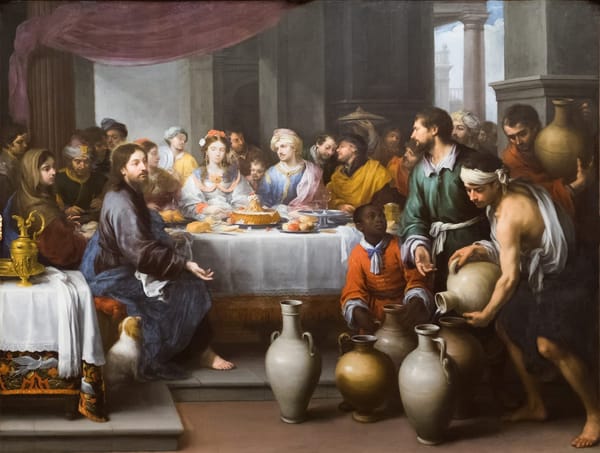
The marriage feast at Cana: Christ at table as servants fill the water jars
Gold cross ornament
The Marriage Feast at Cana, Bartolomé Esteban Murillo (1617–1682), c. 1672. Credits

The Second Sunday after Epiphany

THE third Mystery of the Epiphany shows us the completion of the merciful designs of God upon the world, at the same time that it manifests to us, for the third time, the glory of our Lord and Saviour, Jesus Christ. The star has led the soul to faith; the sanctified Waters of the Jordan have conferred purity upon her; the Marriage-Feast unites her to her God. We have been considering, during this Octave, the Bridegroom revealing himself to the Spouse; we have heard him calling her to come to him from the heights of Libanus; and now, after having enlightened and purified her, he invites her to the heavenly feast, where she is to receive the Wine of his divine love.

A Feast is prepared;1 it is a Marriage-Feast; and the Mother of Jesus is present at it, for it is just that, having co-operated in the mystery of the Incarnation of the Word, she should take part in all that her Son does, and in all the favours he bestows on his elect. But, in the midst of the Feast, the Wine fails. Wine is the symbol of Charity or Love, and Charity had failed on the earth; for the Gentiles had never tasted its sweetness; and as to the Synagogue, what had it produced but wild grapes?2 The True Vine is our Jesus, and he calls himself by that name.3 He alone could give that Wine which gladdeneth the heart of man;4 he alone could give us that Chalice which inebriateth,5 and of which the Royal Psalmist prophesied.

Mary said to Jesus: They have no Wine. It is the office of the Mother of God to tell him of the wants of men, for she is also their Mother. But Jesus answers her in words which are apparently harsh: Woman! what is it to me and to thee? My hour is not yet come. The meaning of these words is, that, in this great Mystery, he was about to act, not as the Son of Mary, but as the Son of God. Later on, the hour will come when, dying upon the Cross, he will do a work, in the presence of his Mother, and he will do it as Man, that is, according to that human nature which he has received from her. Mary at once understands the words of her Son, and she says to the waiters of the Feast, what she is now ever saying to her children: Do whatsoever he shall say to you.

Now, there were six large waterpots of stone there, and they were empty. The world was then in its Sixth Age, as St Augustine and other Holy Doctors tell us. During these six ages, the earth had been awaiting its Saviour, who was to instruct and redeem it. Jesus commands these waterpots to be filled with water; and yet water does not suit the Feast of the Spouse. The figures and the prophecies of the ancient world were this water, and until the opening of the Seventh Age, when Christ, who is the Vine, was to be given to the world, no man had contracted an alliance with the Divine Word.

But, when the Emmanuel came, he had but to say, Now draw out, and the waterpots were seen to be filled with the wine of the New Covenant, the Wine which had been kept to the end. When he assumed our human nature—a nature weak and unstable as water—he effected a change in it; he raised it up even to himself, by making us partakers of the divine nature;6 he gave us the power to love him, to be united to him, to form that one Body, of which he is the Head, that Church of which he is the Spouse, and which he loved from all eternity, and with such tender love, that he came down from heaven to celebrate his nuptials with her.

St Matthew, the Evangelist of the Humanity of our Lord, has received from the Holy Ghost the commission to announce to us the Mystery of Faith by the star; St Luke, the Evangelist of Jesus' Priesthood, has been selected, by the same Holy Spirit, to instruct us in the Mystery of the Baptism in the Jordan; but the Mystery of the Marriage-Feast was to be revealed to us by the Evangelist John, the Beloved Disciple. He suggests to the Church the object of this third Mystery, by this expression: This beginning of miracles did Jesus in Cana of Galilee, and he manifested his glory.7 At Bethlehem, the Gold of the Magi expressed the Divinity of the Babe; at the Jordan, the descent of the Holy Ghost and the voice of the Eternal Father proclaimed Jesus (known to the people as a carpenter of Nazareth) to be the Son of God; at Cana, it is Jesus himself that acts, and he acts as God, for, says St Augustine, he who changed the water into wine in the waterpots could be no other than the same who, every year, works the same miracle in the vine. Hence it was that, from that day, as St John tells us, his disciples believed in him,8 and the Apostolic College began to be formed.

Mass

The Introit proclaims the joy of this day, which shows us human nature espoused to the Son of the eternal Father. Surely the earth will henceforth surrender itself wholly to the love and praise of this sacred Name which, in the Marriage Feast, has become that of the Sons of Adam.

Introit

Omnis terra adoret te, Deus, et psallat tibi: psalmum dicat nomini tuo, Altissime. Ps. Jubilate Deo omnis terra, psalmum dicite nomini ejus: date gloriam laudi ejus. Gloria Patri. Omnis terra.
Let all the earth adore thee, and sing to thee, O God: let it sing a psalm to thy name, O Most High. Ps. Shout with joy to God, all the earth, sing ye a psalm to his name; give glory to his praise. Glory be to the Father. Let all the earth.

This name of Sons of God which has become ours by right through the bond of the sacred nuptials is none other, as Jesus himself tells us in his Beatitudes, than Peace—the Peace of God, ours truly through the action of his grace ever working it out within us. In the Collect Peace again figures as the final end of God's government both in heaven and on earth, likewise as the supreme desire of the Church.

Collect

Omnipotens sempiterne Deus, qui cœlestia simul et terrena moderaris: supplicationes populi tui clementer exaudi, et pacem tuam nostris concede temporibus. Per Dominum.
Almighty and Eternal God, supreme Ruler both of heaven and earth, mercifully give ear to the prayers of thy people, and grant us peace in our time. Through, etc.

Commemoration is made, by their proper Collects, of the Saint whose feast may occur with this Sunday; the third prayer will be that of the Blessed Virgin.

Commemoration of the Blessed Virgin Mary

Deus qui salutis æternæ, beatæ Mariæ virginitate fœcunda, humano generi præmia præstitisti; tribue, quæsumus, ut ipsam pro nobis intercederesentiamus, per quam meruimus auctorem vitæ suscipere, Dominum nostrum Jesum Christum Filium tuum. Qui tecum.
O God, who, by the fruitful Virginity of the Blessed Mary, hast given to mankind the rewards of eternal salvation, grant, we beseech thee, that we may experience her intercession, by whom we received the Author of life, our Lord Jesus Christ, thy Son. Who liveth, etc.

Epistle

Lectio Epistolæ beati Pauli Apostoli ad Romanos.
Cap. XII.
Fratres: Habentes donationes secundum gratiam, quæ data est nobis, differentes: sive prophetiam secundum rationem fidei, sive ministeriura in ministrando, sive qui docet in doctrina, qui exhortatur in exhortando, qui tribuit in simplicitate, qui præest in sollicitudine, qui miseretur in hilaritate. Dilectio sine simulatione. Odientes malum, adhærentes bono: Caritate fraternitatis invicem diligentes: Honore invicem prævenientes: Sollicitudine non pigri: Spiritu ferventes: Domino servientes: Spe gaudentes: In tribulatione patientes: Orationi instantes: necessitatibus sanctorum communicantes: Hospitalitatem sectantes. Benedicite persequentibus vos: benedicite et nolite maledicere. Gaudere cum gaudentibus, flere cum flentibus: idipsum invicem sentientes: non alta sapientes, sed humilibus consentientes.
Lesson from the Epistle of St Paul the Apostle to the Romans.
Ch. XII.
Brethren: Having different gifts, according to the grace that is given us, either prophecy, to be used according to the rule of faith: or ministry, in ministering; or he that teacheth, in doctrine; he that exhorteth in exhorting; he that giveth with simplicity; he that ruleth with carefulness; he that sheweth mercy with cheerfulness. Let love be without dissimulation. Hating that which is evil, cleaving to that which is good. Loving one another with the charity of brotherhood: with honour preventing one another. In carefulness not slothful, in spirit fervent: serving the Lord: rejoicing in hope: patient in tribulation: instant in prayer: communicating to the necessities of the saints: pursuing hospitality. Bless them that persecute you: bless and curse not. Rejoice with them that rejoice, weep with them that weep. Being of one mind one towards another, not minding high things, but consenting to the humble.

This peace which characterizes, in the abode of saints, the Sons of God, effects in like measure on earth the oneness of the Bride, that is of the Church: peace it is that makes her to be but one body wherein the many members find their multiplicity upheld and guided by the head, the one lord; their functions, so diverse in themselves, regulated and brought under the rule and love of the Bridegroom, Christ Jesus. The Epistle which has just been read sets before us the different operations of this peace which has as its ruling motive Charity, the Queen of virtues, and which is so essential to Christianity; the Apostle specifies in detail its forms and conditions and adapts its practice to every social condition and circumstance of life. Of such value does the Church judge these considerations, that, on the following Sunday, she resumes the text of the Apostle where today she has interrupted it.

Far from a divine life in the peace of God which was its precious gift, the human race incurred death with its penalty of separation. Let us then in the Gradual sing of this wonder that has been wrought in our midst, and with the angelic choirs exalt the Lord in praise and admiration.

Gradual

Misit Dominus verbum suum, et sanavit eos: et eripuit eos de interitu eorum.℣. Confiteantur Domino misericordiæ ejus, et mirabilia ejus filiis hominum. Alleluia, alleluia.℣. Laudate Deum omnes Angeli ejus: Iaudate eum omnes virtutes ejus. Alleluia.
The Lord sent his word and healed them: and delivered them out of their distresses.℣. Let the mercies of the Lord give glory to him: and his wonderful works to the children of men. Alleluia, alleluia.℣. Praise ye the Lord, all his angels, praise him all his hosts. Alleluia.

Gospel

Sequentia sancti Evangelii secundum Joannem.
Cap. II.
In illo tempore: Nuptiæ factæ sunt in Cana Galilææ, et erat Mater Jesu ibi. Vocatus est autem et Jesus et discipuli ejus ad nuptias. Et deficiente vino, dicit Mater Jesu ad eum: Vinum non habent. Et dicit ei Jesus: Quid mihi et tibi est, mulier? nondum venit hora mea. Dicit Mater ejus ministris: Quodcumque dixerit vobis, facite. Erant autem ibi lapideæ hydriæ sex, positæ secundum purificationem Judæorum, capientes singulæ metretas binas vel ternas. Dicit eis Jesus: Implete hydrias aqua. Et impleverunt eas usque ad summum. Et dicit eis Jesus: Haurite nunc, et ferte architriclino. Et tulerunt. Ut autem gustavit architriclinus aquam vinum factam, et non sciebat unde esset, ministri autem sciebant qui hauserant aquam; vocat sponsum architriclinus, et dicit ei: Omnis homo primum bonum vinum ponit, et cum inebriati fuerint, tunc id quod deterius est; tu autem servasti bonum vinum usque adhuc. Hoc fecit initium signorum Jesus in Cana Galilææ, et manifestavit gloriam suam, et crediderunt in eum discipuli ejus.
Sequel of the holy Gospel according to John.
Ch. II.
At that time, there was a marriage in Cana of Galilee; and the Mother of Jesus was there. And Jesus also was invited, and his disciples to the marriage. And the wine failing, the Mother of Jesus saith to him, They have no wine. And Jesus saith to her, Woman, what is it to me and to thee? my hour is not yet come. His Mother saith to the waiters, Whatsoever he shall say to you, do ye. Now there were set there six waterpots of stone; according to the manner of the purifying of the Jews, containing two or three measures apiece. Jesus saith to them, Fill the waterpots with water. And they filled them up to the brim. And Jesus saith to them, Draw out now, and carry to the chief steward of the feast: and they carried it. And when the chief steward had tasted the water made wine, and knew not whence it was, but the waiters knew who had drawn the water; the chief steward calleth the bridegroom, and saith to him, Every man at first setteth forth good wine, and when men have well drunk, then that which is worse: but thou hast kept the good wine until now. This beginning of miracles did Jesus in Cana of Galilee, and manifested his glory, and his disciples believed in him.

O the wonderful dignity of man! God has vouchsafed, says the Apostle, to show the riches of his glory on the vessels of mercy, which had no claim to, nay, were unworthy of such an honour. Jesus bids the waiters fill them with water and the water of Baptism purifies us; but, not satisfied with this, he fills these vessels, even to the brim, with that heavenly and new Wine, which was not to be drunk save in the kingdom of his Father.9 Thus, divine Charity, which dwells in the Sacrament of Love, is communicated to us; and that we might not be unworthy of the espousals with himself, to which he called us, he raises us up even to himself. Let us, therefore, prepare our souls for this wonderful union, and, according to the advice of the Apostle, let us labour to present them to our Jesus with such purity as to resemble that chaste Virgin, who was presented to the spotless Lamb.10

During the Offertory, the Church resumes her songs of joy and gives free course to her holy transports. All faithful souls are invited by her to the celebration of this adorable Mystery, the intimate union of man with God.

Offertory

Jubilate Deo universa terra: psalmum dicite nomini ejus, venite et audite, et narrabo vobis omnes qui timetis Deum, quanta fecit Dominus animæ meæ. Alleluia.
Shout with joy to God, all the earth, sing ye a psalm to his name. Come and hear, all ye who fear God, and I will tell you what great things he hath done for my soul. Alleluia.

Secret

Oblata, Domine, munera sanctifica: nosque a peccatorum nostrorum maculis emunda. Per Dominum.
Sanctify, O Lord, our offerings, and cleanse us from the stains of our sins. Through, etc.

After the Secret of the Saint who is being commemorated today, that of the Blessed Virgin is said.

Commemoration of the Blessed Virgin Mary

Tua, Domine, propitiatione, et beatæ Mariæ semper Virginis intercessione, ad perpetuam atque præsentem hæc oblatio nobis proficiat prosperitatem et pacem. Per Dominum.
By thy merciful forgiveness, O Lord, and by the intercession of blessed Mary, ever a Virgin, let this offering avail us for welfare and peace, both now and for evermore. Through our Lord.

The Communion Antiphon recalls once more the miracle of the changing of the water into wine. This was only a dim figure of that wondrous transformation which is accomplished on our altars, only a symbol of that divine Sacrament, the food of our souls whereby, in an unspeakable way, is realized our union with God.

Communion

Dicit Dominus: Implete hydrias aqua et ferte architriclino. Cum gustasset architriclinus aquam vinum factam. dicit sponso: Servasti vinum bonum usque adduc. Hoc signum fecit Jesus primum coram discipulis suis.
The Lord saith: Fill the waterpots with water and carry to the chief steward of the feast. When the chief steward had tasted the water made wine, he said to the bridegroom: Thou hast kept the good wine until now. This beginning of miracles did Jesus before his disciples.

Postcommunion

Augeatur in nobis, quæsumus Domine, tuæ virtutis operatio: ut divinis vegetati sacramentis, ad eorum promissa capienda tuo munere præparemur. Per Dominum.
May the efficacy of thy power, O Lord, be increased in us, that being fed with thy divine sacraments, we may, through thy bounty, be prepared to receive what they promise. Through, etc.

Commemoration of the Blessed Virgin Mary

Hæc nos communio, Domine, purget a crimine: et intercedente beata Virgine Dei Genitrice María, cœlestis remedii faciat esse consortes.
May this communion, O Lord, cleanse us from sin, and by the intercession of blessed Mary, the Virgin-Mother of God, make us partakers of thy heavenly remedy.

Vespers

The Psalms, Capitulum, Hymn and Verse are given on pages 88-97.

Antiphon of the Magnificat

Ant. Deficiente vino, jussit Jesus impleri hydrias aqua, quæ in vinum conversa est. Alleluia.
Oremus Omnipotens sempiterne Deus, qui cœlestia simul et terrena moderaris: supplicationes populi tui dementer exaudi, et pacem tuam nostris concede temporibus. Per Dominum.
Ant. The wine failing, Jesus commanded that the waterpots should be filled with water, and it was changed into wine. Alleluia.
Let us pray O Almighty and Eternal God, supreme Ruler both of heaven and earth, mercifully give ear to the prayers of thy people, and grant us peace in our time. Through, etc.
  1. St John ii. ↩︎
  2. Isa. v 2. ↩︎
  3. St John xv 1. ↩︎
  4. Ps. ciii 15. ↩︎
  5. Ibid. xxii 5. ↩︎
  6. St Pet. i 4. ↩︎
  7. St John ii 11. ↩︎
  8. Ibid. ↩︎
  9. Rom. ix 23. ↩︎
  10. 2 Cor. xi 2. ↩︎

January 15: St. Paul, the First Hermit
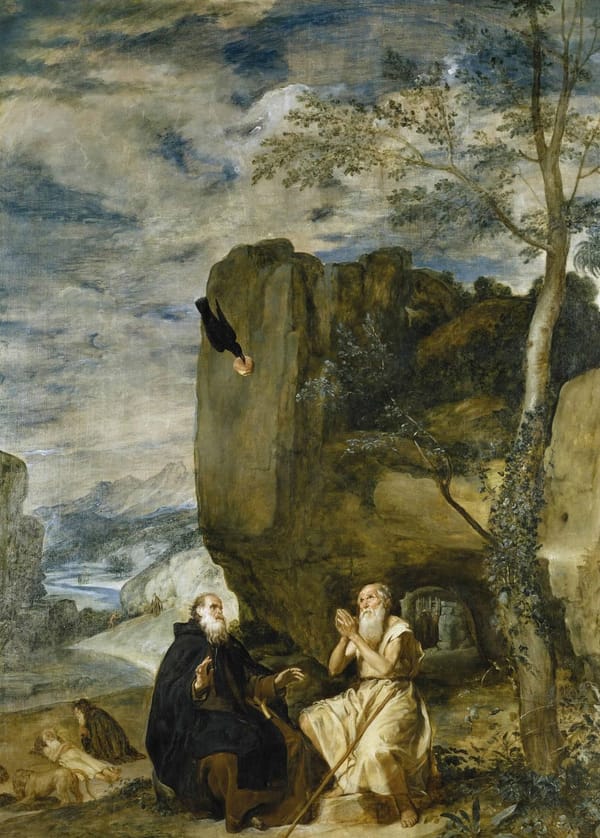
St Paul the Hermit and St Anthony Abbot seated in a rocky desert as a raven brings bread
Saints Anthony Abbot and Paul the Hermit, Diego Velázquez (1599–1660), c. 1634. Credits

TO-DAY the Church honours the memory of one of those men who were expressly chosen by God to represent the sublime detachment from all things which was taught to the world by the example of the Son of God, born in a Cave, at Bethlehem. Paul the Hermit so prized the poverty of his Divine Master that he fled to the desert, where he could find nothing to possess and nothing to covet. He had a mere cavern for his dwelling; a palm-tree provided him with food and clothing; a fountain gave him wherewith to quench his thirst; and heaven sent him his only luxury, a loaf of bread brought to him daily by a crow. For sixty years did Paul thus serve, in poverty and in solitude, that God who was denied a dwelling on the earth he came to redeem, and could have but a poor Stable wherein to be born.

But God dwelt with Paul in his cavern; and in him began the Anchorites, that sublime race of men who, the better to enjoy the company of their God, denied themselves not only the society, but the very sight of men. They were the Angels of earth, in whom God showed forth, for the instruction of the rest of men, that he is powerful enough and rich enough to supply the wants of his creatures, who, indeed, have nothing but what they have from him. The Hermit, or Anchoret, is a prodigy in the Church, and it behoves us to glorify the God who has produced it. We ought to be filled with astonishment and gratitude, at seeing how the Mystery of a God made Flesh has so elevated our human nature as to inspire a contempt and abandonment of those earthly goods which heretofore had been so eagerly sought after.

The two names, Paul and Antony, are not to be separated; they are the two Apostles of the Desert; both are Fathers—Paul of Anchorites, and Antony of Cenobites; the two families are sisters, and both have the same source, the Mystery of Bethlehem. The sacred Cycle of the Church's year unites, with only a day between their two Feasts, these two faithful disciples of Jesus in his Crib.

The Church reads in her Office the following abridgement of St Paul's wonderful Life.

Paulus, Eremitarum auctor et magister, apud inferiorem Thebaidem natus, cum quindecim esset annorum, orbatus parentibus est. Qui postea declinandæ causa persecutionis Decii et Valeriani, et Deo liberius inserviendi, in eremi speluncam se contulit: ubi, palma ei victum et vestitum præbente, vixit ad centesimum et decimum tertium annum: quo tempore ab Antonio nonagenario Dei admonitu invisitur. Quibus inter se, cum antea non nossent, proprio nomine consalutantibus, et multa de regno Dei colloquentibus, corvus, qui antea semper dimidiatum panem attulerat, integrum detulit.
Post corvi discessum: Eia, inquit Paulus, Dominus nobis prandium misit vere pius, vere misericors. Sexaginta jam anni sunt, cum accipio quotidie dimidii panis fragmentum; nunc ad adventum tuum militibus suis Christus duplicavit annonam. Quare cum gratiarum actione ad fontem capientes cibum, ubi tantisper recreati sunt, iterum gratiis de more Deo actis, noctem in divinis laudibus consumpserunt. Diluculo Paulus de morte, quæ sibi instaret, admonens Antonium, hortatur ut pallium, quod ab Athanasio acceperat, ad involvendum suum corpus afferret. Quo ex itinere rediens ille, vidit inter Angelorum choros, inter Prophetarum et Apostolorum cœtus, Pauli animam in cœlum ascendere.
Cumque ad ejus cellam pervenisset, invenit genibus complicatis, erecta cervice, extensisque in altum manibus corpus examine: quod pallio obvolvens, hymnosque et psalmos ex Christiana traditione decantans, cum sarculum, quo terram foderet, non haberet; duo leones ex interiore eremo rapido cursu ad beati senis corpus feruntur: ut facile intelligeretur, eos, quo modo poterant, ploratum edere; qui certatim terram pedibus effodientes, foveam, quæ hominem commode caperet, effecerunt. Qui cum abiissent, Antonius sanctum corpus in eum locum intulit: et injecta humo, tumulum ex christiano more composuit: tunicam vero Pauli, quam in sportæ modum ex palma foliis ille sibi contexuerat, secum auferens, eo vestitu diebus solemnibus Paschæ et Pentecostes, quoad vixit, usus est.
Paul, the institutor and master of Hermits, was born in the Lower Thebaid. He lost his parents when he was fifteen years of age. Not long after that, in order to escape the persecution of Decius and Valerian, and to serve God more freely, he withdrew into the desert, where he made a cave his dwelling. A palm-tree afforded him food and raiment, and there he lived to the age of a hundred and thirteen. About that time, he received a visit from Antony, who was ninety years old. God bade him visit Paul. The two Saints, though they had not previously known each other, saluted each other by their names. Whilst holding a long conversation on the kingdom of God, a crow, which every day brought half a loaf of bread, carried them a whole one.
When the crow had left them, Paul said: ‘See! our truly good and truly merciful Lord has sent us our repast. For sixty years I have daily received a half loaf; now, because thou art come to see me, Christ has doubled the portion for his soldiers.' Wherefore they sat near the fountain, and giving thanks, they ate the bread; and when they were refreshed, they again returned the accustomed thanks to God, and spent the night in the divine praises. At daybreak, Paul tells Antony of his approaching death, and begs him go and bring the cloak which Athanasius had given him, and wrap his corpse in it. As Antony was returning from his cell, he saw Paul’s soul going up into heaven amidst choirs of Angels, and a throng of Prophets and Apostles.
When he had reached the hermit’s cell, he found the lifeless body: the knees were bent, the head erect, and the hands stretched out and raised towards heaven. He wrapped it in the cloak, and sang hymns and psalms over it, according to the custom prescribed by Christian tradition. Not having a tool wherewith to make a grave, two lions came at a rapid pace from the interior of the desert, and stood over the body of the venerable Saint, showing how, in their own way, they lamented his death. They began to tear up the earth with their feet, and seemed to strive to outdo each other in the work, until they had made a hole large enough to receive the body of a man. When they had gone, Antony carried the holy corpse to the place, and covering it with the soil, he arranged the grave after the manner of the Christians. As to the tunic, which Paul had woven for himself out of palmleaves, as baskets are usually made, Antony took it away with him, and as long as he lived, wore it on the great days of Easter and Pentecost.

We give three stanzas of the Hymn sung by the Greek Church in honour of our holy Hermit. We take them from the Menæa.

Die XV Januarii

Quando nutu divino, Pater, vitæ sollicitudines sapienter reliquisti, et ad ascesis labores transisti, tunc gaudens invia occupasti deserta; æstu inflammatus amoris Domini; ideo deserens libidines, in meliorum perseverantia rerum, Angelo similis, vitam duxisti.
Ab omni humana teipsum, Pater, societate segregans ex adolescentia, primus omnino solitudinem, Paule, occupasti ultra quemcumque solitarie viventem, et per totam vitam visus es incognitus; ideo Antonius te invenit nutu divino tamquam latentem, et orbi terrarum manifestavit.
Insolitæ in terra conversationi deditus, Paule, cum bestiis habitasti, avis ministerio divina voluntate utens; et hoc ut vidit quando te maximus invenit Antonius, stupens, omnium et Prophetam et Magistrum, quasi Deum, te sine intermissione magnificavit.
When, O Father! thou didst by divine inspiration wisely leave the cares of this life, and devote thyself to the labours of an ascetic, thou didst joyfully enter the trackless desert. Inflamed with the heat of divine love, thou didst abandon human affections, and Angel-like, didst spend thy life in the persevering search after more perfect things.
Father! thou didst, from thy early youth, separate thyself from all human society, and wast the first to live in the desert, surpassing all other Anchorets. Thou, Paul, didst pass thy whole life unknown to men; therefore was Antony divinely inspired to go in search of thee, as the hidden Saint; he found thee and revealed thee to the whole earth.
A life unknown to the world was thine, O Paul! the wild beasts were thy companions, and a bird, sent thee by God, ministered to thee. When the great Antony found thee, and saw all this, he was filled with wonder, and never ceased speaking thy praises, as a Prophet and Teacher of all men, and as something divine.

Father and Prince of Hermits! thou art now contemplating in all his glory that God whose weakness and lowliness thou didst study and imitate during the sixty years of thy desert life: thou art now with him in the eternal union of the Vision. Instead of thy cavern, where thou didst spend thy life of unknown penance, thou hast the immensity of the heavens for thy dwelling; instead of thy tunic of palm-leaves, thou hast the robe of Light; instead of the pittance of material bread, thou hast the Bread of eternal life; instead of thy humble fountain, thou hast the waters which spring up to eternity, filling thy soul with infinite delights. Thou didst imitate the silence of the Babe of Bethlehem by thy holy life of seclusion; now thy tongue is for ever singing the praises of God, and the music of infinite bliss is for ever falling on thine ear. Thou didst not know this world of ours, save by its deserts; but now thou must compassionate and pray for us who live in it; speak for us to our dear Jesus; remind him how he visited it in wonderful mercy and love; pray his sweet blessing upon us, and the graces of perfect detachment from transitory things, love of poverty, love of prayer, and love of our heavenly country.


January 15 (the Same Day): St. Maurus, Abbot

SAINT MAURUS—one of the greatest masters of the Cenobitical Life, and the most illustrious of the Disciples of St Benedict, the Patriarch of the Monks of the West—shares with the First Hermit the honours of this fifteenth day of January. Faithful, like the holy Hermit, to the lessons taught at Bethlehem, Maurus has a claim to have his Feast kept during the forty days, which are sacred to the sweet Babe Jesus. He comes to us each January to bear witness to the power of that Babe's humility. Who, forsooth, will dare to doubt of the triumphant power of the poverty and the obedience shown in the Crib of our Emmanuel, when he is told of the grand things done by those virtues in the cloisters of fair France?

It was to Maurus that France was indebted for the introduction into her territory of that admirable Rule which produced the great Saints and the great men to whom she owes the best part of her glory. The children of St Benedict trained by St Maurus struggled against the barbarism of the Franks under the first race of her kings; under the second, they instructed in sacred and profane literature the people in whose civilization they had so powerfully co-operated; under the third—and even in modem times, when the Benedictine Order, enslaved by the system of Commendatory Abbots, and decimated by political tyranny or violence, was dying out amidst every kind of humiliation—they were the fathers of the poor by the charitable use of their large possessions, and the ornaments of literature and science by their immense contributions to ecclesiastical science and archæology, as also to the history of their own country.

St Maurus built his celebrated Monastery of Glanfeuil, and Glanfeuil may be considered as the mother house of the principal Monasteries in France, Saint Germain and Saint Denis of Paris, Marmoutier, Saint Victor, Luxeuil, Jumièges, Fleury, Corbie, Saint Vannes, Moyen-Moutier, Saint Wandrille, Saint Waast, La Chaise-Dieu, Tiron, Cheza, Benoit, Le Bec, and innumerable other Monasteries in France gloried in being daughters of Monte-Cassino by the favourite Disciple of St Benedict. Cluny, which gave several Popes to the Church, and among them St Gregory the Seventh and Urban the Second, was indebted to St Maurus for that Rule which gave her her glory and her power. We must count up the Apostles, Martyrs, Bishops, Doctors, Confessors, and Virgins who were formed, for twelve hundred years, in the Benedictine Cloisters of France; we must calculate the services, both temporal and spiritual, done to this great country by the Benedictine Monks during all that period; and we shall have some idea of the results produced by the mission of St Maurus—results whose whole glory redounds to the Babe of Bethlehem, and to the mysteries of his humility, which are the source and model of the Monastic Life. When, therefore, we admire the greatness of the Saints, and recount their wonderful works, we are glorifying Jesus, the King of all Saints.

The Monastic Breviary, in the Office of this Feast, gives us the following sketch of the Life of St Maurus.

Maurus Romanus a patre Eutychio, Senatorii ordinis, Deo, sub sancti Benedicti disciplina, puer oblatus, et in schola talis ac tanti morum magistri institutus, prius sublimem monasticæ perfectionis gradum, quam primos adolescentiæ annos, attigit: adeo ut suarum virtutum admiratorem simul et præconem ipsummet Benedictum habuerit, qui eum velut observantiæ regularis exemplar, cæteris ad imitandum proponere consueverat. Cilicio, vigiliis, jejuniisque, carnem continuis atterebat, assidua interim oratione, piis lacrymis, sacrarumque litterarum lectione recreatus. Per quadragesimam bis tantum in hebdomada cibo ita parce utebatur, ut hunc prægustare potius quam sumere videretur: somnum quoque stando, vel cum nimia eum lassitudo compulisset, sedendo, alio autem tempore super aggestum calcis et sabuli strato cilicio recumbens capiebat; sed ita modicum, ut noctumas longioribus semper precibus, toto etiam sæpe psalterio recitato, vigilias preveniret.
Admirabilis obedientiæ specimen dedit, cum periclitante in aquis Placido, ipse sancti Patris jussu ad lacum advolans super undas sicco vestigio ambulavit: et apprehensum capillis adolescentulum, hostiam cruento gladio divinitus reservatam, ex aquis incolumem extraxit. Hinc eum ob eximias virtutes beatus idem Pater sibi curarum consortem assumpsit: quem jam inde ab ipsis monasticæ vitæ tirociniis socium miraculorum asciverat. Ad sacrum Levitarum ordinem ex ejusdem sancti Patris imperio promotus, stola quam ferebat, muto puero vocem, eidemque claudo gressum impertívit. Missus in Galliam ab eodem sancto Benedicto, vix eam ingressus erat, cum triumphalem beatissimi Patris in cœlos ingressum suspexit. Gravissimis subinde laboribus, curisque perfunctus, Regulam ejusdem Legislatoris manu exaratam datamque promulgavit: exstructoque celebri monasterio, cui quadraginta annos præfuit, fama nominis sui factorumque adeo inclaruit, ut nobilissimi proceres, ex aula Theodeberti regis, in sanctiore militia merituri, ad ejus signa convolarint.
Biennio ante obitum abdicans se Monasterii regimine, in cellam sancti Martini sacello proximam secessit: ubi se in arctioris pœnitentiæ operibus exercens, cum humani generis hoste, internecionem Monachis minitante, pugnaturus in arenam descendit. Qua in lucta solatorem Angelum bonum habuit, qui mali astus, divinumque illi decretum aperiens, eum una cum discipulis ad coronam evocavit. Quare cum emeritos milites supra centum dux ipse brevi secuturus, veluti totidem triumphi sui antecessores, in cœlum præmisisset: in Oratorium deferri voluit, ubi vitæ sacramento munitus, substratoque cilicio recubans ad aram ipse victima, pretiosa morte procubuit septuagenario major, postquam in Galliis Monasticam disciplinam mirifice propagasset, innumeris ante et post obitum clarus miraculis.
Maurus was by birth a Roman. His father, whose name was Eutychius, a Senator by rank, had placed him, when a little boy, under the care of St Benedict. Trained in the school of such and so great a Master of holiness, he attained to the highest degree of monastic perfection, even before he had ceased to be a child; so that Benedict himself was in admiration, and used to speak of his virtues to everyone, holding him forth to the rest of the house as a model of religious discipline. He subdued his flesh by austerities, such as wearing a hair-shirt, night watching, and frequent fasting; giving, meanwhile, to his spirit the solace of assiduous prayer, holy compunction, and reading the Sacred Scriptures. During Lent, he took food but twice in the week, and that so sparingly as to seem rather to be tasting than taking it. He slept standing, or when excessive fatigue obliged him to it, sitting, or at times lying down on a heap of lime and sand, over which he threw his hair-shirt. His sleep was exceedingly short, for he always recited very long prayers, and often the whole of the Psalms, before the midnight Office.
He gave a proof of his admirable spirit of obedience on the occasion of Placid’s fall into the lake. Maurus, at the bidding of the Holy Father, ran to the lake, walked dry-shod upon the water, and taking the child by the hair of his head, drew him safe to the bank; for Placid was to be slain by the sword as a martyr, and our Lord reserved him as a victim which should be offered to him. On account of such signal virtues as these, the same Holy Father made Maurus share the care of his duties; for, from his very entrance into the monastic life, he had had a part in his miracles. He had been raised to the holy order of Deaconship by St Benedict’s command; and by placing the stole he wore on a dumb and lame boy, he gave him the power both to speak and walk. Maurus was sent by his Holy Father into France. Scarcely had he set his foot in that land, than he had a vision of the triumphant entrance of that great saint into heaven. He promulgated in that country the Rule which St Benedict had written with his own hand, and had given to him on his leaving Italy; though the labour and anxiety he had to go through in the accomplishment of his mission were exceedingly great. Having built the celebrated Monastery, which he governed for forty years, so great was the reputation of his virtues, that several of the noblest lords of King Theodebert’s court put themselves under Maurus’ direction, and enrolled in the holier and more meritorious warfare of the monastic life.
Two years before his death, he resigned the government of his Monastery, and retired into a cell near the Oratory of St Martin. There he exercised himself in most rigorous penance, wherewith he fortified himself for the contest he had to sustain against the enemy of mankind, who threatened him with the death of his Monks. In this combat a holy Angel was his comforter, who, after revealing to him the snares of the wicked spirit, and the designs of God, bade him and his disciples win the crown prepared for them. Having, therefore, sent to heaven before him, as so many forerunners, a hundred and more of his brave soldiers, and knowing that he, their leader, was soon to follow them, he signified his wish to be carried to the Oratory, where, being strengthened by the Sacrament of Life, and lying or his hair-shirt, as a victim before the Altar, he died a saintly death. He was upwards of seventy years of age. It would be difficult to describe the success wherewith he propagated Monastic discipline in France, or to tell the miracles which, both before and after his death, rendered him glorious among men.

We give a selection of Antiphons, taken from the Monastic Office of St Maurus.

Beatus Maurus patricio genere illustris, a puero majores divitias æstimavit thesauris mundi, improperium Christi Domini.
Induit eum Dominus stola sancta Levitarum, qua claudos fecit ambulare, et mutos loqui.
In Franciam missus, doctrinam Regulæ quasi antelucanum illuminavit omnibus, et enarravit eam usque ad longinquum.
Floro, primariisque Regni proceribus decorata exsultabat, et fiorebat quasi lilium novi cœnobii solitudo.
Quos in Christo genuerat filios, morti proximus in cœlum præmisit, et inter preces corpus ad aras, animam cœlo deposuit. Alleluia.
O dignissimum Patris Benedicti discipulum, quem ipse sui spiritus hæredem reliquit, ut Regulæ sanctæ promulgator esset primarius, et in Galliis Monastici Ordinis propagator mirificus. Alleluia.
O beatum virum, qui spreto sæculo jugum sanctæ Regulæ a teneris annis amanter portavit, et factus obediens usque ad mortem semetipsum abnegavit, ut Christo totus adhæreret. Alleluia.
Hodie sanctus Maurus super cilicium stratus, coram altari feliciter occubuit. Hodie primogenitus beati Benedicti discipulus per ducatum sanctæ Regulæ securus ascendens, choris comitatus angelicis, pervenit ad Christum. Hodie vir obediens, loquens victorias, a Domino coronari meruit. Alleluia, alleluia.
The blessed Maurus, illustrious by birth, as being of a patrician family, esteemed the reproach of Christ our Lord to be greater riches than the treasures of this world.
The Lord clothed him with the holy stole of Levites: wherewith he made the lame walk, and the dumb speak.
Being sent into France, he enlightened all men by the teaching of the Rule, as the dawn lights the world, and he made it known even to distant lands.
The solitude of the new monastery bloomed with the coming of Florus and the chief nobles of the kingdom; it was glad and flowered as the lily.
When near his death, he sent before him to heaven the children he had begotten in Christ; and whilst in prayer, he laid down his body at the Altar, his soul resting in heaven. Alleluia.
O most worthy disciple of his Father Benedict, who made him heir of his own spirit, that he might become the chief promulgator of the Holy Rule, and the wonderful propagator of the Monastic Order in France! Alleluia.
O blessed Maurus! who from early childhood despised the world, and lovingly bore the yoke of the Holy Rule, and being obedient even unto death, denied himself, that he might cling unreservedly to Christ. Alleluia.
On this day did Saint Maurus, laid before the Altar on his hairshirt, happily breathe forth his soul. On this day the eldest disciple of blessed Benedict, securely ascending by the path of the Holy Rule, and accompanied by choirs of Angels, was led to Christ. On this day the obedient man, speaking victory, was rewarded by receiving the crown from his Lord. Alleluia, alleluia.

The Responsories of the same Office are equally fine. We select the following.

℟. Maurus a teneris annis sancto Benedicto in disciplinam ab Eutychio patre in Sublaco traditus, Magistri sui virtutes imitando expressit, * Et similis ejus effectus est.℣. Inspexit et fecit secundum exemplar, quod ipsi in monte monstratum est. * Et similis.℟. Prolapso in lacum Placido, Maurus advolans, Spiritu Domini ferebatur super aquas; * Dum Patri suo in auditu auris obediret.℣. Aquæ multæ non potuerunt exstinguere caritatem ejus, neque flumina illam obruere. * Dum Patri.℟. Sanctus Benedictus dilectum præ cæteris Discipulum suum Maurum transmittit in Galliam: * Et magnis patitur destitui solatiis, ut proximi saluti provideat.℣. Caritas benigna est, nec quærit quæ sua sunt, sed quæ Jesu Christi. * Et magnis.℟. In Deo raptus viam vidit innumeris coruscam lampadibus, qua Benedictus ascendebat in gloriam, * In perpetuas æternitates.℣. Justorum semita quasi lux splendens procedit, et crescit usque ad perfectam diem. * In perpetuas.℟. Quæ in sinu beati Patris Benedicti hauserat Maurus sapientiæ flumina in Galliis effudit; * Et inter Franciæ lilia sacri Ordinis propagines sevit.℣. Quasi trames aquæ de fluvio rigavit hortum plantationum suarum. * Et inter.℟. Christianissimus Francorum Rex venit ad monasterium, ut audiret sapientiam novi Salomonis: * Et regiam purpuram submisit pedibus ejus.℣. Quia humilis fuit in oculis suis, glorificavit illum Dominus in conspectu regum. * Et regiam.℟. Biennio ante mortem siluit sejunctus ab hominibus, * Et solus in superni inspectoris oculis habitavit secum.℣. Præparavit cor suum, et in conspectu Domini sanctificavit animam suam. * Et solus.℟. Maxima pars fratrum sub Mauro duce militantium per Angelum de morte monita, ultimum cum dæmone pugnavit; * Et in ipso agone occumbens, cœlestes triumphos promeruit.℣. Bonum certamen certavit, cursum consummavit, fidem servavit. * Et in ipso agone.℟. Postquam sexaginta annos in sacra militia meruisset, imminente jam morte, ad aras deferri voluit, ut effunderet in conspectu Domini orationem, et animam suam, dicens: * Concupiscit et deficit anima mea in atria Domini.℣. Altana tua, Domine virtutum, Rex meus, et Deus meus. * Concupiscit.℟. Substrato cilicio in Ecclesia recumbens, ex domo orationis transivit in locum tabernaculi admirabilis, usque ad domum Dei, * Cujus nimio amore flagrabat.℣. Coarctabatur enim, desiderium habens dissolvi, et esse cum Christo. * Cujus nimio.
℟. Maurus, when quite a child, was taken to Subiaco, and consigned by his father Eutychius to the care of Saint Benedict: he imitated the virtues of his Master, and reflected them in his own conduct, * And became like unto him.℣. He looked and did according to the image that was shown him on the mount. * And became.℟. Placid having fallen into the lake, Maurus flies to his rescue, and was borne upon the waters by the Spirit of the Lord; * Whilst obeying his Father in the hearing of the ear.℣. Many waters could not quench his charity, neither could floods drown it. * Whilst obeying.℟. Saint Benedict sent into France his disciple Maurus, whom he loved above the rest: * And suffers himself to be deprived of his great consolation, that he may provide for his neighbour’s salvation.℣. Charity is kind, neither seeketh she her own, but the things that are of Jesus Christ. * And suffers.℟. Being rapt in God, he beheld the path glittering with countless lamps, whereby Benedict was mounting to glory, * For an endless eternity,℣. The path of the just, as a shining light, proceedeth and increaseth even unto perfect day. * For an endless.℟. The wisdom that he had learnt from the blessed Father Benedict he poured forth in France; * And he planted shoots of the Holy Order amidst the lilies of France.℣. As a brook out of a river, he waters the garden of his plants. * And he planted.℟. The Most Christian King of the Franks went to the monastery, that he might hear the wisdom of the new Solomon: * And he laid the regal purple under his feet.℣. Because he was humble in his own eyes, the Lord glorified him in the sight of kings. * And he laid.℟. He spent the two years before his death in silence and separation from men, * And alone, he dwelt with himself under the eye of the all-seeing God.℣. He prepared his heart, and in the sight of the Lord he sanctified his soul. * And alone.℟. The greater part of the brethren, who fought under the leadership of Maurus, were warned by an Angel of their death, and fought their last battle with the demon: * And dying in that battle, they won to themselves the triumph of heaven.℣. They fought the good fight, they finished their course, they kept the faith. * And dying.℟. After he had meritoriously served sixty years in the holy warfare, and death being at hand, he willed that they should carry him to the Altar, there to breathe forth, in the presence of the Lord, his prayer and his soul: he said: * My soul longeth and fainteth for the courts of the Lord;℣. Thy altars, O Lord of hosts, my King and my God. * My soul.℟. Laid on his hair-shirt in the Church, he passed from the house of prayer into the place of the wonderful tabernacle, even to the house of God. * With love of whom he burned exceedingly.℣. For he was straitened, desiring to be dissolved, and to be with Christ. * With love.

Of the three Hymns to St Maurus, we choose this, as being the finest.

Maurum concelebra Gallia canticis,
Qui te prole nova ditat, et inclyti
Custos imperii, regia protegit
Sacro pignore lilia.
Hic gentilitiis major honoribus,
Spretis lætus adit claustra palatiis,
Calcat delicias, prædia, purpuram,
Ut Christi subeat jugum.
Sancti propositam Patris imaginem
Gestis comparibus sedulus exprimit;
Spectandis pueri lucet in actibus
Vitæ norma monasticæ.
Se sacco rigidus conterit aspero,
Frænat perpetui lege silentii;
Noctes in precibus pervigil exigit,
Jejunus solidos dies.
Bum jussis patriis excitus advolat,
Sicco calcat aquas impavidus pede,
Educit Placidum gurgite sospitem,
Et Petro similis redit.
Laudem jugis honor sit tibi Trinitas,
Quæ vultus satias lumine cœlites!
Da sanctæ famulis tramite Regulæ
Mauri præmia consequi.
Amen.
Hymn Maurus in thy canticles, O France!
for he enriched thee with a new race;
he is the guardian of thy fair throne,
and his sacred relics protect thy royal lilies.
Rising above the honours of his family,
and deeming palaces beneath him, he gladly seeks the cloister:
luxuries, lands, robes of state, he tramples on them all,
that he may take up the yoke of Christ,
Strenuously does he express in his conduct the image he had proposed to himself
—he does what his Holy Father does:
the Rule of the monastic life is brightly mirrored
in the actions of the youthful Maurus.
Severe to himself, he subdues the flesh by a rough hair-shirt;
he bridles nature by the law of perpetual silence;
he spends his wakeful nights in prayer,
and whole days are passed in long unbroken fast.
He flies at his Father's bidding,
and dryshod and fearless treads upon the waters of the lake;
he rescues Placid from a watery grave,
and, like another Peter, sinks not as he walks.
Unending praiseful homage be to thee, O holy Trinity,
that givest to the Saints the satiating Light of Vision!
Grant to thy servants, who are walking in the path of the Holy Rule,
to obtain the rewards so bravely won by Maurus.
Amen.

How blessed was thy Mission, O favourite and worthy disciple of the great Saint Benedict! How innumerable the Saints that sprang from thee and thy illustrious Patriarch! The Rule thou didst promulgate was truly the salvation of that great country which thou and thy disciples evangelized; and the fruits of the Order thou didst plant there have been indeed abundant. But now that from thy throne in heaven thou beholdest that fair France which was once covered with Monasteries, and from which there mounted up to God the ceaseless voice of prayer and praise, and scarce findest the ruins of these noble Sanctuaries—dost thou not turn towards our Lord, and beseech him that he make the wilderness bloom once more as of old? Oh! what has become of those Cloisters, wherein were trained Apostles of Nations, learned Pontiffs, intrepid defenders of the liberty of the Church, holy Doctors and heroes of sanctity—all of whom call thee their second Father? Who will bring back again those vigorous principles of poverty, obedience, hard work, and penance, which made the Monastic Life the object of the people’s admiration and love, and attracted thousands of every class in society to embrace it? Instead of this holy enthusiasm of the ages of faith, we, alas! can show little else than cowardice of heart, love of this life, zeal for enjoyment, dread of the cross, and at best, comfortable and inactive piety. Pray, great Saint! that these days may be shortened; that the Christians of the present generation may grow earnest by reflecting on the sanctity to which they are called; that new strength may spring up in our tepid hearts, for the Church has need of courageous souls in order that her future glory may be as great and bright as we could hope for in our most fervent love. Oh! if God hear thy prayer, and give us once more the Monastic Life in all its purity and vigour, we shall be safe, and the evil of faith without earnestness, which is now producing such havoc in the spiritual world, will be replaced by Christian energy. Teach us, O Maurus! to know the dear Babe of Bethlehem, and to fix well in our hearts his life and doctrine; for we shall then understand the greatness of our Christian vocation, and that only by following him, our Guide and Master, shall we be able to overcome our enemy the world.

Previous
January 14 (the Same Day): St. Kentigern, Bishop and Confessor
Next
January 15: St. Paul, the First Hermit