Daily reading
Epiphanytide
Double · Temporal
January 29, 2023
From Dom Guéranger’s The Liturgical Year.

|
The Fourth Sunday after Epiphany
Mass
Introit
Collect
Then are added the Collects special to the season of Christmas, in honour of our Lady, against the persecutors of the Church, or for the Pope; which are given above, page 251.
Epistle
Cap. XIII.Fratres, nemini quidquam debeatis, nisi ut invicem diligatis: qui enim diligit proximum, legem implevit. Nam: Non adulterabis; Non occides; Non furaberis; Non falsum testimonium dices; Non concupisces, et si quod est aliud mandatum, in hoc verbo instauratur: Diliges proximum tuum sicut teipsum. Dilectio proximi malum non operatur. Plenitudo ergo legis est dilectio.
Ch. XIII.Brethren, owe no man any thing, but to love one another; for he that loveth his neighbour hath fulfilled the law. For, 'Thou shalt not commit adultery: Thou shalt not kill: Thou shalt not steal: Thou shalt not bear false witness: Thou shalt not covet': and if there be any other commandment, it is comprised in this word: 'Thou shalt love thy neighbour as thyself.’ The love of our neighbour worketh no evil. Love, therefore, is the fulfilling of the law.
During this holy season, when the very Son of God is giving so great a proof of his love for man, whose nature he has assumed, the Church is continually exhorting the Faithful, in the words of the Apostle, to practise charity towards each other. Emmanuel comes to us as our Lawgiver: now he has resumed his whole Law in the precept of Love; he is come in order to unite what sin had divided. Let us comply with his divine intentions, and accomplish with earnestness the Law he has imposed upon us.
Gradual
Gospel
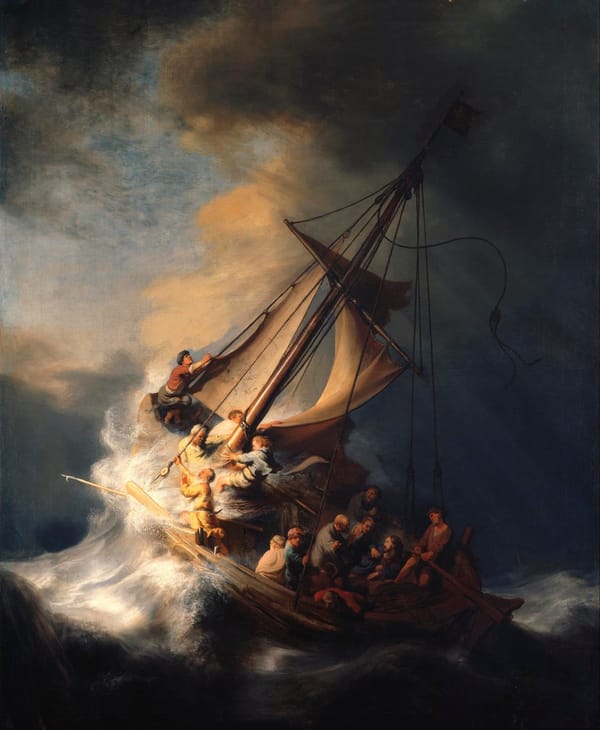
Cap. VIII.In illo tempore, Ascendente Jesu in naviculam, secuti sunt eum discipuli ejus. Et ecce motus magnus factus est in mari, ita ut navicula operiretur fluctibus; ipse vero dormiebat. Et accesserunt ad eum discipuli ejus, et suscitaverunt eum dicentes: Domine, salva nos. perimus. Et dicit eis Jesus: Quid timidi estis, modicæ fidei? Tunc surgens, imperavit ventis et mari, et facta est tranquillitas magna. Porro homines mirati sunt, dicentes: Qualis est hic, quia venti et mare obediunt ei?
At that time, when Jesus entered into the boat, his disciples followed him; and behold a great tempest arose in the sea, so that the boat was covered with waves; but he was asleep. And his disciples came to him, and awakened him, saying: Lord, save us, we perish. And Jesus saith to them: Why are ye fearful, O ye of little faith? Then rising up, he commanded the winds and the sea, and there came a great calm. But the men wondered, saying: What manner of man is this, for the winds and the sea obey him!
Let us adore the power of our Emmanuel, who is come to calm the tempest which threatened the human race with death. In the midst of their danger, the successive generations of men had cried out: Lord! save us; we perish. When the fulness of time had come, he awoke from his rest; he had but to command, and the power of our enemies was destroyed. The malice of the devils, the darkness of idolatry, the corruption of paganism—all yielded. Nation after nation was converted to Jesus. They had said, when in their misery and blindness: 'Who is this Jesus, whom no power can resist?' and then they embraced his Law. This power of Jesus to break down every obstacle, and that, too, at the very time when men were disquieted at his apparent slumbering, has often shown itself in the past ages of the Church. How many times has he not chosen for saving the world that period which seemed the least likely for rescue! The same happens in the life of each one among us. Oftentimes we are tossed to and fro by violent temptations; it would seem as though the billows must sink us; and yet our will is firmly anchored to God! And what is all this, if not Jesus sleeping in the storm-tossed boat, protecting us by this his sleeping? And if our cry for help at length awaken him, it is only to proclaim his own and our victory; for he has already conquered, and we have conquered in him.
Offertory
Secret
To this are added the other Secrets, as given on page 255. The Preface is that of the Blessed Trinity, page 256.
Communion
Postcommunion
Then are added the other Postcommunions, as given on page 257.
Vespers
The Psalms, Antiphons, Capitulum, Hymn and Versicle are given on pages 89-96.
Antiphon of the Magnificat
January 29: St. Francis of Sales, Bishop
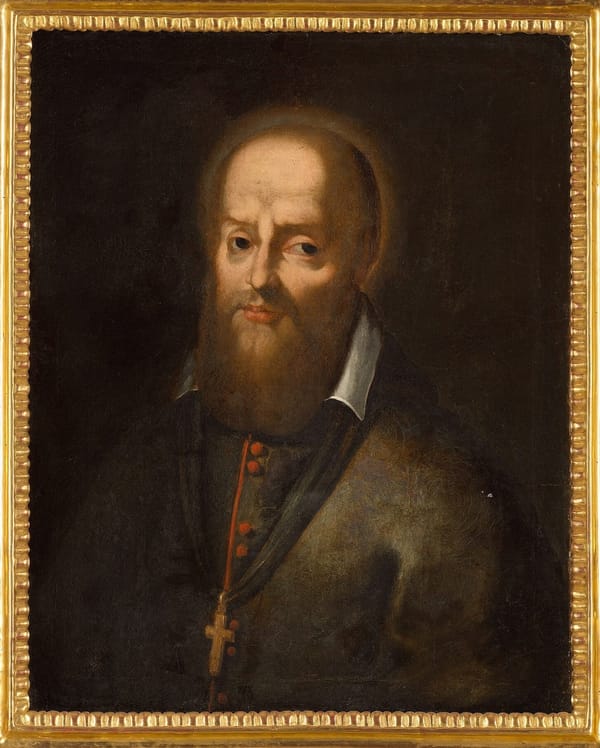 |
THE angelical Bishop Francis of Sales has a right to a distinguished position near the Crib of Jesus, on account of the sweetness of his virtues, the childlike simplicity of his heart, and the humility and tenderness of his love. He comes with the lustre of his glorious conquests upon him—seventy-two thousand heretics converted to the Church by the ardour of his charity; an Order of holy servants of God, which he founded; and countless thousands of souls trained to piety by his prudent and persuasive words and writings.
God gave him to the Church at the very time that heresy was holding her out to the world as a worn-out system, that had no influence over men’s minds. He raised up this true minister of the Gospel in the very country where the harsh doctrines of Calvin were most in vogue, that the ardent charity of Francis might counteract the sad influence of that heresy. If you want heretics to be convinced of their errors, said the learned Cardinal du Perron, you may send them to me; but if you want them to be converted, send them to the Bishop of Geneva.
Francis of Sales was sent, then, as a living image of Jesus, opening his arms and calling sinners to repentance, the victims of heresy to truth, the just to perfection, and all men to confidence and love. The Holy Spirit had rested on him with all his divine power and sweetness. A few days back we were meditating on the Baptism of Jesus, and how the Holy Ghost descended upon him in the shape of a dove. There is an incident in the life of Francis which reminds us of this great Mystery. He was singing Mass on Whit Sunday at Annecy. A dove, which had been let into the Cathedral, after flying for a long time round the building, at length came into the sanctuary, and rested on the Saint’s head. The people could not but be impressed with this circumstance, which they looked on as an appropriate symbol of Francis’ loving spirit; just as the globe of fire which appeared above the head of St Martin, when he was offering up the Holy Sacrifice, was interpreted as a sign of his apostolic zeal.
The same thing happened to our Saint on another occasion. It was the Feast of our Lady’s Nativity, and Francis was officiating at Vespers in the Collegiate Church at Annecy. He was seated on a Throne, the carving of which represented the Tree of Jesse, which the prophet Isaias tells us produced the virginal Branch, whence sprang the divine Flower, on which there rested the Spirit of love. They were singing the psalms of the feast, when a dove flew into the Church, through an aperture in one of the windows of the choir, on the epistle side of the Altar. It flew about for some moments, and then lighted first on the Bishop’s shoulder, then on his knee, where it was caught by one of the assistants. When the Vespers were over the Saint mounted the pulpit, and ingeniously turned the incident that had occurred into an illustration which he hoped would distract the people from himself—he spoke to them of Mary, who, being full of the grace of the Holy Spirit, is called the Dove that is all fair, in whom there is no blemish.1
If we were asked which of the Disciples of our Lord was the model on which this admirable Prelate formed his character, we should mention, without any hesitation, the Beloved Disciple, John. Francis of Sales is, like him, the Apostle of charity; and the simplicity of the great Evangelist caressing an innocent bird is reflected with perfection in the heart of the Bishop of Geneva. A mere look from John, a single word of his, used to draw men to the love of Jesus; and the contemporaries of Francis were wont to say: 'If the Bishop of Geneva is so amiable, what, O Lord, must not thou be!'
A circumstance in our Saint's last illness again suggests to us the relation between himself and the Beloved Disciple. It was on the 27th of December, the Feast of St John, that Francis, after celebrating Mass, and giving Communion to his dear Daughters of the Visitation, felt the first approach of the sickness which was to cause his death. As soon as it was known, the consternation was general; but the Saint had already his whole conversation in heaven, and on the following day, the Feast of the Holy Innocents, his soul took its flight to its Creator, and the candour and simplicity of his spirit made him a worthy companion of those dear little ones of Bethlehem.
But on neither of these two days could the Church place his feast, as they were already devoted to the memory of St John and the Holy Innocents; but she has ordered it to be kept during the forty days consecrated to the Birth of our Lord, and this 29th of January is the day fixed for it.
St Francis, then, the ardent lover of our new-born King, is to aid us, like all these other Christmas saints, to know the charms of the Divine Babe. In his admirable Letters we find him expressing, with all the freedom of friendly correspondence, the sweetness which used to fill his heart during this holy season. Let us read a few passages from these confidential papers—they will teach us how to love our Jesus.
Towards the end of the Advent of 1619, he wrote to a religious of the Visitation, instructing her how to prepare for Christmas.
My very dear Daughter, our sweet Infant Jesus is soon to be born in our remembrance, at the coming feasts; and since he is born on purpose that he may visit us in the name of his Eternal Father, and is to be visited in his Crib by the Shepherds and the Kings, I look on him as both the Father and the Child of our Lady of the Visitation.
Come, then, load him with your caresses; join all our Sisters in giving him a warm welcome of hospitality; sing to him the sweetest carols you can find; and above ail, adore him very earnestly, and very sweetly, and with him adore his poverty, his humility, his obedience and his meekness, as did his most holy Mother and St Joseph. Take one of his divine tears, which is the dew of heaven, and put it on your heart, that so you may never admit any other sadness there, than the sadness which will gladden this sweet Infant. And when you recommend your own soul to him, recommend mine also, for you know its devotedness to yours.I beg of you to remember me affectionately to the dear Sisters, whom I look upon as simple shepherdesses keeping watch over their flocks, that is, their affections, and who, being warned by the Angel, are going to pay their homage to the Divine Babe, and offer him, as an earnest of their eternal loyalty, the fairest of their lambs, which is their love, unreserved and undivided.
On Christmas Eve, filled by anticipation with the joy of the sacred night which is to give the world its Redeemer, Francis writes to St Jane Frances de Chantal, and thus invites her to profit by the visit of the Divine Infant:
May the sweet Infant of Bethlehem ever be your happiness and your love, my very dear Mother. Oh! the loveliness of this Little Child! I imagine I see Solomon on his ivory throne, all beautifully gilded and carved, which, as the Scripture tells us, had no equal in all the kingdoms of the earth, neither was there any king that could be compared for glory and magnificence with the king that sat upon it. And yet I would a hundred times rather see the dear Jesus in his Crib, than all the kings of the world on their thrones.
But when I see him on the lap or in the arms of his Blessed Mother, he seems to me to be more magnificent on this Throne, not only than Solomon ever was on his of ivory, but than he himself on any throne with which the heavens could provide him; for though the heavens surpass Mary in outward grandeur, yet she surpasses them in invisible perfections. Oh! may the great St Joseph give us some of the consolation that filled his soul; may the Blessed Mother lend us something of her own love, and the Infant Jesus mercifully pour into our hearts of the infinite abundance of his merits!
I beseech you to keep close to this Divine Babe, and rest near him as lovingly as you can; he will love you in return, even should your heart feel no tenderness or devotion. What sense had the poor ox and the ass? and yet he refuses not to let them breathe warmly upon him. And think you he will refuse the aspirations of our poor hearts, which, though just at present they feel no devotion, yet are sincerely and loyally his, and are ever offering themselves to be the faithful servants of his own divine self, and of his Holy Mother, and of his dear protector Joseph!
The sacred night is over, and has brought Peace to men of good will. Francis again writes to the same Saint, and thus betrays to her the joy he has received from the contemplation of the great Mystery;
Oh! the sweetness of this night! The Church has been singing these words—honey has dropped from the heavens. I thought to myself, that the Angels not only come down on our earth to sing their admirable Gloria in excelsis, but to gaze also on this sweet Babe, this Honey of heaven resting on two beautiful Lilies, for sometimes he is in Mary's arms, and sometimes it is Joseph that caresses him.
What will you say of my having the ambition to think that our two Angel Guardians were of the grand choir of blessed Spirits that sang the sweet hymn on this night? I said to myself : Oh! happy we, if they would deign to sing once more their heavenly hymn, and our hearts could hear it! I besought it of them, that so there might be glory in the highest heavens, and peace to hearts of good will.
Returning home from celebrating these sacred mysteries, I rest awhile in thus sending you my Happy Christmas! for I dare say that the poor Shepherds took some little rest, after they had adored the Babe announced to them by the Angels. And as I thought of their sleep on that night, I said to myself: How sweetly must they not have slept, dreaming of the sacred melody wherewith the Angels told them the glad tidings, and of the dear Child and the Mother they had been to see!
We will close our quotations by the following passage of another of his Letters to St Jane Frances de Chantal, in which he speaks of the Most Holy Name of 'Jesus,' which the Divine Child of Mary received at his Circumcision.
O my Jesus! fill our hearts with the sacred balm of thy Holy Name, that so the sweetness of its fragrance may penetrate our senses, and perfume our every action. But that our hearts may be capable of receiving this sweetness, they must be circumcised: take, therefore, from them whatever could displease thy divine sight. O glorious Name! named by the heavenly Father from all eternity, be thou for ever written on our souls; that as thou, Jesus, art our Saviour, so may our souls be eternally saved. And thou, O Holy Virgin! that wast the first among mortals to pronounce this saving Name, teach us to pronounce it as it behoveth us, that so we may merit the Salvation which thou didst bring into this world!
My dear Daughter! it was but right that my first letter of this year should be to Jesus and Mary: my second is to you, to wish you a Happy New Year, and exhort you to give your whole heart to God. May we so spend this year, that it may secure to us the years of eternity! My first word on waking this morning was: Jesus! and I felt as though I would gladly pour out on the face of the whole earth the oil of this sweet Name.
As long as balm is shut up in a well-sealed vase, no one knows its sweetness, save him who put it there: but as soon as the vase is opened, and a few drops are sprinkled around, all who are present say: "What sweet Balm!'' Thus it was, my dear Daughter, with our Jesus. He contained within himself the balm of salvation; but no one knew it until his divine Flesh was laid open by the fortunate wound of that cruel knife; and then people knew him to be the Balm of the world's Salvation, and first Joseph and Mary, then the whole neighbourhood began to cry out: Jesus! which means Saviour.
Let us now turn to the Office of the Church for this feast, and read the life of our Saint.
Pope Alexander the Seventh himself composed the Collect for the Office and Mass of the Saint's Feast. Let us say it with our holy Mother the Church.
Collect
Peaceful conqueror of souls! Pontiff beloved of God and man! we venerate thee as the perfect imitator of the sweetness and gentleness of Jesus. Having learnt of him to be meek and humble of heart, thou didst, according to his promise, possess the land2 Nothing could resist thee. Heretics, however obstinate; sinners, however hardened; tepid souls, however sluggish; all yielded to the powerful charm of thy word and example. We love to see thee standing near the Crib of our loving Jesus, and sharing in the glory of John and the Innocents, for thou wast an Apostle like John, and simple like the children of Rachel. Oh! that our hearts might be filled with the spirit of Bethlehem, and learn how sweet is the yoke, and how light the burden of our Emmanuel!3
Pray for us to our Lord, that our charity may be ardent like thine; that the desire of perfection may be ever active within us; that we may gain that introduction to a devout Life which thou hast so admirably taught; that we may have that love of our neighbour, without which we cannot hope to love God; that we may be zealous for the salvation of souls; that we may be patient and forgive injuries, in order that we may love one another, not only in word and in tongue, but, as thy great model says, in deed and in truth.4 Bless the Church Militant, whose love for thee is as fresh as though thou hadst but just now left her; thou art venerated and loved throughout the whole world.
Hasten the conversion of the followers of Calvin. Thy prayers have already miraculously forwarded the great work, and the Holy Sacrifice has long since been publicly offered up in the very City of Geneva. Redouble those prayers, and then even we may live to see the grand triumph of the Church. Root out too the last remnants of that Jansenistic heresy, which was beginning to exercise its baneful influence at the close of thy earthly pilgrimage. Remove from us the dangerous maxims and prejudices which have come down to us from those unhappy times, when this odious sect was at the height of its power.
Bless with all the affection of thy paternal heart the holy Order thou didst found, and which thou didst offer to Mary under the title of her Visitation. Maintain it in its present edifying favour; give it increase in number and merit; and do thou thyself direct it, that so thy family may be ever animated by the spirit of its father. Pray, also, for the venerable Episcopate, of which thou art the ornament and model: ask our Lord to bless his Church with Pastors endowed with thy spirit, inflamed with thy zeal, and imitators of thy sanctity.
| Previous January 28 (the Same Day): The Blessed Charlemagne, Emperor | Next January 29: St. Francis of Sales, Bishop |