Daily reading
Epiphanytide
Double · February 4 · Sanctoral
February 4, 2023
From Dom Guéranger’s The Liturgical Year.
A Double leads the weekday.Rubric
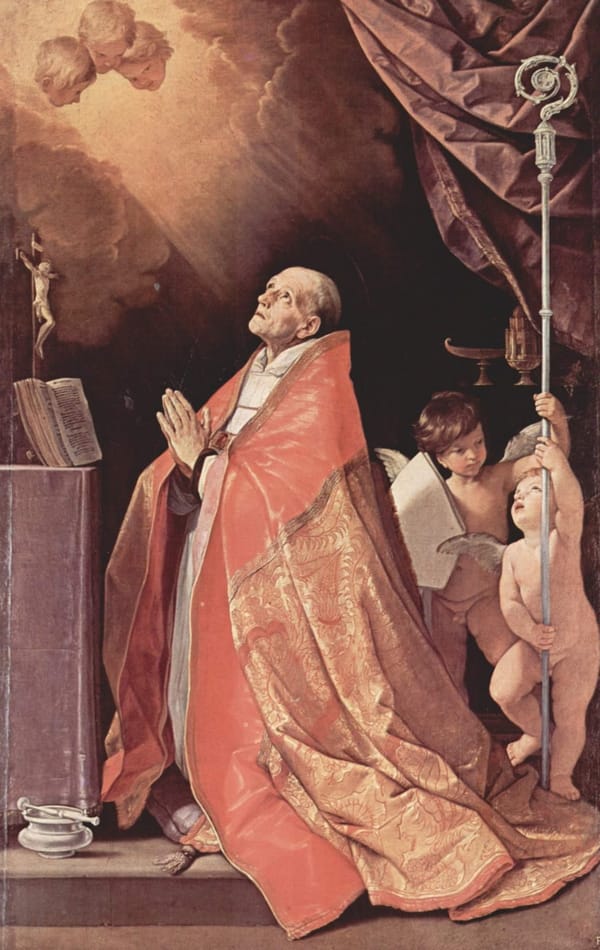 |
February 4: St. Andrew Corsini, Bishop and Confessor
The saintly bishop, whose feast we keep to-day pressingly invites us, by his austere life and his burning zeal for the salvation of souls, to procure, at all costs, our own reconciliation with the divine justice. We are indebted for this feast to a member of the illustrious family of the Corsini, Pope Clement XII., who, however, was but the instrument used by divine Providence. The holy bishop of the little town of Fiesole ever sought to be unknown during his life, and God, who willed that he should be glorified by the whole Church, inspired the sovereign Pontiff to inscribe his name among the saints of the universal calendar. Andrew the saint was once a sinner; his example will encourage us in the work of our conversion.
Let us read the account of his virtues as given us by the Church.
Hear, O holy pontiff, our prayer: we are sinners, and would learn from thee how we are to return to the God we have offended. His mercy was poured out upon thee; obtain the same for us. Have pity on Christians throughout the world, for the grace of repentance is now being offered to all; pray for us, that we may be filled with the spirit of compunction. We have sinned; we sue for pardon; intercession like thine can win it for us. From wolves, change us into lambs. Strengthen us against our enemies; obtain for us an increase of the virtue of humility, which thou hadst in such perfection; and intercede for us with our Lord, that He crown our efforts with perseverance, as He did thine; that thus we may be enabled to unite with thee in singing, for ever, the praises of our Redeemer.
Saturday before Septuagesima Sunday
Suspension of the Alleluia
The calendar of the liturgical year will soon bring us to the commemoration of the Passion and Resurrection of our Redeemer; we are but nine weeks from these great solemnities. It is time for the Christian to be preparing his soul for a fresh visit from his Saviour; a visit even more sacred and more important than that He so mercifully paid us at His Birth.
Our holy mother the Church knows how necessary it is for her to rouse our hearts from their lethargy, and give them an active tendency towards the things of God. On this day, the eve of Septuagesima, she uses a powerful means for infusing her own spirit into the minds of her children. She takes the song of heaven away from us: she forbids our further uttering that Alleluia, which is so dear to us, as giving us a fellowship with the choirs of angels, who are for ever repeating it. How is it that we poor mortals, sinners, and exiles on earth, have dared to become so familiar with this hymn of a better land? It is true, our Emmanuel, who established peace between God and men, brought it us from heaven on the glad night of His Birth; and we have had the courage to repeat it after the angels, and shall chant it with renewed enthusiasm when we reach our Easter. But to sing the Alleluia worthily, we must have our hearts set on the country whence it came. It is not a mere word, nor a profane unmeaning melody; it is the song that recalls the land we are banished from, it is the sweet sigh of the soul longing to be at home.
The word Alleluia signifies praise God: but it says much more than this, and says it as no other word or words could. The Church is not going to interrupt her giving praise to God during these nine weeks. She will replace this heaven-lent word by a formula also expressive of praise: Laus tibi, Domine, Rex æternæ gloriæ! Praise be to Thee, O Lord, King of eternal glory! But this is the language of earth; whereas Alleluia was sent us from heaven. ‘Alleluia,’ says the devout Abbot Rupert, ‘is like a stranger amidst our other words. Its mysterious beauty is as though a drop of heaven’s overflowing joy had fallen down on our earth. The patriarchs and prophets relished it, and then the Holy Ghost put it on the lips of the apostles, from whom it flowed even to us. It signifies the eternal feast of the angels and saints, which consists in their endless praise of God, and in ceaselessly singing their ever new admiration of the beauty of the God on whose Face they are to gaze for everlasting ages. This mortal life of ours can in no wise attain such bliss as this. But, to know where it is to be found, and to have a foretaste of it by the happiness of hope, and to hunger and thirst for what we thus taste, this is the perfection of saints here below. For this reason, the word Alleluia has not been translated; it has been left in its original Hebrew, as a stranger to tell us that there is a joy in his native land, which could not dwell in ours: he has come among us to signify, rather than to express that joy.'*
During this season of Septuagesima, we have to gain a clear knowledge of the miseries of our banishment, under pain of being left for ever in this tyrant Babylon. It was, therefore, necessary that we should be put on our guard against the allurements of our place of exile. It is with this view that the Church, taking pity on our blindness and our dangers, gives us this solemn warning. By taking from us our Alleluia, she virtually tells us that our lips must first be cleansed, before they again be permitted to utter this word of angels and saints; and that our hearts, defiled as they are by sin and attachment to earthly things, must be purified by repentance. She is going to put before our eyes the sad spectacle of the fall of our first parents, that dire event whence came all our woes, and our need of Redemption. This tender mother weeps over us, and would have us weep with her.
Let us, then, comply with the law she thus imposes upon us. If spiritual joy is thus taken away from us, what are we to think of the frivolous amusements of the world? And if vanities and follies are insults to the spirit of Septuagesima, would not sin be an intolerable outrage on that same spirit? We have been too long the slaves of this tyrant. Our Saviour is soon to appear, bearing His cross; and His sacrifice is to restore fallen man to all his rights. Surely, we can never allow that precious Blood to fall uselessly on our souls, as the morning dew that rains on the parched sands of a desert! Let us with humble hearts confess that we are sinners, and, like the publican of the Gospel, who dared not so much as to raise up his eyes, let us acknowledge that it is only right that we should be forbidden, at least for a few weeks, those divine songs of joy, with which our guilty lips had become too familiar; and that we should interrupt those sentiments of presumptuous confidence which prevented our hearts from having the holy fear of God.
That indifference for the liturgy of the Church, which is the strongest indication of a weak faith, and which now reigns so universally in the world, is the reason why so many, even practical Catholics, can witness this yearly suspension of the Alleluia, without profiting by the lesson it conveys. A passing remark, or a chance thought, is the most they give to it, for they care for no other devotions but such as are private; the spirit of the Church, in her various seasons, is quite beneath their notice. If these lines should meet their eye, we would beg of them to reflect for a moment that the Church is their mother; that her authority is the highest on earth; that her wisdom enables her to know what is best for her children. Why, then, keep aloof from her spirit, as though there were some other to be found, that could better lead them to their God? Why be indifferent in this present instance? Why deem of no interest to piety this suspension of the Alleluia, which she, the Church, considers as one of the principal and most solemn incidents in her liturgical year? Perhaps we shall be doing them a service, by showing them how keenly this interruption of the word of heavenly joy was felt by the Christians of those ages, when faith was the grand ruling principle, not only with society at large, but with each individual.
The farewell to Alleluia, in the Middle Ages, varied in the different Churches. Here, it was an affectionate enthusiasm, speaking the beauty of the celestial word; there, it was a heart-felt regret at the departure of the much-loved companion of all their prayers.
We begin with two antiphons, which would seem to be of Roman origin. We find them in the Antiphonarium of Saint Cornelius of Compiègne, published by Dom Denys de Sainte Marthe. They are a farewell to Alleluia made by our Catholic forefathers in the ninth century; they express, too, the hope of its coming back, as soon as the Resurrection of Jesus shall have brightened up the firmament of the Church.
Ant. Alleluia, mane apud nos hodie, et crastina proficisceris, Alleluia; et dum ortus fuerit dies, ambulabis vias tuas, Alleluia, Alleluia, Alleluia.
Ant. Alleluia, abide with us to-day, and to-morrow thou shalt set forth, Alleluia; and when the day shall have risen, thou shalt proceed on thy way, Alleluia, Alleluia, Alleluia.
The Gothic Church of Spain thus saluted the Alleluia, on the eve of its interruption. We merely make a selection from what is almost a complete Office.
Hymn
Cives ætherei, psallite unanimiter
Alleluia perenne.
Ad summum resonate hymniferis choris
Alleluia perenne.
Quæ lætis resonans cantibus, excitat
Alleluia perenne.
Victores capite, quo canere possitis
Alleluia perenne.
Jocundum reboat carmine perpetim
Alleluia perenne.
Oblectans reduces, haustibus affluens
Alleluia perenne.
Rerum carminibus, laudeque pangimus
Alleluia perenne.
Nostris, omnipotens, ac tibi dicimus
Alleluia perenne: Alleluia perenne.
Reddentes Domino gloriticum melos,
Alleluia perenne.
give forth Alleluia in your holy canticles;
sing with one voice your eternal Alleluia.
as ye sing to the great God, in your hymning choirs,
the eternal Alleluia,
the city which echoes with songs of joy,
and awakens the eternal Alleluia.
wherein ye may chant
the eternal Alleluia.
with sweetest voices singing ever their joyous,
their eternal Alleluia.
to exiles reaching home; and this is their cup of overflowing nectar:
the eternal Alleluia.
in sweetest hymns we praise thee, singing
our eternal Alleluia.
to thee we say:
Eternal Alleluia! Eternal Alleluia!
and return to your Lord with your melody of glory,
the eternal Alleluia.
Capitulum
Anthem
Benediction
The Churches of Germany, in the Middle Ages, expressed their farewell to the Alleluia in the following fine sequence, which is to be found in all their missals up to the fifteenth century.
Sequence
In laudibus æterni regis, hæc plebs resultet Alleluia.
Hoc denique cœlestos chori cantent in altum Alleluia.
Hoc beatorum per prata Paradisiaca psallat concentus Alleluia.
Quin et astrorum micantia luminaria jubilent altum Alleluia.
Nubium cursus, ventorum volatus, fulgurum coruscatio et tonitruum sonitus, dulce consonent simul Alleluia.
Hinc variæ volucres Creatorem laudibus concinite cum Alleluia.
Ast illic respondeant voces altæ diversarum bestiarum Alleluia.
Istinc montium celsi vertices sonent Alleluia.
Hinc vallium profunditates saltent Alleluia.
Tu quoque maris jubilans abysse, dic Alleluia.
Necnon terrarum molis immensitates: Alleluia.
Nunc omne genus humanum laudans exsultet Alleluia.
Et Creatori grates frequentans consonet Alleluia.
Hoc deniqua nomen audire jugiter delecfcatur Alleluia.
Hoc etiam carmen cœleste comprobat ipse Christus Alleluia.
Nunc vos socii cantate lætantes: Alleluia.
Et vos pueruli respóndete semper: Alleluia.
Nunc omnes canite simul, Alleluia Domino, Alleluia Christo, Pneumatique Alleluia.
In praise of the eternal King, let this assembly give forth Alleluia.
And let the heavenly choirs loudly chant Alleluia.
Let the choir of the blessed sing in the land of paradise, Alleluia.
Nay, let the bright stars hymn one loud Alleluia.
Fleet clouds, swift winds, flashing lightning, and pealing thunder, let all unite in a sweet Alleluia.
And ye countless birds, sing the praises of your Maker with an Alleluia.
To which let the loud-voiced beasts respond another Alleluia.
Let the high mountain-tops ring with Alleluia.
And the deep valleys echo Alleluia.
Thou, too, deep jubilant sea, say Alleluia;
And thou, boundless earth, Alleluia!
Now let the whole race of men say its praiseful Alleluia,
And oft to its Creator give this canticle of thanks, Alleluia!
He loves to hear this word eternally repeated, Alleluia;
And Jesus too applauds the song, the heavenly Alleluia.
Do you, then, brethren, be glad, and sing: Alleluia!
And you, little children, never fail to respond: Alleluia!
Let all, then, sing together: Alleluia to the Lord; Alleluia to Christ; and to the Holy Ghost, Alleluia!
The Churches of France, in the thirteenth century, and long even after that, used to sing at Vespers of the Saturday before Septuagesima the following beautiful hymn:
Hymn
Alleluia laus suavis Est choris cœlestibus,
Quam canunt Dei manentes In domo per sæcula.
Alleluia vox tuorum Civium gaudentium:
Exsules nos flere cogunt Babylonis flumina.
Alleluia vox reatus Cogit intermittere;
Tempus instat quo peracta Lugeamus crimina.
Ut tuum nobis videre Pascha des in æthere,
Quo tibi læti canamus Alleluia perpetim.
is the melody of heaven’s choir,
chanted by them that dwell for ever in the house of God.
Alleluia is the language of thy happy citizens.
The rivers of Babylon, where we poor exiles live, force us to weep.
Our sins bid us interrupt our Alleluia.
The time is at hand when it behoves us to bewail our crimes.
that thou grant us to come to that Easter of heaven,
where we shall sing to thee our joyful everlasting Alleluia.
In the present form of the liturgy, the farewell to Alleluia is more simple. The Church, at the conclusion of to-day’s Vespers, repeats the mysterious word four times:
Deo gratias, Alleluia, Alleluia
Thanks be to God, Alleluia, Alleluia.
This song of heaven, then, is taken from us. It will return, when the triumph of Jesus’ Resurrection is proclaimed upon our earth.
* De divinis Officiis, lib. i., cap. xxxv. ↩︎
| Previous February 3: St. Blaise, Bishop and Martyr | Next Saturday before Septuagesima Sunday |