Daily reading
Septuagesima
Double · February 8 · Sanctoral
February 8, 2023
From Dom Guéranger’s The Liturgical Year.
A Double leads the weekday.Rubric
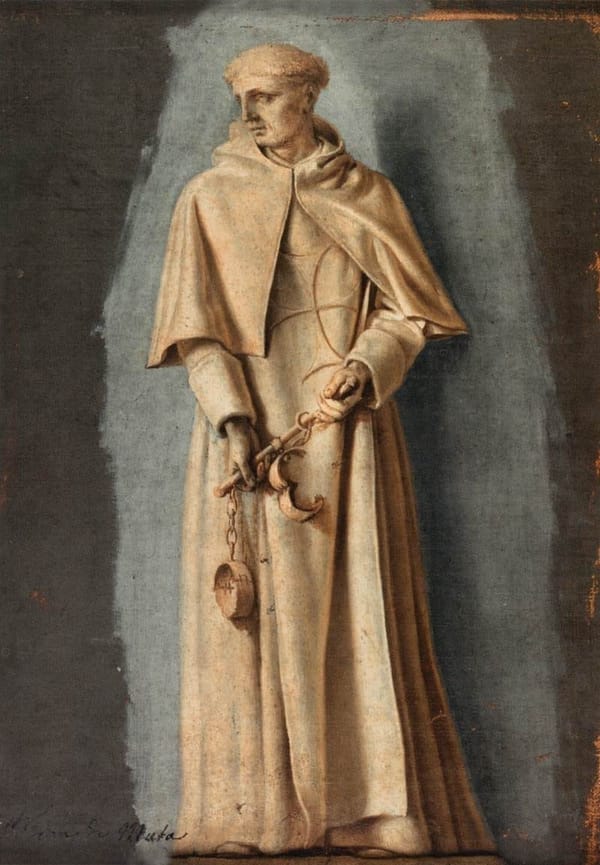 |
February 8: St. John of Matha, Confessor
We were celebrating, not many days ago, the memory of Peter Nolasco, who was inspired, by the holy Mother of God, to found an Order for the ransoming of Christian captives from the infidels: to-day, we have to honour the generous saint, to whom this sublime work was first revealed. He established, under the name of the most holy Trinity, a body of religious men, who bound themselves by vow to devote their energies, their privations, their liberty, nay, their very life, to the service of the poor slaves who were groaning under the Saracen yoke. The Order of the Trinitarians, and the Order of Mercy, though distinct, have the same end in view, and the result of their labours, during the six hundred years of their existence, has been the restoration to liberty and preservation from apostasy of upwards of a million slaves. John of Matha, assisted by his faithful co-operator, Felix of Valois (whose feast we shall keep at the close of the year), established the centre of his grand work at Meaux, in France. We are preparing for Lent, when one of our great duties will have to be that of charity towards our suffering brethren: what finer model could we have than John of Matha, and his whole Order, which was called into existence for no other object than that of delivering from the horrors of slavery brethren who were utter strangers to their deliverers, but were in suffering and in bondage. Can we imagine any almsgiving, let it be ever so generous, which can bear comparison with this devotedness of men, who bind themselves by their rule, not only to traverse every Christian land begging alms for the ransom of slaves, but to change places with the poor captives, if their liberty cannot be otherwise obtained? Is it not, as far as human weakness permits, following to the very letter the example of the Son of God Himself, who came down from heaven that He might be our ransom and our Redeemer? We repeat it: with such models as these before us, we shall feel ourselves urged to follow the injunction we are shortly to receive from the Church, of exercising works of mercy towards our fellow-creatures, as being one of the essential elements of our lenten penance.
But it is time we should listen to the account given us by the liturgy of the virtues of this apostolic man, who has endeared himself, both to the Church and to mankind, by his heroism of charity.
And now, generous-hearted saint, enjoy the fruits of thy devoted charity. Our blessed Redeemer recognizes thee as one of His most faithful imitators, and the whole court of heaven is witness of the recompense wherewith He loves to honour thy likeness to Himself. We must imitate thee; we must walk in thy footsteps; for we too hope to reach the same eternal resting-place. Fraternal charity will lead us to heaven, for the works it inspires us to do have the power of freeing the soul from sin, as our Lord assures us.1 Thy charity was formed on the model of that which is in the heart of God, who loves our soul yet disdains not to provide for the wants of our body. Seeing so many souls in danger of apostasy, thou didst run to their aid, and men were taught to love a religion which can produce heroes of charity like thee. Thy heart bled at hearing of the bodily sufferings of these captives, and thy hand broke the chains of their galling slavery. Teach us the secret of ardent charity. Is it possible that we can see a soul in danger of being lost, and remain indifferent? Have we forgotten the divine promise, told us by the apostle: ‘He that causeth a sinner to be converted from the error of his way, shall save his soul from death, and shall cover a multitude of his own sins’?2 Obtain for us, also, a tender compassion for such as are in bodily suffering and poverty, that so we may be generous in comforting them under these trials, which are but too often an occasion of their blaspheming Providence. Dear friend and liberator of slaves! pray, during this holy season, for those who groan under the captivity of sin and Satan; for those, especially, who, taken with the frenzy of earthly pleasures, feel not the weight of their chains, but sleep on peacefully through their slavery. Ransom them by thy prayers, convert them to the Lord their God, lead them back to the land of freedom. Pray for France which was thy country, and save her from infidelity. Protect the venerable remnants of thy Order, that so it may labour for the present wants of the Christian world, since the object for which thou didst institute it has ceased to require its devotedness.
Wednesday of Septuagesima Week
Wednesday of Septuagesima Week
The guilty pair appear before the great God, whom they have offended; and instead of acknowledging their guilt, they seek to palliate and excuse it. But divine justice pronounces their condemnation, and the sentence will be felt by their posterity, even to the last generation. The two beings, that had committed the heinous crime, had been enriched with every gift of nature and grace. It was not with them, as it is with us. Concupiscence which gives us an inclination for what is wrong; ignorance and forgetfulness which cloud the intellect of fallen man, these miseries had nothing whatever to do with the fall of our first parents. They sinned through sheer ingratitude. They began by weighing the proposal of revolt, when they ought to have spurned it with indignation and conquered by flight. Then, by degrees, the proposed crime seemed no great harm, because, though God would lose their obedience, they would gain by the disobedience! And at length, the love of God was made to give place to the love of self, and they declared their independence! Yet God had mercy on them, because of their posterity.
The angels were all created at one and the same instant, and each of them was subjected to the trial, which was to decide his eternal future. Each angel depended on his own act, on his own choice between fidelity to his Creator and rebellion against Him; so that they who rebelled drew on themselves the eternity of God’s chastisement. The human race, on the contrary, existed not save as represented in its two first parents, and was plunged by and with them into the abyss of God’s reprobation: therefore, God, who spared not the angels, mercifully spared the human race.
But let us listen to the three sentences pronounced by God after the fall of man. The first is against the serpent, and is the severest. The curse, which is already upon him, is deepened, and the pardon, which is about to be promised to the human race, is to be given in the form of an anathema against that wicked spirit, that has dared to war with God in the work of His hands.
'I will put enmities between thee and the woman; she shall crush thy head.’1 Thus does God avenge Himself on His enemy. The victory won over the woman is made to turn against the proud conqueror, and become his humiliation and his defeat. In his fiendish craft, he had directed his first attack, not against the man, but against the woman. She, by nature, was weaker and more credulous; and if he conquered her, he hoped—too well, alas!—that Adam would be led to turn against his Creator, in order not to displease the creature. All happened as he willed it: but now, see how God uses the woman to foil and punish him. He enkindles in her heart an implacable hatred against His and our enemy. This cruel serpent may raise his proud head, and, here and there, find men that will adore him: the day will come, when a woman’s foot shall crush this head, which refused to bend before God. This daughter of Eve, whom all generations are to call blessed,2 shall be prefigured by other women: by Debbora, Judith, Esther, and others, all celebrated for their victories over the serpent. She shall be followed, until the end of time, by an uninterrupted succession of Christian virgins and matrons, who, with all their weakness, shall be powerful in co-operating with God’s designs, and, as the apostle says, ‘the unbelieving husband shall be sanctified by the believing wife.’3
Thus will God punish the serpent’s pride. Before pronouncing upon our first parents the sentence they have deserved, He promises to bless their posterity, and pours into their own hearts a ray of hope.
In Dominica Tyrophagi.
| Previous Tuesday of Septuagesima Week | Next Wednesday of Septuagesima Week |