Daily reading
February 11 · Sanctoral
February 11, 2023
From Dom Guéranger’s The Liturgical Year.
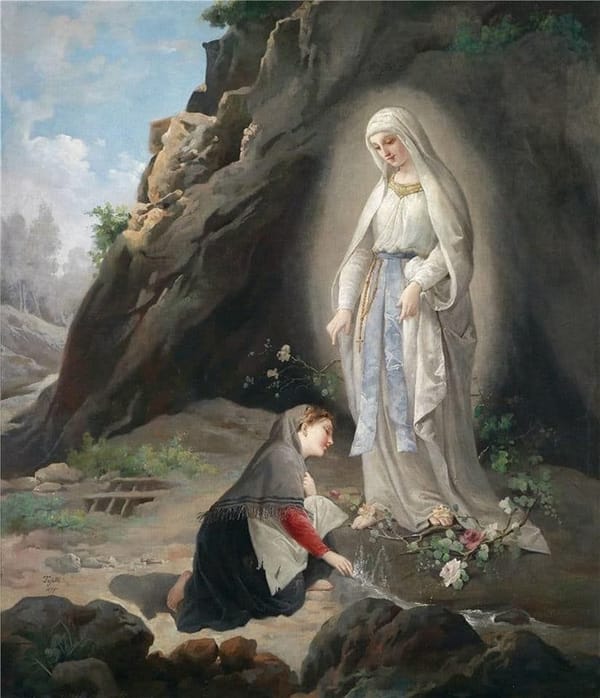
February 11: Our Lady of Lourdes
My bow shall appear in the clouds and I will remember My covenant with you.1
The lessons at Matins on February 11, 1854 (Thursday in Sexagesima week) recalled these words, and the world soon learned that on this very day Mary had appeared, more fair than the sign of hope which typified her at the time of the deluge.
Portents, the realization of which we see in these days, were being multiplied. Mankind had grown old, and seemed about to perish in a deluge more dreadful than the former one. ‘I am the Immaculate Conception,’ said the Mother of divine grace to the humble child whom she chose at such a time to bear her message to the captain of the Ark of salvation. She pierced the gathering darkness with the light of that sublime privilege which the supreme pilot, to his eternal glory, had declared three years before to be dogma.
Indeed, if, as the beloved disciple says, it is our faith to which victory on earth is promised,2 and if faith is nourished by light—what individual dogma is there which so presupposes and recalls all other dogmatic truths, and at the same time throws such light upon them? It is a royal crown on the brow of the victorious queen, resplendent like the rainbow which breaks through the clouds with all the glories of heaven.
But perchance it was still necessary to open the eyes of the blind to these splendours, to inspire courage into hearts saddened by hell’s denials, and to infuse strength to make an act of faith into so many understandings weakened by the education of these days. The Immaculate Virgin summoned the multitudes to the scene of her blessed visit, and both sweetly and strongly succoured the weakness of souls by healing bodies. She smiled upon publicity, welcomed investigation, and confirmed by the authority of miracles her own words and the definition of the Vicar of Christ.
The Psalmist said that the works of God tell His praises in all tongues,3 and St. Paul taxes with folly and impiety those who will not accept this testimony.4 So, too, we may say that the men of these times have no excuse if they do not recognize the blessed Virgin in her works. May she extend the field of her beneficence and take pity on that worst of diseases—that weakness of soul which refuses to see out of a secret fear of the conclusions to be drawn from the evidence, and struggles against the truth until the mind is filled with contradictions and the heart with darkness, so that it seems as though the reason itself were given over to that reprobate sense5 which St. Paul describes as striking the pagans in their flesh.
The things that take place at Lourdes are as famous as any events of contemporary history. Let us listen to the short account which the Church has enshrined in the Liturgy:
‘O Mary, conceived without sin, pray for us who have recourse to thee!’ Thou didst teach us this prayer in 1830 as a safeguard against the dangers of the future. In 1846 the two shepherds of La Salette reminded us of thy tears and exhortations: ‘Pray for poor sinners, pray for the world which is so disturbed.’ To-day the little seer of the grotto of Massabielle brings us thy message: ‘Penitence! Penitence! Penitence!’
We desire to obey thee, O blessed Virgin, to combat in ourselves and all around us that enemy of mankind who is our only real enemy, and sin, that supreme evil which is the source of all others. Praise be to the Almighty, who saved thee from all stain of sin, and thus inaugurated in thee the full restoration of our fallen race. Praise be to thee, who, having no debts of thy own, didst pay our debts with the Blood of thy Son and the tears of His Mother, thus reconciling heaven and earth and crushing the head of the serpent.
Prayer, expiation—the Church from apostolic times has ever urged these thoughts upon us during the days which immediately precede Lent. Dear Mother in heaven, we bless thee for having thus united thy voice to that of our Mother on earth. The world no longer desired, no longer understood, the infallible but indispensable remedy offered by the justice and mercy of God to the misery of man.
Men seemed to have forgotten the words: 'Except you do penance, you shall all perish.’6 Thy pity wakes us from this fatal stupor, O Mary. Thou knowest our weakness, and hast mingled sweetness in the bitter draught. Thou lavishest temporal favours upon man in order that he may ask of thee eternal blessings. We will not be like those children who welcome their mother’s caresses, but neglect her admonitions and the corrections which her tenderness sought to make acceptable. We will pray and suffer in union with Jesus and thee. By thine assistance during this Lent we will be converted and do penance.
Saturday of Septuagesima Week
The sentence pronounced by the Almighty upon our first parents was to fall upon their children to the end of time. We have been considering, during this week of Septuagesima, the penalties of the great sin; but the severest and most humiliating of them all remains to be told. It is the transmission to the whole human race of original sin. It is true that the merits of the promised Redeemer will be applied to each individual man, in the manner established by God at various periods of time: still, this spiritual regeneration, whilst cleansing us from the leprosy which covered us, and restoring us to the dignity of children of God, will not remove every scar of the old wound. It will save us from eternal death, and restore us to life; but, as long as our pilgrimage lasts, we shall be weak and sickly. Thus it is that ignorance makes us short-sighted in those great truths, which should engross all our thoughts; and this fills us with illusions, which, by an unhappy inclination of our will, we cling to and love. Concupiscence is ever striving to make our soul a slave to the body; and in order to escape this tyranny, our life has to be one continual struggle. An unruly love for independence is unceasingly making us desire to be our own masters, and forget that we were born to obey. We find pleasure in sin, whereas virtue rewards us with nothing, in this life, save the consciousness of our having done our duty.
Knowing all this, we are filled with admiration and love when we think of thee, O Mary! thou purest of God’s creatures. Thou art our sister in nature; thou art a daughter of Eve; but thou wast conceived without sin, and art therefore the honour of the human race. Thou art of the same flesh and blood as ourselves; and yet thou art immaculate. The divine decree, which condemned us to inherit the disgrace of original sin, could not include thy most pure conception; and the serpent felt, as thy foot crushed his haughty head, that thou hadst never been under his power. In thee, O Mary! we find our nature such as it was when our God first created it. Hail, then, spotless Mirror of justice!
O Mary! beautiful in thine unsullied holiness, pray for us who are weighed down by the consequences of that sin of our first parents, which God would not suffer to approach thee. Thou art the implacable enemy of the serpent; watch over us, lest his sting inflict death on our souls. We were conceived in sin, and born in sorrow; pray for us, that we may so live as to merit blessing. We are condemned to toil, to suffering, and to death; intercede for us, that our atonement may find acceptance with our Lord. We are exposed to the treachery of our evil inclinations; we are in love with this present life; we forget eternity; we are ever striving to deceive our own hearts: how could we escape hell, were the grace of thy divine Son not unceasingly offered to us, enabling us to triumph over all our enemies? Thou, O Immaculate Mother of Jesus, art the Mother of divine grace! Pray for us, that we, who glory in being thy kindred by nature, may be daily more and more enriched with this priceless gift.
Let us salute the blessed Mother of God in the words of the following sequence, taken from the ancient missal of Cluny. Catholic piety has consecrated to Mary the Saturday of each week.
Sequence
Modulemur licet rei,
Poscentes remedia.
Spes mirandæ speciei,
Quæ vernat in gloria.
Spes Solaris, sola laris
Terreni fiducia.
Passus rectos et directos,
Da pacis suffragia.
Fulgens dux in pelago,
Tu præclara.
Stella nitens celebris,
Deo cara.
Residens, hæc mellica
Admitte cantica, Virgo pia.
Trementi pro scelere
Des ausus, Tu plausus, Veri vena.
Mundi medicina,
Munda scelus nostrum,
Piissima.
Nos ad vitam mina,
Placans Deum,
Tu benignissima.
Patria parens, Virgo pia,
Nos in umbræ mortis via
Sedentes illumina!
Tui Nati tuti cruce,
Mereamur cœli luce
Per te frui, Domina.
sing a hymn in praise of the Mother of God;
let us sing our prayer for help.
that beautiful Mother,
whose glory is bright as spring!
and warms our earthly home
with the sunny beam of hope.
direct us, steer us,
get us the calm of peace.
guiding us, as does the friendly star which leads
the shipwrecked into port.
thou art the shining well-known star,
so dear to God.
receive, O Virgin Mother,
these our sweet canticles.
do thou, fount of truth,
give courage and applause.
thou art the solace of the world;
may thy loving prayers
cleanse us from our guilt.
but intercede for us to God,
most merciful Queen!
and so lead us unto life.
Mother of thy Creator!
Virgin ever merciful! enlighten us
that are sitting in the shades of death.
and protected by the cross of thy Son,
we may, through thy intercession,
be brought to the enjoyment of light eternal.
| Previous Friday of Septuagesima Week | Next Saturday of Septuagesima Week |