Daily reading
Simple · February 15 · Sanctoral
February 15, 2023
From Dom Guéranger’s The Liturgical Year.
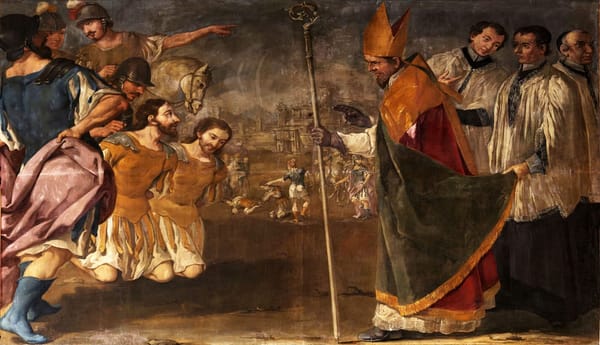
February 15: Sts. Faustinus and Jovita, Martyrs
The two brothers whom we are to honour to-day suffered martyrdom in the beginning of the second century, and their memory has ever been celebrated in the Church. The glory of the great ones of this world passes away, and men soon forget even their very names. Historians have oftentimes a difficulty in proving that such heroes ever existed, or, if they did exist, that they flourished at such a period, or achieved anything worth notice. Brescia, the capital of one of the Italian provinces, can scarcely mention the names of those who were its governors or leading men in the second century; and yet here are two of her citizens, whose names will be handed down, with veneration and love, to the end of the world, and the whole of Christendom is filled with the praise of their glorious martyrdom. Glory, then, to these sainted brothers, whose example so eloquently preaches to us the great lesson of our season, fidelity in God's service.
The sufferings which merited for them the crown of immortality, are thus recorded in the liturgy:
When we compare our trials with yours, noble martyrs of Christ, and our combats with those that you had to fight, how grateful ought we to be to our Lord for having so mercifully taken our weakness into account! Should we have been able to endure the tortures, wherewith you had to purchase heaven, we that are so easily led to break the law of God, so tardy in our conversion, so weak in faith and charity? And yet, we are made for that same heaven which you now possess. God holds out a crown to us also, and we are not at liberty to refuse it. Rouse up our courage, brave martyrs! Obtain for us a spirit of resistance against the world and our evil inclinations; that thus we may confess our Lord Jesus Christ, not only with our lips, but with our works too, and testify, by our conduct, that we are Christians.
Wednesday of Sexagesima Week
O God of infinite justice! we have sinned; we have abused the life Thou hast given us: and when we read, in Thy Scriptures, how Thine anger chastised the sinners of former days, we are forced to acknowledge, that we have deserved to be treated in like manner. We have the happiness to be Christians and children of Thy Church; the light of faith, and the power of Thy grace, have brought us once more into Thy friendship; but how can we forget that we were once Thy enemies? And are we so deeply rooted in virtue, that we can promise ourselves perseverance in it to the end? Pierce, O Lord! pierce my flesh with Thy fear.1 Man’s heart is hard, and unless it fear Thy sovereign Majesty, it may again offend Thee.
We are penetrated with fear, when we remember that Thou didst bury the world and destroy mankind by the waters of the deluge; for we learn by this, how Thy patience and long-suffering may be changed into inexorable anger. Thou art just, O Lord! and who shall presume to take scandal, or to murmur, when Thy wrath is enkindled against sinners?
We have defied Thy justice, we have braved Thine anger; for, though Thou hast told us that Thou wilt never more destroy sinners by a deluge of water, yet we know that Thou hast created, in Thy hatred for sin, a fire, which shall eternally prey on them that depart this life without being first reconciled with Thy offended Majesty.
O wonderful dignity of our human nature! We cannot be indifferent towards that infinite Being that created us: we must be His friends or His enemies! It could not have been otherwise. Ile gave us understanding and free-will: we know what is good and what is evil, and we must choose the one or the other: we cannot remain neutral. If we choose good, God turns towards us and loves us; if evil, we separate from Him, who is our sovereign Good. But, whereas He bears most tender mercy towards this frail creature whom He created out of pure love, and because He wills that all men should be saved, He waits with patience for the sinner to return to Him, and, in countless ways, draws his heart to repentance.
But woe to him that obeys not the divine call, when that call is the last! Then justice takes the place of mercy, and revelation tells us how fearful a thing it is to fall into the hands of the living God.2 Let us, then, flee from the wrath to come,3 by making our peace with the God we have offended. If we be already restored to grace, let us walk in His fear, until love shall have grown strong enough in our hearts to make us run the way of the commandments.4
The following prayer is from the Mozarabic breviary of the Gothic Church of Spain.
Oratio
(In capite jejunii.)
| Previous Tuesday of Sexagesima Week | Next Wednesday of Sexagesima Week |