Daily reading
Lent
Double · Movable from Easter · Temporal
February 23, 2023
From Dom Guéranger’s The Liturgical Year.
 |
Thursday after Ash Wednesday
Although the law of fasting began yesterday, yet Lent, properly so called, does not begin till the Vespers of Saturday next. In order to distinguish the rest of Lent from these four days which have been added to it, the Church continues to chant Vespers at the usual hour, and allows her ministers to break their fast before having said that Office. But, beginning with Saturday, the Vespers will be anticipated; every day (Sundays excepted, which always exclude fasting), they will be said at such an early hour, that when the faithful take their full meal, the evening Office will be over. It is a remnant of the discipline of the primitive Church, which forbade the faithful to break their fast before sunset, in other words, before Vespers or Evensong.
The Church has given to these three days after Ash Wednesday a resemblance to the other ferias of her lenten season, by assigning to each of them a lesson from the Old Testament, and a Gospel, for Mass. We, of course, insert them, adding a few reflections to each. We also give the Collects of these three days.
The station, in Rome, for the Thursday after Ash Wednesday, is in the church of St. George in Velabro (the veil of gold).
Collect
Epistle
Cap. xxxviii.In diebus illis, ægrotavit Ezechias usque ad mortem: et introivit ad eum Isaias filius Araos propheta, et dixit ei: Hæc dicit Dominus: Dispone domui tuæ, quia morieris tu, et non vives. Et convertit Ezechias faciem suam ad parietem, et oravit ad Dominum, et dixit: Obsecro, Domine, memento, quæso, quomodo ambulaverim coram te in veritate, et in corde perfecto, et quod bonum est in oculis tuis fecerim. Et flevit Ezechias fletu magno. Et factum est verbum Domini ad Isaiam dicens: Vade, et dic Ezechiæ: Hæc dicit Dominus Deus David patris tui: Audivi orationem tuam, et vidi lacrymas tuas: ecce ego adjiciam super dies tuos quindecim annos: et de manu regis Assyriorum eruam te, et civitatem istam, et protegam eam, ait Dominus omnipotens.
Ch. xxxviii.In those days, Ezechias was sick even to death, and Isaias the son of Amos the prophet came unto him, and said to him: Thus saith the Lord: Take order with thy house, for thou shalt die, and not live. And Ezechias turned his face towards the wall, and prayed to the Lord, and said: I beseech thee, O Lord, remember how I have walked before thee in truth, and with a perfect heart, and have done that which is good in thy sight. And Ezechias wept with great weeping. And the word of the Lord came to Isaias, saying: Go and say to Ezechias: Thus saith the Lord the God of David thy father: I have heard thy prayer, and I have seen thy tears: behold I will add to thy days fifteen years: and I will deliver thee and this city out of the hands of the king of the Assyrians, and I will protect it, saith the Lord almighty.
Yesterday, the Church spoke to us upon the certainty of death. Die we must: we have not only God’s infallible word for it, but no reasonable man could ever entertain the thought that he was to be an exception to the rule. But if the fact of our death be certain, the day on which we are to die is also fixed. God, in His wisdom, has concealed the day from us; it becomes our duty not to be taken by surprise. This very night, it might be said to us, as it was to Ezechias: Take order with thy house, for thou shalt die. We ought to spend each day, as though it were to be our last. Were God even to grant us, as He did to the holy king of Juda, a prolongation of life, we must come, sooner or later, to that last hour, beyond which there is no time, and eternity begins. The Church’s intention in thus reminding us of our mortality, is to put us on our guard against the allurements of this short life, and urge us to earnestness in the great work of regeneration, for which she has been preparing us during these last three weeks. How many there are of those who yesterday received the ashes, who will never see the joys of Easter, at least in this world! To them, the ceremony has been a prediction of what is to happen to them, perhaps before the month is out. And yet the very same words that were pronounced over them, were said to us. May not we ourselves be of the number of those who are thus soon to be victims of death? In this uncertainty, let us gratefully accept the warning, which our Jesus came down from heaven to give us: ‘Do penance; for the kingdom of God is at hand.’*
Gospel
Cap. viii.In illo tempore: Cum introisset Jesus Capharnaum, accessit ad eum centurio, rogans eum et dicens: Domine, puer meus jacet in domo paralyticus, et male torquetur. Et ait illi Jesus: Ego veniam, et curabo eum. Et respondens centuno, ait: Domine, non sum dignus ut intres sub tectum meum; sed tantum dic verbo, et sanabitur puer meus. Nam et ego homo sum sub potestate constitutus, habens sub mo milites, et dico huic: Vado, et vadit; et alii: Veni, et venit; et servo meo: Fac hoc, et facit. Audiens autcm Jesus miratus est, et sequentibus se dixit: Amen dico vobis, non inveni tantam fidem in Israel: Dico autem vobis, quod multi ab oriente et occidente venient, et recumbent cum Abraham, et Isaac, et Jacob in regno cœlorum; filii autem regni ejicientur in tenebras exteriores: ibi erit fletus et stridor dentium. Et dixit Jesus centurioni: Vade, et sicut credidisti, fiat tibi. Et sanatus est puer in illa hora.
Ch. viii.At that time: When Jesus had entered into Capharnaum, there came to him a centurion, beseeching him, and saying: Lord, my servant lieth at home sick of the palsy, and is grievously tormented. And Jesus saith to him: I will come and heal him. And the centurion making answer said: Lord, I am not worthy that thou shouldst enter under my roof; but only say the word, and my servant shall be healed. For I also am a man under authority, having under me soldiers; and I say to this, Go, and he goeth; and to another, Come, and he cometh; and to my servant, Do this, and he doth it. And Jesus hearing this, marvelled, and said to them that followed him: Amen, I say to you, I have not found so great faith in Israel. And I say to you, that many shall come from the east and the west, and shall sit down with Abraham, and Isaac, and Jacob, in the kingdom of heaven; but the children of the kingdom shall be cast out into exterior darkness: there shall be weeping and gnashing of teeth. And Jesus said to the centurion; Go, and as thou hast believed, so be it done to thee. And the servant was healed at the same hour.
The sacred Scriptures, the fathers, and theologians, tell us that there are three eminent good works which are, at the same time, works of penance: prayer, fasting, and almsdeeds. In the lessons she gives us on these three days, which form as it were the threshold of Lent, the Church instructs us upon these works. To-day it is prayer she recommends to us. Look at this centurion, who comes to our Saviour, beseeching Him to heal his servant. His prayer is humble; in all the sincerity of his heart, he deems himself unworthy to receive Jesus under his roof. His prayer is full of faith; he doubts not for an instant that Jesus is able to grant him what he asks. And with what ardour he prays! The faith of this Gentile is greater than that of the children of Israel, and elicits praise from the Son of God. Such ought to be our prayer, when we solicit the cure of our souls. Let us acknowledge that we are not worthy to speak to God, and yet, let us have an unshaken confidence in the power and goodness of Him, who only commands us to pray that He may pour out His mercies upon us. The season we are now in is one of prayer; the Church redoubles her supplications; it is for us that she makes them; we must take our share in them. Let us, during this season of grace, cast off that languor which fastens on the soul at other times; let us remember that it is prayer which repairs the faults we have already committed, and preserves us from sin for the future.
* St. Matt. iv. 17. ↩︎
February 23: St. Peter Damian, Cardinal and Doctor of the Church
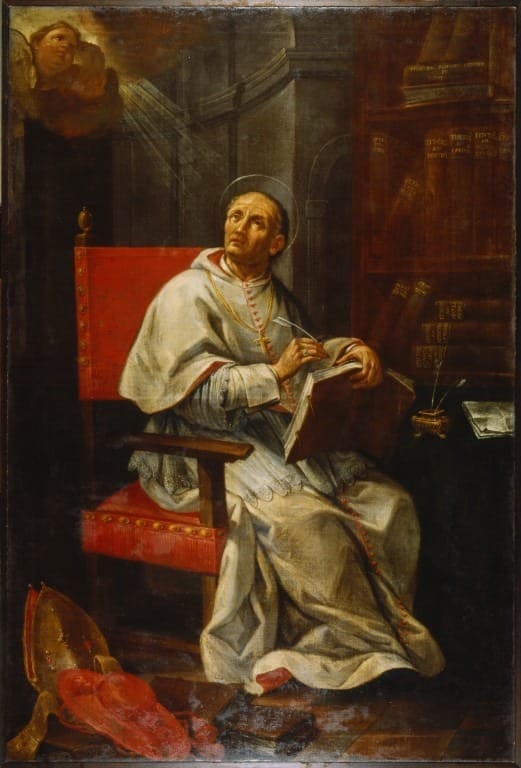 |
It is the feast of the austere reformer of the eleventh century, Peter Damian, the precursor of the holy pontiff Gregory VII., that we are called upon to celebrate to-day. To him is due in part that glorious regeneration, which was effected at that troubled period when judgment had to begin at the house of God.1 The life he had led under the monastic rule had fitted him for the great contest. So zealously did he withstand the disorders and abuses of his times, that we may attribute to him, at least in great measure, the ardent faith of the two centuries which followed the scandals of the tenth. The Church ranks him among her doctors, on account of his admirable writings: and his penitential life ought to excite us to be fervent in the work we have in hand, the work of our conversion.
The following lessons, read by the Church, on this feast, give us a sketch of our saint’s life:
Thy soul was inflamed by the zeal of God’s house, O Peter! God gave thee to His Church in those sad times when the wickedness of the world had robbed her of well-nigh all her beauty. Thou hadst the spirit of an Elias within thee, and it gave thee courage to waken the servants of the Lord: they had slept, and while they were asleep, the enemy came, and the field was oversown with tares.2 Then did better days dawn for the bride of Christ; the promises made by our Lord were fulfilled; but who was the friend of the bridegroom?3 Who was the chief instrument used by God to bring back to His house its ancient beauty? A saint who bore the glorious name of Peter Damian! In those days, the sanctuary was degraded by secular interference. The princes of the earth said: 'Let us possess the sanctuary of God for an inheritance.’4 The Church, which God intended to be free, was but a slave, in the power of the rulers of this world; and the vices, which are inherent to human weakness, defiled the temple. But God had pity on the bride of Christ, and for her deliverance He would use human agency: He chose thee, Peter, as His principal co-operator in restoring order. Thy example and thy labours prepared the way for Gregory, the faithful and dauntless Hildebrand, into whose hands the keys were no sooner placed, than the work of regeneration was completed. Thou hast fought the good fight; thou art now in thy rest; but thy love of the Church, and thy power to help, are greater than ever. Watch, then, over her interests. Obtain for her pastors that apostolic energy and courage, which alone can cope with enemies so determined as hers are. Obtain for her priests the holiness which God demands from them that are the salt of the earth.5 Obtain for the faithful the respect and obedience they owe to those who direct them in the path of salvation. Thou wast not only the apostle, thou wast moreover the model, of penance in the midst of a corrupt age; pray for us, that we may be eager to atone for our sins by works of mortification. Excite within our souls the remembrance of the sufferings of our Redeemer, that so His Passion may urge us to repentance and hope. Increase our confidence in Mary, the refuge of sinners, and make us, like thyself, full of filial affection towards her, and of zeal that she may be honoured and loved by those who are around us.
| Previous February 22: St. Peter's Chair at Antioch | Next February 23: St. Peter Damian, Cardinal and Doctor of the Church |