Daily reading
Semidouble · Movable from Easter · Temporal
March 10, 2023
From Dom Guéranger’s The Liturgical Year.
Friday of the Second Week of Lent
The Station for to-day is in the church of Saint Vitalis, martyr, the father of the two illustrious Milanese martyrs, Saints Gervasius and Protasius.
Collect
Epistle
Cap. xxxvii.In diebus illis: Dixit Joseph fratribus suis: Audite somnium meum quod vidi: Putabam nos ligare manipulos in agro: et quasi consurgere manipulum meum, et stare, vestrosque manipulos circumstantes adorare manipulum meum. Responderunt fratres ejus: Numquid rex noster eris? aut subjiciemur ditioni tuæ? Hæe ergo causa somniorum atque sermonum, invidiæ et odii fomitem ministra vit. Aliud quoque vidit somnium, quod narrans fratribus ait; Vidi per somnium quasi solem, et lunam, et Stellas undecim adorare me, Quod quum patri suo et fratribue retulisset, increpavit eum pater suns, et dixit: Quid sibi vult hoc somnium quod vidisti? Num ego, et mater tua, et fratres tui adorabimus te super terram? Invidebant ei igitur fratres sui: pater vero rem tacitus considerabat. Cumque fratres illiue in pascendis gregibus patris morarentur in Sichem, dixit ad eum Israël: Fratres tui pascunt oves in Siohimie: veni, mittam te ad eos. Quo respondente: Præsto sum; ait ei: Vade, et vide si cuneta prospera sint erga fratres tuos, et pecora: et renuntia mihi quid agatur. Missus de valle Hebron, venit in Sichem: invenitque eum vir errantem in agro, et interrogavit quid quæreret. At ille respondit: Fratres meos quæro: indica mihi ubi paecant greges. Dixitque ei vir: Recesserunt de loco isto; audivi autem eos dicentes: Eamus in Dothain. Perrexit ergo Joseph post fratres suos, et invenit eos in Dothain. Qui cum vidissent eum procul, antequam accederet ad eos, cogitaverunt ilium occidere, et mutuo loquebantur: Ecce somniator venit: venite, occidamus eum, et mittamus in cistemam veterem: dicemusque: Fera pessima devoravit eum, et tune apparebit quid illi prosint somnia sua. Audiens autem hoc Ruben, nitebatur liberare eum de manibus eorum, et dicebat: Non interficiatis animam ejus, nec effundatis sanguinem; sed projicite eum in cisternam hane, quæ est in solitudine, manusque vestras servate innoxias. Hoc autem dicebat, volens eripere eum de manibus eorum, et reddere patri suo.
Ch. xxxvii.In those days: Joseph said to his brethren: Hear my dream which I have dreamed. I thought we were binding sheaves in the field; and my sheaf arose, as it were, and stood, and your sheaves, standing about, bowed down before my sheaf. His brethren answered: Shalt thou be our king? or shall we be subject to thy dominion? Therefore this matter of his dreams and words ministered nourishment to their envy and hatred. He dreamed also another dream, which he told his brethren, saying: I saw in a dream, as it were, the sun, and the moon, and eleven stars, worshipping me. And when he had told this to his father and brethren, his father rebuked him and said: What meaneth this dream that thou hast dreamed? shall I and thy mother, and thy brethren, worship thee upon the earth? His brethren therefore envied him, but his father considered the thing with himself. And when his brethren abode in Sichem, feeding their father’s flocks, Israel said to him: Thy brethren feed the sheep in Sichem; come, I will send thee to them. And when he answered: I am ready; he said to him: Go, and see if all things be well with thy brethren and the cattle, and bring me word again what is doing. So being sent from the vale of Hebron, he came to Sichem. And a man found him there wandering in the field, and asked him what he sought. But he answered: I seek my brethren; tell me where they feed their flocks. And the man said to him: They are departed from this place; for I heard them say: Let us go to Dothain. And Joseph went forward after his brethren, and found them in Dothain. And when they saw him afar off, before he came nigh them, they thought to kill him, and said one to another: Behold the dreamer cometh; come, let us kill him, and cast him into some old pit: and we will say: Some evil beast hath devoured him: and then it shall appear what his dreams avail him. And Ruben hearing this, endeavoured to deliver him out of their hands, and said: Do not take away his life, nor shed his blood; but cast him into this pit that is in the wilderness, and keep your hands harmless. Now he said this, being desirous to deliver him out of their hands, and to restore him to his father.
To-day the Church reminds us of the apostasy of the Jewish nation, and of the consequent vocation of the Gentiles. This instruction was intended for the catechumens; let us, also, profit by it. The history here related from the old Testament is a figure of what we read in to-day’s Gospel. Joseph is exceedingly beloved by his father Jacob, not only because he is the child of his favourite spouse Rachel, but also because of his innocence. Prophetic dreams have announced the future glory of this child: but he has brothers; and these brothers, urged on by jealousy, are determined to destroy him. Their wicked purpose is not carried out to the full; but it succeeds at least this far, that Joseph will never more see his native country. He is sold to some merchants. Shortly afterwards, he is cast into prison; but he is soon set free, and is made the ruler, not of the land of Chanaan that had exiled him, but of a pagan country, Egypt. He saves these poor Gentiles from starvation, during a most terrible famine, nay, he gives them abundance of food, and they are happy under his government. His very brothers, who persecuted him, are obliged to come down into Egypt, and ask food and pardon from their victim. We easily recognize in this wonderful history our divine Redeemer, Jesus, Son of God and Son of Mary. He was the victim of His own people’s jealousy, who refused to acknowledge in Him the Messias foretold by the prophets, although their prophecies were so evidently fulfilled in Him. Like Joseph, Jesus is the object of a deadly conspiracy; like Joseph, He is sold. He traverses the shadow of death, but only to rise again, full of glory and power. But it is no longer on Israel that He lavishes the proofs of His predilection; He turns to the Gentiles, and with them He henceforth dwells. It is to the Gentiles that the remnant of Israel will come seeking Him, when, pressed by hunger after the truth, they are willing to acknowledge, as the true Messias, this Jesus of Nazareth, their King, whom they crucified.
Gospel
Cap. xxi.In illo tempore: Dixit Jesus turbis Judæorum, et principibus sacerdotum parabolam hane: Homo erat paterfamilias, qui plantavit vineam, et sepem circumdedit ei, et fodit in ea torcular, et ædifieavit turrim, et locavit eam agricolis, et peregre profectus est. Cum autem tempus fructuum appropinquasset, misit servos suos ad agricolas, ut acciperent fructus ejus. Et agricolæ, apprehensis servis ejus, alium ceciderunt, alium occiderunt, alium vero lapidaverunt. Iterum misit alios servos plures priori bus, et fecerunt illis similiter. Novissime autem misit ad eos filium suum, dicens: Verebuntur filium meum. Agricolæ autem videntes filium, dixerunt intra se: Hic est hæres: venite, occidamus eum, et habebimus hæreditatem ejus. Et apprehensum eum ejecerunt extra vineam, et occiderunt. Cum ergo venerit dominus vineae, quid faciet agricolis illis? Aiunt illi: Malos male perdet: et vineam suam locabit aliis agricolis, qui reddant ei fructum temporibus suis. Dicit illis Jesus: Nunquam legistis in Scripturis: Lapidem quem reprobaverunt ædificantes, hicfactus est in caput anguli? A Domino factum est istud, et est mirabile in oculis nostris. Ideo dico vobis, quia auferetur a vobis regnum Dei, et dabitur genti facienti fructus ejus. Et qui ceciderit super lapidem istum, confringetur: super quem vero ceciderit, conteret eum. Et cum audissent principes sacerdotum et pharisæi parabolas ejus, cognoverunt quod de ipsis diceret. Et quærentes eum tenere, timuerunt turbas: quoniam sicut prophetam eum habebant.
Ch. xxi.At that time: Jesus spoke to the multitude of the Jews, and to the chief priests this parable: There was a man an householder, who planted a vineyard, and made a hedge round about it, and dug in it a press, and built a tower, and let it out to husbandmen, and went into a strange country. And when the time of the fruits drew nigh, he.sent his servants to the husbandmen, that they might receive the fruits thereof. And the husbandmen laying hands on his servants, beat one, and killed another, and stoned another. Again he sent other servants, more than the former; and they did to them in like manner. And last of all he sent to them his son, saying: They will reverence my son. But the husbandmen seeing the son, said among themselves: This is the heir, come, let us kill him, and we shall have his inheritance. And taking him, they cast him forth out of the vineyard, and killed him. When, therefore, the lord of the vineyard shaU come, what will he do to those husbandmen? They say to him: He will bring those evil men to an evil end: and will let out his vineyard to other husbandmen that shall render him the fruit in due season. Jesus saith to them: Have you never read in the Scriptures: The stone which the builders rejected, the same is become the head of the corner? By the Lord this has been done, and it is wonderful in our eyes. Therefore I say to you, that the kingdom of God shall be taken from you, and shall be given to a nation yielding the fruits thereof. And whosoever shall fall on this stone, shall be broken; but on whomsoever it shall fall, it shall grind him to powder. And when the chief priests and pharisees had heard his parables, they knew that he spoke of them. And seeking to lay hands on him they feared the multitude; because they held him as a prophet.
Here we have more than the mere figures of the old Law, which show us our Redeemer in the far distant future; we have the great reality. Yet a little while, and the thrice holy Victim will have fallen beneath the blows of His persecutors. How awful and solemn are the words of Jesus, as His last hour approaches! His enemies feel the full weight of what He says; but, in their pride, they are determined to keep up their opposition to Him, who is the Wisdom of the Father. They have made up their minds not to acknowledge Him to be what they well know He is—the stone, on which he that falls shall be broken, and which shall grind to powder him on whom it shall fall. But what is the vineyard, of which our Lord here speaks? It is revealed truth; it is the rule of faith and morals; it is the universal expectation of the promised Redeemer; and, lastly, it is the family of the children of God, His inheritance, His Church. God had chosen the Synagogue as the depository of such a treasure; He willed that His vineyard should be carefully kept, that it should yield fruit under their keeping, and that they should always look upon it as His possession, and one that was most dear to Him. But, in its hard-heartedness and avarice, the Synagogue appropriated the Lord’s vineyard to itself. In vain did He, at various times, send His prophets to reclaim His rights; the faithless husbandmen put them to death. The Son of God, the Heir, comes in Person. Surely, they will receive Him with due respect, and pay Him the homage due to His divine character! But no; they have formed a plot against Him; they intend to cast Him forth out of the vineyard, and kill Him. Come, then, ye Gentiles, and avenge this God! Leave not a stone on a stone of the guilty city that has uttered this terrible curse: ‘May His Blood be upon us and upon our children!’1 But you shall be more than the ministers of the divine justice; you yourselves are now the favoured people of God. The apostasy of these ungrateful Jews is the beginning of your salvation. You are to be keepers of the vineyard to the end of time; you are to feed on its fruits, for they now belong to you. From east and west, from north and south, come to the great Pasch, that is being prepared! Come to the font of salvation, O ye new people, who are gathered unto God from all nations under the sun! Your mother the Church will fill up from you, if you be faithful, the number of the elect; and when her work is done, her Spouse will return, as the dread Judge, to condemn those who would not know the time of their visitation.2
Let us encourage within ourselves the spirit of humility and penance by the following hymn, which we take from the Greek liturgy. It was composed by St. Andrew of Crete.
Hymn (Feria V. quintæ hebdomadæ)
March 10: The Forty Martyrs
|
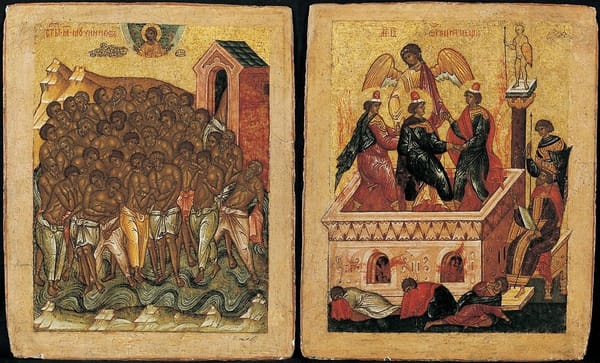
We know the mystery of the number forty. This tenth of March brings it before us. Forty new advocates! Forty encouraging us to enter bravely on our career of penance! On the frozen pool, which was their field of battle, these martyrs reminded one another that Jesus had fasted for forty days, and that they themselves were forty in number! Let us, in our turn, compare their sufferings with the lenten exercises which the Church imposes upon us; and humble ourselves on seeing our cowardice; or, if we begin with fervour, let us remember that the grand thing is to be faithful to the end, and bring to the Easter solemnity the crown of our perseverance. Our forty martyrs patiently endured the cruellest tortures; the fear of God, and their deep-rooted conviction that He had an infinite claim to their fidelity, gave them the victory. How many times we have sinned, and had not such severe temptations as theirs to palliate our fall! How can we sufficiently bless that divine mercy, which spared us, instead of abandoning us as it did that poor apostate, who turned coward and was lost! But, on what condition did God spare us? That we should not spare ourselves, but do penance. He put into our hands the rights of His own justice; justice, then, must be satisfied, and we must exercise it against ourselves. The lives of the saints will be of great help to us in this, for they will teach us how we are to look upon sin, how to avoid it, and how strictly we are bound to do penance for it after having committed it.
The Church, in her liturgy, thus relates to us the martyrdom of the soldiers of Sebaste.
That we may the more worthily celebrate the memory of the forty martyrs, we borrow a few stanzas from the hymn in which the Greek liturgy so enthusiastically sings their praises.
Hymn (Die IX . Martii)
Valiant soldiers of Christ, who meet us, with your mysterious number, at this commencement of our forty days’ fast, receive the homage of our devotion. Your memory is venerated throughout the whole Church, and your glory is great in heaven. Though engaged in the service of an earthly prince, you were the soldiers of the eternal King: to Him were you faithful, and from Him did you receive your crown of eternal glory. We, also, are His soldiers; we are fighting for the kingdom of heaven. Our enemies are many and powerful; but, like you, we can conquer them, if, like you, we use the arms which God has put in our hands. Faith in God’s word, hope in His assistance, humility, and prudence, with these we are sure of victory. Pray for us, O holy martyrs, that we may avoid all compromise with our enemies; for our defeat is certain, if we try to serve two masters. During these forty days, we must put our arms in order, repair our lost strength, and renew our engagements; come to our assistance, and get us a share in your brave spirit. A crown is also prepared for us: it is to be won on easier terms than yours; and yet we shall lose it, unless we keep up within us an esteem for our vocation. How many times, in our past lives, have we forfeited that glorious crown! But God, in His mercy, has offered it to us again, and we are resolved on winning it. Oh, for the glory of our common Lord and Master, make intercession for us.
Our work of preparation is over: we are ready to obey our mother’s call to Lent. During the three past weeks, we have studied the fall of our first parents, and the miseries it brought upon man; the necessity of a Saviour; the justice of God, against which the human race dared to rebel; the terrible chastisement of the deluge, wherewith that revolt was punished; and finally, the covenant made by God, through Abraham, with those who are faithful to Him, and shun the maxims of a perverse and guilty world.
Now we are to see the accomplishment of the great mysteries, whereby the wounds of our fall were healed, the divine justice was disarmed, and God’s grace was poured out upon us, delivering us from the yoke of Satan and the world.
The Man-God, whose sweet presence has been less sensible during this Septuagesima season, is now about to show Himself to us again, but this time it is on His way to Calvary, where He is to be immolated for our redemption. The dolorous Passion, which our sins have imposed upon Him, is about to be brought before us: the greatest of anniversaries will soon be upon us.
Let us be all attention to the mysteries: let us be fervent in the great work of our own purification. Let us walk on courageously in the path of penance, so that each day the burden of our sins may be lightened, and after we have partaken, by heartfelt compassion, of the cup of our Redeemer’s Passion, our lips will be once more permitted to sing the songs of joy, and our hearts will thrill at Easter with the loud burst of the Church’s Alleluia!
| Previous Thursday of the Second Week of Lent | Next March 10: The Forty Martyrs |