Daily reading
Lent
Greater Double · March 21 · Sanctoral
March 21, 2023
From Dom Guéranger’s The Liturgical Year.
A Greater Double leads the weekday.Rubric

|
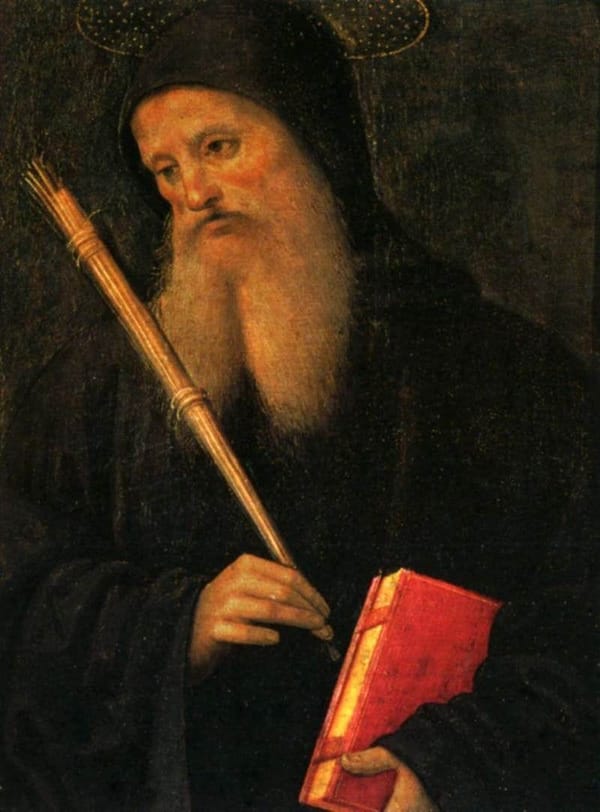
March 21: St. Benedict, Abbot
Forty days after the white dove of Cassino had mounted to heaven, Benedict, her glorious brother, ascended by a bright path to the blissful abode, where they were to be united for ever. Both of them reached the heavenly country during that portion of the year which corresponds with the holy season of Lent. It frequently happens, however, that St. Scholastica’s feast is kept before Lent has begun; whereas St. Benedict’s day, the twenty-first of March, always comes during the season of penance. God, who is the sovereign Master of time, willed that the faithful, whilst practising their exercises of penance, should always have before their eyes a saint whose example and intercession would inspire them with courage.
With what profound veneration ought we to celebrate the festival of this wonderful saint, who, as St. Gregory says, was filled with the spirit of all the just! If we consider his virtues, we find nothing superior in the annals of perfection presented to our admiration by the Church.
Love of God and man, humility, the gift of prayer, dominion over the passions—form him into a masterpiece of the grace of the Holy Ghost. Miracles seem to constitute his life: he cures the sick, commands the elements, casts out devils, and raises the dead to life. The spirit of prophecy unfolds futurity to him; and the most intimate thoughts of men are not too distant for the eye of his mind to scan. These superhuman qualifications are heightened by a sweet majesty, a serene gravity, and a tender charity, which shine in every page of his wonderful life; and it is one of his holiest children who wrote it, St. Gregory the Great. It is this holy Pope and Doctor, who had the honour of telling posterity all the wonders which God vouchsafed to work in His servant Benedict.
Posterity had a right to know the life and virtues of a man, whose salutary influence upon the Church and society has been so observable during the ages of the Christian era. To describe the influence exercised by the spirit of St. Benedict, we should have to transcribe the annals of all the nations of the western Church, from the seventh century down to our own times. Benedict is the father of Europe. By his Benedictines, numerous as the stars of heaven and as the sands of the sea-shore, he rescued the last remnants of Roman vigour from the total annihilation threatened by the invasion of barbarians; he presided over the establishment of the public and private laws of those nations, which grew out of the ruins of the Roman empire; he carried the Gospel and civilization into England, Germany, and the northern countries, including Slavonia; he taught agriculture; he put an end to slavery; and to conclude, he Baved the precious deposit of the arts and sciences from the tempest which would have swept them from the world, and would have left mankind a prey to a gloomy and fatal ignorance.
And Benedict did all this by that little book which we call his Rule. This admirable code of Christian perfection and prudence disciplined the countless legions of religious, by whom the holy patriarch achieved all these prodigies. During the ages which preceded the promulgation of this rule, so wonderful m its simple eloquence, the monastic life in the western Church had produced some few saintly men; but there was nothing to justify the hope that this kind of life would become, even more than it had been in the east, the principal means of the Christian regeneration and civilization of so many nations. Once this rule was written, all others gradually give place to it, as the stars are eclipsed when the sun has risen. The west was overspread with monasteries; and from these monasteries flowed upon Europe all those blessings, which have made it the privileged quarter of the globe.
An incredible number of saints, both men and women, who look up to Benedict as their father, purify and sanctify the world, which had not yet emerged from the state of semi-barbarism. A long series of Popes who had once been novices in the Benedictine cloister, preside over the destinies of this new world, and form for it a new legislation, which, being based exclusively on the moral law, is to avert the threatening prevalence of brutal despotism. Bishops innumerable, trained in the same school of Benedict, consolidate this moral legislation in the provinces and cities over which they are appointed. The apostles of twenty barbarous nations confront their fierce and savage tribes, and, with the Gospel in one hand and the rule of their holy father in the other, lead them into the fold of Christ. For many centuries, the learned men, the doctors of the Church, and the instructors of youth, belong, almost exclusively, to the Order of the great patriarch, who, by the labours of his children, pours forth on the people the purest beauty of light and truth. This choir of heroes in every virtue, of Popes, of bishops, of apostles, of holy doctors, proclaiming themselves as his disciples, and joining with the universal Church in glorifying that God, whose holiness and power shine forth so brightly in the life and actions of Benedict—what a corona, what an aureola of glory for one saint to have!
Let us now read the sketch of his life, as given us in the liturgy:
The Benedictine Order celebrates the praise of its illustrious patriarch in these three hymns:
Hymn I
Templa solemnes modulentur hymnos;
Hac die summi Benedicts arcem
Scandit Olympi.
Cum puer dulcis patriae penates
Liquit, et solus latuit silenti
Conditus antro.
Vicit altricem scelerum juventam:
lade conscripsit documenta vitæ
Pulchra beatæ.
Et nemus stravit Veneri dicatum,
Atque Baptistæ posuit sacrato
Monte sacellum.
Inter ardentes Seraphim catervas,
Spectat, et dulci reficit clientum
Corda liquore.
Et tibi compar utriusque semper
Spiritus alme, Deus unus, omni
Tempore sæcli.
let our temples echo with solemn hymns:
for on this day Benedict ascended
to the highest heavens.
he left his sweet home,
and hid himself from the sight of all
in a lonely cave.
by rolling amidst nettles and prickly thorns.
After this, he wrote a beautiful rule
of a holy life.
and a grove that was sacred to Venus:
and on the holy mount
he built an oratory in honour of the Baptist.
amidst the burning Seraphim:
he looks down on those that invoke him,
and refreshes their hearts with a nectar of sweetness.
To thee, also, O Spirit of love,
coequal with them, one God,
be glory for endless ages.
Hymn II
Quidquid æternæ monimenta legis,
Continet nobis celebranda summi
Vita monarchæ.
Inclytum proles Abraham decorat,
Isaac sponsae decus, et severi
Jussa parentis.
Celsior nostri patriarcha coetus
Isaac, Mosen, Abraham sub uno
Pectore clausit.
Hic pius flatu statuat secundo,
Pax ubi nullo, requiesque gliscit
Mista pavore.
Et tibi compar utriusque semper
Spiritus alme, Deus unus, omni
Tempore sæcli.
and all that the books of the divine Law tell us of holiness,
is contained in the life of the great patriarch
which we are now extolling.
Abraham for his being father of all believers;
Isaac for the beauty of his bride, and his obedience
to the trying commands of his father.
was richly laden with every virtue;
and in his single person represented
Isaac, Moses, and Abraham.
whom he has delivered from this stormy world,
and lead them with prosperous gales to the port
where there is no fear that can ruffle peace and repose.
To thee, also, O Spirit of love,
coequal with them, one God, be glory
for endless ages.
Hymn III
Quas sacro partas retinent agone,
Emicas celsis meritis coruscus,
O Benedicte.
Nil sibi de te rapuit voluptas,
Aruit mundi tibi flos ad alta
Mente levato.
Deseris, fervens nemorum colonus,
Edomas carnem, subigisque Christo
Tortor acerbus.
Signa te produnt operum pioruin,
Spargitur felix celeri per orbem
Fama volatu.
Et tibi, compar utriusque semper
Spiritus alme, Deus unus, omni.
Tempore sæcli.
with the crowns they have won in the holy contest,
thou, O Benedict, shinest resplendent
with thy sublime merits.
the pleasures of the world had no hold on thee,
and its flowers seemed but as withered weeds to a soul like thine,
that was fixed on heavenly things.
and becamest a fervent solitary.
Thou didst tame the rebellion of the flesh, and by sharp mortification
thou didst bring it into subjection to Christ.
thy holy miracles betrayed thee,
and the glorious fame of thy sanctity
swiftly spread through the world.
To thee, also, O Spirit of love,
coequal with them, one God,
be glory for endless ages.
The monastic missal contains the following sequence in honour of St. Benedict:
Sequence
Dona ferens novæ lucis,
Hodie recolitur.
Corde sonet in ardenti
Quidquid foris promitur.
Admiremur ascenderitis
Patriarchæ speciem.
Ilium fecit instar solis,
Abrahæ persimilem.
Hine Eliam latitantem
Specu nosce parvulo.
Cum securis revocatur
De torrentis alveo.
Illum Jacob futurorum
Mens effecit conscia.
Nos perducat in manentis
Semper Christi gaudia.
the happy death of our great leader,
which brings us the blessings of new light.
Oh! may the fervent heart re-echo
what the voice sings forth!
as he ascends to heaven
by the path of the east.
for he is the rich seed from which
a countless race hath sprung.
thou thinkest of Elias,
that hid himself in the little cave.
when he makes the head of the axe return
from the bed of the stream.
and like Jacob by the spirit
of prophecy.
and lead us safe to the joys of our Lord Jesus Christ,
who abideth for ever.
The Greek Church has not forgotten, in her liturgy, the praise of the great patriarch of the monks of the west. We take from the menæa some of the stanzas, in which she celebrates the name of Saint Benedict:
Hymn (Die XXI Martii)
O Benedict! thou vessel of election, thou palm of the wilderness, thou angel of earth, we offer thee the salutation of our love! What man was ever chosen to work on the earth more wonders than thou hast done? The Saviour has crowned thee as one of His principal co-operators in the work of the salvation and sanctification of men. Who could count the millions of souls who owe their eternal happiness to thee? Thy immortal rule has sanctified them in the cloister, and the zeal of thy Benedictines has been the means of their knowing and serving the great God who chose thee. Around thee, in the realms of glory, a countless number of the blessed acknowledge themselves indebted to thee, after God, for their eternal happiness; and upon the earth whole nations profess the true faith, because the Gospel was first preached to them by thy disciples.
O father of so many people! look down upon thine inheritance, and once more bless this ungrateful Europe, which owes everything to thee, yet has almost forgotten thy name! The light which thy children imparted to it has become dimmed, the warmth they imparted to the societies they founded and civilized by the cross has grown cold; thorns have covered a large portion of the land in which they sowed the seed of salvation. Come and protect thine own work; and, by thy prayers, keep it from perishing. Give firmness to what has been shaken. May a new Europe, a Catholic Europe, spring up in place of that which heresy and false doctrines have formed.
O patriarch of the servants of God! look down from heaven on the vineyard which thy hand hath planted, and see into what a state of desolation it has fallen. There was a time when thy name was honoured as that of a father in thirty thousand monasteries, from the shores of the Baltic to the borders of Syria, and from the green Erin to the steppes of Poland. Now, alas! few and feeble are the prayers that ascend to thee from the whole of that immense patrimony, which the faith and gratitude of the people had once consecrated to thee. The blight of heresy and the rapaciousness of avarice have robbed thee of these harvests of thy glory. The work of sacrilegious spoliation is now centuries old, and unceasingly has it been pursued; at one time having recourse to open violence, and at another pleading the urgency of political interests. Sainted father of our faith! thou hast been robbed of those thousands of sanctuaries, which, for long ages, were fountains of life and light to the people. The race of thy children has become almost extinct: watch over them that still remain, and are labouring to perpetuate thy rule. An ancient tradition tells us how our Lord revealed to thee that thy Order would last to the end of the world, and that thy children would console the Church of Rome and confirm the faith of many in the last great trials: deign to protect, by thy powerful intercession, the remnants of that family which still calls thee its father. Raise it up again; multiply it; sanctify it: let the spirit which thou hast deposited in thy holy rule flourish in its midst, and show, by thus blessing it, that thou art ever Benedict, the servant of God.
Support the holy Church, by thy powerful intercession, dear father! Assist the apostolic See, which has been so often occupied by disciples of thy school. Father of so many pastors of thy people! obtain for us bishops like those sainted ones whom thy rule has formed. Father of so many apostles! ask for the countries which have no faith preachers of the Gospel, who may convert the people by their blood and by their words, as did those who went out missioners from thy cloisters. Father of so many holy doctors! pray that the science of sacred literature may revive, to aid the Church and confound error. Father of so many sublime ascetics! rekindle the zeal of Christian perfection, which has grown so cold among the Christians of our days. Patriarch of the religious life in the western Church! bless all the religious Orders which the holy Spirit has given successively to the Church; they all look on thee with admiration, as their venerable predecessor: do thou pour out upon them the influence of thy fatherly love.
Lastly, O blessed favourite of God! pray for all the faithful of Christ during these days which are consecrated to thoughts and works of penance. It was in the midst of the holy austerities of Lent that thou didst mount to the abode of everlasting delight; ah! help us Christians, who are, at this very time, in the same campaign of penance. Rouse our courage by thy example and precepts. Teach us to keep down the flesh, and to subject it to the spirit, as thou didst. Obtain for us a little of thy blessed spirit, that, turning away from this vain world, we may think on the eternal years. Pray for us, that our hearts may never love, and our thoughts never dwell on, joys so fleeting as are those of time.
Catholic piety invokes thee as one of the patrons, as well as one of the models, of a dying Christian. It loves to tell men of the sublime spectacle thou didst present at thy death, when standing at the foot of the altar, leaning on the arms of thy disciples, and barely touching the earth with thy feet, thou didst give back, in submission and confidence, thy soul to its Creator. Obtain for us, dear saint! a death courageous and sweet as was thine. Drive from us, at our last hour, the cruel enemy who will seek to ensnare us. Visit us by thy presence, and leave us not till we have breathed forth our soul into the bosom of the God who has made thee so glorious a saint.
Tuesday of the Fourth Week of Lent
The Station is in the church of Saint Laurence in Damaso; so called, because it was built, in the fourth century, in honour of the glorious archdeacon of Rome, by Pope St. Damasus, whose body rests here.
Collect
Epistle
Cap. xxxii.In diebus illis, locutus est Dominus ad Moysen, dicens: Descende de monte: peccavit populus tuus, quem eduxisti de terra Ægypti. Recesserunt cito de via, quam ostendisti eis: feceruntque sibi vitulum conflatilem, et adoraverunt, atque immolantes ei hostias, dixerunt: Isti sunt dii tui, Israël, qui te eduxerunt de terra Ægypti. Rursumque ait Dominus ad Moysen: Cemo quod populus iste duræ cervicis sit: dimitte me, ut irascatur furor meus contra eos, et deleam eos, faciamque te in gentem magnam. Moyses autem orabat Dominum Deum suum, dicens: Cur, Domine, irascitur furor tuus contra populum tuum, quem eduxisti de terra Ægypti in fortitudine magna, et in manu robusta? Ne, quæso, dicant Ægyptii: Callide eduxit eos, ut interficeret in montibus, et deleret e terra: quiescat ira tua, et esto placabilis super nequitia populi tui. Recordare Abraham, Isaac, et Israël, servorum tuorum, quibus jurasti per temetipsum, dicens: Multiplicabo semen vestrum sicut Stellas cceli; et universam terram hanc, de qua locutus sum, dabo semini vestro, et possidebitis eam semper. Placatusque est Dominus ne faceret malum, quod locutus fuerat adversus populum suum,
Ch. xxxii.In those days, the Lord spoke to Moses saying: Go, get thee down from the mountain: thy people, which thou hast brought out of the land of Egypt, hath sinned. They have quickly strayed from the way which thou didst show them; and they have made to themselves a molten calf, and have adored it, and sacrificing victims to it, have said: These are thy gods, O Israel, that have brought thee out of the land of Egypt. And again the Lord said to Moses: I see that this people is stiff-necked: let me alone that my wrath may be kindled against them, and that I may destroy them, and I will make of thee a great nation. But Moses besought the Lord his God, saying: Why, O Lord, is thy indignation enkindled against thy people, whom thou hast brought out of the land of Egypt, with great power, and with a mighty hand? Let not the Egyptians say, I beseech thee: He craftily brought them out, that he might kill them in the mountains, and destroy them from the earth; let thy anger cease and be appeased upon the wickedness of thy people. Remember Abraham, Isaac and Israël thy servants, to whom thou swarest by thy own self, saying: I will multiply your seed as the stars ofheaven; and this whole land that I have spoken of, I will give to your seed, and you shall possess it for ever. And the Lord was appeased from doing the evil which he had spoken against his people.
When the world first received the preaching of the Gospel, idolatry was the prevailing crime. For many centuries after, all the catechumens, who were instructed in the true faith, were tainted with it. It was in order to inspire them with a horror of their past lives, that the Church read to them, on this day, the terrible words of God, who, had not Moses interceded, was about to exterminate His people, because they had relapsed into idolatry; and this, after He had worked in their favour the most unheard-of miracles, and had come in person to give them His Law. The worship of false gods is no longer to be found amongst us; but it exists in all those countries, where the Gospel has been preached and rejected. Strange as it may sound, yet it is most true: Europe, with all its civilization, would return to idolatry, were it to lose the faith of our Lord Jesus Christ. Not much more than a centqry ago, an idol was erected to reason; it had its altar, its decorations and its incense; and they who paid homage to it were Europeans! Individuals or peoples, once slaves to Satan, are not their own masters to say, ‘We will go thus far in sin, and no farther’The descendants of Noe, notwithstanding the terrible lesson given to them by the deluge, fell into idolatry; nay, Abraham was called by God from the rest of men, lest he should be led away by the almost universal corruption. Let us be grateful to the Church, who, by her teachings of faith and morals, preserves us from this degrading abomination; and let us resist our passions, which, if the light of faith were taken from us, would lead us to idolatry.
Gospel
Cap. vii.In illo tempore: Jam die festo mediante, ascendit Jesus in templum, et docebat. Et mirabantur Judæi, dicentes: Quomodo hic litteras scit, cum non didicerit? Responds eis Jesus, et dixit: Mea doctrina non est mea, sed ejus qui misit me. Si quis voluerit voluntatem ejus facere, cognoscet de doctrina, utrum ex Deo sit an ego a meipso loquar. Qui a semetipso loquitur, gloriam propriam quærit: qui autem quærit gloriam ejus qui misit eum, hic verax est, et injustitia in illo non est. Nonne Moyses dedit vobis legem? et nemo ex vobis facit legem. Quid me quæritis interficere? Respondit turba, et dixit: Dæmonium habes: quis te quærit interficere? Respondit Jesus, et dixit eis: Unum opus feci, et omnes miramini. Propterea Moyses dedit vobis circumcisionem (non quia ex Moyse est, sed ex patribus): et in Sabbato circumciditis hominem. Si circumcisionem accipit homo in Sabbato, ut non solvatur lex Moysi: mihi indignamini quia totum hominem sanum feci in Sabbato? Nolite judicare secundum faciem, sed justum judicium judicate. Dicebant ergo quidam ex Jerosolymis: Nonne hic est quem quærunt interficere? Et ecce palam loquitur, et nihil ei dicunt. Numquid vere cognoverunt principes quia hic est Christus? Sed hunc scimus unde sit: Christus autem cum venerit, nemo scit unde sit. Clamabat ergo Jesus in templo docens, et dicens: Et me scitis, et unde sim scitis: et a meipso non veni, sed est verus qui misit me, quem vos nescitis. Ego scio eum: quia ab ipso sum, et ipse me misit. Quærebant ergo cum apprehendere: et nemo misit in ilium manus, quia nondum venerat hora ej us. De turba autem multi crediderunt in eum.
Ch. vii.At that time: About the midst of the feast, Jesus went up into the temple and taught. And the Jews wondered, saying: How doth this man know letters, having never leamed? Jesus answered them, and said: My doctrine is not mine, but his that sent me. If any man will do the will of him, he shall know of the doctrine whether it be of God, or whether I speak of myself. He that speaketh of himself, seeketh his own glory; but he that seeketh the glory of him that sent him, he is true, and there is no injustice in him. Did not Moses give you the law? And yet none of you keepeth the law. Why seek you to kill me? The multitude answered and said: Thou hast a devil: who seeketh to kill thee? Jesus answered, and said to them: One work I have done, and you all wonder. Therefore Moses gave you circumcision (not because it is of Moses, but of the fathers); and on the Sabbath-day you circumcise a man. If a man receive circumcision on the Sabbath-day that the law of Moses may not be broken, are you angry at me, because I have healed the whole man on the Sabbath-day? Judge not according to the appearance, but judge just judgment. Some therefore of Jerusalem said: Is not this he whom they seek to kill? And behold he speaketh openly, and they say nothing to him. Have the rulers known for a truth that this is the Christ? But we know this man whence he is. But when the Christ cometh, no man knoweth whence he is. Jesus therefore cried out in the temple, teaching and saying: You both know me, and you know whence I am; and I am not come of myself, but he that sent me is true, whom you know not; I know him because I am from him, and he hath sent me. They sought therefore to apprehend him; and no man laid hands on him, because his hour was not yet come. But of the people many believed in him.
This Gospel carries our thoughts to the sacrifice of ihe divine Lamb, which is to be offered up in Jerusalem. The hour has not yet come, but it is fast approaching. His enemies are already seeking how they may put Him to death. So blinded are they by their passions, that they accuse Him of being a violater of the Sabbath, because He healed the sick, by the simple act of His will, on the Lord’s day! In vain does Jesus refute their prejudices, by reminding them that they themselves have no scruple in fulfilling the law of circumcision on this day, or (as He said to them, on another occasion) in drawing out of the pit an ass or an ox that may have fallen in.1 They are deaf to all He says; they are men of one idea, and it is, that their victim shall not escape death. His miracles are incontestable, and all are wrought out of a motive of mercy and love. The only time He refuses to work one, is when His enemies ask Him to satisfy their curiosity and pride by letting them see a sign. This exercise of His power of working miracles, far from exciting them to admiration and gratitude, only incites them to envy, and in their envy, they declare, not only that He acts by Beelzebub,2 but that He has a devil within Him. We shudder at such a blasphemy. Yet, such is the pride of these Jewish doctors that they care neither for common sense nor for religion, and their hearts thirst more and more for the Blood of Jesus. Whilst some of the people allow themselves to be seduced by their leaders into the same feelings against Jesus, others, who affect to be indifferent, reason about Him, and then declare it to be their opinion that this Jesus does not realize in Himself the character of the promised Messias! They argue that, when the Christ cometh no one will know whence He is. But have not the prophets declared that He is to be of the family of David? Now every Jew knows well enough that Jesus is of that royal race. Besides, they own that there is to be something mysterious about the Messias, and that He is to come from God. Had they listened with docile attention to the teachings of Jesus—teachings which He had confirmed by numerous miracles—they would have been enlightened both as to His temporal birth, and to His being the Son of God. But indifference and the perversity of the human heart keep them in culpable ignorance; and, perhaps, on the day of His death, they will join in the cry: ‘Let His Blood be upon us and upon our children!’3
The Greek liturgy supplies us with the following humble act of contrition. We take it from the hymn composed by St. Andrew of Crete.
Canon Magnus
(Feria V. Hebdomadæ V. Jejuniorum)
| Previous Monday of the Fourth Week of Lent | Next Tuesday of the Fourth Week of Lent |