Daily reading
Semidouble · Movable from Easter · Temporal
March 28, 2023
From Dom Guéranger’s The Liturgical Year.
Tuesday in Passion Week
The Station in Rome was formerly the church of the martyr St. Cyriacus, and as such it is still given in the Roman missal; but this holy sanctuary having been destroyed, and the relics of the holy deacon translated to the church of St. Mary in Via lata, it is here that the Station is now held.
Collect
Epistle
Cap. xiv.In diebus illis: Congregati sunt Babylonii ad regem, et dixerunt ei: Trade nobis Danielem, qui Bel destruxit, et draconem interfecit; alioquin interficiemus te et domum tuam. Vidit ergo rex quod irruerent in eum vehementer: ut necessitate compulsus tradidit eis Danielem. Qui miserunt eum in lacum leonum, et erat ibi diebus sex. Porro in lacu erant leones septem, et dabantur eis duo corpora quotidie, et duæ oves: et tunc non data sunt eis, ut devorarent Danielem. Erat autem Habacuc propheta in Judæa, et ipse coxerat pulmentum, et intriverat panes in alveolo: et ibat in campum ut ferret messoribus. Dixitque angelus Domini ad Habacuc: Fer prandium quod habes in Babylonem Danieli, qui est in lacu leonum. Et dixit Habacuc: Domine, Babylonem non vidi, et lacum nescio. Et apprehendit eum angelus Domini in vertice ejus, et portavit eum capillo capitis sui, posuitque eum in Babylone supra lacum in impetu spiritus sui. Et clamavit Habacuc, dicens: Daniel, serve Dei, tolle prandium quod misit tibi Deus. Et ait Daniel: Recordatus es mei Deus, et non dereliquisti diligentes te. Surgensque Daniel comedit. Porro angelus Domini restituit Habacuc confestim in loco suo. Venit ergo rex die septimo, ut lugeret Danielem: et venit ad lacum, et introspexit, et ecce Daniel sedens in medio leonum. Et exclamavit voce magna rex, dicens: Magnus es, Domine Deus Danielis! Et extraxit eum de lacu leonum. Porro illos qui perditionis ejus causa fuerant, intromisit in lacum, et devorati sunt in momento coram eo. Tunc rex ait: Paveant omnes habitantes in universa terra Deum Danielis; quia ipse est Salvator, faciens signa et mirabilia in terra: qui liberavit Danielem de lacu leonum.
Ch. xiv.In those days: The people of Babylon gathered together against the king: and said to him: Deliver up to us Daniel, who hath destroyed Bel, and killed the dragon, otherwise we will destroy thee and thy house. And the king saw that they pressed upon him violently; and being constrained by necessity, he delivered Daniel to them. And they cast him into the den of lions, and he was there six days. And in the den there were seven lions, and they had given to them two carcasses every day, and two sheep: but then they were not given unto them, to the intent that they might devour Daniel. Now there was in Judea a prophet called Habacuc, and he had boiled pottage, and had broken bread in a bowl; and was going into the field to carry it to the reapers. And the angel of the Lord said to Habacuc: Carry the dinner which thou hast, into Babylon, to Daniel, who is in the lions’ den. And Habacuc said: Lord, I never saw Babylon, nor do I know the den. And the angel of the Lord took him by the top of his head, and carried him by the hair of his head, and set him in Babylon, over the den, in the force of his spirit. And Habacuc cried, saying: O Daniel, thou servant of God, take the dinner that God hath sent thee. And Daniel said: Thou hast remembered me, O God, and thou hast not forsaken them that love thee. And Daniel arose and ate. And the angel of the Lord presently set Habacuc again in his own place. And upon the seventh day the king came to bewail Daniel: and he came to the den, and looked in, and behold Daniel was sitting in the midst of the lions. And the king cried out with a loud voice, saying: Great art thou, O Lord, the God of Daniel. And he drew him out of the lions’ den. But those that had been the cause of his destruction, he cast into the den, and they were devoured in a moment before him. Then the king said: Let all the inhabitants of the whole earth fear the God of Daniel: for he is the Saviour, working signs and wonders in the earth; who hath delivered Daniel out of the lions den.
This lesson was intended, in an especial manner, as an instruction to the catechumens. They were preparing to enroll themselves as Christians; it was, therefore, necessary that they should have examples put before them, which they might study and imitate, Daniel, oast into the lions’ den for having despised and destroyed the idol Bel, was the type of a martyr. This prophet had confessed the true God in Babylon; he had put to death a dragon, to which the people, after Bel had been destroyed, had given their idolatrous worship; nothing less than Daniel’s death could appease their indignation. The holy man full of confidence in God, allowed himself to be thrown into the lions’ den, thus setting an example of courageous faith to the future Christians: they would imitate him, and for three centuries would nobly shed their blood for the establishment of the Church of Christ. In the Roman catacombs we continually meet with the representation of Daniel surrounded by lions, and many of these paintings date from the ages of persecution. Thus the eyes of the catechumens could see what their ears heard; both told them to be ready for trial and sacrifice. It is true, the history of Daniel showed them the power of God interfering and delivering him from death; but they were fully aware that, in order to merit a like deliverance, they would have to show a like constancy, and be ready to suffer death rather than deny their faith. From time to time, a Christian was led to the amphitheatre, and the wild beasts would fawn at his feet: but such miracles only put off the martyr’s sacrifice, and perhaps won others to the faith.
It was the prophet’s courage, and not his victory over the lions, that the Church proposed to her catechumens. The great thing for them to bear in mind was this maxim of our Lord: Fear not them that kill the body, and are not able to kill the soul; but rather fear Him that can destroy both soul and body into hell.* We are the descendants of these early Christians; but our faith has not cost us what it cost them. And yet we have a tyrant to try even ours: we have to confess our faith, not indeed before pro consuls and emperors, but before the world. Let the example of the brave martyrs send us forth from our Lent with a courageous determination to withstand this tyrant, with his maxims, his pomps, and his works. There has been a truce between him and us, during these days of retirement and penance; but the battle will soon be renewed, and then we must stand the brunt, and show that we are Christians.
Gospel
Cap. vii.In illo tempore: Ambulabat Jesus in Galilæam, non enim volebat in Judæam ambulare, quia quærebant eum interficere. Erat autem in proximo dies festus Judæorum, Scenopegia. Dixerunt autem ad eum fratres ejus: Transi hinc, et vade in Judæam, ut et discipuli tui videant opera tua quæ facis. Nemo quippe in occulto quid facit, et quærit ipse in palam esse: si hæc facis, manifesta teipsum mundo. Neque enim fratres ejus credebant in eum. Dicit ergo eis Jesus: Tempus meum nondum advenit: tempus autem vestrum semper est paratum. Non potest mundus odisse vos; me autem odit: quia ego testimonium perhibeo de illo, quod opera ejus mala sunt. Vos ascendite ad diem festum hunc, ego autem non ascendo ad diem festum istum: quia meum tempus nondum impletum est. Hæc cum dixisset, ipse mansit in Galilæa. Ut autem ascenderunt fratres ejus, tunc et ipse ascendit ad diem festum non manifeste, sed quasi in occulto. Judæi ergo quærebant eum in die festo, et dicebant: Ubi est ille? et murmur multum erat in turba de eo. Quidam enim dicebant: Quia bonus est. Alii autem dicebant: Non, sed seducit turbas. Nemo tamen palam loquebatur de illo, propter metum Judæorum
Ch. vii.At that time: Jesus walked in Galilee: for he would not walk in Judea, because the Jews sought to kill him. Now the Jews’ feast of tabernacles was at hand. And his brethren said to him: Depart from hence, and go into Judea, that thy disciples also may see thy works which thou dost. For there is no man that doth anything in secret, and he himself seeketh to be known openly; if thou do these things, manifest thyself to the world. For neither did his brethren believe in him. Then Jesus said to them: My time is not yet come: but your time is always ready. The world cannot hate you; but me it hateth: because I give testimony of it, that the works thereof are evil. Go you up to this festival day, but I go not up to this festival day; because my time is not accomplished. When he had said these things, he himself staid in Galilee. But after his brethren were gone up, then he also went up to the feast, not openly, but as it were in secret. The Jews therefore sought him on the festival day, and said: Where is he? And there was much murmuring among the multitude concerning him. For some said: He is a good man. And others said: No, but he seduceth the people. Yet no man spoke openly of him, for fear of the Jews.
The facts here related refer to an earlier part of our Lord’s life; but the Church proposes them to our consideration to-day, on account of their connexion with those given us in the Gospels read to us during the last few days. We learn from these words of St. John, that the Jews were plotting the death of Jesus, not only when this the last Pasch for the Synagogue was approaching, but even so far back as the feast of tabernacles, which was kept in September. The Son of God was reduced to the necessity of going from place to place as it were in secret; if He would go to Jerusalem, He must take precautions! Let us adore these humiliations of the Man-God, who has deigned to sanctify every position of life, even that of the just man persecuted and obliged to hide himself from his enemies. It would have been an easy matter for Him to confound His adversaries by working miracles, such as those which Herod’s curiosity sought for; He could have compelled them to treat Him with the reverence that was due to Him. But this is not God’s way: He does not force man to duty; He acts, and then leaves man to recognize his Creator’s claims. In order to do this, man must be attentive and humble, he must impose silence on his passions. The divine light shows itself to the soul that thus comports herself. First, she sees the actions, the works, of God; then, she believes, and wishes to believe: her happiness, as well as her merit, lies in faith, and faith will be recompensed in eternity with light, with the vision.
Flesh and blood cannot understand this; they love show and noise. The Son of God, having come down upon this earth, could not subject Himself to such an abasement as that of making a parade of His infinite power before men. He had to work miracles, in order to give a guarantee of His mission; but, as Man, not everything He did was to be a miracle. By far the longest period of His life was devoted to the humble duties of a creature; had it not been so, how should we have learned from Him what we so much needed to know? His brethren (the Jews gave the name of brothers to all who were collaterally related) wished Jesus to make a display of His miraculous power, for some of the glory would have accrued to them. This their ambition caused our Lord to address them in these strong words, upon which we should meditate during this holy season, for, later on, we shall stand in need of the teaching: 'The world cannot hate you; but Me it hateth.’ Let us, therefore, for the time to come, not please the world; its friendship would separate us from Jesus Christ.
The following devout hymn, taken from the ancient Roman-French missals, may serve us as an expression of the sentiments we entertain towards our loving Redeemer.
Hymn
Redemptor et credentium:
Placare votis supplicum
Te laudibus colentium.
Crucis per alma vulnera,
Virtute solvit ardua
Primi parentis vincula.
Tegmen subisti carneum:
Dignatus es vilissimam
Pati doloris formulam.
Mundi mentis complices:
Per probra tergens crimina
Quæ mundus auxit plurima.
Terram sed omnem concutis:
Tradis potentem spiritum,
Nigrescit atque sæculum.
Victor resplendens culmine;
Cum Spiritus munimine
Defende nos, Rex optime.
Redeemer, too, of believers,
be appeased by the prayer
and praise of thy humble suppliants.
by the dear wounds of the cross,
broke so powerfully the fetters
forged by our first parents.
didst deign to assume
a body of flesh, and endure
the most humiliating sufferings.
accomplices of a world condemned:
thou didst suffer shame, so to cleanse away
the manifold sins of the world.
but thou movest the whole earth:
thou breathest forth thy mighty Spirit,
and the world is buried in darkness.
triumphantly on the high throne of thy Father’s glory:
do thou, O best of kings,
defend us by the protection of the holy Spirit.
Let us pay our homage to the holy cross, in these words of the Greek liturgy.
Hymn (Feria IV mediæ Septimanæ)
* St. Matt. X. 28. ↩︎
March 28: St. John Capistran, Confessor
|
The nearer the Church approaches to the end of her earthly existence, the more she seems to love to enrich her cycle with feasts that recall the glorious past. Indeed, one of the objects of the sacred Liturgy is to keep before our minds all that God has done for us. ‘Remember the days of old: think upon every generation,’1 said God to His people in the alliance of Sinai. It was a law in Jacob that the fathers should hand on these traditions to their children, who were in their turn to transmit them to their descendants.2 The Church has taken the place of the ancient Israel and her annals speak, even more than those of the Jewish people, of the manifestations of divine power. The children of the new Sion have more right than the sons and daughters of Juda to say, as they look back on the past: ‘Thou art thyself my king and my God, who commandest the saving of Jacob.’
At the time when the defeat of the Iconoclasts was being completed in the East, a new and most terrible war was beginning in which the West was to fight for the sake of civilization and for the cause of the Incarnate Word of God. Like a sudden torrent, Islam overwhelmed Eastern Europe, reaching even to Gaul, and for a thousand years it disputed, foot by foot, with Christ and His Chutch, the land occupied by the Latin races. The glorious Crusades of the twelfth and thirteenth centuries, which attacked this power in its very centre, only succeeded in paralyzing it for the time being. In Spain the struggle continued until the triumph of the Cross was complete, but in other parts of Europe Christian princes forgot the traditions of Charlemagne and St. Louis, grew weary of the holy war, and gave themselves up to the pursuit of their private ambition, so that the Crescent was able once more to defy the Christian powers and renew its plan of universal conquest.
In 1453 Byzantium, the capital of the Eastern empire, fell before the Turkish janissaries, and three years later Mahomet II. invested Belgrade on the very outskirts of the Western empire. It might have been expected that all Europe would hasten to the aid of the besieged fortress, for if this last dyke were to fall, Hungary, Austria and Italy would be overwhelmed and the peoples of the North and West would share the fate of the East, that life in death, that irremediable sterility of soil and intelligence which still holds captive the once brilliant Greece. But this imminent danger only resulted in deepening the breach in Christian unity, and the Christian nations were at the mercy of a few thousand infidels. Only the Papacy was true to itself in the midst of all this egoism and perfidy. Truly Catholic in its thoughts, its labours, its sufferings, as in its joys and triumphs, it took up the common cause which had been basely betrayed by kings and princes. The powerful were deaf to the Pope’s appeals, but he turned to the humble and, trusting more in prayer to the God of armies than in military tactics, he sought for the deliverers of Christendom among the poor.
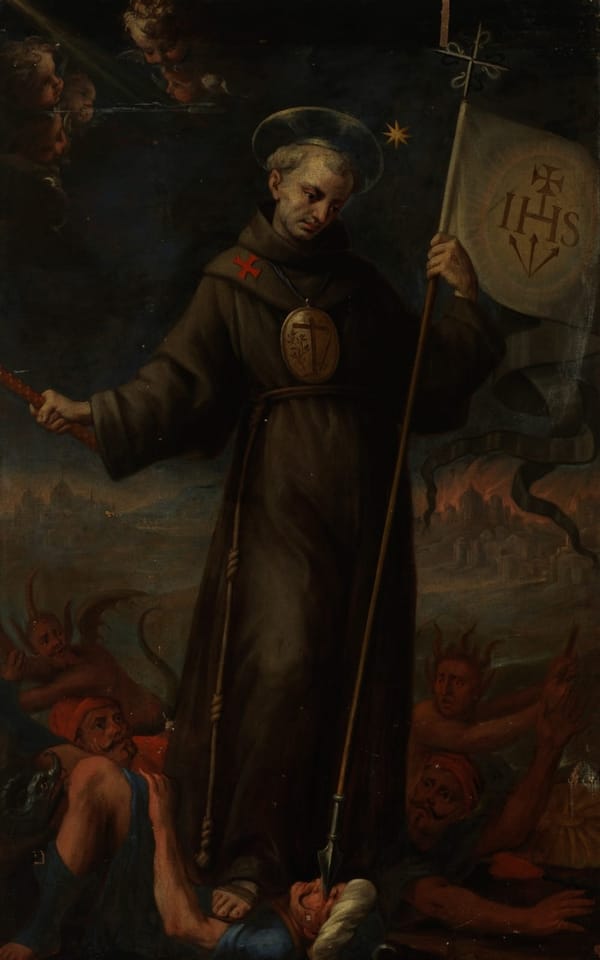
It was then that John Capistran, the saint of to-day, attained the consummation of his glory and his sanctity. At the head of a few poor men of good-will, unknown peasants gathered together by the Franciscan Friars, this ‘poor man of Christ’ undertook to defeat the strongest and best organized army of the century. On July 14, 1456, he broke through the Ottoman lines with John Hunyades, the only one of the Hungarian nobles who would accompany him, and revictualled Belgrade; and on July 22, feeling that he could no longer endure the defensive, he threw himself, to the stupefaction of Hunyades, on the enemy entrenchments. His troops were armed only with flails and pitchforks, and their only strategy was the name of Jesus. John had inherited this victorious battle-cry from his master, Bernardine of Siena. The Psalmist said: ‘Some trust in chariots and some in horses: but we will call upon the name of the Lord our God.’3 This name, so holy and so terrible, proved once more the salvation of the people. At the end of that memorable day twenty-four thousand Turks lay dead on the field of battle; three hundred cannon and all the spoils of the infidels were in the hands of the Christians, and Mahomet II. was seeking a distant hiding-place for his shame. The news of this victory, so like that of Gedeon,4 reached Rome on August 6, and Pope Callistus III. decreed that henceforth the Universal Church should keep a solemn commemoration of the Transfiguration of Our Lord on that day, for it was with the soldiers of the Cross as with the heroes of Israel,5 ‘they got not the possession of the land by their own sword: neither did their own arm save them, but thy right hand and thy arm and the light of thy countenance because thou wast pleased with them,’ as with Thy beloved Son on Mount Thabor.6
Let us read the life of St. John Capistran as related in the Liturgy:
‘The Lord is with thee, O most valiant of men. Go in this thy strength and thou shalt deliver Israel out of the hand of Madian. Know that I have sent thee.’7 Thus did the angel of the Lord salute Gedeon when he chose him from among the least of his people8 to fulfil a high destiny. Thus do we in our turn salute thee, O glorious son of St. Francis of Assisi, and we beseech thee to be our constant aid. The enemy whom thou didst defeat on the field of battle is no longer an imminent peril for the West, but there is a greater danger, as Moses said to his people after their deliverance from Egypt: ‘Take heed and beware lest at any time thou forget the Lord thy God . . . lest after thou hast eaten and art filled, hast built goodly houses . . . and shalt have herds of oxen and flocks of sheep and plenty of gold and of silver, and of all things; thy heart be lifted up and thou remember not the Lord who brought thee out of the house of bondage.’9 If the Turk had conquered in that struggle of which thou wert the hero, what would have become of the civilization of which we are so proud? Since thy day the Church has had once more to champion the cause of Society, which the heads of the nations no longer seem to understand. May the need of giving expression to the gratitude which is due to her preserve her children from the forgetfulness which is the great evil of the present generation. We thank God for the feast of to-day; it is a perpetual memorial of His goodness and of the noble deeds of His saints. Help us to conquer in that warfare which is being incessantly carried on within our own souls against the world, the flesh, and the devil. May the name of Jesus put our enemies to flight, may His Cross be our standard and lead us through the death of self-love to the triumph of the Resurrection.
| Previous Monday in Passion Week | Next March 28: St. John Capistran, Confessor |