Daily reading
Holy Week
Double · Movable from Easter · Temporal
April 2, 2023
From Dom Guéranger’s The Liturgical Year.

|
Palm Sunday
Including descriptions of the following:
- Blessing of Palms
- The Procession
- Mass of Palm Sunday
- The Passion and Gospel according to St. Matthew
- Vespers of Palm Sunday
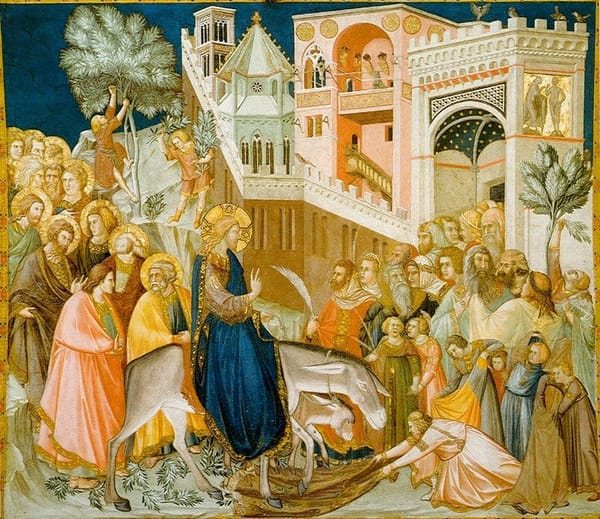
Early in the morning of this day, Jesus sets out for Jerusalem, leaving Mary His Mother, and the two sisters Martha and Mary Magdalene, and Lazarus, at Bethania. The Mother of sorrows trembles at seeing her Son thus expose Himself to danger, for His enemies are bent upon His destruction; but it is not death, it is triumph, that Jesus is to receive to-day in Jerusalem. The Messias, before being nailed to the cross, is to be proclaimed King by the people of the great city; the little children are to make her streets echo with their Hosannas to the Son of David; and this in presence of the soldiers of Rome’s emperor, and of the high priests and pharisees: the first standing under the banner of their eagles; the second, dumb with rage.
The prophet Zachary had foretold this triumph which the Son of Man was to receive a few days before His Passion, and which had been prepared for Him from all eternity, ‘Rejoice greatly, O daughter of Sion! Shout for joy, O daughter of Jerusalem! Behold thy King will come to thee; the Just and the Saviour. He is poor, and riding upon an ass, and upon a colt, the foal of an ass.’1 Jesus, knowing that the hour has come for the fulfilment of this prophecy, singles out two from the rest of His disciples, and bids them lead to Him an ass and her colt, which they would find not far off. He has reached Bethphage, on Mount Olivet. The two disciples lose no time in executing the order given them by their divine Master; and the ass and the colt are soon brought to the place where He stands.
The holy fathers have explained to us the mystery of these two animals. The ass represents the Jewish people, which had been long under the yoke of the Law; the colt, upon which, as the evangelist says, no man yet hath sat,2 is a figure of the Gentile world, which no one had ever yet brought into subjection. The future of these two peoples is to be decided a few days hence: the Jews will be rejected, for having refused to acknowledge Jesus as the Messias; the Gentiles will take their place, to be adopted as God’s people, and become docile and faithful.
The disciples spread their garments upon the colt; and our Saviour, that the prophetic figure might be fulfilled, sits upon him,3 and advances towards Jerusalem. As soon as it is known that Jesus is near the city, the holy Spirit works in the hearts of those Jews, who have come from all parts to celebrate the feast of the Passover. They go out to meet our Lord, holding palm branches in their hands, and loudly proclaiming Him to be King.4 They that have accompanied Jesus from Bethania, join the enthusiastic crowd. Whilst some spread their garments on the way, others cut down boughs from the palm-trees, and strew them along the road. Hosanna is the triumphant cry, proclaiming to the whole city that Jesus, the Son of David, has made His entrance as her King.
Thus did God, in His power over men’s hearts, procure a triumph for His Son, and in the very city which, a few days later, was to clamour for His Blood. This day was one of glory to our Jesus, and the holy Church would have us renew, each year, the memory of this triumph of the Man-God. Shortly after the birth of our Emmanuel, we saw the Magi coming from the extreme east, and looking in Jerusalem for the King of the Jews, to whom they intended offering their gifts and their adorations: but it is Jerusalem herself that now goes forth to meet this King. Each of these events is an acknowledgment of the kingship of Jesus; the first, from the Gentiles; the second, from the Jews. Both were to pay Him this regal homage, before He suffered His Passion. The inscription to be put upon the cross, by Pilate’s order, will express the kingly character of the Crucified: Jesus of Nazareth, King of the Jews. Pilate, the Roman governor, the pagan, the base coward, has been unwittingly the fulfiller of a prophecy; and when the enemies of Jesus insist on the inscription being altered, Pilate will not deign to give them any answer but this: ‘What I have written, I have written.’ To-day, it is the Jews themselves that proclaim Jesus to be their King: they will soon be dispersed, in punishment for their revolt against the Son of David; but Jesus is King, and will be so for ever. Thus were literally verified the words spoken by the Archangel to Mary, when he announced to her the glories of the Child that was to be born of her: ‘The Lord God shall give unto Him the throne of David, His father; and He shall reign in the house of Jacob for ever.’5 Jesus begins His reign upon the earth this very day; and though the first Israel is soon to disclaim His rule, a new Israel, formed from the faithful few of the old, shall rise up in every nation of the earth, and become the kingdom of Christ, a kingdom such as no mere earthly monarch ever coveted in his wildest fancies of ambition.
This is the glorious mystery which ushers in the great week, the week of dolours. Holy Church would have us give this momentary consolation to our heart, and hail our Jesus as our King. She has so arranged the service of to-day, that it should express both joy and sorrow; joy, by uniting herself with the loyal hosannas of the city of David; and sorrow, by compassionating the Passion of her divine Spouse. The whole function is divided into three parts, which we will now proceed to explain.
The first is the blessing of the palms; and we may have an idea of its importance from the solemnity used by the Church in this sacred rite. One would suppose that the holy Sacrifice has begun, and is going to be offered up in honour of Jesus, entry into Jerusalem. Introit, Collect, Epistle, Gradual, Gospel, even a Preface, are said, as though we were, as usual, preparing for the immolation of the spotless Lamb; but, after the triple Sanctus! Sanctus! Sanctus! the Church suspends these sacrificial formulas, and turns to the blessing of the palms. The prayers she uses for this blessing are eloquent and full of instruction; and, together with the sprinkling with holy water and the incensation, impart a virtue to these branches, which elevates them to the supernatural order, and makes them means for the sanctification of our souls and the protection of our persons and dwellings. The faithful should hold these palms in their hands during the procession, and during the reading of the Passion at Mass, and keep them in their homes as an outward expression of their faith, and as a pledge of God’s watchful love.
It is scarcely necessary to tell our reader that the palms or olive branches, thus blessed, are carried in memory of those wherewith the people of Jerusalem strewed the road, as our Saviour made His triumphant entry; but a word on the antiquity of our ceremony will not be superfluous. It began very early in the east. It is probable that, as far as Jerusalem itself is concerned, the custom was established immediately after the ages of persecution. St. Cyril, who was bishop of that city in the fourth century, tells us that the palm-tree, from which the people cut the branches when they went out to meet our Saviour, was still to be seen in the vale of Cedron.6 Such a circumstance would naturally suggest an annual commemoration of the great event. In the following century, we find this ceremony established, not only in the churches of the east, but also in the monasteries of Egypt and Syria. At the beginning of Lent, many of the holy monks obtained permission from their abbots to retire into the desert, that they might spend the sacred season in strict seclusion; but they were obliged to return to their monasteries for Palm Sunday, as we learn from the life of Saint Euthymius, written by his disciple Cyril.7 In the west, the introduction of this ceremony was more gradual; the first trace we find of it is in the sacramentary of St. Gregory, that is, at the end of the sixth, or the beginning of the seventh, century. When the faith had penetrated into the north, it was not possible to have palms or olive branches; they were supplied by branches from other trees. The beautiful prayers used in the blessing, and based on the mysteries expressed by the palm and olive trees, are still employed in the blessing of our willow, box, or other branches; and rightly, for these represent the symbolical ones which nature has denied us.
The second of to-day’s ceremonies is the procession, which comes immediately after the blessing of the palms. It represents our Saviour’s journey to Jerusalem, and His entry into the city. To make it the more expressive, the branches that have just been blessed are held in the hand during it. With the Jews, to hold a branch in one’s hand was a sign of joy. The divine law had sanctioned this practice, as we read in the following passage from Leviticus, where God commands His people to keep the feast of tabernacles: 'And you shall take to you, on the first day, the fruits of the fairest tree, and branches of palm-trees, and boughs of thick trees, and willows of the brook, and you shall rejoice before the Lord your God.'8 It was, therefore, to testify their delight at seeing Jesus enter within their walls, that the inhabitants, even the little children, of Jerusalem, went forth to meet Him with palms in their hands. Let us, also, go before our King, singing our hosannas to Him as the conqueror of death, and the liberator of His people.
During the middle ages, it was the custom, in many churches, to carry the book of the holy Gospels in this procession. The Gospel contains the words of Jesus Christ, and was considered to represent Him. The procession halted at an appointed place, or station: the deacon then opened the sacred volume, and sang from it the passage which describes our Lord’s entry into Jerusalem. This done, the cross which, up to this moment, was veiled, was uncovered; each of the clergy advanced towards it, venerated it, and placed at its foot a small portion of the palm he held in his hand. The procession then returned, preceded by the cross, which was left unveiled until all had re-entered the church. In England and Normandy, as far back as the eleventh century, there was practised a holy ceremony which represented, even more vividly than the one we have just been describing, the scene that was witnessed on this day at Jerusalem: the blessed Sacrament was carried in procession. The heresy of Berengarius, against the real presence of Jesus in the Eucharist, had been broached about that time; and the tribute of triumphant joy here shown to the sacred Host was a distant preparation for the feast and procession which were to be instituted at a later period.
A touching ceremony was also practised in Jerusalem during to-day’s procession, and, like those just mentioned, was intended to commemorate the event related by the Gospel. The whole community of the Franciscans (to whose keeping the holy places are entrusted) went in the morning to Bethphage. There, the father guardian of the holy Land, being vested in pontifical robes, mounted upon an ass, on which garments were laid. Accompanied by the friars and the Catholics of Jerusalem, all holding palms in their hands, he entered the city, and alighted at the church of the holy sepulchre where Mass was celebrated with all possible solemnity.
This beautiful ceremony, which dated from the period of the Latin kingdom in Jerusalem, has been forbidden, for now almost two hundred years, by the Turkish authorities of the city.
We have mentioned these different usages, as we have done others on similar occasions, in order to aid the faithful to the better understanding of the several mysteries of the liturgy. In the present instance, they will learn that, in to-day’s procession, the Church wishes us to honour Jesus Christ as though He were really among us, and were receiving the humble tribute of our loyalty. Let us lovingly go forth to meet this our King, our Saviour, who comes to visit the daughter of Sion, as the prophet has just told us. He is in our midst; it is to Him that we pay honour with our palms: let us give Him our hearts too. He comes that He may be our King; let us welcome Him as such, and fervently cry out to Him: ‘Hosanna to the Son of David!'
At the close of the procession a ceremony takes place, which is full of the sublimest symbolism. On returning to the church, the doors are found to be shut. The triumphant procession is stopped; but the songs of joy are continued. A hymn in honour of Christ our King is sung with its joyous chorus; and at length the subdeacon strikes the door with the staff of the cross; the door opens, and the people, preceded by the clergy, enter the church, proclaiming the praise of Him, who is our resurrection and our life.
This ceremony is intended to represent the entry of Jesus into that Jerusalem of which the earthly one was but the figure—the Jerusalem of heaven, which has been opened for us by our Saviour. The sin of our first parents had shut it against us; but Jesus, the King of glory, opened its gates by His cross, to which every resistance yields. Let us, then, continue to follow in the footsteps of the Son of David, for He is also the Son of God, and He invites us to share His kingdom with Him. Thus, by the procession, which is commemorative of what happened on this day, the Church raises up our thoughts to the glorious mystery of the Ascension, whereby heaven was made the close of Jesus’ mission on earth. Alas! the interval between these two triumphs of our Redeemer are not all days of joy; and no sooner is our procession over, than the Church, who had laid aside for a moment the weight of her grief, falls back into sorrow and mourning.
The third part of to-day’s service is the offering of the holy Sacrifice. The portions that are sung by the choir are expressive of the deepest desolation; and the history of our Lord’s Passion, which is now to be read by anticipation, gives to the rest of the day that character of sacred gloom, which we all know so well. For the last five or six centuries, the Church has adopted a special chant for this narrative of the holy Gospel. The historian, or the evangelist, relates the events in a tone that is at once grave and pathetic; the words of our Saviour are sung to a solemn yet sweet melody, which strikingly contrasts with the high dominant of the several other interlocutors and the Jewish populace. During the singing of the Passion, the faithful should hold their palms in their hands, and, by this emblem of triumph, protest against the insults offered to Jesus by His enemies. As we listen to each humiliation and suffering, all of which were endured out of love for us, let us offer Him our palm as to our dearest Lord and King. When should we be more adoring, than when He is most suffering?
These are the leading features of this great day. According to our usual plan, we will add to the prayers and lessons any instructions that seem to be needed.
This Sunday, besides its liturgical and popular appellation of Palm Sunday, has had several other names. Thus it was called Hosanna Sunday, in allusion to the acclamation wherewith the Jews greeted Jesus on His entry into Jerusalem. Our forefathers used also to call it Pascha Floridum, because the feast of the Pasch (or Easter), which is but eight days off, is to-day in bud, so to speak, and the faithful could begin from this Sunday to fulfil the precept of Easter Communion. It was in allusion to this name, that the Spaniards, having on the Palm Sunday of 1513, discovered the peninsula on the Gulf of Mexico, called it Florida. We also find the name of Capitilavium given to this Sunday, because, during those times when it was the custom to defer till Holy Saturday the baptism of infants born during the preceding months (where such a delay entailed no danger), the parents used, on this day, to wash the heads of these children, out of respect to the holy chrism wherewith they were to be anointed. Later on, this Sunday was, at least in some churches, called the Pasch of the competents, that is, of the catechumens, who were admitted to Baptism; they assembled to-day in the church, and received a special instruction on the symbol, which had been given to them in the previous scrutiny. In the Gothic Church of Spain, the symbol was not given till to-day. The Greeks call this Sunday Baïphoros, that is, Palmbearing.
THE BLESSING OF THE PALMS
It begins with the chanting of the following antiphon, which serves as an Introit.
Antiphon
Recording of the antiphon:
https://www.youtube.com/watch?v=S5sfnrALK0g
The priest then sums up, in the following prayer, the petitions of the faithful. This is what he asks for his people: that after this short life is over, they may come to that eternal kingdom, which has been prepared for them by the Death and Resurrection of Jesus.
After this prayer, the subdeacon chants a passage from the Book of Exodus, which relates how the people of God, after they had gone forth from Egypt, pitched their tents at Elim, beneath the shade of seventy palm-trees, where also were twelve fountains. While here, they were told by Moses that God was about to send them manna from heaven, and that, on the very next morning, their hunger would be appeased. These were figures of what is now given to the Christian people. The faithful, by a sincere conversion, have separated themselves from the Egypt of a sinful world. They are offering the palms of their loyalty and love to Jesus, their King. The fountains typify the Baptism, which, a few days hence, is to be administered to our catechumens. These fountains are twelve in number; the twelve articles of the symbol of our faith were preached to the world by the twelve apostles. And finally, on the morning of Easter day, Jesus, the Bread of life, the heavenly Manna, will arise from the tomb, and manifest His glory to us.
Cap. xv.In diebus illis: Venerunt filii Israel in Elim, ubi erant duodecim fontes aquarum, et Septuaginta palmæ: et castrametati sunt juxta aquas. Profectique sunt de Elim: et venit omnis multitudo filiorum Israel in desertum Sin, quod est inter Elim et Sinai: quintodecimo die mensis secundi, postquam egressi sunt de terra Ægypti. Et murmuravit omnis congregatio filiorum Israel contra Moysen et Aaron in solitudine. Dixeruntque filii Israel ad eos: Utinam mortui essemus per manum Domini in terra Ægypti, quando sedebamus super ollas carnium: et comedebamus panem in saturitate. Cur induxistis nos in desertum istud, ut occideretis omnem multitudinem fame? Dixit autem Dominus ad Moysen: Ecce ego pluam vobis panes de cœlo. Egrediatur populus, et colligat quæ sufficiunt per singulos dies: ut tentem eum, utrum ambulet in lege mea, an non. Die autem sexto parent quod inferant: et sit duplum, quam colligere solebant per singulos dies. Dixeruntque Moyses et Aaron ad omnes filios Israel: Vespere scietis, quod Dominus eduxerit vos de terra Ægypti: et mane videbitis gloriam Domini.
Ch. xv.In those days, the children of Israel came into Elim, where there were twelve fountains of water, and seventy palm-trees; and they encamped by the waters. And they set forward from Elim; and all the multitude of the children of Israel came into the desert of Sin, which is between Elim and Sinai, the fifteenth day of the second month after they came out of the land of Egypt. And all the congregation of the children of Israel murmured against Moses and Aaron in the wilderness. And the children of Israel said to them: Would to God we had died by the hand of the Lord in the land of Egypt, when we sat over the flesh pots, and ate bread to the full. Why have you brought us into this desert, that you might destroy all the multitude with famine? And the Lord said to Moses: Behold I will rain bread from heaven for you; let the people go forth, and gather what is sufficient for every day, that I may prove them whether they will walk in my law, or no. But the sixth day let them provide for to bring in, and let it be double to that they were wont to gather every day. And Moses and Aaron said to the children of Israel: In the evening you shall know that the Lord hath brought you forth out of the land of Egypt: and in the morning you shall see the glory of the Lord.
After this lesson, the choir sings one of the two following responsories, which commemorate the Passion of our Lord.
Responsory
Recording of the responsory:
https://www.youtube.com/watch?v=LLoLVshD3qc
The deacon then chants, from the Gospel of Saint Matthew, the history of Jesus’ triumphant entry into Jerusalem. The palms of the new Testament entwine with those of the old, in honour of the Man-God, who is the connecting link of both.
Gospel
Cap. xxi.In illo tempore: Cum appropinquasset Jesus Jerosolymis et venisset Bethphage, ad montem Oliveti; tunc misit duos discipulos, dicens eis: Ite in castellum, quod contra vos est: et statini invenietis asinam alligatam et pullum cum ea: solvite, et adducite mihi. Et si quis vobis aliquid dixerit, dicite quia Dominus his opus habet: et confestim dimittet eos. Hoc autem totum factum est, ut adimpleretur quod dictum est per prophetam dicentem: Dicite filiæ Sion: Ecce Rex tuus venit tibi mansuetus, sedens super asinam, et pullum filiura subjugalis. Euntes autem discipuli, fecerunt sicut præcepit illis Jesus. Et adduxerunt asinam, et pullum: et imposuerunt super eos vestimenta sua, et eum desuper sedere fecerunt. Plurima autem turba straverunt vestimenta sua in via. Alii autem cædebant ramos de arboribus, et sternebant in via. Turbæ autem quæ præcedebant, et quæ sequebantur, clamabant, dicentes: Hosanna filio David! benedictus qui venit in nomine Domini!
Ch. xxi.At that time: When Jesus drew nigh to Jerusalem, and was come to Bethphage, unto mount Olivet, he sent two disciples, saying to them: Go ye into the village that is over against you, and immediately you shall find an ass tied and a colt with her; loose them and bring them to me. And if any man shall say anything to you, say ye, that the Lord hath need of them; and forthwith he will let them go. Now all this was done that it might be fulfilled which was spoken by the prophet, saying: Tell ye the daughter of Sion: Behold, thy King cometh to thee, meek, and sitting upon an ass, and a colt, the foal of her that is used to the yoke. And the disciples going, did as Jesus commanded them: and they brought the ass and the colt, and laid their garments upon them, and made him sit thereon. And a very great multitude spread their garments in the way, and others cut boughs from the trees, and strewed them in the way; and the multitudes that went before and that followed, cried, saying: Hosanna to the Son of David! Blessed is he that cometh in the name of the Lord!
And now the mystery-speaking palms are to receive the Church’s blessing. The priest begins by two scriptural allusions: the first is to Noah, who received an olive-branch, when the waters of the deluge had subsided; the second is to Moses, whose people, after quitting Egypt, encamped under the seventy palm-trees. Then in the solemn tone of the Preface, he calls upon all creatures to give praise to the adorable name of Jesus, for whom we are preparing the homage of our devoted love. Let us respond to the invitation, and sing with all our hearts: Holy! Holy! Holy!—Hosanna in excelsis!
Pleni sunt coeli et terra gloria tua.
Hosanna in excelsis.
Benedictus qui venit in nomine Domini.
Hosanna in excelsis.
Heaven and earth are full of thy glory.
Hosanna in the highest!
Blessed is he that cometh in the name of the Lord.
Hosanna in the highest!
The prayers which now follow, explain the mystery of the palms, and draw down the blessing of God both upon them and upon the faithful who receive and keep them with proper dispositions.
The priest completes the blessing of the palms by sprinkling them with holy water and thurifying them with incense. After which, he adds the following prayer.
After this prayer, the priest distributes the palms to the faithful.9 During the distribution, the choir reminds us, by the two following antiphons, of the enthusiasm of the little children of Jerusalem, who, with their palms in their hands, sang their loud: Hosanna to the Son of David!
Antiphon
Recording of the antiphon:
https://www.youtube.com/watch?v=a16POhiuP8c
Antiphon
Recording of the antiphon:
https://www.youtube.com/watch?v=XKw_52x9dj8
As soon as the distribution is over, the priest concludes this first part of the service by the following prayer.
THE PROCESSION
The priest having blessed the incense—which, according to the custom of the Church, always heads a procession and sheds its perfume along the path that is to be taken—the deacon turns towards the people, and gives the signal for departure, with these words:
The choir answers:
The procession then advances, the clergy and people holding the palms in their hands. The choir chants the following antiphons, in honour of Jesus, the King of Israel.
Antiphon
Recording of the antiphon:
https://www.youtube.com/watch?v=WHNz7NE__tg
Antiphon
Recording of the antiphon:
https://www.youtube.com/watch?v=6JVZpN273ps
Antiphon
Recording of the antiphon:
https://www.youtube.com/watch?v=41GyvDYbFqU
Antiphon
Recording of the antiphon:
https://www.youtube.com/watch?v=F8Ee5Q1IWZE
Antiphon
Recording of the antiphon:
https://www.youtube.com/watch?v=DxIFVMTYeM4
Antiphon
The procession is now on its return to the church: but it cannot enter, for the doors are shut. We have already explained the meaning of this part of the ceremony. Immediately there are heard voices within the holy place; they are singing the praises of Christ, our King and Saviour. These cantors represent the holy angels in heaven, who are greeting the entry of Jesus into the eternal Jerusalem. Outside the church, there stands the choir, re-echoing the hymn of triumph; but it is man celebrating the entry of the Son of David into the earthly Jerusalem. The two choirs are thus kept separated from each other, until at length the victorious cross throws open the door, which represents the gate of heaven, and unites the Church militant with the Church triumphant. The hymn which is sung during this ceremony, was composed by Theodulf bishop of Orleans, when prisoner at Angers, by order of Louis the Good. The Church of Rome, by using the first six stanzas of this short poem, has immortalized it throughout the world.
The cantors within the church begin the first stanza, which is repeated by the choir without, not only after this, but also after each of the following five stanzas.
Hymn
Cui puerile decus prompsit Hosanna pium.
to whom the innocent children sang their fervent Hosanna.
Nomine qui in Domini, rex benedicte, venis.℟. Gloria, laus.
Et mortalis homo, et cuncta creata simul.℟. Gloria, laus.
Cum prece, voto, hymnis, adsumus ecce tibi.℟. Gloria, laus.
Nos tibi regnanti pangimus ecce melos.℟. Gloria, laus.
Rex bone, rex clemens, cui bona cuncta placent.℟. Gloria, laus.
Blessed art thou our King! that comest in the name of the Lord.℟. Glory, praise, &c.
and men on earth, and all created things praise thee.℟. Glory, praise, &c.
behold, we, too, present ourselves before thee, with our prayers, desires, and hymns.℟. Glory, praise, &c.
we sing our hymn to thee seated on thy throne.℟. Glory, praise, &c.
O dear and merciful King! to whom all is pleasing that is good.℟. Glory, praise, &c.
Recording of the Hymn:
https://www.youtube.com/watch?v=xtm0Jy1OFHM
As soon as the choir has sung its response to the last stanza, the subdeacon knocks with the cross at the door, which is immediately opened. In some places, it is the celebrant himself who performs this ceremony, and while doing it he recites the words of Psalm xxiii, in which David celebrates the entrance of our Redeemer into heaven on the day of His Ascension.
The procession then enters the church, singing the following responsory:
Responsory
Recording of the antiphon:
https://www.youtube.com/watch?v=BgLZrFHUHLY
Mass
The Station at Rome is in the basilica of St. John Lateran, the mother and mistress of all Churches. The papal function, however, now takes place at St. Peter’s; but the usual indulgences are still granted to those who visit the archbasilica.
The Mass of this Sunday retains no vestige of the joy, which characterized the ceremony of the palms. The Introit is taken from Psalm xxi, in which the royal prophet expresses the anguish of soul suffered by Jesus on the cross.
Introit
Ps. Deus, Deus meus, respice in me, quare me dereliquisti? Longe a salute mea verba delictorum meorum.
Domine, ne longe.
Ps. O God, my God, look upon me: why hast thou forsaken me? It is the cry of my sins that keeps salvation far from me.
O Lord, keep not, &c.
Recording of the Introit:
https://www.youtube.com/watch?v=MmM5BWlvFtg
In the Collect the Church prays that we may have grace to imitate the patience and humility of our Saviour. Jesus suffers and humbles Himself for us; it is but just that we should work out our salvation by following His example, that we should suffer, and be humble.
Collect
Epistle
Cap. ii.Fratres: Hoc enim sentite in vobis, quod et in Christo Jesu. Qui cum in forma Dei esset, non rapinam arbitratus est, esse se æqualem Deo: sed semetipsum exinanivit, formam servi accipiens, in similitudinem hominum factus, et habitu inventus ut homo. Humiliavit semetipsum, factus obediens usque ad mortem, mortem autem crucis. Propter quod et Deus exaltavit illum: et donavit illi nomen, quod est super omne nomen: ut in nomine Jesu (here, all kneel,) omne genu flectatur, cœlestium, terrestrium, et infernorum: et omnis lingua confiteatur, quia Dominus Jesus Christus in gloria est Dei Patris.
Ch. ii.Brethren: For let this mind be in you, which was also in Christ Jesus: who being in the form of God, thought it not robbery to be equal with God, but emptied himself, taking the form of a servant, being made in the likeness of men, and in habit found as a man. He humbled himself, becoming obedient unto death, even to the death of the cross. For which cause God also hath exalted him and hath given him a name which is above all names; that in the name of Jesus (here, all kneel,) every knee should bow, of those that are in heaven, on earth, and under the earth. And that every tongue should confess that the Lord Jesus Christ is in the glory of God the Father.
In obedience to the wishes of the Church, we have knelt down at those words of the apostle, where he says that every knee should bow at the holy name of Jesus. If there be one time of the year rather than another, when the Son of God has a right to our fervent adorations, it is this week, when we see Him insulted in His Passion. Not only should His sufferings excite us to tender compassion; we should also keenly resent the insults that are heaped upon our Jesus, the God of infinite majesty. Let us strive, by our humble homage, to make Him amends for the indignities He suffered in atonement for our pride. Let us unite with the holy angels, who, witnessing what He has gone through for the love of man, prostrate themselves, in profoundest adoration, at the sight of His humiliations.
In the Gradual, the Church makes use of the words of the royal prophet, who foretells the future glories of the Victim that dies on Calvary; but he also confesses that the success permitted to the enemies of Jesus had well nigh shaken his confidence.
Gradual
Recording of the antiphon:
https://www.youtube.com/watch?v=L_vhJ-IvDJI
The Tract consists of several verses taken from Psalm xxi, the first words of which were spoken by our Redeemer on the cross. So clear and explicit are the words of this psalm, that it might almost be called a history, as well as a prophecy, of the Passion.
Tract
Recording of the Tract:
https://www.youtube.com/watch?v=LnXYQkbB4mc
It is now time that we should hear the history of our Saviour’s Passion: but, in order that we may show both heaven and earth that we are not scandalized, as were the disciples, at the sight of His apparent weakness and the triumph of His enemies, we hold in our hands the palms, wherewith we have been proclaiming Him as our King.
The Church reads, on four different days of this week, the four evangelists’ narration of the Passion. She begins with that of St. Matthew, who was the first to write the Gospel. To express the sorrow which fills the hearts of the faithful, the acolytes do not carry the lights, nor is the book incensed. Omitting the customary salutation, the deacon, who is to take the part of the evangelist, at once begins the mournful history of our Lord’s sufferings and death.
The Passion and Gospel
Cum autem Jesus esset in Bethania, in domo Simonis leprosi, accessit ad eum mulier habens alabastrum unguenti pretiosi: et effudit super caput ipsius recumbentis. Videntes autem discipuli, indignati sunt, dicentes: ut quid perditio hæc? Potuit enim istud venundari multo, et dari pauperibus. Sciens autem Jesus, ait illis: Quid molesti estis huic mulieri? Opus enim bonum operata est in me. Nam semper pauperes habetis vobiscum: me autem non semper habetis. Mittens enim hæc unguentum hoc in corpus meum, ad sepeliendum me fecit. Amen dico vobis, ubicumque prædicatum fuerit hoc Evangelium in toto mundo, dicetur et quod hæc fecit in memoriam ejus.
Here the deacon pauses, and honours the Death of our Lord and Saviour by a solemn act of adoration. All the faithful kneel down, and remain for some time in that position. In many places, it is the custom to prostrate, and kiss the ground. The deacon then resumes his narration.
That the Mass of this Sunday may not be deprived of that essential rite which we call the Gospel, the deacon reserves a portion of the narrative; and going to the altar, he asks the priest to bless the incense. Which done, the deacon, himself also having received the priest’s blessing, goes to the place appointed for chanting the Gospel; but the acolytes do not carry their lights. After having thurified the book, he thus closes the history of the Passion.
Recording of St. Matthew Passion (Bach):
https://www.youtube.com/watch?v=ZwVW1ttVhuQ
The Offertory is again a prophecy of David. It foretells the state of abandonment to which our Saviour was to be reduced in the midst of all His sufferings, and the cruelty of His enemies, who would feed Him with gall and vinegar. Thus is He treated who is preparing to give us His Body for our food, and His Blood for our drink.
Offertory
Recording of the antiphon (Gregorian chant):
https://www.youtube.com/watch?v=YCBceN5Wtb0
Recording of the antiphon (Palestrina):
https://www.youtube.com/watch?v=oiEA8lCfM34
The Secret asks of God that He would impart to His servants the twofold fruit of Jesus’ Passion: grace in this life, and glory in the next.
Secret
In the Communion-anthem, the Church, after receiving into herself the life of Christ by the chalice of salvation, calls to our minds that other chalice which Jesus was to drink in order that He might gift us with immortality.
Communion
Recording of the antiphon:
https://www.youtube.com/watch?v=RmDey4MX3rA
The Church concludes the prayers of the Sacrifice she has just been offering, by asking the remission of sin for all her children, that they may see fulfilled that longing of their souls—a share in the glorious Resurrection of Jesus.
Postcommunion
Vespers
The psalms and antiphons are given on page 81.
Capitulum (Phil. ii.)
For the hymn and versicle, see page 89.
Antiphon of the Magnificat
Recording of the antiphon:
https://www.youtube.com/watch?v=u1H-cp3r3xg
Let us now go over in our minds the other events which happened to our divine Lord on this day of His solemn entry into Jerusalem. St. Luke tells us that it was on His approach to the city, that Jesus wept over it, and spoke these touching words: ‘If thou also hadst known, and that in this thy day, the things that are to thy peace! But now they are hidden from thine eyes. For the days shall come upon thee, and thine enemies shall cast a trench about thee, and compass thee round, and straiten thee on every side, and beat thee flat to the ground, and thy children who are in thee; and they shall not leave in thee a stone upon a stone; because thou hast not known the time of thy visitation.’10
A few days ago, we were reading in the holy Gospel how Jesus wept over the tomb of Lazarus; to-day He sheds tears over Jerusalem. At Bethania His weeping was caused by the sight of bodily death, the consequence and punishment of sin; but this death is not irremediable: Jesus is the resurrection and the life, and he that believeth in Him shall live.11 Whereas, the state of the unfaithful Jerusalem is a figure of the death of the soul, and from this there is no resurrection, unless the soul, while time is given to her, return to the Author of life. Hence it is, that the tears shed by Jesus over Jerusalem are so bitter. Amidst the acclamations which greet His entry into the city of David, His heart is sad; for He sees that many of her inhabitants will not profit of the time of her visitation. Let us console the Heart of our Jesus, and be to Him a faithful Jerusalem.
The sacred historian tells us that Jesus, immediately upon His entrance into the city, went to the temple, and cast out all them that sold and bought there.12 This was the second time that He had shown His authority in His Father’s house, and no one had dared to resist Him. The chief priests and pharisees found fault with Him, and accused Him to His face, of causing confusion by His entry into the city; but our Lord confounded them by the reply He made. It is thus that in after ages, when it has pleased God to glorify His Son and the Church of His Son, the enemies of both have given vent to their rage; they protested against the triumph, but they could not stop it. But when God, in the unsearchable ways of His wisdom, allowed persecution and trial to follow these periods of triumph, then did these bitter enemies redouble their efforts to induce the very people, that had cried Hosanna to the Son of David, to clamour for His being delivered up and crucified. They succeeded in fomenting persecution, but not in destroying the kingdom of Christ and His Church. The kingdom seemed, at times, to be interrupted in its progress; but the time for another triumph came. Thus will it be to the end; and then, after all these changes from glory to humiliation, and from humiliation to glory, the kingdom of Jesus and of His bride will gain the last and eternal triumph over this world, which would not know the time of its visitation.
We learn from St. Matthew13 that our Saviour spent the remainder of this day at Bethania. His blessed Mother and the house of Lazarus were comforted by His return. There was not a single offer of hospitality made to Him in Jerusalem, at least there is no mention in the Gospel of any such offer. We cannot help making the reflection, as we meditate upon this event of our Lord’s life:—an enthusiastic reception is given to Him in the morning, He is proclaimed by the people as their King; but when the evening of that day comes on, there is not one of all those thousands to offer Him food or lodging. In the Carmelite monasteries of St. Teresa’s reform, there is a custom, which has been suggested by this thought, and is intended as a reparation for this ingratitude shown to our Redeemer. A table is placed in the middle of the refectory; and after the community have finished their dinner, the food which was placed upon that table is distributed among the poor, and Jesus is honoured in them.
We give, as a conclusion to this day, a selection from the hymn used by the Greek Church on Palm Sunday. It was written by the celebrated hymnographer, Cosmas of Jerusalem.
Hymn (In Dominica Palmarum)
clamant: Benedictus qui venit in nomine Domini Salvatoris nostri.
that cry to him: Blessed is he that cometh in the name of the Lord our Saviour!
- Zach. ix. 9. ↩︎
- St. Mark xi. 2. ↩︎
- Ibid. 7, and St. Luke xix. 35. ↩︎
- St. Luke xix. 38. ↩︎
- St. Luke i. 32. ↩︎
- Cateches. x. versus fin. ↩︎
- Act. Ss. Jan. 20. ↩︎
- Lev. xxiii. 40. ↩︎
- In receiving the palm, the faithful should kiss first the palm itself, and then the priest's hand. ↩︎
- St. Matt. xxi.17. ↩︎
- St. John xi. 25. ↩︎
- St. Matt. xxi. 12. ↩︎
- St. Matt. xxi. 17. ↩︎
April 2: St. Francis of Paula
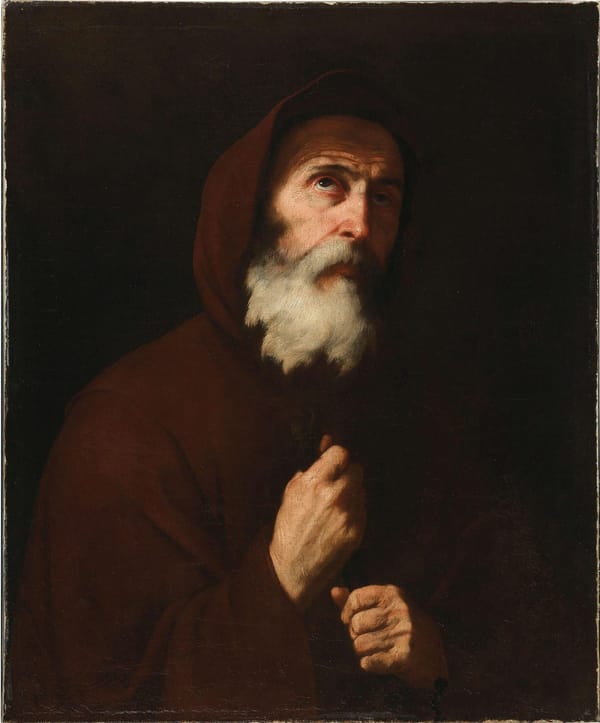 |
The founder of a religious Order, whose distinguishing characteristics were humility and penance, comes before us to-day; it is Francis of Paula. Let us study his virtues and beg his intercession. His whole life was one of great innocence; and yet we find him embracing, from his earliest youth, mortifications which, nowadays, would not be expected from the very worst sinners. How was it that he could do so much? and we, who have so often sinned, do so little? The claims of divine justice are as strong now as ever they were; for God never changes, nor can the offence we have committed against Him by our sins be pardoned, unless we make atonement. The saints punished themselves, with life-long and austere penances, for the slightest sins; and the Church can scarcely induce us to observe the law of Lent, though it is now reduced to the lowest degree of severity.
What is the cause of this want of the spirit of expiation and penance? It is that our faith is weak, and our love of God is cold, because our thoughts and affections are so set upon this present life, that we seldom if ever consider things in the light of eternity. How many of us are like the king of France, who having obtained permission from the Pope that St. Francis of Paula should come and live near him, threw himself at the saint's feet, and besought him to obtain of God, that he, the king, might have a long life! Louis XI. had led a most wicked life; but bis anxiety was, not to do penance for his sins, but to obtain, by the saint's prayers, a prolongation of a career which had been little better than a storing up of wrath for the day of wrath. We, too, love this present life; we love it to excess. The laws of fasting and abstinence are broken, not because the obeying them would endanger life, or even seriously injure health—for where either of these is to be feared, the Church does not enforce her lenten penances—but people dispense themselves from fasting and abstinence, because the spirit of immortification renders every privation intolerable, and every interruption of an easy comfortable life insupportable. They have strength enough for any fatigue that business or pleasure calls for; but the moment there is question of observing those laws which the Church has instituted for the interest of the body as well as of the soul, all seems impossible; the conscience gets accustomed to these annual transgressions, and ends by persuading the sinner that he may be saved without doing penance.
St. Francis of Paula was of a very different way of thinking and acting. The Church gives us the following abridged account of his life:
Apostle of penance: thy life was always that of a saint, and we are sinners: yet do we presume, during these days, to beg thy powerful intercession, in order to obtain of God that this holy season may not pass without having produced within us a true spirit of penance, which may give us a reasonable hope of receiving His pardon. We admire the wondrous works which filled thy life—a life that resembled, in duration, that of the patriarchs, and prolonged the privilege the world enjoyed of having such a saint to teach and edify it. Now that thou art enjoying in heaven the fruits of thy labours on earth, think upon us, and hearken to the prayers addressed to thee by the faithful. Gain for us the spirit of compunction, which will add earnestness to our works of penance. Bless and preserve the Order thou hast founded. Thy holy relics have been destroyed by the fury of heretics; avenge the injury thus offered to thy name, by praying for the conversion of heretics and sinners, and drawing down upon the world those heavenly graces, which will revive among us the fervour of the ages of faith.
April 2 (the Same Day, in Some Dioceses): St. Mary of Egypt, Penitent
One of the most striking examples of penance ever witnessed, is this day proposed for our consideration: Mary, the sinner and penitent of Egypt, comes to animate us to persevere in our lenten exercises. Like Magdalene and Margaret of Cortona, she had sinned grievously; like them she repented, atoned for her guilt, and is now the associate of angels. Let us adore the omnipotence of our God, who thus changed a vessel of dishonour into one of honour; let us lovingly contemplate the riches of His mercy, and hope for our own participation in them. At the same time, let us remember that pardon is not granted save where there is repentance; and that repentance is not genuine, unless it produce an abiding spirit and deeds of penance. Mary of Egypt had the misfortune to lead a life of sin for seventeen years; but her penance lasted forty: and what kind of penance must hers have been, living alone in a desert, under a scorching sun, without the slightest human consolation, and amidst every sort of privation! The pledge of pardon—the holy Communion —which we received so soon after our sins, was not granted to Mary, till she had done penance for nearly half a century. That pledge of Jesus' forgiveness, which He has given us in the Sacrament of His love, and which was communicated to us so promptly, was withheld from this admirable penitent, so that she received it for the second time only at the moment when death was on the point of separating her soul from her body which was worn out by austerities! Let us humble ourselves at such a comparison; let us think with fear on this great truth—that God’s justice will require an exact account of all the graces He has heaped upon us; and with this thought, let us rouse ourselves to a determination to merit, by the sincerity of our repentance, a place near the humble penitent of the desert.
We take the lessons of the Office of St. Mary of Egypt from the ancient Roman-French breviaries:
In praise of our incomparable penitent, we offer to the reader the following beautiful sequence, taken from the ancient missals of Germany:
Sequence
In amplexum Salomonis
Nostri transit filia;
Ex abjecta fit electa,
Ex rugosa fit formosa,
Ex lebete phiala.
Ad dilectum quam conduxit
Pacia nectens fædera;
Matre Dei mediante,
Peccatrici, Christo dante,
Sunt dimissa scelera.
Pervenit in Jerusalem,
Nuptura Pacifico;
Hinc excluso adultero
Maritatur Sponso vero
Ornata mirifico.
Dum laborat, mox redire
Necdum digna cogitur;
Ad cor suum revertitur,
Fletu culpa submergitur,
Fletu culpa teritur.
Leviathan conteritur,
Mundus, caro vincitur,
Domus patris postponitur,
Vultus mentis componitur,
Decor camis spernitur.
Tuia ornata tympanis,
Lauda quondam sterilis,
Gaude, plaude, casta, munda,
Virtutum prole fœcunda,
Vitis meri fertilis.
Umbilicus est præcisus
Tuus continentia;
Aquis lotam, pulchram totam
Te salivit, te condivit
Sponsi sapientia.
Intus tota delibuta
Oleo lætitiæ;
Croco rubene charitatis;
Bysso cincta castitatis,
Zona pudicitiæ.
Dum superna contemplaris,
Mutatis affectibus;
Vestiris discoloribus,
Cubile vernat floribus,
Fragat aromatibus.
Decoravit et amavit
Sic te Christi gratia,
Memor semper peccatorum,
Et cunctorum populorum,
Plaude nunc in gloria.
to the espousals with Jesus,
our true Solomon.
She that was abject, is made a chosen one;
she that was deformed, is made fair;
the vessel of dishonour is made one of honour.
and leading her to her beloved Son,
has knit the bond of peace.
The Mother of God interceded;
Christ forgave;
the sinner’s sins are pardoned.
came to Jerusalem,
to be espoused to the King of peace;
leaving her false lover,
she is united to the true Spouse,
honoured by the wonderful One.
but her unworthiness forbids it;
she is compelled to retire.
Then does she return to her own heart;
she weeps for her sins,
and her weeping blots them out.
tramples on Leviathan;
conquers the world and the flesh;
forgets her father’s house:
neglects the beauty of the body,
that her spirit may be made comely.
Thou, that once wast barren,
take up thy harp, and sing.
Exult and be joyful, for now thou art chaste and pure,
fruitful in virtue,
a vine that yields a precious fruit.
the shame of thy disorders
is effaced by the merit of thy purity.
The wisdom of thy heavenly Spouse has given thee,
cleansed and all fair,
the incorruption of his grace.
thou wast anointed with the oil of gladness.
The scarlet of charity,
the lily of chastity,
the girdle of modesty
—all were upon thee.
for thy affections were changed
from earthly to heavenly things.
Thy vesture was of every richest hue,
and thy couch was decked with flowers,
sweeter than those of spring.
in that Christ so loved thee,
and beautified thee with grace.
Be mindful of us sinners;
pray for all mankind;
feast now in thy eternal glory!
Thou wilt sing for all eternity, O Mary, the mercies of the Lord, who changed thee from a sinner into so glorious a saint; we join thee in thy praises, and we give Him thanks for having shown us so evidently, in thy person, that a true penitent, whatever and how great soever may have been his sins, may not only avoid eternal torments, but merit everlasting bliss. How light must now appear to thee, O Mary, that forty years’ penance, the very thought of which terrifies us! How short a time, when compared with eternity! How insignificant its austerity, if we think of hell! And how rich must its reward seem to thee, now that thou art face to face with infinite Beauty! We, too, are sinners; dare we say that we are penitents? Aid our weakness, O Mary! Thou wast made known to the world at the close of thy hidden life, in order that Christians might learn from thee the grievousness of sin, of which they make so little account; the justice of God, of which they are so apt to form so false an idea; ¿md the goodness of that Father, whom they cease not to offend. Pray for us, O Mary, that we may profit by the instructions given to us so profusely during this holy season. Pray that our conversion may be complete; that we may leave our pride and our cowardice; that we may appreciate the grace of reconciliation with our Maker; and, lastly, that we may ever approach to the holy Table with compunction and love such as thou hadst, when, in thy last happy Communion, Jesus gave Himself to thee in His Sacrament, and then took thee to Himself in the kingdom of everlasting rest and joy.
| Previous Saturday in Passion Week | Next April 2: St. Francis of Paula |