Daily reading
Paschal Time
Double · April 21 · Sanctoral
April 21, 2023
From Dom Guéranger’s The Liturgical Year.
A Double leads the weekday.Rubric
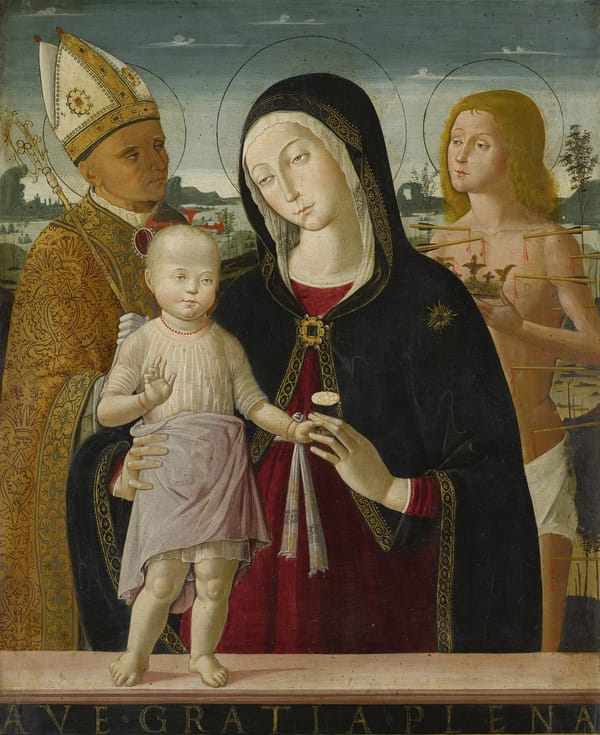 |
April 21: St. Anselm, Bishop, and Doctor of the Church
A MONK, a Bishop, a Doctor of the Church—such was the Saint whose feast comes to gladden us on this twenty-first day of April. He was a martyr, also, at least in desire, and we may add, in merit too—for he did enough to earn the glorious palm. When we think of Anselm, we picture to ourselves a man in whom are combined the humility and meekness of the cloister with the zeal and courage of the episcopal dignity; a man who was both a sage and a saint; a man whom it was impossible not to love and respect.
He left his native country of Piedmont for the Monastery of Bec in France, where he became a Benedictine monk. Being elected Superior, he realized in himself the type of an Abbot, as drawn by St Benedict in his Rule: ‘He that is made Abbot,’ says the holy Patriarch, ‘should study to give help rather than to give commands,’1 We read that the love entertained for Anselm by his brethren was beyond description. His whole time was devoted to them, either in giving them spiritual direction, or in communicating to them his own sublime knowledge of the sacred sciences. After governing them for several years, he was taken from them, and compelled to accept the dignity of Archbishop of Canterbury. He was a worthy successor of Augustine, Dunstan, Elphege, and Lanfranc; and by his own noble example of courage, he prepared the way for the glorious martyr Thomas, who succeeded him in less than a century.
As bishop, his whole life was spent in fighting for the liberty of the Church. Though gentle as a lamb by nature, he was all energy for this great cause. He used to say: ‘Christ would not have his Spouse be a slave; there is nothing in this world that God loves more than the liberty of his Church.’ There was a time when the Son of God allowed himself to be fettered with bonds in order that he might loosen us from the chains of our sins; but now that he has risen in triumph from the dead, he wills that his Spouse should be, like himself, free. She cannot otherwise exercise the ministry of salvation confided to her by her divine Lord; and yet there is scarcely a single hundred years of her existence in which she has not had to fight for this holy liberty. The rulers of this earth, with very few exceptions, have ever been jealous of her influence, and have sought to lessen it by every possible means. In our own times there are numbers of her children who do not even know that she has any rights or privileges; they would be at a loss to understand you, if you told them that she is the Spouse of Christ, and therefore a queen; they think it quite enough for her, if she enjoy the same amount of freedom and toleration as the sects she condemns; and they cannot see how, under such conditions as these, the Church is not the kingdom he wished her to be, but a mere slave. St Anselm would have abominated all such theories as these; so does every true Catholic. He is not driven into disloyalty to the Church by the high-sounding words, progress and modern society; he knows that there is nothing on earth equal to the Church; and when he sees the world convulsed by revolutions, he knows that all comes from the Church having been deprived of her rights. One of these is that she should not only be recognized, in the secret of our conscience, as the one only true Church, but that, as such, she should be publicly confessed and outwardly defended against every opposition or error. Jesus, her divine Founder, promised to give her all nations as her inheritance; he kept his promise, and she was once the Queen and Mother of them all. But nowadays, a new principle has been asserted, to the effect that the Church and all sects must be on an equal footing as far as the protection of the State goes. The principle has been received with acclamation, and hailed as a mighty progress achieved by modern enlightenment: even Catholics, whose previous services to religion had endeared them to our hearts and gained our confidence, have become warm defenders of the impious theory.
Trying as were the times when St Anselm governed the See of Canterbury, they were spared the humiliation of producing and ratifying such doctrine as this. The tyrannical interference of the Norman kings was an evil far less injurious than the modern system, which is subversive of the very idea of a Church. Open persecution would be a boon, compared to the fashionable error of which we are speaking. A winter torrent brings desolation in its track: but in the summer, when the flood is over, nature brings back her verdure and flowers. The errors which now prevail are like a great sea that gradually sweeps over the whole earth: and when the Church can find no spot whereon to rest, she will take her flight to heaven, and men must expect the speedy coming of the judge.
Anselm was not only the zealous and heroic defender of the rights and privileges of the Church; he was also a light to men by his learning. The contemplation of revealed truths was his delight. He studied them in their bearings one upon the other, and his writings occupy a distinguished place in the treatises of Catholic Theology. God had blessed him with extraordinary talent. Amidst all the troubles and anxieties and occupations of his various duties, he found time for study. Even when passing from place to place, as an exile, he was intent on the meditation of the mysteries of religion, thus preparing those sublime reflections which he has left us on the articles of our Faith.
The Church gives us, in her Liturgy, the following sketch of our Saint’s life:
We take the following Responsories and Antiphons from an office approved by the Holy See:
℣. Afflictions await me; but I fear none of them, so that I may consummate my course.* And your joy shall soon be changed into mourning, alleluia.℟. When the Fathers were assembled in Council, Urban, the Pope, cried out: Where art thou, Father and Master Anselm, Archbishop of the English? Come up here to us; fight for thine own and our Mother, and help us, alleluia.℣. Blessed be thy wisdom, and blessed the word of thy mouth!* Come up here to us; fight for thine own and our Mother, and help us, alleluia.
The following hymn is from the same Office:
Hymn
Laurea doctor redimitus astat:
Festus Anselmo chorus æmuletur
Dicere carmen.
Sæculi florem pereuntis horret;
Atque Lanfranci documenta quærens,
Intrat eremum.
Fertur immotæ fidei volatu:
Dogmatum puros latices an ullus
Altius hausit?
Te voves charæ soboli: benignis
Debiles portas humeris, alacres
Prævius hortans.
Quid times luctam? properant triumphi;
Exteras gentes, generosus exsul,
Lumine reples.
Parta, cui Christus nihil ante ponit,
Urget Anselmum: studio quis aequo
Vindicat ipsam?.
Pontifex summus tibi fert honores;
Te fides poscit: siluere Patres:
Dogma tuere.
Sis ad æternam Triadem, precamur,
Cuncta cui dignas resonent per orbem
Sæcula laudes.
a true monk, a doctor with his laurel wreath upon him.
Let our festive choir sing
fervently a hymn in his praise.
so wise, indeed, that he trampled on the flower of this perishable world,
and fled to solitude,
that he might receive instruction from Lanfranc.
he entered into the mysteries of the Word.
Did any mortal drink more fully
than he of the limpid fount of Truth?
thou didst tenderly care for thy flock.
Thou didst carry the weak upon thy shoulders
and encourage the fervent by thine own example.
O fear not the combat! Triumph shall be thine.
When he sends thee into exile, thou wilt shine,
as a generous light, upon lands beyond the sea.
which he won for us by redeeming us,
excited Anselm’s zeal.
Never had it a braver defender than he.
The Supreme Pontiff showed thee great honour,
when, in the presence of the Fathers, he said to thee:
‘Fight for the faith! Defend our dogmas!’
be mindful of the holy flock!
Intercede for us to the Blessed Three,
to whom be worthy praise from all for ever.
O holy Pontiff Anselm! beloved of God and men! the Church, whose cause thou didst so zealously defend on earth, celebrates, this day, thy praise, and honours thee as one of her dearest Saints. Thy meekness, condescension and charity gave thee a resemblance to Jesus, the Good Shepherd. Like him, thou couldst truly say: I know my sheep, and my sheep know me.2 Thou didst watch over them day and night, lest the wolf should come and find them unprotected. Far from fleeing at his approach, thou didst go forth to meet him, and nothing could induce thee to yield to his sacrilegious tyranny. Heroic champion of the Church's liberty! protect it in these our days, when there is not a country left where it is not insulted or ignored. Raise up in every place pastors with a spirit of holy independence such as thou hadst; that thus the faithful may take courage and that every Christian may boldly and proudly confess that he himself is a member of the Church, and that the interests of our spiritual mother are far more deserving of our solicitude than those of the whole world besides.
God had gifted thee, O Anselm, with that Christian philosophy which bows down to the teachings of faith, and which, being thus purified by humility, is elevated to the intelligence of the sublimest truths. The Church, in acknowledgement of the benefits she derived from thy learning, has conferred upon thee the title of Doctor, which for a long time was confined to those great men who lived in the early Christian Ages, and whose writings are the reflex of the preaching of the Apostles. Thy teaching has been deemed worthy of being numbered with that of the ancient Fathers, for it came from the same divine Spirit, and was the result of prayer rather than of study. Obtain for us, O holy Doctor, that ‘our faith,' like thine, ‘may seek understanding,'Nowadays, there are many who blaspheme what they know not;3 but there are many also who know little or nothing of what they believe. Hence arise a deplorable confusion of ideas, compromises are made between truth and error, and the only true doctrines are despised, scouted, or at least undefended. Pray to our heavenly Father, O Anselm, that he would bless the world with holy and learned men, who may teach the path of truth, and dispel the mists of error; that thus the children of the Church may not be led astray.
Look down with affection, O holy Pontiff, on the venerable Order, which, when God called thee from the vanities of the world, received thee, made thee one of her children, gave thy soul its life, and thy mind the light of wisdom. She claims thy protection. Thou art a son of the great Patriarch Benedict: forget not thy brethren. Bless them in France, where thou didst first embrace the Monastic Life; bless them in England, where thou wast Primate, and yet still the humble monk. Pray for the two countries, for both are dear to thee. Faith is weak in one; and heresy reigns supreme in the other. Beseech our Lord to show his mercy to both: he is all-powerful, and he turns not a deaf ear to the prayers of his Saints. If, in his justice, he have decreed not to restore to these two countries their ancient Catholic constitution, pray that, at least, the number of souls saved may be great, that conversions may be frequent, and that the labourers sent at the eleventh hour to the vineyard may emulate the zeal of them that were first called!
Friday of the Second Week after Easter
LET us to-day turn to another subject. Let us think of that unfortunate Jerusalem, which, a few days since, re-echoed with the blasphemous cry: Away with him! Away with him! Crucify him! Is the city impressed by the great events that have taken place in her midst? Is the report still afloat of the sepulchre’s being found empty? Have Jesus’ enemies succeeded in tranquillizing the public mind by their lying scheme? They have summoned the soldiers who were set to guard the tomb, and have bribed them to say that they neglected their duty, that they fell asleep, and that the disciples came in the meanwhile, and stole away their Master’s corpse. As to the punishment due to this infraction of military discipline, the soldiers are told that they need be under no apprehension, inasmuch as they are assured that every excuse shall be made to the governor in case of need.1
Such is the final effort made by the Synagogue to make the world forget the name of Jesus of Nazareth! She would convince men that he was a mere contemptible impostor, who deserved his ignominious death, and will now be execrated for the posthumous attempt at a Resurrection! And yet, in a few years hence, the name of Jesus will be known and loved far beyond the walls of Jerusalem or the territory of Judea—it will be held in blessing in the furthermost parts of the earth. Let a hundred years pass, and the adorers of this Jesus will be found in every country. After three centuries paganism will own itself beaten; the idols will roll in the dust; the majesty of the Cæsars will humble itself before the Cross. And thou, O blind and obstinate Jew! wilt have it that he whom thou didst blaspheme and crucify is not risen, although he be now the King of the earth—the loved Monarch of a boundless empire! Read thy heaven-given prophecies, which thou hast handed down to us. Do they not tell thee that the Messias is to be despised—reputed with the wicked,2 and treated as one of them? But do they not likewise tell thee that his sepulchre shall he glorious?3 With all other men the grave puts an end to their name and their glory; whereas with Jesus his sepulchre is the trophy of his victory; we proclaim him to be the Messias, the King of ages, the Son of God, because by his own death he conquered death.
But Jerusalem is carnal-minded; and the humble Nazarene has not flattered her pride. His miracles were undeniable; the wisdom and authority of his words surpassed everything that had ever been heard; his goodness and compassion even exceed the miseries he is come to allay—but Israel has seen nothing, heard nothing, understood nothing; and now he remembers nothing. Alas! his fate is sealed, and it is himself that has sealed it. Five centuries before this, Daniel had thus prophesied: The people that shall deny him (Christ) shall not he his.4 Let them, therefore, that would escape the most terrible chastisement ever sent upon man, lose no time in recognizing the risen Jesus as the Messias.
A heavy atmosphere broods over the deicide city. Her people have said: Let his Blood he upon us and upon our children!—so indeed it is: it hangs like a storm-cloud of vengeance over Jerusalem, and, forty years hence, will send forth its thunderbolts of slaughter, fire, destruction, and a desolation which shall continue even to the end.5 Impostors will rise up, giving themselves out as the Messias. Jerusalem knows that the time for the fulfilment of the prophecies is come; and hence the credulity of her people in siding with these pretenders. Seditions are the consequence of this fanaticism. At length Rome is obliged to interfere. She sends her legions; and having drowned the rebellion with a deluge of blood, she banishes Israel from his country, making him a Cain-like wanderer on the face of the earth.
Why do not these unhappy Jews acknowledge, as the Messias, this Jesus whom they have crucified? Why still expect a fulfilment which has been so evidently accomplished? Why pass by, with sullen unrepentance, this empty sepulchre which is ever protesting against them? Have they not clamoured for the shedding of innocent Blood? They have but to confess this crime—this fruit of their pride—and they will be pardoned. But if they persist in defending what they have done, there is no hope for them—their chastisement will be blindness of heart, they will walk on in darkness even to the abyss, and hell will be their eternity. Bethphage and Mount Olivet are still echoing with the cry of Hosanna to the Son of David! O Israel! thou hast yet time! repeat this acclamation of thy loyalty! The hours are passing swiftly by; the solemnity of Pentecost will soon be upon us. On that day the law of the Son of David is to be promulgated, and the law of Moses will be abrogated, for its work is done and its figures are turned into realities. On that day thou wilt feel two peoples within thy womb6 one, weak in number, but destined to conquer all nations by leading them to the true God, will humbly and lovingly acknowledge for their King this Crucified and Risen Son of David; the other, proud and haughty, will obstinately blaspheme its Messias, and will become, by its ingratitude, the type of voluntary hardness of heart. It denies, even to this day, the Resurrection of its victim; but the chastisement which is to lie upon it to the end of time proves that he who punishes is God—the God of truth, whose anathemas are infallible.
Let us honour the Resurrection of our divine Messias by offering him this Easter sequence of the ancient Missal of St Gall.
Sequence
Atque pulchritudo
In cruce victoriam,
Est mortis principatus,
Est peccati veteris
Chirographum,
Immolatur victima
Pro ovili,
De Edom qui venerat,
Et de Bosra.
Serpentini vulneris
Sanat morsum.
Reconciliatur mundus:
Per lignum nunc redemptus,
Per lignum in Adam venditus.
Sociatur matutinis,
Factura novissima,
Restaurans cœli dispendia.
Vitam mundi portans
Atque pretium,
Tu vectis es botri
Nati in vineis
Engaddi.
Inimicitias solvens
Iis qui erant prope
Dans pacem,
Et his qui a longe.
Mundum attrahis,
Amplexando tuis
Hinc inde brachiis.
Ima perforans,
Vinctos, quos absolvis,
Ad summa erigis.
Hac dierum summa constructum,
Quam tetragrammaton
Adam græce colligit,
In te dissolvendum obtulit
Sed, ut mundum
Salvet quadrifidum,
Reaedificat post triduum.
Cruce tollens crimina mundi,
Da, ut in augmento
Charitatis, fidei, spei,
Crucis sacrosanctae valeamus,
Cum sanctis omnibus,
Dimensiones comprehendere,
Carnem macerantes,
Crucis almae bajulos
Tua trahas post vestigia.
Ibi ad tribunal, judex, tuum
Simus sanctae
Crucis per signaculum,
Quia regnavit a ligno Deus.
praise magnify
on the Cross.
the empire of death;
the handwriting
of the sin that was of old;
the Paschal Lamb
for the flock;
by him that came from Edom
and Bosra.
that cures the sting
of the serpent’s wound.
brought back into God's favour;
it was, in Adam, sold by a tree,
and by a tree is now redeemed.
the last made of creatures
is associated with the morning stars,
and repairs heaven’s losses.
that bearest the Life
and Ransom of the world
—thou art the staff,
bearing upon thee the cluster of grapes
from the vineyards of Engaddi.
who taketh enmities away,
and giveth peace
to them that are afar off,
and to them that are nigh.
thou drawest the whole world
to thyself, and, with thy two arms,
embracest all mankind.
thou penetratest into the depths below,
and raisest to heaven
the captives thou loosest.
—which had been built in the number of days
expressed by the four Greek letters composing Adam’s name
—he offered it that it might be destroyed;
but he raised it up again
in three days,
that he might save
the four quarters of the world.
that by the Cross takest away the sins of the world!
grant, that by our growth
in faith, hope, and charity,
we may be able to comprehend,
with all the Saints,
the measure of the Holy Cross;
and mortifying our flesh,
we may carry the dear Cross,
and be drawn by thee to walk in thy footsteps.
grant, O divine Judge,
that, by the sign of the holy Cross,
we may be so, when standing before thy tribunal,
‘That the Lord hath reigned from the Wood.’
| Previous Thursday of the Second Week after Easter | Next Friday of the Second Week after Easter |