Daily reading
Paschal Time
Semidouble · Movable from Easter · Temporal
April 23, 2023
From Dom Guéranger’s The Liturgical Year.

|
Second Sunday after Easter
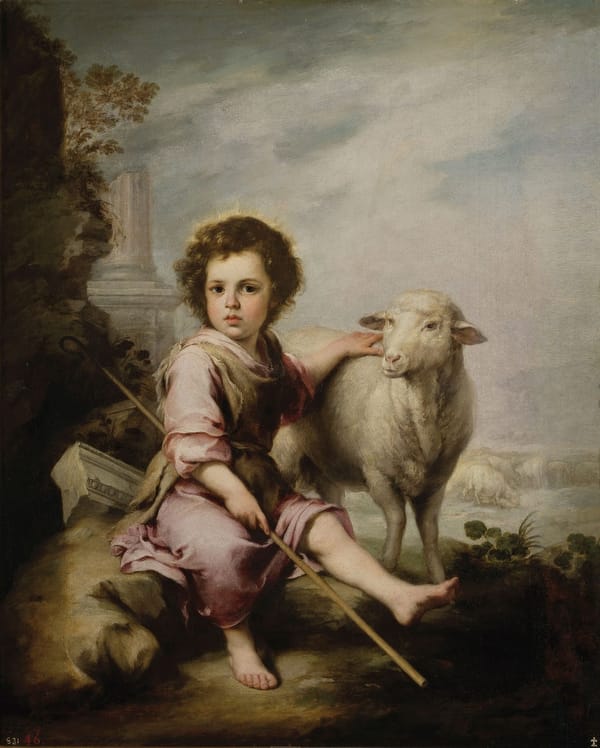
THIS Sunday goes under the name of Good Shepherd Sunday, because in the Mass there is read the Gospel of St John, wherein our Lord calls himself by this name. How very appropriate is this passage of this Gospel to the present season, when our divine Master began his work of establishing and consolidating the Church, by giving it the pastor, or shepherd, who was to govern it to the end of time!
In accordance with the eternal decree, the Man-God, on the fortieth day after his Resurrection, is to withdraw his visible presence from the world. He is not to be again seen upon the earth till the last day, when he will come again to judge the living and the dead. And yet he could never abandon mankind, for which he offered himself on the Cross, and delivered from death and hell by rising triumphantly from the grave. He will continue to be its Head after his Ascension into heaven: but what shall we have on earth to supply his place? We shall have the Church. It is to the Church that he will leave all his own authority to rule us; it is into the hands of the Church that he will entrust all the truths he has taught; it is the Church that he will make the dispenser of all those means of salvation which he has destined for the world.
This Church is a society, unto which all mankind is invited. It is composed of two classes of members; the governing and the governed; the teaching and the taught; the sanctifying and the sanctified. This society is the Spouse of Christ; it is by her that he produces his elect. She is the one only Mother of the elect; out of her bosom there is no salvation.
But how is this society to subsist? how is it to persevere through the long ages of time, even to the last day? who is to give it unity and adhesion of its parts? what is to be the visible link between its members—the palpable sign of its being the true Spouse of Christ, in the event of other societies rising up and disputing her titles? If Jesus himself could have remained with us we should have had nothing to fear, for where he is, there also are truth and life; but, as he says, he is going, and we may not as yet follow him. Give ear, then, and learn what is the primary quality of the true Spouse of Christ.
Jesus was one day, previous to his Passion, in the country of Cesarea Philippi; his Apostles were standing around him, and he began questioning them about what they thought of him. One of them, Simon the son of John or Jonas, and brother to Andrew, answered in the name of all, and said: Thou art Christ, the Son of the living God!1 Jesus expressed his pleasure at receiving Simon’s testimony, which was not the result of any human knowledge, but the expression of a divine revelation there and then granted to him; and he immediately told this Apostle that from that time forward he was to be, not Simon, but Peter (which means a rock). Christ had been spoken of by the prophets under the name of a Rock, or Stone;2 by thus solemnly conferring upon his disciple a title so characteristically that of the Messias, Jesus would give us to understand that Simon was to have something in common with himself which the other Apostles were not to have. After saying to him: ‘Thou art Peter (that is, thou art the rock), he added:' And upon this rock I will build my Church.’3
Let us weigh the force of these words of the Son of God: I will build my Church. He has, then, a project in view—he intends to build a Church. It is not now that he will build it, but at some future period; but one thing we already know as a certainty—it is that this Church will be built on Peter. Peter will be its foundation; and whosoever is not on that foundation will not belong to the Church. Let us again give ear to the text: And the gates of hell shall not prevail against my Church. In scriptural language gates signify powers: the Church of Christ, therefore, is to be proof against all the efforts of hell. And why? Because the foundation which Jesus is to give to it shall be one that no power can shake. The Son of God continues: And I will give to thee the keys of the kingdom of heaven. In the language of the Jews, keys signify the power of governing; and in the Gospel Parables the kingdom of heaven is the Church built by Christ. By saying to Peter (which is henceforth to be Simon’s name), I will give to thee the keys of the kingdom of heaven, Jesus implied this: ‘I will make thee the King of my Church, of which thou art to be the foundation!’ Nothing could be clearer. But let us remember that all these magnificent promises regard the future.4
That future has now become the present. We are now come to the last days of Jesus’ visible presence here below. The time is come for him to make good his promise, and found the kingdom of God—that Church which he was to build upon the earth. The Apostles, in obedience to the order sent them by the angels, are come into Galilee. Our Lord appears to them on the shore of the lake of Tiberias: after providing them with a mysterious repast, and whilst they are all attentive to his words, he suddenly addresses himself to Peter: Simon, son of John, lovest thou me?5 Observe, he does not call him Peter; he, as it were, goes back to the day when he said to him: Simon, son of Jonas, thou art Peter; he would have his disciples note the connection between the promise and its actual fulfilment. Peter, with his usual eagerness, answers his Master’s question: Yea, Lord, thou knowest that I love thee. Jesus resumes, with a tone of authority: Feed my lambs! Then repeating the question, he says: Simon, son of John, lovest thou me? Peter is surprised at his Master’s urging such an inquiry; still he answers with the same simplicity as before: Yea, Lord, thou knowest that I love thee: and as soon as he has given answer, Jesus repeats the words of investiture: Feed my lambs!
The disciples respectfully listen to this dialogue; they see plainly that, here again. Peter is made an object of Jesus’ partiality, and is receiving something which they themselves are not to receive. They remember what happened at Cesarea Philippi and how. ever since that day, Peter has been treated by their Master with especial honour. And yet there is another privilege or office to be added to this of feeding the lambs. A third time, then, Jesus says to Peter: Simon, son of John, lovest thou me? This is too much for the Apostle. These three questionings of his love bring to his mind the three denials he had so sinfully made to the servant girl of Caiphas. He feels the allusion to his recent infidelity; and this third time, his answer implies a prayer for forgiveness; his reply bespeaks humility rather than assurance: Lord! says he, thou knowest all things! Thou knowest that I love thee! Then, making Peter’s authority complete, Jesus pronounces these imposing words: Feed my sheep!6
Here, then, we have Peter made shepherd by him who says of himself: I am the good Shepherd. Firstly, our Lord gives his Apostle, twice over, the care of his lambs; this does not make him the complete shepherd: but when he bids him feed his sheep too, the whole flock is subjected to his authority. Now, therefore, let the Church show herself, let her take her stand, let her spread herself through the length and breadth of the nations; Simon, the son of John, is proclaimed its visible head. Is the Church a building? he is the foundation-stone, the Petra, the rock. Is she a kingdom? he holds the keys, that is, the sceptre. Is she a fold? he is the shepherd.
Yes, this Church, which Jesus is now organizing, which is to be proclaimed to the world on the day of Pentecost, is to be a fold. The Word, the Second Person of the blessed Trinity, is come down from heaven, that he may gather together in one the children of God that were dispersed;7 and the time is at hand when there shall he but one fold and one shepherd.8 O Jesus! our divine Shepherd! we bless thee, we give thee thanks. It is by thee that the Church thou art now founding subsists and lives through every age, congregating and saving all that put themselves under her guidance. Her authority, her strength, her unity, all come from thee, her infinitely powerful and merciful shepherd! We likewise bless and thank thee that thou hast secured this authority, this strength, this unity, by giving us Peter as thy Vicar, Peter our shepherd in and by thee, Peter to whom all, both sheep and lambs, owe obedience, Peter in whom thou, our divine Head, wilt be for ever visible, even to the end of the world!
In the Greek Church, the second Sunday after Easter, which we call Good Shepherd Sunday, goes under the appellation of the Sunday of the holy Myrophorœ, that is Perfume-Bearers. The Office celebrates the devotion of the holy women who brought their perfumes to the sepulchre, that they might embalm the Body of Christ. Joseph of Arimathea is also commemorated in the Greek Liturgy of this week.
The Roman Church reads the Acts of the Apostles in her Matins, from last Monday to the third Sunday after Easter exclusively.
Mass
The Introit takes a tone of triumph. It celebrates in the words of the Royal Psalmist the mercy of the Lord, which by the foundation of the Church has filled the whole earth. The heavens (by which, in the mysterious language of the Scripture, is frequently meant the Apostles), were firmly established by the Word of the Lord, when Jesus (the Word) gave them Peter as their shepherd and their rock.
Introit
Ps. Exsultate justi in Domino: rectos decet collaudatio.℣. Gloria Patri.
Misericordia.
Ps. Rejoice in the Lord, O ye just! Praise becometh the upright.℣. Glory, etc.
The earth, etc.
In the Collect, the Church asks the grace of holy Joy for her children: it is the spirit of Eastertide. Surely, it is a duty to rejoice at our having been saved from death by our Jesus' Resurrection! Moreover, these Paschal joys are a preparation for those of eternity.
Collect
To this are added two of the following Collects:
Of the Blessed Virgin
Against the Persecutors of the Church
For The Pope
Epistle
1 Cap. ii.Charissimi, Christus passus est pro nobis, vobis relinquens exemplum, ut sequamini vestigia ejus. Qui peccatum non fecit, nec inventus est dolus in ore ejus: qui quum malediceretur, non maledicebat, quum pateretur, non comminabatur: tradebat autem judicanti se injuste: qui peccata nostra ipse pertulit in corpore suo super lignum: ut peccatis mortui, justitiae vivamus: cujus livore sanati estis. Eratis enim sicut oves errantes, sed conversi estis nunc ad pastorem et episcopum animarum vestrarum.
1 Ch. ii.Dearly beloved: Christ also suffered, leaving you an example, that you should walk in his steps. Who did no sin, neither was guile found in his mouth. Who, when he was reviled, did not revile; when he suffered, he threatened not: but delivered himself to him that judged him unjustly: who his own self bore our sins in his body upon the tree: that we being dead to sins, should live to justice: by whose stripes you were healed. For you were as sheep going astray; but you are now converted to the shepherd and bishop of your souls.
It is the prince of the Apostles, the visible shepherd of the universal Church, who addresses these words to us. Observe how he ends by turning our thoughts to the invisible shepherd, whose Vicar he is; and how carefully he avoids any allusion to himself. So, also, when assisting his disciple Mark to write his Gospel, he would not allow him to relate the history of Christ's having made him the shepherd of the whole flock; whereas, he insisted on his telling every circumstance of his thrice denying Jesus to be his Master. See, too. how feelingly the Apostle here speaks of his Saviour—of the sufferings he endured, of his patience, of his devotedness for those poor straying sheep of whom he was to form his fold! These words will one day be verified in Peter himself. The hour will come when, like his Master, he will be fastened to a cross, and patiently endure every insult and cruelty. Jesus told him that it was to be so. After entrusting him with the care of the sheep and lambs, our Lord told him that when he should have grown old, he would stretch forth his hands upon a cross, and suffer violence from men.9 This is to happen not merely to Peter, but to a considerable number of his successors, who are one with himself, and whom future generations are to see continually persecuted, exiled, imprisoned, and put to death. Let us also follow Jesus' steps, by cheerfully suffering for justice’ sake: we owe it to him who from all eternity, being equal in glory to God the Father, deigned to come down to our earth that he might be the shepherd and bishop of our souls.
The first Alleluia Versicle commemorates the repast at Emmaus: in a few moments we also shall know Jesus in the breaking of the Bread of Life.
The second proclaims, in Jesus’ own words, the dignity and qualities of a shepherd, his love for his sheep, and the eagerness wherewith his sheep recognize him as their Master.
Alleluia.℣. Ego sum Pastor bonus; et cognosco oves meas, et cognoscunt me meæ, alleluia.
Alleluia.℣. I am the good Shepherd, and I know my sheep, and my sheep know me, alleluia.
Gospel
Cap. x.In illo tempore: Dixit Jesus Pharisæis: Ego sum Pastor bonus. Bonus pastor animam suam dat pro ovibus suis. Mercenarius autem et qui non est pastor, cujus non sunt oves propriae, videt lupum venientem, et dimittit oves, et fugit: et lupus rapit et dispergit oves: mercenarius autem fugit, quia mercenarius est, et non pertinet ad eum de ovibus. Ego sum Pastor bonus: et cognosco oves meas, et cognoscunt me meae. Sicut novit me Pater, et ego agnosco Patrem: et animam meam pono pro ovibus meus. Et alias oves habeo, quæ non sunt ex hoc ovili: et illas oportet me adducere, et vocem meam audient, et fiet unum ovile, et unus pastor.
Ch. x.At that time: Jesus said to the Pharisees: I am the good Shepherd. The good shepherd giveth his life for his sheep. But the hireling, and he that is not the shepherd, whose own the sheep are not, seeth the wolf coming, and leaveth the sheep, and flieth, and the wolf catcheth, and scattereth the sheep: and the hireling flieth, because he is a hireling: and he hath no care for the sheep. I am the good Shepherd: and I know mine, and mine know me. As the Father knoweth me, and I know the Father: and I lay down my life for my sheep. And other sheep I have, that are not of this fold: them also I must bring, and they shall hear my voice, and there shall be one fold, and one shepherd.
Divine Shepherd of our souls! how great is thy love for thy sheep! Thou givest even thy life to save them. The fury of wolves does not make thee flee from us; thou becomest their prey, that we may escape. Thou didst die in our stead, because thou wast our Shepherd. We are not surprised at thy requiring from Peter a greater love than thou didst require from his brother Apostles: thou didst will to make him their and our shepherd. Peter answered thee without hesitation, that he loved thee; and thou didst confer upon him thine own name, together with the reality of thine office, in order that he might supply thy place after thy departure from this world. Be thou blessed, O divine Shepherd! for thy having thus provided for the necessities of thy fold, which could not be one, were it to have many shepherds without one supreme shepherd. In obedience to thy command, we bow down before Peter, with love and submission; we respectfully kiss his sacred feet; for it is by him that we are united to thee; it is by him that we are thy sheep. Preserve us, O Jesus, in the fold of Peter, which is thine. Keep far from us the hireling who usurps the place and rights of the shepherd. He has intruded himself, or been intruded by violence, into the fold, and would have us take him as the master; but he knows not the sheep, and the sheep do not know him. Led, not by zeal, but by avarice and ambition, he flieth at the approach of danger. He that governs through worldly motives is not a man to lay down his life for others. The schismatic pastor loves himself; he does not love thy sheep; how could he give his life for them? Protect us, O Jesus, from this hireling! He would separate us from thee, by separating us from Peter, whom thou hast appointed thy Vicar; and we are determined to recognize no other. Anathema to him who would command as in thy name, and yet not be sent by Peter! Such a pastor could be but an impostor; he would not rest on the foundation; he would not have the keys of the kingdom of heaven; to follow him would be our ruin. Grant, then, Good Shepherd, Jesus! that we may ever keep close to thee and to Peter; that as he rests upon thee, we may rest upon him; and thus we may defy every tempest, for thou, dear Lord, hast said: A wise man built his house upon a rock; and the rain fell, and the floods came, and the winds blew, and they beat upon that house, and it fell not; for it was founded on a rock.10
The Offertory is an aspiration to God. taken from the royal Prophet.
Offertory
In the Secret, the Church prays that the divine energy of the Mystery, about to be consummated on the Altar may produce within us the effect for which we long—death to sin. and resurrection to grace.
Secret
To this the priest adds two of the following Secrets.
Of the Blessed Virgin
Against The Persecutors Of The Church
For the Pope
The Communion Anthem speaks to us of the beautiful Mystery of to-day—the Good Shepherd. Let us once more offer our homage to the Son of God, who deigns to assume this endearing character; and let us ever be his devoted sheep.
Communion
Jesus, the Good Shepherd, has given himself, in this divine banquet, to his sheep: holy Church prays, in the Postcommunion, that we may ever be penetrated with sentiments of love for this august Sacrament; we ought to glory in it, as being the food that prepares us for immortality.
Postcommunion
To this the priest adds two of the following Postcommunions.
Of the Blessed Virgin
Against the Persecutors of the Church
For the Pope
Vespers
The Psalms, Hymn and Versicle are given on pages 81-90.
Antiphon of the Magnificat
Oremus.
We will close the day with this beautiful preface taken from the Mozarabic Missal. It commemorates the Resurrection.
Illatio
(Feria vi Paschœ)
April 23: St. George, Martyr
|
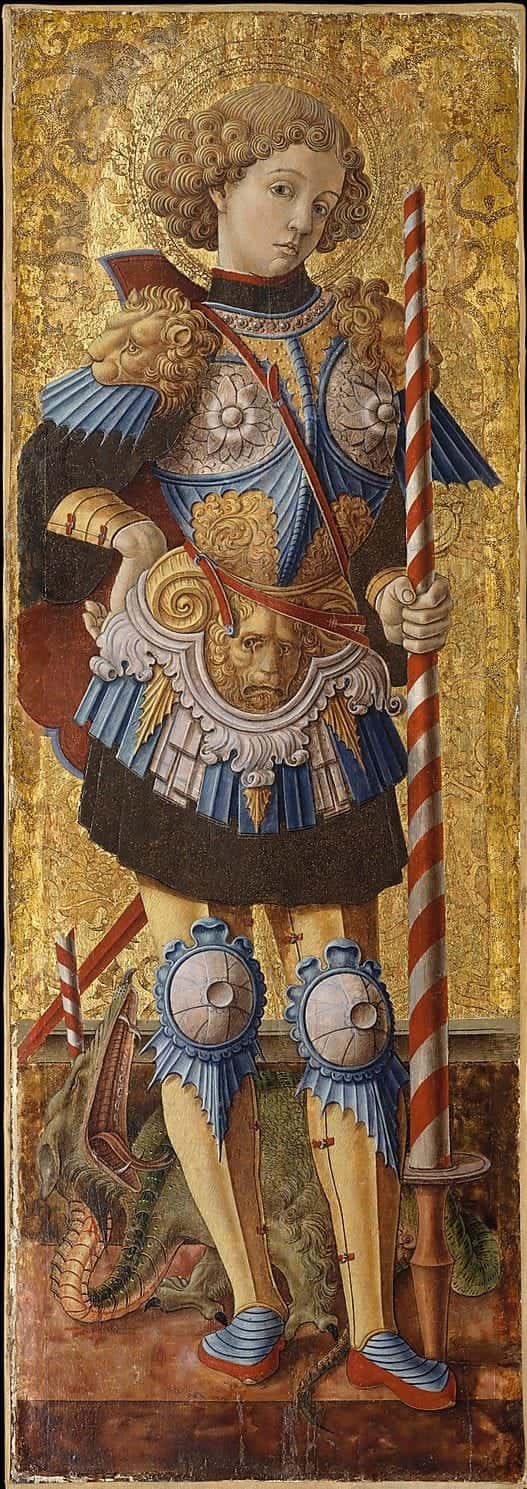
CLAD in his bright coat of mail, mounted on his war-steed, and spearing the dragon with his lance, George, the intrepid champion of our Risen Jesus, comes to gladden us today with his feast. From the East, where he is known as the great Martyr, devotion to St George soon spread in the Western Church, and our Christian armies have always loved and honoured him as one of their dearest patrons. His martyrdom took place in Paschal Time; and thus he stands before us as the guardian of the glorious sepulchre, just as Stephen, the Protomartyr, watches near the crib of the Infant God.
The Roman Liturgy gives no lessons on the life of St George; but, in their stead, reads to us a passage from St Cyprian on the sufferings of the martyrs. This derogation from the general rule dates from the fifth century. At a celebrated Council held in Rome in the year 496, Pope St Gelasius drew up, for the guidance of the faithful, a list of books which might or might not be read without danger. Among the number of those that were to be avoided, he mentioned the ‘Acts of St Georg,' as having been compiled by one who, besides being an ignorant man, was also a heretic. In. the East, however, there were other ' Acts ' of the holy martyr, totally different from those current in Rome; but they were not known in that city. The cultus of St George lost nothing, in the holy city, by this absence of a true legend. From a very early period, a church was built in his honour; it was one of those that were selected as Stations, and gave a Title to a Cardinal; it exists to this day, and it is called Saint George in Velabro (the Veil of Gold) .
The Bollandists were in possession of several copies of the forbidden ‘Acts '; they found them replete with absurd stories, and, of course, they rejected them. Father Papebroch has given us other and genuine ‘Acts ' written in Greek, and quoted by St Andrew of Crete. They bring out the admirable character of our martyr, who held an important post in the Roman army during the reign of the Emperor Diocletian. He was one of the first victims of the great persecution and suffered death at Nicomedia. Alexandra, the Emperor's wife, was so impressed at witnessing the Saint’s courage, that she professed herself a Christian, and shared the crown of martyrdom with the brave soldier of Christ.
As we have already said, devotion to St George dates from a very early period. St Gregory of Tours gives us several proofs of its having taken root in Gaul. St Clotilde had a singular confidence in the holy martyr, and dedicated to him the Church of her dear Abbey of Chelles. But this devotion became more general and more fervent during the Crusades, when the Christian armies witnessed the veneration in which St George was held by the Eastern Church, and heard the wonderful things that were told of his protection on the field of battle. The Byzantine historians have recorded several remarkable instances of the kind; and the Crusaders returned to their respective countries publishing their own experience of the victories gained through the Saint's intercession. The Republic of Genoa chose him for its patron; and Venice honoured him as its special protector, after St Mark. But nowhere was St George so enthusiastically loved as in England. Not only was it decreed in a Council held at Oxford, in the year 1222, that the feast of the Great Martyr should be observed as one of obligation; not only was devotion to the valiant soldier of Christ encouraged, throughout Great Britain, by the first Norman Kings; but there are documents anterior to the invasion of William the Conqueror, which prove that St George was invoked as the special patron of England even so far back as the ninth century. Edward III did but express the sentiment of the country when he put the Order of the Garter, which he instituted in 1330, under the patronage of the warrior Saint. In Germany, King Frederic III founded the Order of St George in the year 1468.
St George is usually represented as killing a dragon; and where the representation is complete, there is also given the figure of a princess, whom the Saint thus saves from being devoured by the monster. This favourite subject of both sacred and profane art is purely symbolical, and is of Byzantine origin. It signifies the victory won over the devil, by the martyr's courageous profession of faith; the princess represents Alexandra, who was converted by witnessing the Saint’s heroic patience under his sufferings. Neither the ' Acts ' of St George nor the hymns of the Greek Liturgy allude to the martyr's having slain a dragon and rescued a princess. It was not till after the fourteenth century that this fable was known in the West; and it arose from a material interpretation of the emblems with which the Greeks honoured St George, and which were introduced among us by the crusaders.
Although, as has been said, the Office of St George in the Roman Breviary has been taken from the Common of Martyrs in Paschal Time, the following historical lesson has recently been approved for the Dioceses of England:
Let us, in honour of our glorious patron, recite the following stanzas, taken from the Menæa of the Greek Church:
Hymn (Die XXIII Aprilis)
Thou, O George, art the glorious type of a Christian soldier. Whilst serving under an earthly monarch, thou didst not forget thy duty to the King of heaven. Thou didst shed thy blood for the faith of Christ; and he, in return, appointed thee protector of Christian armies. Be their defender in battle, and bless with victory them that fight in a just cause. Protect them under the shadow of thy standard; cover them with thy shield; make them the terror of their enemies. Our Lord is the God of Hosts; and he frequently uses war as the instrument of his designs, both of justice and mercy. They alone win true victory who have heaven on their side; and such soldiers, when on the battle-field, seem to the world to be doing the work of man, whereas it is the work of God they are furthering. Hence are they more generous, because more religious, than other men. The sacrifices they have to make, and the dangers they have to face, teach them unselfishness. What wonder, then, that soldiers have given so many martyrs to the Church!
But there is another warfare, in which we Christians are all enlisted, and of which St Paul speaks, when he says: Labour as a good soldier of Christ; for no man is crowned, save he that striveth lawfully.1 That we have thus to strive and fight during our life, the same Apostle assures us in these words: Take unto you the armour of God, that ye may be able to resist in the evil day, and to stand in all things perfect. Stand, therefore, having your loins girt about with truth, and having on the breastplate of justice, and your feet shod with the preparation of the Gospel of peace. In all things taking the shield of faith, wherewith ye may be able to extinguish all the fiery darts of the most wicked one. And take unto you the helmet of the hope of salvation, and the sword of the spirit, which is the word of God.2 We, then, are soldiers, as thou wast, O holy martyr! Before ascending into heaven, our divine leader wishes to review his troops; do thou present us to him. He has loaded us with honours, notwithstanding our past disloyalties; we must, henceforth, prove ourselves worthy of our position. In the Paschal Communion which we have received, we have a pledge of victory; how can we ever be so base as to permit ourselves to be conquered! Watch over us, O sainted warrior! Let thy prayers and example encourage us to fight against the dragon of hell. He dreads the armour we wear; for it is Jesus himself that prepared it for us, and tempered it in his own precious Blood: may we, like thee, present it to him whole and entire, when he calls us to our eternal rest!
There was a time when the whole Christian world loved and honoured thy memory with enthusiastic joy: but now, alas! this devotion has grown cold, and thy feast passes unnoticed by thousands. O holy martyr! avenge this ingratitude by imitating thy divine King, who maketh his sun to rise upon both good and bad; take pity on this world, perverted as it is by false doctrines, and tormented at this very time by the most terrible scourges. Have compassion on thy dear England, which has been seduced by the dragon of hell, and by him made the instrument for effecting his plots against the Lord and his Christ. Take up thy spear as of old; give the monster battle, and emancipate the isle of Saints from his slavish yoke. Heaven and earth join in this great prayer! In the name of our Risen Jesus, aid thine own and once devoted people to a glorious resurrection!
| Previous Saturday the Second Week after Easter | Next April 23: St. George, Martyr |