Daily reading
Paschal Time
Double · April 24 · Sanctoral
April 24, 2023
From Dom Guéranger’s The Liturgical Year.
A Double leads the weekday.Rubric
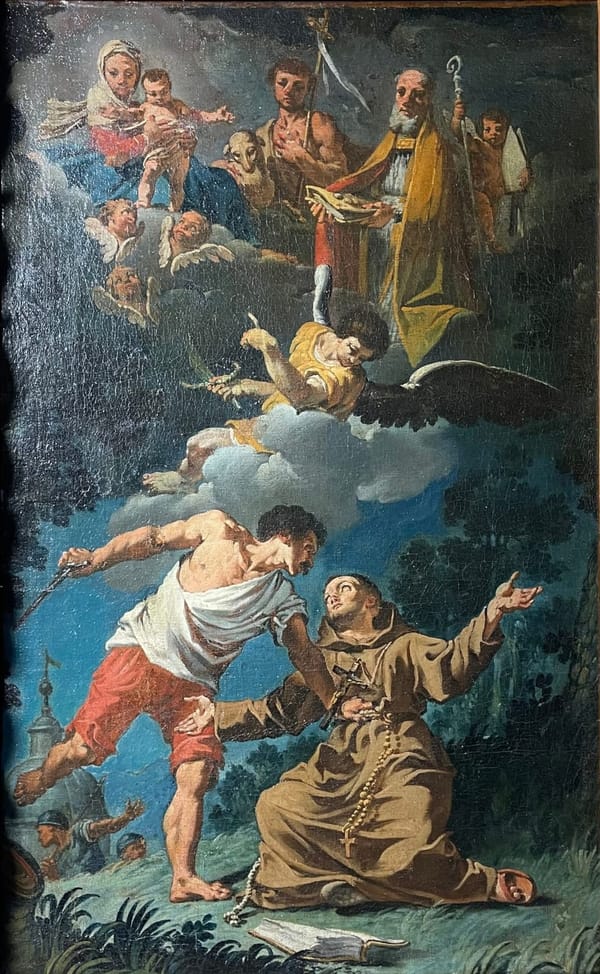 |
April 24: St. Fidelis of Sigmaringen, Martyr
OUR Risen Lord would have around him a bright phalanx of martyrs. Its privileged members belong to the different centuries of the Church’s existence. Its ranks open today to give welcome to a brave combatant, who won his palm, not in a contest with paganism, as those did whose feasts we have thus far kept, but in defending his mother, the Church, against her own rebellious children. They were heretics that slew this day’s martyr, and the century that was honoured with his triumph was the seventeenth.
Fidelis was worthy of his beautiful name. Neither difficulty nor menace could make him fail in his duty. During his whole life, he had but the glory and service of his divine Lord in view: and when the time came for him to face the fatal danger, he did so, calmly but fearlessly, as behoved a disciple of that Jesus who went forth to meet his enemies. Honour, then, be to-day to the brave son of St Francis! truly he is worthy of his seraphic Patriarch, who confronted the Saracens, and was a martyr in desire!
Protestantism was established and rooted by the shedding of torrents of blood; and yet Protestants count it as a great crime that, here and there, the children of the true Church made an armed resistance against them. The heresy of the sixteenth century was the cruel and untiring persecutor of men, whose only crime was their adhesion to the old faith—the faith that had civilized the world. The so-called Reformation proclaimed liberty in matters of religion, and massacred Catholics who exercised this liberty, and prayed and believed as their ancestors had done for long ages before Luther and Calvin were bom. A Catholic who gives heretics credit for sincerity when they talk about religious toleration, proves that he knows nothing of either the past or the present. There is a fatal instinct in error, which leads it to hate the Truth; and the true Church, by its unchangeableness, is a perpetual reproach to them that refuse to be her children. Heresy starts with an attempt to annihilate them that remain faithful; when it has grown tired of open persecution it vents its spleen in insults and calumnies; and when these do not produce the desired effect, hypocrisy comes in with its assurances of friendly forbearance. The history of Protestant Europe, during the last three centuries, confirms these statements; it also justifies us in honouring those courageous servants of God who, during that same period, have died for the ancient faith.
Let us now respectfully listen to the account given us, in the Liturgy, of the life and martyrdom of St Fidelis; we shall find that the Church has not grown degenerate in her Saints.
How truly couldst thou, O Fidelis! say with the Apostle: I have finished my course!1 Yea, thy death was even more beautiful than thy life, holy as that was. How admirable the calmness wherewith thou didst receive death! how grand the joy wherewith thou didst welcome the blows of thine enemies—thine, because they were those of the Church! Thy dying prayer, like Stephen's, was for them; for the Catholic, while he hates heresy, must love the heretics who put him to death. Pray, O holy martyr, for the children of the Church. Obtain for them an appreciation of the value of faith, and of the favour God bestowed on them when he made them members of the true Church. May they be on their guard against the many false doctrines which are now current through the world. May they not be shaken by the scandals which abound in this age of effeminacy and pride. It is faith that is to bring us to our Risen Jesus: and he urges it upon us by the words he addressed to Thomas: Blessed are they that have not seen and have believed!2 Of this number we wish to be: and therefore is it that we cling to the Church, the sovereign mistress of faith. We wish to believe her, and not human reason, which has neither the power to fathom the word of God, nor the right to sit in judgement over it. Jesus has willed that this holy faith should come down to us bearing on itself the strengthening testimony of the martyrs; and each age has had its martyrs. Glory to thee, O Fidelis, who didst win thy palm by combating the errors of the pretended Reformation! Take a martyr’s revenge, and pray without ceasing to our Jesus, that he would bring all heretics back to the faith and to union with the Church. They are our brethren by baptism; pray for them, that they may return to the Fold, and that we may one day celebrate with them the true Paschal banquet, wherein the Lamb of God gives himself to be our food, not figuratively, as in the Old Law, but really and truly, as fits the New Covenant.
Monday of the Third Week after Easter
THE first stone of the Church is laid; and on this foundation Jesus now begins to build. The shepherd of the sheep and lambs has been proclaimed; it is time to form the fold. The keys of the kingdom have been given to Peter; it is time to inaugurate the kingdom. Now this Church, this fold, this kingdom, designate a society which is to be called Christian, after the name of its Founder. This society, composed of the disciples of Christ, is destined to receive within it every individual of the human race; and if all do not actually enter, it is not in consequence of any ban of exclusion. It will subsist to the end of time; for there can be no elect out of its pale. It will be One; for Christ says not: ‘I will build my Churches he speaks but of One. It will be holy; for all the means of sanctification are in its keeping. It will be Catholic, that is, Universal, in order that, being known in all times and places, men may be able to hear its teachings and follow them. It will be Apostolic; that is to say, that how long soever this world may last, it will come down, by lawful succession, from these men with whom Jesus is, during these forty days, arranging everything that is connected with its establishment.
Such is to be the Church, out of which there is no salvation for those who, having known her, have refused to become her members. A few days hence, and the world will hear of her existence. The spark that is now but in Judea will soon become a fire spread throughout the whole earth. Before the close of the century, not only will there be members of the Church in every province of the vast Roman Empire, but even in countries where Rome has never planted the standard of her proud eagles. Nay more, this miraculous propagation is to be perpetual—in every page new apostles will set forth, and win new victories for this immortal Church. Nothing human is lasting; but the Church's ceaseless duration will excite the spleen of incredulity and baffle all its calculations. Persecutions, heresies, schisms, apostasies, and scandals—all will strive to work her ruin; but she will survive them all. The descendants of her bitterest foes will call her mother. Thrones and dynasties, nations, and even whole races, will be carried away by the tide of time: she alone will subsist throughout the ages, stretching out her arms to receive all men, teaching ever the same truths, repeating, even to the last day, the same symbol of faith, and ever faithful to the instructions given her by our Risen Jesus during these forty days preceding his Ascension.
How shall we worthily thank thee, O God our Saviour, for thy having, even at our first entrance into life, made us members of this thy immortal Spouse, which alone possesses thy heavenly teachings and the means whereby is wrought salvation? We have no need to search for thy Church; it is in and by her that we live, even here below, the supernatural life, the perfection of which is to be given to us in heaven, provided we be faithful to grace. Oh! show thy mercy to those countless souls who have not had the privilege we have enjoyed, and whose entrance into thy Church is to cost them many a painful sacrifice. Strengthen them with light; give them courage; rouse them from indifference; bless their efforts; that thus, O divine Shepherd! thy fold may increase, and thy Church, thy Spouse, may be, as thou hast promised she ever shall be, the joyful mother of children!
Let us continue our homage to the mystery of the Pasch, borrowing another canticle from the inexhaustible Adam of Saint-Victor.
Sequence
Lux insignis, lux unica,
Lux lucis et laetitiae,
Lux immortalis gloriae.
Commendat ab initio,
Quam Christi resurrectio
Ditavit privilegio.
Lucis exsultent filii,
Vindicent membra meritis
Conformitatem Capitis.
Et vota sunt solemnia;
Primae diei dignitas
Prima requirit gaudia.
Paschalis est victoria,
Sub multis aenigmatibus
Prius promissa patribus.
Quod vetus lex praecinuit
Figuram res exterminat,
Et umbram lux illuminat.
Quid hœdus gesserit,
Nostra purgans piacula,
Messias nobis aperit.
Solvit a morte debita;
Praedam captans illicitam,
Praeda privatur licita.
Caro peccati nescia;
Die reflorens tertia
Corda confirmat dubia.
Tu Christo nos vivifica!
Mors morti non obnoxia,
Da nobis vitæ praemia.
the brilliant light, the light above all other,
the light of light and joy,
the light of immortal glory.
from the very beginning of the world:
the day enriched
with the prerogative of Christ’s Resurrection.
exult with the hope of everlasting joy:
let the members so act as to merit
to be like their Head.
so are our prayers.
The grandest of days
should have the grandest joy.
is the most glorious of feasts.
It was promised to our fathers
under many types.
and all is made visible that was foretold in the Old Law.
The reality effaces the figure;
and light throws light on the shadow.
—has revealed to us
the mysteries of the spotless Lamb
and the Kid.
he delivered us from the death we so truly deserved.
Death, making a prey of him on whom he had no claim,
was deprived of the prey that was justly his own.
cancelled the sins of ours:
it rose again on the third day,
and, reblooming, refreshed all wavering hearts.
give us to live in Jesus.
O undying death!
give us the prize of life.
| Previous April 23: St. George, Martyr | Next Monday of the Third Week after Easter |