Daily reading
Paschal Time
Double · April 28 · Sanctoral
April 28, 2023
From Dom Guéranger’s The Liturgical Year.
A Double leads the weekday; St. Vitalis is commemorated.Rubrics
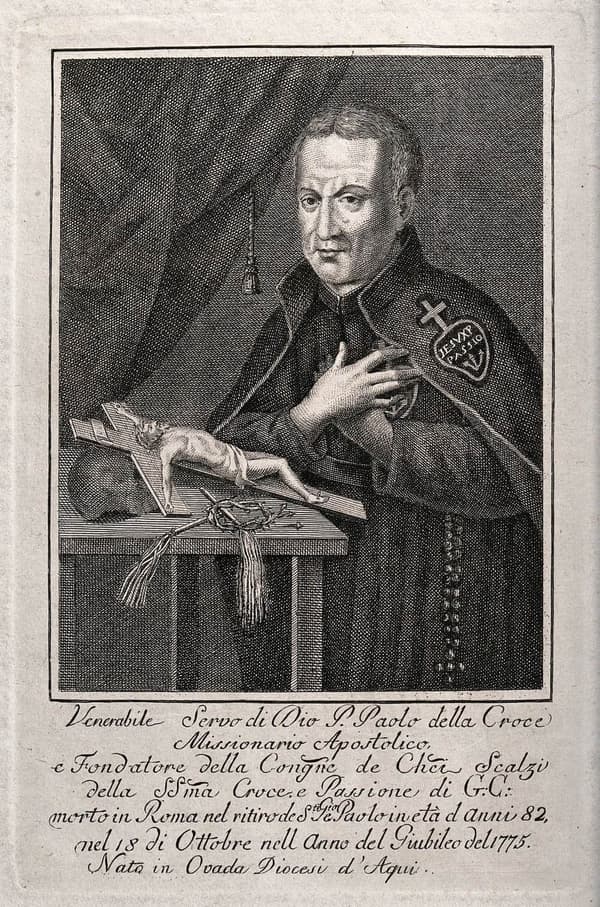 |
April 28: St. Paul of the Cross, Confessor
SPLENDIDLY adorned with the sacred sign of the Passion, Paul of the Cross comes to-day to pay homage to the Conqueror of Death. It behoved Christ to suffer and so enter into his glory. It behoves the Christian, the member of Christ, to follow his Head in suffering that he may share his triumph. Even as a child Paul penetrated deeply into the ineffable mystery of the suffering of a God. He was filled with an ardent love for the cross, and ran with giant strides along this royal road. He passed through the torrent, following his divine Head, he was buried with him in death, and has won a share in his Resurrection.
The diminution of truths among the children of men seemed to have dried up the fount of sanctity, when Italy, ever fruitful in her vivid faith, gave birth to the Christian hero, who stands out in the arid waste of the eighteenth century, like a saint of olden times. God never deserts his Church. He confronts a century of revolt and sensualism veiled under the name of philosophy with the Cross of his Son. A new Paul, recalling both in his name and his works the great Apostle of the Gentiles, rises in the midst of a generation intoxicated with pride and falsehood, to whom the Cross has become once more a folly and a scandal. This apostle was weak, poor, isolated and long misunderstood, but his heart was full of love and self-abnegation, and he sought to put to confusion the wisdom of sages and the prudence of prudent men. Clad in a coarse habit, with bare feet, his head crowned with thorns and a heavy cross on his shoulder, he journeyed through cities, claiming the attention of both the humble and the mighty, and desiring to know nothing but Jesus Crucified. The Cross made his zeal fruitful and showed itself to be indeed the power and the wisdom of God. Those who prided themselves on having banished the miraculous from history and the supernatural from the life of the people, might exult in their triumph, but, unknown to them, wonderful prodigies, countless miracles, were making whole peoples submissive to the voice of this man who, by completely destroying sin in his own person, had regained the power which Adam once had over nature, and seemed to possess in his mortal flesh the qualities of a glorified body.
But the apostolate of the Cross was not to end with Paul’s death. The resources of ancient times were no longer sufficient for a decrepit age. We are far from the days when the exquisite delicacy of Christian sentiment was strongly moved by the sight of the cross amid flowers, as it is seen in the paintings of the catacombs. Man’s senses have been dulled by unhealthy emotions, and there is need of a stimulant in the form of a constant representation of the tears, the Blood, and the gaping wounds of our divine Redeemer. Paul of the Cross received the mission to supply this need. At the cost of unspeakable sufferings he became the father of a new religious family, which adds to the three ordinary vows of religion a fourth vow—to propagate devotion to the sacred Passion of our Lord, the badge of which each Religious wears visibly on his breast.
We must not forget that the Passion of our Lord is for the Christian soul only a preparation for the great mystery of the Pasch, the glorious term of the manifestations of the Word, the supreme end of the elect, whose piety finds therein its completion and its crown. The Holy Spirit, who guides the Church throughout the admirable course of the liturgical cycle, has no other end in view for the souls who abandon themselves unreservedly to his sanctifying power. Paul's desire was to be nailed to the cross on Calvary, but he was often carried thence to the heights of heaven where he heard mysterious words such as it is not granted to man to utter.1 He assisted at the triumph of the Son of Man, who, after having lived on earth a mortal life and passed through death, is living now for ever and ever.2 He saw on the throne of God the Lamb standing as though slain, and giving light to the heavenly city,3 and this sublime vision of the realities of heaven inspired him with that divine enthusiasm, that intoxication of love, which, in spite of his terrifying austerities, gives an incomparable charm to his whole person. ‘Fear not,' he said to his children who were terrified by the furious attacks of the Devil, ' fear not, cry “Alleluia.” The devil is afraid of the Alleluia; it is a word that comes from Paradise.' He could not restrain his feelings when he saw nature born again with her Saviour in these days of spring, the flowers blossoming under the steps of his Risen Lord, the birds celebrating his victory in their harmonious songs. His heart was full to overflowing with love and poetry; he touched the flowers gently with his stick and upbraided them, saying: ‘Hold your peace, hold your peace.’ ‘To whom do these lands belong?’ he said one day to a companion, ‘to whom do these lands belong, I say? You do not understand. They belong to our great God.’ And his biographer relates that he was rapt in an ecstasy of love and carried some distance through the air. ‘Love God, my brethren,' he repeated to all those whom he met, ‘love God, who so well deserves our love. Do you not hear the very leaves on the trees telling you to love God? O love of God, love of God!'
We yield to the charm of a sanctity which is so sweet and yet so strong. It is a divine attraction, such as could never be exercised by the false spirituality, so much in vogue in the eighteenth century, even among the holiest. Under pretext of subduing man's evil nature and avoiding possible excesses, the new teachers allied themselves, though unwittingly, with Jansenism, checked the flight of the soul, disciplined it, remade it according to their own fashion, and confined it within the limits of certain rules which were supposed to lead all souls to perfection at the same rate. But saints are made by the divine Spirit, the spirit of love and holiness, to whose essence liberty belongs. He does not confine himself within the bounds of human methods. Our Lord says: ' The Spirit breatheth where he will . . . but thou knowest not whence he cometh and whither he goeth. So is every one that is bom of the Spirit.'4 The Holy Ghost chose Paul in his earliest infancy. He took possession of this child, so richly endowed by nature, destroyed nothing and sanctified everything. He formed him according to ancient models, always ardent, always attractive, and exceedingly holy. Such a one could never have been produced by a school whose over-correct methods wear the soul out by a barren and self-centred asceticism.
The Liturgy gives the following short account of St Paul of the Cross:
Romam profectus, theologicis disciplinis rite imbutus, a summo Pontifice Benedicto Decimo tertio ex obedientia sacerdotio auctus est. Facta sibi ab eodem potestate aggregandi socios, in solitudinem recessit Argentarii montis, quo eum beata Virgo jampridem invitaverat, veste illi simul ostensa atri coloris, Passionis Filli sui insignibus decorata, ibique fundamenta jecit novæ Congregationis. Quæ brevi, plurimis ab eo toleratis laboribus, præclaris aucta viris, cum Dei benedictione valde succrevit; a Sede Apostolica non semel confirmata una cum regulis, quas orando ipse a Deo acceperat, et quarto addito voto pergratam Dominicæ Passionis memoriam promovendi. Sacras Virgines quoque instituit, quæ excessum caritatis divini Sponsi sedulo meditarentur. Hæc inter, animarum inexhausta aviditate ab Evangelii prsedicatione numquam deficiens, homines pene innumeros etiam perditissimos aut in hæresim lapsos, in salutis tramitem adduxit. Præsertim Christi enarranda Passione, mirifica ejus prationis vis erat, qua una cum adstantibus in fletum effusus quælibet obdurata corda ad poenitentiam scindebat.
Thou hadst but one thought, O Paul. Hidden in those ‘clefts of the rock,’5 which are the sacred Wounds of the Saviour, thou wouldst bring all men to these divine fountains which quench the thirst of the true Israel in the desert of this life. Happy were they who could hear thy victorious word and save themselves by the Cross in the midst of a perverse generation. But in spite of thy apostolic zeal, thy voice could not make itself heard in all lands, and where thou wast absent evil was let loose upon the world. False science and mistaken piety, mistrust of Rome and the corruption of the great had prepared the way for the destruction of the old Christian social order, and the world was given over to teachers of lies. Thy prophetic gaze saw the abyss in which kings and peoples were soon to be engulfed. The successor of St Peter, unable to quell the storm which raged against the Church, sought by his efforts and sacrifices to hold back the floods, even for a time. Thou wert the friend of the Pontiffs and their support in those sad days, the witness of Christ suffering in his Vicar. What sorrows were confided to thee! And what must have been thy thoughts when at thy death thou didst bequeath the venerated image of the Mater Dolorosa to a Pontiff who was destined to drain the cup of bitterness and die a captive in a strange land! Thou didst promise to watch over the Church from thy throne in heaven with that tender compassion which identified thee on earth with her suffering Spouse. Keep this promise to-day, O Paxil! This age of social disintegration has neither made atonement for the sins of the past nor learnt wisdom from misfortune. The Church is the victim of oppression on all sides, the power is in the hands of her persecutors, and the Vicar of Christ is a prisoner in his palace and lives on alms. The Bride has no bed but the Cross of her Spouse, she lives on the memory of his sufferings. The Holy Spirit who guards her and is preparing her for the final summons, has raised thee up to keep her perpetually in mind of those sufferings which are to strengthen her in the trials of the last days.
Thy children all the world over are true to the spirit of their father and continue thy work on earth. They have gained a footing in England where thy prophetic gaze foresaw their labours, and this kingdom, for which thou didst pray so earnestly, is being gradually freed, through their influence, from the bonds of schism and heresy. Bless their apostolate. May they grow and be multiplied to meet the ever-increasing needs of these unhappy times! May their zeal ever continue to minister to the Church, and may the holiness of their lives ever redound to the glory of their father!
Thou, O Paul, wast faithful to thy crucified Master in his humiliation, and he has been faithful to thee in his triumphant Resurrection. In the hour of darkness thou didst live hidden in the clefts of the mysterious Rock. But what must be thy glory, now that Christ victorious ‘enlighteneth wonderfully from the everlasting hills’!6 Enlighten and perfect us, we beseech thee. We give thanks to God for thy triumph. Do thou in return help us to be faithful to the standard of the Cross, so that we, like thee, may be illuminated by its glory, when it appears in the clouds of heaven on the day of judgement.7 O Apostle of the Cross, initiate us into the mystery of the Pasch, which is so closely connected with that of Calvary. Only he who has shared the combat can comprehend the victory and have part in the triumph.
April 28 (the Same Day): St. Vitalis, Martyr
THERE are few martyrs of the West whose names are more celebrated than those of SS Gervasius and Protasius. The veneration in which they aie held by the Roman Church has led her to honour the memory of their father, who also won the palm under the persecution of Nero. She has chosen for his feast the glad season of Easter. The account given by the Liturgy of St Vitalis is short; but we can gather, from the few circumstances related, what fine characters these primitive Christians were who received the crown of martyrdom under the first of all the persecutions—the one that numbers among its choicest victims the two Apostles SS Peter and Paul.
Sin is the enemy of the soul; it throws her back again into that death whence Jesus had drawn her by his Resurrection. To preserve one of thy brethren from this misery, thou, O Vitalis, didst bravely raise a cry of zealous warning to him in the midst of his torments, and thy words awakened him to self-possession and courage. Show this same fraternal charity to us. We are living the life of our Risen Jesus; but the enemy is bent on robbing us of this life. He will seek to intimidate us; he will lay all manner of snares wherewith to deceive us; he will give us battle, and this untiringly. Pray then for us, O holy martyr, that we may be on our guard, and that the mystery of the Pasch may be fully accomplished within us, now and for ever!
Friday of the Third Week after Easter
CHURCH of Jesus! that wast promised by him to the earth during the days of his mortal life; that camest forth from his sacred Side when wounded by the spear upon the Cross; that wast organized and perfected by him during the last days of his sojourn here below; we lovingly greet thee as our mother; thou art the Spouse of our Redeemer, and it is through thee that we were born to him. It is thou that gavest us life by baptism; it is thou that givest us the word, which enlightens us; it is thou that ministerest to us the helps, whereby we are led, through our earthly pilgrimage, to heaven; it is thou that governest us, in the spiritual order, by thy holy ordinances.
Under thy maternal care we are safe; we have nothing to fear. What can error do against us? Thou art the pillar and ground of the truth!1 What effect can the revolutions of our earthly habitation have upon us? We know, that if everything else should fail us, thou wilt ever be with us. It was during these very days which precede the Ascension, that our Lord Jesus said to his Apostles, and through them, to their successors: Behold! I am with you all days, even to the consummation of the world.2 What a promise of duration was this! If we consult the history of these last eighteen hundred years, it will tell us that this promise has never once been broken. The gates of hell have risen up against thee innumerable times; but they have never prevailed against thee, no, not for one single moment!
And thus it is, O Church! that being founded on Christ thy Spouse, thou givest us a share in thine own divine immutability! Established as we are in thee, there is not a truth which the eye of our faith cannot see; there is not a blessing which, despite our weakness, we may not make our own; there is no object shown us by hope, which we may not attain. Thou holdest us in thine arms; and from the height whereto thou raisest us, we see the mysteries of time and the secrets of eternity. Our eye admiringly follows thee, whether we consider thee as militant on earth, suffering in thy dear ones who are in the temporary state of expiation, or triumphant in heaven. Thou art with us in our exile, and already art thou, in millions of thy children, heiress of the eternal kingdom. Keep us near thee, nay, within thee, O thou our Mother, who art the beloved Spouse of our Lord. To whom shall we go but to thee? Is it not to thee, and to thee alone, that he has entrusted the words of eternal life?
How much they are to be pitied, O Church! who do not know thee! And yet, if they are seeking God with all their heart, they will, one day, know thee. How much they are to be pitied who once knew thee, and afterwards, in their pride and ingratitude, denied thee! And yet no one ever fell into such misery, unless he first voluntarily shut his eyes against the light that was within him. How much they are to be pitied who know thee, and still live enjoying what thou givest thy children, and who yet take side with thine enemies in insulting and betraying thee! They are men whose character is shallowness of mind; they speak their opinions as though they were oracles; they have contracted the flippant effrontery of our age: and to hear them speak of thee, one would suppose that they look on thee as a human institution, which they may approve or blame according to their humour.
Instead of revering whatsoever thou hast taught regarding thyself and thy rights; instead of revering what thou hast ordained, regulated, and practised; these Catholics, whose sympathies are all with thine enemies, would have thee conform thy teachings and conduct with the so-called Progress of the times. The whole world is given to thee as thine inheritance; and yet these insolent children would have thee be content with what they think proper to assign to thee. Thou, the Mother of mankind, must be under their wise care! It is from them thou must, henceforth, learn how best to fulfil thy mission! Godless men, adorers of what they called the rights of man, dared, a century back, to expel thee from political life, which up till then thou hadst kept in harmony with its divine Master. These men have left disciples, who would have thee withdraw from everything that regards the outward world, and look on as a mere stranger. Thou must no longer exercise the rights given thee by the Son of God over both soul and body; this royalty of thine is out of date, and thou must be satisfied to enjoy the liberty which, in virtue of the law of Progress, is granted alike to error and to truth. The wise and powerful ones of this world have dethroned the Vicar of thy Spouse after a thousand years' reign; and instead of resenting such a project with holy indignation, as tending to the destruction of the last bulwark of Christendom—there are many among us who approve of it, and this on principles which are, it is true, in favour with rationalistic politicians, but which are formally condemned by thy teachings, thy acts, nay, by thy very existence. How short-sighted are such Catholics as these, who hope to make thee acceptable to the world by giving thee the semblance of a human institution! The world is too shrewd: it knows thee to be essentially supernatural, and this is what it never can tolerate.
Wiser and more Christian by far are they who, detesting such profane theories, have, like devoted Machabees, drawn the sword against thine enemies, O Church of Christ! and even in an age like this, when faith has grown weak, have so well understood their Christian duty as to die in thy defence, and, by so dying, to win the crown of martyrdom. Yes, it is our duty to confess thee: to disguise thee is to belie thee. Thou art one of the articles of our Creed: 'I believe the holy Catholic Church.' Thou hast been known these nineteen hundred years; and shall men now pretend that thou must conform to the world’s capricious views? This cannot be. Jesus made thee be like himself—a sign of contradiction:3 and as such we must receive thee. We must listen to thy protestations against false principles and practices, and not attempt to remodel thee. Only God has power to give his Church a form other than that he has already given her.
Blessed are they who share thy lot, dear Church of our Redeemer! In these unchristian times thou art unpopular. Thou wast so in ages long gone by, when men could not become thy children save at the risk of being despised. It is the same now, and we are resolved to espouse thy cause. We confess thee to be our mother, inaccessible to the changes of this world. Whether honoured or persecuted, thou continuest thy mission here below. Thus will it be until the time comes when this earth, which was created to be thy kingdom, shall see thee ascend to heaven, and flee from a world which will deserve the severest chastisements of God’s anger, because of its having despised and rejected thee.
In honour of the divine Spouse of our Mother, let us sing this paschal canticle, taken from the ancient Missals of Flanders.
Sequence
Alleluia, votis, voce solemnia
Celebrando paschalia.
Congaudeat turma,
Sacro fonte nivea,
Spernens Phlegethontis undas.
Aptemus fibras
Arte musica;
Voce sonora
Modificantes
Prorsus neumata
Voce satis tinnula.
Factus nostra ob remedia,
Crucis tulit robora;
Maneret, subiit lethalia.
Passus praelibare pocula.
Transfixus clavis et lancea.
Descendit ad ima Tartara.
Revehit potens ampla ovando trophæa.
Ac resumpta carne,
Resurgit victor
Die hodierna.
Ipsi canamus odas.
Redit æterna,
Et cœli clara
Nobis patescit aula.
Alleluia! and by its prayers and hymns,
celebrate the Paschal solemnity.
share in the common joy;
it comes, white as snow, from the sacred font,
having been rescued from the waters of the stream of hell.
string our harps
to tune;
And sing,
whilst going through
the many-varied modes,
with voices sweet and ringing.
has become the Victim of our salvation,
and has carried the wood of his Cross.
that we might have eternal life.
the bitter cup of gall.
with the nails and spear.
he descended into the depths below.
and brought back, in power and triumph, the richest trophies.
his Soul was reunited to his Body;
and this is the day
of his glorious Resurrection.
to him our lays of joy.
and heaven’s bright gate
thrown open to us
by him.
| Previous Thursday of the Third Week after Easter | Next April 28 (the Same Day): St. Vitalis, Martyr |