Daily reading
Paschal Time
Double of the II Class · May 1 · Sanctoral
May 1, 2023
From Dom Guéranger’s The Liturgical Year.
A Double of the II Class leads the weekday.Rubric

|
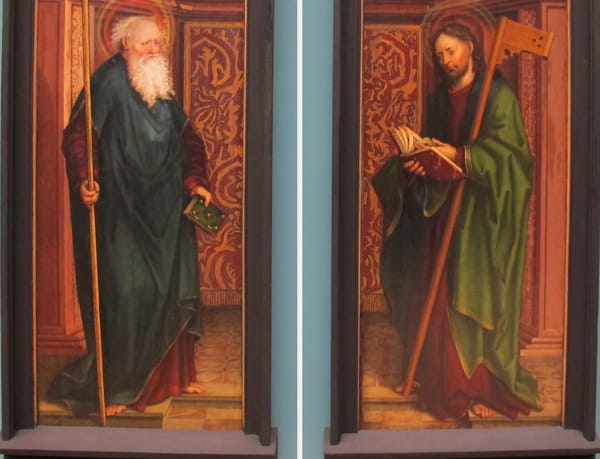
May 11 [May 1]: Sts. Philip and James the Less, Apostles
[This feast day, previously kept on May 1, was moved to May 11 when the feast of St. Joseph the Worker was established on May 1. The Solemnity of St. Joseph, which was replaced by St. Joseph the Work, was originally celebrated on the Third Sunday after Easter, as it was in the time of Dom Guéranger, whose article on that feast can be found here.-Ed.]
From Dom Guéranger's The Liturgical Year.
TWO of the favoured witnesses of our beloved Jesus' Resurrection come before us on this first day of May. Philip and James are here, bearing testimony to us that their Master is truly risen from the dead, that they have seen him, that they have touched him, that they have conversed with him,1 during these forty days. And, that we may have no doubt as to the truth of their testimony, they hold in their hands the instruments of the martyrdom they underwent for asserting that Jesus, after having suffered death, came to life again and rose from the grave. Philip is leaning upon the cross to which he was fastened, as Jesus had been; James is holding the club wherewith he was struck dead.
Philip preached the Gospel in the two Phrygias, and his martyrdom took place at Hierapolis. He was married when he was called by our Saviour; and we learn from writers of the second century that he had three daughters, remarkable for their great piety, one of whom lived at Ephesus, where she was justly revered as one of the glories of that early Church.
James is better known than Philip. He is called, in the sacred Scripture, Brother of the Lord,2 on account of the close relationship that existed between his own mother and the blessed Mother of Jesus. He claims our veneration during Paschal Time, inasmuch as he was favoured with a special visit from our Risen Lord, as we learn from St Paul.3 There can be no doubt but that he had done something to deserve this mark of Jesus’ predilection. St Jerome and St Epiphanius tell us that our Saviour, when ascending into heaven, recommended to St James’s care the Church of Jerusalem, and that he was accordingly appointed the first bishop of that city. The Christians of Jerusalem, in the fourth century, had possession of the chair on which St James used to sit when he assisted at the assemblies of the faithful. St Epiphanius also tells us that the holy Apostle used to wear a lamina of gold upon his forehead as the badge of his dignity. His garment was a tunic made of linen.
He was held in such high repute for virtue that the people of Jerusalem called him ' The Just and when the time of the siege came, instead of attributing the frightful punishment they then endured to the deicide they or their fathers had .committed, they would have it to be a consequence of the murder of James, who, when dying, prayed for his people. The admirable Epistle he has left us bears testimony to the gentleness and uprightness of his character. He there teaches us, with the eloquence of an inspired writer, that works must accompany our faith if we would be just with that justice which makes us like our Risen Lord.
The bodies of SS Philip and James repose in the Basilica of the Holy Apostles at Rome. These relics are counted as one of the richest treasures of the Holy City, and there is reason to believe that this first of May is the real anniversary of their translation. For a long period the Church of Rome kept special feasts in honour of four only of the Apostles: SS Peter and Paul, St John the Evangelist, and St Andrew (Peter’s brother): the rest were united in the solemnity of June 29, and a vestige of this is still to be found in the office of that day, as we shall see later on. The reception of the bodies of SS Philip and James, which were brought from the East somewhere about the sixth century, gave rise to the institution of to-day's feast; and this led gradually to the insertion into the Calendar of special feasts for the other Apostles and Evangelists.
Let us now read the brief account given of St Philip in the Liturgy.
The Breviary then gives the two following Lessons upon St James:
The Greek Church celebrates the memory of these two Apostles on distinct days, which are the anniversaries of their martyrdom. The following stanzas are from the hymn in honour of St Philip:
Hymn (Die XIV Novembris)
Let us now make a selection from the Menæa in honour of St James, whose memory is so affectionately cherished by the Eastern Churches:
Hymn (Die XXIII Octobris)
Holy Apostles! you saw our Risen Jesus in all his glory. He said to you on the evening of that great Sunday: Peace be to you! He appeared to you during the forty days following, that he might make you certain of his Resurrection. Great indeed must have been your joy at seeing once more that dear Master, who had admitted you into the number of his chosen Twelve; and his return made your love of him more than ever fervent. We address ourselves to you as our special patrons during this holy season, and most earnestly do we beseech you to teach us how to know and love the great mystery of our Lord’s Resurrection. May our hearts glow with Paschal joy, and may we never lose the new life that our Jesus has now given unto us.
Thou, O Philip! wast devoted to him, even from the first day of his calling thee. Scarcely hadst thou come to know him as the Messias, than thou didst announce the great tidings to thy friend Nathanael. Jesus treated thee with affectionate familiarity. When about to work the great miracle of the multiplication of the loaves, it was to thee that he addressed himself, and said to thee: Whence shall we buy bread, that these may eat?4 A few days before the Passion of thy divine Master, some of the Gentiles wished to see this great Prophet, of whom they had heard such wonderful things, and it was to thee that they applied. How fervently didst thou not ask him, at the Last Supper, to show thee the Father! Thy soul longed for the divine light; and when the rays of the Holy Ghost had inflamed thy spirit, nothing could daunt thy courage. As a reward of thy labours, Jesus gave thee to share with him the honours of the Cross. O holy Apostle! intercede for us, that we may imitate thy devotedness to Jesus; and that, when he deigns to send us the Cross, we may reverence and love it.
We also honour thy love of Jesus, O thou that art called the brother of the Lord, on whose venerable features was stamped the likeness of our Redeemer. If, like the rest of the Apostles, thou didst abandon him in his Passion, thy repentance was speedy and earnest, for thou wast the first, after Peter, to whom he appeared after his Resurrection. We affectionately congratulate thee, O James, for the honour thus conferred upon thee; do thou, in return, obtain for us that we may taste and see how sweet is our Risen Lord.5 Thy ambition was to give him every possible proof of thy gratitude; and the last testimony thou didst bear, in the faithless city, to the divinity of thy dear Master (when the Jews took thee to the top of the Temple) opened to thee, by martyrdom, the way that was to unite thee to him for eternity. Pray for us, O thou generous Apostle, that we also may confess his holy Name with the firmness which befits his disciples; and that we may ever be brave and loyal in proclaiming his rights as King over all creatures.
O holy Apostles! we beseech you to unite your prayers, and intercede for the Churches of the East, to which you preached the Gospel. Have compassion on Jerusalem, the dupe of schism and heresy; obtain her purification and her liberty; and rid her Holy Places of the sacrileges that have so long polluted them. Lead back the Christians of Asia Minor to union with the fold governed by the one supreme pastor. And lastly, pray for Rome, the city where your bodies repose, awaiting their glorious Resurrection. In return for the long hospitality she has given you, shield her with your protection; and permit not that the city of Peter, your venerable Head, should be deprived of its grandest glory—the presence of the Vicar of Christ.
Monday of the Fourth Week after Easter
OUR Risen Jesus is not satisfied with establishing his Church and constituting the hierarchy which is to govern it in his name to the end of time; he also confides in his disciples his divine word, that is, the truths he is come to reveal to mankind, into which truths he has given them an insight during the three years preceding his Passion. The word of God, which is also called revelation, is, together with grace, the most precious gift that heaven could bestow upon us. It is by the word of God that we know the mysteries of his divine essence, the plan according to which he framed the creation, the supernatural end he destined for such of his creatures as he endowed with understanding and free-will, the sublime work of redemption by the Incarnation of the Second Person of the Blessed Trinity—in a word, the means whereby we are to honour and serve him, and attain the end for which we were made.
From the very commencement of the world, God revealed his word to man; later on, he spoke by the prophets; but when the fulness of time came, he sent upon the earth his Only Begotten Son, that he might complete this first revelation. We have seen how, for three years, Jesus has been teaching men, and how, in order that he might make them the more easily understand his words, he has stooped to their littleness. Though his teaching was of the sublimest possible character, yet did he make it so intelligible that no instruction could be compared to his in clearness. It was for this reason that he made use of simple parables, whereby he conveyed his divine truths to the mind of his hearers. His Apostles and disciples, who were afterwards to preach his Gospel to the world, received from him frequent special instructions; although, until the accomplishment of the mysteries of his Death and Resurrection, they were slow in understanding his teaching. Since his Resurrection, they are better able to appreciate his instructions, for not only are his words more telling now that he is in the glory of his triumph over death, but the minds of his hearers have become more enlightened by the extraordinary events that have occurred. If he could say to them at the Last Supper: I will not now call you servants; but I have called you my friends: because all things whatsoever I have heard from my Father, I have made known unto you;1 how must he not treat them now that he has repeated to them the whole of his teaching, given them the whole word of God, and is on the eve of sending the Holy Spirit upon them, in order to perfect their understanding, and give them power to preach the Gospel to the entire world?
O holy word of God! O holy revelation! through thee are we admitted into divine mysteries, which human reason could never reach. We love thee, and are resolved to be submissive to thee. It is thou that givest rise to the grand virtue, without which it is impossible to please God;2 the virtue which commences the work of man's salvation, and without which this work could neither be continued nor finished. This virtue is faith. It makes our reason bow down to the word of God. There comes from its divine obscurity a light far more glorious than are all the conclusions of reason, how great soever may be their evidence. This virtue is to be the bond of union in the new society which our Lord is now organizing. To become a member of this society, man must begin by believing; that he may continue to be a member, he must never, not even for one moment, waver in his faith. We shall soon be hearing our Lord saying these words: He that believeth and is baptized shall be saved; but he that believeth not shall be condemned.3 The more clearly to express the necessity of faith, the members of the Church are to be called by the beautiful name of the faithful: they who do not believe are to be called infidels.
Faith, then, being the first link of the supernatural union between man and God, it follows that this union ceases when faith is broken, that is, denied; and that he who, after having once been thus united to God, breaks the link by rejecting the word of God, and substituting error in its place, commits one of the greatest of crimes. Such a one will be called a heretic, that is, one who separates himself; and the faithful will tremble at his apostasy. Even were his rebellion to the revealed word to fall upon only one article, still he commits enormous blasphemy; for he either separates himself from God as being a deceiver, or he implies that his own created, weak, and limited reason is superior to eternal and infinite Truth.
As time goes on, heresies will rise up, each attacking some dogma or other; so that scarcely one truth will be left unassailed; but all this will serve for little else than to bring out the revelation purer and brighter than before. There will, however, come a time, and that time is our own, when heresy will not confine itself to some one particular article of faith; but will proclaim the total independence of reason, and declare revelation to be a forgery. This impious system will give itself the high-sounding name of rationalism, and these are to be its leading doctrines: Christ's mission a failure and his teaching false; his Church an insult to man's dignity; the eighteen centuries of Christian civilization a popular illusion! The followers of this school, the so-called philosophers of modem times, would have subverted all society, had not God come to its assistance, and fulfilled the promise he made, of never allowing his revealed word to be taken away from mankind, nor the Church, to whom he confided his word, to be destroyed.
Others go not so far as this. They do not pretend to deny the benefits conferred on the world by the Christian religion; the facts of history are too evident to be contested: still, as they will not submit their reason to the mysteries revealed by God, they have a way peculiar to themselves for eliminating the clement of faith from this world. As every revealed truth, and every miracle confirmatory of divine interposition, is disagreeable to them, they attribute to natural causes every fact which bears testimony to the Son of God being present among us. They do not insult religion, they simply pass it by; they hold that the supernatural serves no purpose; people, they say, have taken appearances for realities. The laws of history and common sense count for nothing. Agreeably to their system, which they call naturalism, they deny what they cannot explain; they maintain that the people of the past eighteen centuries have been deceived, and that the Creator cannot suspend the laws of nature, just as the rationalists teach that there is nothing above reason.
Are reason and nature, then, to be obstacles to our Redeemer’s love for mankind? Thanks be to his infinite power, he would not have it so! As to reason, he repairs and perfects her by faith; and he suspends the laws of nature, that we may cheerfully believe the word whose truth is guaranteed by the testimony of miracles. Jesus is truly risen; let reason and nature rejoice; for he has ennobled and sanctified them by the glad mystery.
Let us proclaim the triumph of the Redeemer whom we adore. Let us make our own this sequence of the Cluny Missal of 1523.
Sequence
Leo de tribu Juda.
Mors vicit mortem,
Et mors nostra est vita.
Mira bella, et stupenda satis
Inter oves victoria.
Ut moriens superaret fortem
Cum callida versutia.
Domum ejus ingressus
Est Rex aeternus,
Et averni confregit vasa.
Drachmam secum quæ perierat
Asportavit, et patefecit regni claustra.
Paradisi porta
Quæ clausa fuerat
Per lignum vetitum
Et lethale in primaevo.
Quam clauserat Eva conditori,
Clauseratque cunctis
Postmodum natis
De stirpe sua.
Quæ commisit protoplastus,
Reseravit dextra per stirpis materiam.
Susceperat mors indemnem,
Quem tenere numquam potuerat propter culpam.
Dum ambiit illicita.
Quæ tenebat juste
Perdidit acquisita.
Ampliare voluerat in secessu,
Et remansit evacuata.
Hic verus est agnus legalis
Qui multis se manifestavit figuris,
Tandem se hostiam pro mundo
Dedit Patri ut redimeret membra sua.
Hic lapis est angularis,
Quem reprobaverunt aedificantes.
Jam factus est in caput anguli
Super omnes in excelso.
Regnum ejus magnum
Et potestas ejus prima per sæcula.
the Lion of the Tribe of Juda, hath conquered.
Death hath conquered death;
and that Death is our Life.
Strange was the war, and stupendous the victory
that was seen by the flock of Christ.
When he, by his Death,
vanquished the strong and crafty enemy.
The Eternal King
forced the enemy’s house,
and broke the armour of hell.
He brought back the groat that was lost,
and opened the gates of heaven.
Heaven’s gate,
that had been shut, at the beginning of the world,
by the forbidden fruit,
which brought death;
The gate, which Eve had closed
against him from whom she had been formed
and against all the children
that were to be born of her race;
Yea, what our first parent thus sinfully closed,
was thrown open by the right hand of the God that assumed our flesh.
Death laid hands on him
on whom it had no claim because he was free from sin;
And by thus coveting
what was not its own,
it lost what it hitherto had justly held.
By wishing to add to its prey,
it was made to yield up what it had devoured.
Christ is the true Lamb,
that was foretold in the Law under manifold figures,
and who, at length, offered himself to the Father
as a Victim for the world's redemption.
This is the Corner-Stone,
rejected by the builders.
He is now the Head of the Corner,
set high above all the rest.
His kingdom is great, and his power supreme:
they are for ever and ever.
| Previous April 30: St. Catherine of Siena, Virgin | Next Monday of the Fourth Week after Easter |