Daily reading
Paschal Time
Double of the II Class · May 3 · Sanctoral
May 3, 2023
From Dom Guéranger’s The Liturgical Year.
A Double of the II Class leads the weekday; Sts. Alexander I, Eventius and Theodulus, and Juvenal are commemorated.Rubrics

|
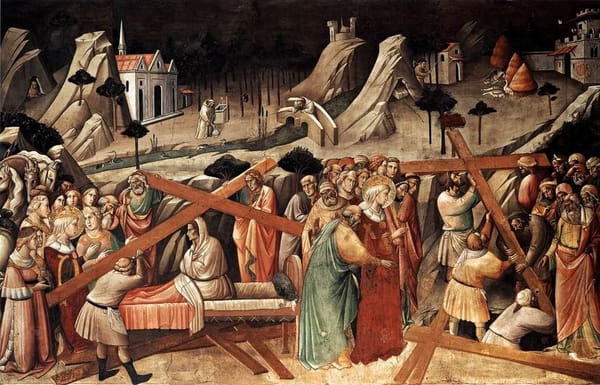
May 3: The Finding of the Holy Cross
IT was most just that our divine King should show himself to us with the sceptre of his power, to the end that nothing might be wanting to the majesty of his empire. This sceptre is .the Cross; and Paschal Time was to be the season for its being offered to him in glad homage. A few weeks back, and the Cross was shown to us as the instrument of our Emmanuel's humiliation and as the bed of suffering whereon he died; but has he not since then conquered Death? and what is his Cross now but a trophy of his victory? Let it then be brought forth to our gaze and let every knee bend before this sacred Wood, whereby our Jesus won the honour and praise we now give him!
On the day of his birth at Bethlehem we sang these words of the Prophet Isaias: A child is bom unto us, and a son is given unto us, and his government is upon his shoulder.1 We have seen him carrying this Cross upon his shoulder; as Isaac carried the wood for his own immolation; but now it is no longer a heavy burthen. It is shining with a brightness that ravishes the eyes of the angels; and after having received the veneration of man as long as the world lasts, it will suddenly appear in the clouds of heaven, near the Judge of the living and the dead—a consolation to them that have loved it, but a reproach to such as have treated it with contempt or forgetfulness.
Our Saviour did not think the time between his Resurrection and Ascension a fitting one for glorifying the instrument of his victory. The Cross was not to be brought into notice until it had subjected the world to him whose glory it so eloquently proclaimed. Jesus was three days in the tomb; his Cross is to lie buried, unknown to men, for three centuries: but it is to have its resurrection, and the Church celebrates this resurrection to-day. Jesus would, in his own good time, add to the joy of Easter by miraculously revealing to us this sacred monument of his love for mankind. He entrusts it to our keeping—it is to be our consolation—as long as this world lasts: is it not just that we should love and venerate it?
Never had Satan's pride met with such a humiliation as when he saw the instrument of our perdition made the instrument of our salvation. As the Church expresses it in her Preface for Passiontide: ‘He that overcame mankind by a Tree, was overcome by a Tree.' Thus foiled, he vented his fury upon this saving Wood, which so bitterly reminded him both of the irresistible power of his conqueror and of the dignity of man who had been redeemed at so great a price. He would fain have annihilated the Cross; but knowing that this was beyond his power, he endeavoured to profane it, and hide it from view. He therefore instigated the Jews to bury it. At the foot of Calvary, not far from the sepulchre, was a deep hole. Into this was the Cross thrown, together with those of the two thieves, the Nails, the Crown of Thoms, and the Inscription or Title written by Pilate. The hole was then filled up with rubbish and earth, and the Sanhedrim exulted in the thought of its having effaced the memory of the Nazarene, who could not save himself from the ignominious death of the Cross.
Forty years after this, Jerusalem was destroyed by the Romans, the instruments of God’s vengeance. The Holy Places were desecrated by the idolaters. A small temple to Venus was erected on Calvary, and another to Jupiter over the Holy Sepulchre. By this, the pagans intended derision; whereas, they were perpetuating the knowledge of two spots of most sacred interest. When peace was restored under Constantine, the Christians had but to remove these pagan monuments, and their eyes beheld the holy ground that had been bedewed with the Blood of Jesus, and the glorious Sepulchre. As to the Cross, it was not so easily found. The sceptre of our divine King was to be raised up from its tomb by a royal hand. The saintly Empress Helen, Constantine's mother, was chosen by heaven to pay to Jesus—and that, too, on the very spot where he had received his greatest humiliations—the honours which are due to him as the King of the world. Before laying the foundations of the Basilica of the Resurrection, this worthy follower of Magdalen and the other holy women of the sepulchre was anxious to discover the instrument of our salvation. The Jews had kept up the tradition of the site where it had been buried: the Empress had the excavations made accordingly. With what holy impatience she must have watched the works! and with what ecstasy of joy did she behold the redeeming Wood, which, though not at first distinguishable, was certainly one of the three Crosses that were found! She addressed a fervent prayer to the Saviour, who alone could reveal to her which was the trophy of his victory; the bishop, Macarius, united his prayers with hers; and their faith was rewarded by a miracle that left them no doubt as to which was the true Cross.
The glorious work was accomplished, and the Church was put in possession of the instrument of the world’s Redemption. Both East and West were filled with joy at the news of this precious discovery, which heaven had set on foot, and which gave the last finish to the triumph of Christianity. Christ completed his victory over the pagan world by raising thus his standard—not a figurative one, but his own real standard—his Cross, which, up to that time, had been a stumbling-block to the Jews, and foolishness to the Gentiles; but before which every Christian is henceforth to bend his knee.
Helen placed the holy Cross in the Basilica which had been built by her orders, and which covered both the glorious Sepulchre and the hill of the Crucifixion. Another Church was erected on the site where the Cross had lain concealed for three hundred years, and the faithful are enabled, by long flights of steps, to go down into the deep grotto which had been its tomb. Pilgrims came from every part of the world to visit the hallowed places where our Redemption had been wrought, and to venerate the sacred Wood of the Cross. But God’s merciful providence willed not that the precious pledge of Jesus’ love for mankind should be confined to one sanctuary only, however venerable it might be. Immediately after its discovery, Helen had a very large piece cut from the Cross; and this fragment she destined for Rome, the new Jerusalem. The precious gift was enshrined in the Basilica built by her son Constantine in the Sessorian garden, which was afterwards called the Basilica of Holy-Cross-in-Jerusalem.
By degrees, other places were honoured by the presence of the Wood of the Holy Cross. So far back as the fourth century, we have St Cyril of Jerusalem attesting that many of the pilgrims used to obtain small pieces of it, and thus carried the precious treasure into their respective countries; and St Paulinus of Nola, who lived in the same century, assures us that these many gifts lessened not the size of the original relic. In the sixth century, the holy Queen St Radegonde obtained from the Emperor Justin II a large piece from the fragment that was in the imperial treasury of Constantinople. It was for the reception of this piece of the True Cross into France that Venantius Fortunatus composed the Vexilla Regis—that beautiful hymn which the Church uses in her Liturgy as often as she celebrates the praise of the Holy Cross. After several times losing and regaining it, Jerusalem was at length for ever deprived of the precious relic. Constantinople was a gainer by Jerusalem’s loss. From Constantinople, especially during the Crusades, many churches of the West procured large pieces. These again supplied other places; until at length the Wood of the Cross was to be found in almost every town of any importance. There is scarcely to be found a Catholic who, some time or other in his life, has not had the happiness of seeing and venerating a portion of this sacred object. How many acts of love and gratitude have not been occasioned by this? And who could fail to recognize, in this successive profusion of our Jesus’ Cross, a plan of divine providence for exciting us to us appreciation of our Redemption, on which rest all our hopes of eternal happiness?
How dear, then, to us should this day be, which blends together the recollection of the holy Cross and the joys of the Resurrection of that Jesus who by the Cross has won the throne to which we shall soon see him ascend! Let us thank our Heavenly Father for his having restored to mankind a treasure so immensely precious as is the Cross. Until the day comes for it to appear with himself in the clouds of heaven, Jesus has entrusted it to his Spouse, as a pledge of his second coming. On that day, he will collect together all the fragments by his divine power; and the Tree of Life will then gladden the elect with its dazzling beauty, and invite them to eternal rest beneath its refreshing shade.
The Liturgy gives us the following history of the great event we are celebrating today:
Both the Eastern and Western Churches abound in liturgical compositions in honour of the holy Cross. We offer our readers a selection from these, beginning with the glorious verses of Venantius Fortunatus:
Fulget Crucis mysterium,
Qua Vita mortem pertulit,
Et morte vitam protulit.
Mucrone diro, criminum
Ut nos lavaret sordibus,
Manavit unda et sanguine.
David fideli cannine,
Dicendo nationibus:
Regnavit a ligno Deus.
Ornata Regis purpura,
Electa digno stipite,
Tam sancta membra tangere.
Pretium pependit sæculi,
Statera facta corporis,
Tulitque praedam tartari.
Paschale quæ fers gaudium,
Piis adauge gratiam,
Reisque dele crimina.
Collaudet omnis spiritus;
Quibus Crucis victoriam
Largiris, adde præmium.
the mystery of the Cross shines upon us
—that Cross on which Life suffered death,
and by his Death gave life.
that by the Water and the Blood
which flowed from the wound
he might cleanse us from sin.
the prophecy foretold
in David’s truthful words:
‘God hath reigned ffom the Tree.’
beautified by the scarlet of the King,
and chosen as the noble trunk
that was to touch such sacred limbs.
on whose arms hung the ransom of the world!
It was the balance wherein was placed the Body of Jesus,
and thereby hell lost its prey.
that bringest us the Paschal joy.
Increase the grace of the good
and cleanse sinners from their guilt.
thou fount of salvation!
and by the Cross, whereby thou gavest us victory,
give us too our recompense.
The Roman Church has the following Responsories and Antiphons in her Office for this feast. They are full of unction, and breathe a fragrance of antiquity:
Our Latin Churches of the Middle Ages are fervent in their hymns in honour of the holy Cross. The first we select is the celebrated sequence of Adam of Saint-Victor:
Sequence
Nos qui Crucis exsultamus speciali gloria:
Nam in Cruce triumphamus,
Hostem ferum superamus
Dulce melos
Tangat cœlos;
Dulce lignum
Dulci dignum
Credimus melodia:
Cum vox vitam non remordet, dulcis est symphonia.
Per quam Crucem sibi gaudent vitæ dari munera.
Dicant omnes, et dicant singuli:
Ave salus totius sæculi, arbor salutifera!
Fuit hæc salutis ara
Rubens Agni sanguine,
Agni sine macula,
Qui mundavit sæcula
Ab antiquo crimine!
Per quam Christus, rex cœlorum,
Ad se trahit omnia;
Forma cujus hoc ostendit
Quæ terrarum comprehend it quatuor confinia.
Nec recenter est inventa crucis hæc religio:
Ista dulces aquas fecit;
Per hanc silex aquas jecit Moysis officio.
Nisi Cruce munit homo superliminaria:
Neque sensit gladium,
Nec amisit filium
Quisquis egit talia.
Spem salutis est adepta
Pauper muliercula:
Sine lignis fidei
Nec lecythus olei
Valet, nec farinula.
Sub figuris
Ista latent,
Sed jam patent
Crucis beneficia;
Reges credunt,
Hostes cedunt;
Sola Cruce,
Christo duce,
Unus fugat millia.
In profundum vidit mersas una cum Maxentio:
Fusi Thraces, caesi Persæ,
Sed et partis dux adversæ victus ab Hemclio.
Semper facit et victores;
Morbos sanat et languores, reprimit dæmonia;
Dat captivis libertatem,
Vitæ confert novitatem:
Ad antiquam dignitatem Crux reduxit omnia.
Vera mundi salus, vale!
Inter ligna nullum tale fronde, flore, germine;
Medicina Christiana,
Salva sanos, ægros sana:
Quod non valet vis humana fit in tuo nomine.
Consecrator Crucis, audi,
Atque servos tuæ Crucis
Post hanc vitam, veræ lucis transfer ad palatia;
Quos tormento vis servire,
Fac tormenta non sentire;
Sed quum dies erit iræ.
Confer nobis et largire sempiterna gaudia.
we who have so special a reason to exult in it;
for it is in the Cross that we triumph,
and gain the victory of life over our fierce enemy.
reach the heavens,
for our faith
tells us
that this sweet Wood
is worthy of sweet songs.
is not a reproach to the life we lead, then is our music sweet.
whereby they have been blessed with the gifts of life.
Let each and all thus sing:
Hail, thou saving Tree, thou salvation of the world!
was this altar of salvation,
that was crimsoned with the Blood
of the spotless Lamb,
who purified the world
from its old iniquity!
whereby Christ, the King of heaven,
draws all things to himself.
Its very shape shows
that it takes in the four parts of the earth.
nor does the honour that is paid it date from modern times.
It was the Cross that made the bitter waters sweet;
it was with the Cross that Moses struck the rock, and made the waters flow.
of him who marked not the door-posts with the Cross.
But he that so marked them
neither felt the destroying sword,
nor lost his first-born son.
found her salvation
whilst picking sticks.
Without the Wood of faith,
there is nor oil
nor meal.
hidden under
scriptural figures,
but now made manifest
to the world.
Kings have embraced the faith,
and enemies are put to flight.
With the Cross alone,
under the leader Christ,
one man routs a thousand.
and all his fleet drowned in the deep.
The Thracians were dispersed, the Persians slaughtered,
and the leader of the hostile troops vanquished.
and victory to its soldiers;
cures all disease and sickness; checks the devil;
sets captives free;
gives newness of life;
restores all things to their former dignity.
the world's true salvation!
No tree can yield such shade or flower or fruit as thine.
O Medicine of Christian life!
keep the healthy strong, and give health to the sick.
What man cannot, of his own strength, he can do in thy name.
hear the prayers of them that celebrate the praises of thy Cross.
We are the servants of thy Cross
—oh! take us, after this life, to the courts of true light.
Grant that we who honour the instrument of thy sufferings,
may escape the sufferings of hell:
and when the day of thy wrath comes,
give us to enjoy eternal bliss.
The following hymn is taken from the ancient Roman-French Breviaries for this feast:
Hymn
Vera spes nostra, vera ferens gaudia,
Signum salutis, salus in periculis,
Vitale lignum Vitam portans omnium.
In te redempti, dulce decus sæculi,
Semper laudamus, tibi semper canimus,
Per lignum servi, per te lignum liberi.
Nos a privatis, Christe, munda maculis,
Humilitatem miseratus fragilem,
Per Crucem sanctam lapsis dona veniam.
Populum cunctum Crucis per signaculum,
Morbos averte corporis et animæ;
Hoc contra signum nullum stet periculum.
Sit coæqualis laus Sancto Spiri tui,
Civibus summis gaudium sit Angelis,
Honor in mundo sit Crucis Inventio.
our true hope, that bringest us true joy,
the standard of salvation, our protection in danger,
the living Tree, that bearest him who is the life of all!
tire not in praising and hymning thee as the adorable and life-giving Cross.
We were made slaves by a tree;
by thee, O Tree, were we made freedmen.
by thy holy Cross, cleanse us from our own guilty stains,
have pity on our human frailty,
and grant pardon to them that have fallen.
bless, sanctify thy whole people;
avert from them every malady of body and mind;
let no danger prevail against this sign.
praise coequal be to the Holy Ghost!
May the Finding of the Cross be a joy to the angel citizens of heaven,
and a glory to the world!
From the liturgical compositions produced by the Greek Church in honour of the holy Cross, we select the following Canon, or hymn. It was written by St Theodore the Studite:
Hymn
Christ Crucified is the power and wisdom of God,2 Thus spoke thine Apostle, O Jesus! and we are witnesses of the truth of his words. The Synagogue thought to dishonour thee by nailing thee to a Cross, for it was written in the Law: Cursed is he that hangeth on a tree.3 But, lo! this gibbet, this tree of infamy, is become the trophy of thy grandest glory! Far from dimming the splendour of thy Resurrection, the Cross enhances the brilliance of thy magnificent triumph. Thou wast attached to the Wood—thou tookest on thyself the curse that was due to us; thou wast crucified between two thieves; thou wast reputed as an impostor, and thine enemies insulted thee in thine agony on this bed of suffering. Hadst thou been but man, O Son of David! all this would have disgraced thy name and memory; the Cross would have been the ruin of thy past glory: but thou art the Son of God, and it is the Cross that proves it. The whole world venerates thy Cross. It was the Cross that brought the world into submission to thee. The honours that are now paid it more than make amends for the insults that were once offered it. Men are not wont to venerate a cross; but if they do, it is the Cross on which their God died. Oh! blessed be he that hung upon the Tree! And do thou, dearest crucified Jesus! in return for the homage we pay to thy Cross, fulfil the promise thou madest us: And I, if I be lifted up from the earth, will draw all things unto myself.4
That thou mightest the more effectually draw us, thou this day permittedst us to find the very Wood, whereon thou didst stretch forth thy divine arms to embrace us. Thou hast deigned to give us this holy instrument of thy victory which is to shine near thee in the heavens on the day of judgement; thou hast mercifully confided it to our keeping, in order that we might thence derive a salutary fear of divine Justice, which demanded thy death on this Wood in atonement for our sins. Thou also gavest us this most precious relic, that it might excite us to a devoted love for thee, O divine Victim! who, that we might be blessed, didst take upon thyself the maledictions due to our sins. The whole world is offering thee to-day its fervent thanks for so inestimable a gift. Thy Cross, by being divided into countless fragments, is in all places, consecrating and protecting by its presence every country of the Christian world.
Oh! that we had St Helen's spirit, dear Jesus, and knew, as she did, the breadth, and length, and height, and depth of the mystery of thy Cross.5 Her love of the mystery made her so earnest in her search for the Cross. And how sublime is the spectacle offered to us by this holy Empress! She adorns thy glorious Sepulchre; she raises thy Cross from its |rave; who was there, that ever proclaimed with such solemnity as this, the Paschal Mystery? The Sepulchre cries out to us: ‘He is risen: he is not here!’ The Cross exclaims: ‘I held him captive but for a few passing hours: he is not here! He is resplendent in the glory of his Resurrection!’ O fross! O Sepulchre! how brief was the period of his humiliation, and how grand the kingdom he won by you! We will adore in you the place where his feet stood,6 making you the instruments of our Redemption, and thereby endearing you to our respectful love for ever. Glory, then, be to thee, O Cross! dear object of this day’s festival! Continue to protect this world where our Jesus has left thee. Be its shield against Satan. Help us to remember that union of sacrifice and triumph which will support us in all our crosses, for it is by thee, O Cross! that Christ conquers, and reigns, and commands. Christus vincit, Christus regnat, Christus imperat.
May 3 (the Same Day): Sts. Alexander I, Pope, Eventius and Theodulus, Martyrs, and Juvenal, Bishop and Confessor
A HOLY Pope and martyr comes to-day to lay his bright crown at the foot of the triumphant Cross whereby he won his victory. It is Alexander, the fifth successor of St Peter. Let us honour this venerable witness of the faith, who is now receiving the devout homage of the Church Militant, and who, for long ages past, has been enjoying in heaven the company of our Risen Jesus. The Passion of his divine Master was ever present to his mind, whilst here on earth; and the Church has registered in her annals his addition to the Canon of the Mass of four words in which he expresses the fact of our Lord’s having instituted the august mystery of the Eucharist the day before he suffered.
We owe to the same holy Pontiff another institution most dear to Catholic piety. It is by him that the Church received the sacramental which is such an object of terror to Satan, and which sanctifies everything it touches—Holy Water. This is an appropriate day for us to renew our faith in this powerful element of blessing, which heretics and infidels have so frequently made the subject of their blasphemies, but whose use will ever serve as one of the distinguishing marks between them that are and them that are not children of the Church. Water, the instrument of our regeneration, and salt, the symbol of immortality, form, under the Church’s blessing, this sacramental, in which we should have the greatest confidence. The sacramentais, like the sacraments, derive their efficacy from the blood of our Redeemer, the merits of which are applied to certain material objects by the power of the priesthood of the new law. Indifference for these secondary means of salvation would be not only an indiscretion, but a sin; and yet in these days of weak faith nothing is so common as this indifference. There are Catholics for whom Holy Water is as though there were no such thing in existence; the continual use made of it by the Church is a lesson lost to them; they deprive themselves, without a single regret, of the help wherewith God has thus provided them, both to strengthen their weakness and to purify their souls. May the holy Pontiff Alexander pray for them, that their faith may become more what it ought to be; and that they may begin to value the supernatural aids which God, out of pure mercy to them, has so profusely bestowed on his Church.
The Church commemorates with St Alexander two holy priests, Eventius and Theodulus, who suffered with him, and St Juvenal, bishop of Nami and Confessor, whose death occurred on the same day. A short account of the latter has been added to the lesson in commemoration of the martyrs.
Receive, O holy Pontiff, on this day, sacred to the Cross of thy divine Master, the devout homage of the Christian people. It was by the way of the Cross that thou didst this day ascend to heaven; it is but just that thy praise should be mingled with those which we are giving to the sacred instrument of our Redemption. Intercede for us with him who shed his blood for us upon this Tree of Life: may he graciously accept our celebration of his triumphant Resurrection and the hymns we sing in honour of his Cross. Pray for us that our faith may increase; that thus we may appreciate the divine economy of the Redemption, whereby our Lord Jesus Christ deigned to employ for our salvation those very elements which the enemy had perverted to our destruction. Drive far from us that wretched rationalism which, whilst approving of certain usages of the Church because they happen to fit in with its fancies, presumes to treat all the rest with disdain. Pray also for the holy Church of Rome! She invokes thy name on this thy feast; prove to her that she is still dear to thee.
Wednesday of the Fourth Week after Easter
THE Son of God is soon to ascend to his Father. He has said to his Apostles: Going, teach all nations: preach the Gospel to every creature. Thus, then, the nations are not to receive the word from the lips of Jesus, but through his ministers. The glory and happiness of being instructed directly by the Man-God were for none but the Israelites, and even for them for only three short years.
The impious may murmur at this, and say, in their pride:’Why should there be men between God and us?' God might justly answer:’And what right have you to expect me to speak to you myself, seeing that you can otherwise be as certain of my word as though you heard it from myself V Was the Son of God to lose his claim to our faith unless he remained on this earth to the end of time? If we reflect on the infinite distance there is between the Creator and creature, we shall detest such a blasphemy. If we receive the testimony of men, the testimony of God is greater:1 and how can we reject it? Can we call that testimony human, which was given by the Apostles, when, in proof of their being sent by God, they showed the power, conferred on them by their divine Master, of working miracles? Of course the pride of reason may rebel; it may protest, and refuse to believe men who speak in God’s name. Did not the very Son of God meet with more unbelievers than believers? And why? Because he affirmed himself to be God, yet showed nothing exteriorly but his human nature. So that there was an act of faith to be made, even when Jesus himself spoke; and pride might rebel, and say:’I will not believe just as it will do when the Apostles speak in his name. The two cases are alike. God demands of us, as long as we are in this world, that we give him our faith; and faith is not possible without humility. God confirms his word by miracles; but man has always the power to resist, and for that very reason faith is a virtue.
If it be asked—why, when God took his Son from this earth, he did not commission his angels to teach us in his name, instead of giving such a sublime office to men, frail and mortal as we ourselves are who receive their teaching—the reason is, that man could not be raised up from the state of degradation into which he had fallen by pride, except by submission and humility; and consequently, it was fitting that the ministry of the divine word should not be entrusted to angels, inasmuch as our pride might have been flattered by our having for our teachers beings so noble and exalted. We believed the serpent when he spoke to us, and we had the pride to think that we might one day become gods: our merciful Creator, in order to save us, has imposed it as a law upon us, that we should yield submission to men, when they speak in his name.
These men, therefore, are to preach the Gospel to every creature; and he that believeth not, shall be condemned. O word of God! thou heavenly seed planted in the field of the Church, how fruitful hast thou not been! Yet one little while, and the harvest will be ripe. Faith will have spread throughout the world; the faithful shall be found in every land. And how came they by the faith? By hearing, answers the great Apostle of the Gentiles.2 They heard the word, and they believed. How honoured above the rest of our senses is our hearing, at least in this present life! Let us listen to St Bernard, speaking on this subject.’One would have thought that the Truth would have entered into our souls by that noblest of our senses, the eye: but no, my soul! that is reserved for the future life, when we shall see face to face. For the present, let the remedy come in by the same door through which crept the malady; let life, and light, and the antidote of truth, come to us in the track previously taken by death and darkness, and the serpent’s poison. Thus the troubled eye will be cured by the ear, and will see, when calm, what she cannot when troubled. The ear was the first door of death; let it be the first to be opened to life. The ear took away our Light; let it now restore our Light; for unless we believe, we shall not understand.3 Hearing, therefore, is the instrument of our merit; sight is to be our reward . . . . Observe, too, how the Holy Ghost follows this order in the spiritual education of the soul: he forms the ear, before he gladdens the eye. He says to her: Hearken, O daughter, and see!4 Forget thine eye for the present: it is thine ear I now ask for. Dost thou wish to see Christ? First hear him; hear what is said of him: that so, when thou dost see him, thou mayest say: As we have heard, so have we seen!5 The brightness is immense; thine eye is weak; and thou canst not bear the splendour. But what thine eye cannot do, thine ear can; . . . only let this ear of thine be fervent, and watchful, and faithful. Faith will give to thine eye the clearness it lost by sin; disobedience shut it, but obedience will open it.”6
To the glory of him who has sent us his word by his ambassadors, and whom we have received as himself, let us recite this ancient sequence of Saint Gall: it expresses the faith of our fathers, and this faith is ours also.
Sequence
Ac Regi Christo Deo
Solvant omnes insularum incolæ,
Quem exspectatum dies jam tenent, et leges ejus
Mentibus captent promptulis.
Quos derelicto populo
Delegit Judæo,
De Abrahæ carne genito,
Quos Abrahæ natos fecit, et cognatos
Suum sanctum per sanguinem.
O Christe,
Consanguinee naturae nostrae, nos fove,
Tuere ab omni incursu inimici, et insidiis.
Quem per carnis edulium
Delusisti hamo tuae majestatis, Fili Dei.
Tu resurgens imperitas,
Non moriturus amplius.
Tu mortalem nostram
Et terream naturam
Resurgens incorruptivam fecisti,
Atque cœlis invexisti.
render thanks to Christ,
our Saviour, King and God,
The Expected One, who is at length come,
and whose Law is now devoutly obeyed by mankind.
He cast off the Jewish people,
who were born
of Abraham according to the flesh;
And he chose, for his own,
them that he made children of Abraham by faith,
them that he had made his brethren by his precious Blood.
O Jesus
who art united to us by the bond of consanguinity! protect us,
And, by thy divine power,
defend us from every attack and snare of the enemy.
Thou, O Son of God! didst show him the Flesh thou hadst assumed,
and he, taking it, was taken by the hook of thy divinity.
Rising again, thou triumphest,
for death shall never more triumph over thee.
By thy Resurrection,
thou gavest incorruptibility
to our mortal and earthly nature,
and didst raise it to heaven.
| Previous Tuesday of the Fourth Week after Easter | Next May 3 (the Same Day): Sts. Alexander I, Pope, Eventius and Theodulus, Martyrs, and Juvenal, Bishop and Confessor |