Daily reading
Paschal Time
Double · May 5 · Sanctoral
May 5, 2023
From Dom Guéranger’s The Liturgical Year.
A Double leads the weekday.Rubric
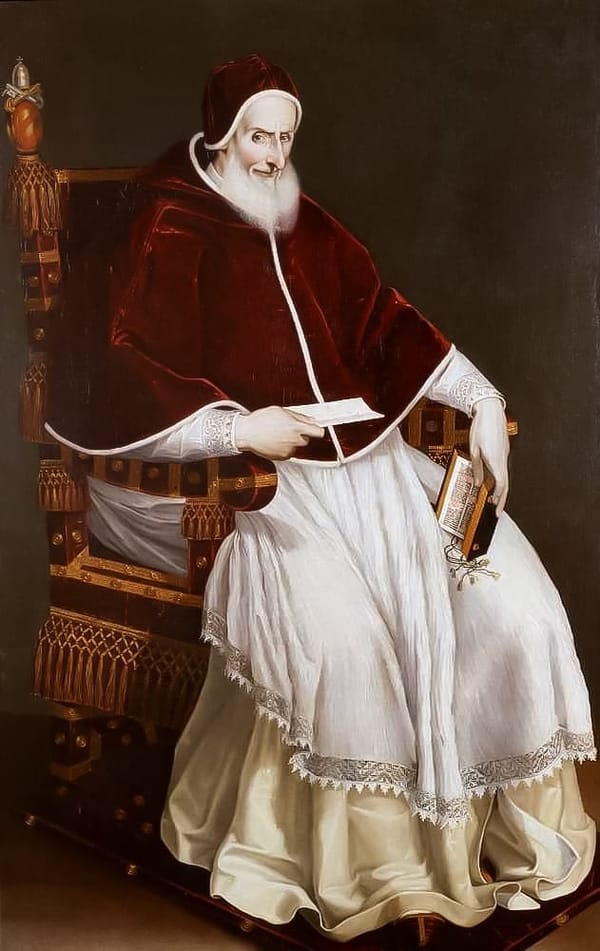 |
May 5: St. Pius V, Pope
WE have already met with the names of several Pontiffs on the Paschal Calendar. They form a brilliant constellation around our Risen Jesus, who, during the period between his Resurrection and Ascension, gave to Peter, their predecessor, the keys of the kingdom of heaven. Anicetus, Soter, Caius, Cletus and Marcellinus, held in their hands the palm of martyrdom: Leo was the only one who did not shed his blood in the cause of his divine Master. To-day there comes before us a holy Pope who governed the Church in these latter times; he is worthy to stand amidst the Easter group of Pontiffs. Like Leo, Pius V was zealous in combating heresy; like Leo, he saved his people from the barbarian yoke.
The whole life of Pius V was a combat. His pontificate fell during those troubled times when Protestantism was leading whole countries into apostasy. Italy was not a prey that could be taken by violence: artifice was therefore used, in order to undermine the Apostolic See and thus develop the whole Christian world in the darkness of heresy. Pius defended the Peninsula with untiring devotedness from the danger that threatened her. Even before he was raised to the Papal Throne he frequently exposed his life by his zeal in opposing the preaching of false doctrines. Like Peter the Martyr, he braved every danger and was the dread of the emissaries of heresy. When seated on the Chair of Peter, he kept the innovators in check by fear, roused the sovereigns of Italy to energy and by measures of moderate severity drove back beyond the Alps the torrent that would have swept Christianity from Europe had not the Southern States thus opposed it. From that time forward, Protestantism has never made any further progress: it has been wearing itself out by doctrinal anarchy. We repeat it: this heresy would have laid all Europe waste, had it not been for the vigilance of the pastor who animated the defenders of truth to resist it where it already existed, and who set himself as a wall of brass against its invasion in the country where he himself was the master.
Another enemy, taking advantage of the confusion caused in the West by Protestantism, organized an expedition against Europe. Italy was to be its first prey. The Ottoman fleet started from the Bosphorus. This again would have meant the ruin of Christendom but for the energy of the Roman Pontiff, our Saint. He gave the alarm, and called the Christian Princes to arms. Germany and France, tom by domestic factions that had been caused by heresy, turned a deaf ear to the call. Spain alone, together with Venice and the little Papal fleet, answered the summons of the Pontiff. The Cross and Crescent were soon face to face in the Gulf of Lepanto. The prayers of Pius V decided the victory in favour of the Christians, whose forces were much inferior to those of the Turks. We shall return to this important event when we come to the Feast of the Rosary in October. But we cannot omit to mention to-day the prediction uttered by the holy Pope, on the evening of the great day of October 7, 1571. The battle between the Christian and Turkish fleets lasted from six o'clock in the morning till late in the afternoon. Towards evening, the Pontiff suddenly looked up towards heaven, and gazed upon it in silence for a few seconds. Then turning to his attendants, he exclaimed: ' Let us give thanks to God! The Christians have gained the victory!' The news soon arrived at Rome; and thus, Europe once more owed her salvation to a Pope! The defeat at Lepanto was a blow from which the Ottoman Empire has never recovered: its fall dates from that glorious day.
The zeal of this holy Pope for the reformation of Christian morals, his establishment of the observance of the laws of discipline prescribed by the Council of Trent and his publication of the new Breviary and Missal have made his six years' pontificate to be one of the richest periods of the Church’s history. Protestants themselves have frequently expressed their admiration of this vigorous opponent of the so-called Reformation.
‘I am surprised,’ said Bacon, ‘that the Church of Rome has not yet canonized this great man.’ Pius V did not receive this honour till about a hundred and thirty years after his death; so impartial is the Church, when she has to adjudicate this highest of earthly honours even to her most revered Pastors!
Of the many miracles which attested the merits of this holy Pontiff, even during his life, we select the two following: As he was one day crossing the Vatican piazza, which is on the site of the ancient Circus of Nero, he was overcome with a sentiment of enthusiasm for the glory and courage of the martyrs who had suffered on that very spot in the first persecution. Stooping down, he took up a handful of dust from the hallowed ground which had been trodden by so many generations of the Christian people since the peace of Constantine. He put the dust into a cloth which the Ambassador of Poland, who was with him, held out to receive it. When the Ambassador opened the cloth, after returning to his house, he found it all saturated with blood, as fresh as though it had been that moment shed: the dust had disappeared. The faith of the Pontiff had evoked the blood of the martyrs, which thus gave testimony against the heretics that the Roman Church, in the sixteenth century, was identically the same as that for which those brave heroes and heroines laid down their lives in the days of Nero.
The heretics attempted more than once to destroy a life which baffled all their hopes of perverting the faith of Italy. By a base and sacrilegious stratagem, aided by treachery, they put a deadly poison on the feet of the crucifix which the Saint kept in his Oratory, and which he was frequently seen to kiss with great devotion. In the fervour of prayer, Pius was about to give this mark of love to the image of his crucified Master, when suddenly the feet of the crucifix detached themselves from the Cross and eluded the proffered kiss of the venerable old man. The Pontiff at once saw through the plot whereby his enemies would fain have turned the life-giving Tree into an instrument of death.
In order to encourage the faithful to follow the sacred Liturgy, we will select another interesting example from the life of this great Saint. When, lying on his bed of death, and just before breathing his last, he took a parting look at the Church on earth, which he was leaving for that of heaven, he wished to make a final prayer for the flock which he knew was surrounded by danger; he therefore recited, but with a voice that was scarcely audible, the following stanza of the Paschal hymn: ‘We beseech thee, O Creator of all things! that in these days of Paschal joy, thou defend thy people from every assault of death!’1
Let us now read the eulogy of this saintly Pope of modern times, as given in the divine Office:
St Pius is one of the leading glories of the Dominican Order. We find the following Responsories and Hymns in the Breviary of that Order:
Responsories
Hymn
Canora pangant organa:
Nimbosque pellant nubilos
Sacræ diei gaudia.
Fregit draconis impetum:
Piique sumpto nomine,
Hostem repressit impium.
Umbone firmo depulit:
Sectariorum spicula
Mucrone forti messuit.
Sacris stetit pro mcenibus,
Ut barbaros acinaces
Arceret a fidelibus.
Cura revexit sedula:
Et impiis erroribus
Objecit hic repagula.
Non vinxit in sudario
Necessitates publicas
Toto juvans ærario.
Manus habens tomatiles,
Pavit greges famelicos
Effusione munerum.
In hoc paschali gaudio,
Ab omni mortis impetu
Tuum defende populum.
give forth their glad sound in honour of blessed Pius!
Let the joys of this sacred day
dispel all stormy clouds.
and he conquered the devil in battle:
he took the name of Pius
and repressed the impious foe.
against the dangers that attacked the Church:
he was the strong sword
that mowed down the ranks of the heretics.
who stood for the defence of the Holy City,
that he might protect the faithful
from the scimitar of the Turks.
redisciplined morals;
and to impious errors
he opposed a barrier of restraint.
to hide his wealth in a napkin;
he threw open his whole treasury,
that he might relieve the necessities of his people.
with his hands ever pouring forth charity,
he fed and amply provided for his subjects
when suffering famine.
that in these days of Paschal joy
thou defend thy people
from every assault of death.
The following hymn is placed near the tomb of our Saint, in the Church of Saint Mary Major, for the use of those who visit his shrine:
Hymn
Cultus Dei contemnitur:
Ultrixque culpam persequens,
Jam poena terris imminet.
Cœlestium de sedibus
Præsentiorem vindicem,
Quam te, Pie, invocabimus?
Intensiore robore
Quam tu, superni numinis
Promovit in terris decus;
Avertit a cervicibus,
Quod christianis gentibus
Jugum parabant barbari.
Tu supplices nunc aspice:
Tu civium discordias
Compesce et iras hostium.
Terras revisat, ut
Deo Tuti queamus reddere
Mox lætiora cantica.
Uni Deo sit gloria,
Laus et potestas omnia
Per sæculorum sæcula.
for the worship of God is despised:
the chastisement that avenges guilt
is menacing our earth.
which of the heavenly citizens
can we better invoke
in our defence than thee, O Pius?
no mortal ever laboured
with such zealous vigour
to promote God's glory on earth as thou didst;
to free Christian lands from the yoke
which barbarians were seeking
to put upon them.
that thou art in heaven:
look upon us thy clients!
Restrain civil discord and repel our enemies.
that in calm security
we may sing our canticles to God
with a gladder heart.
one God, be glory,
praise and power, for ever
and ever.
Pontiff of the living God! thou wast, whilst on earth, the pillar of iron and wall of brass, spoken of by the prophet.2 Thine unflinching firmness preserved the flock entrusted to thee from the violence arid snares of its many enemies. Far from desponding at the sight of the dangers thou didst redouble thy courage just as men raise the embankments higher when they see the torrent swell. By thee was the spread of heresy checked; by thee was the Mussulman invasion repelled, and the haughty Crescent humbled. God honoured thee by choosing thee as the avenger of his glory and the deliverer of the Christian people: receive our thanks and the homage of our humble praise! By thee were repaired the injuries .done to the Church during a period of unusual trial. The true reform—the reform that is wrought by authority—was vigorously applied by thy strong and holy hand. To thee is due the restoration of the Divine Service by the publication of the books of holy Liturgy. And all these glorious deeds were done in the six short years of thy laborious pontificate!
Hear now the prayers addressed to thee by the Church Militant, whose destinies were once in thy hands. When dying, thou didst beseech our Risen Jesus to grant her protection against the dangers which were then threatening her: oh! see the state to which licentious error has now reduced almost the whole Christian world! The Church has nothing left to her wherewith to make head against her countless enemies, save the promises of her divine Founder; all visible support is withdrawn from her; she has been deprived of everything except the merit of suffering and the power of prayer. Unite, O holy Pontiff, thy prayers to hers, and show how unchanged is thy love of the flock of Christ. Protect in Rome the Chair of thy successor attacked by open violence and astute hypocrisy. Princes and peoples seem to have conspired against God and his Christ: disconcert the schemes of sacrilegious ambition, and the plots of impiety which would fain give the lie to the word of God. Avert, by thine intercession, the scourges which are threatening those nations that have become ungrateful to the Church and indifferent to the attempts made against her to whom they owe all they possess. Pray that the blind may see and the wicked be confounded. Pray that the True Faith may enlighten those numberless souls that call error truth and darkness light.
In the midst of this dark and menacing night, thine eyes, O holy Pontiff, discern them that are the faithful sheep of Christ: bless them, aid them, increase their number. Graft them on the venerable Tree which dieth not, that they may not be carried away by the storm. Obtain for them docility to the Faith and traditions of Holy Church; it is their only stay amidst the tide of error which is now threatening to deluge the whole world. Preserve to the Church the holy Order in which thou wast trained for the high mission destined for thee; maintain within her that race of men, powerful in work and word, zealous for the faith and sanctification of souls, of which we read in her Annals, and which has yielded saints such as thyself. And lastly, O Pius, remember that thou wast once the Father of the faithful: continue to be so, by thy powerful intercession, till the number of the elect be filled up!
- The Stanza recited by the dying Pontiff was, in the Breviary of his time, as follows: Quæsumus, Auctor omnium, In hoc Paschali gaudio, Ab omni mortis impetus Tuum defende populum. When the hymns were corrected under the pontificate of Urban the Eighth, this stanza was totally changed: Ut sis perenne mentibus, etc. [The Monastic Breviary has retained the original.—Tr.] ↩︎
- Jer. i 18. ↩︎
Friday of the Fourth Week after Easter
PRAISE be to our Risen Jesus, for his having said to us: He that believeth and is baptized, shall be saved!1 Thanks to his infinite mercy, we believe and have been baptized; we are, therefore, in the path of salvation. It is true that faith will not save us without good works; but, on the other hand, good works without faith cannot merit eternal salvation. With what transport of joy ought we not to give thanks to God, for his having produced in us, by his grace, this unspeakable gift,2 this first pledge of our everlasting happiness! How carefully ought we not to strive to keep it pure, yea and increase it by our fidelity! Faith, like other virtues, has its degrees: we should, therefore, frequently use the prayer addressed to Jesus by his Apostles: Lord! increase our faith!3
We are living in an age when faith is weak amongst the majority even of them that believe; and it is one of the greatest dangers that could befall us in this world. When faith is weak, charity must needs grow cold. Our Saviour one day asked his disciples if they thought that he would find faith upon the earth when he should come to judge mankind.4 Have we not reason to fear that we are fast approaching that awful time, when the want of faith will paralyze men's hearts?
Faith proceeds from our will moved by the Holy Ghost. We believe because we wish to believe; and for this reason it is a happiness to believe. The blind man to whom Jesus restored his sight said to him, when he bade him believe in the Son of God: Who is he, Lord? that I may believe in him.5 These same dispositions ought to animate us, when there is question of our making an act of faith—we should believe, in order that we may know that which, without faith, we could not know: then will God manifest himself to both our mind and heart.
You will meet with Christians who seem to make it their business to keep down the faith of their friends as much as possible. They seem to be jealous of faith getting too much; are ever talking about the rights of reason; and will have it that they who are so ready to believe are guilty of underrating the dignity, range, and divine origin of reason. Let them that are thus accused, answer: ‘We are far from denying the existence of that natural light within us, which is called reason. The teaching of the Church is too express on this point to admit of any doubt; but she also teaches us that this light—even had it retained its primal power, and had not been obscured by original sin—is incapable of discovering, by itself alone, the end for which man was created, and the means whereby that end is to be gained. Faith alone can enable man to attain to such sublime knowledge as this.’
Others, again, maintain that as soon as a Christian comes to the full age of reason, he has a right to suspend the exercise of his faith, in order that he may examine for himself whether it be reasonable or not to continue believing. Such an opinion is most false and has made many an apostate. The Church has ever taught from the days of the Apostles down to our own times, and will so teach to the end of the world, that the child who has received holy baptism has also, and at that same instant, received the gift of infused faith; that he thereby became a member of Christ, and child of his Church; and that if, when he comes to the age of reason, he should be tempted with doubts regarding matters of faith, he receives grace to resist those doubts by faith, and that he would be risking his salvation were he to suspend his faith. This does not imply that the Church forbids him to confirm his faith by study and science; far from it. This is a totally different thing from suspension of one’s faith; it is, according to the admirable saying of the great St Anselm,’faith seeking understanding,’ and, we may add, finding it, for God gives this recompense to faith.
You may probably meet with persons who think it right that there should be found among us a class of men, called free-thinking philosophers, that is to say, men without faith, who hold, with regard to God and creatures, doctrines which are wholly independent of revelation, and who teach a morality that entirely ignores the supernatural element. Is it possible that Catholics can not only countenance and praise such men as these, but even defend them, and be partial towards them?
And what must we say of the sad effects resulting from living with heretics? Most of us could give instances of the dangerous compromises and deplorable concessions made in consequence of much intercourse with those who are not of the faith. The terrible line of demarcation specified by St John, in his second Epistle,6 is being forgotten; the very mention of it is offensive to modern ears. A strong indication of this is to be found in the frequency of mixed marriages, which in a number of cases, though often by imperceptible degrees, result in leading the Catholic party to religious indifference. Let us listen to the energetic language of that illustrious ascetical writer, Father Faber:’The old-fashioned hatred of heresy is becoming scarce. God is not habitually looked at as the sole Truth; and so the existence of heresies no longer appals the mind. It is assumed that God must do nothing painful, and his dominion must not allow itself to take the shape of an inconvenience or a trammel to the liberty of his creatures. If the world has outgrown the idea of exclusiveness, God must follow our lead, and lay it aside as a principle in his dealings with us. What the many want they must have at last. This is the rule and the experience of a constitutional country. Thus discord in religion, and untruth in religion, have come to be less odious and less alarming to men, simply because they are accustomed to them. It requires courage, both moral and mental, to believe the whole of a grand nation in the wrong, or to think that an entire country can go astray. But theology, with a brave simplicity, concludes a whole world under sin, and sees no difficulty in the true Church being able to claim only a moderate share of the population of the earth. The belief in the facility of salvation outside the Church is very agreeable to our domestic loves and to our private friendships. Moreover, if we will hold this, the world will pardon a whole host of other superstitions in us, and will do us the honour of complimenting the religion God gave, as if it were some literary or philosophical production of our own. Is this such a huge gain? Many seem amazingly pleased with it, and pay dear for it quite contentedly. Now it is plain that this belief must lower the value of the Church in our eyes. It must relax our efforts to convert others. It must relax our efforts to convert ourselves. Those who use the system of the Church least will of course esteem it least, and see least in it; and are therefore least fitted to be judges of it. Yet it is just these men who are the most forward and the most generous in surrendering the prerogatives of the Church to the exigencies of modern smoothness and universalism.'7 Another sign of the decay of the spirit of faith, even among many of those who do not neglect their religion, is the disregard for, one might almost say the ignorance of, holy practices recommended by the Church. How many Catholic houses are there, where there is never a drop of Holy Water, or a blessed Candle, or a Palm to be seen? These sacred objects, given to us to be a protection, deserve from us that same reverence and love which our forefathers had when they defended them, even at the risk of their lives, against the Protestants of the sixteenth century. What a jeering look of incredulity is evinced by many amongst us, when mention is made of any miracle that is not found in the Bible! With what an air of contemptuous disbelief they hear or read of anything in connection with the mystic life, such as ecstasies, raptures, or revelations! How uneasy they seem, when the subject of the heroic acts of penance done by the Saints, or of the simplest practices of bodily mortification, happens to come across them! How loudly and pathetically do they not protest against the noble sacrifices which some favoured souls are inspired to make, whereby they break asunder the dearest ties, and shut themselves out of the world, behind the grille of a monastery or convent! The spirit of faith makes a true Catholic appreciate the beauty, the reasonableness, and the sublimity of all these practices and acts; whilst the want of this spirit makes them be condemned as extravagant, unmeaning, and folly.
Faith longs to believe; for believing is its life. It limits not itself to the strict Creed promulgated by the Church. It knows that the Spouse of Christ possesses all truths, though she does not solemnly declare them all, nor under the pain of anathema. Faith forestalls the declaration of a dogma; it believes piously, before believing under obligation. A secret instinct draws it towards this as yet veiled truth; and when the dogma is published by a definition of the supreme Pontiff, then does this same faith rejoice in the triumph of the truth which was revealed from the very commencement of the Church; and its joy is great in proportion to the fidelity wherewith it honoured the truth, when only generous and loyal hearts embraced it.
Glory, then, be to our Risen Jesus, who requited his Mother’s faith, who strengthened that of the disciples and the holy women, and who, as we humbly pray, will mercifully reward ours. Let us offer him our homage, in the words of a sequence from the ancient Missal of Saint Gall.
Sequence
Atque Redemptoris gloriam.
Astutia callidi serpentis,
Sua refecit gratia.
Futurum ut germen
Sancta proferret fœmina;
Nociva exsuperaret capita.
Cernunt saecula.
Novo pollet Maria.
Mire edidit miracula.
Sed statim inter suæ nativitatis primordia.
Per Simeonis verba
Judaica ad se vel corda, vel munera
Attrahens nutu gentilia.
Atque Spiritus Sanctus specie, glorificat.
Docent auctoritate sua.
Dona dedit multa,
Doctrinaeque perplura verba
Ore suo promulgavit saluberrima;
Colaphos, et flagella,
Vestem quoque ludo quæsitam,
Et spineum venit sertum
Ad crucis brachia.
A mortuis resurgens,
Sprevit victoria, ducens secum primitiva
Ad coelos membra,
Et nuper dispersa
Revocans ovilia.
Licet ultima membra simus, spondet dona.
of our Creator and Redeemer!
to them whom he had created aright,
yet who were seduced by the cunning of the crafty serpent.
that a holy Woman would,
one day, bring forth a Fruit,
the baneful head of the old enemy.
these promises that were long forgotten.
put forth a new Flower.
and miracles marked his life,
but immediately after his birth.
and by Simeon’s words,
he drew to himself the heart of the Jew
and the gift of the Gentile.
and by the visible form under which the Holy Ghost appeared.
were appointed to teach others in his name.
abundant gifts of salvation,
and promulgating, with his own lips,
the doctrine of eternal life,
in which he was insulted, spit upon,
buffeted, scourged, vested as a mock-king,
crowned with thorns,
and nailed to a Cross.
he rises triumphant from the grave;
he takes them that belonged to the generations of old,
and leads them with himself to heaven;
he forms into one fold
the scattered sheep.
he promises future gifts, and bids us hope.
| Previous Thursday of the Fourth Week after Easter | Next Friday of the Fourth Week after Easter |