Daily reading
Paschal Time
Greater Double · May 8 · Sanctoral
May 8, 2023
From Dom Guéranger’s The Liturgical Year.
A Greater Double leads the weekday.Rubric

|
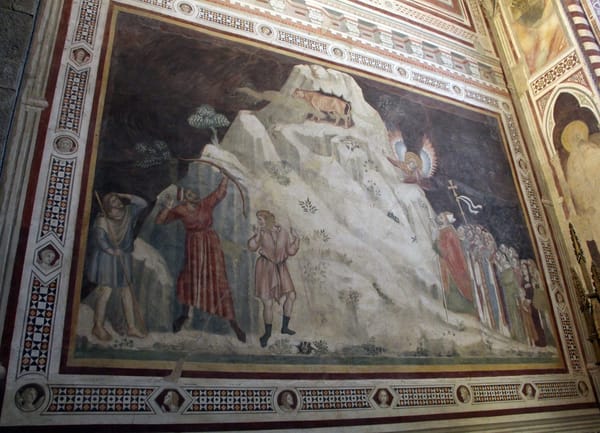
May 8: The Apparition of St. Michael the Archangel
DAVID foretold that Emmanuel's entrance into this world would be greeted by the angels and that they would humbly adore him on his first appearance among us.1 We saw this prophecy fulfilled on the ever blessed night when Mary brought forth the Fruit of her womb. The angelic choir sang one of their heavenly hymns, which led the shepherds to the stable; we blended our songs with theirs in homage to our infant God. The Resurrection of our Emmanuel was sure to be honoured by the presence of these blessed spirits, who had witnessed with amazement and trembling the humiliations and cruelties of his Passion. The moment he passed through the barrier that imprisoned him in his sepulchre, an angel, with a face bright as the sun, and garments white as snow, came and rolled back the stone, and proclaimed to the holy women that he whom they were seeking had risen. When they entered the cave of the sepulchre, two other angels, clad in white robes, appeared to them, and repeated the tidings of Jesus' triumph.
Let us reverently honour these princely heralds of our deliverance, and consider with what respect they cluster round Jesus their King and God during the forty days after his Resurrection. They adore this glorified humanity, which they are soon to see raised up to the highest heavens and enthroned at the Father's right hand. They rejoice with us in the happiness given by this Paschal feast, which restores immortality to us in the person of our Risen Saviour; and thus, as St Gregory told us a few days back, ‘it is the feast of the angels, because, by recalling us to heaven, it fills up their number,’2 It was but right, therefore, that one day in Paschal Time should be devoted to honouring the angelic spirits. On the day previous to the Annunciation we kept the Feast of St Gabriel, our Lady's honoured messenger; to-day it is St Michael, the Archangel and prince of the heavenly host, who is to receive our love and praise. He himself selected this day, by appearing on it and leaving us a pledge of his presence and protection.
The very name of Michael urges us to honour this glorious spirit; it is a cry of enthusiasm and fidelity, for it signifies: ‘Who is like unto God?’ Satan trembles at hearing this name, for it reminds him of the noble protest wherewith the bright Archangel answered the call of the rebel angels. Michael proved his strength and prowess when he fought the great battle in heaven. On that account, he was made the guardian and protector of God's people; first of the Jews, and afterwards of the Christian Church, for the Synagogue has forfeited all her honours. Michael now watches over Jesus' Spouse, our mother; he supports her in her trials and she wins no triumph in which he has not had some part.
But we are not to suppose that the holy Archangel is so engaged in attending to the general interests of Christ's kingdom on earth that he cannot listen to the prayers of each individual member of the Church. God has given him a compassionate love for men; and there is not a single soul that escapes his notice. He wields the sword in defence of the Spouse of Christ; he wars with the dragon, who is ever lying in wait for the Woman and her Child;3 but, at the same time, he is attentive to each one of us; for fter having confessed our sins to Almighty God, and to the Blessed Mary ever a Virgin, we acknowledge them likewise to Blessed Michael the Archangel and beseech him to pray for us to the Lord our God.
He assists at every death-bed, for his special office is to receive the souls of the elect on their quitting the flesh. With loving solicitude and princely bearing, he presents them to the Light Eternal and introduces them into the House of God’s glory. It is Holy Church herself that tells us, in the words of her Liturgy, of these prerogatives of the great Archangel. She teaches us that he has been set over Paradise, and that God has given him the charge of leading to heaven the souls of them that are to be received there. On the last day, when our Risen Jesus is to appear on the clouds of heaven to judge mankind, all of whom will then have resumed their bodies in the general resurrection, Michael with the rest of the angels will have to fulfil a ministry of awful import—that of separating the good from the bad. Our Catholic forefathers, in the Middle Ages, were fond of representing the holy Archangel engaged in this dread function, standing at the foot of Jesus’ judgement-seat, and holding a scale, in which he is weighing the souls of men and their works.
Devotion to St Michael was sure to spread through the Church, especially after the worship of idols had been banished from the various countries, and men were no longer tempted to give divine honour to creatures. Constantine built a celebrated Church called Michaelion in honour of the great Archangel, and at the time when Constantinople fell under the power of the Turks, there were no fewer than fifteen churches bearing the name of Saint Michael, either in the city or the suburbs. In other parts of Christendom this devotion took root only by degrees; and it was through apparitions of the holy Archangel that the faithful were prompted to have recourse to him. These apparitions were local and for reasons which to us might seem of secondary importance: but God, who from little causes produces great effects, made use of them whereby to excite Christians to have confidence in their heavenly protector. The Greeks celebrate the apparition that took place at Chone, the ancient Colosse in Phrygia. There was in that city a Church dedicated to St Michael, and it was frequently visited by a holy man named Archippus, who was violently persecuted by the pagans. One day, when Archippus was at his devotions in his favourite St Michael's, his enemies resolved to destroy both him and the Church. Hard by ran a brook which flowed into the river Lycus; they turned it aside and flooded the ground on which the church stood. Suddenly there appeared the Archangel St Michael holding a rod in his hand: the water immediately receded, and flowed into a deep gulf near Colosse, where the Lycus empties itself and disappears. The date of this apparition is not certain, but it occurred at the period when the pagans were numerous enough in Colosse to harass the Christians.
Another apparition, which encouraged devotion to St Michael in Italy, took place on Mount Gargano, in Apulia; it is the one honoured by to-day's feast. A third happened on Mount Tomba, on the coast of Normandy: we shall commemorate it on October 16.
The feast we are keeping to-day is not so solemn as the one of September 29; it is, however, more exclusively in honour of St Michael, inasmuch as the autumn feast includes all the choirs of the angelic hierarchy. The Roman Breviary gives us the following account of the apparition on Mount Gargano:
Holy Church tells us of the glories of St Michael in several portions of the Liturgy; but particularly in the following Responsory and Antiphons, taken from to-day's Office:
The first of the following hymns is used by the Church in the Vespers of the Feasts of St Michael. The second is taken from the Lauds. They speak the praises, not only of our great Archangel, but likewise of St Gabriel, St Raphael, and of all the blessed spirits in general. The Church has not instituted a feast for the collective celebration of the nine choirs of Blessed Spirits, but she includes all the members of the angelic host in her tribute of honour on the Feasts of St Michael.
First Hymn
Te vita, Jesu, cordium,
Ab ore qui pendent tuo
Laudamus inter Angelos.
Ducum corona militat:
Sed explicat victor crucem
Michael salutis signifer.
In ima pellit tartara,
Ducemque cum rebellibus
Coelesti ab arce fulminat.
Sequamur hunc nos principem,
Ut detur ex Agni throno
Nobis corona gloriæ.
Qui, quos redemit Filius,
Et sanctus unxit Spiritus,
Per Angelos custodiat.
who obey thee, we praise thee,
O Jesus, thou brightness and power of the Father,
thou life of our hearts!
this army of a thousand thousand princes,
at whose head is Michael, the Conqueror,
the standardbearer of salvation, who unfurls the Cross.
the cruel dragon into the depths of hell,
and drove the rebels, with their chief,
from the heavenly city.
that we may deserve to receive,
from the throne of the Lamb,
a crown of glory.
who, by means of the angels,
guards those whom the Son hath redeemed
and the Holy Spirit anointed.
Second Hymn
Gentis humanæ sator et redemptor,
Cœlitum nobis tribuas beatas
Scandere sedes.
Cœlitus nostras veniat; serenæ
Auctor ut pacis lacrymosa in orcum
Bella releget.
Pellat antiquos, et amica cœlo
Quæ triumphator statuit per orbem,
Templa revisat.
Adsit e cœlo Raphael, utomnes
Sanet ægrotos, dubiosque vitæ
Dirigat actus.
Et sacer nobis chorus Angelorum
Semper assistat, simul et micantis
Regia cœli.
Patris, ac Nati, pariterque Sancti
Spiritus, cujus resonat per omnem
Gloria mundum.
the Creator and Redeemer of mankind!
grant that we may ascend to the happy thrones
of the heavenly citizens.
come from heaven into this our temple,
bring us sweet peace,
and drive dismal war back again to hell.
come and rout our ancient foe;
may he often visit the heaven-loved temples
which the triumphant Jesus has placed throughout the world.
descend and visit us,
that he may heal all that are infirm
and direct our faltering steps in the path of life.
may the holy choir of angels;
may the bright court of heaven
ever assist and protect us.
Father, Son, and Holy
Ghost, whose glory is proclaimed through the whole world,
grant us this our prayer.
The following sequence is from the collection of the Monastery of Saint-Gall, and was composed by the monk Notker in the eleventh century:
Sequence
Rex cœlice, laudes Cuncta
Pangat jam canora
Caterva symphonia
Odas, atque solvat
Concio tibi nostra.
Michaelis inclyta valde festa,
Per quæ lætabunda
Perornatur machina Mundi tota.
Spirituum sunt agmina
Per te facta.
Facis hæc flammea
Per angelicas Officinas.
Sed cum simus nos ultima Factura,
Sed imago tua.
Nobis hæc ter tripartita
Per privata officia.
Phalanx et archangelica,
Principans turma.
Ac Potestas almiphona,
Dominantia numina,
Divinaque subsellia,
Cherubim ætherea,
Ac Seraphim ignicoma.
Vera dans Verbi nuntia, Atque Raphael,
Vitæ vernula, Transferte nos inter Paradisicolas.
Complentur mandata,
Quæ dat ejusdem Sophia,
Compar quoque Pneuma,
Una permanens in usia,
Cui estis administrantia Deo millia
Millium sacra.
Bis atque quingenta vestra
Centena millena
Assistunt in aula,
Ad quam Rex ovem centesimam verbigena,
Drachmamque decimam Vestra
Duxit ad agalmata.
Nos per rura terrea, pars electa,
Harmonica vota damus hinc
Per lyricas citharas.
Nostra Deo sint accepta auream super aram
Thymiamata, quo in coeva jam gloria
Condecantemus Alleluia.
may our whole assembly and choir
now sound forth
its instruments of sweet music
and sing hymns
in thy praise.
of Michael's most glorious feast,
which fills the whole earth
with great joy.
created by thee,
into nine choirs;
when thou wiliest
to seek their ministry.
whereas we are thy last,
but made after thine image.
according to their special offices,
reveals to us the mysterious design of God.
then the phalanx of Archangels;
then the host of the Principalities.
the sweet-sounding Powers,
The spiritual Dominations,
the divine Thrones,
the ethereal Cherubim,
the burning Seraphim.
messenger of the Incarnate Word! Raphael,
our guide through life! lead us to the company of the citizens of Paradise.
all the commands of the Father,
the Son who is his Wisdom,
and the co-equal Spirit,
the Three, One in essence,
the God before whom ye stand thousands
of thousands in number, as ministering spirits.
times a hundred thousand;
and hither did the King,
the Father of the Word,
bring the hundredth sheep,
and the tenth groat,
that they might share in your bliss.
and we the elect flock on earth,
give forth our tuneful praise
on sweetsounding harps.
when set on the golden altar, be acceptable to God;
Thus, when united in the same eternal glory,
may we sing together our Alleluia!
How beautiful art thou, O Michael. in thy heavenly armour, giving glory to the God whose enemy thou hadst overcome! Thine humble and fervent gaze is fixed on the throne of Jehovah, whose rights thou didst defend, and who gave thee the victory. Thy sublime cry: ‘Who is like unto God?’ roused the faithful legions and became thy name and thy crown. It will remind us for all eternity of thy fidelity to our Creator and thy triumph over the dragon. Meanwhile, we enjoy thy loving protection; we are thy happy clients.
Guardian angel of Holy·Church! now is the time for thee to exert all the might of thine arm. Satan is furious in his efforts against the noble Spouse of thy Master; brandish thy bright sword, and give battle to this implacable enemy. The kingdom of Christ is shaken to its very foundations. Is it that the reign of the Man of Sin is about to be proclaimed on the earth? Are we near that last day when, this guilty world is to be destroyed by fire, and thou art to exercise, in the name of the Sovereign Judge, the terrible office of separating the goats from the sheep? If this earth is still to exist; if the mission of the Church is not yet completed; is it not time for thee, O Michael! to show the dragon of hell that he may not, with impunity, insult on this earth the God who created it, who redeemed it, and whose name is King of kings and Lord of lords? The forces of error and crime are unceasingly dragging the world to the brink of the precipice; save it, O glorious Archangel, by confounding the dark plots which are laid for its destruction!
Thou, O Michael, art the protector of our souls in their passage from time to eternity. During this present life thine eye is upon our wants, and thine ear open to our prayers. Though awed by the brightness of thy glory, we love thee, dear prince of heaven! and we live happy and contented beneath the shadow of thy wings. In a few days, or at most years, our holy Mother the Church will be performing her last sacred rites over our lifeless remains; she will pray for us to our heavenly Father, that we may be delivered from the lion's mouth, and that the standard-bearer, St Michael, may bring us into the holy light.4 Watch over us now, O holy Archangel, lest we should then not deserve thy protection. The dragon is ever threatening us; he makes no secret of his wish to devour us. Teach us, O Michael, to repeat thy beautiful words: ' Who is like unto God?’ God’s honour, the rights he has over us, our obligation to be faithful to him, and serve him, and confess him as our Lord in all times and places—yes! these thoughts must be our shield in danger, and the armour wherewith we must fight, like thee, and win the battle. But we need the sturdy courage which resulted from the love thou hadst within thee. Oh! pray for us, that we, too, may love our common Lord and Master; then shall we be invincible. Satan cannot make head against a creature that is filled with the love of the great God.
God created thee, O Michael! and thou lovest him as thy Creator; but he has not only created us, he has redeemed us, yea, and at the price of his own Blood! What, then, should be the intensity of our love for him! Strengthen this love in our hearts; and since we are fighting under thy leadership, guide us, inspirit us; let thy look give us courage; ward off from us the blows of the enemy’s sword. We venture to hope that thou wilt be present at our last moments, O standard-bearer of our salvation! In return for our tender devotion towards thee, deign to keep guard round our deathbed, cover it with thy shield. If the dragon see the flash of thy sword, he will not dare to come near us. May our soul, on leaving the body, throw herself with affection into thine arms! Cast her not from thee, O holy Archangel, when she seeks to cling to thee; carry her to the judgement-seat, cover her beneath thy wings, calm her fears; and may the Lord, thy Master, bid thee bear her speedily to the kingdom of eternal bliss!
Monday of the Fifth Week after Easter
JESUS bestows an inestimable gift upon his Apostles; and from this gift there proceed two sacraments. On the sixth day of the creation, the divine Word infused his breath into man, whose body he had formed out of the slime of the earth; and immediately this body was animated by a soul, bearing upon it the image of God. On the evening of the day of his Resurrection, the same divine Word, then made visible in the flesh he had assumed, suddenly appeared in the midst of his Apostles, and said to them: Peace be to you! As the Father hath sent me, I also send you.1 Then breathing upon them, he added, in a tone of command: Receive ye the Holy Ghost!2 What is this Breath, which is not given to all men but only to a few chosen ones? Jesus himself explains it, by the words he speaks: this Breath imparts the Holy Ghost to them that receive it. The Holy Ghost is given to the Apostles, because they are sent by Jesus, as Jesus is sent by the Father.
The Apostles, then, receive this divine Spirit, in order that they may communicate him to men, just as they themselves have had him given to them by Jesus. The Church's tradition fills up the brief account of the Gospel. Two sacraments, as we have already stated, take their origin from this act of our Risen Jesus, who afterwards instructed his Apostles as to the rites wherewith each of the two was to be administered.
The first of these two sacraments is Confirmation, for whose institution we will return our humble thanks to-day; the other is Holy Orders, which we will explain further on in the week; both of them belong, in their administration, to the episcopal character, which is the source whence flow the gifts conferred upon the Apostles for man’s sanctification.
Such is the importance of the sacrament of confirmation, that until such time as we have received it, we cannot be considered as perfect Christians. It is true that, by virtue of our baptism, we are children of God, members of Christ and his Church; but, as Christians, we are soldiers: we have to confess our faith, sometimes before tyrants, and even to the shedding of our blood; sometimes before the world, whose false seductive maxims are the occasion of so many apostasies; sometimes against Satan and his wicked angels, whose power is so justly feared by the servants of Christ. The seal of the Holy Ghost confers on us a degree of strength which baptism does not give. Baptism made us citizens of the Church; confirmation makes us soldiers of God and of his Christ. Again, it is true that we can fight and conquer with the armour of baptism; such is God’s will, who knows that the sacrament which perfects the Christian is oftentimes an impossibility; but, woe to them that neglect to receive the completion of their baptism I Hence, after administering the sacrament of regeneration on Holy Saturday, the bishop at once proceeded to give the Holy Ghost to all those who had been just bom in the Son, and had been adopted by the Father.
Yes, confirmation is administered by a bishop, it is for him to say to the baptized: Receive ye the Holy Ghost! It was just that this divine Spirit should be thus honoured. Even when, in cases of necessity, a priest is delegated, by the Pope, to administer this sacrament, he cannot validly do so except on the condition of his using chrism consecrated by a bishop: and thus the episcopal power is always uppermost in the conferring of the Holy Ghost.
What a solemn moment is that, wherein the Spirit of power, who strengthened the Apostles, descends upon the neophytes kneeling before the bishop! The pontiff stretches his hands over them: he pours out upon them the Spirit he has received in order to communicate him to others; and that he may give all possible solemnity to the gift he is about to bestow, he cites the words of Isaias, which prophesy the descent of the Spirit on the Branch that was to spring up from the root of Jesse—a prophecy which was fulfilled in our Jesus, when he received baptism in the river Jordan, from the hands of St John the Baptist:’ O Almighty and Eternal God! who hast vouchsafed to regenerate these thy servants by water and the Holy Ghost; send forth from heaven upon them thy sevenfold Spirit, the Holy Paraclete: the Spirit of wisdom and understanding; the Spirit of counsel and fortitude; the Spirit of knowledge and godliness; fill them with the Spirit of thy fear, and sign them with the sign of the Cross of Christ.’3
Then is brought the sacred chrism, of whose virtue we heard so much on Maundy Thursday. Confirmation was anciently called the Sacrament of Chrism—of chrism in which dwells the power of the Holy Ghost. The pontiff anoints with it the foreheads of the neophytes, and, at the same instant, the Holy Ghost imprints on their souls the sign of a perfect Christian. They are confirmed, and for ever. Let them but listen to the voice of the sacrament which is now within them, and no trial, no danger can master them. The holy oil wherewith the cross has been signed on their forehead has imparted to them that firmness of adamant which was given to the Prophet Ezechiel, and enabled him to withstand all his enemies.4
To a Christian, strength is salvation; for man's life on earth is a warfare.5 Glory, then, be to our Risen Jesus, who, foreseeing the attacks that would be made against us, has armed us for the battle, and, in this admirable sacrament of confirmation, has given us the divine Spirit, who proceeds from himself and the Father, that we might be strong and invincible! Let us thank him, with all our hearts, for his having thus completed the grace already given us in baptism. The Father, who so graciously adopted us, has delivered up his Only Begotten Son for us; the Son gives us the Spirit, that he may dwell within us; oh! how wonderful a creature is man, who is so loved by the Trinity! And yet man is a sinner and an unfaithful creature: and but too frequently, all these graces are rendered fruitless by his negligence or malice! Let us at least be faithful, by keeping ourselves closely united to Holy Church, and by devoutly celebrating, with her, the mysteries of God’s goodness which the liturgical year brings successively before us.
Let us adore our Risen Jesus, our divine Benefactor. In the name of his Church, enriched as she is by such precious gifts, let us offer him this beautiful Paschal canticle, taken from the ancient Missal of Saint Gall.
Sequence
Carmina comparibus
Ecclesia dilecto pangat suo,
Illius gaudens
Reditus triumpho.
Tergens gena lacrymulam,
Læta nunc excipiat regressum,
Quem nuper flebat
Ademptum.
Hujus et affectu ardens,
Tersit suo vulnere
Ab illa nævum
Parentis primulae.
Procul de nuptae gaudio
Synagoga pellatur,
Colore obfuscata nigerrimo.
Alta confixus crucis arbore
Sacravit lateris
Illam flumine.
Viri cum fabricatur a costa,
Et Noe arcula
Aquis levata.
Nuper tyrannus
Misere afflictam,
Atque suis a sedibus
Translatam,
Favens plorati,
Atque sternens Babylonem,
Revocasti Sion tuum
Ad montem.
Ovantem gaudiis
Gratia figurat
Mundi florentis,
Consortes nos esse
Fac Jesu redemptos
Tuo cruore;
Canopicos afflixisti
Morte principes,
Ut nos inde solveres,
Praesta in eremo
Hujus vitæ,
Viperas
Conteramus igneas.
Te duce, promissam
Veniamus ut ad terram.
rejoicing in the triumphant
return of her Beloved,
sing to him her canticles,
with voice well attuned.
from her beautiful cheeks,
and gladly welcome back her Jesus,
for whom she wept
when he was taken from her.
out of burning love for her;
and, by his Blood,
cleansed her
from the stain of Eve’s offence.
clad in robes of blackest hue,
is driven, by the Bridegroom’s piercing rays,
from the Marriage Feast.
Jesus was nailed to the lofty Tree of the Cross,
and he sanctified her by the stream
that flowed from his Side.
was a figure of the Church;
so, too, was Noe's Ark,
when it sailed on the waters.
cruelly treated thy Spouse,
O Christ,
and sent her
into exile:
on her sorrow,
and, destroying Babylon,
didst bring her back
to thy holy Mount of Sion.
decked in her flowers of spring,
is a figure of thy Church’s
triumphant joy.
to imitate her loveliness,
for thou hast redeemed us
by thy Blood.
and for our deliverance,
didst bring death
upon the princes of Egypt;
grant that we may safely walk through
the desert of this life
beneath our feet,
And, having thee
for our leader,
reach the Promised Land.
| Previous May 7: St. Stanislaus, Bishop and Martyr | Next Monday of the Fifth Week after Easter |