Daily reading
Paschal Time
Double · May 9 · Sanctoral
May 9, 2023
From Dom Guéranger’s The Liturgical Year.
A Double leads the weekday.Rubric
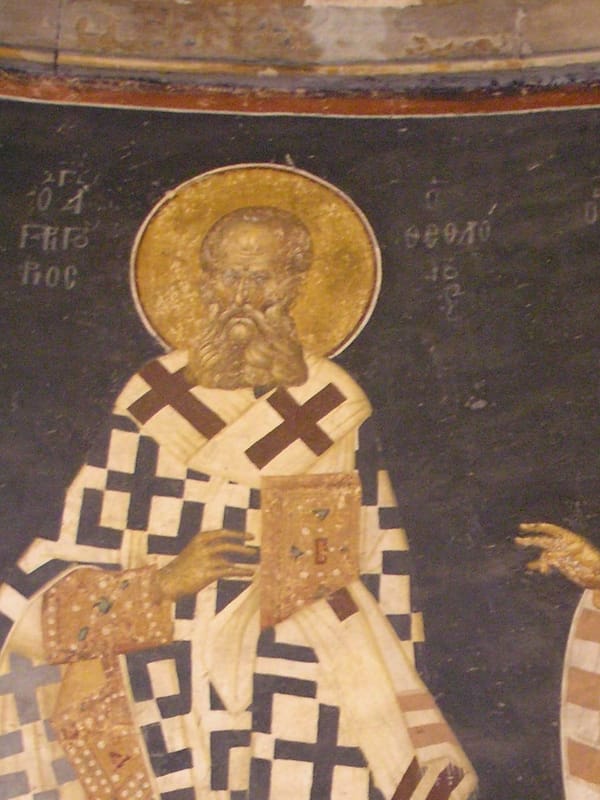 |
May 9: St. Gregory Nazianzen, Bishop, and Doctor of the Church
SIDE by side with Athanasius, another Doctor of the Church comes forward at this glad season to offer to the Risen Jesus the tribute of his learning and eloquence. It is Gregory of Nazianzum, the friend of Basil, the great orator, the admirable poet, whose style combines energy of thought with a remarkable richness and ease of expression; the one of all the Gregories who has merited and received the glorious name of Theologian, on account of the soundness of his teachings, the sublimity of his ideas, and the magnificence of his diction. Holy Church exults at being able to offer us so grand a Saint during Easter Time, for no one has spoken more eloquently than he on the Mystery of the Pasch. Let us listen to the commencement of his second Sermon for Easter; and then judge for ourselves:
I will stand upon my watch, says the admirable Prophet Habacuc.1 I, also on this day, will imitate him; I will stand on the power and knowledge granted me by the favour of the Holy Ghost, that I may consider and know what is to be seen, and what will be told unto me. And I stood and I watched: and lo! a man ascended to the clouds; and he was of exceeding high stature, and his face was the face of an angel, and his garment was dazzling as a flash of lightning. And he lifted up his hand towards the East, and cried out with a loud voice. His voice was as the voice of a trumpet, and around him stood, as it were, a multitude of the heavenly host, and he said: "To-day is salvation given to both the visible and the invisible world. Christ hath risen from the dead: do ye also rise. Christ hath returned to himself: do ye also return. Christ hath freed himself from the tomb: be ye set free from the bonds of sin. The gates of hell are opened, and death is crushed; the old Adam is laid aside, and the new one is created. Oh! if there be a new creature formed in Christ, be ye made new!”
Thus did he speak. Then did the other angels repeat the hymn they first sang when Christ was born on this earth, and appeared to us men: Glory be to God in the highest, and peace on earth to men of good will! I join my voice with them, and speak these things to you: oh! that I could have an angel’s voice, to make myself heard throughout the whole earth!
It is the Pasch of the Lord! the Pasch!—in honour of the Trinity, I say it a third time: the Pasch! This is our Feast of feasts, our Solemnity of solemnities. It is as far above all the rest, not only of those which are human and earthly, but of those even which belong to Christ and are celebrated on his account—yea, it as far surpasses them all as the sun surpasses the stars. Commencing with yesterday, how grand was the day with its torches and lights! . . . But how grander and brighter is all on this morning! Yesterday’s light was but the harbinger of the great Light that was to rise; it was but a foretaste of the joy that was to be given to us. But to-day we are celebrating the Resurrection itself, not merely in hope, but as actually come to pass, and drawing the whole earth to itself.2
This is a sample of the fervour and eloquence wherewith our Saint preached the mysteries of faith. He was a man of retirement and contemplation. The troubles of the world in which he had been compelled to live damped his spirits; the duplicity and wickedness of men fretted his noble heart; and leaving to another the perilous honour of the see of Constantinople, which he had reluctantly accepted a very short time previously, he retired to his dear solitude, there to enjoy his God and the study of holy things. And yet, during the short period of his episcopal government, notwithstanding all the obstacles that stood in his way, he confirmed the faith that had been shaken, and left behind him a light which continued even to the time when St John Chrysostom was chosen to fill the troubled Chair of Byzantium.
The holy Liturgy thus speaks to us of the virtues and actions of this great Saint:
The Greek Church, in her Menæa, gives the following magnificent encomium of St Gregory Nazianzen:
Hymn (Die XXV Januarii)
We salute thee, O glorious Doctor of the Church, on whom both East and West have conferred the title of Theologian! Illumined by the rays of the glorious Trinity, thou gavest us to share in the light thus imparted to thee—and a brighter was never granted to mortal eye. In thee was verified that saying of our Saviour: Blessed are the clean of heart, for they shall see God.3 The purity of thy soul prepared thee to receive the divine light, and thy inspired pen has transmitted to thy fellow-men something of thine own soul's enraptured knowledge. Obtain for us the gift of faith, which puts the creature in communication with its God; obtain for us the gift of understanding, which makes the creature relish what it believes. The object of all thy labours was to guard the faithful against the seductive wiles of heresy, by putting before them the magnificence of the divine dogmas. Oh! pray for us, that we may avoid the snares of false doctrines, and have our eye ever fixed on the ineffable light of the mysteries of faith; for, as St Peter tells us, it is as a lamp in a dark place, that shineth until the day dawn, and until the day-star arise in our hearts.4
There now seems to be a gleam of hope for the East, that has been, for so many long ages, a prey to error and slavery. Great changes are preparing for the unfortunate Byzantium, and politicians are studying how to profit by the crisis, and make her the prey of their respective Governments. Canst thou forget the city of which thou wast once the pastor, and where thy name is still held in veneration? Oh! help her to throw off the shackles of schism and heresy. Her being a slave to the infidel is the punishment of her having revolted against the Vicar of Christ! this yoke seems about to be broken; pray, O Gregory, that the more dangerous and humiliating one of error and schism may also be broken. A movement of return to the truth has already begun to show itself. Whole provinces are awakening to a knowledge of their misery, and are casting a look of hope towards the common Mother of all Churches, who opens her arms to receive them. Aid this long-desired conversion by thy prayers. Both East and West honour thee as one of the sublimest preachers of divine Truth; obtain by thy powerful intercession that East and West may be once more united in the one fold, and under the one shepherd, before our Risen Jesus returns to our earth to separate the cockle from the good seed, and lead back to heaven the Church, his Spouse and our Mother, out of whose pale there is no salvation.
Help us, during this season, to contemplate the glories of our Risen Lord. Oh! for something of the holy enthusiasm for this Pasch, which inebriated thee with its joys and inspired thee with such glowing eloquence! Jesus, the Conqueror of Death, was the object of thy fervent affections even from thy childhood; and when old age came, thy heart still beat with love for him. Pray for us, that we too may persevere in his service; that his divine mysteries may ever be our grandest joy; that this year’s Pasch may ever abide in our souls; that the renovation it has brought us may be visible throughout our lives; and that it may, each year as it returns, find us attentive and eager to receive its graces, until the eternal Easter comes with its endless joy!
Tuesday of the Fifth Week after Easter
THE third sacrament—the Holy Eucharist—is so intimately connected with our Redeemer's Passion that its institution could not be deferred till the Resurrection had taken place. On Maundy Thursday, we honoured the solemn act whereby our Jesus prepared for the morrow’s sacrifice, by instituting the mystery of his Body and Blood, which are really immolated in the Eucharistic Supper. The Apostles were not only admitted, as all future generations were to be, to partake of the divine Food, which giveth life to the world,1 but they moreover received power from Jesus, the Priest for ever,2 to do what he himself had just done. The great Mystery was inaugurated; the new priesthood was instituted: and now that Jesus is risen from the dead, he makes known to his Apostles the whole importance of the gift bestowed upon mankind at the Last Supper; he bids them begin the exercise of the sublime power conferred on them, as soon as the Holy Ghost, by descending upon the earth, shall give to the Church the signal for her using the prerogatives wherewith she has been endowed; and, finally, he teaches how they are to perform this special function of their Priesthood.
At the Last Supper, the Apostles were still carnal-minded men. They were taken up with the sad event that was about to happen, and overcome with grief at their divine Master telling them that that was the last Pasch he was to keep with them. They were not, therefore, in a fit state to appreciate what it was that Jesus had done for them, when he uttered those words: Take ye and eat; this is my Body. Drink ye all of this; for this is my Blood. Still less did they understand the greatness of the power they received, of doing what their Lord himself had just done in their presence. Now that Jesus is risen from the grave, he unfolds all these mysteries to them. The sacrament of the Eucharist was not instituted during these days, but it was made known, explained, and glorified by its divine institutor: and this circumstance gives a fresh lustre to the sacred season we are now going through.
Of all the sacraments, there is not one that can be compared in dignity to that of the Eucharist. The others give grace; this gives us the very Author of grace. The others are only sacraments; this is both a sacrament and a sacrifice. We will endeavour to explain it in all its magnificence, when we come to the bright feast of Corpus Christi. Let us for the present pay the tribute of our loving adoration to our Jesus, the Living Bread, that giveth life to the world.3 Let us acknowledge his immense love for his sheep. He seems to be on the point of leaving them that he may return to his Father, and yet his love retains him amongst them by means of this august mystery, wherein he is truly though invisibly present.
Be thou blessed, then, O Son of the Eternal Father! who, even in the days of the ancient covenant, didst assure us that thy delights are to be with the children of men.4 Thou provest it now by this wonderful sacrament, which reconciles thy two announcements, apparently so contradictory: thy leaving us, and thy abiding ever in our midst.
Be thou blessed for having provided for the nourishment of our souls as well as for that of our bodies. At Christmas we welcomed thy birth at Bethlehem, which signifies a House of Bread. Thou wast both the Saviour who was born for us, and the Food that came down from heaven to nourish our souls.
Be thou blessed, who, not satisfied with working the greatest of wonders at the Last Supper, by changing bread into thy Body and wine into thy Blood, hast also willed that this same miracle should be renewed, everywhere and to the end of time, for the support and consolation of our souls.
Be thou blessed in that thou hast put no limits to our longing after this Bread of Life. On the contrary, thou biddest us make it our daily Bread, and this in order that we may not faint in the way of this our exile.
Be thou blessed for the generosity wherewith, out of thy desire to communicate thyself unto us, thou hast exposed thyself to the blasphemies of heretics, to the sacrileges of bad Christians, and to the indifference of the tepid.
Be thou blessed, O divine Lamb, who enrichest the new Pasch by the shedding of thy Blood, and invitest the new Israel to a banquet where thy sacred Body is offered as nourishment to thy faithful; there do they receive life at its very source, and share in the ineffable joys of thy Resurrection.
Be thou blessed, O Jesus, for having instituted, in the Holy Eucharist, not only the greatest of the sacraments, but also a sacrifice which surpasses all others; a sacrifice whereby we are enabled to offer to the divine Majesty the only homage that is worthy of him, give him thanks in keeping with his favours to us, make him a superabundant atonement for our sins, and finally beg and obtain from him all the graces of which we stand in need.
Be thou blessed, O Emmanuel, who, having promised to give us this heavenly Food, didst fulfil thy promise on the eve of thy Passion, and gavest us this adorable sacrament as the testament of thy love. In the interval between thy Resurrection and Ascension, thou didst reveal to thine Apostles the excellency of thy gift, that so we might receive it with becoming faith.
We offer thee, dear Jesus, this homage of our faith. We confess that in this august Mystery the bread is changed into thy Body, and the wine into thy Blood: and we believe it, because thou hast said it, and because thou canst do all things.
In praise of our Paschal Lamb, who gives himself to us to be our nourishment, let us recite the following beautiful canticle, composed by Notker for the Church of Saint Gall.
Sequence
Esu potuque dignas,
Praebeant omnes se Christianae animae.
Ipse summus Pontifex.
Ejus illita sacrosancto cruore, tuta a clade Canopica,
In mari rubro sunt obruti.
Pedes tutentur adversus viperas;
Contra canes jugiter manu bajulent;
Quo de barathro victor rediit.
Ornatibus Christo consurgens, fideles admonet,
Cum eo victuros.
to partake of the Paschal Lamb,
by holy lives.
for their sakes, as an oblation to the Father.
of the Lamb; they are protected from the slaughter that fell upon Egypt,
were engulfed in the Red Sea.
let them protect their feet against vipers;
to defend themselves against dogs;
whereby he rose again victorious from the tomb.
rises together with Christ. She teaches us,
are to share in Jesus’ victory.
| Previous Monday of the Fifth Week after Easter | Next Tuesday of the Fifth Week after Easter |