Daily reading
Paschal Time
Double · May 10 · Sanctoral
May 10, 2023
From Dom Guéranger’s The Liturgical Year.
A Double leads the weekday; Sts. Gordian and Epimachus are commemorated.Rubrics
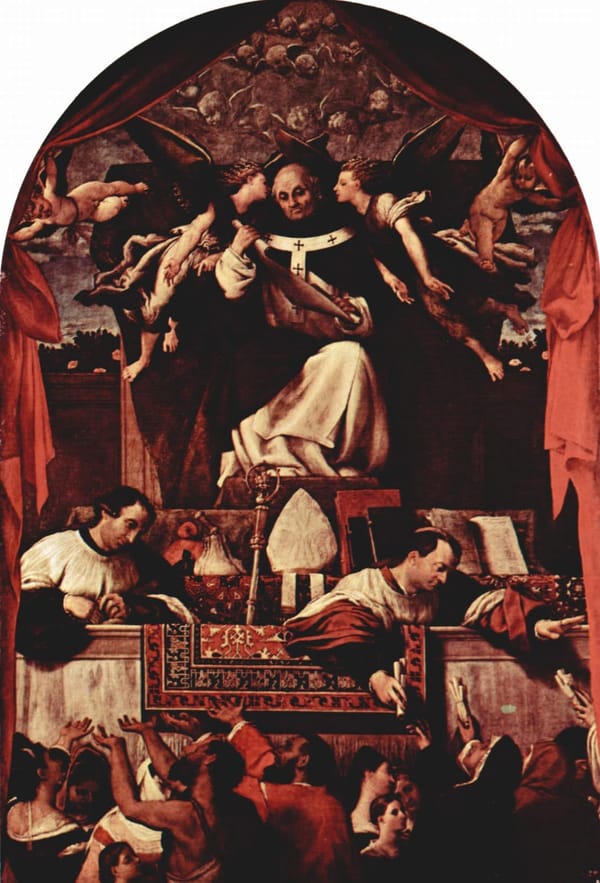 |
May 10: St. Antoninus, Bishop and Confessor
THE Order of St Dominic, which has already presented to our triumphant Jesus Peter the Martyr and Catharine the seraph of Siena, offers him to-day one of the many bishops trained and formed in its admirable school. It was in the fifteenth century, a period when sanctity was rare on the earth, that Antoninus realized in his own person the virtues of the greatest bishops of ancient times. His apostolic zeal, his deeds of charity, his mortified life, are the glory of the Church of Florence, which was confided to his care. Heaven blessed that illustrious city with temporal prosperity on account of its saintly archbishop. Cosmo de Medici was frequently heard to say that Florence owed more to Antoninus than to any other man. The holy prelate was also celebrated for his great learning. He defended the Papacy against the calumnies of certain seditious bishops in the Council of Basle: and, at the General Council of Florence, he eloquently asserted the truth of the Catholic faith, which was assailed by the abettors of the Greek schism. How beautiful is our holy Mother the Church, who produces such children as Antoninus, and has them in readiness to uphold what is true and withstand what is false!
She thus speaks the praises of the Saint of to-day:
Disciple of the great Dominic, inheritor of his burning zeal, protect the holy order which he founded, and of which thou art so bright an ornament. Show that thou still lovest it. Give it increase, and procure for its children the holiness that once worked such loveliness and fruit in the Church. Holy Pontiff, be mindful of the faithful, who implore thine intercession at this period of the year.
Thy eloquent lips announced the Pasch, so many years, to the people of Florence, and urged them to share in the Resurrection of our divine Head. The same Pasch, the immortal Pasch, has shone once more upon us. We are still celebrating it; pray that its fruits may be lasting in us, and that our Risen Jesus, who has given us life, may, by his grace, preserve it in our souls for all eternity.
May 10 (the Same Day): Sts. Gordian and Epimachus, Martyrs
TWO more martyrs ascend from our earth on this day and are admitted to share in Jesus’ glory. Again it is Rome that deputes them to bear her homage to the Conqueror of Death. Gordian was one of the magistrates who were commissioned, under Julian the Apostate, to persecute the Christians. One day, whilst exercising his office, he suddenly descended from the tribunal and took his place among the criminals. He was soon called upon to shed his blood for the faith. His martyrdom, together with that of the illustrious brothers, John and Paul, whose feast we shall keep in June, closes the period of the pagan persecutions in the West. The fact of his being buried in the crypts on the Latin Way awakened the memory of another martyr, whose relics, half consumed by fire, had long before been brought thither from Alexandria. His name was Epimachus; and on this day the two martyrs were inseparably united in the devotion of the faithful. Neither the place nor the period of their combat was the same; but both of them fought for the one cause and won the same victory. The two conquerors are buried in peace in the Eternal City; but he, for whose name they delivered their bodies to death, is mindful of their precious remains. Yet a little while, and he will fulfil, in their regard, the promise he made when he said: I am the Resurrection and the Life. He that believeth in me, although he he dead, shall live.1
Sleep your sleep of peace, O holy martyrs! Rest yet a little time, till your fellow-servants and brethren, who are to be slain even as you, shall be filled up.2 The number has been added to in every century; but the world is now near its end, and its last period is to be rich in martyrdom. When the reign of the man of sin3 begins its course, and the final tempest rages against the bark of holy Church, then, O martyrs of Christ, protect the Christian people, in return for the yearly tribute of honour that it has paid to your venerable names. Pray also for those living during these sad times, whose miseries seem like the distant howling of the storm that is to precede the end of the world. Strengthen our hearts, O holy martyrs! and whatever may be the lot prepared for us by Providence, obtain for us that we may be faithful to him, who would be to us what he has been to you—the Resurrection and the Life.4
Wednesday of the Fifth Week after Easter
WE now come to the fourth sacrament, which may be justly called the sacrament of mercy. Jesus knew the weakness of man. He knew that the great majority of Christians would not persevere in the grace they received at baptism; and that sin would in most cases spoil the beautiful plant which had been watered by the dew of heaven, and which, after growing and flowering, was to be transplanted into the garden of eternal life. Like grass that lies withered on the field, so would be this once fair plant. How could it ever revive, unless he that made it gave it life again? Thanks to his infinite mercy, this is what he has the will to do. Consulting the sinner's salvation rather than his own glory, he prepared, as the holy Fathers express it, a second plank after shipwreck. The first was baptism; but mortal sin came, and the soul was again plunged into the wild abyss. She had fallen once more into the hands of her enemy; she was fettered by chains which it was out of her power to break.
During his mortal life on earth, Jesus, who came not to judge the world, hut to save it,1 declared that these fetters, forged by the sinner’s malice, should be broken by a power which he would one day establish in his Church. Speaking to his Apostles, he told them that whatsoever they should loosen upon earth, should he loosed also in heaven.2 Since making that solemn promise, our Redeemer has offered his sacrifice on the Cross; his infinitely precious Blood has been shed for the superabundant expiation of the sins of the world. He that loved us to such a degree as this could never forget the promise he had made. On the contrary, he was most anxious to keep it, for he knew the fearful dangers to which our salvation is exposed. On the very day of his Resurrection, he appears to his Apostles, and his first words evince his eagerness to fulfil the promise he had previously made. It seems as though his mercy were impatient to break asunder the humiliating and terrible bonds of sin, which held us captives. No sooner has he breathed the Holy Ghost upon his Apostles, than he adds these words: Whose sins ye shall forgive, they are forgiven them.3 Observe here, as the holy Fathers have done, the strength of the words spoken by our Lord: They are forgiven. He says not, ‘they shall be forgiven;’ it is no longer the promise of a gift, but the gift itself. Before the Apostles have exercised the divine power conferred on them by Jesus, every absolution which they and their successors in this sacred ministry shall pronounce, even to the end of time, is already confirmed.
Glory, then, be to our Risen Jesus, who has removed the barriers of his justice, that his mercy might inundate the world! Let mankind unite and sing to him the sublime canticle of David, wherein, foreseeing the wondrous events that were to take place under the New Law, this royal psalmist prophesied the forgiveness of sins, which the Apostles were afterwards to teach us as an Article of our Creed.
Bless the Lord, O my soul! and let all that is within thee bless his holy Name. Who forgiveth all thine iniquities, who healeth all thy diseases, who redeemeth thy life from destruction.
Thy youth shall be renewed like the eagle's. The Lord is compassionate and merciful, long-suffering and plenteous in mercy. He will not always be angry. He hath not dealt with us according to our sins. As far as the east is from the west, so far hath he removed our iniquities from us.As a father hath compassion on his children, so hath the Lord compassion on them that fear him; for he knoweth our frame; he remembereth that we are dust. Man's days are as grass; as the flower of the field, so shall he flourish; for the spirit shall pass in him, and he shall not be, and he shall know his place no more. But the mercy of the Lord is from eternity and unto eternity upon them that fear him. O my soul! bless thou the Lord.4
And yet we, the children of the promise, know even better than David did the greatness of God’s mercy. Jesus was not content with giving us his assurance that if, after having sinned, we have recourse with humble repentance to the divine Majesty, we shall obtain pardon: as the sentence of God’s mercy would thus be without any outward sign, a cruel anxiety would have ever been upon us, leaving us in doubt of our forgiveness. Therefore did this loving Saviour ordain that men should give us pardon, in his name. That we might know that the Son of Man hath power on earth to forgive sins,5 he gave power to his delegates to pronounce over us a sentence of absolution which our very ears might hear, and which would convey to our souls the sweet confidence of pardon.
O ineffable sacrament, by whose means heaven is peopled by countless numbers who else had been lost, and who will for ever sing the mercies of the Lord!6 O irresistible power of the words of absolution, which, deriving their efficacy from the Blood of our Redeemer, take away all our iniquities, and plunge them into the abyss of divine mercy! The eternity of torments due to these iniquities would never have expiated them; and yet these few words of the priest: I absolve thee, have utterly annihilated them.
Such is the sacrament of penance. In return for the humble confession of our sins and the sincere sorrow for having committed them, we receive pardon, and this not once or twice only, but as often as we approach the sacred tribunal; not for this or that kind of sin only, but for every sin whatsoever. It is not to be wondered at that Satan should envy man this gift, and strive to throw such doubts and difficulties in the way as to prevent his profiting by it. What has not heresy said against this sacrament? It began by teaching that it takes from the glory of holy baptism; whereas on the contrary, it honours that first sacrament, by repairing the injuries done to it by sin. Later on, it exacted, as absolutely necessary for the sacraments, such perfect dispositions, that absolution would find the soul already reconciled with God. It was by this dangerous snare of Jansenism that so many were ruined, either by pride or by discouragement. And lastly, it has set up that Protestant dictum:’I confess my sins to God just as though God had not the right to lay down the conditions for pardon.
The sacraments being, as they are, such divine institutions, demand our faith; without faith they are simply impossibilities. Though this be true of all the seven, yet the sacrament of penance is especially welcome to a man of faith, because it so thoroughly humbles human pride. It sends man to ask of his fellow-man what God could have given directly himself. Jesus said to the lepers, whom he wished to cure: Go, show yourselves to the priests!7 Surely he has a right to act in the same manner when there is a question of spiritual leprosy.
Let us, as a homage to our generous Redeemer, offer him this Easter hymn; it is the one used by the Church in her Ferial Matins of Paschal Time.
Hymn
Rerum creator omnium,
Æqualis ante sæcula
Semper Parenti Filius.
Imaginem vultus tui
Tradens Adamo, nobilem
Limo jugasti spiritum.
Fædasset humanum genus,
Tu carne amictus perditam
Formam reformas artifex.
Nunc e sepulchro nasceris,
Tecumque nos a mortuis
Jubes sepultos surgere.
Aqua lavis baptismatis:
Hæc est lavacrum mentium,
Hæc est sepulcrum criminum.
Redemptor affixus cruci,
Nostræ dedisti prodigus
Pretium salutis sanguinem.
Paschale, Jesu, gaudium,
A morte dira criminum
Vitæ renatos libera.
Et Filio, qui a mortuis
Surrexit, ac Paraclito,
In sempiterna saecula.
Creator of all things!
Son co-equal with the Father,
before all ages!
thou gavest to Adam a resemblance to thine own divine Face;
and, to his body formed from slime,
thou joinedst a noble soul.
brought degradation upon mankind,
thou, our Maker, didst clothe thyself with flesh
and reform our lost race.
art now born from the sepulchre,
and biddest us rise with thee
from our death and burial.
who washest thy sheep in the waters of baptism:
it is the laver of our souls,
it is the grave of our sins.
upon the Cross that was due to us;
thou generously gavest us thy Blood,
as the ransom of our salvation.
Paschal joy to our hearts, free us,
who have been regenerated unto life,
from the dread death of sin.
and to the Son who rose
from the dead, and to the Paraclete,
for everlasting ages.
| Previous Tuesday of the Fifth Week after Easter | Next May 10 (the Same Day): Sts. Gordian and Epimachus, Martyrs |