Daily reading
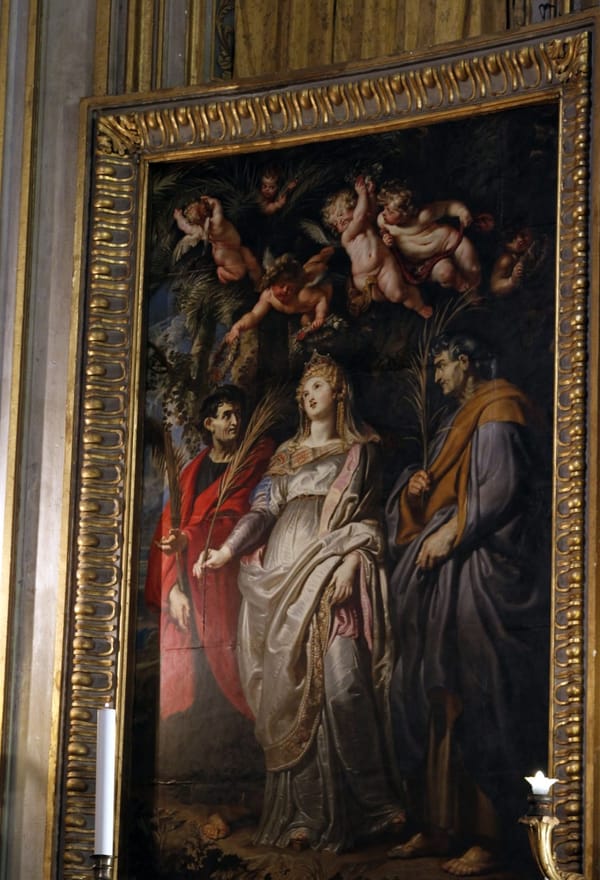
May 12: Sts. Nereus and Achilleus, Martyrs, and St. Flavia Domitilla, Virgin and Martyr
SO far in our Paschal season, the choir of Virgin martyrs has not yet offered to Jesus its crown of roses and lilies. It does so to-day, by presenting to him the noble Flavia Domitilla, the fairest flower of Rome, that was cut down by the sword of martyrdom in the first age of the Christian faith. It was under the persecution of Domitian—during which John the Evangelist was condemned to be burned alive in the cauldron of boiling oil—that Flavia Domitilla was honoured with banishment and death for the sake of our Redeemer, whom she had chosen for her Spouse. She was of the imperial family, being a niece of Flavius Clemens, who adorned the consular dignity by martyrdom. She was one of the Christians belonging to the court of the Emperor Domitian, who show us how rapidly the religion of the poor and humble made its way to the highest classes of Roman life. A few years previous to this, St Paul sent to the Christians of Philippi the greetings of the Christians of Nero's palace.1 There is still extant, not far from Rome, on the Ardeatine Way, the magnificent subterranean cemetery which Flavia Domitilla ordered to be dug on her prædium, and in which were buried the two martyrs, Nereus and Achilleus, whom the Church honours to-day together with the noble virgin who owes her crown to them.
Nereus and Achilleus were in Domitilla’s service.2 Hearing them one day speaking of the merit of virginity, she there and then bade farewell to all worldly pleasures, and aspired to the honour of being the Spouse of Christ. She received the veil of consecrated virgins from the hands of Pope St Clement: Nereus and Achilleus had been baptized by St Peter himself. What glorious reminiscences for one day!
The bodies of these three Saints reposed, for several centuries, in the Basilica, called the Fasciola, on the Appian Way; and we have a Homily which St Gregory the Great preached in this Church on their feast. The holy Pontiff dwelt on the vanity of the earth’s goods; he encouraged his audience to despise them by the example of the three martyrs whose relics lay under the very altar around which they were that day assembled.
These Saints, [said he] before whose tomb we are now standing, trampled with contempt of soul on the world and its flowers. Life was then long, health was uninterrupted, riches were abundant, parents were blessed with many children; and yet, though the world was so flourishing in itself, it had long been a withered thing in their hearts.3
Later on, in the thirteenth century, the Fasciola having been almost reduced to ruins by the disasters that had befallen Rome, the bodies of the three Saints were translated to the Church of St Adrian, in the Forum. There they remained till the close of the sixteenth century, when the great Baronius, who had been raised to the Cardinalate, with the title of Saints Nereus and Achilleus, resolved to repair the Church that was thus entrusted to his care. Through his munificence, the naves were restored; the history of the three martyrs was painted on the walls; the marble pulpit, from which St Gregory preached the Homily, was brought back, and the Homily itself was graven, from beginning to end, on the back; and the Confession was enriched with mosaics and precious marbles, preparatory to its receiving the sacred relics, of which it had been deprived for three hundred years.
Baronius felt that it was high time to put an end to the long exile of the holy martyrs, whose honour was now so specially dear to him. He organized a formal triumph for their return. Christian Rome excels in the art of blending together the forms of classic antiquity and the sentiments inspired by faith. The chariot, bearing a superb canopy, under which lay the relics of the three martyrs, was first led to the Capitol. On reaching the top of the clivus Capitolinus, the eye met two inscriptions, placed parallel with each other. On one were these words: ' To Saint Fla via Domitilla, Virgin and Martyr of Rome, the Capitol, purified from the wicked worship of demons, and restored more perfectly than by Flavius Vespasian and Domitian, Emperors, kinsmen of the Christian Virgin.' On the other: ‘The Senate and People of Rome to Saint Flavia Domitilla, Virgin and Martyr of Rome, who, by allowing herself to be put to death by fire for the faith of Christ, brought greater glory to Rome than did her kinsmen, the Emperors Flavius Vespasian and Domitian, when, at their own expense, they restored the Capitol, that had twice suffered from fire.'
The reliquaries of the martyrs were then placed on an altar that had been erected near the equestrian statue of Marcus Aurelius. After being venerated by the faithful, they were replaced on the chariot, which descended by the opposite side of the Capitol. The procession soon reached the triumphal arch of Septimius Severus, on which were hung these two inscriptions:
To the holy Martyrs Flavia Domitilla, Nereus and Achilleus, the best of citizens, the Senate and People of Rome, for their having honoured the Roman name by their glorious death, and won peace for the Roman commonwealth by shedding their blood.
To Flavia Domitilla, Nereus and Achilleus, the invincible Martyrs of Christ Jesus, the Senate and People of Rome, for their having honoured the City by the noble testimony they bore to the Christian Faith.
Following the Via Sacra, the procession was soon in front of the triumphal arch of Titus, the monument of God’s victory over the deicide nation. On one side were inscribed these words: 'This triumphal arch, formerly dedicated and raised to the Emperor Titus Flavius Vespasian, for having brought the rebellious Judea under the yoke of the Roman people, is now, by the Senate and People of Rome, more auspiciously dedicated and consecrated to Flavia Domitilla, kinswoman of the same Titus, for having, by her death, increased and furthered the Christian Religion.'
On the other side of the arch was the following inscription: ‘To Flavia Domitilla, Virgin and Martyr of Rome, kinswoman of the Emperor Titus Flavius Vespasian, the Senate and People of Rome, for her having, by shedding her blood and laying down her life for the Faith, rendered a more glorious homage to the death of Christ than did the said Titus, when by divine inspiration he destroyed Jerusalem, to avenge that same death.'
Leaving on the left the Coliseum, the hallowed ground whereon so many martyrs had fought the battle of faith, they passed under the triumphal arch of Constantine, which so eloquently speaks of the victory of Christianity, both in Rome and the Empire, and which still bears on it the name of the Gens Flavia, of which the first Christian Emperor was a member. The two following inscriptions were attached to the arch:
To Flavia Domitilla, Nereus and Achilleus, the Senate and People of Rome. On this sacred way, whereon so many Roman Emperors received triumphal honours for having brought various provinces into subjection to the Roman People, these martyrs receive to-day a more glorious triumph, for that they con quered, by a greater courage, the conquerors themselves.
To Flavia Domitilla, the Senate and People of Rome. Twelve Emperors, her kinsmen, conferred honour on the Gens Flavia and on Rome herself by their deeds of fame; but she, by sacrificing all human honours and life itself for Christ's sake, rendered greater service to both family and City than they.
The procession then continued its route along the Appian Way, and at length reached the Basilica. Baronius, assisted by a great number of Cardinals, received the precious relics, and took them with great respect to the Confession of the High Altar. Meanwhile the choir sang this Antiphon of the Pontifical: * Enter, ye Saints of God! for a dwelling hath been prepared for you by the Lord. The faithful people have followed you on your way, that ye may intercede for them with the majesty of the Lord. Alleluia!'
The following is the account of our three martyrs as given in the Liturgy:
How grand was the triumph which Rome gave to you, O holy martyrs, so many centuries after your glorious deaths! How true it is that there is no glory here on earth which can bear comparison with that of the saints! Where are now those twelve Emperors, thy kinsmen, O Domitilla? Who cares for their remains? Who even cherishes their memory? One of them was sur~ named ‘the delight of mankind '; and now how many there are who have never heard of his existence! Another, the last of the twelve, had the glory of proclaiming the victory won by the Cross over the Roman Empire; Christian Rome honours and loves his name; but the homage of religious devotion is not given to him, but to thee, O Domitilla, and to the two martyrs whose names are now associated with thine.
Who does not recognize the power of Jesus' Resurrection in the love and enthusiasm wherewith a whole people welcome your holy relics, O martyrs of the living God? Fifteen hundred years had elapsed; and yet your lifeless remains were greeted with a transport of joy, as though you yourselves were there, and living. It was because we Christians know that Jesus, who is the first-born of the dead,4 has risen from the grave; and that you, like him, are one day to rise in glory. Therefore do the faithful honour by anticipation the immortality which, at a future period, is to be given to your bodies, once slain for Jesus' sake; they already see by faith the future brightness which is to be imparted to your flesh; and thus they proclaim the dignity which the Redemption has given to man, to whom death is now but a transition to true life, and the tomb but a resting-place where the body is consigned, as seed to the earth, to be restored in a hundredfold of richer beauty.
Happy they who, as the prophecy says, have washed their robes and have made them white in the Blood of the Lamb!5 But happier they, says Holy Church, who, after being thus purified, have mingled their own blood with that of the divine Victim! for by so doing they have filled up in their flesh those things that are wanting of the sufferings of Christ.6 Hence, their intercession is powerful, and we should address our prayers to them with love and confidence. Befriend us, then, O holy martyrs Nereus, Achilleus, and Domitilla! Obtain for us an ardent love for our Risen Jesus; perseverance in the new life which he has conferred upon us; detachment from the things of this world, and a determined resolution to trample them beneath our feet, should they become a danger to our eternal salvation. Pray for us, that we may be courageous in resisting our spiritual enemies, ever ready to defend our holy faith, and earnest in our endeavours to gain that kingdom which is to be borne away by violence.7 Be the defenders of the holy Roman Church, which fervently celebrates your memory each year. You, Nereus and Achilleus, were converts of Peter; and thou, Domitilla, wast the spiritual daughter of Clement, Peter's successor; protect the Pontiff who now governs the Church—the Pontiff, in whom Peter still lives—the Pontiff, the successor of Clement. Dispel the storms which are threatening the Cross on the Capitol, and pray for the inhabitants of Rome, that they may be staunch to the faith.
- Phil, iv 22. ↩︎
- The Acts of these two Saints—which were drawn up long after their martyrdom, and on which were formed the Lessons of to-day’s Office—call them “eunuchs”: but it is a mistake of the compiler, who belongs to the fifth or sixth century. The introduction of eunuchs into the Imperial Court, and into the Roman families, is of a later date than the reign of Domitian. ↩︎
- Homil. xxviii in Evang. ↩︎
- Apoc. i 5. ↩︎
- Ibid. vii 14. ↩︎
- Coloss. i 24. ↩︎
- St Matt. xi 12. ↩︎
May 12 (the Same Day): St. Pancras, Martyr
A FOURTH martyr claims our veneration on this twelfth day of May. Like the three others, he culled his palm at Rome. But whilst they died for the faith at the very commencement of the Christian era, Pancras was not called to the glorious combat till the persecution under Diocletian—the last and greatest effort of pagan Rome against the Church. Our young hero was only fourteen years of age; but he was old enough to be a brave martyr, and he has been honoured by a commemoration in Paschal Time. The venerable Church in the Holy City which is dedicated to him, and which gives a title to one of the Cardinals, was built on the site of the cemetery where his body was buried. The following commemoration is made of him in the Matins of this feast:
Divine grace, which called thee to the crown of martyrdom, selected thee, O Pancras, from the distant land of Phrygia, and led thee to the capital of the empire—the centre of every vice and every error of paganism. Thy name, like those of millions of others who were better known to the world, had else been quite forgotten. But now, though thy earthly career was soon ended, the name of Pancras is loved and venerated throughout the whole earth: it is breathed at the altar, in the prayers which accompany the sacrifice of the Lamb. How camest thou, dear youthful martyr, by this celebrity, which will last to the end of the world? It was because, having imitated Jesus' Death by suffering and shedding thy blood for his name, thou hast been made a sharer in the glory of his immortality. In return for the honour we pay thee, deign to aid us by thy protection. Speak of us to Jesus, who is our divine Master, as he was thine. In this vale of our exile, we sing our Alleluia for his Resurrection, which has filled us with hope; obtain for us, by thy prayers, that we may sing Alleluia with thee in heaven, where it will be eternal, and be prompted, not by the gladness of hope, but by the bliss of possession.
Friday of the Fifth Week after Easter
WE have reverently followed our Redeemer in his institution of the sacramental helps, whereby man is placed and kept in the state of sanctifying grace, from his first entrance into this life to his leaving it for the eternal enjoyment of the beatific vision. We must now speak of that sublime sacrament, which was instituted by Jesus as the source whence mankind is to receive the other sacraments.
This sacrament is Holy Orders, and it is so called because of its being conferred in several distinct degrees upon those who receive it. As in heaven the angels are arranged in different ranks according as they have been endowed with a greater or less degree of light and power, in such wise that they who are higher act upon those that are lower; so it is in the sacrament of Holy Orders; there is order in the several ranks, and the higher act upon the lower by the communication of light and power. It is this that constitutes the hierarchy of the Church. Hierarchy means Sacred Government. It comprises three degrees: the episcopate, priesthood, and diaconate, in which last are included the Orders below it. This is called the hierarchy of Order, to distinguish it from the hierarchy of Jurisdiction. This second, which is entrusted with the government of the Church, is composed of the Pope, of the bishops, and of the inferior clergy to whom the Pope and bishops delegate a part of their power of government. We have already seen how this hierarchy takes its origin from that sovereign act whereby our Lord Jesus, the shepherd of men, gave to Peter the keys of the kingdom of God. The hierarchy of Order is intimately connected with the second, and its object is the sanctification of men by the administration of the treasures of grace confided to its keeping.
As we have already said, Jesus appeared to his Apostles on the day of his Resurrection, and said to them: As the Father hath sent me, I also send you.1 Now the Father sent his Son that he might be the Shepherd of men; and we have heard Jesus bidding Peter to feed his lambs and his sheep. The Father sent his Son that he might be the Teacher of men; and we have seen Jesus entrusting to his Apostles the truths which were to be proposed to us as the object of our faith. But the Father sent the Son that he might also be the High Priest of men; Jesus must, therefore, leave this same priesthood on earth, that it may be continued among us to the end of time. Now what is a priest? He is the mediator between heaven and earth; he reconciles man to his God, by offering a sacrifice that gives infinite honour to God and atones for man's sin; he cleanses the sinner's conscience, and makes him a just man; he, in a word, unites man to his God by the mysteries of which he is the dispenser.
Jesus exercised all these functions of a priest agreeably to the mission given him by the Father; but the Father would have them to be continued, even after his Son should have ascended into heaven. For this it was necessary that Jesus should communicate his priestly character, by a special sacrament, to a few chosen men, just as by baptism he conferred upon all his faithful the dignity of being his members. Here again, it will be the Holy Ghost that will act, in each stage or degree of the sacrament. It was by his divine operation that the Incarnate Word entered into Mary's womb; it is his action that will imprint on the souls of them that are presented the priestly character of this same Jesus our Lord. Hence, after using the words just cited, Jesus breathed on his Apostles, and said to them: Receive ye the Holy Ghost! hereby showing that it is by a special infusion of him who is the Spirit of the Father and the Son, that men are fitted for being sent by the Son, as the Son was sent by the Father.
And yet the Apostles and their successors are to confer this sacrament, not by a breath—that is the prerogative of the Word, the author of life—but by the imposition of hands. It is at the solemn moment of the imposition of the bishop's hands over them who are to be ordained, that the Holy Ghost comes down upon them. Thus will be transmitted the heavenly gift from generation to generation. It will be conferred in its several degrees, according to the will of the hierarch, by and with whom the Holy Ghost acts. So that when Jesus comes on the last day to judge the world, he will find on earth the sacred character which he conferred upon his Apostles when he gave them the Holy Ghost.
Let us attentively and devoutly contemplate the mystic ladder of the hierarchy, established by our Jesus, whereby we might ascend to heaven. At the very summit is the bishop, having in himself the plenitude of Holy Orders and the power to produce other pontiffs, and priests, and deacons. He has the power of offering up the Holy Sacrifice; he holds the keys whereof our Lord speaks, when he says: Whatsoever ye shall bind upon earth, shall be bound also in heaven; and whatsoever ye shall loose upon earth, shall be loosed also in heaven;2 he can administer all the sacraments; the consecration of the Chrism and Holy Oils belongs to his office; he can not only bless, he can also consecrate.
Next comes the priest, who truly looks upon the bishop as his spiritual father, seeing that it was by the imposition of the bishop’s hands that he received the dignity and character of priesthood. The priest, however, does not possess the plenitude of Jesus’ priesthood. His hands, though most holy, have not the power to produce other priests; he blesses, but he does not consecrate;3 he must look to the bishop for holy Chrism, for he himself cannot make it. Notwithstanding this, his dignity is great, for he has power to offer the Holy Sacrifice, and his offering is the same as that of the bishop. He forgives the sins of those whom the bishop has put under his care. The solemn administration of baptism is entrusted to him, when the bishop himself does not perform it: and as to extreme unction, it is essentially a priest’s function.
The next lower order is that of deacon, who is, as the Greek name implies, the servant of the priest. Not having the priesthood, he cannot offer sacrifice, nor remit sins, nor give extreme unction to the dying: but he assists and serves the priest at the Altar, and stands by his side during the solemn moment of consecration. He reads the holy Gospel, from the ambo, to the people. The Blessed Sacrament is entrusted to his care, and, failing a priest, he is allowed to distribute it to the faithful. In similar circumstances, he could solemnly administer baptism. He has also the power of preaching the word of God to the people.
These are the three degrees of the hierarchy of Order. They correspond, as the great St Denis teaches, with the three degrees whereby man attains to union with God: namely, purification, illumination, and perfection. The deacon prepares the catechumen and the sinner, by instructing them in the word of God, which will purify their minds from error, and incite them to the repentance of their sins and to a desire of being freed from them. The priest enlightens these same by the illumination of holy baptism, by the remission of their sins, and by admitting them to partake of the Body and Blood of Christ. The bishop pours out upon them the gifts of the Holy Ghost, and raises them, by their seeing his own supereminent prerogatives, to union with Christ. Such is the sacrament of Holy Orders. It is the essential means established for the salvation of mankind, the channel through which God has ordained that the infinite graces of the Incarnation should flow upon the earth, and the medium whereby is perpetuated among us the presence and action of our Redeemer.
Let us give thanks to our Jesus for this unspeakable blessing. Let us honour the priesthood of the New Law; it is Jesus who inaugurated it in his own person, and who afterwards entrusted it to men, chosen by him for continuing the mission given to him by his Father. The sacraments are the true life of the world; but who are the ministers of these sacraments? The priests of the Church. Let us pray for those who are in Holy Orders; for their responsibilities are great, their dignity is divine, and yet they themselves are but men. They are not a tribe or a caste, as were the priests in the Old Law; but they are taken from every race and family. Finally, a priest, though inferior to the angels by nature, is, by the office he holds, superior to these blessed spirits.
Let us celebrate, to-day, the Resurrection of our eternal High Priest, by this joyous canticle of the ancient Missal of Liége:
Sequence
Quibus e terris
Nuncias gaudia,
Visitans patriam.
Dulci voce dixit: Alleluia.
Pia miracula.
Cecinit voce laudanda.
Volucris vacuas
Redii famulis,
Et novam regnare gratiam.
Christus hodie redemit nos a morte dira.
Ut interimerent pro salute nostra.
Ut nos redimeret morte ab aeterna.
Et frui vita perpetua.
Celebri laude sanctum Pascha.
from what land comest thou,
to the whole world.
more our country?
and sweet voice, saying: ‘Alleluia!
dear prodigies wrought by Christ:
that the Lord hath risen from the tomb.
and joyfully sped my way through the thin air:
servants of God!
and the New Law of grace hath begun its reign.’
‘This day hath Christ delivered us from cruel death.
that they might slay him for the sake of our salvation.
that he might redeem us from eternal death.’
and enjoy never-ending life.
the praise of this holy Pasch.
| Previous Thursday of the Fifth Week after Easter | Next May 12 (the Same Day): St. Pancras, Martyr |