Daily reading
Semidouble · Movable from Easter · Temporal
May 20, 2023
From Dom Guéranger’s The Liturgical Year.
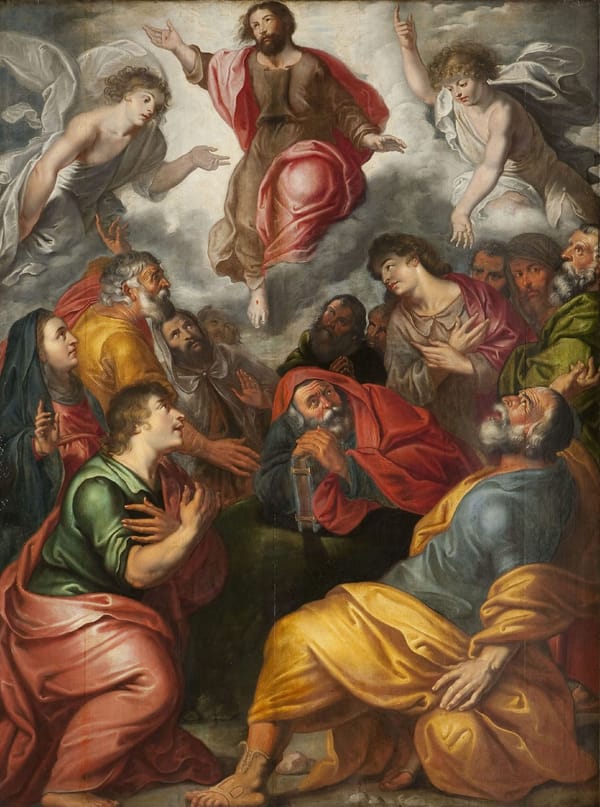
Saturday within the Octave of the Ascension
Jesus, then, the Man who dwelt on the earth and was perfect in all holiness, has ascended into heaven. This earth, accursed of God as it was, has produced the fairest fruit of heaven; and heaven with its gates shut against our race, has had to open them for the entrance of a Son of Adam. It is the mystery of the Ascension; but it is only a part, and it behoves us to know the mystery in its fulness. Let us give ear to the apostle of the Gentiles: ‘God who is rich in mercy, through His exceeding charity wherewith He loved us even when we were dead in sins, hath quickened us together with Christ: and hath raised us up together with Him, and hath made us sit in the heavenly places together with Him.’1 We have celebrated the Pasch of our Saviour’s Resurrection as our own resurrection; we must, agreeably to the apostle’s teaching, celebrate also His Ascension as our own. Let us weigh well the expression: ‘God hath made us sit in the heavenly places together with Christ.’ So then in the Ascension, it is not Jesus alone who ascends into heaven; we ascend thither with Him. It is not He alone that is enthroned there in glory; we are enthroned through and together with Him.
That we may the better understand this truth, let us remember that the Son of God did not assume our human nature with a view to the exclusive glorification of the Flesh which He united to His own divine Person. He came to be our Head. We, consequently, are His members; and where He is, we also are to be; at least, such is His intention, as He implied at the last Supper, when He said: ‘Father! I will that where I am, they also whom Thou hast given Me may be with Me, that they may see My glory which Thou hast given Me.’2 And what is the glory given to Him by His Father? Let us hearken to the royal prophet, who, speaking of the future Ascension, says: ‘The Lord said to my Lord: Sit Thou at My right hand!’3
It is, then, on the very throne of the eternal Father, it is at His right hand, that we shall see Him whom the apostle calls our forerunner.4 We shall be united with Jesus, as members to our Head; so that His glory will be ours; we shall be kings, with His kingship; He will make us partake of all that He Himself has, for He tells us that we are His joint-heirs.5
From this it follows that the august mystery of the Ascension, which began on the day of Jesus’ entrance into heaven, will continue, until His mystical body has received its completion by the ascension of the last of the elect. Look at that countless host of holy souls who were the earliest companions of His triumph: foremost are our first parents; then the patriarchs, the prophets, and the just of every generation of the preceding four thousand years! They had been imprisoned in limbo, but He liberated them, gave them of His own brightness, and made them His partners in the glory of His Ascension. They were His trophy; they formed His court, as He passed from earth to heaven. Well did we exclaim in the words of holy David: ‘Sing to God, ye kingdoms of the earth! Sing ye to the Lord. Sing ye to God, who mounteth above the heaven of heavens, towards the east.’6
The angels were ready to receive our Emmanuel; and then began that sublime dialogue, which the royal psalmist was permitted to hear and prophesy. The glad countless legion of the holy souls, who escorted the divine conqueror, cried out to the guardians of the heavenly Jerusalem: ‘Lift up your gates, O ye princes! Be ye lifted up, O eternal gates! and the King of glory shall enter in.’ The faithful angels replied: ‘Who is this King of glory?’ ‘It is the Lord,’ responded the elect of earth: ‘It is the Lord who is strong and mighty; the Lord mighty in battle.’ Well might they say this of our Jesus, who had vanquished satan, death and hell, and brought themselves to the city’s gate as a sample of His stupendous conquest. The angels repeated their question; the saints re-echoed their reply; the eternal gates were thrown open, and the King and His courtiers entered into heaven.7
The gates, then, are opened to receive our Redeemer, and opened He would have them remain for us to follow Him. Admirable Ascension! oh, let us linger in its contemplation! Jesus inaugurates the grand mystery by His own entrance into heaven, and then perpetuates it by the ascension of His elect of each successive generation. There is a ceaseless procession up to heaven; for some happy souls are ever finishing their purification in purgatory, while some still happier ones are winging their rapid flight direct from this earthly vale of sorrows. Hail, then, O glorious mystery! fruit of the flowers of so many mysteries; term, fulfilment, perfection of our Creator’s decree! Alas! thou hadst a long interruption by Adam’s sin; but Jesus’ triumph restored thy reign on earth, and this earth shall live in thy beauty and grace till that word shall be uttered by the angel: ‘Time shall be no more!’8 O mystery of joy and hope, be thou accomplished in me!
Permit us, then, O Jesus, to apply to ourselves what Thou saidst to Thine apostles: ‘I go to prepare a place for you!’9 This has been Thy aim in all Thou hast done for us: Thou camest into this world to open heaven for us. Thy holy bride, the Church, bids us fix our eyes on heaven; she points to its opened gates, and shows us the bright track through which is passing up from earth an unbroken line of souls. We are still in exile; but the eye of our faith sees Thee in that land above, Thee the Son of Man throned at the right hand of the Ancient of days.10 How are we to reach Thee, dear Jesus? We cannot, as Thou didst, ascend by our own power: Thou must needs fulfil Thy promise, and our desire, of drawing us to Thyself.11 It was the object after which Thy blessed Mother also sighed, when Thou didst leave her on earth; she longed for the blissful hour of Thy taking her to Thyself, and awaited Thy call with faith, labouring meanwhile for Thy glory, and living with Thee, though not seeing Thee. Give us to imitate the faith and love of this Thy Mother, that so we may apply to ourselves those words of Thine apostle: ‘We are already saved, by hope.’12 Yes, we shall be so, if Thou send us, according to Thy promise, the holy Spirit whom we so ardently desire to receive; for He is to confirm within us all that Thy mysteries have produced in our souls; He is to be to us a pledge of our future glorious ascension.
In presenting our petitions this day to heaven, let us take, as addressed to ourselves, the sublime instructions given by the Gothic Church of Spain, on the Ascension feast, to her children.
Missa
May 20: St. Bernardine of Siena, Confessor
|
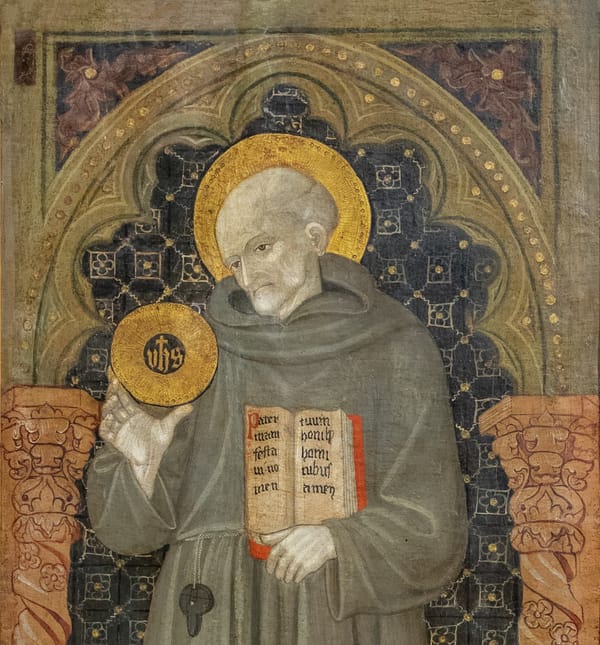
IN that season of the liturgical year when we were kneeling in love and prayer around the crib of the Infant Jesus, one day was devoted to the celebration of the glory and sweetness of his Name. Holy Church was full of joy when she pronounced the dear Name chosen from all eternity by her heavenly Spouse; and mankind found consolation in the thought that the great God who might so justly have bid us call him the Just and the Avenger, willed us henceforth to call him the Saviour. The devout Bemardine of Siena, whose feast we keep to-day, stood then before us, holding in his hands this ever blessed Name, surrounded with rays. He urged the whole earth to venerate with love and confidence the sacred name which expresses the whole economy of our salvation. The Church, ever attentive to what is for the good of her children, adopted the beautiful device. She encouraged them to receive it from the Saint, as a shield that would protect them against the darts of the evil spirit, and as an additional means of reminding ourselves of the exceeding charity wherewith God has loved this world of ours. And finally, when the loveliness of the holy Name of Jesus had won all Christian hearts, she instituted in its honour one of the most beautiful solemnities of Christmastide.
Bemardine, the worthy son of St Francis of Assisi, returns to us on this twentieth day of May, and the sweet flower of the holy Name is, of course, in his hand. But it is not now the prophetic appellation of the newborn Babe; it is not the endearing Name, respectfully and lovingly whispered by the Virgin-Mother over the crib; it is the Name whose sound has gone through the whole creation, it is the trophy of the grandest of victories, it is the fulfilment of all that was prophesied. The Name of Jesus was a promise to mankind of a Saviour; Jesus has saved mankind, by dying and rising again; he is now Jesus in the full sense of the word. Go where you will, and you hear this Name—the Name that has united men into the one great family of the Church.
The chief priests of the Synagogue strove to stifle the Name of Jesus, for it was even then winning men’s hearts. They forbade the Apostles to teach in this Name; and it was on this occasion that Peter uttered the words which embody the whole energy of the Church: We ought to obey God rather than men.1 The Synagogue might as well have tried to stay the course of the sun. So too, when the mighty power of the Roman Empire set itself against the triumphant progress of this Name, and would annul the decree that every knee should bow at its sound,2 its attempt was a complete failure, and at the end of three centuries the Name of Jesus was heard and loved in every city and hamlet of the Empire.
Armed with this sacred motto, Bernardine traversed the towns of Italy, which at that period (the fifteenth century) were at enmity with each other, and not unfrequently torn with domestic strifes. The Name of Jesus, which he carried in his hand, became as a rainbow of reconciliation; and wheresoever he set it up, there every knee bowed down, every vindictive heart was appeased, and sinners hastened to the sacrament of pardon. The three letters (I H S) which represent this Name, became familiar to the faithful; they were everywhere to be seen carved, or engraven, or painted; and the Catholic world thus gained a new form whereby to express its adoration and love of its Saviour.
Bernardine was a preacher of inspired eloquence. He was also a distinguished master in the science of sacred things, as is proved by the writings he has left us. We regret not being able, from want of space, to give our readers his words on the greatness of the Paschal mystery; but we cannot withhold from them what he says regarding the apparition of Jesus to his Blessed Mother after the Resurrection. They will be rejoiced at finding unity of doctrine on this interesting subject existing between the Franciscan school, represented by St Bemardine, and the school of St Dominic, whose testimony we have already given on the Feast of St Vincent Ferrer.
'From the fact of there being no mention made in the Gospel of the visit wherewith Christ consoled his Mother after his Resurrection, we are not to conclude that this most merciful Jesus, the source of all grace and consolation, who was so anxious to gladden his disciples by his presence, forgot his Mother, who he knew had drunk so deeply of the bitterness of his Passion. But it has pleased divine Providence that the Gospel should be silent on this subject; and this for three reasons.
‘In the first place, because of the firmness of Mary's faith. The confidence which the Virgin-Mother had of her Son's rising again had never faltered, not even by the slightest doubt. This we can readily believe, if we reflect on the special grace wherewith she was filled, she the Mother of the Man-God, the Queen of angels, and the Mistress of the world. To a truly enlightened mind, the silence of the Scripture on this subject says more than any affirmation could have done. We have learned to know something of Mary by the visit she received from the angel, when the Holy Ghost overshadowed her. We met her again at the foot of the Cross, where she, the Mother of Sorrows, stood nigh her dying Son. If then the Apostle could say: As ye are partakers of the sufferings, so shall ye he also of the consolation:3 what share must not the Virgin-Mother have had in the joys of the Resurrection? We should hold it as a certain truth that her most sweet Jesus, after his Resurrection, consoled her first of all. The holy Roman Church would seem to express this, by celebrating at Saint Mary Major's the Station of Easter Sunday. Moreover, if from the silence of the Evan-gelists you would conclude that our Risen Lord did not appear to her first, you must go farther, and say that he did not appear to her at all, inasmuch as these same Evangelists, when relating the several apparitions, do not mention a single one as made to her. Now, such a conclusion as this would savour of impiety.
'In the second place, the silence of the Gospel is explained by the incredulity of men. The object of the Holy Spirit, when dictating the Gospels, was to describe such apparitions as would remove all doubt from carnalminded men with regard to the Resurrection of Christ. The fact of Mary's being his Mother would have weakened her testimony, at least in their eyes. For this reason she was not brought forward as a witness, though most assuredly there never was or will be any creature (the humanity of her Son alone excepted) whose assertion better deserved the confidence of every truly pious soul. But the text of the Gospel was not to adduce any testimonies, save such as might be offered to the whole world. As to Jesus' apparition to his Mother, the Holy Ghost has left it to be believed by those that are enlightened by his light.
'In the third place, this silence is explained by the sublime nature of the apparition itself. The Gospel says nothing regarding the Mother of Christ after the Resurrection; and the reason is, that her interviews with her Son were so sublime and ineffable that no words could have described them. There are two sorts of visions: one is merely corporal, and feeble in proportion; the other is mainly in the soul, and is granted only to such as have been transformed. Say, if you will, that Magdalen was the first to have the merely corporal vision, provided that you admit that the Blessed Virgin saw, previously to Magdalen, and in a far sublimer way, her Risen Jesus, that she recognized him, and enjoyed his sweet embraces in her soul, more even than in her body.'4
Let us now read the Life of our Saint, as given, though too briefly, in the Lessons of to-day's Office:
How beautiful, O Bernardine, are the rays that form the aureole round the Name of Jesus! How soft their light on that eighth day after his birth, when he received this Name! But how dazzling, now that this Jesus achieves our salvation, not only by humiliation and suffering, but by the triumph of his Resurrection! Thou comest to us, O Bernardine, in the midst of the Paschal glory of the Name of Jesus. This Name, for which thou didst so lovingly and zealously labour, gives thee to share in its immortal victory. Now therefore, pour forth upon us, even more abundantly than when thou wast here on earth, the treasures of love, admiration and hope, of which this divine Name is the source, and cleanse the eyes of our soul, that we may one day be enabled to join thee in contemplating its beauty and magnificence.
Apostle of peace! Italy, whose factions were so often quelled by thee, may well number thee among her protectors. Behold her now a prey to the enemies of Jesus, rebellious against the Church of God, and abandoned to her fate. Oh! forget not that she is thy native land, that she was obedient to thy preaching, and that thy memory was long most dear to her. Intercede in her favour; deliver her from her oppressors; and show that when earthly armies fail, the host of heaven can always save both cities and countries.
Illustrious son of the great patriarch of Assisi! the seraphic Order venerates thee as one of its main supports. Thou didst reanimate it to its primitive observance; continue now from heaven to protect the work thou didst commence here on earth. The Order of St Francis is one of the grandest consolations of holy Mother Church; make this Order for ever flourish, protect it in its trials, give it increase in proportion to the necessities of the faithful; for thou art the second Father of this venerable family, and thy prayers are powerful with the Redeemer, whose glorious Name thou didst confess upon earth.
| Previous May 19 (the Same Day): St. Pudentiana, Virgin | Next May 20: St. Bernardine of Siena, Confessor |