Daily reading
Paschal Time
Major vigil · Movable from Easter · Temporal
May 27, 2023
From Dom Guéranger’s The Liturgical Year.

|
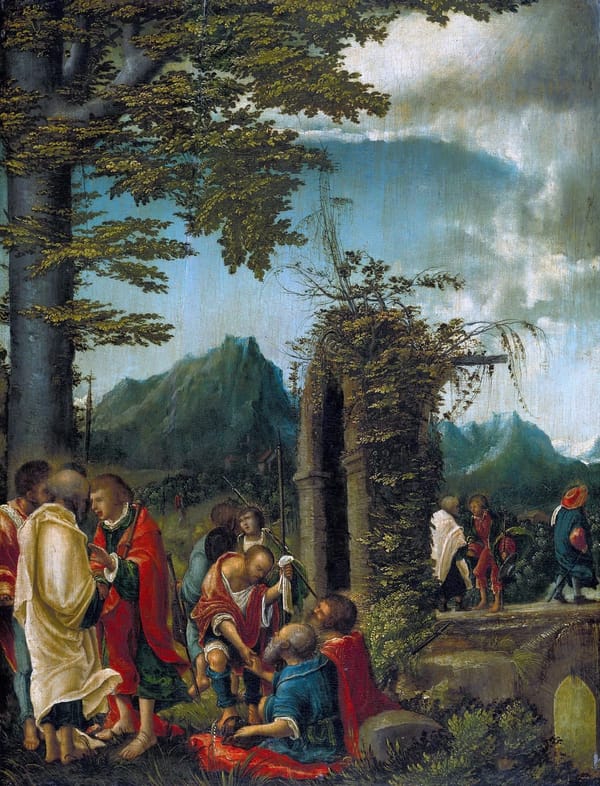
Vigil of Pentecost
The dazzling splendour of to-morrow’s solemnity forecasts its beauty on this day of its vigil. The faithful are preparing themselves by fasting to celebrate the glorious mystery. But the Mass of the neophytes, which formerly was said during the night, is now anticipated, as on Easter Eve; so that by to-day’s noon, we shall have already begun the praises of the Holy Ghost. The Office of Vespers, in the afternoon, will solemnly open the grand festival. The reign of the holy Spirit is, therefore, proclaimed by the liturgy of this very day. Let us unite ourselves in spirit with the holy ones, who are awaiting the fulfilment of Jesus’ promise.
Whilst following the mysteries of the past seasons of the liturgical year, we have been frequently told of the action of the Third Person of the blessed Trinity. The lessons read to us, from both the old and the new Testament, have more than once excited our respectful attention towards this divine Spirit, who seemed to be shrouded in mystery, the time for Him to be made manifest not having yet arrived. The workings of God in His creatures do not come all at once; there is a succession in their coining, but come they certainly will. The sacred historian describes how the heavenly Father, acting through His Word, employed six days in arranging, into its several parts, this world which He had created; but he also tells us, though under the veil of a mysterious expression, that the Spirit moved over the waters, which the Son of God was about to divide from the earth.
If, then, the Holy Ghost’s visible reign on our earth was deferred until such time as the Man-God should be enthroned on the Father’s right hand, we must not conclude that this divine Spirit has been inactive. What are the sacred Scriptures, from which the liturgy has selected so many sublime passages for our instruction, but the silent production of Him, who, as the venerable Symbol has it, ‘spoke by the prophets?’1 He gave us the Word, the Wisdom of God, by the Scripture, who gave us, at a later period, this same Word, in the flesh of human nature.
He has never been a moment of all the past ages without working. He prepared the world for the reign of the Incarnate Word; He did so by bringing together the various races of once separate nations, and by keeping up that universal expectation of a Redeemer, which was held alike by the most barbarous and by the most highly civilized. The earth had not as yet heard the name of the Holy. Ghost, but He moved over the universe of mankind, as He moved over the dead mass of water at the beginning of the world.
Meanwhile, the prophets spoke of Him in several of the prophecies wherein they foretold the coming of the Son of God. The Lord thus spoke by the lips of Joel:’I will pour out My Spirit upon all flesh.’2 He said to us through Ezechiel:’I will pour upon you clean water, and you shall be cleansed from all your filthiness, and I will cleanse you from all your idols. And I will give you a new heart, and put a new spirit within you: and I will take away the stony heart out of your flesh, and I will give you a heart of flesh; and I will put My Spirit in the midst of you.’3
But previously to the manifestation of Himself, the Holy Ghost was to effect that of the divine Word. When infinite power called into existence the body and soul of the future Mother of God, it was He that prepared the dwelling for the sovereign Majesty, by sanctifying Mary from the instant of her conception, and taking possession of her as the temple into which the Son of God was soon to enter. When the ever blessed day of the Annunciation came, the archangel declared unto Mary that the Holy Ghost would come upon her, and that the power of the Most High would overshadow her. No sooner did the Virgin consent to the fulfilment of the eternal decree, than the operation of the divine Spirit produced within her the most ineffable of mysteries: the Word was made Flesh, and dwelt among us!
Upon this flower that sprang from the branch of the tree of Jesse, upon this Humanity divinely produced in Mary, there rested complacently the Spirit of the Father and of the Son: He enriched it with His gifts, He fitted it for its glorious and everlasting destiny.4 He that had so filled the Mother with the treasures of His grace, that it seemed to border on infinity, gave incomparably more to her Child. And, as ever, the holy Spirit worked these stupendous wonders silently; for the time of His manifestation had not come. The earth is to catch but a glimpse of Him on the day of Jesus’ baptism, when He will rest with outstretched wings on the head of the well-beloved Son of the Father. The holy Baptist John will understand the glorious vision, as he had felt, when yet unborn, the presence of the blessed fruit in Mary’s womb; but as to the bystanders, they saw but a dove, and the dove revealed not his eternal secrets.
The reign of the Son of God, our Emmanuel, is established upon its predetermined foundations. In Him we have a brother, for He has assumed our weak human nature; a teacher, for He is the Wisdom of the Father, and leads us into all truth; a physician, for He heals all our infirmities; a mediator, for by His sacred Humanity He brings all creation to its Creator. In Him we have our Redeemer, and in His Blood our ransom; for sin had broken the link between God and ourselves, and we needed a divine Redeemer. In Him we have a Head, who is not ashamed of His members, however poor they may be; a King whom we have seen crowned with an everlasting diadem; a Lord, whom the Lord hath made to sit on His right hand.5
But if He rules over this earth for all ages, it is from His throne in heaven that He is to rule, until the angel’s voice is heard proclaiming that ‘time is no more’;6 and then He will return to ‘crush the heads’7 of sinners. Meanwhile, long ages are to flow onwards in their course, and these ages are to be the reign of the Holy Ghost. But as we learn from the evangelist, the Spirit was not given until such time as Jesus was glorified.8 So that our beautiful mystery of the Ascension stands between the two divine reigns on earth: the visible reign of the Son of God, and the visible reign of the Holy Ghost. Nor is it only the prophets who announce the succession of the second to the first; it is our Emmanuel Himself, who, during the days of His mortal life, heralded the approaching reign of the divine Spirit.
We have not forgotten His words: ‘It is expedient for you that I go; for if I go not, the Paraclete will not come to you.’9 Oh! how much the world must have needed this divine guest, of whom the very Son of God made Himself the precursor! And that we might understand how great is the majesty of this new master who is to reign over us, Jesus thus speaks of the awful chastisements which are to befall them that offend Him: ‘Whosoever shall speak a word against the Son of Man, it shall be forgiven him; but he that shall speak against the Holy Ghost, it shall not be forgiven him, neither in this world nor in the world to come.’10 This divine Spirit is not, however, to assume our human nature, as did the Son; neither is He to redeem the world, as did the Son; but He is to come among men with a love so immeasurable, that woe to them who despise it! It is to Him that Jesus intends to confide the Church, His bride, during the long term of her widowhood; to Him will He make over His own work, that He may perpetuate and direct it in all its parts.
We, then, who are to receive a few hours hence the visit of this Spirit of love, who is to renew the face of the earth,11 must be all attention, as we were at Bethlehem when we were awaiting the birth of our Emmanuel. The Word and the Holy Ghost are coequal in glory and power, and their coming upon the earth proceeds from the one same eternal and merciful decree of the blessed Trinity, who, by this twofold visit, would’make us partakers of the divine nature.’12 We, who were once nothingness, are destined to become, by the operation of the Word and the Spirit, children of the heavenly Father. And if we would know what preparation we should make for the visit of the Paraclete, lot us return in thought to the cenacle, where we left the disciples assembled, persevering with one mind in prayer, and waiting, as their Master had commanded them, for the power of the Most High to descend upon them, and arm them for their future combat.
The first we look for in this sanctuary of recol- lectedness and peace, is Mary, the Mother of Jesus, the master-piece of the Holy Ghost, the Church of the living God, from whom is to be born on the morrow, and by the action of the same divine Spirit, the Church, militant; for this second Eve represents and contains it within herself. Well, indeed, does this incomparable creature now deserve our honour! Have we not seen her glorious share in all the mysteries of the Man-God? And is she not to be the dearest and worthiest object of the Paraclete’s visit? Hail, then, O Mary full of grace! Thou art our mother, and we rejoice in being thy children. The holy Church expresses this joy of ours, when she thus comments the words of David’s canticle: ‘Our dwelling in thee, O holy Mother of God! is as of them that are all rejoicers!’13 In vain wouldst thou decline the honours that await thee on the morrow! Mother Immaculate! Temple of the Holy Ghost! there is no escape, and receive thou must a new visit of the Spirit, for a new work is entrusted to thee: the care of the infant Church for several years to come!
The apostolic college is clustered around the holy Mother; it is such a feast to them to look upon her, for they see the likeness of their Jesus in her face! In the very cenacle where they are now assembled, and in Mary’s presence, an event occurs which is of deep importance. As God, when He formed His Israelite people, chose the twelve sons of Jacob that they might be the fathers of that privileged race, so did Jesus choose twelve men, and they, too, were Israelites, that they might be the foundations of the Church, of which He Himself, and Peter together with and in Him, is the chief corner-stone. The terrible fall of Judas has reduced the number to eleven; the mysterious number is broken, and the Holy Ghost is about to descend upon the college of the apostles. Jesus had not thought proper to fill up the vacanoy before His Ascension into heaven: and yet the number must be completed, before the coming of the Power from on high. The Church surely could not be less perfect than the Synagogue. Who, then, will take Christ’s place in designating the new apostle? Such a right, says St. John Chrysostom, could not belong to any but Peter; but he humbly waived his right, and expressed his wish that there should be an election. The choice fell upon Mathias, who immediately took his place among the apostles, and awaited the promised Comforter.
In the cenacle, and in the blessed Mother’s company, there are also the disciples, less honoured, it is true, than the twelve, yet have they been witnesses of the works and mysteries of the Man-God; they, too, are to share in preaching the good tidings. And finally, Magdalene and the other holy women are there, preparing, as the Master had prescribed, for the visit from on high, which is to tell upon them also. Let us honour this fervent assembly of the hundred and twenty disciples. They are our models. The holy Spirit is to descend first upon them, for they are His first-fruits; but He is to come down upon us also, and it is with a view to prepare us for our Pentecost that the Church imposes on us to-day the obligation of fasting.
Formerly, this vigil was kept like that of Easter. The faithful repaired to the church in the evening, that they might assist at the solemn administration of Baptism. During the night, the Sacrament of regeneration was conferred upon such catechumens as sickness or absence from home had prevented from receiving it on Easter night. Those, also, who had then been thought insufficiently tried or instructed, and had, during the interval, satisfied the conditions required by the Church, now formed part of the group of aspirants to the new birth of the sacred font. Instead of the twelve prophecies, which were read on Easter night while the priests were performing over the catechumens the rites preparatory to Baptism, six only were now read; at least, such was the usual custom, and it would lead us to suppose that the number of those baptized at Pentecost was less than at Easter.
The Paschal Candle was again brought forward during this night of grace, in order to impress the newly baptized with respect and love for the Son of God, who became Man that He might be the light of the world.14 The rites already described and explained for Holy Saturday were repeated on this occasion, and the Sacrifice of the Mass, at which the neophytes assisted, began before the break of day.
In later times, when the charitable custom of conferring Baptism on children immediately after their birth passed into a general law, the Mass of Whitsun-Eve was said early in the morning, as was done in the case of Easter-Eve. The six prophecies, of which we have just spoken, are now read before the celebration of the holy Sacrifice; after which, the baptismal water is solemnly blessed. The Paschal Candle is used at this ceremony, at which the faithful should consider it a duty to assist.
First Vespers are sung in the afternoon. We do not insert them, because Whitsun-Eve can never occur on a Sunday; whereas, for other feasts, for which we have given the first Vespers, the vigil may be a Sunday. Moreover, the first and second Vespers of Whit-Sunday are almost exactly alike.
We will close this day by inserting one of the finest sequences composed by Adam of Saint Victor on the mystery of Pentecost. This great liturgical poet of the western Church has surpassed himself in what he has written on the Holy Ghost; and more than once, during the octave, we will select from his rich store. But the hymn we give to-day is not merely a composition of poetic worth; it is a sublime and fervent prayer to the Paraclete, whom Jesus has promised to send us, and whom we are now expecting. Let us make these sentiments of the devout poet of the twelfth century our own; let us imitate him in his longings for the holy Spirit, who is coming that He may renew the face of the earth, and dwell within us.
Sequence
Genitore Genitoque,
Pariter Paraclite,
Redde linguas eloquentes,
Fac ferventes in te mentes
Flamma tua divite.
Par amborum, et utrique
Compar et consimilis,
Cuncta reples, cuncta foves,
Astra regis, cœlum moves,
Permanens immobilis.
Internarum tenebrarum
Effugas caliginem;
Per te mundi sunt mundati;
Tu peccatum et peccati
Destruis rubiginem.
Et ostendis viam pacis
Et iter justitiæ.
Perversorum corda vitas,
Et bonorum corda ditas
Munere scientiae.
Te praesente nil impurum;
Gloriatur mens jucunda;
Per te laeta,
Per te munda
Gaudet conscientia.
Per te suam sacramenta
Habent efficaciam:
Tu nocivam vim repellis,
Tu confutas et refellis
Hostium nequitiam.
Quando subis, atrae nubis
Effugit obscuritas;
Sacer ignis, pectus uris;
Non comburis, sed a curis
Purgas, quando visitas.
Et sopitas et oblitas
Erudis et excitas.
Foves linguas, formas sonum,
Cor ad bonum facit pronum
A te data charitas.
O solamen miserorum,
Pauperum refugium,
Da contemptum terrenorum:
Ad amorem supernorum
Trahe desiderium.
Habitator et amator
Cordium humilium,
Pelle mala, terge sordes,
Et discordes fac concordes,
Et affer præsidium.
Docuisti, confortasti
Timentes discipulos,
Visitare nos digneris;
Nos, si placet, consoleris
Et credentes populos.
Par potestas est earum,
Et communis deitas:
Tu procedens a duobus
Coæqualis es ambobus:
In nullo disparitas.
Quantus Pater est et qualis;
Servorum humilitas
Deo Patri, Filioque
Redemptori, tibi quoque
Laudes reddat debitas.
who proceedest equally from the Father
and the Son! with thy glowing fire,
give eloquence to our tongues,
and make our hearts fervent
in their love for thee.
equal and coequal with them in essence!
thou fillest and fosterest all things:
and though in thyself immovable,
thou governest the stars,
and givest motion to the heavens.
thou puttest to flight
the gloom of our soul’s darkness.
‘Tis thou that purifiest the pure,
and takest away
sin and its rust.
thou showest us the way of peace
and the path of justice.
Thou shunnest the hearts of perverse sinners;
thou enrichest the hearts of the good
with the gift of knowledge.
when thou art present, there is no impurity.
The soul that possesses thee,
is cheerful:
and her conscience
is joyful and pure.
by thee have the Sacraments
their efficacy:
thou drivest away all evil power:
thou bringest to nought
the wickedness of our enemies.
our hearts are soothed;
when thou enterest, dark clouds are put to flight.
O sacred Fire! when thou visitest us,
thou inflamest our souls; not burning them,
but purging them from the dross of care.
that once were ignorant and drowsy and heedless.
Thou inspirest the tongue,
thou formest its speech;
and the charity thou givest,
makes the heart prompt to all that is good.
O Comforter of the afflicted!
O refuge of the poor!
Give us a contempt for earthly things,
and draw our affections
to the love of what is heavenly.
and guest, and lover
of humble souls!
Drive all evil from us, cleanse our sins,
bring concord where now is discord,
and support us by thy protection.
teach, and strengthen
the timid disciples,
deign to visit us;
vouchsafe to console us
and the faithful throughout the world.
equal the power,
and one the divinity,
of the Three Persons.
Thou proceedest from the Father and the Son,
and art coequal in all things with them.
in all perfections as is the Father,
accept from us thy poor servants
the praise that is due to thee,
equally with the Father
and the Son.
- Qui locutus est per prophetas. (Symbol of Nicœa and Constantinople.) ↩︎
- Joel, ii. 28. ↩︎
- Ezech. xxxvi. 25-27. ↩︎
- Is. ad. 1-3. ↩︎
- Ps. cix. 1. ↩︎
- Apoc. x. 6. ↩︎
- Ps. cix. 6. ↩︎
- St. John, vii. 39. ↩︎
- St. John, xvi. 7. ↩︎
- St. Matth. xii. 32. ↩︎
- Ps. ciii. 30. ↩︎
- 2 St. Peter, i. 4. ↩︎
- The 2nd Nocturn of the Office of the Blessed Virgin; Antiphon to the 86 th Psalm. ↩︎
- St. John, viii. 12. ↩︎
May 27: St. Bede the Venerable, Confessor and Doctor of the Church
THE blessing given by our Lord as he ascended into heaven has revealed its power in the most distant pagan lands, and during these days the liturgical cycle bears witness to a concentration of graces upon the west of Europe.
The band of missionaries begged of Pope Eleutherius by the British king Lucius has been followed by the apostolate of Augustine, the envoy of Gregory the Great, and to-day, as though impatient to justify the lavish generosity of heaven, England brings forward her illustrious son, the Venerable Bede. This humble monk, whose whole life was spent in the praise of God, sought his divine Master in nature and in history, but above all in holy Scripture, which he studied with a loving attention and fidelity to tradition. He who was ever a disciple of the ancients, takes his place to-day among his masters as a Father and Doctor of the Church.
He thus sums up his own life: 'I am a priest of the monastery of the blessed Apostles Peter and Paul. I was bom on their land, and ever since my seventh year I have always lived in their house, obserying the Rule, singing day by day in their church, and making it my delight to learn, to teach or to write. Since I was made a priest, I have written commentaries on the holy Scripture for myself and my brethren, using the words of our venerated Fathers and following their method of interpretation. And now, good Jesus, I beseech thee, thou who hast given me in thy mercy to drink of the sweetness of thy word, grant me now to attain to the source, the fount of wisdom, and to gaze upon thee for ever and ever.’*
The holy death of the servant of God was one of the most precious lessons he left to his disciples. His last sickness lasted fifty days, and he spent them, like the rest of his life, in singing the psalms and in teaching. As the Feast of the Ascension drew near, he repeated over and over again with tears of joy the Antiphon: ‘O king of glory, who hast ascended triumphantly above the heavens, leave us not orphans, but send us the promise of the Father, the Spirit of truth.’ He said to his disciples in the words of St Ambrose: ‘I have not lived in such a sort as to be ashamed to live with you, but I am not afraid to die, for we have a good Master.’ Then, returning to his translation of the Gospel of St John and a work, which he had begun, on St Isidore, he would say: ‘I do not wish my disciples to be hindered after my death by error nor to lose the fruit of their studies.’
On the Tuesday before the Ascension he grew worse, and it was evident that the end was near. He was full of joy and spent the day in dictating and the night in prayers of thanksgiving. The dawn of Wednesday morning found him urging his disciples to hurry on their work. At the hour of Terce they left him to take part in the procession made on that day with the relics of the saints. One of them, a child, who stayed with him, said: 'Dear master, there is but one chapter left; hast thou strength for it?’ ‘It is easy,' he answered with a smile; ‘take thy pen, cut it and write—but make haste.' At the hour of None, he sent for the priests of the monastery and gave them little presents, begging them to remember him at the altar. All wept. But he was full of joy, saying: ‘It is time for me, if it so please my Creator, to return to him who made me out of nothing, when as yet I was not. My sweet Judge has well ordered my life, and now the time of dissolution is at hand. I desire to be dissolved and to be with Christ. Yea, my soul longs to see Christ my king in his beauty.’
So did he pass this last day. Then came the touching dialogue with Wibert, the child mentioned above. ‘Dear master, there is yet one sentence more.' 'Write quickly.' After a moment: ‘It is finished,’ said the child. 'Thou sayest well,' replied the blessed man. ‘It is finished. Take my head in thy hands and support me over against the Oratory, for it is a great joy to me to see myself over against that holy place where I have so often prayed.’ They had laid him on the floor of his cell. He said: ‘Glory be to the Father, and to the Son, and to the Holy Ghost,’ and when he had named the Holy Ghost, he yielded up his soul.
The following account of this holy monk is given in the Breviary:
‘Glory be to the Father, and to the Son, and to the Holy Ghost’ is the hymn of eternity. Before the creation of the angels and of man, God, in the concert of the three divine Persons, sufficed for his own praise, and this praise was adequate, infinite and perfect, like the divinity. This was the only praise worthy of God. However magnificently the world may hymn its Creator in the thousand voices of nature, its praise is always below the divine Object. But, in the designs of God, creation was one day to send up to heaven an echo of that melody which is threefold and yet one, for the Word was to take flesh, through the operation of the Holy Ghost, in the womb of Mary, and was to be Son of Man as truly as he is Son of God. Then the canticle of creation fully and perfectly re-echoed the adorable harmonies once known only to the blessed Trinity. Since that day a man who has understanding finds his perfection in such conformity to the Son of Mary, that he may be one with the Son of God in the divine concert wherein God is glorified.
This, O Bede, was thy life, for understanding was given thee. It was fitting that thy last breath should be spent in that song of love which had filled thy mortal life, and that thus thou shouldst enter at once into a glorious and blessed eternity. May we profit by that supreme lesson, which sums up all the teaching of thy grand and simple life!
Glory be to the almighty and merciful Trinity! These words form the close of the cycle of the mysteries which terminate at this time in the glorification of the Father, our sovereign Lord, by the triumph of the Son our Redeemer, and the inauguration of the reign of the Holy Ghost, our sanctifier. How splendid were the triumph of the Son and the reign of the Holy Ghost in the Isle of Saints in the days when Albion, twice given by Rome to Christ, shone like a priceless jewel in the diadem of the Spouse! O thou who wast the teacher of the English in the days of their fidelity, do not disappoint the hopes of the supreme Pontiff who has in our days extended thy cult to the Universal Church; but rekindle in the hearts of thy countrymen their former love for the Mother of all mankind.
* Bede, Hist, Eccl. cap. ult. ↩︎
May 27 (the Same Day): St. John I, Pope and Martyr
THE palm of martyrdom was won by this holy Pope, not in a victory over a pagan persecutor, but in battling for the Church’s liberty against a Christian king. But this king was a heretic, and therefore an enemy of every Pontiff that was zealous for the triumph of the true faith. The state of Christ’s Vicar here on earth is a state of combat; and it frequently happens that a Pope is veritably a martyr, without having shed his blood. St John I, whom we honour to-day, was not slain by the sword; a loathsome dungeon was the instrument of his martyrdom; but there are many Popes who are now in heaven with him, martyrs like himself, who never even passed a day in prison or in chains: the Vatican was their Calvary. They conquered, yet fell in the struggle with so little appearance of victory, that heaven had to take up the defence of their reputation, as was the case with that angelic Pontiff of the eighteenth century, Clement XIII.
The Saint of to-day teaches us, by his conduct, what should be the sentiment of every worthy member of the Church. He teaches us that we should never make a compromise with heresy, nor approve the measures taken by worldly policy for securing what it calls the rights of heresy. If the past ages, aided by the religious indifference of Governments, have introduced the toleration of all religions, or even the principle that ‘all religions are to be treated alike by the state,’ let us, if we will, put up with this latitudinarianism, and be glad to see that the Church, in virtue of it, is guaranteed from legal persecution; but as Catholics, we can never look upon it as an absolute good. Whatever may be the circumstances in which Providence has placed us, we are bound to conform our views to the principles of our holy faith, and to the infallible teaching and practice of the Church—out of which, there is but contradiction, danger and infidelity.
The holy Liturgy thus extols the virtues and courage of our Saint:
Thy fair palm, O holy Pontiff, was the reward of proclaiming the spotless holiness of the Church of Christ. She is the glorious Church, as St Paul calls her, having neither spot nor wrinkle;1 and, for that very reason she can never consent to yield to heresy any of the inheritance given her by her divine Lord. Nowadays, men form their calculations on the interests of this passing world, and are resolved to regulate society independently of the rights of the Son of God, from whom proceeds all social order, as well as all truth. They have deprived the Church of her external constitution and influence; and at the same time, they give encouragement to the sects that have rebelled against her. O holy Pontiff, teach us to realize what divine truth is, and how error can never create prescription against her rights. Then shall we submit to the unhappy necessities handed down to us by the fatal triumph of heresy, without accepting, as a sign of progress, the principle and law that ‘all religions are on an equality.’ In thy prison, brave martyr, thou didst proclaim the rights of the one only Church; preserve us, who are living during that revolt which was foretold by the Apostle,2 from those cowardly compromises, dangerous prejudices, and culpable want of solid instruction, which are the ruin of so many souls; and may our last words, on leaving this world, be those that were taught us by our Jesus himself: Heavenly Father! Hallowed be thy Name! May thy Kingdom come!
| Previous May 26 (the Same Day): St. Eleutherius, Pope and Martyr | Next May 27: St. Bede the Venerable, Confessor and Doctor of the Church |