Daily reading
Paschal Time
Double of the I Class · Movable from Easter · Temporal
May 30, 2023
From Dom Guéranger’s The Liturgical Year.

|
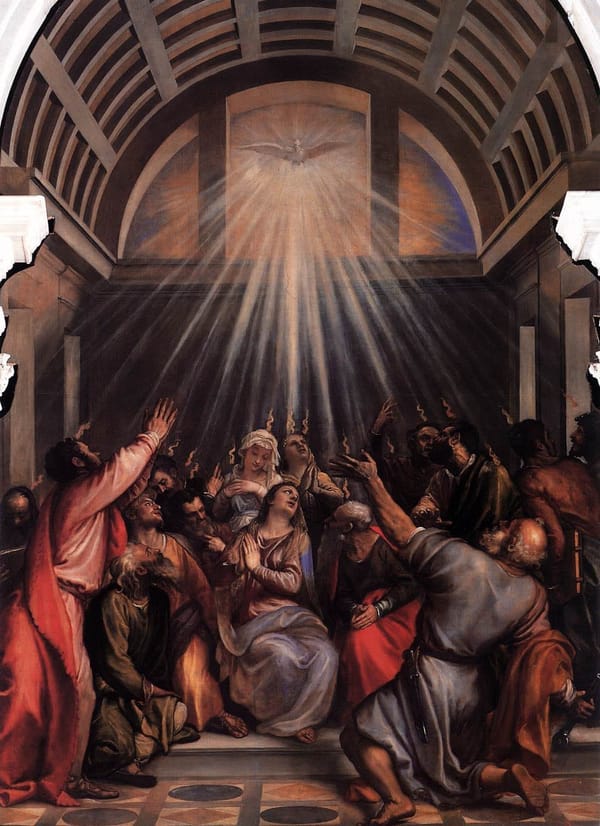
Tuesday in Whitsun Week
Yesterday, we were admiring the work of the Holy Ghost, whereby He drew mankind to the faith and the name of Jesus, to whom ‘all power was given in heaven and in earth.’1 The instruments used for this conquest were the apostles and their immediate successors. The tongue of fire was victorious, and the prince of this world was defeated, Let us continue our reflections, and see the further workings of the holy Spirit for the glory of the Son of God, who had sent Him into this world.
Our Emmanuel came down from heaven, that He might effect the union He had desired from all eternity. He began it by uniting our human nature to His own divine Person; but this personal union did not satisfy His love. He mercifully deigned to invite the whole human race to a spiritual union with Himself, by giving her to become His Church, His own dearest one,2 as He calls her; His ‘glorious Church, not having spot or wrinkle, but holy and without blemish.’3 But how could mankind, deformed as it was by sin, be worthy of such an honour? His love would make it worthy. He tells us that this Church is His bride.4 Having chosen her, He beautified her in the laver of His own precious Blood, and gave her, in dowry, the infinite merits He had acquired.
Thus prepared, her union with Him was to be of the closest. Jesus and His Church are one body; He is the Head, she is the aggregate of the members united together under this one Head. Such is the teaching of the apostle: ‘Christ is the Head of the Church; we are members of His body, of His flesh, and of His bones’.5 This body is to be formed of all who shall, in each successive age, be faithful to the call of divine grace, and enroll themselves as children of the Church. The world we inhabit is to be preserved, till the last elect required to complete the mystic body of Jesus, be added to the Church triumphant: then all will be consummated; the divine mystery of the Incarnation will have achieved its whole work.
But as in the Incarnate Word there was the invisible Soul and the visible Body, so also the Church was to have a soul and a body: a soul, whose hidden beauty no eye but God’s can fully see, at least during her earthly sojourn; and a body, which is to be visible to men: an ever-living proof of God’s power, and of His love for the human race. Up to the day of Pentecost, the just, who had been united under Jesus, their Head, had belonged only to the soul of the Church, for the body was not then in existence. The heavenly Father had adopted them as His children; the Son of God had accepted them as His members; and the Holy Ghost, who is now about to work exteriorly, had interiorly wrought their election and sanctification. The new order of things is to begin in Mary’s person. As we have already explained, the Church in its entirety, that is both soul and body, resided first in her. It was but fitting that she who was as truly the Mother of the Son of God, according to His human Nature, as the heavenly Father was His Father according to the divine Nature, should be superior to all other members of the Church, and this not only in the high degree of grace, but also in the precedence of time.
When our Saviour gave His Church an existence outside the loved sanctuary of His Mother’s heart, He, with His own hands, set the foundation stone, Peter, the rock; He raised up the pillars, and we have seen how He spent the forty days before His Ascension in organizing this Church, which was then so small, but which was afterwards to cover the whole earth. He told His apostles that He would be with them all days even to the consummation of the world;6 it was the same as telling them that, even after His Ascension into heaven, His Church was to continue on earth, even to the end of time.
He left the plan, thus begun by Himself, to be perfected by the Holy Ghost. It was necessary that this holy Spirit should come down from heaven, in order to strengthen those whom Jesus had chosen as His apostles. He was to be their Paraclete; their comforter, in the absence of their Master; He was to be the power from on high, who was to serve them as armour in their future combats; He was to remind them of all the words spoken to them by Christ; He was to give fruitfulness, by His own action, to the Sacraments, which Jesus had instituted, and over which the apostles had power because of the character impressed upon them by this holy Spirit. It is on this account that Jesus said to His apostles: ‘It is expedient to you that I go; for if I go not, the Paraclete will not come to you’.7 We have seen this divine Spirit, on the day of Pentecost, producing His effects on the apostles and disciples; let us now see His action in the creation, maintenance, and perfecting of this Church, which Jesus has promised to assist, by His mysterious presence, even to the consummation of the world.
The first operation of the Holy Ghost in the Church is the election of its members. This right of election is so especially Hisprerogative, that, as we learn from the Scriptures, it was by the Holy Ghost8 that Jesus chose the apostles, who were to be the pillars of His Church. We have seen how this holy Spirit began His mission on the day of Pentecost, by the election of three thousand Jews. A few days after, five thousand were added to the number, being converted by the preaching of Peter and John.9 The Gentiles, also, were called to the Church; and the Holy Ghost, having led Peter to Cornelius the centurion, descended upon this Roman and his household, thus declaring them to be elected as candidates for holy Baptism. The liturgy put this history before us, in the Mass of yesterday.
We seem able to keep pace with these first workings of the holy Spirit; but the sequel is all impetuosity, divine rapidity of action, irresistible conquest. He sends forth His messengers: their sound goeth forth into all the earth, and their words unto the ends of the world.10 He goes before them; He goes with them; He works the victory, while they speak. We come to the commencement of the third century, and we find a Christian writer addressing the magistrates of the Roman empire in these words: ‘We are but of yesterday, and we abound everywhere; in your cities, in your towns, in your camps; in the palace, the senate, the forum.’11 Nothing can withstand the Spirit of God; and in less than three hundred years from the day of His first manifestation, He calls the very emperors of Rome to be members of the Church.
Thus does the bride of Jesus advance in her beauty and strength; He looks upon her from His throne in heaven, and tenderly loves her. In the early part of the fourth century, she exceeds the limits of the Roman empire. Here and there, within this vast empire, there are men who still cling to paganism; but they all know what the Church is, and the very hatred they bear her is a proof that they are aware of her progress.
But let us not suppose that the mission of the Holy Ghost is limited to founding the Church on the ruins of the great pagan empire. No; the bride of Jesus is to be immortal; she is to exist in every place and age; she is to be superior, both by the extent of her dominions and the number of her subjects, to every other human power.
The divine Spirit could not, therefore, suspend His mission. The Roman empire has merited, by her crimes, to be swept away by the inundation of barbarous nations: it is the preparation of a new triumph for the Spirit. He comes and works, invisibly and silently, amidst this huge mass: He has His elect there, and by millions. He has renewed the face of the pagan world; He renews the face of the World, now that the barbarians rule it. He chooses His co-operators, and right faithful are they. He creates new apostles, and He selects them from all classes, for He is Master to do as He wills. Queens such as Clotilda, Bertha, Theodolind, or Hedwiges, are ready to do His biddings; they deck the bride of Jesus with their royal hands, and she comes forth to the world once more, younger and lovelier than ever.
There are, indeed, immense tracts of country in Europe not yet in the Church; it was necessary first to give stability to the work in those that had pre viously been Christian, and had been well-nigh submerged beneath the deluge of invasion. But, at the close of the sixth century, the holy Spirit visits Britain, Germany, Scandinavia and Sclavonia; He sends them apostles, such as Augustine, Boniface, Anscharius, Adalbert, Cyril, Methodius, Otho. By the labours of missioners like these, the bride is compensated for the losses she has sustained in the east, where schism and heresy have encroached upon her primitive inheritance. That holy Spirit, who is God together with the Father and the Son, and has been sent by Them to defend the honour of the bride, is ever faithful to His trust.
Thus, when the so-called Reformation was preparing for Europe the great apostasy of the sixteenth century, the Paraclete was extending the glories of the Church in other continents. The East Indies became the conquest of the most faithful nation; and, in the west, a new world was discovered by and made subject to the Catholic kingdom. The divine Spirit, who is ever jealous to maintain the honour and entirety of the deposit entrusted to Him by the Incarnate Word, then raised up new apostles to go and carry the name of Jesus to these immense tracts of country, which were to be added to the kingdom of His bride. St. Francis Xavier was sent to the East Indies; his brethren, together with the sons of St. Dominio and St. Francis of Assisi, laboured most perseveringly in preaching the Gospel to the people of the West Indies.
If, later on again, our Europe be misled by false theories and break with the Church; if this beloved bride of Jesus be betrayed and pillaged, calumniated and deprived of her rights, by those very nations which she had protected for so many ages, as the most loving of mothers—fear not; the Holy Ghost will add to her glories in some other way. Look at His present workings in the Church. Whence, if not from Him, are those ever increasing vocations to the apostolic ministry? Moreover, whilst conversions from heresy are more numerous than at any previous period, there is not an infidel country where the Gospel is not being preached. Our century has had its martyrs for the faith; it has heard the authorities of China and Cochin China, like the proconsuls of old, putting the Christians through an examination; it has heard the sublime answers, suggested by the Holy Ghost to these brave confessors, as Christ had promised.12 The farthest east produces its elect; the negroes of Africa are evangelized; and the most recently discovered portion of the world already counts its faithful by thousands, flourishing under a hierarchy of lawfully appointed pastors.
Be Thou blessed, then, O holy Spirit! who thus watchest over the dear bride of Jesus! Thanks to Thy ceaseless and untiring action, she has never once failed. In every age, Thou hast raised up apostles to enrich her by their conquests: Thy grace has been uninterruptedly inviting men to give themselves to her; in every nation and period, Thou Thyself hast chosen the members of her happy and countless family. She is our mother and we are her children; she is the bride of our divine Master, to whom we hope to be united through her: so that, by working for the glory of the Son of God who sent Thee, O holy Spirit! Thou hast deigned to work for us poor sinful creatures. We offer Thee our feeble tribute of thanks for all these Thy benefits to us.
Our Emmanuel has revealed to us that Thou art to abide with us to the end of the world; and we now understand how necessary is Thy presence. It is Thou that presidest over the formation of the bride; that maintainest her; that renderest her victorious over her enemies; that carriest her from one country to another, when a people becomes unworthy to possess her; that avengest her when she is insulted; and all this Thou wilt continue to do to the end of time.
But this noble bride of our God is not to remain for ever an exile from her Lord. As Mary was left for several years upon the earth, in order that she might labour for the glory of her Son, and was then taken up to heaven, there to reign eternally with Him; so likewise the Church is to remain militant here below as long as God sees her to be needed for completing the number of His elect. But the time will come of which it is written: ‘The marriage of the Lamb is come, and His wife hath prepared herself. And it is granted to her that she should clothe herself with fine linen glittering and white; for the fine linen are the justifications of the saints.’13 that is, the virtues of the saints she has formed. In those days, the bride ever comely and worthy of her Jesus, will grow no more, nay, she will decrease on earth in proportion as her triumphant glory is perfect in heaven. The revolt, spoken of by St. Paul,14 will show itself; men will abandon her, side with the prince of this world, who is to be let loose for a little while,15 and serve the beast, to whom it shall be given to make war with the saints, yea, and to overcome them.16 The bride herself will not be degenerate, during these her last days on earth, for Thou O holy Spirit! wilt still be with her, supporting her. But as soon as the last of the elect shall have been born, the Spirit and the bride will say ‘Come!’17 Then will Jesus appear upon the clouds of heaven; the mission of the Spirit will be accomplished; and the bride leaning upon her Beloved,18 will ascend from this ungrateful barren earth to heaven, where the eternal nuptials with the Lamb await her.
Mass
The station for to-day is in the church of Saint Anastasia, where we assisted at the Mass of the Aurora on the birthday of our Emmanuel. We revisit it now that we have celebrated all the grand mysteries of our Redemption. Let us bless our God for having so magnificently completed what He began so humbly and so sweetly. The neophytes, clothed in their white garments, are present, bearing testimony both to the love of the Son of God who has cleansed them by His Blood, and to the power of the Holy Ghost who has rescued them from the tyranny of satan, the prince of this world.
The Introit is addressed to the neophytes, inviting them to appreciate the glory they have received, and to give thanks to the God who has called them to a heavenly kingdom. The words of this Introit, which has been used almost from the very commencement of the Church, are taken from the fourth Book of Esdras, which, although not received by the Church as part of the sacred Scriptures, was frequently read by the early Christians on account of the admirable instructions it contains.
Introit
Ps. Attendite, popule meus, legem meam: inclinate aurem vestram in verba oris mei. ℣. Gloria Patri. Accipite.
Ps. Attend, O my people, to my law: incline your ears to the words of my mouth. ℣. Glory, &c. Receive, &c.
In the Collect, the Church teaches us that the action of the Holy Ghost in our souls is one of mercy and power combined. This divine action purifies our souls from all their stains, and defends them from the attacks of the crafty and jealous enemy, who is ever lying in wait for us.
Collect
Epistle
Cap. viii.In diebus illis: Quum au- dissent apostoli, qui erant Jerosolymis, quod recepisset Samaria verbum Dei, miserunt ad eos Petrum et Joannem, qui quum venissent, oraverunt pro ipsis ut acciperent Spiritum sanctum; nondum enim in quemquam illorum venerat, sed baptizati tantum erant in nomine Domini Jesu. Tunc imponebant manus super illos, et accipiebant Spiritum sanctum.
Ch. viii.In those days: When the apostles, who were in Jerusalem, had heard that Samaria had received the word of God, they sent unto them Peter and John. Who when they were come, prayed for them, that they might receive the Holy Ghost. For he was not as yet come upon any of them; but they were only baptized in the name of the Lord Jesus. Then they laid their hands upon them, and they received the Holy Ghost.
The inhabitants of Samaria had received the word of God through the preaching of Philip the deacon. They had received, at his hands, the Sacrament of Baptism, which made them Christians. This reminds us of the dialogue between Jesus and the woman at Jacob’s well, and of the three days that He spent in the city. Their faith is rewarded: Baptism has made them children of God and members of Christ their Redeemer. But they must also receive the Holy Ghost, in the Sacrament that gives perfection to the Christian character. The deacon Philip has not power to confer it upon them: Peter and John, who are invested with episcopal authority, visit them, and complete their happiness. This event makes us think of the grace bestowed on us by the Holy Ghost, when He strengthened our souls by the Sarcrament of Confirmation. Let us thank Him for this favour, which brought us into closer union with Himself, and gave us the courage needed for confessing our faith before heretics or tyrants.
Here all kneel.
Then follows the Sequence, Veni, sancte Spiritus; page 305.
Gospel
Cap. x.In illo tempore: Dixit Jesus Pharisæis: Amen, amen dico vobis, qui non intrat per ostium in ovile ovium, sed ascendit aliunde, ille fur est, et latro. Qui autem intrat per ostium, pastor est ovium. Huic ostiarius aperit, et oves vocem ejus audiunt, et proprias oves vocat nominatim, et educit eas. Et quum proprias oves emiserit, ante eas vadit: et oves illum sequuntur, quia sciunt vocem ejus. Alienum autem non sequuntur, sed fugiunt ab eo: quia non noverunt vocem alienorum. Hoc proverbium dixit eis Jesus. Illi autem non cognoverunt quid loqueretur eis. Dixit ergo eis iterum Jesus: Amen, amen dico vobis, quia ego sum ostium ovium. Omnes quotquot venerunt, fures sunt et latrones, et non audierunt eos oves. Ego sum ostium. Per me si quis introierit, salvabitur: et ingredietur, et egredietur, et pascua inveniet. Fur non venit nisi ut furetur, et mactet et perdat. Ego veni ut vitam habeant, et abundantius habeant.
Ch. x.At that time: Jesus said to the Pharisees: Amen, amen, I say to you: he that entereth not by the door into the sheepfold, but climbeth up another way, the same is a thief and a robber. But he that entereth in by the door, is the shepherd of the sheep. To him the porter openeth; and the sheep hear his voice: and he calleth his own. sheep by name, and leadeth them out. And when he hath let out his own sheep, he goeth before them: and the sheep follow him, because they know his voice. But a stranger they follow not, but fly from him, because they know not the voice of strangers. This proverb Jesus spoke to them. But they understood not what he spoke to them. Jesus therefore said to them again: Amen, amen, I say to you, I am the door of the sheep. All others, as many as have come, are thieves and robbers: and the sheep heard them not. I am the door. By me if any man enter in, he shall be saved; and he shall go in, and go out, and shall find pastures. The thief cometh not, but for to steal, and to kill, and to destroy. I am come that they may have life, and may have it more abundantly.
The Church’s motive for putting this passage of the Gospel before the neophytes of Pentecost was, to put them on their guard against a danger which might probably occur in after years. At present, they are the favoured sheep of the good Shepherd Jesus, represented by men to whom He Himself has given the charge to feed His lambs. These men have received their mission from Peter; and he who is with Peter, is with Jesus. But it has not unfrequently happened that false shepherds have got into the fold; our Saviour calls them thieves and robbers. He tells us that He Himself is the door, through which they must pass who can claim the right to feed His sheep. Every shepherd, if he would avoid the imputation of being a robber, must have received his mission from Jesus; and this mission cannot be given save by him whom Jesus has appointed to be His vicar and representative until He Himself return.
The Holy Ghost has poured forth His divine gifts upon these new Christians; but the virtues that are in them cannot be meritorious of eternal life, unless they continue to be members of the true Church. If, instead of following the lawful pastor, they were to be so unhappy as to go after false pastors, all these virtues would become barren. They should, therefore, flee, as they would from a stranger, from any guide who has not received his mission from the Master, who alone can lead them to the pastures of life. During the past centuries, schismatical pastors have risen up from time to time: the faithful were bound to shun them. We, who are living now, should take seriously to heart the admonition here given us by our Redeemer. The Church He has founded, and which He guides by His holy Spirit, is apostolic. The mission of those pastors alone is lawful who are sent by apostolic authority; and whereas Peter lives in his successors, the successor of Peter is the source whence alone can come pastoral power. He who is with Peter, is with Christ.
In the Offertory, the Church excites our devotion to the holy Sacrifice at which we are assisting, by speaking to us, in the words of the psalmist, the praises of the sacred nourishment which is to be given to us; it is a manna from heaven, it is the very Bread of the angels.
Offertory
The Victim that is about to be offered, has the power to purify, by His immolation, those who are to feed upon His sacred Flesh. The Church prays in the Secret, that it may be thus with them that are assisting at this holy sacrifice.
Secret
The Preface is given page 310.
In the Communion-anthem, the Church puts before us the words wherein Jesus told His disciples that the Holy Ghost would glorify Him. We, who have seen the workings of this holy Spirit throughout the whole earth, can testify to the most perfect fulfilment of the prophecy.
Communion
The faithful people have partaken of the sacred mysteries; and the Church comes immediately after, telling them that the Holy Ghost has actively co-operated in what has taken place. It is He that achieved the change of the bread and wine into the Body and Blood of our Redeemer; it is He also that prepared our souls for their union with the Son of God, by purifying them from their sins.
Postcommunion
Vespers
They are the same as on Sunday page 311, with the exception of the Magnificat antiphon and the Prayer.
Antiphon of the Magnificat
The Prayer is the Collect of the Mass, given above, page 368.
Again let us give ear to the Armenian Church celebrating the coming of the Holy Ghost, and that with all the dignity of sentiment and diction which characterizes its hymnarium.
Hymn (Canon tertiæ diei)
Sequence
Veri splendor auxilii,
Totius spes solatii.
Et præmium justorum:
Sublevator perditorum.
Ac omnis sanctitudinis
Ac beatitudinis Donator,
Omnis rectitudinis amator.
Omnitenens, innoxius.
Justius, carius
Quo nihil est potentius,
Quo nihil est vel melius.
Per quem ad Patrem omnium
Venitur, et ad Filium.
Dator gaudii:
Medicina vitii,
Spiritus consilii.
Et invariabilis;
Habilis, nobilis,
Et insuperabilis,
Promptus et amabilis.
Dans intellectum,
Dans et affectum,
Diligens rectum.
Vivificans Paraclitus:
Divinæ dextræ digitus.
Pietas et bonitas,
Benignitas et largitas:
Quando vult,
Et ubi vult,
Quousque vult,
Et quantum vult,
Spirat et erudit,
Replet et erigit,
Ditat et instruit.
Ad consolandum hodie
Apostolis donatur:
Et eis plenarie
Fons verae sapientiae
Per hunc administratur.
thou art our true and brightest aid,
in whom alone we hope for solace.
the reward of the just,
the resuscitator of sinners!
and holiness,
and blessing!
Lover of all righteousness.
All-governing,
and so merciful!
and strong, and spiritual!
No, nothing is so mighty, nothing so good!
by whom we come to the Father of all,
and to the Son.
giver of joy;
remedy for sin;
Spirit of counsel!
and unchangeable;
prudent, noble,
and invincible;
prompt and endearing!
‘tis thou that givest us understanding
and love,
and that lovest what is right.
the lifegiving Paraclete;
the Finger of God’s right hand!
mercy and goodness,
benignity and munificence;
and when he wills,
and where he wills,
and as long as he wills,
and as much as he wills,
inspires and teaches,
fills and exalts,
enriches and guides.
is given to the apostles,
on this day,
that he may console them.
By him is opened to them, in all its fullness,
the fount of true wisdom.
- St. Matth. xxviii. 18. ↩︎
- Cant. vi. 8. ↩︎
- Eph. v. 27. ↩︎
- St. Matth, ix. 15; xxv. 6. St. Mark, ii. 19. St. Luke, v. 34. St. John, iii. 29. ↩︎
- Eph. v. 23, 30. ↩︎
- St. Matth, xxviii. 20. ↩︎
- St. John, xvi. 7. ↩︎
- Acts, i. 2. ↩︎
- Ibid. iii. & iv. 4 ↩︎
- Ps. xviii. 5. ↩︎
- Tertullian, Apologet. xxxvii. ↩︎
- St. Matth. x. 20. ↩︎
- Apoc. xix.7, 8. ↩︎
- II Thess. ii. 3. ↩︎
- Apoc. xx. 3. ↩︎
- Ibid. xiii. 7. ↩︎
- Ibid. xxii. 17. ↩︎
- Cant. viii. 5. ↩︎
Tuesday in Whitsun Week: The Gift of Knowledge
Detached from evil by the fear of the Lord, and ennobled with holy love by the gift of godliness, the soul feels the want of knowing how she is to avoid what she must fear, and how to find what she must love. The Holy Ghost comes to her assistance, and brings her what she needs, by infusing into her the gift of knowledge. By means of this precious gift, truth is made evident to her; she knows what God asks of her and what He condemns, she knows what to seek and what to shun. Without this holy knowledge, we are in danger of going astray, because of the frequent darkness which, more or less, clouds our understanding. This darkness arises, in the first place, from our own nature, which bears upon itself the hut too visible proofs of the fall. It is added to by the false maxims and judgments of the world, which so often warp even those whose upright minds seemed to make them safe. And lastly, the action of satan, who is the prince of darkness, has this for one of its chief aims: to obscure our mind, or to mislead it by false lights.
The light of our soul is faith, which was infused into us at our Baptism. By the gift of knowledge, the Holy Ghost empowers our faith to elicit rays of light strong enough to dispel all darkness. Doubts are then cleared up, error is exposed and put to flight, truth beams upon us in all its beauty. Everything is viewed in its true light, the light of faith. We see how false are the principles which sway the world, which ruin so many souls, and of which we ourselves were once, perhaps, victims.
The gift of knowledge reveals to us the end which God had in creation, and out of which creatures can never find either happiness or rest. It teaches us what use we are to make of creatures, for they were not given us to be a hindrance, but a help whereby to reach our God. The secret of life thus possessed, we walk on in safety, we halt not, and we are resolved to shun every path which would not lead us to our end.
The apostle had this gift in view, when, speaking to the converts of Ephesus, he said: ‘Ye were heretofore darkness, but now light in the Lord: walk then as children of the light.’1 Hence comes that unhesitatingness, that confidence of the Christian life. There may be a want of experience now and then; so much so, indeed, that the little world around talks feelingly about the indiscretions and scandals which are almost sure to arise; but they forget that there is the gift of knowledge, of which the sacred Scripture thus speaks: ‘She conducted the just through the right ways, and gave him the knowledge of holy things,’ or, as some render it, ‘the science of the saints.’2 We have daily proofs of this truth: a Christian, by means of supernatural light, is found to escape every danger; he has no experience of his own, but he has the experience of God.
We give thee thanks, O holy Paraclete! for this Thy gift of light, which Thou so lovingly maintainest within us! Oh! never permit us to seek any other. It alone is sufficient; without it, there is nought but darkness. Preserve us from those sad inconsistencies, of which so many are guilty, who follow Thy guidance to-day, and the maxims of the world to-morrow; wretched double-dealing, which displeases Thee, and does not please the world! Make us love that knowledge, which Thou gavest us in order to our salvation. The enemy of our souls is jealous of our having such a gift, and is ever studying to make us exchange it for his lying principles. O divine Spirit! suffer not his treachery to triumph. Be Thou ever within us, aiding us to distinguish truth from falsity, and right from wrong. May our eye be single and simple, as our Jesus bids it be; that so our body, that is, our actions, desires, and thoughts, may be lightsome; and preserve us from that evil eye, which makes the whole body to be darkness.3
May 30: St. Felix I, Pope and Martyr
THE holy Popes of the primitive ages of the Church abound during these last days of our Paschal season. To-day we have Felix I, a martyr of the persecution under Aurelian, in the third century. His Acts have been lost, with the exception of this one detail: that he proclaimed a dogma of the Incarnation, with admirable precision, in a letter addressed to the Church of Alexandria, a passage of which was read with much applause at the two (Ecumenical Councils of Ephesus and Chalcedon.
We also learn from a law he passed for those troubled times of the Church, that this holy Pontiff was zealous in procuring for the martyrs the honour that is due to them. He decreed that the Holy Sacrifice should be offered up on their tombs. The Church still keeps this law in mind by requiring that all altars, whether fixed or portable, must have, amongst the relics that are placed in them, a portion of some belonging to the martyrs. We shall have to speak of this custom in a future volume.
The Liturgy gives us this short notice regarding the holy Pontiff:
Thou, O holy Pontiff, didst imitate thy divine Master in his death, for thou gavest thy life for thy sheep. Like him, too, thou art to rise from thy tomb, and thy happy soul shall be reunited to its body, which suffered death in testimony of the truth thou proclaimedst at Rome. Jesus is the first-born of the dead;* thou didst follow him in his Passion, thou shalt follow him in his Resurrection. Thy body was laid in those venerable vaults, which the piety of early Christians honoured with the appellation of Cemeteries—a word which signifies a place wherein to sleep. Thou, O Felix, wilt awaken on that great day whereon the Pasch is to receive its last and perfect fulfilment: pray that we also may then share with thee in that happy resurrection. Obtain for us that we may be faithful to the graces received in this year's Easter; and prepare us for the visit of the Holy Ghost, who is soon to descend upon us, that he may give stability to the work that has been achieved in our souls by our merciful Saviour.
* Apoc. i 5. ↩︎
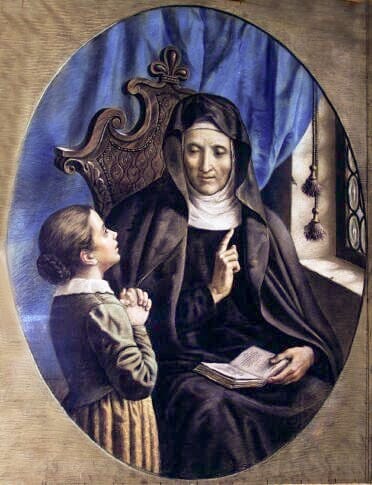
June 1 [May 31]: St. Angela de Merici, Virgin
 |
[This feast day, previously kept on May 31, was moved to June 1 when the feast of the Queenship of Mary was established on May 31.-Ed.]
From Dom Guéranger's The Liturgical Year.
THIS last day of May, which is honoured by the virginal triumph of Aurelia Petronilla, in the first age of the Church, is also fragrant with the lilies that wreathe the brow of Angela de Merici. The sixteenth century, which, a few days back, offered to our Risen Lord the seraphic Magdalen de Pazzi, now presents him with this second fruit of heroic sanctity. Angela realized the whole meaning of her beautiful name. She possessed the purity of the blessed spirits in a mortal body, and she imitated their celestial energy by the vigorous practice of every virtue. This heroine of grace trampled beneath her feet everything that could impede her heavenward march. Gifted at an early age with the highest contemplation, she bravely travelled to Palestine, there to venerate the footsteps of her divine Spouse Jesus. After this, she visited the New Jerusalem, Rome, and offered up her fervent prayers at the Confession of St Peter. She then returned to her life of seclusion, and founded a Religious Order which is, and will be to the end of time, one of the glories and aids of Holy Church.
The thought of the great St Ursula and her virginal legion made a deep impression on Angela’s soul, and she too would form to our Lord an army of valiant women. Ursula confronted the barbarian host; Angela would give battle to the world and to its seductions, which are so dangerous to young girls. God blessed her with victory. As a trophy of her combats, she can point to the countless generations of young people whom her Order has saved during the last three centuries, by giving them a solid Christian education.
The Liturgy thus speaks of the virtues and actions of St Angela:
Thou didst fight the battles of our Lord, O Angela, and thy holy labours merited for thee a glorious rest in the mansions of eternal bliss. An insatiable zeal for the honour of Jesus whom thou hadst chosen as thy Spouse, and an ardent charity for the creatures redeemed by his precious Blood were the characteristics of thy whole life. This love of thy neighbour made thee the mother of a countless progeny; for who can number the young children that have been educated, in sound doctrine and piety, by thy daughters? Thou didst powerfully contribute to the welfare of Christian society, by thus preparing so many for the duties of domestic life; and how many other Congregations, in imitation of thy Ursulines, have taken up the same admirable work, and have brought consolation to the Church, and happiness to the world? The sovereign Pontiff has ordered that thy feast should be kept throughout the whole Church. He declared, in issuing this decree, that he wished to put under thy maternal protection the young girls who are nowadays exposed to such fearful dangers by the enemies of Christ and his Church. They have formed the project of undermining the faith of women, that so their good influence may be destroyed in their families. Disconcert these impious plans, O Angela! Protect thy sex; nourish within it the sentiment of the dignity of Christian woman, and society may still be saved.
We turn to thee, O Spouse of Christ, and ask for fervour in the liturgical year, wherein we are made to follow in the path that was so dear to thee. Thy devotion in following the divine Mysteries which are successively brought before us, led thee to visit the Holy Land. Thou didst long to see Nazareth and Bethlehem, to traverse Galilee and Judea, to give thanks in the Cenacle, to weep on Calvary, and to adore the glorious Sepulchre. Deign to bless our feeble desires and efforts to tread in these same holy paths. We have still to follow thee to Mount Olivet, whence our Redeemer ascended into heaven; we have to return to the Cenacle, which the Holy Ghost is preparing to light up with his divine Fire. Obtain for us, O Angela, that we may follow thee to these hallowed spots, which made thee quit thy country and undertake a long and perilous pilgrimage. Oh! prepare our hearts for the sublime Mysteries which are to crown our Paschal season.
May 30 (the Same Day): St. Ferdinand III, King of Castile and Confessor
DURING the season consecrated to the mystery of our Emmanuel's Birth, we saw standing near his crib the blessed Emperor Charlemagne. Crowned with the imperial diadem, and with a sword in his fearless hand, he seemed to be watching over the Babe, whose first worshippers were shepherds. And now near the glorious Sepulchre, which was first visited by Magdalene and her companions, we perceive a king—Ferdinand the Victorious—wearing a crown, and keeping guard with his valiant sword, the terror of the Saracen.
Catholic Spain is personified in her Ferdinand. His mother Berengaria was sister to Blanche, the mother of St Louis of France. In order to form ‘the Catholic Kingdom,’ there was needed one of our Lord's Apostles, St James the Great; there was needed a formidable trial, the Saracen invasion, which deluged the Peninsula; there was needed a chivalrous resistance, which lasted eight hundred years, and by which Spain regained her glory and her freedom. St Ferdinand is the worthy representative of the brave heroes who drove out the Moors from their fatherland and made her what she is: but he had the virtues of a saint, as well as the courage of a soldier.
His life was one of exploits, and each was a victory. Cordova, the city of the Caliphs, was conquered by this warrior Saint. At once its Alhambra ceased to be a palace of Mahometan effeminacy and crime. Its splendid Mosque was consecrated to the divine service, and afterwards became the Cathedral of the City. The followers of Mahomet had robbed the Church of St James at Compostella of its bells, and had them brought in triumph to Cordova; Ferdinand ordered them to be carried thither again, on the backs of the Moors.
After a siege of sixteen months, Seville also fell into Ferdinand's hands. Its fortifications consisted of a double wall, with a hundred and sixty-six towers. The Christian army was weak in numbers; the Saracens fought with incredible courage, and had the advantages of position and tactics on their part: but the Crescent was to be eclipsed by the Cross. Ferdinand gave the Saracens a month to evacuate the city and territory. Three hundred thousand withdrew to Xeres, and a hundred thousand passed over into Africa. The brave Moorish General, when taking his last look at the city, wept, and said to his officers: ‘None but a Saint could, with such a small force, have made himself master of so strong and well-manned a place.’
We will not enumerate the other victories gained by our Saint. The Moors foresaw that the result would be their total expulsion from the Peninsula. But this was not all that Ferdinand proposed: he even intended to invade Africa, and thus crush the Mussulman power for ever. The noble project was prevented by his death, which took place in the fifty-third year of his age.
He always looked upon himself as the humble instrument of God’s designs, and zealously laboured to accomplish them. Though most austere towards himself, he was a father in his compassion for his people, and was one day heard to say: ‘I am more afraid of the curse of one poor woman, than of all the Saracen armies together.’ He richly endowed the churches which he built in Spain. His devotion to the holy Mother of God was most tender, and he used to call her his Lady: in return, Mary procured him victory in all his battles, and kept away all pestilence and famine from the country during his entire reign, which, as the contemporary chroniclers observe, was an evident miracle, considering the circumstances of the age and period. The life of our Saint was one of happiness and success, whereas the life of that other admirable king, St Louis of France, was one of almost uninterrupted misfortune; as though God would give to the world, in these two Saints, a model of courage in adversity, and an example of humility in prosperity. They form unitedly a complete picture of what human life is, regenerated as it has now been by our Jesus, in whom we adore both the humiliations of the Cross and the glories of the Resurrection. What happy times were those, when God chose kings whereby to teach mankind such sublime lessons!
One feels curious to know how such a man, such a king, as Ferdinand, would take death when it came upon him. When it came, he was in his fifty-fourth year. The time approached for his receiving the Holy Viaticum. As soon as the priest entered the room with the blessed Sacrament, the holy king got out of bed, prostrated himself in adoration, and, humbly putting a cord round his neck, received the Sacred Host. This done, and feeling that he was on the verge of eternity, he ordered his attendants to remove from him every sign of royalty, and called his sons round his bed. Addressing himself to the eldest, who was Alphonsus the Good, he entrusted him with the care of his brothers, and reminded him of the duties he owed to his subjects and soldiers; he then added these words: ‘My son, thou seest what armies, and possessions, and subjects thou hast, more than any other Christian king; make a proper use of these advantages; and as thou hast the power, be good and do good. Thou art now master of the country which the Moors took, in times past, from king Rodriguez. If thou keep the kingdom in the state wherein I now leave it to thee, thou wilt be, as I have been, a good king, which thou wilt not be, if thou allowest any portion of it to be lost.’
As his end drew nigh, the dying king was favoured with an apparition from heaven. He thanked God for granting him that consolation, and then asked for the blessed candle; but before taking it in his hand, he raised up his eyes to heaven, and said: 'Thou, O Lord, hast given me the kingdom, which I should not otherwise have had; thou hast given me more honour and power than I deserved; receive my thanks! I give thee back this kingdom, which I have increased as far as I was able; I also commend my soul into thy hands!' He then asked pardon of the bystanders, begging them to overlook any offence that he might have committed against them. The whole court was present, and, with tears, asked the Saint to forgive them.
The holy king then took the blessed candle into his hands, and raising it up towards heaven, said: ‘Lord Jesus Christ! my Redeemer! naked I came from my mother’s womb, and naked I return to the earth. Lord, receive my soul! and, through the merits of thy most holy Passion, deign to admit it among those of thy servants!’ Having said this, he gave back the candle, and asked the bishops and priests, who were present, to recite the Litanies; which being ended he bade them sing the Te Deum. When the hymn was finished, he bowed down his head, closed his eyes, and calmly expired.
Thus died those men, whose glorious works were the result of their faith, and who looked on themselves as only sent into this world that they might serve Christ and labour to propagate his kingdom. It was to them that Europe owed its highest glory; they made the Gospel its first law, and based its constitution on the Canons of the Church. It is now governed by a very different standard; it is paying dearly for the change, and is drifting rapidly to dissolution and ruin.
The following are the Lessons used in the Office of St Ferdinand:
By delivering thy people from the yoke of the infidel, thou, O Ferdinand, didst imitate our Risen Jesus, who rescued us from death and restored us to the life we had lost. Thy conquests were not like those of this world’s conquerors, who have no other aim than to satisfy their own and their people’s pride. Thy ambition was to deliver thy people from an oppression which had weighed heavily on them for long ages. Thy object was to save them from the danger of apostasy, which they incurred by being under the Moorish yoke. O Champion of Christ! it was for his dear sake that thou didst lay siege to the Saracen cities. His banner was thine; and thy first anxiety was to spread his kingdom. He, in return, blessed thee in all thy battles, and made thee ever victorious.
Thy mission, O Ferdinand, was to form for our God a nation, which has been honoured by Holy Church above all others with the glorious name of the 'Catholic Kingdom.’ Happy Spain, for by her perseverance and courage she broke the Mussulman yoke, that still weighs down the other countries which it made its prey! Happy Spain, for she repelled the invasion of Protestantism, and, by this, preserved the faith, which both saves souls and constitutes a nation’s strongest power! Pray for thy country, O saintly king! False doctrines and treacherous influences are now rife within her, and many of her children have been led astray. Never permit her to injure, by cowardly compromise, that holy faith which has hitherto been her grandest glory and safeguard. Frustrate the secret plots which are working to undermine her Catholicity. Keep up within her her old hatred of heresy, and maintain her in the rank she holds among Catholic nations. Unity in faith and worship may still save her from the abyss into which so many other countries have fallen. O holy king! save once more the land that God entrusted to thy keeping, and which thou didst restore to him with such humble gratitude, when thou wast about to change thine earthly for a heavenly crown. Thou art still her beloved protector; hasten, then, to her aid!
May 30 (the Same Day): St. Joan of Arc, Virgin
WHILE the angelic hosts acclaim the Incarnate Word as he takes possession of his eternal throne, a virgin at the head of the armies of earth re-echoes the praises of heaven. She was a child of the countryside, pious, gentle, and utterly ignorant, especially of the art of war, but Michael the soldier of God trained her with the aid of the Virgin Martyrs Catharine and Margaret, and suddenly, like a challenge thrown to modem naturalism in the broad daylight of history, she made her appearance, at the age of seventeen, as an incomparable warrior. Her victories, her personal influence and strategical genius equal those of the most famous captains of any times. But she surpasses them all in heroism, in her childlike simplicity, virginal purity, and faith in her Lord Jesus, the Son of St Mary, for whom she died—even greater at the stake at Rouen than in the days of her triumph. ‘De par le Roi du ciel’ (‘By order of the King of heaven’) was the motto on her banner. By order of the King of heaven, her sovereign liege, in whose royal service she is day by day, she calls upon cities to return, to their lawful obedience. By order of the King of heaven she intimates to the English that she has been sent to drive them out of France. ‘For,’ as she declared to the Dauphin's representative, 'the kingdom does not appertain to the Dauphin, but to my Lord. But it is the will of my Lord that the Dauphin should be made king and should hold the kingdom in commendam.’ ‘And who is thy Lord?’ asked Baudricourt. ‘My Lord is the King of heaven.’
To Charles she said: ‘I am called Joan the Maid, and through me does the King of heaven give you to understand that you shall be viceregent of the King of heaven who is king of France.' To the Duke of Burgundy, who was then in alliance with the enemy, she said: 'I tell you by order of the King of heaven, that all who make war on the said holy kingdom, make war on the King Jesus, the King of heaven and of all the earth.'
Joan came into the world on the feast of the glorious Epiphany, which manifested the divine Child to the world as the Lord of lords. It was during these days of his Ascension, when he takes his seat at the right hand of his Father, that she began her campaigns in 1428, achieved her greatest triumph in 1429, and closed her warlike career in 1430.
She died May 30, 1431, the eve of the Feast of Corpus Christi—a worthy consummation for a life like hers, a supreme consecration for her cause. As her soul rose from the flames to join Michael and his hosts and the Virgin Martyrs at the court of the immortal King of Ages, she left the Church on earth prostrate before Christ the King, the Ruler of the Nations, who, as it were, holds his royal assizes where he is glorified in the mystery of faith.
The following account of her life is given by the Church:
O King of Glory, who dost to-day ascend above the heights of heaven, thou didst drink of the torrent in the way and therefore dost thou now lift up thy head. Thy ancestor David prophesied it, thine Apostle proclaimed it. Thou didst humble thyself unto death, even the death of the cross, and therefore has God the Father exalted thee on this day, therefore does every knee bow at thy name, in heaven, on earth, and under the earth. It was becoming that the law of the Head should be the law also of all those who were to be called to share his glory. Before all the ages, in the great Counsel of which, as the Church sings on Christmas Day, thou wert the Angel, the conditions of definitive victory and eternal success were thus laid down.
The Gospel tells us that the hour would come for the disciples of Jesus to give testimony and that men would think to serve God by putting them to death. Joan, like Jesus, was questioned, judged and condemned with all the legal forms and imposing ceremonial of orthodoxy. But, O ye enemies of Joan and of France, ye thought yourselves her executioners, and ye were offering her in sacrifice. France was saved, for God accepted the virginal victim. Her passing mission became a permanent patronage, and the deliverer of her country on earth has become her immortal protectress in heaven.
| Previous Monday in Whitsun Week | Next Tuesday in Whitsun Week: The Gift of Knowledge |